


Food Traceability & Blockchain Solutions Market Size
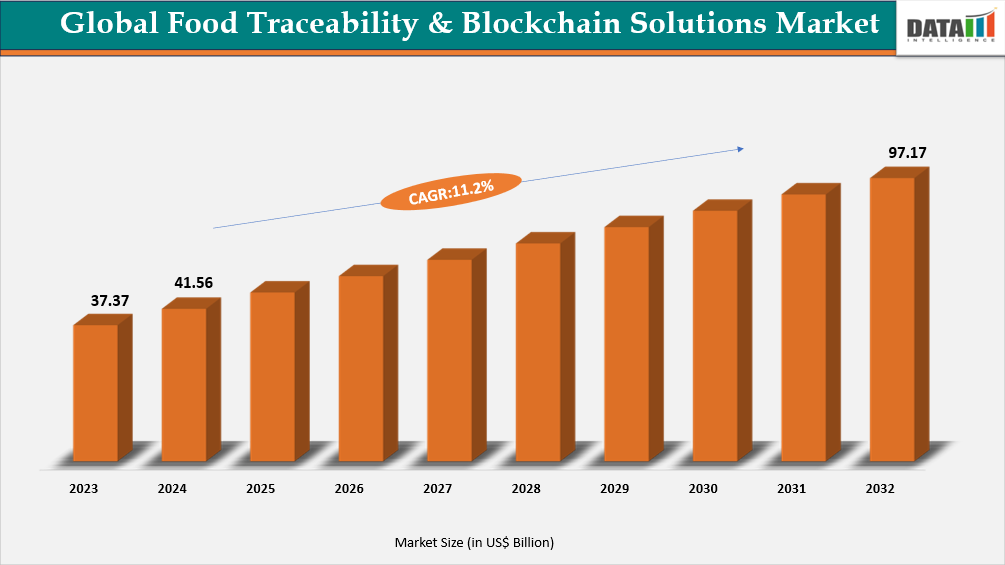
The global food traceability & blockchain solutions market reached US$46.25 billion in 2025 and is expected to reach US$108.05 billion by 2033, growing at a CAGR of 11.2% from 2026 to 2033.
The food traceability & blockchain solutions market is growing as rising consumer demand for transparency, stricter food-safety regulations, and the need to prevent recall-related losses push companies toward more reliable, tamper-proof tracking systems. Adoption is further accelerated by the integration of IoT sensors, cloud platforms, and real-time data capture, which make blockchain-based traceability more practical and scalable across farming, processing, distribution, and retail. At the same time, sustainability commitments and pressure for ethical sourcing are encouraging businesses to adopt end-to-end visibility tools. Together, these drivers are moving the market from small pilots to widespread implementation, creating steady, multi-sector growth as digital traceability becomes an operational and compliance priority.
Food Traceability & Blockchain Solutions Market Industry Trends and Strategic Insights
- North America leads the global food traceability & blockchain solutions market, capturing the largest revenue share of 38.45% in 2024.
- By Component segment, software led the global food traceability & blockchain solutions market, capturing the largest revenue share of 42.34% in 2024.
Global Food Traceability & Blockchain Solutions Market Size and Future Outlook
- 2025 Market Size: US$46.25 billion
- 2033 Projected Market Size: US$108.05 billion
- CAGR (2026–2033): 11.2%
- Dominating Market: North America
- Fastest Growing Market: Asia-Pacific
Market Scope
| Metrics | Details |
| By Component | Software, Hardware, Services |
| By Technology | Radio Frequency Identification, Barcodes, Infrared, Biometrics, Global Positioning Systems, Others |
| By Deployment Mode | Cloud-based, On-premise, Hybrid |
| By Application | Meat & Livestock, Seafood, Fruits & Vegetables, Dairy, Others |
| By End-User | Retailers & Supermarkets, Distributors, Farmers & Primary Producers, Others |
| By Region | North America, South America, Europe, Asia-Pacific, Middle East and Africa |
| Report Insights Covered | Competitive Landscape Analysis, Company Profile Analysis, Market Size, Share, Growth |
Market Dynamics
Increasing Focus on Food Safety and Contamination Control
Growing concerns around food safety and contamination control are accelerating the adoption of food traceability and blockchain solutions, as companies seek systems that minimize risk and ensure rapid detection. The scale of the problem is critical, FAO reports that unsafe food sickens 600 million people annually and causes 420,000 deaths, creating immense pressure on governments and industries to strengthen monitoring. This burden is even heavier in low- and middle-income countries, where contamination leads to significant productivity losses and weakens supply-chain reliability. As the economic cost of unsafe food reaches US$110 billion each year, organizations are turning to digital traceability tools that reduce errors and support faster, data-driven responses.
These rising risks make immutable and real-time tracking technologies essential, as blockchain allows every stage—from farms to processors to retailers, to record contamination-related data with full accountability. By enabling quicker trace-back during outbreaks, these systems help limit the public-health impact and reduce costly recalls tied to widespread contamination. This creates strong alignment between safety objectives and digital transformation, encouraging more producers and regulators to integrate blockchain into food-safety frameworks. As a result, the growing urgency to control contamination directly drives market expansion, linking public-health concerns with the rapid modernization of food-supply systems.
Segmentation Analysis
The global food traceability & blockchain solutions market is segmented based on component, technology, deployment, application, end-user, and region.
Software Lead with 42.34% Share for Real-Time Tracking and Blockchain Visibility
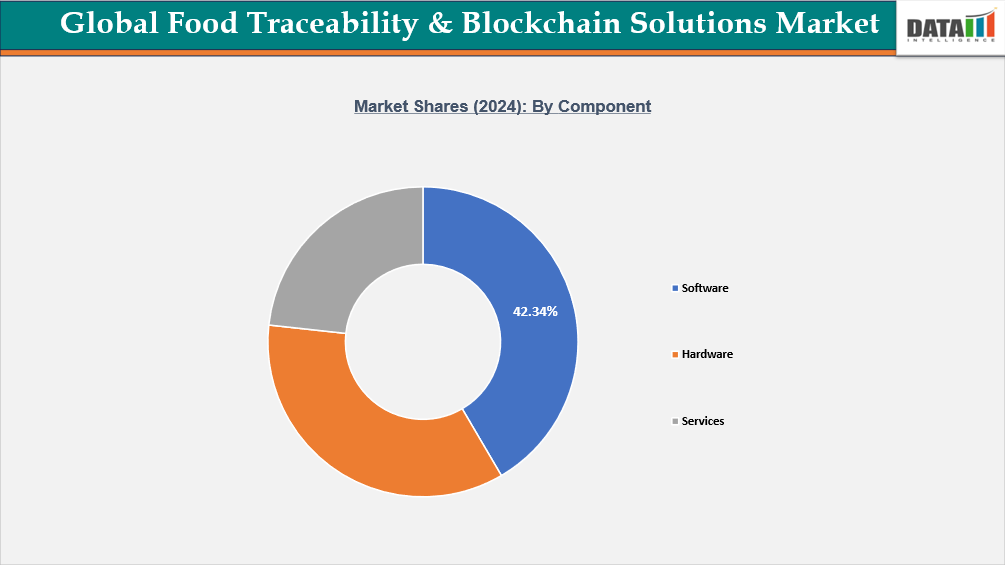
Software dominates the Food Traceability & Blockchain Solutions Market as it enables real-time recording, storage, and analysis of supply-chain data. Platforms integrate IoT devices, QR codes, and RFID scanners to capture accurate information from farms to retailers. In December 2024, Mahaseel Technologies partnered with the Egyptian Food Bank to launch a blockchain-powered digital traceability system, assigning unique QR codes to each food item. This ensures transparency, quality control, and operational efficiency, demonstrating how software drives data-driven decision-making and compliance.
The scalability and cloud-based nature of software make it ideal for both small producers and large organizations. Blockchain-enabled software ensures immutable, auditable records, which are critical during contamination incidents or audits. The Mahaseel-Egyptian Food Bank example highlights how software enhances food security, prevents waste, and builds stakeholder confidence. Overall, its ability to integrate with hardware, enable end-to-end visibility, and provide actionable insights cements software as the leading segment in the market.
Hardware Holds Significant Share Driven by Rising Demand for Sensors And IoT-Based Food Monitoring
Hardware holds a significant share in the Food Traceability & Blockchain Solutions market because it forms the backbone of data collection and verification across the supply chain. Devices such as IoT sensors, RFID tags, barcode scanners, and GPS trackers enable real-time monitoring of temperature, humidity, location, and product movement. Accurate and continuous data capture is critical for detecting contamination risks and ensuring compliance with strict food-safety regulations. As a result, companies increasingly invest in robust hardware to complement blockchain software, ensuring that recorded data is reliable and tamper-proof.
Geographical Penetration
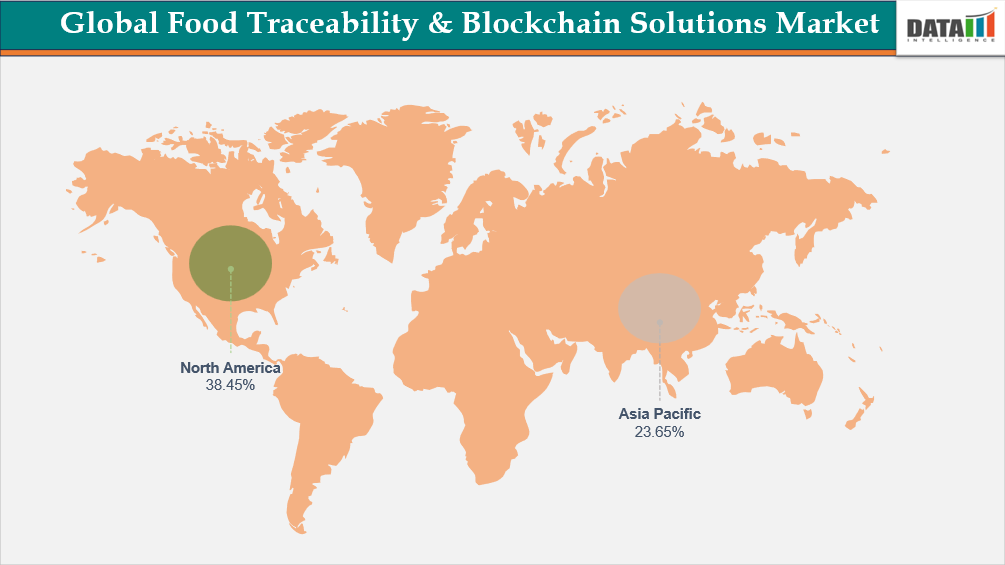
Dominating Market: North America Holds the Highest 38.45% Share due to Strong Regulations and Tech Adoption
North America leads the Food Traceability & Blockchain Solutions market, driven by strong regulatory frameworks and high consumer demand for food safety and transparency. Advanced technology infrastructure, including IoT, cloud computing, and blockchain, supports real-time tracking across supply chains. The FDA Food Safety Modernization Act (FSMA) is shifting the region’s focus from responding to foodborne illness to preventing it, with rules outlining preventive actions across the supply chain. These factors collectively strengthen the adoption of traceability solutions throughout North America.
US Food Traceability & Blockchain Solutions Market Outlook
In the U.S., the need for robust traceability is reinforced by alarming foodborne disease statistics, with about 48 million people falling ill each year, 128,000 hospitalized, and 3,000 deaths reported by the CDC. This major but largely preventable public health burden has accelerated the adoption of blockchain and IoT-enabled monitoring systems. Large food processors and retailers are investing in end-to-end digital traceability to ensure compliance, protect consumers, and reduce recall costs. FSMA further strengthens this trend by mandating preventive actions and accountability at all points in the supply chain.
Canada Food Traceability & Blockchain Solutions Market Trends
Canada’s market growth is supported by stringent food-safety regulations and increasing consumer awareness of ethical and sustainable sourcing. Blockchain and IoT-based traceability solutions are increasingly adopted in the meat, dairy, and seafood sectors to ensure regulatory compliance and reduce contamination risks. Collaborative initiatives between government bodies, tech providers, and food companies enhance the digital infrastructure across the supply chain. As a result, Canada is rapidly advancing its traceability capabilities, contributing significantly to North America’s overall market leadership.
Fastest Growing Market: Asia-Pacific Records the Fastest Growth Driven by Rising Food Safety Demand and Blockchain Adoption
Asia-Pacific dominates the food traceability and blockchain solutions market due to rapid digitalization, increasing exports, and the need for stringent food safety compliance. Countries in the region are adopting technologies like RFID, IoT, and blockchain to enhance supply chain transparency and reduce economic losses from counterfeiting and adulteration. The growing consumer awareness and regulatory pressure are driving demand for traceability solutions across diverse food and pharmaceutical sectors. This widespread adoption positions APAC as the largest regional market globally.
India Food Traceability & Blockchain Solutions Market Insights
India’s market growth is fueled by the urgent need to combat counterfeit goods, which cost the economy ₹2.62 lakh crore annually. In July 2025, Domino India partnered with BlockSynergy Technology’s Jumbo Blockchain to launch TagITX, a “Made-in-India” blockchain traceability solution printing tamper-evident QR codes for real-time product verification. This system spans pharmaceuticals, agrochemicals, food & beverages, electronics, and auto parts, enabling MSMEs and multinationals to meet global traceability mandates. Such innovations are strengthening India’s blockchain ecosystem and accelerating nationwide adoption.
China Food Traceability & Blockchain Solutions Market Industry Growth
China contributes significantly to APAC’s dominance due to extensive food safety reforms and traceability mandates in key sectors. According to the World Bank, foodborne diseases in China cause over US$30 billion per year in human capital productivity loss, accounting for nearly 50% of Asia’s total economic burden. This economic impact is driving both government and private sectors to adopt blockchain-enabled traceability across food, pharmaceuticals, and agro-industries. With high digital infrastructure maturity and national initiatives, China’s scalable traceability systems are setting benchmarks for the region.
Sustainability Analysis
The sustainability of the food traceability & blockchain solutions market is driven by its ability to enhance transparency, reduce food fraud, and ensure regulatory compliance across the supply chain. By minimizing waste and optimizing resource use, blockchain adoption supports environmental and economic sustainability. Integration of renewable energy-powered data centers and eco-friendly technologies further strengthens its green credentials. Growing consumer demand for ethically sourced and safe food continues to reinforce the market’s long-term sustainable growth.
Competitive Landscape
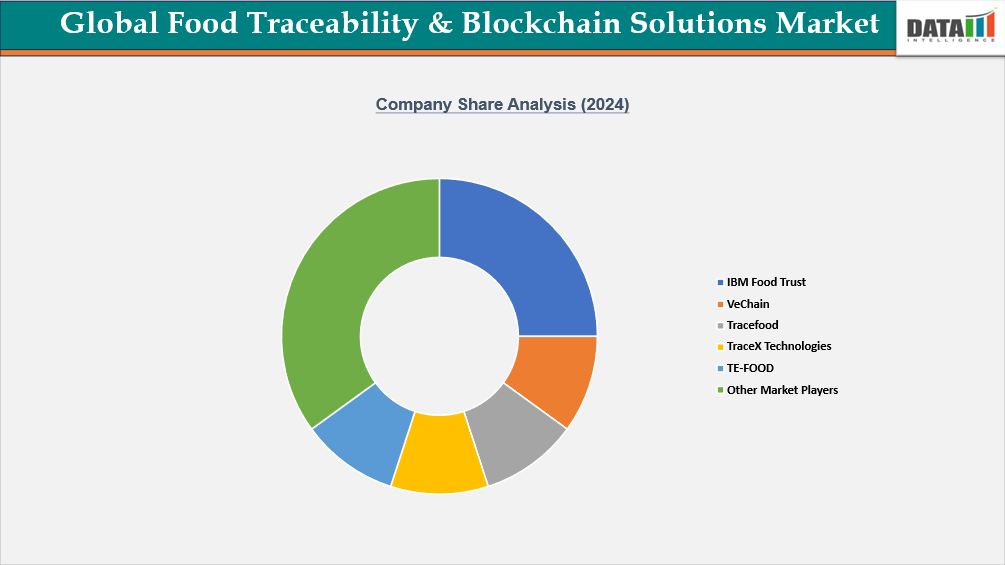
- The food traceability and blockchain solutions market is rapidly maturing, driven by stronger regulatory pressure and rising consumer demand for transparency.
- The landscape is dominated by a handful of global players, including, IBM Food Trust, VeChain, Tracefood, TraceX Technologies, Microsoft, TE-FOOD, Wholechain, FoodLogiQ, OpsSmart, Decapolis.
- Key players compete on innovation, offering modular, scalable platforms that integrate IoT sensors, QR/RFID tags, and enterprise systems to deliver end-to-end supply chain visibility.
Key Developments
- May 2026: IBM expanded blockchain-enabled food traceability partnerships with global retailers and food manufacturers, strengthening supply-chain transparency, contamination tracking and regulatory compliance capabilities.
- April 2026: Oracle enhanced cloud-based food traceability platforms integrating AI-powered analytics, real-time shipment monitoring and blockchain authentication for improved food safety management.
- March 2026: SAP advanced blockchain-integrated supply-chain solutions supporting end-to-end food provenance verification, inventory visibility and sustainable sourcing initiatives globally.
- February 2026: Walmart expanded blockchain food-tracking programs across fresh produce and packaged-food categories, improving recall efficiency and supplier accountability throughout its retail ecosystem.
- January 2026: Nestlé strengthened digital traceability initiatives leveraging blockchain technology to improve ingredient sourcing transparency, ethical procurement and consumer trust programs internationally.
- December 2025: Carrefour expanded blockchain-based QR-code food verification systems enabling consumers to access real-time product origin, quality and sustainability information.
- November 2025: Microsoft accelerated development of blockchain-enabled food supply-chain platforms integrating IoT sensors, predictive analytics and automated compliance-management capabilities.
- October 2025: Alibaba Group enhanced blockchain food-authentication technologies supporting cross-border food trade, anti-counterfeit protection and cold-chain monitoring efficiency across Asia-Pacific markets.
- September 2025: VeChain expanded enterprise blockchain adoption in food and beverage supply chains, improving product traceability, operational transparency and smart-contract verification systems globally.
- July 2025: TE-FOOD upgraded farm-to-table traceability platforms supporting livestock monitoring, food safety compliance and real-time supply-chain visibility for global food producers and distributors.
Investment & Funding Landscape
The traceability & blockchain solutions market is witnessing strong investment momentum as companies and startups secure funding to develop scalable, interoperable platforms across food, pharmaceuticals, and luxury goods. Notable investments include multi-million-dollar rounds in carbon traceability tokens, blockchain-based seafood and honey tracking, and enterprise-grade FSMA 204 compliance solutions. Venture capital and corporate funding are targeting solutions that integrate IoT, AI, and ERP systems to enhance end-to-end supply chain transparency.
| Company | Investment/Funding | Year | Details | |
| Verofax | US$3 Million raising | 2024 | Verofax, a Web3 services company, raised US$3 million in bridge funding led by Plug & Play Tech Centre, Navig8 Group, and King Abdullah University for Science and Technology. The funding will support projects across the Middle East and EU, including AI-powered guides and interactive experiences leveraging blockchain, AR, and AI. Verofax’s solutions, applied in retail, tourism, and sports, enable brands like Anheuser Busch and Emirates Airlines to enhance consumer engagement and drive digital transformation through immersive and traceable experiences. | |
What Sets This Global Food Traceability & Blockchain Solutions Market Intelligence Report Apart
- Latest Data & Forecasts – Comprehensive, up-to-date insights and projections through 2032. Coverage includes global value by Component, source, distribution channel, end-user and application segments (sleep disorders, jet lag, shift-work). Scenario forecasts with region-level splits (North America, Europe, Asia-Pacific, South America, Middle East and Africa) and sensitivity to factors such as regulatory reclassification and raw-material costs.
- Regulatory Intelligence – Actionable analysis of regulatory frameworks that materially affect Food Traceability & Blockchain Solutions commercialization, revenue by country, allowable label claims, permitted doses, import/export controls and advertising restrictions.
- Competitive Benchmarking – Standardized profiling and benchmarking of leading pharma and nutraceutical players, contract manufacturers and e-commerce specialists active in the market.
- Geographic & Emerging Market Coverage – Region-by-region market sizing, growth drivers, reimbursement dynamics, cultural/consumer behavior and market access considerations. Focus on high-growth or regulatory-uncertain markets.
- Actionable Strategies – Identify opportunities for launching innovative products, while leveraging strategic partnerships and supply chain integration for maximum ROI.
- Pricing & Cost Analysis – In-depth assessment of price trends, raw material costs and sustainability-driven cost efficiencies across regional markets.
- Expert Analysis – Insights from industry experts such as clinical sleep specialists, regulatory affairs professionals and key manufacturing companies.


























































