


Fluoropolymers Market Size
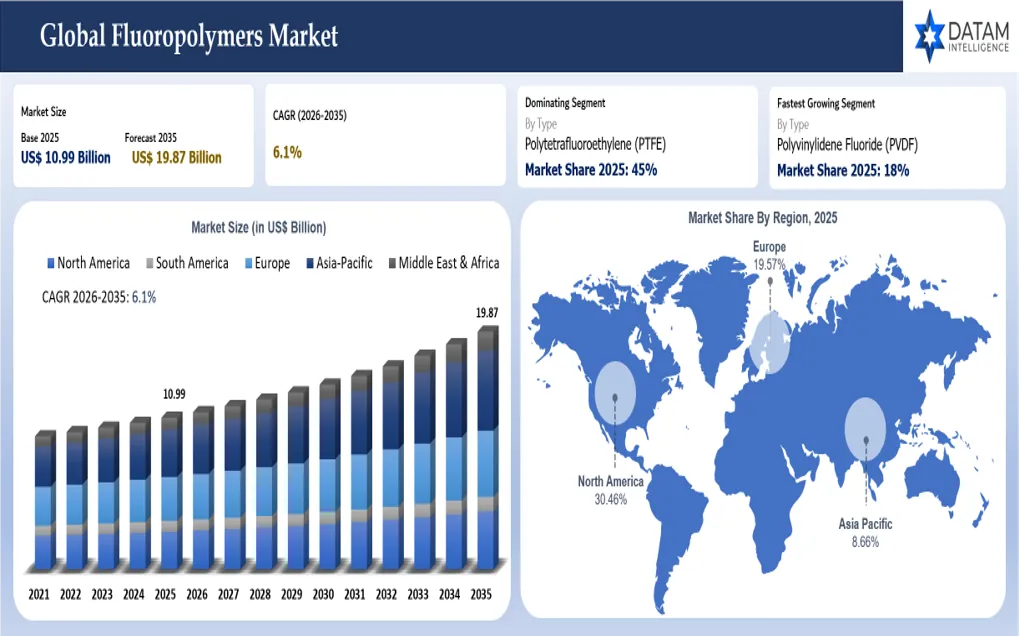
The global Fluoropolymers market reached US$ 10.99 billion in 2025 and is expected to reach US$ 19.87 billion by 2035, growing with a CAGR of 6.1% during the forecast period 2026-2035.
Fluoropolymers are becoming increasingly popular within the field of semiconductor production, electric vehicle, battery manufacturing, chemical processing, aerospace and renewable energy industries due to their ability to withstand harsh chemicals, elevated temperatures, electricity and other rigorous operating conditions. The rising utilization of fluoropolymer tubing, fittings, valves and seals in semiconductor manufacturing is driving up the demand for fluoropolymers as more advanced nodes get manufactured.
Electrification and modern energy technology are also driving the market for fluoropolymer products. Fluoropolymer products are now used in electric vehicle batteries, cables, charging systems, fuel cells, hydrogen-related technologies and photovoltaics. In such applications, it is crucial that fluoropolymer products perform well thermally, chemically and electrostatically for a long period of time. Furthermore, strict PFAS regulations drive companies to focus on more environmentally friendly manufacturing, emissions reductions and more efficient fluoropolymer production methods.
Fluoropolymers Market Key Takeaways
- The Electrical & Electronics segment held around 34% share of the global fluoropolymer market in 2025 due to the rising application in semiconductor equipment, insulation for wiring and cables, connectors, seals and electronic components needing high dielectric and chemical resistance.
- The PVDF segment is expected to be one of the most rapidly growing segments of fluoropolymers, exhibiting a CAGR of around 8.5% over the period of 2026 to 2035 due to rising demand from battery binders, semiconductor, photovoltaics and chemical processing industries.
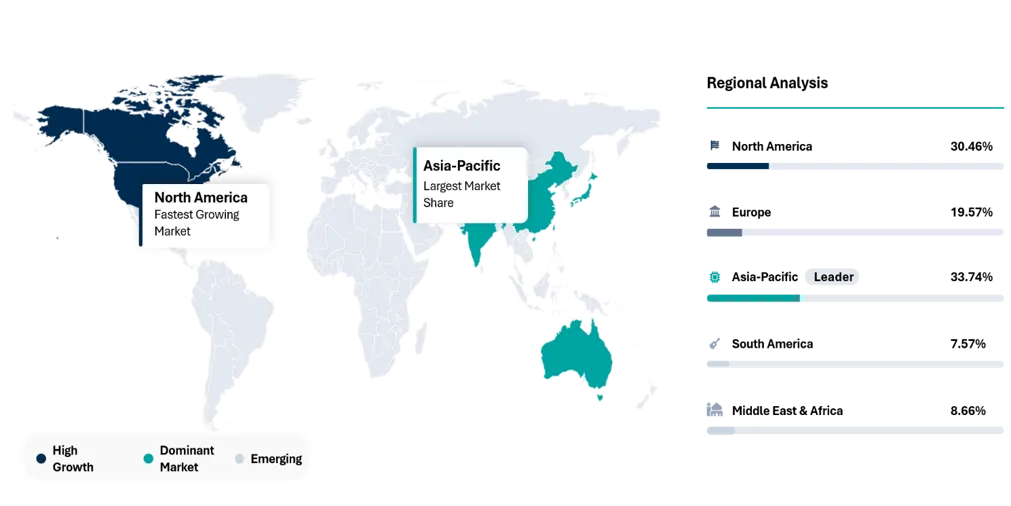
- In 2025, Asia-Pacific is expected to capture 33.74% of the fluoropolymers market share due to growth in electronics and semiconductor production, auto manufacturing, battery manufacturing and chemical processing industries in the region.
- The PTFE segment held around 45% share in terms of revenue in the fluoropolymers market in 2025, owing to wide use of PTFE in seals, gaskets, linings, bearings, tubing, wire insulation and corrosion resistance parts.
- High performance and specialty fluoropolymers enjoy large price premiums compared to their general grades due to very demanding purity, processing and qualification criteria for applications in semiconductors, aerospace, medical and high voltage electricity sectors.
Fluoropolymers Market Scope
| Metrics | Details | |
| 2025 Market Size | US$ 10.99 Billion | |
| 2035 Projected Market Size | US$ 19.87 Billion | |
| CAGR (2026-2035) | 6.1% | |
| Largest Market | North America | |
| Fastest Growing Market | Asia-Pacific | |
| By Type | Polytetrafluoroethylene (PTFE), Fluorinated Ethylene Propylene (FEP), Polyvinylidene Fluoride (PVDF), Ethylene Tetrafluoroethylene (ETFE), Polychlorotrifluoroethylene (PCTFE), Perfluoroalkoxy Alkanes (PFA) and Others | |
| By Application | Electrical and Electronics, Transportation, Industrial, Healthcare, Medical, Construction and Others | |
| By Region | North America | U.S., Canada, Mexico |
| Europe | Germany, UK, Russia, France, Spain, Italy, Poland | |
| Asia-Pacific | China, India, Japan, Australia, South Korea, Indonesia, Malaysia, Singapore, Vietnam, Thailand, Philippines, Taiwan | |
| South America | Brazil, Argentina | |
| Middle East and Africa | UAE, Saudi Arabia, South Africa, Israel, Turkiye, Nigeria | |
| Report Insights Covered | Competitive Landscape Analysis, Company Profile Analysis, Market Size, Share, Growth | |
Fluoropolymers Market White Space & Investment Opportunities
- High-Purity Fluoropolymer Components for Semiconductor Fabs: Investing in ultra-high purity fluoropolymer tubing, valves, fittings, seals and liners provides an opportunity since semiconductor manufacturers continue to increase their production capabilities and raise their contamination control standards.
- Fluoropolymers for EV Battery Systems: Creating improved grades of fluoropolymers with greater resistance to chemicals, high dielectric strength, heat resistance and fire resistance is another potential area of white space development in battery insulation and other applications.
- Recycling and Circular Fluoropolymer Technologies: Investing in technologies for the recycling of fluoropolymers can help to comply with increasingly strict regulations and reduce reliance on new raw materials.
- Low-Emission Fluoropolymer Manufacturing: Technologies that seek to minimize both emissions and waste are ripe for investment, given the shift in procedures by manufacturers responding to PFAS environmental regulations that are becoming increasingly stringent.
- Fluoropolymers for Hydrogen and Fuel-Cell Infrastructure: Applications in specialized membranes, seals, hoses, tubing and coatings with excellent hydrogen permeability resistance offer exciting prospects in the face of growing hydrogen production and fuel-cell infrastructure.
Fluoropolymers Market Buyer Decision-Making Criteria
The evaluation done by buyers of fluoropolymers is based on factors such as chemical performance, thermal performance, mechanical performance and electrical performance under specific operational conditions. The selection process in the case of many applications, including semiconductor and electrical applications, is quite strict since in such situations, factors like the purity of the product, stability of the dimensions of the product, dielectric properties of the product, resistance of the product to permeation and durability of the product will directly affect the efficiency of the equipment and the quality of the product.
Major Decision-Making Criteria
- Chemical and Corrosion Resistance
- Operating Temperature Range
- Electrical and Dielectric Performance
- Material Purity and Contamination Control
- Mechanical Strength and Dimensional Stability
- Permeation and Barrier Performance
- Grade and Application-Specific Performance
- Regulatory and PFAS Compliance
- Batch-to-Batch Quality Consistency
- Supplier Reliability and Supply Capacity
- Processing and Fabrication Compatibility
- Total Cost of Ownership
Fluoropolymers Market BCG Matrix: Company Evaluation
STAR
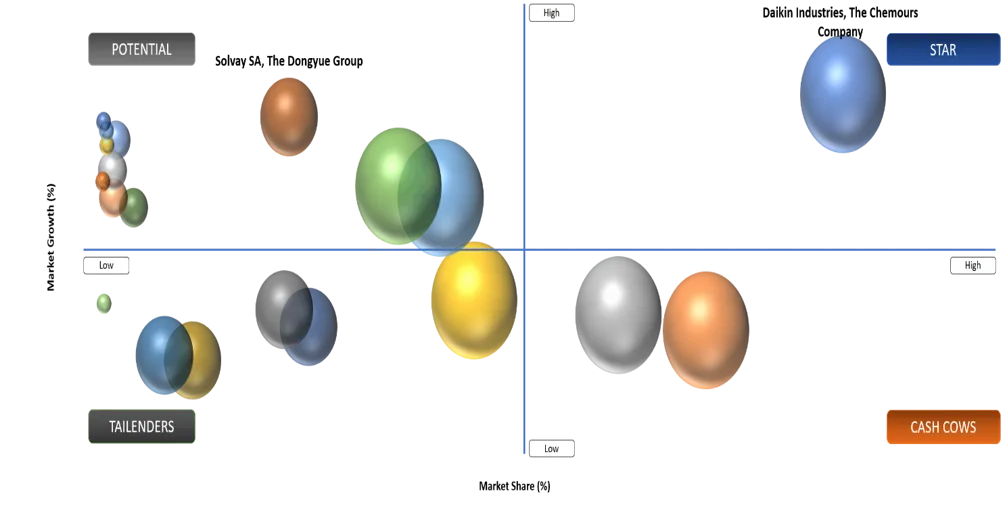
Daikin Industries, The Chemours Company, Gujarat Fluorochemicals Limited, AGC Inc., Arkema and Kureha Corporation are positioned as Stars because of their strong capabilities in fluoropolymers and being exposed to high-value sectors like electronics and semiconductors, batteries, EVs and advanced industrial manufacturing. These firms have advanced manufacturing capabilities, technology and product development techniques that assist them in remaining competitive as the demand for performance specialty fluoropolymers begins to grow.
POTENTIAL
Solvay SA, The Dongyue Group, Nexgen Fluoropolymers Pvt. Ltd. and Solstice Advanced Materials are identified as Possible participants, having chances to reinforce their positions in accordance with their specialty-grade development, growth of capacities and improvement of customer qualification processes and penetration into high-growth applications. Their potential is especially related to high-purity fluoropolymers, materials for batteries, semiconductor applications and advanced electric systems in which technical performance and compliance with regulations are becoming more and more significant.
Fluoropolymers Market Dynamics
Driver Impact Analysis
| Driver | Market Growth Impact (%) | Demand Concentration | Impacted Use Case | Strategic Impact |
Expansion of semiconductor manufacturing | 26% | North America, East Asia | High-purity tubing, fittings, seals, valves and process components | Accelerates demand for high-purity fluoropolymers and supports premium-grade adoption as semiconductor fabrication capacity expands. |
Growth of electric vehicles and battery production | 22% | Asia-Pacific, North America, Europe | Battery components, insulation, seals and fluid-management systems | Creates new demand for chemically resistant and electrically insulating fluoropolymer materials across EV and battery systems. |
Rising demand for corrosion-resistant materials in chemical processing | 18% | Asia-Pacific, North America, Europe | Linings, pipes, gaskets, valves and pumps | Strengthens fluoropolymer adoption in aggressive chemical environments where conventional materials have shorter service lives. |
Increasing deployment of renewable energy and hydrogen technologies | 14% | Asia-Pacific, Europe, North America | Fuel-cell components, hydrogen seals, photovoltaic materials and electrical insulation | Expands opportunities for specialized fluoropolymers in high-temperature, chemically demanding and electrically intensive energy applications. |
Driver: Semiconductor Manufacturing Expansion Drives Demand for High-Purity Fluoropolymers
The surged rise in capacity for semiconductor production drives the fluoropolymer market forward because advanced equipment requires utilization of materials that can resist aggressive chemicals combined with extreme temperature and plasma exposure, as well as strict contamination parameters. Fluoropolymers are utilized in tubing and piping, valves and fittings and seals, connectors, wafer handlers, chemical delivery systems and inner coatings of the equipment, as all these sectors require extremely pure material. Therefore, the creation of next-generation fabrication plants as well as localized production in the U.S., Japan, South Korea, Taiwan and Europe boosts the demand for high-purity fluoropolymer products and gives new opportunities to the suppliers capable of fulfilling increasingly tough performance and qualification criteria.
Restraint Impact Analysis
| Restraint | Drag on Market Growth (%) | Primary Impact Area | Impacted Use Case | Strategic Impact |
Tightening PFAS regulations and environmental restrictions | 28% | Europe, North America | Fluoropolymer manufacturing, coatings and processing | Increases compliance costs and encourages manufacturers to modify production processes and develop lower-emission alternatives. |
High production costs and energy-intensive processing | 21% | Global | Specialty fluoropolymer manufacturing and high-performance components | Pressures margins and limits adoption where lower-cost engineering polymers can meet performance requirements. |
Volatility in fluorochemical raw-material supply and pricing | 17% | Asia-Pacific, North America, Europe | PTFE, FEP, PFA, PVDF and other fluoropolymer production | Creates cost uncertainty for producers and can increase downstream pricing for fluoropolymer products. |
Complexity of fluoropolymer recycling and end-of-life management | 13% | Europe, North America, Asia-Pacific | Industrial components, automotive parts, electrical products | Raises lifecycle-management costs and increases pressure on manufacturers to develop recovery, recycling and circular-material solutions. |
Restraint: PFAS Regulatory Restrictions Increase Compliance Costs and Limit Fluoropolymer Manufacturing Flexibility
The toughening of PFAS regulations and environmental considerations represents a significant limitation for the fluoropolymers industry especially in Europe and North America because the regulatory pressure on fluorinated compounds is rising. While fluoropolymers have unique characteristics and uses, their manufacturing process may utilize some PFAS-related products and discharges, resulting in the need for more stringent considerations in terms of process control, emissions control, reporting, waste management and regulations compliance. This may lead to higher manufacturing expenses, difficulties in the qualification of products and an incentive for some consumers to consider other products when possible, which encourages fluoropolymer manufacturers to develop less emitting manufacturing processes.
Fluoropolymers Market Geographical Penetration
U.S. Fluoropolymers Market Landscape
The U.S. fluoropolymers market is driven by significant demand arising from semiconductor production, aerospace & defense, chemical processing, automotive electrification and high-performance electrical applications. The growth in domestic semiconductor production and advanced packaging has led to increased demand for high-purity fluoropolymer tubing, fittings, valves, seals and various process components. In addition, the manufacture of electric vehicles and batteries creates additional needs for insulation, seals and fluid management components that can withstand the chemical environment. Another characteristic of U.S. fluoropolymers market is a high level of importance given to compliance with PFAS regulations which leads companies to make investments aimed at producing materials with lower emissions and improving material accountability, recycling and development of fluoropolymer grades complying with the changing requirement in the environmental systems. The presence of domestic production, know-how and being close to a wide range of the end-users provides well-known producers with strong competitive advantages, while the localization of semiconductor and battery supply chains offers opportunities for emerging producers of specialty fluoropolymer products.
Japan Fluoropolymers Market Outlook
Japan's market for fluoropolymers is notable for being boosted by robust marketplace demand in the semiconductor, automotive, electronics, chemical processing and precision manufacturing sectors, thanks to the country’s capability in high-performance materials. Growing advanced semiconductor production is necessitating the use of more fluoropolymer components, hoses, seals and production materials. Production sustainability needs arising from automotive electrification open up new markets for fluoropolymers. Companies such as Daikin Industries and AGC utilize Japan’s extensive fluorochemical industry, which provides excellent conditions for specialty product development and precision processing. Moreover, tougher PFAS regulations provide Japanese companies with a chance to improve emission control and production efficiency.
Fluoropolymers Market Competitive Landscape
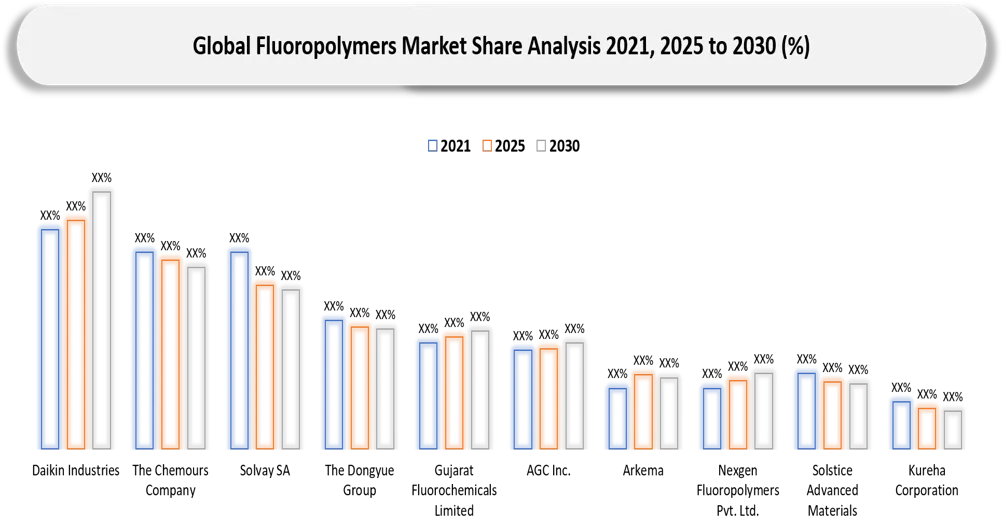
- Strong concentration among global fluorochemical producers: The competition is characterized by dominant companies such as Daikin Industries, The Chemours Company, AGC Inc., Arkema and Gujarat Fluorochemicals competing based on their broad fluoropolymer range, international production and customer relations.
- Shift toward specialty and high-purity grades: The competition is becoming more specialized as regards PFA, FEP, PVDF and other specialty fluoropolymers for use in semiconductors, electronics, batteries and high-end industrial applications where material qualification and consistency act as barriers to entry.
- Capacity expansion is a key competitive strategy: Major players continue their investments in expanding their production volume and shifting to local production in order to meet the demands on the market and enhance both the reliability of supply and dependence on the supply chain geographically.
- PFAS regulations are reshaping competitive positioning: Companies are redefining themselves through low-emission manufacturing, improving production processes, developing recycling systems and creating fluoropolymer methods in accordance with environmental requirements.
- Application-specific innovation is increasing differentiation: Businesses are creating new fluoromers that possess even better thermal stability, resistance to chemicals, dielectric performance, permeability and mechanical properties to satisfy requirements of the markets dealing with semiconductors, EVs, aerospace and chemical engineering.
Key Companies of Fluoropolymers Market
- Daikin Industries
- The Chemours Company
- Solvay SA
- The Dongyue Group
- Gujarat Fluorochemicals Limited
- AGC Inc.
- Arkema
- Nexgen Fluoropolymers Pvt. Ltd.
- Solstice Advanced Materials
- Kureha Corporation
Fluoropolymers Market Recent Developments
- August 2026 - The Dongyue Group: In its H1 2026 financial statement, Dongyue announced revenues of approximately RMB 8.06 billion for H1 2026, up from RMB 7.46 billion for the same period last year.
- August 2026 - U.S. EPA: The regulatory environment of the U.S. kept changing with regard to PFAS, where EPA initiatives included regulations of PFAS chemicals, drinking water, refrigerants and others relevant for the manufacture of fluorochemicals. These changes are raising the significance of emissions reduction, regulatory compliance and sustainable fluoropolymer manufacturing.
- July 2026 - AGC Inc.: F-CLEAN™ fluoropolymer greenhouse film from AGC Inc. was awarded a Guinness World Record for the world’s longest use of an agricultural greenhouse film cover over a period of 36 years of continuous usage.
- June 2026 - Arkema: Expansion of the company’s PVDF production capacity by 15% has been successfully carried out at Calvert City, Kentucky.
- June 2026 - The Chemours Company: An agreement has been made between Chemours and the U.S. Environmental Protection Agency (EPA) regarding PFAS claims at three operating facilities, involving a USD 90 million worth mitigation effort.
What DATAM Uniquely Provides
- Fluoropolymer Type-Level Market Intelligence: Comprehensive analysis of PTFE, FEP, PVDF, ETFE, PCTFE, PFA and all other types of fluoropolymers to determine demand trends and business opportunities associated with each type.
- Application-Specific Demand Mapping: Analysis of consumption of fluoropolymers in various applications, including electrical & electronics, automotive, industrial, health care, medical and construction applications.
- High-Value Application Opportunity Assessment: Focuses on key markets for fluoropolymers such as semiconductor manufacturing, electric vehicles, high-voltage applications, hydrogen technologies and renewable energy systems where criteria for performance are particularly stringent.
- Regulatory and Technology Impact Analysis: Evaluates the effects that changes in regulations related to PFAS, emissions controls, recycling and new materials technology may have on fluoropolymer production, selection and investments.
- Company-Level Competitive Benchmarking: Provides a company-level benchmark of leading fluoropolymer manufacturers on their product portfolio, specialties, manufacturing base, capacity growth and other strategic initiatives.




























































