


Fiber to the Home (FTTH) Market Szie and Overview
The global FTTH market is estimated at approximately US$ 89.9 billion in 2025 and is projected to reach about US$ 269.4 billion by 2035, representing an estimated CAGR of around 11.6% during 2026-2035. The estimate includes fiber access equipment, passive optical infrastructure, ONTs/ONUs, software and deployment-related services rather than the full value of broadband subscription revenue.
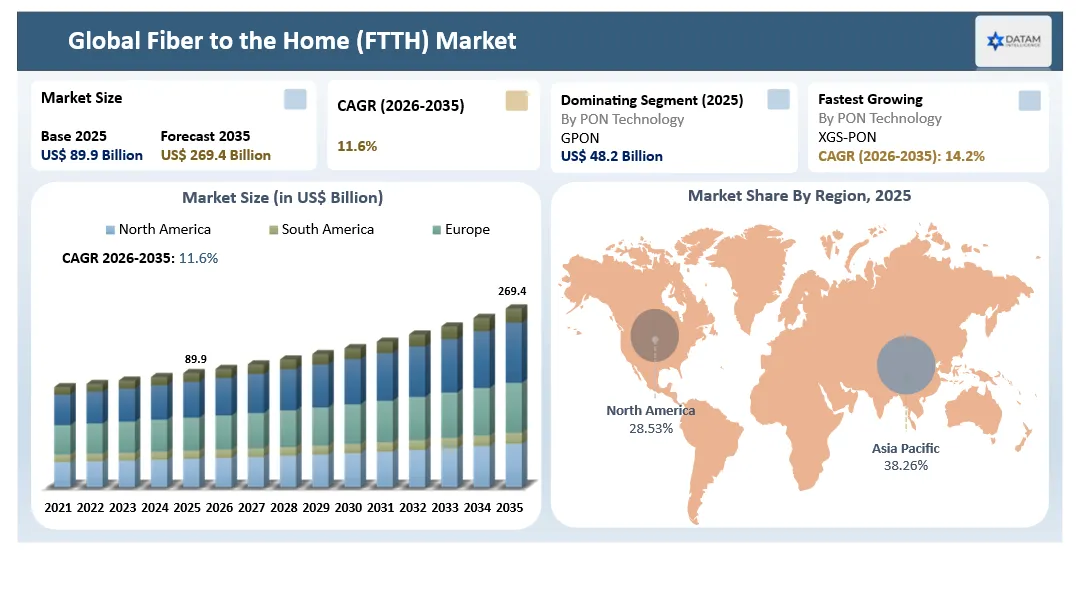
Growth is being driven by gigabit and multi-gigabit broadband demand, copper retirement, rising video and cloud traffic, government-funded broadband expansion and operator migration from GPON toward XGS-PON and higher-speed PON. Network economics increasingly favor fiber where operators can achieve sufficient take rates and reuse passive infrastructure across multiple technology generations.
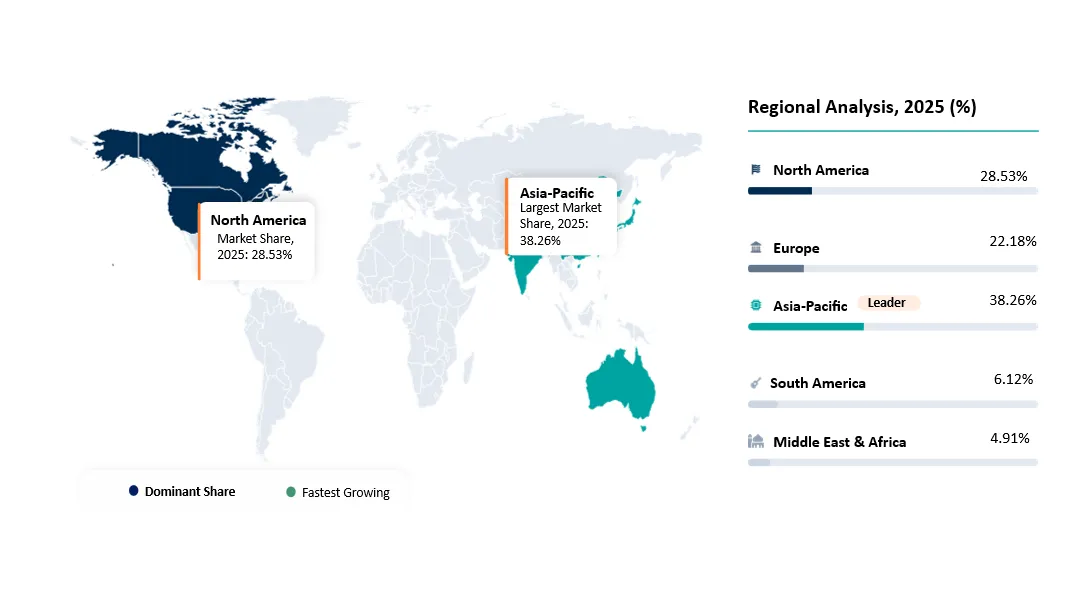
North America and Europe are major upgrade and rural-funding markets, while Asia-Pacific remains the largest installed-base and deployment region. Growth increasingly centers on XGS-PON, 25G/50G PON roadmaps, open-access networks, managed Wi-Fi, software-defined access and lower-cost deployment models.
| Metric | FTTH Market Insight |
| 2025 Market Size | ~US$ 89.9 billion (modeled estimate) |
| 2035 Market Size | ~US$ 269.4 billion (modeled estimate) |
| 2026-2035 CAGR | ~11.6% |
| Core Technology | GPON, XGS-PON and next-generation PON |
| Largest Revenue Pool | Fiber access equipment, passive infrastructure and deployment services |
| Fastest Technology Shift | GPON to XGS-PON and 25G/50G PON |
| Primary Demand Driver | Gigabit broadband, copper retirement and public fiber investment |
| Key Risk | Civil works cost, permitting, labor and take-rate uncertainty |
FTTH Market Key Takeaways
- FTTH is becoming the strategic fixed-access architecture for operators seeking multi-gigabit capacity, long asset life, lower maintenance intensity and a path beyond copper and legacy HFC networks.
- XGS-PON is moving from premium-tier deployment toward a mainstream upgrade path as operators seek symmetrical multi-gigabit services and converged residential/business access.
- 25G PON and 50G PON expand the upgrade runway for business, mobile transport and premium residential use while preserving much of the existing passive optical distribution network.
- Government broadband funding remains a major deployment catalyst in rural and underserved markets, but project economics depend heavily on construction cost, labor availability, permitting and subscriber take rate.
- Managed Wi-Fi and in-home experience are becoming more important to FTTH monetization because customer perception depends on end-to-end service quality rather than access-line speed alone.
- Open-access and wholesale fiber models can improve infrastructure utilization by separating passive network ownership from retail service competition.
- Network virtualization, cloud-managed access and automated service assurance are reducing operating complexity and helping smaller operators scale fiber networks with fewer specialized resources.
- Competitive advantage depends on PON roadmap depth, optical integration, software, interoperability, supply reliability, lifecycle support and total deployment economics rather than headline access speed alone.
FTTH Industry Trends and Strategic Insights
- Operators are accelerating GPON-to-XGS-PON upgrades using coexistence strategies that reuse installed fiber, splitters and outside plant while replacing or adding OLT line cards and subscriber ONTs.
- Fiber access platforms are shifting toward software-defined and cloud-managed architectures, with disaggregated OLT concepts and open interfaces gaining attention among large and wholesale-focused operators.
- Higher-speed PON roadmaps, including 25G and 50G PON, are widening the addressable use cases for FTTH infrastructure into business access, mobile transport and bandwidth-intensive premium residential services.
- Deployment productivity is becoming a critical differentiator. Operators are investing in pre-connectorized fiber, digital design tools, automated documentation and simplified drop-installation methods to reduce cost per home passed.
- In-home Wi-Fi 7, managed mesh, security and experience analytics are becoming part of the FTTH value proposition as operators seek lower churn and higher ARPU after the physical fiber is installed.
- Public policy continues to reshape deployment economics through rural broadband grants, open-access requirements, infrastructure sharing, permitting reform and local-content or domestic-manufacturing incentives.
FTTH Market Scope
| Segmentation | Subsegments |
| Component | OLT Platforms & Access Software; ONT / ONU & CPE; Optical Fiber & Cable; Splitters & Passive Components; Network Management & Orchestration; Deployment & Managed Services |
| Network Architecture | Centralized OLT; Distributed / Remote OLT; Cloud-Managed Access; Hybrid Centralized-Distributed; Virtualized / Software-Defined Access |
| PON Technology | GPON; XGS-PON; 25G PON & Higher-Speed PON; EPON / 10G-EPON; NG-PON2 / WDM-PON & Hybrid |
| Service Type | Residential Broadband; Business Broadband; Wholesale / Open Access; Managed Wi-Fi & In-Home Experience; Voice, Video & Converged Services |
| Application | High-Speed Internet; Video & IPTV; VoIP / UC; Cloud, Gaming & Remote Work; Smart Home / IoT |
| End User | Residential; Commercial & SME; MDU; Government & Public Sector; Education & Healthcare; Rural & Underserved Communities; Telecom Operators & ISPs |
| Deployment Type | Tier-1 Telecom Operators; Regional & Alternative ISPs; Municipal / Utility Broadband; Real Estate & MDU Operators; Government Programs; Wholesale Fiber Providers |
| Distribution / Sales Model | Direct OEM / Operator Sales; Telecom Distributors; Network Integrators & EPCs; Operator / ISP Channel Partners; Managed-Service / Wholesale Channel |
| Region | North America; Europe; Asia-Pacific; South America; Middle East & Africa |
| Study Period | 2025 base year; forecast through 2035 |
Why does this report matter in 2026?
In 2026, FTTH investment sits at the intersection of broadband policy, copper retirement, multi-gigabit service competition and rapidly rising network traffic. Operators are under pressure to expand coverage while improving capital efficiency, making architecture, take rate and deployment cost more important than simple homes-passed targets.
The market is also entering a new upgrade cycle. XGS-PON is increasingly mainstream, 25G/50G PON roadmaps are extending asset life, and software-defined access is changing how operators provision and manage subscriber services. For vendors and investors, the key question is where value will accrue across OLTs, ONTs, optical cable, passive components, software and deployment services.
FTTH Market White Space & Investment Opportunities
- Rural and underserved FTTH builds supported by government broadband funding and lower-cost construction models.
- XGS-PON overlay upgrades that reuse existing passive fiber infrastructure while enabling symmetrical multi-gigabit tiers.
- 25G/50G PON and coherent access solutions for premium residential, business and mobile-transport convergence.
- Open-access and wholesale fiber platforms that improve infrastructure utilization and support multiple retail service providers.
- Managed Wi-Fi, Wi-Fi 7, subscriber experience analytics and smart-home services that increase monetization after fiber installation.
- Pre-connectorized outside plant, microduct, automated design and construction-management tools that reduce labor intensity and cost per home passed.
FTTH Future Market Transformation
By 2035, FTTH is expected to be the default fixed-access architecture across many developed and rapidly urbanizing markets, with the passive optical distribution network serving as a multi-decade infrastructure asset. Value creation will increasingly shift from first-time fiber construction toward electronics upgrades, software, managed in-home experience and higher-value services.
Technology coexistence will be central to this transition. GPON, XGS-PON and higher-speed PON can share outside plant, enabling operators to upgrade subscribers selectively while preserving sunk fiber investment. Software-defined access, open interfaces and network will further reduce the operational cost of running multi-generation networks.
FTTH Buyer Decision-Making Criteria
Buyers prioritize cost per connected premise, PON roadmap, OLT density, ONT interoperability, optical budget, power efficiency, network management, service activation speed, Wi-Fi integration, supply continuity and lifecycle support. In rural projects, construction productivity and grant-compliance requirements can outweigh equipment price differences.
Large telecom operators emphasize scale, standards compliance, software network and multi-generation roadmaps. Alternative ISPs and municipalities place greater weight on ease of deployment, managed services, open-access support and predictable total cost of ownership.
FTTH Market Economic & Investment Analysis
The FTTH investment case is built on long-lived passive infrastructure, lower maintenance intensity than copper, higher broadband ARPU potential and the ability to support future speed upgrades largely through electronics replacement. Returns depend on density, construction cost, take rate, churn and competitive overlap.
Investment is shifting toward rural broadband, XGS-PON upgrades, open-access fiber, network network and subscriber-experience platforms. These themes increase spending on OLTs, ONTs, fiber cable, passive components, software, construction services and managed operations.
FTTH Investment Trends in the Market
- Investment in embedded access platforms, edge ONTs and access ONT and access gateways and broadband connectivity modules for new access platforms.
- Expansion of cloud connectors, broadband data brokers and edge software that route contextualized fiber access data into analytics and AI environments.
- R&D in FTTH XGS-PON, 25G PON, high-speed PON, deterministic networking, service orchestration and telemetry models and automated subscriber and device security lifecycle management.
- Growth of copper-network migration solutions that bridge copper DSL, DOCSIS/HFC, legacy PON and proprietary access platforms.
- Acquisitions and partnerships linking telecom equipment vendors with broadband software, edge computing, digital twin and network cybersecurity capabilities.
- Investment in multi-vendor interoperability testing, conformance laboratories, developer ecosystems and lifecycle integration services.
Strategic Indicators for FTTH Market
High Regulation Impact
Broadband funding rules, rights-of-way, building-access regulation, infrastructure-sharing policies, telecom security requirements and local procurement rules can materially affect FTTH deployment schedules and economics.
High Investment Activity
Capital investment remains high across incumbent operators, alternative fiber providers, municipalities and wholesale networks, supported by broadband grants, copper retirement and demand for multi-gigabit services.
Supply Chain Disruption
FTTH supply chains depend on optical fiber and cable, connectors, splitters, semiconductor components, lasers, OLT/ONT manufacturing and construction labor. Disruption can delay homes-passed targets even when customer demand is strong.
Pricing Volatility
Pricing pressure is strongest in standardized ONTs, optical components and mature GPON equipment, while premium economics remain available in XGS-PON, higher-speed PON, advanced Wi-Fi, software and managed services.
Procurement Pressure
Operators increasingly require lower power per bit, multi-generation PON support, supply assurance, open APIs, automated provisioning, strong cybersecurity, Wi-Fi integration and measurable total cost of ownership.
New Technology Adoption
XGS-PON, 25G/50G PON, software-defined access, cloud-managed OLTs, Wi-Fi 7, coherent access and automated network operations are moving from trials into broader commercial deployment.
Regional Expansion Opportunity
North America offers strong rural-funding and copper-replacement opportunities, Europe combines overbuild competition with regulatory fiber targets, and Asia-Pacific remains the largest scale market with significant upgrade potential.
Government Policy Support
Government programs supporting universal broadband, rural connectivity, digital inclusion, infrastructure sharing and national fiber strategies continue to expand the addressable market for FTTH equipment and services.
Pricing Intelligence
Pricing intelligence requires separating passive infrastructure, active electronics, construction and software. Cost per home passed can vary dramatically by aerial versus underground build, density, labor rates and permitting complexity.
Disruption Analysis of FTTH Market
The market is being disrupted by the shift from simple broadband access toward software-defined, experience-managed connectivity. Operators increasingly combine PON electronics, cloud management, Wi-Fi, cybersecurity and subscriber analytics to compete on service quality rather than access speed alone.
A second disruption is convergence between residential broadband and other access use cases. Higher-speed PON enables the same fiber infrastructure to support business services, mobile transport and wholesale access, improving network utilization and challenging siloed access-network architectures.
FTTH Market BCG Matrix: Company Evaluation
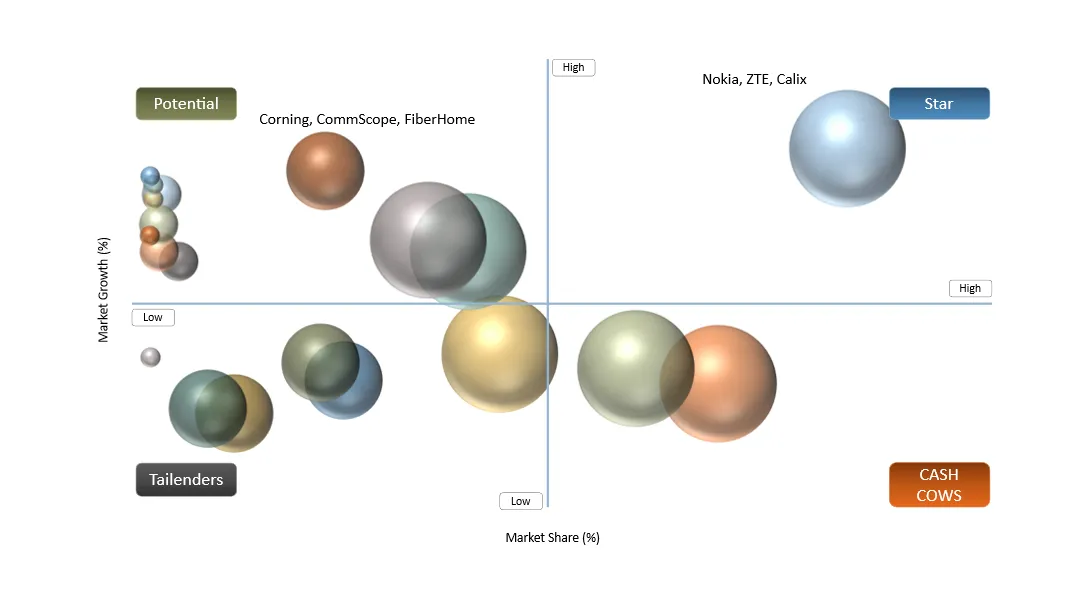
STAR: Nokia, ZTE, Calix, Adtran and Huawei are strongly positioned through broad PON portfolios, large operator relationships, software capabilities and active XGS-PON / higher-speed PON roadmaps. Their ability to combine access electronics with management and in-home platforms supports architectural influence.
POTENTIAL: Corning, CommScope, FiberHome, DZS, Ciena and specialist optical-component suppliers can capture attractive niches through fiber/cable scale, passive infrastructure, open-access platforms, rural deployment and converged optical-network capabilities.
FTTH Market Dynamics
Driver Impact Analysis
| Driver | 2026-2028 Impact | 2029-2032 Impact | 2033-2035 Impact | Strategic Meaning |
| Gigabit & multi-gigabit demand | Very High | Very High | High | Bandwidth growth supports continued fiber adoption and electronics upgrades |
| Copper retirement & network modernization | Very High | High | Medium-High | Operators redirect maintenance and capex toward all-fiber access |
| Government broadband funding | Very High | High | Medium | Rural and underserved deployments expand addressable homes passed |
| XGS-PON / higher-speed PON upgrades | High | Very High | Very High | Electronics refresh cycles extend monetization of existing passive fiber |
Driver: Gigabit Demand, Copper Retirement and Government Broadband Investment
Video, cloud applications, remote work, gaming and connected-home usage continue to raise fixed-network bandwidth requirements. At the same time, operators are retiring copper and governments are funding coverage in underserved areas. FTTH combines high capacity with a long-lived passive asset base, supporting both competitive differentiation and lower lifecycle operating cost.
Restraint Impact Analysis
| Restraint | 2026-2028 Impact | 2029-2032 Impact | 2033-2035 Impact | Strategic Meaning |
| Civil works & labor cost | Very High | High | High | Construction economics remain the largest barrier to new coverage |
| Permitting & rights-of-way | High | Medium-High | Medium | Approval delays can materially shift build schedules |
| Take-rate & overbuild risk | High | High | High | Returns depend on subscriber conversion and competitive intensity |
| Supply-chain & skilled workforce constraints | Medium-High | Medium | Medium | Optical components and field labor can create project bottlenecks |
Restraint: Construction Cost, Permitting, Labor and Take-Rate Risk
FTTH economics can be constrained by civil works, rights-of-way, building access, skilled labor shortages and uncertain subscriber take rates. These issues are most severe in low-density or heavily overbuilt areas, where cost per connected premise can remain high even when equipment prices decline.
FTTH Market Segmentation Analysis
The global FTTH market is segmented based on Component, Network Architecture, PON Technology, Service Type, Application, End Use Industry, Deployment Type, Distribution / Sales Model and region.
By Component
OLT Platforms & Access Software Remain the Core Monetized Layer
OLT platforms, ONTs/ONUs, optical fiber, splitters, connectors, access software and deployment services form the core monetized FTTH value chain. Active electronics capture recurring upgrade value, while passive outside plant represents the long-lived infrastructure base.
By Network Architecture
Hybrid Centralized-Distributed Architectures Gain Momentum
Centralized OLT architectures remain the installed-base norm, while distributed, remote and cloud-managed approaches are expanding where operators need higher density, lower latency, simpler operations and flexible service activation.
By PON Technology
GPON Dominates, XGS-PON and 25G PON Grow Faster
GPON remains the largest installed base, while XGS-PON is the fastest mainstream upgrade path. 25G PON and 50G PON are gaining attention for premium residential, business and converged transport use cases.
By Service Type
Managed Broadband Services and Open Access Expand Value Creation
Residential broadband remains the largest service pool, while business broadband, wholesale/open-access fiber, managed Wi-Fi and converged services create higher-value monetization layers beyond basic access connectivity.
By Application
High-Speed Internet and In-Home Experience Are Key Growth Pools
High-speed internet access is the primary application, while IPTV, VoIP, cloud gaming, remote work, smart-home services and Wi-Fi experience management expand demand for higher bandwidth and better end-to-end service quality.
By Deployment Type
Telecom Operators Lead, While Altnets and Municipal Networks Expand
Tier-1 operators remain the largest deployment group, but regional ISPs, municipal networks, utilities, real-estate developers and open-access providers are strategically important because they expand fiber coverage in underserved or competitively attractive areas.
By End Use Industry
Residential Broadband Anchors Demand
Residential users represent the largest FTTH demand base, while commercial/SME, MDU, public-sector, education, healthcare and rural deployments create differentiated requirements for service assurance, building access, open-access support and cost-efficient construction.
By Distribution / Sales Model
Direct OEM Sales and Integrator Channels Both Matter
Large operators typically buy directly from access-equipment and optical-infrastructure vendors, while distributors, EPCs and network integrators remain important for regional ISPs, municipal networks, rural programs and MDU deployments.
FTTH Market Geographical Penetration
U.S. FTTH Market Landscape
The U.S. FTTH market is supported by large incumbent fiber programs, competitive overbuilders, rural broadband funding and copper retirement. AT&T, Verizon, regional carriers, utilities and community networks continue to expand fiber coverage, while BEAD-related activity is increasing project pipelines in underserved areas.
Germany FTTH Market Outlook
Germany remains one of Europe’s largest fiber white-space opportunities because FTTH penetration historically lagged several neighboring markets. Incumbent and alternative operators are accelerating builds, supported by national gigabit objectives, open-access models and strong construction activity.
Japan FTTH Market Trends
Japan has a mature FTTH installed base and high household fiber penetration. Growth therefore centers on XGS-PON and higher-speed upgrades, service quality, enterprise convergence and replacement of older access electronics rather than first-time fiber coverage.
China FTTH Market Outlook
China is the world’s largest FTTH-scale market by installed fiber broadband base, supported by extensive carrier investment and domestic equipment supply. The market is increasingly focused on 10G-class access, all-optical home architectures and higher-speed PON evolution.
India FTTH Market Outlook
India is a high-growth FTTH opportunity supported by rising fixed-broadband adoption, rapid urbanization, operator fiber expansion and demand for home broadband. Deployment economics vary widely by density and building type, making aerial fiber, MDU access and shared infrastructure important.
Middle East and Africa FTTH Market Outlook
Middle East and Africa combine advanced urban fiber markets in Gulf countries with large underserved opportunities elsewhere. Growth depends on national broadband strategies, urban development, submarine and backbone capacity, operator investment and cost-efficient last-mile construction.
FTTH Market Competitive Landscape
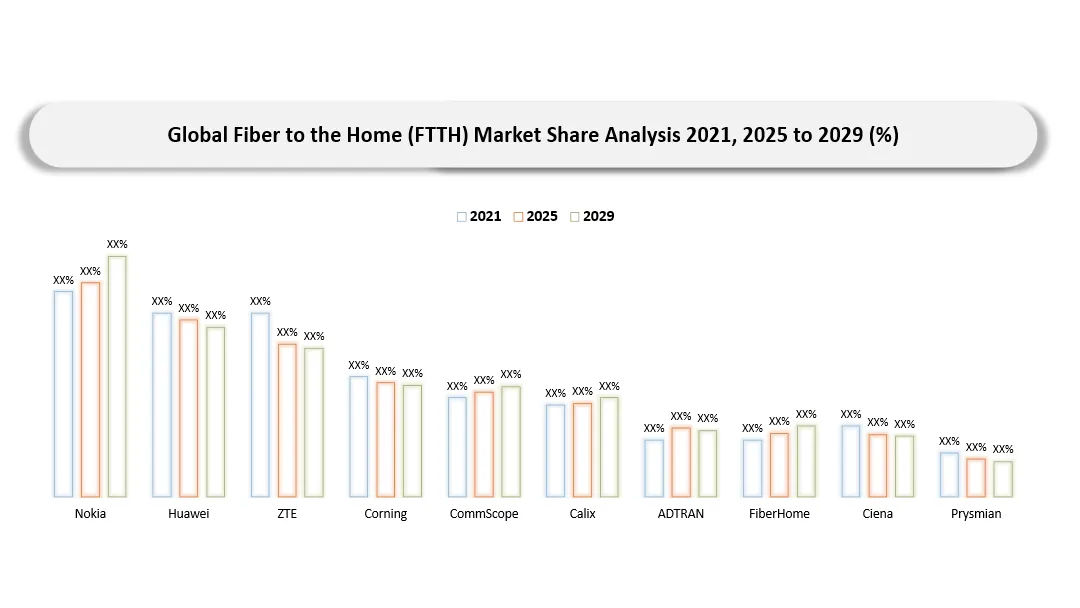
- Competition spans global access-equipment vendors, broadband software companies, optical-fiber and passive-component suppliers, ONT/CPE providers and network integrators. Nokia, Calix, Adtran, Corning and ZTE represent differentiated positions across active access, software, outside plant and subscriber-edge infrastructure.
- Specialist and adjacent vendors such as Huawei, FiberHome, CommScope, DZS, Ciena, Vecima Networks, Harmonic, Sterlite Technologies, Prysmian and Sumitomo Electric compete through PON platforms, optical components, cable systems, open-access software and deployment support.
- Competitive positioning is best assessed through installed operator base, PON roadmap, ONT ecosystem, optical infrastructure scale, software automation, supply reliability and lifecycle support because FTTH revenue is rarely disclosed as a standalone reporting line.
- Network integrators and construction contractors remain strategically important because physical deployment, splicing, permitting, building access, testing and activation can represent a substantial share of total project cost.
- Long-term differentiation will move toward higher-speed PON, cloud-managed access, open interfaces, energy efficiency, subscriber-experience software and lower-cost outside-plant deployment.
- Market share will increasingly depend on operators’ ability to balance homes passed, take rate, capex per premise, service quality and lifecycle operating cost.
Public Company Q1-Q2 2026 Performance Comparison
| Public Company | Q1-Q2 2026 Performance | Growth Factors Relevant to FTTH | Direct FTTH Exposure |
| Nokia | Q2 2026 net sales €4.815B, +8% reported; Network Infrastructure sales €2.037B, +12% YoY. | Fiber access pipeline, multi-gigabit PON, network modernization and AI/cloud traffic support fixed-network investment. | Direct exposure through Lightspan OLTs, ONTs and fixed-network software; FTTH revenue is not separately disclosed. |
| Calix | Q2 2026 revenue US$293.3M, +21% YoY and +5% sequentially. | Regional and rural broadband builds, XGS-PON adoption, cloud software and managed subscriber experience. | High direct exposure through access platforms, ONTs, cloud management and broadband-service-provider customers. |
| Adtran | Q1 2026 revenue US$286.1M, +15.5% YoY; preliminary Q2 revenue US$280-282M. | BEAD deployment, European fiber investment, XGS-PON and open access support demand despite project timing volatility. | High direct exposure through OLT/ONT, fiber access and broadband software portfolios. |
| Corning | Q2 2026 core sales US$4.74B, +17% YoY; Optical Communications sales US$2.07B, +32%. | Fiber construction, connectorized deployment, broadband capacity additions and domestic infrastructure spending. | Direct upstream exposure through optical fiber, cable and connectivity; FTTH-specific revenue not separately disclosed. |
| ZTE | Q1 2026 revenue RMB34.99B, +6.1% YoY. | Carrier network investment, 10G/50G PON upgrades and emerging-market fiber expansion support access demand. | Direct exposure through PON OLTs, ONTs and broadband access platforms; market-specific revenue not separately disclosed. |
Market Ecosystem Table
| Value Chain Sector | Representative Organizations | Role in FTTH Market | Value Creation |
| Standards & Policy | ITU-T, Broadband Forum, Fiber Broadband Association, national telecom regulators | PON standards, interoperability, deployment policy and broadband funding frameworks | Reduces fragmentation and supports scalable investment |
| Optical Fiber & Cable | Corning, Prysmian, OFS, Sterlite Technologies, Sumitomo Electric | Fiber, drop cable, closures and outside-plant connectivity | Creates long-lived passive infrastructure |
| OLT / Access Platforms | Nokia, Huawei, ZTE, Adtran, Calix, FiberHome | OLT chassis, line cards, access software and orchestration | Controls aggregation, PON capacity and upgrade roadmap |
| ONT / CPE | Nokia, ZTE, Huawei, Adtran, Calix and specialist CPE vendors | Subscriber termination, Wi-Fi gateways and service activation | Defines in-home performance and subscriber experience |
| Passive Optical Components | CommScope, Corning, Senko, Furukawa and regional suppliers | Splitters, connectors, cabinets, terminals and pre-connectorized systems | Reduces deployment time and outside-plant cost |
| Operators & ISPs | AT&T, Verizon, Deutsche Telekom, Orange, Telefonica, Jio, regional altnets | Build, own and monetize FTTH access networks | Converts homes passed into recurring broadband revenue |
| Wholesale / Open Access | CityFibre, Open Fiber, Chorus, Uniti and municipal networks | Neutral-host infrastructure and wholesale fiber access | Improves utilization and broadens retail competition |
| Engineering & Construction | MasTec, Dycom, Circet and regional EPCs | Design, permitting, civil works, splicing and activation | Determines cost per home passed and deployment velocity |
Key Companies
- Nokia (Finland)
- Calix (U.S.)
- Adtran (U.S.)
- Corning (U.S.)
- ZTE (China)
- Huawei (China)
- FiberHome (China)
- CommScope (U.S.)
- DZS (U.S.)
- Ciena (U.S.)
- Vecima Networks (Canada)
- Harmonic (U.S.)
- Sterlite Technologies (India)
- Prysmian (Italy)
- Sumitomo Electric (Japan)
Company Profiles
Nokia
Nokia is a global leader in fixed access, with GPON, XGS-PON and higher-speed PON platforms spanning OLTs, ONTs, access software and network network. Its Lightspan portfolio supports large incumbents, alternative operators and wholesale fiber networks.
Competitive priorities include multi-gigabit PON, 25G/50G PON evolution, software-defined access, energy efficiency, open interfaces and network of large-scale fiber operations.
Calix
Calix supplies access platforms, cloud software and subscriber-experience solutions to broadband service providers, especially regional, rural and community-focused operators in North America.
Competitive priorities include XGS-PON, AI-native operations, managed Wi-Fi, subscriber experience, revenue expansion for broadband providers and simplified end-to-end operations.
Adtran
Adtran provides fiber access, OLT/ONT, optical networking and software platforms to service providers, utilities, municipalities and alternative fiber operators across North America and Europe.
Competitive priorities include XGS-PON, open and software-defined access, rural broadband, European fiber upgrades, optical convergence and operational efficiency.
Corning
Corning is a major supplier of optical fiber, cable, connectivity and pre-connectorized solutions used throughout FTTH outside plant and premises deployment. Its scale and materials expertise make it a critical upstream infrastructure supplier.
Competitive priorities include high-density fiber systems, deployment productivity, domestic manufacturing, rural broadband, pre-connectorized solutions and lower installation cost.
ZTE
ZTE supplies PON access systems, ONTs, optical networking and broadband software across a large global carrier footprint. It is particularly strong in Asia and emerging markets and continues to develop 10G and higher-speed PON solutions.
Competitive priorities include XGS-PON, 50G PON, all-optical campus and home architectures, integrated CPE, AI-enabled network operations and cost-efficient scale deployment.
Huawei
Huawei is a major global supplier of GPON, XGS-PON and all-optical access platforms, ONTs and broadband software, with substantial installed scale across Asia, Europe, Latin America, the Middle East and Africa.
Competitive priorities include 10G and higher-speed PON, all-optical home architectures, integrated Wi-Fi/CPE, energy efficiency and AI-enabled network operations.
FiberHome
FiberHome supplies optical access systems, OLTs, ONTs, fiber and transport solutions across carrier networks, with strong exposure to large-scale fiber deployment in China and international markets.
Competitive priorities include XGS-PON and 50G PON, integrated optical access, cost-efficient scale manufacturing and expansion in emerging markets.
CommScope
CommScope supplies fiber connectivity, terminals, closures, cabinets and other outside-plant and premises infrastructure used in FTTH deployment, particularly in North America and Europe.
Competitive priorities include pre-connectorized deployment, high-density connectivity, outside-plant simplification and lower installation time per subscriber.
DZS
DZS supplies broadband access platforms, OLTs, ONTs and software to regional carriers, utilities and alternative service providers, with exposure to fiber modernization and open-access networks.
Competitive priorities include XGS-PON, cloud-managed access, open interfaces, rural broadband and simplified operations for smaller service providers.
Ciena
Ciena supplies optical networking and access-adjacent platforms that can support converged broadband transport, aggregation and edge architectures around large fiber-access deployments.
Competitive priorities include optical aggregation, coherent networking, routing, automation and convergence between access and metro transport.
Vecima Networks
Vecima Networks provides broadband access and service-delivery solutions, including distributed access and software platforms used by cable and fiber operators.
Competitive priorities include access modernization, software-defined networking, distributed architectures and operator transition from legacy access networks.
Harmonic
Harmonic supplies broadband access and network virtualization platforms, including solutions that help cable operators evolve toward fiber and software-defined access architectures.
Competitive priorities include virtualized access, fiber evolution, cloud-native operations, broadband service automation and convergence of legacy and next-generation networks.
Sterlite Technologies
Sterlite Technologies is a major optical-fiber, cable and network-integration supplier with significant exposure to telecom infrastructure and broadband rollout projects in India and international markets.
Competitive priorities include fiber and cable scale, integrated network deployment, rural broadband, manufacturing localization and cost-efficient outside plant.
Prysmian
Prysmian is one of the world’s largest cable manufacturers and supplies optical fiber and telecom cable used in FTTH and broader fixed-network infrastructure.
Competitive priorities include fiber-cable capacity, high-density designs, low-friction deployment, regional manufacturing and long-term operator supply agreements.
Sumitomo Electric
Sumitomo Electric is a major optical-fiber, cable and connectivity supplier serving telecom networks worldwide. Its materials and manufacturing capabilities support long-lived passive infrastructure used in FTTH and broader fiber-access deployments.
Competitive priorities include optical-fiber innovation, cable-system reliability, connectivity components, manufacturing scale and long-term telecom customer relationships.
FTTH Market Major Pain Points
- High civil-works cost, permitting delays and difficult rights-of-way can materially reduce FTTH project returns.
- Low subscriber take rates or aggressive competitive overbuild can lengthen payback periods after the fiber is constructed.
- Skilled labor shortages in design, splicing, testing and field installation can slow deployment velocity.
- Building access and MDU wiring complexity can delay customer activation even where street-level fiber is already available.
- Supply continuity for fiber cable, connectors, splitters, lasers and ONTs remains important during large synchronized build programs.
- Operators must manage interoperability across OLTs, ONTs, Wi-Fi gateways, OSS/BSS and subscriber-management systems.
- In-home Wi-Fi performance can undermine customer perception of FTTH even when the optical access line itself performs well.
- Project economics can be difficult to compare because cost per home passed varies materially by aerial versus underground construction, density, labor and permitting conditions.
FTTH Market Recent Developments
- August 2026: Adtran reported continued demand from broadband operators and highlighted U.S. BEAD deployment momentum, European fiber investment and strength in optical networking despite customer project timing volatility.
- July 2026: Nokia reported Q2 2026 net sales of EUR 4.815 billion, with Network Infrastructure sales up 12% year on year. Fixed access remained strategically important as operators expanded fiber and multi-gigabit broadband footprints.
- July 2026: Calix reported record Q2 revenue of US$293.3 million, up 21% year on year, supported by broadband-service-provider demand for its access and cloud platform portfolio.
- July 2026: Corning reported Q2 core sales of US$4.74 billion, with Optical Communications sales up 32% to US$2.07 billion, reflecting strong demand for optical connectivity and network-capacity expansion.
- April 2026: ZTE reported Q1 revenue of RMB34.99 billion, up 6.1% year on year, while continuing investment in next-generation carrier, computing and all-optical network technologies.
Analyst View/Opinion on FTTH Market
- FTTH is likely to remain one of the most important fixed-broadband infrastructure markets through 2035 because it combines high capacity, long passive-asset life and a clear path to multi-gigabit upgrades.
- The most durable value pools are likely to include higher-speed PON electronics, optical infrastructure, managed Wi-Fi, access software, network automation and deployment services rather than basic connectivity hardware alone.
- XGS-PON is becoming the mainstream multi-gigabit standard, while 25G and 50G PON can expand the market into premium residential, enterprise and converged transport applications.
- Cloud-managed access and subscriber analytics will increase the strategic value of software as operators seek lower operating cost and better customer experience across very large fiber footprints.
- Large equipment vendors benefit from installed-base scale and operator relationships, while specialist optical-component, cable, software and construction suppliers retain strong positions in specific parts of the value chain.
- Operators that standardize network design, activation workflows, in-home experience and lifecycle operations are likely to extract more value from FTTH than those focused only on homes passed.
FTTH Market Target Audience
| CUSTOMER / DEPLOYMENT SEGMENT | FTTH REQUIREMENT | PRIORITY |
| Urban Residential | High-density coverage, multi-gigabit tiers, Wi-Fi experience | Very High |
| Rural & Underserved | Low-cost construction, grant compliance, long reach | Very High |
| MDU / Multi-Family | Building access, compact distribution, rapid activation | Very High |
| Commercial & SME | Symmetrical bandwidth, SLAs, managed services | High |
| Municipal / Utility Broadband | Open access, simple operations, lifecycle support | High |
| Wholesale Fiber | Multi-tenant provisioning, network, neutral-host economics | High |
| Premium / Converged Access | 25G+ PON, business and mobile transport convergence | Medium-High |
Why Choose DATAM?
- Data-driven insights combining market sizing, PON architecture, broadband policy, deployment economics, competitive intelligence and country-level opportunity.
- Post-purchase analyst support for market entry, segmentation, partner identification and competitive benchmarking.
- Annual updates covering product launches, acquisitions, public-company performance, regulatory change and technology adoption.
- Specialized focus on emerging markets and infrastructure-linked demand rather than generalized regional commentary.
- Actionable analysis connecting OLTs, ONTs, optical fiber and cable, passive components, access software, managed Wi-Fi, network automation and operator procurement criteria.
What DATAM Uniquely Provides
- Ten-year forecasts across component, network architecture, PON technology, service type, application, end user, deployment type, distribution / sales model and region.
- Detailed ecosystem mapping covering standards bodies, fiber and cable suppliers, OLT/ONT vendors, passive-component providers, operators, open-access networks, integrators and construction partners.
- Public-company 2026 performance comparison tied to fiber broadband infrastructure and FTTH-relevant growth factors.
- Buyer-focused analysis of PON roadmap, deployment cost, interoperability, Wi-Fi experience, copper retirement, rural build economics and lifecycle cost.
- Country-level views linking broadband funding, operator capex, fiber penetration, competitive overbuild and infrastructure-sharing policy.
- Strategic recommendations for rural deployment, XGS-PON migration, open-access models, managed Wi-Fi, channel development and construction productivity.


























































