


EV Powertrain and Inverter Market Size
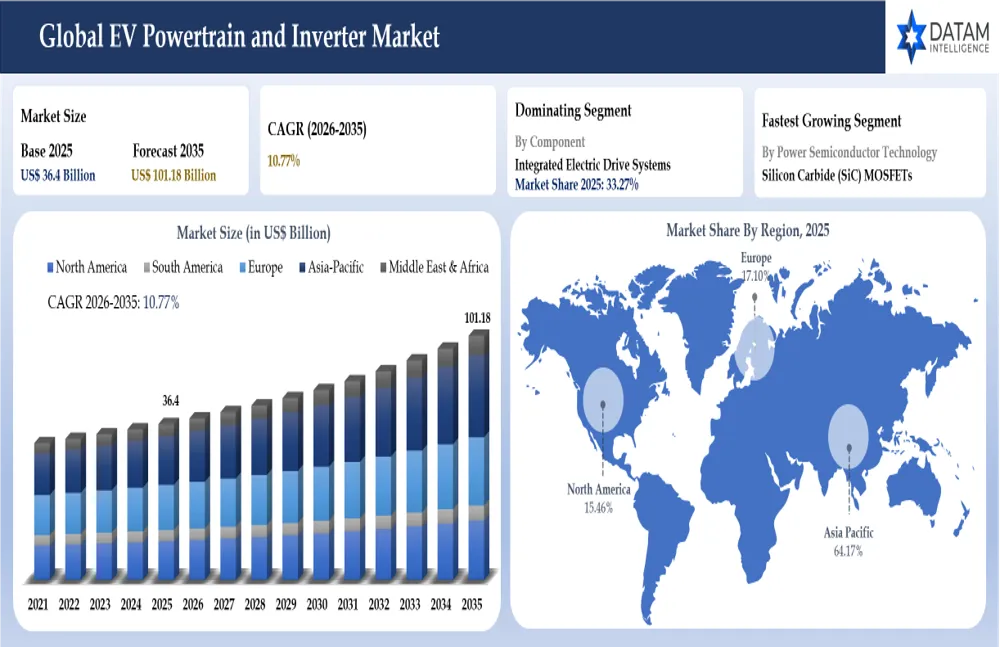
The global EV powertrain and inverter market reached US$ 36.4 billion in 2025 and is expected to reach US$ 101.18 billion by 2035, growing with a CAGR of 10.77% during the forecast period 2026-2035.
The EV powertrain and inverter marketplace is adopting integrated electric drive technologies that create electric motors, traction inverters and reduction gearboxes as one complete unit. As reported in the Global EV Outlook 2025 report by the International Energy Agency (IEA), the 2024 tariffs on manufacturing electric drive products was US$44/kW in China, US$70/kW in the EU and US$80/kW in the USA. The IEA also brings to the attention the inverter box rates which stood at US$15/kW in China, US$24/kW in the EU and US$27/kW in the US. These rates speak loudly about the effectiveness of production scale, localized supply chains and affordable system integration.
The emergence of new high-voltage platforms and sophisticated semiconductor technology is providing even more scope for improvements in terms of the efficiency, power density and heat dissipation capabilities of inverters. The U.S. Department of Energy suggests that Silicon Carbide (SiC) components are able to work at elevated temperatures and voltages compared with regular silicon components; in its technical overview, the Department mentions that SiC devices will be able to survive in environments where the temperature reaches up to 300°C, while silicon components only survive when the temperature reaches up to 150°C. In addition, the Department notes that savings in switching losses and heat losses may lead to small cooling systems and small power electronics systems. This makes SiC a desirable material for high performance and high voltage EV applications, but still other factors need to be considered in its adoption.
EV Powertrain and Inverter Market Key Takeaways
- The prominence of integrated electric drive systems is increasing due to the development of compact e-axle units with electric motors, traction inverters and reduction gearboxes combined together. Integrated e-axles had a share of 33.27% in the global EV powertrain and inverter market in 2025 since companies are looking for compact designs and simplified assembly processes and increased efficiency of the powertrain.
- Silicon Carbide traction inverters are seen as one of the areas of growth due to their applicability in high performance and high voltage electric vehicles. The SiC MOSFET segment is projected to grow at a CAGR of 19.34% within the EV powertrain and inverter market from 2026 to 2031 due to the fact of lower switching losses and an increase in power density and efficiency.
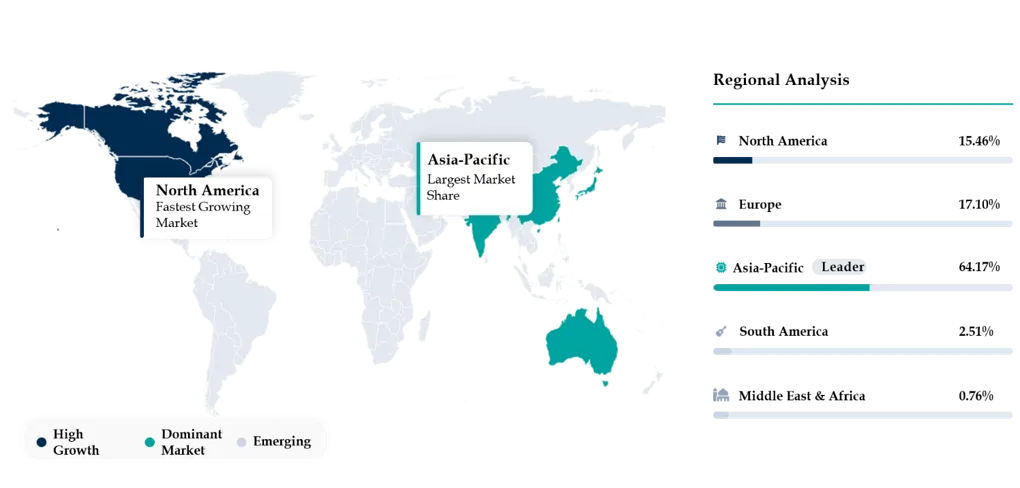
- Asia-Pacific holds about 64.17% in the global EV powertrain and inverter market in 2025 because of China’s well-established EV manufacturing ecosystem and established automotive and power electronics industries in Japan and South Korea.
- Advanced inverter modules, thermal management and insulation technologies for 800 V systems and high-voltage power electronics offer the possibility for innovative designs in inverter technology. They can improve the electrical loss and increase the power generation and fast charging capabilities, especially when applied in premium passenger EVs and high-performance EVs.
- Motor technologies without rare earth materials like EESMs and induction motors have been proposed as an alternative to decrease dependency on permanent magnet materials. The adoption of these motor technologies will be based on cost considerations, efficiency, controls and performance specifications.
EV Powertrain and Inverter Industry Trends and Strategic Insights
- Auto manufacturers have been implementing an 800 V powertrain platform to lower the amount of electrical losses that occur due to current in high power applications and enable fast-charging capabilities, resulting in traction inverters, HV motors and insulation systems to meet this need.
- Silicon carbide (SiC) traction inverters have been seen more frequently in premium or high-performance EVs owing to their potential for low switching losses and increased power density, with higher cost components preventing further implementation in other types of vehicles.
- Manufacturers are integrating electric motors, traction inverters and reduction gears in e-axles and three-in-one or multi-in-one drive systems in order to lower packaging needs, simplify car assembly processes and increase the efficiency of the propulsion system overall.
- Vehicle manufacturers and component suppliers are diversifying their motors by testing permanent magnet synchronous motors, electrically excited synchronous motors and induction motors on account of efficiency, rare earth dependency, cost and torque demands.
- Cooling systems and motor-inverter software control have become increasingly important competitive advantages since liquid and oil cooling, regenerative braking and power electronics control may enhance thermal management, battery range and powertrain longevity.
EV Powertrain and Inverter Market Scope
| Metrics | Details | |
| 2025 Market Size | US$ 36.4 Billion | |
| 2035 Projected Market Size | US$ 101.18 Billion | |
| CAGR (2026-2035) | 10.77% | |
| Largest Market | Asia-Pacific | |
| Fastest Growing Market | North America | |
| By Component | Electric Motors, Traction Inverters, Powertrain Controllers, Transmission and Reduction Systems and Integrated Electric Drive Systems | |
| By Propulsion Type | Battery Electric Vehicles (BEVs), Hybrid Electric Vehicles (HEVs), Plug-in Hybrid Electric Vehicles (PHEVs), Mild Hybrid Electric Vehicles (MHEVs) and Fuel Cell Electric Vehicles (FCEVs) | |
| By Inverter Power Rating | Up to 100 kW, 101–300 kW, 301–600 kW and Above 600 kW | |
| By Voltage Architecture | Up to 100 V, 101–400 V, 401–800 V and Above 800 V | |
| By Power Semiconductor Technology | Silicon IGBT, Silicon MOSFET, Silicon Carbide (SiC) MOSFET, Gallium Nitride (GaN) Devices and Hybrid Semiconductor Modules | |
| By Vehicle Type | Passenger Vehicles, Light Commercial Vehicles (LCVs) and Heavy Commercial Vehicles (HCVs) | |
| By Drive Configuration | Front-Wheel Drive, Rear-Wheel Drive, All-Wheel Drive, Dual-Motor Drive and Multi-Motor Drive | |
| By Cooling Technology | Air-Cooled Systems, Liquid-Cooled Systems, Oil-Cooled Systems, Refrigerant-Cooled Systems and Direct-Dielectric Cooling Systems | |
| By Sales Channel | Original Equipment Manufacturers (OEMs), Aftermarket and Replacement Components | |
| By Region | North America | U.S., Canada, Mexico |
| Europe | Germany, UK, Russia, France, Spain, Italy, Poland | |
| Asia-Pacific | China, India, Japan, Australia, South Korea, Indonesia, Malaysia, Singapore, Vietnam, Thailand, Philippines, Taiwan | |
| South America | Brazil, Argentina | |
| Middle East and Africa | UAE, Saudi Arabia, South Africa, Israel, Turkiye, Nigeria | |
| Report Insights Covered | Competitive Landscape Analysis, Company Profile Analysis, Market Size, Share, Growth | |
Why does this report matter in 2026?
The EV powertrain and inverter market in 2026 is at a crucial juncture where automobile manufacturers are striving to cut down the costs involved in electric propulsion, increase efficiency and achieve economies of scale with respect to powertrain systems. The emergence of 800-volt systems, silicon carbide (SiC) traction inverters and integrated e-axles has brought about changes in the requirements of components, suppliers and the design of the vehicles themselves. It is therefore important to know under what conditions the use of advanced inverter technologies is justified and how motor technologies will be able to reduce reliance on rare earth materials.
The report is also relevant due to the rising competition among incumbent automotive suppliers, vertically-integrated electric vehicle manufacturers and power electronics specialists. Challenges related to semiconductor procurement, local manufacturing, OEMs' cost-cutting needs and advances in motor designs affect vendor selection and capital expenditures. Through analyzing the prospects at the component level, technology adoption, local manufacturing capabilities and supply chain weaknesses, the report assists in making decisions on investments and finding commercially viable uses of electric powertrains for passenger and commercial vehicles.
EV Powertrain and Inverter Market White Space & Investment Opportunities
- The development of cost-effective silicon carbide (SiC) traction inverters by means of sophisticated semiconductor packaging, local production and advanced thermal management could provide an opportunity to expand premium EVs beyond mass market passenger cars and commercially-oriented fleets.
- Investments in high voltage inverters, compatible electric motors and insulation system technology would cater to the demands of 800 V or higher voltage electric vehicles especially premium passenger EVs and commercial high performance electric vehicles.
- Integrated electric axles and single-unit electric drive modules that integrate motor, inverter, gearing and controls have potential to minimize packaging needs, ease assembly and support scalable manufacturing processes for different electric vehicle models.
- Electrically excited synchronous machines (EESMs) and advanced induction machines have potential to minimize reliance on rare earth magnets while optimizing efficiency, torque output, manufacturing cost and logistics.
- The development of traction inverters of high power, tough electric motors and liquid/oil cooling systems in electric trucks and buses is an area that investors can consider in their efforts to provide reliable power output.
EV Powertrain and Inverter Future Market Transformation
The EV powertrain and inverter market is expected to evolve from a component-based market to a more integrated electric propulsion ecosystem based on high-voltage architecture, advanced power semiconductor technology and software-defined control. The increase in the number of 800 V systems, SiC inverters and multi-in-one e-axles will drive changes to components, thermal management systems and manufacturing processes, while non-rare earth motors and modular drive systems can serve as an alternative solution to reduce material expenses and supply chain risks. As the optimization of the entire powertrain system to achieve energy efficiency, range and cost becomes the priority of car manufacturers, there will be increased demands for hardware and software integration. Future success in the market will be defined by production costs, adaptability to different types of vehicles and semiconductor supply chain availability.
EV Powertrain and Inverter Market Buyer Decision-Making Criteria
EV powertrains and inverters are sourced by automotive OEMs according to how well they achieve the performance objectives for the particular vehicle while managing costs, energy usage and reliability. The buying decision is not limited only to component pricing but extends to the capability of the parts to work with 400V and 800V systems, semiconductors, thermal efficiency, vehicle control software interface and the capacity to deliver parts on time. Suppliers that have proven performance, reliable semiconductors sources, scalability and automotive qualification capabilities will be able to get longer OEM contracts.
Major Buyer Decision-Making Criteria:
- Total System Cost
- Energy Efficiency
- Voltage and Power Compatibility
- Semiconductor Technology
- Thermal Management and Reliability
- System Integration
- Manufacturing Capacity and Delivery Reliability
- Supplier Cost Competitiveness
- Supply-Chain Resilience
- Automotive Qualification and Compliance
EV Powertrain and Inverter Market Economic & Investment Analysis
The prospects for the EV powertrain and inverter market depend on the relationship between the cost of electrical drives, investments in the development of power electronics technology and the desire of automobile manufacturers to make their cars cheaper. Investments are increasingly made into manufacturing technologies for e-axles, high-voltage inverters for traction systems, silicon carbide (SiC) power modules and manufacturing facilities for automation. Even though integration helps in reducing the number of parts, packaging and assembling difficulties, suppliers still have to incur significant engineering, tooling and testing expenses before reaching the economy of scale. Profitability is dependent on the volume of production, conditions for buying semiconductors and standardization of powertrain platforms for several vehicles.
Investment will be increasingly tied to technologies that offer demonstrable benefits in efficiency, performance and manufacturing economics. Investments in SiC inverters and 800V powertrains are possible cases in point where efficiency gains will offset the cost of components and the use of integrated e-axles and rare earth-free motors could help solve issues relating to packaging and sourcing materials. Investment in regional manufacturing capabilities will be necessary to meet supplier demand for locations close to automotive production centers and closer control over semiconductors. Uncertain demand for EVs, price competition from vertically integrated suppliers and potential underutilization of production capacity will be risks to consider when investing in powertrain technology and facilities.
EV Powertrain and Inverter Investment Trends in the Market
- Capital is being directed by companies towards the fabrication of SiC semiconductors, packaging and manufacturing capabilities for power modules and inverters to optimize power density, minimize losses and reduce manufacturing costs in electric traction systems for EVs.
- Automotive suppliers are focusing on investment in manufacturing capability and scalable manufacturing processes for the integrated e-axles and multi-in-one electric drives systems to integrate components and reduce assembly efforts across multiple vehicle platforms.
- Investments in high voltage traction inverter technologies and 800V-ready power electronics have been made in order to serve high end electric vehicles and performance vehicle architectures, with funds being invested for engineering and manufacture of qualified parts.
- There is a move towards increasing production capability within the regions and semiconductor suppliers for the powertrains through local production, supplier relations and procurement contracts to minimize import dependency and risks in supply chain logistics.
- There is investment in motor control software, powertrain simulation, hardware-in-the-loop testing and thermal management technologies to speed up development process, test inverter functionality and increase energy efficiency in real world operations.
Strategic Indicators for EV Powertrain and Inverter Market
High Regulation Impact
The EV powertrain and inverter market is greatly impacted by the safety standards that apply to vehicles as well as emissions standards and electrical and electronics standards. The UN ECE R100 provides specifications for electric powertrains and rechargable energy storage systems, whereas the ISO 26262 takes care of functional safety in automotive electrical and electronic systems and ISO/SAE 21434 takes care of automotive cybersecurity engineering. All these regulations affect the design, test and qualification of traction inverters, motor controller and the overall e-axles, raising the cost of compliance and motivating the manufacturers to improve their HV protection and fault detection capabilities.
High Investment Activity
Funding for the EV powertrain and inverter market has been geared towards SiC semiconductors, high voltage traction inverter manufacturing and e-axle integration. The automotive suppliers are funding themselves in power module packaging, improved cooling technology, automation of assembly lines and testing facilities to enhance manufacturing capabilities and reliability of products. Funding for 800 V compatible propulsion systems and local manufacturing have also become critical for suppliers as they strive to win OEM deals and ensure supply chain capability for semiconductors.
Supply Chain Disruption
EV powertrain & inverter supply chain is vulnerable to disruptions in terms of the availability of semiconductors used in the powertrain of automobiles like SiC devices and silicon IGBT modules, as well as high-voltage capacitors, amongst others. Vulnerabilities in the form of concentrated semiconductor supply chain and long qualification period for semiconductors, together with rare earth minerals such as neodymium and dysprosium used in the manufacturing of permanent magnet electric motor increase the exposure of EV Powertrain & Inverter to export control, geopolitics and pricing risk. Such disruptions can lead to delays in the manufacture of traction inverters and electric axles, as well as an increase in the cost of procurement, thus necessitating the qualification of alternate parts and design modifications in power modules.
Pricing Volatility
Pricing in the market for EV powertrain and inverter will be impacted by the volatility in silicon carbide (SiC) devices, silicon IGBT modules and the cost of copper and rare-earth elements found in electric motors. For instance, the price of SiC power modules could have a hefty premium over the silicon IGBT modules as a cost comparison between 3.3kV modules showed a 3.5x price ratio. Nonetheless, this does not necessarily indicate an automotive price benchmarking standard. At the same time, strong competition and OEM pricing negotiations may exert a downward pressure on the prices of inverters despite higher input costs from semiconductors. These two conflicting cost and price pressures may be a challenge for suppliers to maintain their margins.
Procurement Pressure
The procurement process in the EV powertrain and inverter market is affected by the need to procure automotive quality SiC-based components, silicon IGBT modules, high-voltage capacitors, copper windings and precise motors in order to keep cost-effective and quality level. The procurement process should be conducted considering long-term agreements on purchasing semiconductors and the volatile prices of materials, transition to new technologies and cost-cutting pressure from automakers. There are tight component qualification procedures which make any changes in the suppliers and replacement of inverter components complicated and time-consuming. Thus, companies are now focusing on dual sourcing, local sourcing, standardization of components and long-term purchasing contracts to sustain their production process, control costs and minimize their exposure.
New Technology Adoption
The EV powertrain and inverter market is advancing by utilizing silicon carbide (SiC) semiconductors in power modules, 800 V battery packs, integrated e-axles and advanced motor control software. Utilization of SiC power semiconductors in traction inverters may result in lower switching losses and higher power density especially in high power and high voltage applications, while integration of drive units with electric machines, inverters and reducers may lead to reduced packaging complexity and easier assembling of vehicles. Development of rare-earth free electrically excited synchronous motors (EESMs), advanced liquid and oil cooling systems and predictive algorithms is being undertaken to enhance energy efficiency and reliability. However, it relies on costs of semiconductors, technological readiness, compatibility with different vehicles and verification of the product's reliability in automotive environments.
Regional Expansion Opportunity
Expanding regions in the EV powertrain and inverter market include the activities of car manufacturers that seek to build localized manufacturing and enter regional OEMs' supplier agreements. India presents chances for traction motors and inverters manufacturing due to the increasing volume of domestic EV manufacturing and Southeast Asia can become another chance for suppliers due to the increasing assembling of vehicles and electrification in the region. North America and Europe offer opportunities for suppliers due to the establishment or expansion of manufacturing and engineering centers for integrated e-axles, high voltage traction inverters and SiC power electronics located close to car manufacturing centers. Expansion success will rely on OEM relationships, availability of competent semiconductor suppliers, engineering skills locally available and meeting regional requirements of cost, performance and regulation.
Government Policy Support
Policies enacted by governments affect the EV powertrain and inverter Market, as the former drives the adoption of electric vehicles and the latter promotes local manufacturing and investments in new technologies in the automotive industry. Specifically, in India, the scheme “PM E-DRIVE” promotes the adoption of electric mobility solutions, whereas “PLI Scheme for Automobile and Auto Components” provides incentives to invest in eligible advanced automotive technologies. The industrial policies in relation to EVs, as well as initiatives promoting the manufacturing of semiconductors in the United States and Europe, could potentially foster regional power electronics supply chain, as well as advanced inverter technologies. Such policies would help improve demand visibility and promote manufacturing of electric motors, traction inverters and e-axles; however, their effectiveness would depend on policy eligibility and the rate of EV deployment.
Pricing Intelligence
Pricing intelligence for the EV powertrain and inverter market needs benchmarking on component costs based on power rating of inverters, voltage architectures, semiconductor technology used and level of system integration. This will involve comparison of inverter configurations using silicon IGBT and SiC semiconductors; individual components as well as e-axle systems considering the need for cooling systems, control electronics, warranties and volume considerations. The decisions on OEM purchases are now more focused on total powertrain cost per vehicle, efficiency of energy conversion and performance of the system compared to the cost of an inverter alone. Through extensive benchmarking on quotations from suppliers, specifications of components, localization percentages and cost-performance ratios, manufacturers will be able to exploit price competitiveness.
| HS Code | Reporter | Trade Flow | 2025 Trade Value | Interpretation |
| 8504 | China | Exports | US$55 billion | China’s substantial exports of transformers and static converters indicate a strong electrical equipment manufacturing and export base, including products relevant to power electronics. |
| 8504 | United States | Imports | US$36 billion | High imports indicate significant demand for electrical transformers and static converters across industrial, energy and electronic applications. |
| 8501 | China | Exports | US$17 billion | Reflects China’s strong electric motor and generator manufacturing base, relevant to the broader EV motor supply chain. |
| 8501 | United States | Imports | US$14 billion | Indicates significant demand for imported electric motors and generators across automotive and other industrial applications. |
Note: HS 8504 covers electrical transformers and static converters, while HS 8501 covers electric motors and generators. The 2025 trade values represent broader electrical equipment trade and are not specific to EV powertrains or traction inverters. These figures should therefore be interpreted as indicators of the global electrical equipment supply chain relevant to the EV powertrain and inverter market.
AI Impact Analysis of EV Powertrain and Inverter Market
AI technology is enhancing the design process for the powertrains in electric vehicles with the help of data-driven optimization of electric motors, traction inverter switching and thermal management systems. Machine learning can be used to examine the torque requirements, switching losses, temperature of semiconductors and driving cycles, which can help to make the process more energy-efficient and prevent the components from overheating. Simulation using artificial intelligence technology as well as the use of digital twins helps engineers to assess the SiC-based inverters, 800 V systems and integrated e-axles under different conditions, which reduces the need for physical prototypes.
Automated inspection, predictive maintenance and fault detection by AI are also improving quality of powertrain manufacturing and operations. Machine vision systems are capable of detecting faults in inverter assemblies and power modules and predictive models provide this capability by identifying abnormal temperatures, electrical deterioration and movement of motors before they fail. Using these systems results in fewer production defects, warranty costs and unexpected outages. Nevertheless, the performance of these systems relies on a reliable operation data, good quality sensors, proper validation of models and compliance with safety requirements in automotive applications.
Disruption Analysis of EV Powertrain and Inverter Market
Disruption is being witnessed in the EV powertrain and inverter market due to the trend moving away from discrete motors, inverters and transmissions to the more integrated e-axles and multi-in-one electric drive. The disruption will bring about a new supplier dynamics where there will be fewer components to source and increased competition among traditional car Tier-1 suppliers and vertically integrated EV makers. Furthermore, the incorporation of silicon carbide (SiC) power semiconductors in appropriate areas has disrupted inverter design, cooling systems, integration and sourcing for suppliers who can provide greater power density and efficiency.
Another disruption being created by alternative drive-train technology, higher voltage systems and software-based powertrain optimization. The use of 800 volts systems and non-rare earth-based EESM creates additional need for high voltage insulation, inverter system design, cooling systems and motor control methods. At the same time, car manufacturers tend to select propulsion systems according to overall efficiency, cost and performance of the whole system, not single components characteristics. Those suppliers which integrate modular hardware along with innovative control software and manufacturing scalability will be able to deal with the changing demands of OEMs for electric passenger vehicles and commercial vehicles.
EV Powertrain and Inverter Market BCG Matrix: Company Evaluation
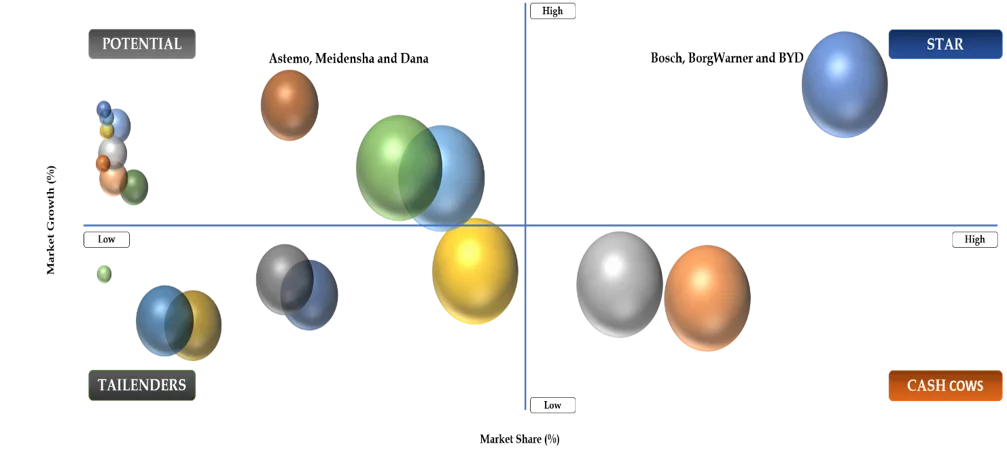
STAR
Bosch, BorgWarner and BYD serve as typical Star companies owing to the fact that they have a good reputation in terms of producing electric powertrains along with the exposure that these companies have due to the increasing demand for EVs. Bosch and BorgWarner provide electric motors and traction inverters, whereas BYD has the advantage of producing its electric drives within the organization. Competitive positions of these companies will be determined by their efficiency, production size, cost reduction and usage of power electronics technologies.
POTENTIAL
Potential growth companies include Astemo, Meidensha and Dana due to their abilities in electric motor, inverter and electrification. The growth opportunities can be from OEM penetration of the integrated drives system, efficiency of powertrains and customized solutions for passenger cars and commercial electric vehicles. These companies success in becoming market leaders will depend on getting vehicle programs, production capacities and competitiveness in terms of system cost, reliability and performance.
EV Powertrain and Inverter Market Dynamics
Driver Impact Analysis
| Driver | Market Growth Impact (%) | Demand Concentration | Impacted Use Case | Strategic Impact |
Accelerating EV adoption and stricter vehicle-emission regulations | 30% | China, Europe, North America | Battery electric passenger cars, electric SUVs and urban mobility vehicles | Increases demand for traction inverters, electric motors and integrated drive systems as automakers expand EV production and improve drivetrain efficiency. |
Rising adoption of Silicon Carbide (SiC) semiconductors and high-voltage architectures | 25% | China, Europe, North America | Premium EVs, 800 V electric vehicle platforms and high-performance EVs | Encourages development of high-efficiency inverters with lower switching losses, improved thermal performance and higher power density. |
Growing adoption of integrated e-axles and compact electric drive units | 20% | China, Europe, Japan and South Korea | Electric passenger cars, crossovers, light commercial vehicles and all-wheel-drive EVs | Promotes integration of motors, inverters and reduction gears, reducing packaging requirements and simplifying vehicle assembly. |
Electrification of commercial vehicles and expansion of electric fleets | 15% | China, Europe, North America and India | Electric buses, delivery vans, medium-duty and heavy-duty trucks | Drives demand for high-power inverters, durable electric drive systems and thermal management solutions suitable for demanding operating conditions. |
Advancements in electric motor efficiency and power density | 10% | China, Europe, Japan and South Korea | Long-range EVs, performance vehicles and energy-efficient commercial EVs | Encourages development of improved motor designs, advanced cooling systems and optimized electromagnetic architectures to enhance efficiency and extend driving range. |
Driver: Rising Demand for Integrated Electric Drive Systems and High-Efficiency Traction Inverters
Increased use of electric and hybrid cars has increased the demand for the integration of e-axles, traction inverters at high voltages and energy-efficient electric motors. The automotive industry is integrating motors, inverters and reduction gears into powertrains, utilizing SiC power semiconductors and 800 volts architecture in cases where the improved power density, reduced conversion loss and quick charging outweigh the cost. There is an opportunity for companies that can provide cost-effective and thermally efficient electric powertrain solutions.
Restraint Impact Analysis
| Restraint | Drag on Market Growth (%) | Primary Impact Area | Impacted Use Case | Strategic Impact |
High cost of advanced power electronics and SiC-based inverter systems | 30% | Component costs and manufacturing economics | Mass-market passenger EVs and price-sensitive electric two- and three-wheelers | Increases system costs and pressures OEM margins, encouraging cost-optimized inverter designs and localized sourcing. |
Supply-chain concentration for specialized power semiconductors | 25% | Semiconductor sourcing and production continuity | High-volume EV manufacturing and high-voltage electric drive platforms | Creates procurement risks and potential production delays, encouraging supplier diversification and long-term sourcing agreements. |
Thermal management, reliability and power-density constraints | 20% | Inverter cooling, motor insulation and component durability | High-performance EVs and heavy-duty electric commercial vehicles | Increases cooling, testing and engineering requirements, complicating the development of compact, high-power drive systems. |
High R&D, validation and automotive qualification costs | 15% | Product development and time to market | Next-generation traction inverters, integrated e-axles and 800 V powertrain platforms | Raises development costs and delays commercialization, particularly for smaller suppliers and manufacturers introducing new semiconductor technologies. |
Restraint: High System Costs and Semiconductor Integration Challenges
The expense of SiC-based power devices, modern inverter modules, high-voltage insulation and special cooling systems raises the costs associated with EV powertrain production, especially in markets where customers are price sensitive. Moreover, combining motors, inverters and transmissions happens to be an engineering challenge, with issues of thermal management, electromagnetic compatibility, software tuning and reliability of components.
EV Powertrain and Inverter Market Segment Analysis
The global EV powertrain and inverter market is segmented based on the component, propulsion type, inverter power rating, voltage architecture, power semiconductor technology, vehicle type, drive configuration, cooling technology, sales channel and region.
By Component
Integrated Electric Drive Systems Account for a Significant Share of the EV Drivetrain Market
Integrated electric drive systems have captured around 33.27% of the total global market share of EV powertrain and inverter in 2025, driven by the integrated e-axle category. The use of systems that integrate motors, inverters and reduction gearboxes is aiding automobile manufacturers to decrease components and enhance manufacturing efficiency. This type of integration is especially advantageous when applied to high-volume passenger EVs, which require efficient manufacturing and minimized powertrain cost.
By Power Semiconductor Technology
Silicon Carbide MOSFETs Are Driving the Next Phase of Traction Inverter Technology Growth
It is expected that Silicon Carbide (SiC) MOSFET will experience the fastest growth among all other semiconductor technologies in the electric vehicle power inverter industry with a CAGR of 19.34% between 2026 and 2035. The adoption of these technologies is rising in high-voltage and performance-oriented EVs thanks to lower switching losses, high power density and better thermal efficiency. However, high costs of devices remain an obstacle for mass-market adoption of these systems - especially in mass-market vehicles.
EV Powertrain and Inverter Market Geographical Penetration
China EV Powertrain and Inverter Market Trends
China’s EV powertrain and inverter market features quick adoption of integrated electric drives, high participation of domestic suppliers and increasing vertical integration efforts from OEMs. Firms like BYD, INOVANCE Automotive and Huawei’s electric drive technology arm have been helping develop integrated e-drives and power electronics, whereas domestic vendors have been developing their IGBT technologies and silicon carbide (SiC) technologies. Increasing use of 800V vehicle platforms is driving the need for high efficiency traction inverters, smaller e-axles and advanced thermal management technologies and fierce pricing pressures on suppliers are forcing them to optimize production scale, power density and efficiency.
Germany EV Powertrain and Inverter Market Analysis
The German market for EV powertrains & inverters is fueled by the country’s reputation for engineering vehicles and the shift towards more efficient integration of electric drive systems. The key players like Bosch, ZF and Schaeffler feature a range of differentiated solutions such as SiC-based traction inverters, electric axle drives and integrated motor transmission, which support 400V and 800V architecture. However, competition from foreign suppliers with cheaper options and growing need to decrease EV manufacturing costs have made the issue of manufacturing efficiency, modularity and retaining domestic expertise of electric motors and power electronics within the country more important.
Japan EV Powertrain and Inverter Market Outlook
The Japan’s EV powertrain & inverter market is influenced by the country’s robust hybrid vehicle eco-system and proficiency in electric motor, power control unit and automotive power electronics. Companies like DENSO, Aisin and Astemo aid in the development of high-efficiency motors, inverter cooling and electric drive system integration, as Japanese OEMs manage to meet the demands for hybrid vehicles along with their shift towards BEVs. This dual approach allows for the possibility of suppliers becoming more efficient in producing inverters, lowering component sizes and reducing production costs and developing technologies that can be used for both hybrid and pure EVs.
U.S. EV Powertrain and Inverter Market Landscape
The U.S. EV powertrain and inverter market is driven by the push towards domestic manufacture of electric drive systems by OEMs, efficiency improvements in propulsion and supply chain risk reduction. Electric drive system development for vehicles is carried out by Tesla, whereas other manufacturers of electric drive systems, such as BorgWarner and Dana, offer technologies for electrifying vehicles like traction inverters, electric motors and complete drive systems. There is an opportunity to enhance power density and efficiency through increased adoption of silicon carbide (SiC) power electronics and high voltage architectures, but challenges exist in manufacturing costs and competitive Asian suppliers.
EV Powertrain and Inverter Market Competitive Landscape
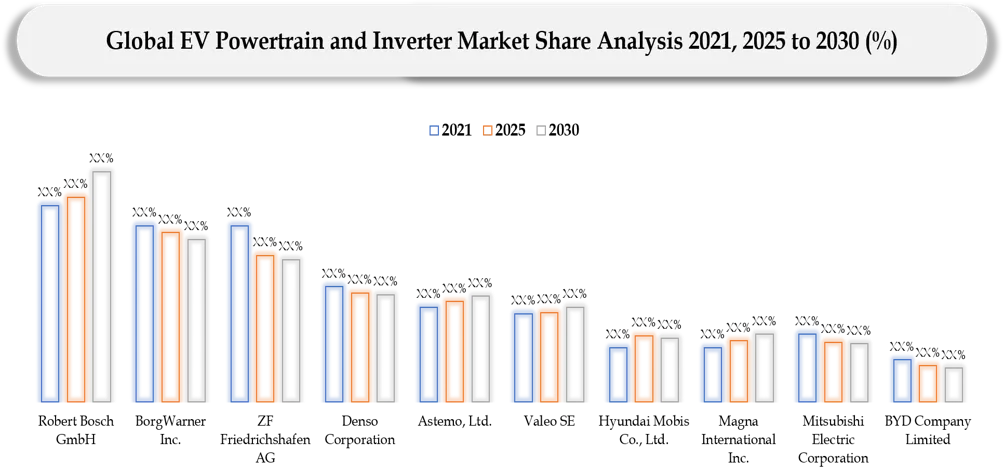
- The traditional automotive suppliers, including Bosch, BorgWarner, ZF and Denso, compete through electric drives systems, inverters technology and existing connections with global automakers, while manufacturing volume and the ability to comply with the OEMs’ price and performance requirements play a role in selecting the right supplier.
- The Chinese manufacturers, especially BYD, improve their competitive advantage through vertical integration of EV manufacturing, production of power electronics and very integrated electric drives systems, putting pressure on component suppliers.
- Competition between suppliers of traction inverters is defined by their semiconductor technologies, which can be distinguished by silicon-based IGBT or SiC semiconductor technologies, switch efficiency, cooling capabilities, power density and high voltage platform compatibility.
- Integrated e-axles and multi-in-one powertrain systems impact OEM choices because these systems combine the motor, inverter, reduction gearing and control systems in a small package for easy vehicle integration and packaging of components.
- Competitive positioning is achieved based on pricing, scale of manufacture, capacity and region of production, as well as semiconductor availability. In addition, the ability to customize powertrain systems for passenger cars, light commercial vehicles and heavy commercial vehicles is critical.
Public Company Q1-Q2 2026 Performance Comparison
The table below compares five publicly listed companies with direct or strategically relevant exposure to the EV powertrain and inverter market. Financial metrics are presented at the company-wide or relevant business-segment level because standalone revenue from electric motors, traction inverters and integrated electric drive systems is generally not disclosed separately. Performance drivers therefore distinguish overall financial results from developments directly related to electrification and electric powertrain technologies.
| Company | Q1–Q2 2026 Performance | EV Powertrain and Inverter Exposure | Key Performance Driver |
| Magna International Inc. | Q1: US$10.38 billion; Q2: US$10.98 billion; H1: US$21.36 billion | Electric propulsion systems, e-drive technologies and electrification-related automotive systems. | Operational efficiencies, new program launches and performance across automotive systems businesses. |
| Hyundai Mobis Co., Ltd. | Q1: US$11.23 billion; Q2: US$11.20 billion; H1: approximately US$22.43 billion | Integrated electric drive systems, traction inverters, electric motors and power electronics. | Electrification-system production, automotive electronics and after-sales service performance. |
| Schaeffler AG | Q1: US$6.18 billion; Q2: US$6.33 billion; H1: approximately US$12.51 billion | Electric motors, integrated electric drive systems and e-mobility components. | E-Mobility product ramp-ups, regional demand and business performance across its divisions. |
| Valeo SE | Q1: US$5.48 billion; Q2: US$5.67 billion; H1: approximately US$11.15 billion | High-voltage traction inverters, electric motors, SiC power electronics and integrated e-axles. | Electrification technology development and performance across powertrain, lighting and electronics businesses. |
| BorgWarner Inc. | Q1: US$3.53 billion; Q2: US$3.65 billion; H1: US$7.18 billion | Traction inverters, electric motors, integrated drive modules and high-voltage power electronics. | Cost management, electrification program awards and demand for integrated electric drive solutions. |
Note: Company-level revenue should not be interpreted as EV powertrain and inverter revenue unless separately disclosed. Financial periods, reporting currencies and exchange rates may differ across companies.
Key Companies of EV Powertrain and Inverter Market
- Robert Bosch GmbH (Germany)
- BorgWarner Inc. (USA)
- ZF Friedrichshafen AG (Germany)
- Denso Corporation (Japan)
- Astemo, Ltd. (Japan)
- Valeo SE (France)
- Hyundai Mobis Co., Ltd. (South Korea)
- Magna International Inc. (Canada)
- Mitsubishi Electric Corporation (Japan)
- Tesla, Inc. (USA)
- BYD Company Limited (China)
- LG Magna e-Powertrain Co., Ltd. (South Korea)
- Aisin Corporation (Japan)
- Schaeffler AG (Germany)
- Dana Incorporated (USA)
- Meidensha Corporation (Japan)
- Cummins Inc. (USA)
- Nidec Corporation (Japan)
- Toyota Industries Corporation (Japan)
- Dauch Corporation (USA)
Company Profiles of EV Powertrain and Inverter Market
Robert Bosch GmbH (Germany)
Robert Bosch GmbH is one of the biggest suppliers in the automotive tech industry with products such as electric motors, traction inverters, power modules, controllers and e-axles for electric or hybrid automobiles. The company’s e-axle product range features a compact integration of the motor, power electronics and transmission in different configurations ranging from 400 V to 800 V. In addition, Bosch provides fourth generation of inverters using silicon carbide (SiC) semiconductors for increased efficiency and performance.
Competitive strategies include increasing adoption of integrated e-axle, increasing efficiency of SiC inverters, scalability of modular powertrain systems, reduction in cost of the system by standardization of production and supporting passenger and commercial EVs.
BorgWarner Inc. (USA)
BorgWarner is an international auto parts manufacturer whose electrification products consist of electric motors, power electronics, traction inverters, electric transmissions and integrated drive modules. Integrated drive modules (iDMs) integrate the electric machine, transmission and power electronics into one solution that simplifies packaging and enhances system integration. BorgWarner is also involved in designing high-voltage inverter technologies such as the Viper power module platform and developing solutions for hybrid and battery-powered vehicles.
Competitive priorities are securing contracts from original equipment manufacturers for iDMs, developing high voltage and SiC inverter technology, increasing efficiency of the motors and inverter, decreasing system weight and manufacturing costs and scalability of electric propulsion systems.
ZF Friedrichshafen AG (Germany)
ZF Friedrichshafen AG is an automotive technology group which provides products such as electric motors, traction inverters, reduction gears, converters and powertrain software. The SELECT e-drive range from ZF includes components which are assembled into electric drives for specific performance and voltage needs. ZF's range of inverters includes 400 V and 800 V configurations along with silicon and silicon carbide semiconductors. The motor types in the company’s offerings are permanent magnet synchronous motors, asynchronous motors and separately excited synchronous motors. This makes it possible for car manufacturers to achieve an ideal balance between efficiency, cost and material dependencies.
Some of the competitive focuses of the firm are scaling of modular e-drive systems, increasing the use of 800 V inverters, improving power density and energy efficiency, providing alternative motors which do not depend on rare earths and decreasing OEM development time with standardization.
DENSO Corporation (Japan)
DENSO Corporation is a significant automotive component manufacturer, which already has experience working on electrification technologies including electric motors, inverters and power control units (PCUs). The PCU from DENSO combines inverter with boost and DC-DC converters to regulate the electrical power distribution from the car battery to the motor and auxiliary electrical systems. The double-sided inverter cooling technology developed by DENSO Corporation allows better heat dissipation and reduces thermal resistance, thus enabling higher power density and smaller sizes of the power electronics in hybrid and electric vehicles.
The competitive priorities of DENSO include increasing the efficiency and size of the PCU, developing semiconductor cooling and thermal management technology, integration of power conversion and motor control technologies, decreasing cost of power electronics production and becoming dominant in hybrid and electric drive trains.
Astemo, Ltd. (Japan)
Astemo, Ltd. is a Japanese supplier of mobility technology whose electric powertrain product line includes highly efficient motors, inverters and battery control modules. The motor technologies offered by Astemo are designed to have high torque density, high efficiency, low noise and low vibration; at the same time, its inverter products incorporate power semiconductors, control board, capacitors and current sensors. An official statement issued by Astemo in June 2026 revealed that Astemo’s motors and inverters have been used in the electric powertrain developed by JATCO for the Nissan LEAF.
The competitive advantages of the company include higher efficiency and torque density of motors, lower weight of inverters, integration of motor and inverter technologies, better thermal and electrical performance and development of relationship with OEMs through production-grade electric vehicle technologies.
Valeo SE (France)
Valeo SE is an automotive technology manufacturer in the global market and has a specific powertrain electrification product line including high voltage and 48 V inverters, electric motors and integrated electric axle system. 800 V SiC inverter platform offered by Valeo is developed for applications requiring high power density and increased conversion efficiency and at the same time, inverter architecture could be used for 400 V systems and semiconductors based on silicon material. Three-in-one Valeo electric axle consists of electric motor, inverter and reduction gear and is integrated into one housing unit. It serves as a compact solution for BEVs and electric drive axle for hybrid cars.
Key competitive priorities of Valeo are integration of e-axle applications, efficiency increase of 800 V SiC inverter, development of scalable 48 V and high voltage solutions and adaptation of powertrain system to various types of motors.
EV Powertrain and Inverter Market Major Pain Points
- The high cost of SiC power devices, high-voltage insulation systems and special power modules contributes to higher cost of traction inverter production and poses difficulties for vendors to offer competitively priced traction inverters in EV mass production vehicles while maintaining their efficiency and performance.
- The traction inverters go through thermal stresses and electrical stresses as a result of acceleration, regeneration braking and loading; and this is a difficult aspect in regard to semiconductor packaging and cooling system design.
- Reliance on rare earth elements such as neodymium and dysprosium in PM motors poses supply chain and raw materials price fluctuations to the producers. Other types of motors like the electrically excited synchronous motor and the induction motor could be considered to address this issue.
- Combining electric motors, inverters, reduction gears and control electronics in an e-axle presents a host of engineering challenges including thermal issues, electromagnetic interference, vibration, maintainability and fault detection.
- The variations in vehicle electrical voltage systems, characteristics of motors used, the rating of motors, cooling requirements and control systems will necessitate a lot of calibration and testing of vehicles, making the process quite costly and time consuming.
EV Powertrain and Inverter Market Recent Developments
- Hyundai Mobis Co., Ltd. - September 2026: On September 3, Hyundai Mobis launched mass production of integrated PE systems at its newly constructed manufacturing site in Nováky, Slovakia. The factory has a capacity of producing up to 280,000 such integrated systems per year, which include an electric motor, inverter and reduction gear.
- Valeo SE - August 2026: Valeo previewed its suite of commercial vehicle technologies on August 31 ahead of IAA Transportation 2026, emphasizing the company’s electrification solutions for truck applications and last mile deliveries. This release highlights the increasing attention being paid to electric drivetrain technologies.
- BorgWarner Inc. - August 2026: On August 4th, BorgWarner obtained a new integrated drive module program with a global OEM. The three-in-one solution integrates an electric motor, gearbox and fully integrated GenIV inverter, which is expected to enter production in 2027.
- BorgWarner Inc. - August 2026: On August 3rd, BorgWarner obtained extensions of several high-volume inverter programs for plug-in hybrid and 800V battery-electric vehicle platforms. The 800V traction inverter has Silicon Carbide (SiC) power switches and a dual-sided cooled power module and production is set to commence in 2029.
- Robert Bosch GmbH – July 2026: On July 13, the U.S. Department of Commerce provided up to US$225 million under the CHIPS Act for supporting Bosch's US$2 billion investment into production of silicon carbide semiconductor at its facility in Roseville, California. The development is important for the supply chain of the advanced power electronics that can be applied for vehicle electrification.
Analyst View / Opinion on EV Powertrain and Inverter Market
- The competitive nature of the market is evolving from the individual competitiveness of the motor and the inverter to competitiveness based on efficiency and integration at the system level. Suppliers able to provide optimized e-axles consisting of the motor, traction inverter and reduction gears will be more suited to the requirements of compactness and ease of assembly in vehicle applications.
- Silicon carbide (SiC) use will be driven by the application in question and will not become universal. The benefits of SiC in terms of efficiency and power density are especially important in high performance and 800V EVs, but in terms of cost-effective segments, IGBT silicon inverters will retain their competitiveness.
- The choice of motor technologies has become a supply chain management decision rather than just an engineering issue. EESMs and induction machines have the potential to minimize dependence on rare earth magnets but depend on cost considerations between the materials used and efficiency and control.
- Electric commercial vehicles provide a unique area for growth due to the need for high torque and inverter capacity along with thermal management capabilities. The companies who develop the powertrain systems in order to optimize their performance within certain duty cycles and operating costs will be at an advantage.
- Supplier competitiveness in the long run will rely on the ability to provide dependable and cost-effective powertrains for different OEMs, without requiring much customization. Those who are able to create standardized architectures, reduce validation times and ensure availability of semiconductors are more likely to succeed in production and partnership with automakers.
Target Audience of EV Powertrain and Inverter Market
| INDUSTRY | WHO SHOULD BUY THIS REPORT? | REASON TO BUY THIS REPORT |
| Automotive OEMs | Passenger vehicle manufacturers | Evaluate EV powertrain technologies, inverter architectures, supplier capabilities and electrification strategies. |
| EV Powertrain Manufacturers | Electric motor, e-axle and integrated drive unit manufacturers | Identify product opportunities, technology gaps and demand across vehicle categories. |
| Power Inverter Manufacturers | Traction inverter and power electronics manufacturers | Assess inverter demand, voltage architectures, semiconductor adoption and competitive positioning. |
| Semiconductor Industry | SiC, IGBT, MOSFET and GaN device manufacturers | Evaluate semiconductor adoption trends and identify opportunities in EV traction inverters. |
| Automotive Tier-1 Suppliers | Automotive component suppliers and system integrators | Benchmark competitors, identify OEM partnerships and assess integrated electric drive system opportunities. |
EV Platform Developers and Battery Technology Companies | EV platform engineers and battery technology providers | Understand powertrain integration requirements, energy efficiency priorities and compatibility with vehicle electrical architectures. |
| Commercial Vehicle Manufacturers | Electric bus, truck and van manufacturers | Evaluate high-power drive systems, durability requirements and powertrain solutions for demanding operating conditions. |
| Investors and Private Equity Firms | Institutional investors, venture capital firms and private equity funds | Identify investment opportunities, emerging technologies and growth areas across the EV powertrain value chain. |
| Raw Material and Component Suppliers | Manufacturers of magnetic materials, copper windings, power modules and cooling systems | Assess component demand, sourcing opportunities and potential supply-chain partnerships. |
| Market Research Firms and Consultants | Industry analysts, strategy consultants and market intelligence providers | Access market segmentation, competitive analysis, technology trends and regional growth opportunities for strategic planning. |
Why Choose DATAM?
- Data-Driven insights: Dive into detailed analyses with granular insights such as pricing, market shares and value chain evaluations, enriched by interviews with industry leaders and disruptors.
- Post-Purchase Support and Expert Analyst Consultations: As a valued client, gain direct access to our expert analysts for personalized advice and strategic guidance, tailored to your specific needs and challenges.
- White Papers and Case Studies: Benefit quarterly from our in-depth studies related to your purchased titles, tailored to refine your operational and marketing strategies for maximum impact.
- Annual Updates on Purchased Reports: As an existing customer, enjoy the privilege of annual updates to your reports, ensuring you stay abreast of the latest market insights and technological advancements. Terms and conditions apply.
- Specialized Focus on Emerging Markets: DataM differentiates itself by delivering in-depth, specialized insights specifically for emerging markets, rather than offering generalized geographic overviews. The approach equips our clients with a nuanced understanding and actionable intelligence that are essential for navigating and succeeding in high-growth regions.
- Value of DataM Reports: Our reports offer specialized insights tailored to the latest trends and specific business inquiries. The personalized approach provides a deeper, strategic perspective, ensuring you receive the precise information necessary to make informed decisions. The insights complement and go beyond what is typically available in generic databases.
What DATAM Uniquely Provides
- DATAM performs its evaluation of EV powertrain and inverter market at the component level by segmenting electric motors, traction inverters, control unit of the powertrain, reduction systems and assembled e-axles in a way that the creation of value through technology is easily identifiable and offers opportunities for differentiation.
- The analysis compares silicon IGBT and silicon carbide (SiC) inverter technologies along various voltage architectures and power ratings thereby evaluating cost-effectiveness of the inverter and carrying out a critical assessment of the applications that would warrant higher prices of the component.
- The report analyzes the shift from permanent magnet synchronous motors, EESMs and induction motors. The analysis links the choice of electric motor to the degree of dependence on rare earth metals and material prices, manufacturing costs and automotive performance needs.
- The report focuses on the assessment of integration approaches both in individual parts, three-in-one drive assemblies and multi-in-one electric powertrain systems in order to reveal supplier possibilities for increasing the packaging efficiency, vehicle integration and scaling technologies for different EV models.
- DATAM reveals application-specific niches among passenger cars, light and heavy commercial vehicles based on the needs of power, torque, thermal robustness and efficiency in order to recognize possible technology niches and those areas where the technology is not affordable due to cost and performance constraints.


























































