


Global Esophageal Cancer Market: Industry Outlook
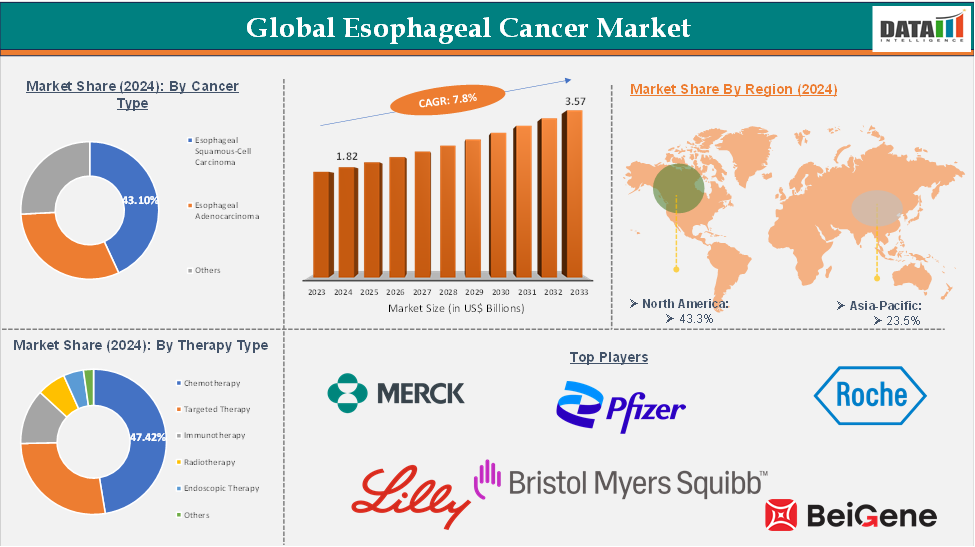
The global esophageal cancer market reached US$ 1.70 Billion in 2023, with a rise of US$ 1.82 Billion in 2024 and is expected to reach US$ 3.57 Billion by 2033, growing at a CAGR of 7.8% during the forecast period 2025-2033.
The global esophageal cancer market is experiencing significant growth due to rising incidences, advancements in diagnostic techniques, increased awareness, and the development of targeted therapies and immunotherapies. Esophageal cancer is one of the most aggressive gastrointestinal malignancies, with squamous cell carcinoma and adenocarcinoma being the major histological types. Treatment options include chemotherapy, radiotherapy, surgery, and an expanding pipeline of biologics and targeted drugs.
North America dominates the market due to its well-established healthcare infrastructure, high healthcare spending, early adoption of advanced therapies, and major pharmaceutical companies. However, the Asia-Pacific region is projected to witness the fastest growth due to increasing cancer awareness, improved healthcare infrastructure, a growing geriatric population, and high prevalence of risk factors like smoking and alcohol consumption. The market is poised for steady expansion, supported by technological innovation and an increasing emphasis on precision medicine.
Global Esophageal Cancer Market: Executive Summary
Global Esophageal Cancer Market Dynamics: Drivers & Restraints
Driver: Rising prevalence of esophageal cancer globally
The global esophageal cancer market is growing due to factors like aging populations, lifestyle changes, tobacco and alcohol consumption, obesity, and GRD. Squamous cell carcinoma is prevalent in Asia and Africa, while adenocarcinoma is more common in Western countries. As more patients are diagnosed, the demand for advanced diagnostic tools, effective treatment, and personalized therapeutic approaches is increasing. This trend highlights the need for continuous research, improved screening programs, and global expansion of cancer care services.
For instance, the American Cancer Society predicts that by 2025, the US will have 22,070 new esophageal cancer cases, with 17,430 men and 4,640 women. Men are more likely to develop the disease, with a lifetime risk of 1 in 127 men and 1 in 434 women. Factors affecting these chances can be found in the Esophageal Cancer Risk Factors section.
Driver: Increasing adoption of minimally invasive surgical Therapy Types
The market for minimally invasive surgical Therapy Types for esophageal cancer treatment is expanding due to the advantages of advanced techniques like laparoscopic and robotic-assisted esophagectomy. These Therapy Types offer reduced trauma, shorter hospital stays, quicker recovery times, and lower postoperative complications. Technological advancements have improved patient outcomes and quality of life. As healthcare systems prioritize cost-efficiency and patient-centric care, the demand for these minimally invasive options is expected to rise.
Moreover, the advancement of minimally invasive techniques (MIS) is expected to expand their application to a wider range of patients, including those with advanced diseases or comorbidities. Improved healthcare infrastructure and training, particularly in developing regions, will facilitate wider access to MIS, narrowing the treatment gap between high- and low-resource settings. MIS will also integrate with multimodal therapies, offering personalized medicine and enhanced recovery pathways, ultimately improving patient outcomes and reducing healthcare costs.
Restraint: High cost of cancer treatment and diagnostics
The global esophageal cancer market faces a significant challenge due to the high cost of cancer diagnosis, treatment, and long-term management. Advanced diagnostic techniques, treatments, and financial burdens can be prohibitive, especially in low- and middle-income countries with limited healthcare resources and inadequate insurance coverage. This financial toxicity can lead to delayed treatment, reduced therapy adherence, and increased out-of-pocket expenses, hindering equitable access to optimal care and affecting patient outcomes and slowing the adoption of innovative treatments in the esophageal cancer market.
Opportunity: Advancements in targeted therapies and immunotherapy
The global esophageal cancer market is experiencing a transformative opportunity due to advancements in targeted therapies and immunotherapy. Traditional treatments like chemotherapy and radiation often have side effects and limited specificity. Targeted therapies, such as immune checkpoint inhibitors, offer greater efficacy and fewer adverse effects. Immunotherapies have shown promising results in extending survival and improving response rates in advanced or metastatic esophageal cancer patients. As research uncovers new biomarkers and targets, precision oncology integration into standard care pathways is expected to revolutionize treatment outcomes, creating a key area of opportunity for pharmaceutical companies and healthcare providers.
For more details on this report, Request for Sample
Pipeline Analysis:
Global Esophageal Cancer Market Segment Analysis
The global esophageal cancer market is segmented based on cancer type, therapy type, and region.
Therapy Type:
The chemotherapy segment from the product type is expected to hold 47.42% of the Esophageal Cancer market
Chemotherapy remains a vital treatment for esophageal cancer due to its widespread applicability across various stages and types. Chemotherapeutic agents like cisplatin, fluorouracil, paclitaxel, and docetaxel have proven clinically effective in shrinking tumors, managing symptoms, and improving survival rates, especially in advanced cases.
Chemotherapy is often used in combination with radiation therapy or as an adjunct to surgery, enhancing treatment effectiveness. The increasing availability of combination regimens and supportive care drugs has improved patient tolerance and outcomes. In regions with limited access to advanced therapies, chemotherapy remains a primary and affordable option.
For instance, in March 2025, the US FDA has approved Tevimbra (tislelizumab-jsgr) for use in combination with platinum-containing chemotherapy as first-line treatment for adults with unresectable or metastatic esophageal squamous cell carcinoma (ESCC) expressing PD-L1. The approval was based on data from the phase 3 RATIONALE-306 trial, which evaluated tislelizumab in 649 patients without prior systemic therapy for advanced or metastatic ESCC.
Global Esophageal Cancer Market - Geographical Analysis
North America dominated the global esophageal Cancer market with the highest share of 43.3% in 2024
North America leads the global esophageal cancer market due to its robust healthcare infrastructure, high healthcare expenditure, and early adoption of advanced diagnostic technologies. The region's strong R&D capabilities, supported by leading pharmaceutical and biotechnology companies, drive demand for effective treatment solutions. Risk factors like obesity, GERD, smoking, and alcohol consumption contribute to increased esophageal cancer incidence. Awareness campaigns, early screening programs, and favorable reimbursement policies further enhance patient access to timely cancer care.
For instance, in May 2025, AstraZeneca and Daiichi Sankyo received a Time-Limited Reimbursement (TLR) recommendation from Canada's Drug Agency (CDA) for ENHERTU, the first in gastric cancer. The recommendation is based on the unmet need of adult patients with unresectable, locally advanced, or metastatic HER2-positive gastric or GEJ adenocarcinoma who have received a prior trastuzumab-based regimen. The pan-Canadian Pharmaceutical Alliance has signed a Letter of Intent, paving the way for jurisdictional reimbursement.
Moreover, in January 2025, Astellas Pharma Canada Inc. received approval from Health Canada for VYLOY, a drug used in combination with fluoropyrimidine- and platinum-containing chemotherapy for first-line treatment of adult patients with HER2-negative gastric or GEJ adenocarcinoma. The drug is indicated for use in combination with fluoropyrimidine- and platinum-containing chemotherapy. The Canadian Drug Agency has also issued a draft recommendation to reimburse VYLOY with specific conditions.
Asia-Pacific is the global esophageal cancer market with a market share of 23.5% in 2024
The Asia-Pacific region is the fastest-growing market for esophageal cancer due to high disease burden, improved healthcare infrastructure, and growing awareness about early diagnosis and treatment. Countries like China and India are experiencing a rise in esophageal squamous cell carcinoma due to lifestyle factors.
Moreover, regulatory approvals, governments are investing in modernization and cancer screening initiatives, while the expanding medical tourism industry and focus on affordable treatment options attract global attention. As access to advanced therapies and diagnostics improves, Asia-Pacific is poised to contribute significantly to the global esophageal cancer market.
For instance, in January 2024, China's National Medical Products Administration approved sugemalimab (Cejemly) in combination with fluorouracil and platinum-based chemotherapy for frontline treatment of unresectable ESCC.
Global Esophageal Cancer Market - Key Players
The major global players in the esophageal cancer market include Merck & Co., Inc., Bristol-Myers Squibb, BeiGene, F. Hoffmann-La Roche, Eli Lilly & Co., and Pfizer Inc., among others.
Global Esophageal Cancer Market – Emerging Players
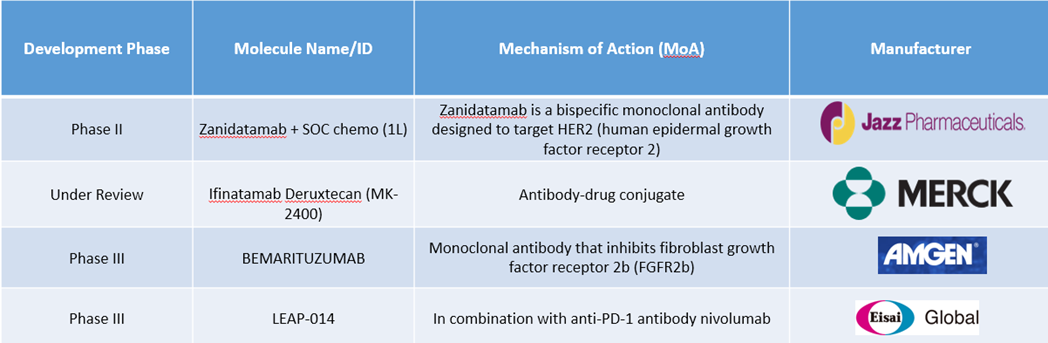
The emerging players in the esophageal cancer market include Amgen, Jazz Pharmaceuticals, and Eisai Global, among others.
Global Esophageal Cancer Market – Key Developments
In January 2025, Researchers at Johns Hopkins Kimmel Cancer Center and Johns Hopkins University School of Medicine developed a biomarker algorithm that can help clinicians identify patients with esophageal cancer or precancerous conditions like Barrett's esophagus or high-grade dysplasia. This algorithm, when combined with a noninvasive esophageal cell collection method, could provide valuable insights into these conditions.
Global Esophageal Cancer Market: Scope
Metrics | Details | |
CAGR | 7.8% | |
Market Size Available for Years | 2022-2033 | |
Estimation Forecast Period | 2025-2033 | |
Revenue Units | Value (US$ Bn) | |
Segments Covered | Cancer Type | Esophageal Squamous‑Cell Carcinoma, Esophageal Adenocarcinoma, Others |
Therapy Type | Chemotherapy, Targeted Therapy, Immunotherapy, Radiotherapy, Endoscopic Therapy, Others | |
Regions Covered | North America, Europe, Asia-Pacific, South America, and the Middle East & Africa | |
For more pharmaceutical-related reports, please click here



























































