


Embedded Insurance Market Overview
The global embedded insurance market is estimated at US$145.20 billion in 2025 and is projected to reach US$2,128.35 billion by 2035, expanding at a CAGR of 30.8% during 2026-2035. The market is moving from simple checkout add-ons toward an orchestration model in which insurers, MGAs and technology platforms configure, distribute and service protection across several partner ecosystems. North America remains the largest market, while Asia-Pacific is expected to be the fastest-growing region because mobile commerce, digital banking, vehicle financing, travel platforms and device ecosystems are scaling rapidly.
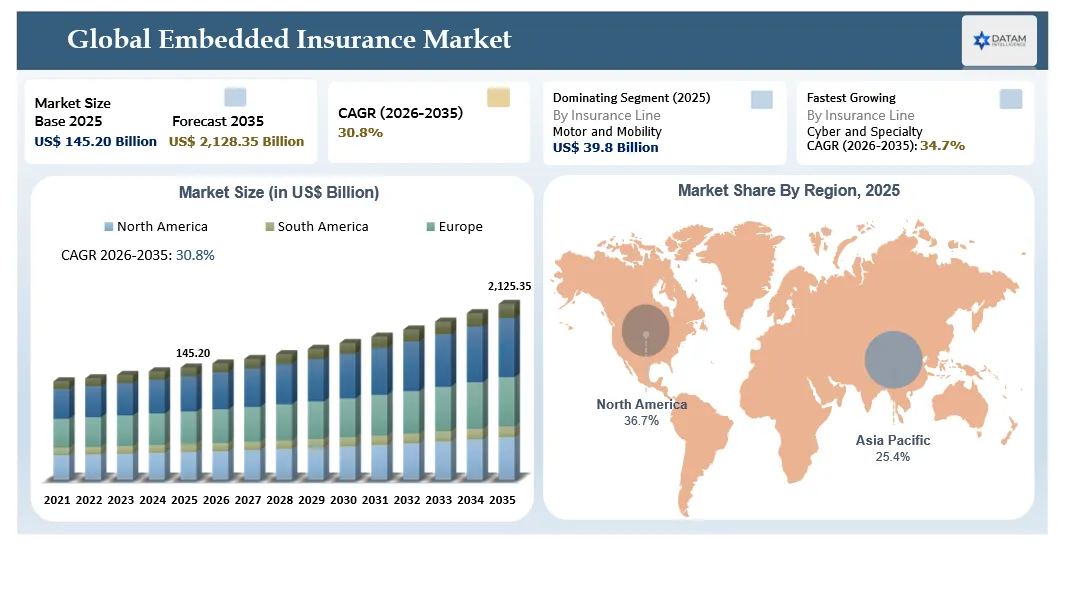
The commercial case is supported by platform economics. Embedded insurance can reduce customer acquisition friction because the product is offered within an existing transaction. BCG reported in 2025 that embedded insurance can generate higher attachment rates and margins than traditional distribution when the technology stack supports dynamic product configuration, real-time monitoring and streamlined policy and claims operations. Online and API-first placements represented more than three quarters of the market in one 2025 industry estimate, illustrating the importance of digital integration rather than standalone insurance websites.
Funding and partnerships show that the market is entering a scale phase. bolttech closed a US$147 million Series C round in June 2025 at a US$2.1 billion valuation and entered a strategic partnership with Sumitomo Corporation to develop embedded programmes in Asia. Qover secured US$12 million of growth funding in March 2026, taking total funding above US$100 million. Qover reported 15 million people protected across more than 32 countries and over US$173 million in gross written premium during the prior four years. These figures show that investors are prioritising platforms capable of coordinating several insurers, products and jurisdictions.
| Metric | Details |
| 2025 Market Size | US$145.20 Billion |
| 2035 Projected Market Size | US$2,128.35 Billion |
| CAGR, 2026-2035 | 30.8% |
| Largest Region | North America |
| Fastest Growing Region | Asia-Pacific |
| Largest Insurance Line | Motor, device and travel protection |
| Fastest Growing Opportunities | SME, EV, fintech, gig-worker and parametric protection |
| Core Technology | API orchestration, product engines, AI underwriting and claims automation |
Embedded Insurance Market Key Takeaways
- The market is estimated at US$145.20 billion in 2025 and is projected to reach US$2,128.35 billion by 2035, supported by digital commerce, platform distribution and API-based insurance infrastructure.
- North America is the largest market because digital commerce, fintech, travel, mobility and insurer technology ecosystems are mature. Asia-Pacific is expected to grow fastest as mobile-first platforms and financial inclusion programmes expand.
- Motor, device and travel products remain the largest embedded categories because protection can be offered at a clear transaction point with understandable coverage and measurable asset value.
- Insurance orchestration platforms are gaining importance because partners want access to several carriers, products and markets without building separate integrations for each programme.
- bolttech closed a US$147 million Series C in 2025 at a US$2.1 billion valuation, indicating investor confidence in global embedded insurance infrastructure.
- Qover reported 15 million people protected in more than 32 countries and more than US$173 million in gross written premium over four years, demonstrating the scale that multi-country platforms can achieve.
- ING selected bolttech in 2026 to support insurance and protection programmes across several European markets, while ING also launched as an MGA with Qover as technology partner for 800,000 customers.
- BYD selected bolttech as its preferred embedded insurance partner across five major European markets in 2026, supporting EV insurance during vehicle purchase and financing.
- Weecover raised EUR4.2 million in 2025 to expand its Insurance-as-a-Service platform and international presence.
- The main commercial risk is poor product relevance. Low attachment, unclear consent, weak claims service or excessive exclusions can damage both insurer economics and the partner brand.
Why does this report matter in 2026?
Embedded insurance is becoming a strategic distribution decision for banks, e-commerce companies, automotive OEMs, airlines, telecom providers and digital platforms. Partners are no longer evaluating only whether an insurance add-on can create commission income. They are assessing whether protection can improve conversion, retention, financing approval, subscription value and customer trust without increasing complaints or regulatory exposure. This report converts the market into practical decision layers covering product selection, carrier capacity, integration model, attachment economics, claims ownership, data access and country-level licensing.
Embedded Insurance Market White Space and Investment Opportunities
- Insurance orchestration platforms that connect several carriers and products through one integration for multi-country partners.
- EV protection covering battery, charging equipment, roadside assistance, finance gap, tyre and connected-device risks.
- SME protection embedded within accounting, payroll, payments, commerce and vertical SaaS platforms.
- Travel disruption, baggage and cancellation products linked to live itinerary and operational data.
- Gig-worker income, accident and equipment protection integrated into work platforms and digital wallets.
- Parametric products using weather, mobility, shipment and event data for automated claims triggers.
- Claims-as-a-service infrastructure that protects partner reputation through fast digital settlement and transparent communication.
Embedded Insurance Future Market Transformation
The market will shift from static add-on products toward continuously optimised protection. Product engines will use transaction context, customer consent, asset characteristics and partner data to configure coverage within approved regulatory boundaries. The winning model will combine an insurer balance sheet, an MGA or broker structure, orchestration technology and a partner-controlled customer journey. Claims will become a central competitive factor because the non-insurance brand is often the first point of customer contact. Platforms that can deliver consistent service across insurers and countries will gain share.
Embedded Insurance Market Buyer Decision-Making Criteria
Partner buyers evaluate embedded insurance providers on product relevance, expected attachment, commission economics, integration effort, regulatory accountability, data ownership, customer consent, carrier strength, claims experience and geographic scalability. Automotive OEMs prioritise coverage that fits finance and vehicle ownership. Travel platforms focus on itinerary-linked protection and claims speed. Banks and fintechs require strong compliance, payment integration and multi-product flexibility. Retail and device partners need simple terms, repair networks and low-friction claims. The purchasing decision increasingly favours providers that can demonstrate programme-level data and optimise conversion without creating conduct risk.
Embedded Insurance Market Economic and Investment Analysis
Investment is moving toward technology platforms that can coordinate insurers, products and distribution partners across markets. bolttech’s US$147 million Series C and US$2.1 billion valuation in 2025, Qover’s US$12 million growth facility in 2026 and Weecover’s EUR4.2 million round in 2025 illustrate continued capital interest. Strategic investors are important because embedded insurance requires distribution access as well as software. Sumitomo Corporation’s investment in bolttech was linked to a joint venture for Asian programmes, showing how funding can accelerate market entry and partner origination. Attractive targets have reusable product infrastructure, licensed distribution capability, strong carrier relationships, claims operations and evidence of recurring programme revenue.
Embedded Insurance Investment Trends in the Market
- Funding for global orchestration platforms with insurer networks and multi-country capabilities.
- Strategic investments linked to distribution partnerships, as seen in Sumitomo Corporation’s participation in bolttech.
- Expansion of MGA structures that give banks and platforms greater control over customer experience.
- Investment in AI-based product recommendation, underwriting, fraud detection and claims triage.
- Acquisition of regional digital platforms to add licences, partners and local servicing capability.
- Growth of parametric and event-data infrastructure for travel, logistics and climate-linked products.
Strategic Indicators for Embedded Insurance Market
| Indicator | Evidence | Strategic Interpretation |
| High Investment Activity | bolttech raised US$147 million in 2025, Qover added US$12 million in 2026 | Capital is concentrating around scalable orchestration and multi-country execution |
| Platform Expansion | Qover protects 15 million people across 32+ countries | Distribution scale increasingly depends on reusable infrastructure |
| Bank Adoption | ING selected bolttech across several European markets and became an MGA with Qover technology | Banks are moving from referral models toward controlled embedded insurance operations |
| Mobility Adoption | BYD selected bolttech for five European markets | Vehicle purchase and finance are becoming key insurance distribution moments |
| Regulatory Pressure | Partners must manage consent, suitability, disclosures and claims responsibility | Compliance architecture is a core product feature |
| AI Adoption | Platforms are applying AI to product matching, underwriting and claims triage | AI can improve economics but requires explainability and governance |
AI Impact Analysis of Embedded Insurance Market
AI can improve embedded insurance by identifying relevant products, predicting attachment, supporting underwriting, detecting fraud and triaging claims. Real-time experimentation can help partners optimise placement and wording, while conversational interfaces can explain coverage during a transaction. AI also creates governance risks. Product recommendations must remain fair, explainable and compliant with consent requirements. Data collected by a retail, mobility or financial platform may not automatically be appropriate for insurance pricing. The strongest providers will combine AI with product governance, audit trails and human review for complex claims or adverse decisions.
Disruption Analysis of Embedded Insurance Market
Embedded insurance is disrupting traditional distribution by moving the insurance decision into the customer’s primary transaction. It separates product origination from the insurer brand and increases the role of orchestration platforms, MGAs and partner ecosystems. Banks are moving into MGA models, OEMs are influencing insurance design and travel companies are treating protection as a strategic ancillary. The disruption also shifts competition from policy price toward integration speed, data quality, attachment optimisation and claims experience. Traditional insurers that cannot support reusable APIs and partner-controlled journeys may lose access to high-growth channels.
Embedded Insurance Market BCG Matrix: Company Evaluation
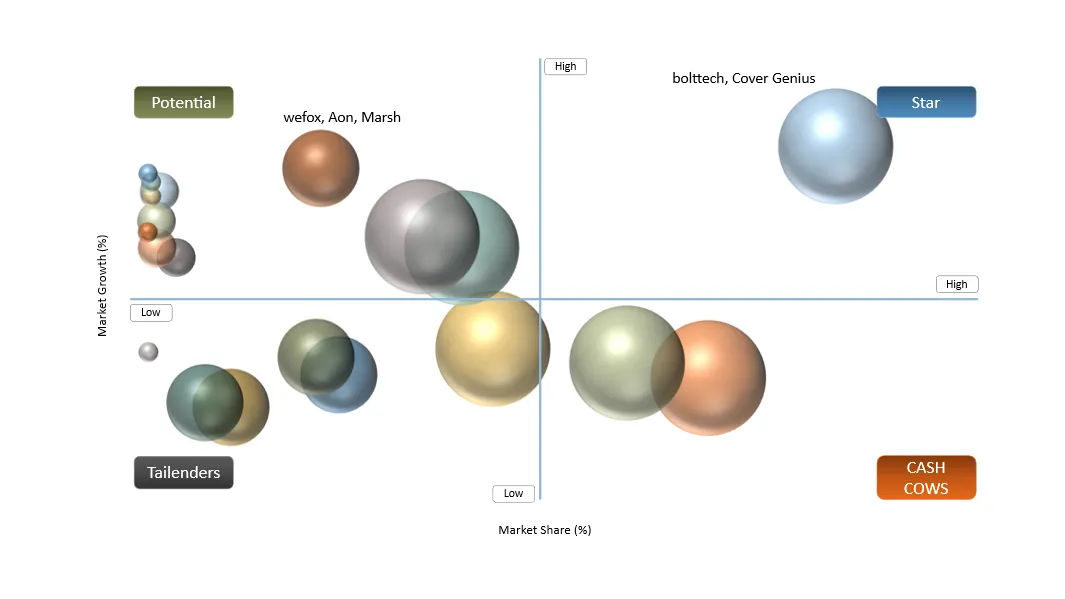
STAR
Companies like bolttech, Cover Genius, Qover, Chubb, AXA Partners, Allianz Partners, Munich Re, Swiss Re, Assurant and Zurich Insurance dominate the Embedded Insurance Market by virtue of their sophisticated embedded insurance solutions, comprehensive global partnerships and varied products including travel insurance, mobility insurance, device insurance, health insurance and financial services. Such companies have an edge because of their advanced APIs for integrations, expertise in underwriting and partnerships with banks, fintechs, e-commerce portals and mobility companies.
POTENTIAL
Companies like wefox, Aon, Marsh, AIG, Sompo, Tokio Marine, weecover, Boost Insurance, InsureMO and ELEMENT Insurance are looking to expand into the Embedded Insurance Market through initiatives like digitized insurance distribution channels, white label insurance services and technological insurance infrastructure. With their emphasis on flexible integration models, specialty insurance products and collaborations with digital platforms, these players are likely to take advantage of the increasing demand for embedded insurance solutions.
Embedded Insurance Market Dynamics
Driver Impact Analysis
| Driver | Market Growth Impact | Demand Concentration | Impacted Use Case | Strategic Impact |
Growth of digital commerce and platform ecosystems | 30% | Global, strongest in North America and Asia-Pacific | E-commerce, fintech, travel, mobility | Creates transaction points where protection can be offered with low acquisition friction |
Insurer demand for lower-cost distribution | 24% | Europe, North America, Asia-Pacific | Banks, retailers, SaaS platforms | Shifts acquisition spending toward partner-led channels and API infrastructure |
Expansion of mobility, travel and device financing | 19% | Europe, U.S., China, India, Southeast Asia | EV, travel, device protection | Links coverage to financed assets and recurring customer relationships |
API and orchestration maturity | 16% | Global | Multi-carrier, multi-country programmes | Shortens product launch and supports scalable programme management |
Financial inclusion and micro-protection | 11% | India, Africa, Latin America, Southeast Asia | Gig, health, credit and income protection | Expands low-ticket insurance through mobile and platform channels |
Driver: Growth of Digital Ecosystems and Contextual Distribution
Digital ecosystems are creating large, repeatable transaction flows where insurance can be offered at a relevant decision point. Travel cover can be linked to a booking, device protection to financing, motor insurance to vehicle purchase and SME cover to a payroll or payments platform. Qover’s expansion to 15 million protected people across more than 32 countries and bolttech’s partnerships with ING, BYD, AXA Partners, LOOP and Kyobo Lifeplanet show that distribution partners increasingly prefer infrastructure that can support several products and markets. The growth driver is stronger where the partner controls high-frequency transactions, has permissioned customer data and can explain the product clearly. This creates investment demand for APIs, product engines, consent management, premium collection, claims integration and programme analytics.
Driver: Insurer Demand for Lower-Cost, Data-Rich Acquisition
Insurers face high acquisition costs in traditional direct and intermediary channels. Embedded distribution can place protection inside an existing customer relationship, reducing the need to acquire the customer from the open market. It can also provide contextual data about the asset, transaction and service environment. BCG noted in 2025 that successful embedded insurance requires flexible product engines, real-time analytics and scalable infrastructure across underwriting, policy and claims. Insurers that use partner data responsibly can improve product relevance and monitor attachment, loss ratio and customer behaviour at programme level. The opportunity is strongest for products with simple triggers and clear value. Complex policies still require advice, making hybrid digital and human models important.
Restraint Impact Analysis
| Restraint | Drag on Growth | Primary Impact Area | Impacted Use Case | Strategic Impact |
Regulatory and conduct risk | 22% | Distribution and product design | Opt-out bundles, credit and health products | Increases approval, disclosure and monitoring requirements |
Weak attachment and adverse selection | 19% | Programme economics | Optional checkout products | Can make partner programmes unprofitable without product optimisation |
Claims friction and partner-brand exposure | 17% | Customer experience | Travel, device, motor and logistics | Poor claims service can damage the non-insurance partner |
| Multi-country complexity | 15% | Expansion | Cross-border platforms | Requires local licences, carriers, wording and tax handling |
| Data privacy and ownership constraints | 12% | Technology and underwriting | AI pricing and personalisation | Limits data sharing and raises governance cost |
Restraint: Regulatory Accountability, Consent and Conduct Risk
Embedded insurance can create conduct risk when coverage is presented too late, consent is unclear, exclusions are difficult to understand or the customer believes the non-insurance partner is the insurer. Regulators may scrutinise opt-out models, bundled credit products, cancellation rights, product value and claims handling. Multi-country programmes add complexity because distribution permissions, premium taxes, product filings and disclosure rules differ. The practical restraint is that a technically simple API integration can still require extensive legal, compliance and operational work. Providers need product governance, suitability controls, consent evidence, complaint monitoring and clear allocation of responsibility between partner, intermediary and carrier.
Restraint: Weak Attachment, Claims Friction and Partner-Reputation Exposure
The partner economics depend on attachment and persistency. A product with weak relevance, poor timing or excessive price can generate low conversion, while broad automatic inclusion may raise complaints. Claims are equally important because customers often associate the experience with the partner brand. Travel, device and motor programmes require fast decisions, clear status updates and access to repair or assistance networks. If the insurer or administrator performs poorly, the retailer, bank or OEM may lose trust. This restraint creates opportunity for claims orchestration, service-level guarantees and programme analytics that identify where product design or servicing is damaging conversion and retention.
Embedded Insurance Market Segment Analysis
By Insurance Line: Motor, Device and Travel Protection Lead Adoption
Motor, device and travel protection are the largest categories because they are linked to identifiable transactions and assets. Motor insurance is increasingly embedded into vehicle purchase, leasing and finance. BYD selected bolttech in 2026 for the UK, Italy, France, Germany and Spain, showing how OEMs can integrate tailored EV cover across online and dealership journeys. Device protection is supported by smartphone financing, telecom distribution and repair ecosystems. Travel protection benefits from booking data and high customer awareness. Turkish Airlines renewed its multi-year Cover Genius partnership in 2026 and planned expansion into Australia and Latin America. Health, life and income products are expected to grow as fintech and employment platforms improve consent, underwriting and servicing.
By Integration Model: Point-of-Sale Add-Ons Remain the Largest Model
Point-of-sale opt-in products remain the largest integration model because they provide clear customer choice and can be implemented without changing the underlying core product. Included and subscription-based protection is growing where insurance strengthens a premium account, membership or financing package. Event-triggered and usage-based models are emerging in mobility, logistics and travel because connected data can determine exposure or claims. The commercial difference is important. Optional add-ons depend on conversion, while included products depend on platform-wide pricing and loss assumptions. Providers need separate analytics for attachment, cancellation, claim frequency and customer value.
By Distribution Ecosystem: Banks, Fintechs and Mobility Platforms Create High-Value Programmes
Banks and fintechs have large authenticated customer bases, payment relationships and recurring engagement. ING’s 2026 selection of bolttech across the Netherlands, Italy, Poland and Belgium shows the scale of bank-led distribution. ING also launched as an MGA with Qover technology for 800,000 customers, allowing the bank to accept applications, handle claims and collect premiums. Automotive OEMs are another high-value channel because insurance can be integrated with financing, warranty, servicing and connected-vehicle data. E-commerce and telecom remain strong for device and purchase protection, while travel platforms use protection as ancillary revenue and service recovery.
By End-Use Industry: Automotive and Mobility Are Becoming Strategic
Automotive and mobility embedded insurance is moving beyond conventional motor cover. EV owners may need battery, charger, roadside, tyre, gap and connected-device protection. Manufacturers can use insurance to improve financing conversion and support ownership packages. bolttech’s BYD partnership covers five European markets, while its Harmony Auto partnership in Indonesia supports BYD EV owners through distribution channels. Mobility platforms can also offer short-duration, usage-based or driver protection. The strongest suppliers will combine insurer capacity, telematics, repair networks and dealer integration.
By Customer Type: SMEs and Gig Workers Represent Major White Space
Consumers account for most existing programmes, but SMEs and gig workers represent a large underpenetrated opportunity. Accounting, payroll, e-commerce, payments and vertical SaaS platforms can distribute liability, cyber, equipment, income and accident protection. These customers often do not purchase standalone coverage because products are complex or distribution costs are high. Embedded models can use existing business data and payment flows to simplify enrolment. The main requirement is product clarity and claims support because small customers have limited risk-management resources.
By Technology Layer: API Orchestration Is the Core Enabler
API and orchestration platforms are the central technology layer because they connect partners with carriers, products, policy administration, payments and claims. Qover’s platform supports major brands across more than 32 countries, while bolttech positions itself as a global embedded protection platform. Product configuration and rating engines are becoming more important as programmes need country-specific wording and pricing. AI can support product recommendation, underwriting and claims triage, but deployment must be governed to avoid unfair outcomes. Providers that offer reusable integrations and real-time programme analytics can reduce launch cost and improve partner economics.
By Business Model: Insurance-as-a-Service and MGA Models Are Expanding
Insurance-as-a-Service allows a non-insurance partner to access product, technology and operational support through one provider. MGA models provide greater control over underwriting, product and claims while relying on carrier capacity. ING’s MGA launch with Qover technology illustrates how a distribution brand can move deeper into the insurance value chain. Revenue-share and commission models remain common, but subscription and platform fees are growing for enterprise orchestration. The most defensible models combine recurring technology revenue with programme-level premium economics and strong carrier relationships.
Embedded Insurance Market Geographical Penetration
North America Embedded Insurance Market Outlook
North America leads because the U.S. has mature e-commerce, fintech, travel and automotive ecosystems, along with substantial insurer and venture capital capacity. The region is attractive for SME platforms, device protection, travel, gig-worker benefits and embedded commercial insurance. Canada supports bank, travel and mobility programmes. Mexico provides growth through fintech, automotive and cross-border commerce. Buyers focus on conversion, claims experience, data privacy and state-level insurance compliance.
Europe Embedded Insurance Market Outlook
Europe is a major market for bank, mobility, travel and retail programmes. ING’s partnerships with bolttech and Qover, BYD’s five-market bolttech programme, Helvetia’s multi-product partnership with Qover and AXA Partners’ collaboration with bolttech show that multi-country orchestration is becoming a strategic requirement. European buyers place strong emphasis on consent, value, privacy and claims governance. Providers with local carrier relationships and reusable compliance infrastructure have an advantage.
Asia-Pacific Embedded Insurance Market Outlook
Asia-Pacific is the fastest growing region because of mobile-first banking, digital wallets, e-commerce, EV sales and device financing. bolttech and Sumitomo Corporation formed a strategic partnership and joint venture for Asian programmes in 2025. bolttech also partnered with Kyobo Lifeplanet in Korea and Harmony Auto in Indonesia. India offers opportunities through fintech, e-commerce, travel and affordable protection. Southeast Asia supports device, mobility and financial inclusion programmes.
South America Embedded Insurance Market Outlook
South America is developing through digital banks, e-commerce, travel and mobility platforms. Brazil is the largest opportunity, supported by fintech adoption and digital insurance distribution. Argentina offers smaller but growing opportunities in travel, device and payment protection. Cross-border providers need local carrier capacity, tax handling and claims operations. Products with clear value and simple digital enrolment are best positioned.
Middle East and Africa Embedded Insurance Market Outlook
The Middle East offers opportunities in travel, aviation, banking, mobility and luxury device protection. UAE and Saudi Arabia are priority markets because of digital finance and tourism growth. Africa is attractive for mobile banking, telecom, device and micro-protection. bolttech entered Kenya through LOOP in 2025 and acquired mTek later that year, strengthening its East African presence. Distribution partnerships can improve insurance access, but affordability, claims networks and regulatory fragmentation remain important constraints.
| Region | 2025 Share | Market Position | Primary Opportunity |
| North America | 36.7% | Largest | E-commerce, fintech, mobility, travel and SME platforms |
| Europe | 28.1% | Mature and regulation-led | Bank, automotive, travel and multi-country orchestration |
| Asia-Pacific | 25.4% | Fastest growing | Mobile commerce, financial inclusion, EV and device protection |
| South America | 5.3% | Emerging | Fintech, travel, device and gig-worker protection |
| Middle East and Africa | 4.5% | Early-stage growth | Mobile banking, telecom, travel and micro-protection |
Embedded Insurance Market Competitive Landscape
- Global insurtech platforms compete through carrier networks, technology integration, country coverage and programme operations.
- Insurers and assistance companies compete through underwriting capacity, brand strength, claims networks and regulatory permissions.
- MGAs are gaining importance because they can design products and manage programmes while using third-party capital.
- Banks, OEMs and large platforms increasingly seek multi-product, multi-country arrangements instead of single-policy integrations.
- Claims experience is becoming a differentiator because poor service can damage the distribution partner’s core brand.
- Strategic partnerships and acquisitions are being used to enter new regions and add licences or servicing capability.
Key Companies of Embedded Insurance Market
- bolttech
- Cover Genius
- Qover
- wefox
- Chubb
- AXA Partners
- Allianz Partners
- Aon
- Marsh
- Munich Re
- Swiss Re
- Assurant
- AIG
- Zurich Insurance
- Sompo
- Tokio Marine
- weecover
- Boost Insurance
- InsureMO
- ELEMENT Insurance
Embedded Insurance Market Recent Developments
- June 2026: ING selected bolttech as a strategic partner for embedded insurance and protection solutions across several European markets, with programmes already live in the Netherlands, Italy, Poland and Belgium.
- April 2026: ING launched as an MGA with Qover as technology partner, enabling the bank to accept applications, manage claims and collect premiums for approximately 800,000 customers.
- April 2026: BYD appointed bolttech as its preferred embedded insurance partner across the UK, Italy, France, Germany and Spain.
- March 2026: Qover secured a US$12 million growth capital extension, bringing total funding above US$100 million. The company reported 15 million people protected across more than 32 countries.
- May 2026: Turkish Airlines renewed its multi-year partnership with Cover Genius and planned to expand embedded travel protection into additional markets.
- December 2025: bolttech acquired Kenya-based mTek to expand digital insurance capability in East Africa.
- September 2025: AXA Partners and bolttech announced a strategic partnership covering the EU, UK and Switzerland across motor, home, travel, credit and lifestyle protection.
- June 2025: bolttech closed its Series C round at US$147 million and a US$2.1 billion valuation.
- January 2025: Weecover raised EUR4.2 million to accelerate international expansion of its Insurance-as-a-Service platform.
Embedded Insurance Market Major Pain Points
- Low attachment when the product is poorly timed, priced or explained.
- Regulatory uncertainty around consent, product value, opt-out design and distribution responsibility.
- Claims service failures that damage the partner brand.
- Complex carrier and licence requirements across countries.
- Limited interoperability between partner systems, policy platforms and claims administrators.
- Data-sharing constraints and uncertainty over customer ownership.
- Difficulty proving incremental customer value beyond commission income.
- Adverse selection where customers can predict losses better than the embedded programme.
Analyst View / Opinion on Embedded Insurance Market
- Embedded insurance will continue to shift insurance distribution toward banks, OEMs, travel companies, marketplaces and software platforms.
- The strongest providers will operate as orchestration layers rather than single-product distributors.
- Claims experience will determine whether partners renew and expand programmes.
- Asia-Pacific will generate the strongest expansion opportunities, while Europe will lead multi-country compliance and bank-led models.
- SME, EV, travel disruption, device lifecycle and gig-worker products offer attractive white-space opportunities.
- Long-term market leadership will depend on carrier access, reusable technology, regulatory execution and programme-level analytics.
Embedded Insurance Market Target Audience
| Industry | Who Should Buy This Report? | Reason to Buy This Report |
Insurers and Reinsurers | Distribution heads, product leaders, strategy teams | To identify partner channels, product gaps and platform requirements |
Insurtech and MGA Platforms | CEOs, product teams, investors | To benchmark business models, regional expansion and competitive positioning |
Banks and Fintechs | Insurance, partnerships and digital product teams | To design embedded protection and evaluate carrier or platform partners |
Automotive and Mobility | OEMs, leasing firms, mobility platforms | To assess EV, motor and usage-based insurance opportunities |
Travel and E-Commerce | Airlines, OTAs, retailers, marketplaces | To optimise ancillary revenue, attachment and claims experience |
| Telecom and Device Ecosystems | Operators, retailers, finance providers | To evaluate device, warranty and lifecycle protection |
| Investors and Consultants | Private equity, venture capital, strategy firms | To screen platforms, partnerships and high-growth segments |
Why Choose DATAM?
- Data-driven insights covering market size, partner economics, technology, regulation and programme design.
- Post-purchase analyst support for partner identification, market entry and product prioritisation.
- White papers and case studies covering mobility, travel, fintech, device and SME embedded insurance.
- Annual updates reflecting funding, regulation, carrier partnerships and platform expansion.
- Specialised coverage of emerging markets across Asia-Pacific, Latin America, Middle East and Africa.
- Buyer-focused analysis designed around attachment, integration, claims and commercial opportunity.
What DATAM Uniquely Provides
- Detailed 10-year forecasts by insurance line, integration model, distribution ecosystem, industry, customer type, technology layer, business model and region.
- Partner decision intelligence covering attachment, API integration, regulatory responsibility, claims experience and commercial economics.
- Competitive assessment of insurers, MGAs, orchestration platforms, brokers and assistance providers.
- Country-level recommendations for platform expansion and carrier partnerships.
- White-space analysis across SME, EV, gig-worker, travel disruption and parametric products.
- Strategic analysis covering AI, funding, acquisitions, disruption and go-to-market models.


























































