


Embedded Finance Market Size and Overview
The global Embedded Finance market reached an estimated US$ 100.2 billion in 2025 and is expected to reach approximately US$ 461.7 billion by 2035, representing a CAGR of about 16.5% during 2026-2035. The estimate reflects revenue generated by embedded payments, lending, banking, insurance and investment infrastructure rather than the gross value of transactions flowing through these products.
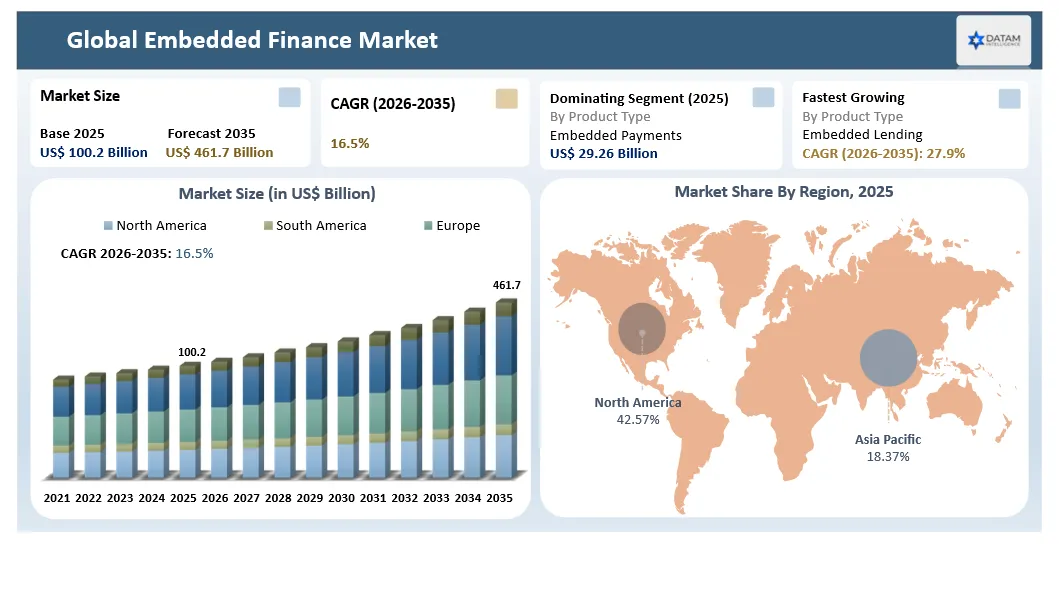
Growth is being driven by non-financial platforms seeking higher monetization and retention, banks opening regulated capabilities through APIs, and users expecting payments and financial services to be native to commerce, mobility and software workflows.
Embedded payments remain the largest product category, while embedded lending, banking/accounts and insurance are broadening the addressable market. Vertical SaaS and B2B marketplaces are especially attractive because financial services can be attached to workflows with high transaction intent and proprietary operating data.
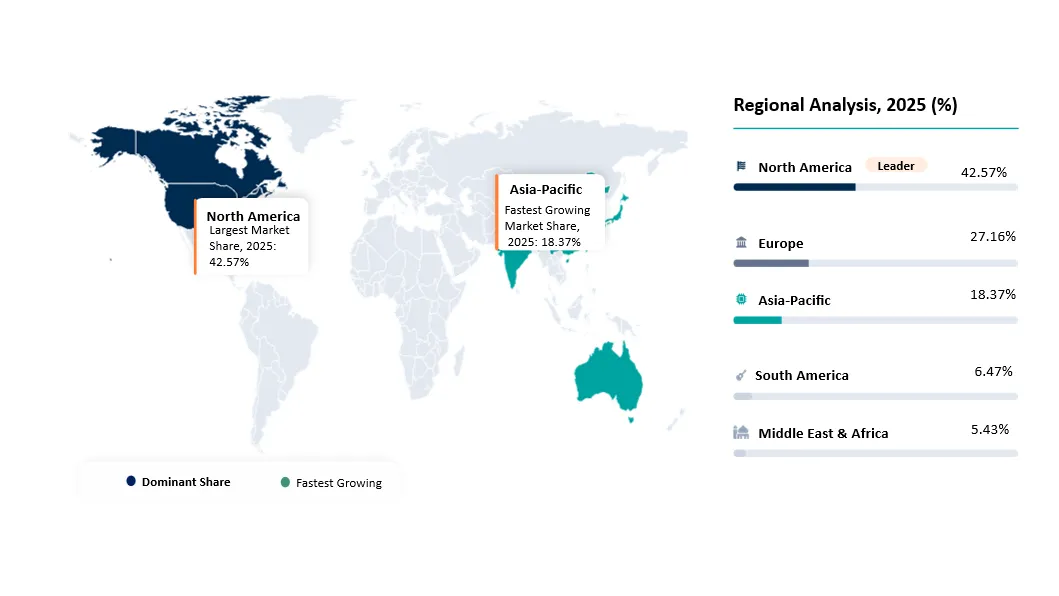
North America leads in platform monetization and fintech infrastructure, Europe benefits from open-banking and payments regulation, and Asia-Pacific is expected to post the fastest expansion through super-apps, digital wallets, marketplaces and SME platforms.
Embedded Finance Market Key Takeaways
- Embedded payments remain the gateway product, but platforms increasingly add cards, accounts, working-capital credit, insurance and treasury capabilities to deepen customer economics.
- API-first infrastructure is reducing time-to-market, although sponsor-bank relationships, licensing, safeguarding and compliance ownership remain critical design decisions.
- B2B and vertical SaaS are becoming major growth vectors as software platforms monetize payment flow, deposits, cards and credit inside operating workflows.
- Embedded lending benefits from first-party transaction data but remains sensitive to funding cost, credit quality and consumer-protection requirements.
- Financial institutions are shifting from closed product distribution toward partnership and infrastructure models that allow third-party platforms to originate or embed regulated services.
- Fraud, identity, reconciliation, ledger integrity and regulatory reporting are becoming essential platform-selection criteria alongside API quality and product breadth.
Embedded Finance Industry Trends and Strategic Insights
- The market is shifting from single embedded-payment capabilities toward modular financial operating systems combining accounts, cards, money movement, lending, fraud, compliance and treasury through unified APIs.
- Vertical platforms are using industry-specific data to underwrite merchants and SMEs, while marketplaces use embedded payouts, wallets and working capital to increase transaction velocity.
- Sponsor-bank concentration is encouraging providers to build multi-bank architectures, regional licensing strategies and stronger compliance controls.
- Real-time payments and account-to-account rails are diversifying monetization beyond card interchange and creating new orchestration requirements.
- AI is being applied to fraud, risk decisioning, customer support and product personalization, but regulated decisions require explainability, monitoring and human oversight.
Embedded Finance Market Scope
| Metrics | Details |
| 2025 Market Size | US$ 100.2 Billion |
| 2035 Projected Market Size | US$ 461.7 Billion |
| CAGR (2026-2035) | 16.5% |
| Largest Product Type | Embedded Payments |
| Fastest-Growing Product Areas | Embedded Lending, Banking & Insurance |
| Largest Region | North America |
| Fastest-Growing Region | Asia-Pacific |
| Key Growth Vector | Vertical SaaS and B2B platforms |
| Core Infrastructure | APIs, ledgers, issuing, KYC, payments & BaaS |
| Primary Buyers | Platforms, merchants, SaaS vendors & banks |
| Key Restraint | Regulatory and sponsor-bank complexity |
| Key Opportunity | Multi-product embedded financial ecosystems |
| Forecast Period | 2026-2035 |
| Base Year | 2025 |
Why does this report matter in 2026?
2026 is a key scaling year because embedded finance is moving from fintech experimentation into core monetization strategy for large software, retail and marketplace platforms. At the same time, regulators are scrutinizing bank-fintech partnerships, consumer disclosures, safeguarding, operational resilience and AI-based risk decisions.
The report helps stakeholders separate gross transaction-value narratives from monetizable infrastructure revenue and evaluate which product categories, industries, business models and regions can generate durable economics.
Embedded Finance Market White Space & Investment Opportunities
- Vertical SaaS platforms can embed payments, cards, accounts and working-capital products using workflow data that traditional banks often do not possess.
- B2B marketplaces offer white space in supplier finance, invoice payments, virtual cards, treasury and cross-border settlement.
- Embedded insurance remains underpenetrated outside travel and mobility, creating opportunities in e-commerce, devices, healthcare and SME software.
- Multi-bank orchestration, compliance automation and ledger infrastructure can reduce sponsor concentration and operational risk.
- Cross-border embedded accounts and payouts are attractive for marketplaces, creator platforms and global contractor ecosystems.
Embedded Finance Future Market Transformation
Embedded finance will evolve toward composable financial infrastructure in which regulated capabilities are called as software functions inside commerce and business workflows. Platforms will choose modular providers for identity, accounts, cards, payments, credit, treasury and insurance while maintaining one branded customer experience.
The strategic contest will shift from access to basic APIs toward orchestration, data advantage, economics, compliance portability and multi-country execution.
Embedded Finance Market Buyer Decision-Making Criteria
Buyers prioritize regulatory coverage, sponsor-bank quality, API reliability, product breadth, settlement and reconciliation, ledger accuracy, fraud controls, implementation speed, pricing transparency, data ownership, uptime, geographic coverage and exit portability.
Large platforms increasingly require multi-provider redundancy and the ability to migrate programs without rebuilding the entire customer journey.
Investment economics vary sharply by business model. Software platforms can generate recurring subscription and transaction revenue with limited credit exposure, while direct providers earn spread and fee income but require funding capacity, loss reserves and risk capital. Marketplace and partner-funded models sit between these structures by monetizing origination and account servicing while transferring part of the credit risk to banks or institutional investors.
Interest rates influence customer demand, affordability and funding costs, while unemployment and delinquency trends determine loss performance. Investors should therefore assess origination growth together with contribution margin, funding mix, credit vintage performance, funding execution, customer acquisition cost and repeat borrowing. Strong platforms are increasingly valued for data-network effects and product expansion rather than raw financial product volume alone.
Embedded Finance Investment Trends in the Market
- Investment is concentrating in infrastructure that can support multiple financial products from a single integration.
- Payments companies are expanding into issuing, accounts, lending and treasury to increase wallet share.
- Banks are investing in partner APIs and embedded distribution as a channel for deposits and fee revenue.
- Consolidation is occurring around banking-as-a-service, card issuance, ledgering and payment orchestration as buyers prefer fewer integration points.
- AI-driven fraud and risk tooling is receiving capital because instant embedded experiences increase exposure to synthetic identity and account-takeover attacks.
Strategic Indicators For Embedded Finance Market
High Regulation Impact
Embedded finance is heavily influenced by payments, banking, lending, insurance and data rules, as well as sponsor-bank oversight. Regulation can accelerate trust and standardization but also raises compliance cost, constrains partner models and increases the need for clear allocation of responsibilities.
High Investment Activity
AI credit models, lending-as-a-service, fraud technology, embedded finance and digital account servicing continue to attract strategic and venture capital because institutions are still replacing manual and legacy credit workflows.
Funding & Capital Market Sensitivity
Warehouse lines, deposits, fundings, whole-financial product buyers and private-credit partnerships determine how quickly digital providers can scale. Funding diversification is a key resilience metric.
Pricing Volatility
Borrower APRs and platform economics move with benchmark rates, credit spreads, acquisition costs and expected losses. Risk-based pricing must adjust quickly without weakening conversion.
Procurement Pressure
Banks demand measurable ROI, strong cybersecurity, regulatory support, explainable models and integration compatibility. Long sales cycles favor vendors with proven bank references and implementation partners.
New Integration Technology Adoption
Generative AI, cash-flow risk decisioning, open banking, biometrics, synthetic-identity detection and real-time decision engines are redefining embedded finance architecture.
Regional Expansion Opportunity
India, Southeast Asia, Latin America and parts of Africa offer strong long-term opportunity because digital identity, instant payments and mobile distribution can bypass legacy branch infrastructure.
Government Policy Support
Digital identity, open banking, instant-payment systems and financial-inclusion policy can materially accelerate embedded-finance adoption when paired with customer-protection frameworks.
Pricing Intelligence
Platform pricing increasingly combines subscriptions, per-application or per-funded-financial product fees, usage-based API charges and performance-linked arrangements. Direct providers optimize APR, fee and funding economics by risk tier.
AI Impact Analysis of Embedded Finance Market
AI improves applicant ranking, income estimation, fraud detection, pricing, financial operations prioritization and customer-service automation. The strongest near-term value comes from combining financial data with transaction and cash-flow signals to improve approval rates at a given loss target. Generative AI can automate document review and banker workflows, but core credit decisions still require controlled, testable and explainable governance frameworks.
Disruption Analysis of Embedded Finance Market
The market is being disrupted by embedded credit, bank-fintech partnerships, open banking and AI-based decisioning. These forces reduce the importance of branch distribution and place greater value on data access, API integration and real-time funding. At the same time, regulatory intervention is forcing the market away from opaque or aggressive growth models and toward transparent pricing, auditable risk decisioning and stronger customer-protection processes.
Embedded Finance Market BCG Matrix: Company Evaluation
STAR
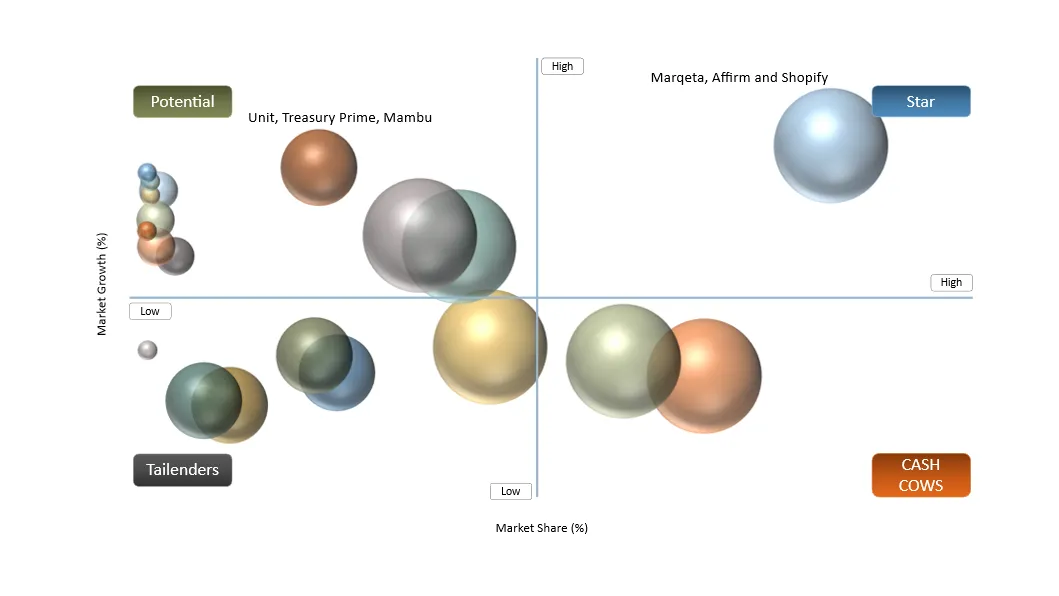
Marqeta, Affirm and Shopify represent high-growth embedded-finance models across infrastructure, credit and commerce distribution. Their strategic advantage depends on API adoption, product attach, partner economics and the ability to expand from a core financial service into broader customer workflows.
POTENTIAL
Unit, Treasury Prime, Mambu, Solaris and other modular infrastructure providers represent potential high-growth enablers. Their opportunity is driven by demand for composable banking, issuing, payments and ledger stacks, although enterprise sales cycles, sponsor-bank requirements and regulatory obligations remain meaningful.
Embedded Finance Market Dynamics
Driver Impact Analysis
| Driver | Market Growth Impact | Demand Concentration | Impacted Use Case | Strategic Impact |
| Platform monetization and retention | 33% | North America, Europe, APAC | Payments, cards, accounts | Adds high-frequency revenue streams inside existing user journeys |
| API-first financial infrastructure | 27% | Global digital platforms | BaaS, issuing, payments | Shortens launch cycles and reduces need to build regulated infrastructure |
| Vertical SaaS and B2B finance | 23% | SME-heavy economies | Payments, working capital, treasury | Uses workflow data and captive distribution to improve economics |
| Open banking and real-time payments | 17% | Europe, India, Brazil | A2A payments, risk decisioning | Improves connectivity, lowers friction and diversifies payment rails |
Driver: AI-Based Underwriting and Automation
AI-based business models can evaluate more variables and automate a larger portion of applications than traditional manual or scorecard workflows. This can reduce decision time from days to minutes and help providers serve customers who lack long conventional credit histories. The commercial value is strongest when higher approval rates are achieved without deterioration in loss performance.
Restraint Impact Analysis
| Restraint | Drag on Market Growth | Primary Impact Area | Impacted Use Case | Strategic Impact |
| Regulatory and sponsor-bank complexity | 32% | BaaS and account programs | Banking, cards, lending | Raises compliance cost and partner concentration risk |
| Fraud, AML and identity risk | 26% | Instant digital journeys | Onboarding and payments | Requires stronger identity, behavioral and transaction monitoring |
| Credit and funding volatility | 23% | Embedded lending | Consumer and SME credit | Can reduce approval appetite and platform economics during stressed cycles |
| Cross-border licensing and data rules | 19% | International platforms | Accounts, insurance, payments | Slows geographic rollout and increases localization requirements |
Restraint: Funding, Regulation and Credit-Cycle Risk
Embedded-finance growth can slow when payment economics compress, sponsor banks tighten risk appetite or embedded-credit losses rise. Providers therefore need diversified regulated partners, strong unit economics and robust monitoring. Scaling also depends on meeting consumer-protection, safeguarding, AML/KYC and operational-resilience expectations.
Embedded Finance Market Segment Analysis
The global Embedded Finance market is segmented based on Component, Deployment Model, Product Type, Business Model, Integration Technology, Enterprise Size, end-use industry, integration model, and region.
By Component
Solutions Will Retain the Largest Share
Software platforms lead because providers require financial-product orchestration, decisioning, identity, document, account servicing and analytics capabilities that can be integrated into existing bank stacks. Services remain important for implementation, model validation, integration and managed operations, particularly among regional banks and platforms.
By Deployment Model
Cloud-Based Lending Platforms Will Record the Fastest Growth
Cloud deployment supports faster releases, elastic capacity and API connectivity. Regulated institutions increasingly use hybrid architectures that keep sensitive systems controlled while moving decisioning, customer experience and analytics into cloud environments.
By Product Type
Personal and SME Lending Remain the Core Digital Use Cases
Personal financial products remain a major digital volume pool because applications can be highly automated. SME lending is growing quickly as bank-account and payment data make cash-flow risk decisioning more practical for smaller businesses that lack extensive financial statements.
By Business Model
Embedded Lending Will Gain Share
Embedded lending integrates financing into commerce, software and banking journeys, reducing acquisition friction. Balance-sheet providers retain economics and control but face capital intensity, while marketplace models can scale faster when institutional funding is available.
By Integration Technology
AI & Machine Learning Underwriting Will Lead Growth
AI-based risk models are the highest-growth technology layer because they can combine bureau, transaction, income and behavioral data. Adoption depends on explainability, stability across cycles and strong model-risk governance.
By Enterprise Size
Consumers Lead, While Small Businesses Offer High Growth
Consumers account for the largest embedded-finance volumes, but micro and small businesses are strategically attractive because digital data can lower risk decisioning cost for customers historically underserved by traditional bank processes.
By End Use Industry
Banks Are Becoming the Largest Integration Technology Buyers
Fintech providers drove early innovation, but banks are increasingly the largest buyers of embedded finance infrastructure because they combine low-cost deposits, regulatory licenses and large customer bases with a need to modernize legacy workflows.
By Integration Model
Embedded and Partner Channels Will Outgrow Direct Acquisition
Direct digital channels remain important, but customer-acquisition costs encourage providers to originate through merchants, banks, payroll providers, affiliates and vertical software platforms where customer intent is already established.
Embedded Finance Market Geographical Penetration
U.S. Embedded Finance Market Landscape
The U.S. leads through large digital-commerce platforms, deep card economics, mature fintech infrastructure, sponsor-bank networks and strong merchant demand for integrated payments, cards and working capital. Oversight of bank-fintech partnerships is increasing, which favors providers with robust compliance and multi-bank structures.
India Embedded Finance Market Outlook
India is a high-growth market supported by UPI, Aadhaar, Account Aggregator infrastructure, digital commerce and SME digitization. Embedded payments are highly mature, while platform credit, merchant finance and insurance are expanding with stronger regulatory expectations around digital lending and data consent.
UK Embedded Finance Market Trends
The UK benefits from mature open banking, payment innovation and a dense fintech ecosystem. Embedded payments, SME finance and banking-as-a-service are well developed, while FCA expectations on consumer duty, safeguarding and operational resilience influence platform design.
China Embedded Finance Market Outlook
China has a large embedded-finance base built around super-apps, e-commerce and digital payments. Growth is increasingly shaped by platform regulation, bank partnerships and tighter controls over consumer credit and data use.
Brazil Embedded Finance Market Outlook
Brazil combines PIX, digital banks, e-commerce and large merchant ecosystems. Embedded accounts, payments and credit are expanding rapidly as retailers, marketplaces and software platforms integrate finance into customer and merchant journeys.
Middle East and Africa Embedded Finance Market Outlook
Gulf markets are investing in digital banking, e-commerce, wallets and fintech infrastructure, while African markets use mobile money and platform finance to reach underserved consumers and SMEs. Regulatory maturity and access to licensed partners vary widely by country.
Embedded Finance Market Competitive Landscape
- Competition spans payments processors, card-issuing platforms, banking-as-a-service providers, digital banks, lending networks and global payment companies.
- Stripe, Adyen, Fiserv, Marqeta, PayPal and Block compete with broad payment and merchant ecosystems, while Unit, Treasury Prime, Solaris and Mambu focus on modular banking or ledger infrastructure.
- Affirm and other credit providers extend embedded finance into merchant-native lending and pay-over-time products, while Shopify demonstrates how a vertical commerce platform can embed payments and capital directly into merchant workflows.
- Differentiation increasingly depends on regulated partner networks, global coverage, API quality, reliability, product breadth, fraud performance and ability to support multiple monetization models.
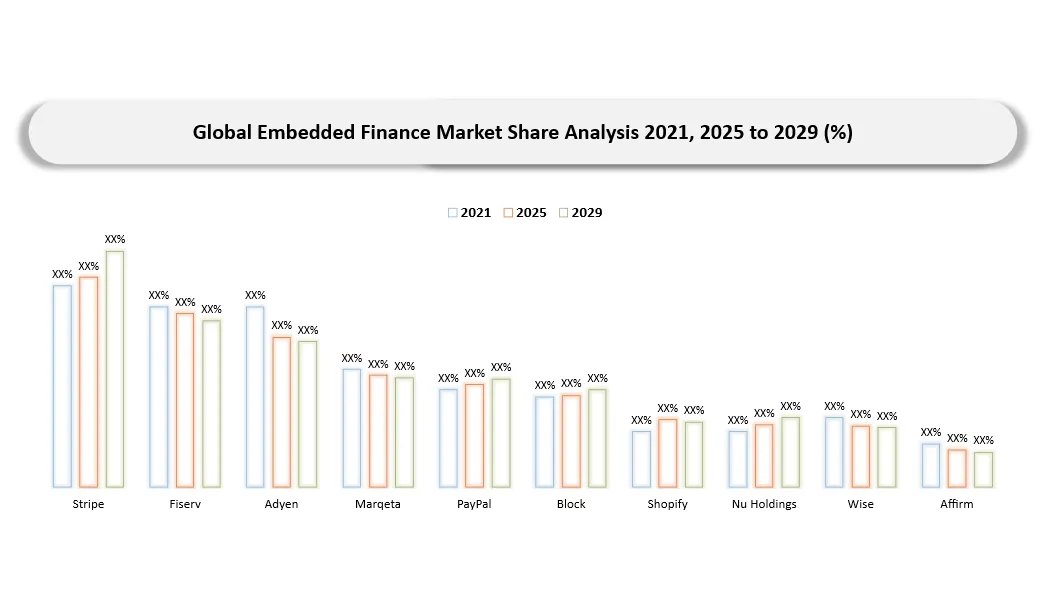
- Market share is difficult to measure consistently because providers report payment volume, platform revenue, lending volume and software fees under different accounting definitions.
Public Company Q1-Q2 2026 Performance Comparison
| Public Company | Period | Q1-Q2 2026 Performance | Growth Drivers | Embedded Finance Exposure |
| Fiserv | Q1 2026 | GAAP revenue US$5.03B; adjusted revenue US$4.68B. | Large bank/merchant installed base, issuer processing, digital banking and embedded banking/payment partnerships. | Broad financial infrastructure; embedded finance is part of Merchant and Financial Solutions. |
| Marqeta | Q1 2026 | Net revenue US$166M, +19% YoY; TPV US$112B, +33%; gross profit US$118M, +19%. | Modern issuing, money movement, credit-builder programs, geographic expansion and API-driven embedded finance. | Direct modern card issuing and embedded-finance infrastructure exposure. |
| Affirm | Fiscal Q3 2026 | Latest fiscal-2026 quarter used for directional comparison; merchant network and pay-over-time volumes continued to expand. | Merchant integrations, repeat consumers, Affirm Card and broader distribution partnerships. | Direct embedded lending / checkout finance exposure. |
| Adyen | H1 2026 | H1 2026 earnings released in August; enterprise payment platform remains the core growth engine. | Unified commerce, platform payments, issuing and expanding billing/merchant infrastructure. | Payments-led embedded-finance exposure through platforms and issuing. |
| Shopify | Q2 2026 | Latest Q2 2026 performance used directionally; Merchant Solutions remains the primary monetization engine. | Shopify Payments, Capital, Balance and merchant-finance attach across commerce workflows. | Embedded finance integrated into a non-financial commerce platform. |
Embedded Finance Market Ecosystem
| Value Chain Sector | Representative Companies / Organizations | Role in Market |
| Regulated Banks & Sponsor Institutions | JPMorgan Chase, Cross River, Sutton Bank, Celtic Bank, Banking Circle | Licensing, deposits, settlement, lending and regulatory sponsorship |
| Payments & acquiring | Stripe, Adyen, Fiserv, PayPal, Block | Payment acceptance, acquiring, orchestration and merchant services |
| Card Issuing & Processing | Marqeta, Galileo, Lithic, i2c, Fiserv | Virtual/physical cards, authorization, processing and program management |
| Banking-as-a-Service & Ledgers | Unit, Treasury Prime, Solaris, Mambu, Thought Machine | Accounts, ledgers, compliance workflows and bank connectivity |
| Embedded Lending | Affirm, Klarna, Amount, Fundbox, Liberis | Merchant, consumer and SME credit embedded at the point of need |
| Identity, KYC & Fraud | Socure, Persona, Trulioo, Entrust, Alloy | Identity verification, AML/KYC, onboarding and fraud prevention |
| Open Banking & Data | Plaid, Tink, TrueLayer, MX, Finicity | Account connectivity, transaction data, payment initiation and cash-flow signals |
| Distribution Platforms | Shopify, Toast, Uber, Amazon, vertical SaaS providers | Embed financial services into commerce and operating workflows |
| Insurance & Wealth APIs | Cover Genius, Qover, DriveWealth, Alpaca, additiv | Embedded insurance, brokerage and investment capabilities |
| Cloud, Security & Compliance | AWS, Microsoft, Google Cloud, ComplyAdvantage, Feedzai | Infrastructure, security, monitoring and regulatory technology |
Key Companies of the Embedded Finance Market
- Stripe
- Fiserv
- Adyen
- Marqeta
- PayPal
- Affirm
- Block
- Shopify
- Nu Holdings
- Wise
- Unit
- Treasury Prime
- Mambu
- Galileo
- Solaris
Stripe
Stripe provides payments, billing, issuing, treasury-style financial accounts and platform infrastructure used by digital businesses to embed money movement and financial services. Its advantage is developer adoption, broad product integration and global enterprise reach.
Fiserv
Fiserv provides merchant acquiring, issuer processing, digital banking, account processing and embedded banking/payment infrastructure. Its large installed base connects financial institutions with commerce platforms and enterprise clients.
Adyen
Adyen combines global acquiring, payments, issuing and platform capabilities on a unified technology stack. It is particularly relevant for marketplaces and enterprise platforms seeking embedded payment and financial-product functionality across countries.
Marqeta
Marqeta is a modern card-issuing and money-movement platform that explicitly enables companies to embed financial services into branded experiences. Its open APIs support debit, credit, virtual cards, program management and real-time decisioning.
PayPal
PayPal provides wallets, checkout, merchant processing, payouts and credit capabilities. Its broad consumer and merchant network makes it a major embedded-payments participant and a distribution platform for financial services.
Affirm
Affirm is an embedded lending and payment network integrated into merchant checkout. It enables installment credit, pay-over-time products and card-based spending while using merchant partnerships as its core distribution channel.
Block
Block combines Square merchant software, Cash App, Afterpay and financial-service capabilities. Its ecosystem embeds payments, lending, wallets and banking-like services into seller and consumer workflows.
Shopify
Shopify embeds payments, merchant capital and financial products directly into its commerce operating system. This demonstrates the strategic value of embedded finance as a monetization and retention layer for vertical software platforms.
Nu Holdings
Nu Holdings operates a digital banking platform across Latin America with cards, payments, deposits and lending. Its scale illustrates how app-native financial ecosystems can integrate multiple financial products into a unified digital customer experience.
Wise
Wise provides cross-border accounts, transfers and infrastructure APIs. Wise Platform enables banks and companies to embed international payments and account capabilities into their own products.
Unit
Unit provides embedded-finance infrastructure for companies to launch accounts, cards, payments and related workflows through APIs, with bank partnerships and compliance support.
Treasury Prime
Treasury Prime provides banking-as-a-service infrastructure connecting fintechs and enterprises with banks for accounts, payments, cards and embedded-banking programs.
Mambu
Mambu provides cloud-native core banking and lending infrastructure that can support embedded-finance programs and digital product launches through composable architecture.
Galileo
Galileo provides payment processing, card issuing and digital financial-services infrastructure within SoFi Technologies, serving fintech and enterprise programs through APIs.
Solaris
Solaris provides embedded-finance infrastructure and regulated capabilities in Europe, supporting accounts, cards, payments and credit products for partner brands.
Embedded Finance Market Major Pain Points
- Sponsor-bank concentration and changes in bank risk appetite can disrupt product continuity.
- Fragmented licensing, consumer-protection and safeguarding rules increase cross-border complexity.
- Fraud and synthetic identities intensify when onboarding and payment experiences become instant.
- Ledger, reconciliation and settlement errors can create operational and regulatory risk at scale.
- Embedded lending adds funding and credit-cycle exposure to otherwise asset-light software models.
- Platform economics can be compressed by interchange regulation and payment-rail competition.
- Customer concentration can be high for infrastructure providers serving a small number of large platforms.
- Migration away from a BaaS or issuing provider can be technically and operationally difficult.
Embedded Finance Market Recent Developments
- July 2026: Fiserv announced it would provide embedded banking and payments capabilities for Datavault AI, illustrating expansion of financial infrastructure into non-financial digital platforms.
- July 2026: Marqeta and zerohash announced a partnership to enable stablecoin spending across global card networks, extending embedded money-movement capabilities.
- May 2026: Marqeta expanded account and money-movement services into 30 additional European countries through Banking Circle, supporting broader cross-border embedded-finance deployment.
- June-July 2026: Adyen announced acquisitions of Orb and Talon.One to broaden billing, payments and customer-engagement infrastructure for enterprise merchants.
- 2026: Financial platforms continue to expand embedded accounts, issuing, credit and treasury services as software and commerce companies seek additional monetization from existing customer relationships.
- June 2026: SoFi expanded into small-business financial products, increasing product breadth within its digital financial-services ecosystem.
Analyst View / Opinion on Embedded Finance Market
- Embedded finance is becoming a distribution architecture for financial services rather than a standalone fintech category.
- The strongest long-term platforms will combine regulated access, reliable infrastructure and deep workflow integration instead of competing only on API speed.
- B2B and vertical SaaS should generate durable growth because financial products can be tied directly to invoicing, procurement, payroll and merchant operations.
- Payments will remain the entry point, but incremental value will come from attaching accounts, cards, credit, treasury and insurance to the same customer relationship.
- Regulatory resilience and partner diversification will become more important competitive advantages as bank-fintech oversight tightens.
- Providers that can demonstrate measurable revenue uplift, lower friction and controlled risk will capture a disproportionate share of enterprise adoption.
Embedded Finance Market Target Audience
| Industry | Who Should Buy This Report? | Reason to Buy This Report |
| Banks & Financial Institutions | Partnership, product, innovation and embedded-banking leaders | Benchmark BaaS models, platform partnerships and API distribution opportunities. |
| Fintech Infrastructure Providers | Founders, product, strategy and sales teams | Identify high-growth products, verticals, regions and partner requirements. |
| SaaS & Commerce Platforms | Product, payments, monetization and finance leaders | Assess embedded payments, cards, accounts, credit and insurance opportunities. |
| Investors & Private Equity | Fintech, payments and software investors | Evaluate market structure, monetization, regulation and competitive positioning. |
| Payment & Card Companies | Issuing, acquiring and platform teams | Map expansion opportunities across embedded banking and lending. |
| Consultants & System Integrators | Digital transformation and financial-services teams | Support partner selection, architecture, compliance and market-entry programs. |
| RegTech / Identity Providers | KYC, fraud and compliance product leaders | Understand demand created by instant onboarding and partner-bank oversight. |
Why Choose DATAM?
- Data-driven insights combining market sizing, digital-origination trends, technology spending, funding economics and country-level adoption.
- Post-purchase analyst consultations for vendor selection, partnership strategy, market entry and custom modeling.
- Annual updates covering regulation, funding markets, platform launches, partnerships, M&A and public-company performance.
- Specialized focus on emerging embedded-finance markets rather than generalized BFSI regional summaries.
- Actionable analysis that connects technology capability with risk decisioning economics, distribution, funding and compliance.
What DATAM Uniquely Provides
- Ten-year forecasts across eight segmentation categories and five major regions.
- Combined analysis of software platforms and digital-native lending business models.
- Market ecosystem mapping from identity and data through decisioning, funding, account servicing and financial operations.
- Public-company Q1-Q2 2026 comparison focused on embedded finance exposure and growth drivers.
- Country-level views linking digital identity, open banking, mobile adoption, regulation and capital availability.


























































