


Electrical Equipment and Components Market Size
The global electrical equipment and components market reached an estimated US$ 1.42 trillion in 2025 and is expected to reach US$ 2.53 trillion by 2035, growing at a CAGR of 5.9% during the forecast period 2026-2035. The market includes power distribution and control equipment, rotating machines, power conversion systems, wiring and connection products, protection devices, automation hardware, meters, sensors, panels and other components used across utility, industrial, commercial, transportation and residential electrical systems.
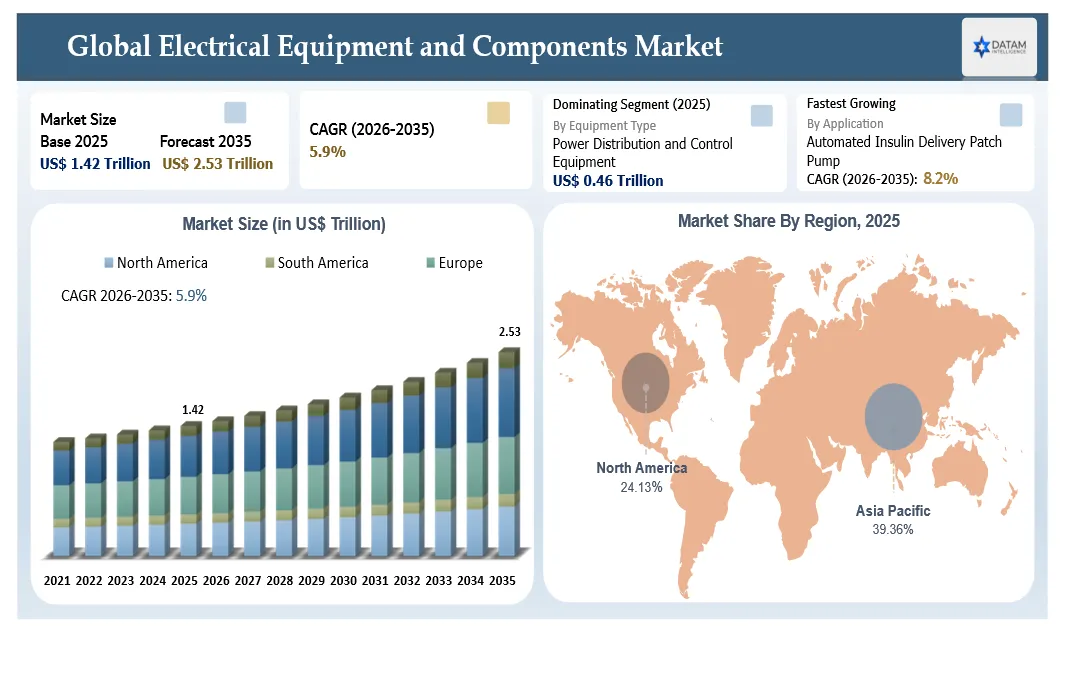
Power distribution and control equipment represents the largest equipment group because grid expansion, renewable integration, industrial electrification and building infrastructure require transformers, switchgear, breakers, relays, busway and control panels. Electronic and power-semiconductor components are expected to record faster growth as equipment becomes more digital, efficient and controllable. Data centers, battery storage, EV charging, automation and renewable systems are increasing demand for power conversion, monitoring and protection products with higher power density and communication capability.
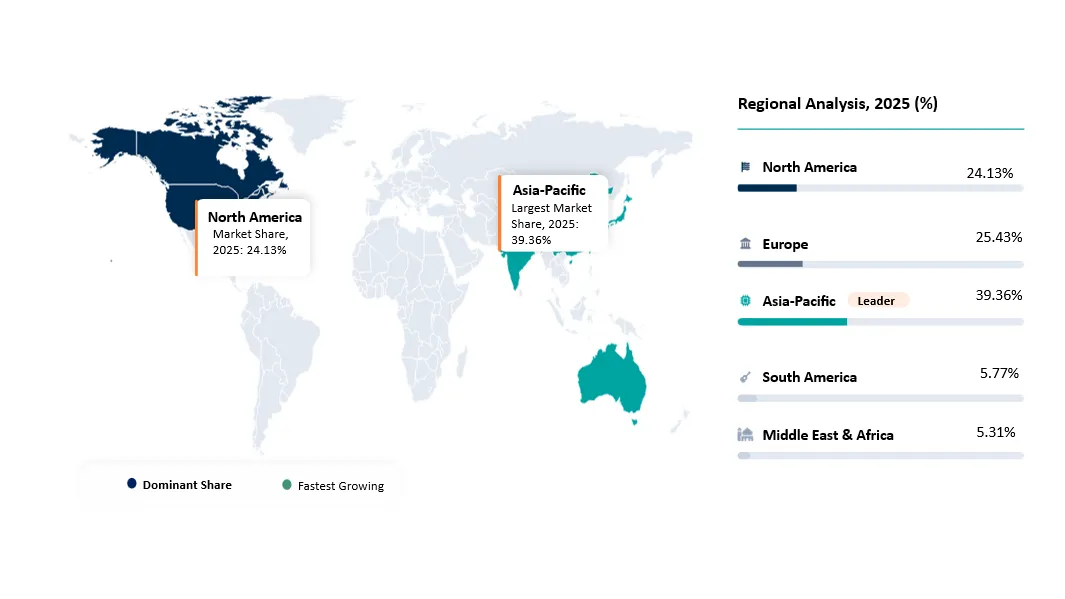
Asia-Pacific leads through large manufacturing ecosystems, utility investment, urbanization and industrial capacity. North America is entering an accelerated replacement and expansion cycle driven by data centers, reindustrialization, resilience spending and transmission constraints. Europe remains important for premium energy-efficient products, electrification and grid modernization. Market growth is constrained by long lead times for transformers and switchgear, copper and electrical steel exposure, skilled-labor shortages, qualification cycles and fragmented standards. Suppliers that combine manufacturing scale, regional capacity, digital monitoring and lifecycle service are best positioned through 2035.
Electrical Equipment and Components Market Key Takeaways
- Power distribution and control equipment accounted for an estimated 31.6% of global market value in 2025, supported by transformer, switchgear, breaker, panel and substation investment.
- Low-voltage equipment represented approximately 46.8% of 2025 demand because it is used across buildings, factories, data centers, transportation systems and residential installations.
- Utilities held an estimated 28.9% end-use share in 2025, while data centers and digital infrastructure are projected to grow at a 9.4% CAGR through 2035.
- Asia-Pacific captured about 46.2% of global revenue in 2025 and is expected to remain the largest production and demand center.
- North America held roughly 22.8% of the market in 2025 and is expected to expand at 6.6% CAGR as grid, data center and manufacturing investment accelerates.
- Electronic and power-semiconductor components are expected to grow at an 8.1% CAGR as electrification shifts value toward inverters, converters, intelligent protection and embedded control.
- Direct project sales remain critical for high-value grid and industrial equipment, while distributors dominate fragmented low-voltage component demand and maintenance purchases.
- Competitive advantage is shifting toward shorter lead times, regional manufacturing, digital lifecycle support, modular design and the ability to meet multiple standards from a common platform.
Electrical Equipment and Components Industry Trends and Strategic Insights
- Grid investment is moving from isolated replacement toward system-wide capacity expansion, automation, resilience and renewable integration, increasing demand across transformers, switchgear, protection and monitoring.
- Data centers are reshaping product specifications through higher fault-current requirements, busway adoption, medium-voltage distribution, redundant UPS architectures and demand for fast delivery.
- Manufacturers are regionalizing production for transformers, switchgear, connectors and power electronics to reduce tariff exposure, shorten lead times and improve access to utility and public-infrastructure programs.
- Equipment is becoming software-defined through embedded sensors, communications, diagnostics and remote configuration, shifting revenue toward recurring service and digital monitoring.
- Energy-efficiency regulation is accelerating replacement of motors, drives, power supplies and building equipment, while buyers increasingly evaluate lifetime energy cost rather than purchase price alone.
- Modular substations, prefabricated power rooms, skid-mounted systems and standardized data center blocks are reducing project schedules and increasing demand for integrated assemblies.
- Copper, electrical steel, aluminum and semiconductor supply remain strategic because material volatility and component shortages can determine delivery performance and margin.
- Sustainability is moving into procurement through low-loss transformers, recycled copper, SF6 alternatives, product carbon data and repairable designs.
Electrical Equipment and Components Market Scope
| Metric | Details |
| 2025 Market Size | US$ 1.42 Trillion |
| 2035 Projected Market Size | US$ 2.53 Trillion |
| CAGR (2026-2035) | 5.9% |
| Largest Region | Asia-Pacific |
| Fastest-Growing Major Region | North America |
| Largest Equipment Type | Power Distribution and Control Equipment |
| Fastest-Growing Application | Data Centers and Digital Infrastructure |
| Report Insights Covered | Market Size, Share, Growth, Pricing, Supply Chain, Competition, Investment and Country-Level Opportunity |
Why does this report matter in 2026?
The year 2026 is a strategic inflection point because electricity demand, generation investment and large-load interconnection are increasing faster than equipment supply in several markets. Utilities and industrial buyers are competing for transformers, switchgear, breakers and power electronics with data center developers, renewable projects and manufacturing facilities. Procurement decisions made now can lock in technology platforms, suppliers and service relationships for a decade. The report helps buyers distinguish between cyclical price effects and structural demand that will persist through 2035.
The market is also becoming more fragmented by performance requirement. A low-voltage panel for a commercial building, a medium-voltage switchgear lineup for a data center, a high-voltage transformer for a utility and a power converter for battery storage have different qualification cycles, channel structures and margin profiles. The study separates these opportunity pools and connects them to voltage level, component category, application, end user and sales channel. This allows suppliers and investors to identify where capacity additions, product development or partnerships can create the highest return.
Regulation and geopolitics further increase the value of current analysis. Energy-efficiency rules, cyber requirements, local-content policies, tariffs, fluorinated-gas restrictions and grid reliability standards are reshaping product design and sourcing. Companies need to decide whether to localize manufacturing, redesign equipment, qualify alternate materials or build digital compliance capabilities. The report provides a common framework for these decisions and supports portfolio planning, market entry, M&A screening and commercial prioritization.
Electrical Equipment and Components Market White Space & Investment Opportunities
- High-voltage and medium-voltage transformer capacity remains a major white space where long lead times support new factories, component localization and remanufacturing services.
- Data center power trains create opportunity in medium-voltage switchgear, busway, static transfer switches, modular substations, intelligent PDUs and power-quality monitoring.
- SF6-free switchgear and low-carbon insulating technologies offer growth as utilities and industrial users prepare for tighter emissions regulation and corporate procurement standards.
- Grid-edge automation, digital relays, sensors and communications modules can convert conventional equipment into intelligent assets with recurring software and service revenue.
- Energy-efficient motors, drives and power electronics provide scalable replacement demand across factories, HVAC, water systems, mining and transport infrastructure.
- Regional assembly and component production in India, Southeast Asia, the Middle East, Mexico and Eastern Europe can serve local-content programs and reduce logistics risk.
- Repair, refurbishment, condition monitoring and spare-parts platforms provide attractive recurring revenue because the installed base is aging and replacement lead times remain long.
- Integrated electrical packages for renewables, storage, hydrogen and electrified industrial processes can capture more value than standalone component sales.
Electrical Equipment and Components Future Market Transformation
The market will transform from a product-led equipment industry into a digitally connected power-infrastructure ecosystem. Hardware will remain the revenue base, but value will increasingly come from engineering, configuration, connectivity, cybersecurity, predictive maintenance and energy optimization. Equipment suppliers will embed sensors and communications into transformers, switchgear, motors, drives and panels, allowing customers to monitor loading, temperature, insulation condition, harmonics and fault risk. This improves uptime and creates recurring digital-service opportunities.
Manufacturing will become more regional and modular. Suppliers will standardize core platforms while adapting ratings, certifications and interfaces for local markets. Prefabricated substations, e-houses, modular power rooms and integrated skids will reduce site labor and compress commissioning schedules. Component makers will need to support common digital protocols, higher power density and circularity. By 2035, leading companies are likely to combine global technology platforms with local assembly, software-enabled service and strong distributor coverage.
The customer base will also change. Utilities will remain the largest buyers, but data centers, renewable developers, battery projects, EV infrastructure and advanced factories will influence product roadmaps. These customers demand faster delivery and standardized blocks, yet also require high reliability and compliance. The strongest suppliers will organize around vertical solutions rather than individual products, combining transformers, switchgear, protection, drives, power conversion and monitoring into repeatable architectures.
Electrical Equipment and Components Buyer Decision-Making Criteria
Buyers prioritize technical compliance, reliability, lead time, lifecycle cost and supplier support. Utility and industrial purchases require proven ratings, fault performance, thermal endurance, environmental compatibility and documentation. For high-value equipment, the cost of downtime and project delay is usually greater than the initial price difference. Approved-vendor status, references and local service therefore create strong barriers to entry.
Digital capability is becoming a formal procurement criterion. Customers evaluate communications, cybersecurity, remote diagnostics, interoperability and data ownership. Data center and industrial users also assess modularity, footprint, maintainability and the ability to scale through repeatable blocks. Sustainability is growing in importance through efficiency, material traceability, repairability, low-carbon manufacturing and alternatives to high-global-warming-potential gases.
The largest gaps are in high-voltage transformers, medium-voltage switchgear, skilled labor and selected electronic components. Mitigation requires capacity reservation, standardized designs, supplier diversification, alternate-material qualification and regional inventory. Buyers can reduce risk through early specification, framework contracts and transparent project pipelines. Suppliers can protect execution through modular product platforms, workforce training, contractual escalation clauses and disciplined acceptance of customized orders.
Electrical Equipment and Components Market Economic & Investment Analysis
The market has become an attractive infrastructure investment theme because demand is supported by several independent drivers: grid expansion, renewable integration, data centers, transport electrification, industrial automation and replacement of aging assets. These drivers reduce dependence on a single construction cycle and support multi-year order visibility. High-voltage equipment and engineered systems can generate strong backlogs, while low-voltage components and aftermarket services provide recurring volume and cash flow.
Capital requirements differ sharply across the value chain. Transformer, switchgear and motor factories require specialized equipment, testing capability, skilled labor and qualification. Connector, relay and sensor production can be more modular but depends on automation and quality control. Power-semiconductor and electronic component exposure adds technology risk and shorter product cycles. Investors should therefore evaluate capacity utilization, order quality, price realization, raw-material pass-through, local-content eligibility and the durability of service revenue.
Valuation should separate backlog-driven growth from normalized demand. Strong order books can support near-term revenue, but bottlenecks may also hide execution risk. A supplier with scarce capacity, high customer qualification and pricing power may sustain attractive margins, while a commodity component producer can face rapid price erosion when capacity normalizes. M&A opportunities are strongest where a buyer can add channel access, complementary voltage classes, digital capability or regional manufacturing to an existing portfolio.
Investment planning should also incorporate working-capital intensity. Long-cycle equipment requires advance procurement of copper, electrical steel, insulation and electronic components, while customers may demand performance guarantees and delayed payments. Companies with disciplined contract terms, escalation clauses and supplier diversification are better positioned to convert demand into free cash flow. Service, remanufacturing and digital monitoring can improve returns by monetizing the installed base after the original equipment sale.
Electrical Equipment and Components Investment Trends in the Market
- Capital is moving into transformer and switchgear capacity because utilities and data center developers face multi-year procurement constraints.
- Manufacturers are expanding in North America, India, the Middle East and Southeast Asia to serve localization programs and reduce shipping risk.
- Private equity and strategic buyers are targeting niche component suppliers with approved-vendor positions, specialized engineering and recurring aftermarket revenue.
- Investment in digital relays, sensors, condition monitoring and asset-management software is increasing as equipment companies build recurring revenue models.
- SF6-free switchgear, low-loss transformers and high-efficiency motors are attracting R&D and factory investment linked to regulation and customer sustainability targets.
- Data center electrical packages are receiving dedicated capacity because standardized designs can support repeat orders and higher engineering content.
- Power electronics, semiconductor modules and thermal management are becoming acquisition priorities as electrification moves value from mechanical systems to controlled electrical architectures.
- Repair, refurbishment and remanufacturing networks are expanding because customers need alternatives to long new-equipment lead times.
Strategic Indicators for Electrical Equipment and Components Market
High Regulation Impact
Electrical equipment is governed by safety, grid, efficiency, environmental and electromagnetic-compatibility standards. Product redesign and certification can materially affect time to market. Utilities add their own technical specifications and approved-vendor processes, creating high compliance costs but durable customer relationships for qualified suppliers.
High Investment Activity
Grid expansion, data centers, renewables, manufacturing and transport electrification are driving capacity announcements across transformers, switchgear, power electronics, motors and controls. Investment is concentrated where lead times are longest or where digital and low-carbon differentiation can defend margins.
Supply Chain Disruption
Copper, electrical steel, aluminum, insulation systems, semiconductors and specialty components remain vulnerable to shortages and trade disruption. A missing bushing, relay or power module can delay an entire system. Dual sourcing, design flexibility and regional inventory are therefore strategic.
Pricing Volatility
Equipment pricing responds to metal costs, labor, logistics, electronics and capacity utilization. Engineered products often use escalation clauses, while standardized components face faster repricing. Buyers increasingly negotiate framework agreements to secure both price and delivery.
Procurement Pressure
Large customers are centralizing procurement, demanding documented lead times, cybersecurity, lifecycle support and sustainability data. Vendors must provide transparent configurations, spare-parts plans and commissioning capability rather than a product quote alone.
New Technology Adoption
Digital substations, solid-state power electronics, wide-bandgap semiconductors, embedded sensing, AI-based diagnostics and modular designs are changing product architecture. Adoption depends on field reliability, interoperability and the ability to integrate with existing assets.
Regional Expansion Opportunity
India, Southeast Asia, the Middle East, Mexico and selected African markets offer growth through industrialization, grid expansion and renewable projects. Local assembly and partnerships can improve qualification and access to public procurement.
Government Policy Support
Transmission programs, domestic manufacturing incentives, energy-efficiency standards and electrification targets support demand. Policy shifts can also increase tariff exposure or require local content, making government strategy central to market entry.
AI Impact Analysis of the Electrical Equipment and Components Market
AI is improving equipment design, manufacturing and lifecycle management. Engineering teams use optimization models to evaluate thermal performance, electromagnetic behavior, material use and fault tolerance before physical prototypes are built. Manufacturers apply machine vision and predictive analytics to winding, assembly, soldering, testing and quality control. These tools can reduce scrap and improve traceability, but they require clean production data and integration with factory systems.
In the installed base, AI can analyze load, temperature, vibration, partial discharge, harmonics and breaker operations to estimate failure risk. Utilities and industrial users can move from time-based maintenance toward condition-based maintenance, improving uptime and reducing unnecessary interventions. AI also supports demand forecasting, inventory planning and configuration selection. Adoption will depend on cybersecurity, explainability and evidence that predicted failures correspond to actionable maintenance decisions.
Disruption Analysis of Electrical Equipment and Components Market
Power electronics and digital control are disrupting traditional electromechanical architectures. Solid-state switching, intelligent breakers, variable-speed drives and software-defined protection can reduce mechanical wear and improve controllability. At the same time, these systems introduce semiconductor dependence, cybersecurity requirements and shorter technology cycles. Incumbent equipment suppliers are responding through acquisitions, partnerships and internal software development.
Modular construction is disrupting project delivery. Prefabricated substations, e-houses, skid-mounted power systems and standardized data center blocks shift value from field labor to factory integration. This favors suppliers with engineering, testing and multi-product capability. Distributed generation and storage also move investment toward the grid edge, creating demand for bidirectional converters, smart protection, meters and communications modules.
Electrical Equipment and Components Market BCG Matrix: Company Evaluation
STAR
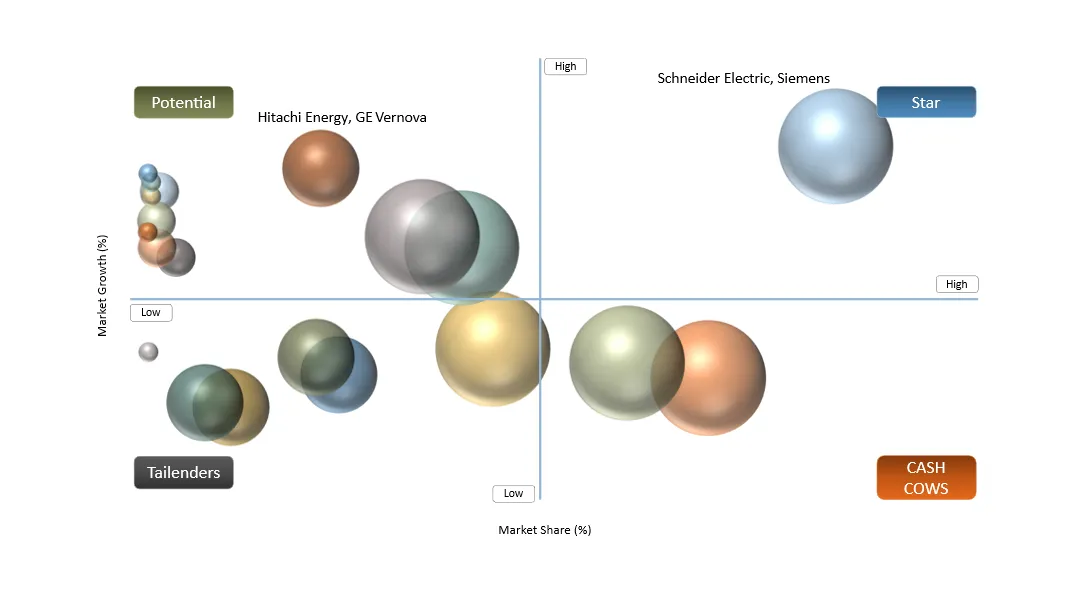
Schneider Electric, Siemens, ABB and Eaton are positioned as Stars because they combine broad portfolios, global channels, digital platforms and strong exposure to electrification, data centers and automation. Their ability to integrate equipment, software and services supports premium positioning and cross-selling across utility, industrial and building customers.
POTENTIAL
Hitachi Energy, GE Vernova, Mitsubishi Electric, Fuji Electric, WEG and Nidec represent high-potential positions in selected grid, motor, power-electronics and regional markets. Growth depends on capacity execution, technology differentiation, geographic expansion and the ability to convert project demand into recurring services.
CASH COWS
Mature wiring devices, contactors, relays, standard motors and commodity connection products can operate as cash-generating categories where companies have strong brands, distributor relationships and efficient manufacturing. Growth is moderate, but installed-base replacement and code-driven demand provide stability.
TAILENDERS
Undifferentiated component suppliers with limited certification, weak channels or high exposure to imported raw materials face margin pressure. These companies may need specialization, partnerships, regional assembly or exit from low-value categories to remain competitive.
Electrical Equipment and Components Market Dynamics
Driver Impact Analysis
| Driver | Growth Impact | Demand Concentration | Impacted Use Case | Strategic Impact |
| Grid modernization and expansion | High | Utilities and infrastructure | Transformers, switchgear, protection and substations | Creates multi-year demand and high qualification barriers. |
| Data center power growth | High | North America, Europe and Asia-Pacific | MV distribution, busway, UPS and controls | Raises power density and compresses delivery schedules. |
| Industrial electrification | Medium-High | Manufacturing, mining and process industries | Motors, drives, panels and power electronics | Expands equipment intensity and replacement demand. |
| Renewables and storage | Medium-High | Global project markets | Inverters, transformers, switchgear and monitoring | Creates bidirectional and grid-integration requirements. |
Driver: Accelerating Grid Modernization and Capacity Expansion
Electricity systems are adding renewable generation, storage and large loads while replacing assets installed decades ago. This increases demand across voltage classes, from high-voltage transformers and substations to low-voltage panels and protection. Grid spending also creates downstream demand for connectors, bushings, relays, sensors, meters and control equipment. The driver is structural because electrification requires both more capacity and more intelligent operation.
Restraint Impact Analysis
| Restraint | Drag on Growth | Primary Impact Area | Impacted Use Case | Strategic Impact |
| Long equipment lead times | High | Project execution | Transformers and switchgear | Can delay revenue and customer projects despite strong demand. |
| Material and component volatility | High | Margins and pricing | Copper, steel, semiconductors and insulation | Requires escalation clauses and supplier diversification. |
| Standards and certification complexity | Medium-High | Market entry | Utility and industrial equipment | Raises qualification cost and slows geographic expansion. |
| Skilled labor shortages | Medium | Manufacturing and field service | Assembly, testing and commissioning | Limits capacity utilization and service responsiveness. |
Restraint: Long Lead Times and Material Cost Volatility
Transformer, switchgear and engineered-system lead times can extend well beyond normal project schedules when factories are full or critical inputs are unavailable. Copper, electrical steel, aluminum, bushings, power modules and insulation systems add cost and supply risk. Buyers may respond by ordering early, standardizing designs or qualifying alternates, but these actions increase working capital and can lock in outdated specifications. Suppliers need transparent capacity planning and contract terms that allocate cost and schedule risk.
Electrical Equipment and Components Market Segment Analysis
The global market is segmented by equipment type, voltage level, component category, application, end-use industry, sales channel and region.
By Equipment Type
Power Distribution and Control Equipment Will Retain the Largest Share
Transformers, switchgear, circuit breakers, relays, panels and substation equipment will remain the largest equipment group because every generation source and end-use load must connect through controlled and protected electrical infrastructure. Utility grid programs provide the largest project values, while industrial facilities, buildings and data centers create additional demand. Rotating equipment remains a major installed-base market, but power distribution and control benefit from both capacity expansion and digital modernization.
By Voltage Level
Low Voltage Will Remain the Largest, While Medium Voltage Grows Faster
Low-voltage equipment leads through broad use in buildings, factories, data centers, charging systems and residential installations. Medium-voltage demand will grow faster as large facilities move distribution closer to loads and renewable, storage and data center projects require higher-capacity architectures. High-voltage markets offer larger project values but longer qualification and procurement cycles.
By Component Category
Electronic and Power Semiconductor Components Will Record the Fastest Growth
Wide-bandgap semiconductors, power modules, digital relays, sensors and communication components are increasing the intelligence and efficiency of electrical equipment. These products support inverters, drives, solid-state protection, EV charging, storage and high-frequency power conversion. Electromechanical components remain essential, but value growth is shifting toward electronic control and monitoring.
By Application
Transmission and Distribution Will Remain the Largest Application
Transmission and distribution equipment captures the largest value because grids require high-value transformers, switchgear, protection, substations and automation. Data centers and digital infrastructure will be the fastest-growing application through 2035, influencing specifications for redundancy, power quality, modularity and delivery speed.
By End-Use Industry
Utilities Will Remain the Largest Buyer Group
Utilities control the largest share through transmission, distribution and metering investment. Manufacturing represents a broad recurring market for motors, drives, panels and controls. Data centers and telecommunications will gain share because electrical systems represent a large portion of facility capital expenditure and require frequent capacity additions.
By Sales Channel
Direct Project Sales Will Lead High-Value Equipment
Direct OEM and project sales dominate transformers, switchgear, integrated substations and engineered systems because suppliers must manage specifications, testing and commissioning. Distributors remain essential for low-voltage products, connectors, relays and maintenance demand. System integrators and panel builders influence component selection and can create durable pull-through for preferred brands.
Electrical Equipment and Components Market Geographical Penetration
U.S. Electrical Equipment and Components Market Landscape
The U.S. market is being reshaped by data center construction, utility capital programs, reindustrialization and replacement of aging grid assets. Demand is particularly strong for transformers, medium-voltage switchgear, breakers, busway, UPS systems, motors and automation. Domestic-capacity expansion and approved-vendor requirements support established suppliers. Key trends include modular substations, local manufacturing, grid resilience, SF6 alternatives and digital monitoring. Procurement pressure remains high because large-load projects compete for limited equipment and interconnection capacity.
Canada Electrical Equipment and Components Market Trends
Canada combines transmission expansion, hydroelectric infrastructure, mining, oil and gas, data centers and building electrification. Remote projects create demand for rugged equipment and service support. Provincial utility structures produce distinct qualification pathways. Growth opportunities include grid reinforcement, mining electrification, renewable integration, cold-climate equipment and cross-border supply partnerships.
Germany Electrical Equipment and Components Market Outlook
Germany remains a premium market for energy-efficient motors, automation, industrial controls, switchgear and building electrification. Grid expansion and renewable integration support medium- and high-voltage equipment, while industrial competitiveness drives demand for efficiency and digitalization. Suppliers must address EU ecodesign, cybersecurity, product carbon and fluorinated-gas requirements.
UK Electrical Equipment and Components Market Trends
The UK market is supported by offshore wind, transmission investment, data centers, rail electrification and building upgrades. Grid-connection queues and network reinforcement create demand for substations, transformers, switchgear and protection. Opportunities are growing in modular construction, energy storage and flexibility infrastructure.
France Electrical Equipment and Components Market Outlook
France benefits from nuclear infrastructure, renewable additions, rail, industrial electrification and a strong domestic electrical-equipment ecosystem. Replacement and modernization of generation and grid assets create demand for protection, control and power-distribution products. Sustainability and EU compliance remain central to procurement.
China Electrical Equipment and Components Market Outlook
China is the largest manufacturing and demand center, supported by grid investment, renewables, EVs, industrial production and urban infrastructure. Domestic suppliers are strong across transformers, switchgear, motors, inverters and components. Growth is shifting toward ultra-high-voltage networks, smart distribution, storage integration, efficient motors and export-oriented equipment platforms.
India Electrical Equipment and Components Market Trends
India is one of the fastest-growing markets through grid expansion, renewable energy, rail electrification, data centers, industrial corridors and urban infrastructure. Local-content programs support domestic manufacturing of transformers, switchgear, motors, cables and electronics. Quality, testing capacity and utility qualification remain critical. Opportunity is strong in medium voltage, distribution automation, smart metering, data center power and industrial drives.
Japan Electrical Equipment and Components Market Trends
Japan has a sophisticated installed base and strong domestic suppliers in power electronics, motors, automation and grid equipment. Demand is driven by factory modernization, data centers, renewable integration, resilience and replacement of aging infrastructure. Buyers emphasize reliability, compact design, efficiency and long lifecycle support.
South Korea Electrical Equipment and Components Market Outlook
South Korea combines semiconductor manufacturing, battery plants, shipbuilding, data centers and energy infrastructure. High-power industrial facilities create demand for reliable switchgear, transformers, motors, drives and monitoring. Domestic technology strength supports exports, while renewable and storage growth increases power-conversion demand.
Brazil Electrical Equipment and Components Market Outlook
Brazil offers opportunities through transmission projects, renewables, mining, oil and gas, industrial investment and urban infrastructure. Local manufacturing and financing structures influence supplier selection. Market growth depends on project execution, currency stability and utility investment. Wind, solar and data centers are increasing demand for transformers, switchgear and power electronics.
Middle East and Africa Electrical Equipment and Components Market Outlook
The region is supported by utility expansion, renewable projects, data centers, oil and gas, mining and urban megaprojects. Gulf markets offer high-value projects and local-content opportunities, while African markets require cost-effective distribution equipment and service coverage. Supplier success depends on regional inventory, EPC partnerships, heat and dust performance, financing and long-term maintenance capability.
Electrical Equipment and Components Market Competitive Landscape
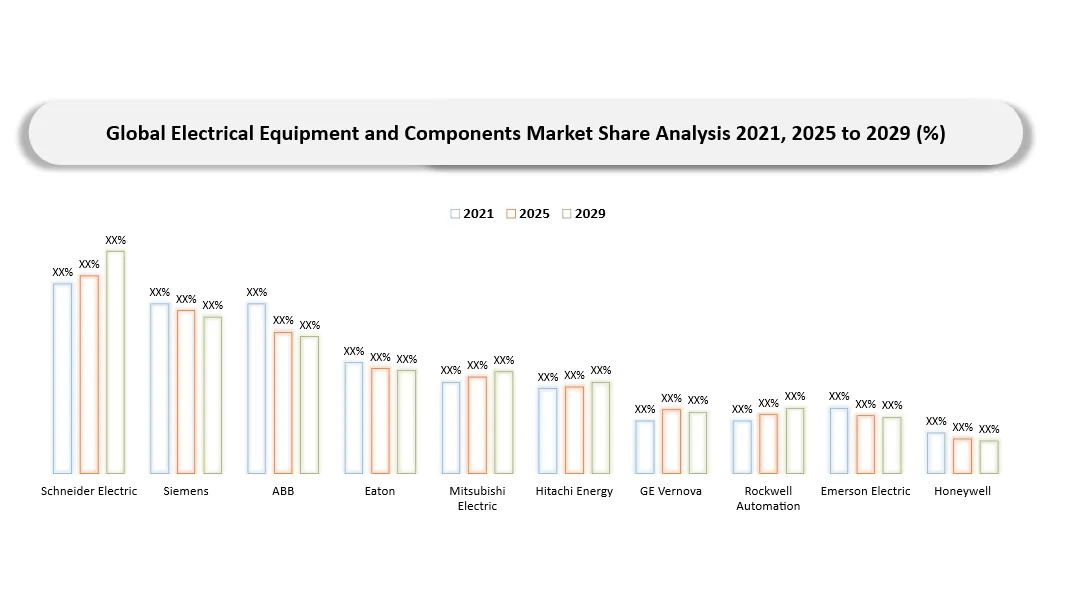
- Competition is led by diversified global suppliers with portfolios spanning voltage classes, automation, power conversion and services.
- Specialists remain important in transformers, connectors, motors, relays, power semiconductors and distribution equipment where technical depth and qualification create defensible positions.
- Capacity availability has become a competitive differentiator, particularly for transformers and medium-voltage switchgear.
- Digital platforms, cybersecurity and condition monitoring are increasingly used to defend installed bases and create recurring revenue.
- Distributor reach and panel-builder relationships determine share in fragmented low-voltage and aftermarket markets.
- M&A is likely to focus on regional manufacturing, digital capability, data center exposure, power electronics and service networks.
Key Companies of Electrical Equipment and Components Market
- Schneider Electric
- Siemens
- ABB
- Eaton
- Mitsubishi Electric
- Hitachi Energy
- GE Vernova
- Rockwell Automation
- Honeywell
- Emerson Electric
- Legrand
- Hubbell
- Fuji Electric
- Toshiba Energy Systems & Solutions
- Nidec
- WEG
- Prysmian Group
- TE Connectivity
- Phoenix Contact
- Larsen & Toubro
Electrical Equipment and Components Market Major Pain Points
- Long lead times for transformers, switchgear and specialized components.
- Volatility in copper, electrical steel, aluminum and semiconductor availability.
- Fragmented standards and lengthy utility qualification.
- Shortage of skilled winding, testing, commissioning and service personnel.
- Cybersecurity and interoperability challenges in connected equipment.
- Difficulty balancing product standardization with project-specific requirements.
- Working-capital pressure from large backlogs and long project cycles.
- Uneven access to service, spare parts and repair capability in emerging markets.
Electrical Equipment and Components Market Recent Developments
- 2026: Global manufacturers continued adding transformer and switchgear capacity to address utility, renewable and data center backlogs.
- 2026: Data center electrical-system suppliers expanded modular power, busway, UPS and medium-voltage offerings for higher-density AI facilities.
- 2025-2026: Utilities accelerated procurement of grid automation, digital protection and condition-monitoring systems alongside conventional equipment replacement.
- 2025-2026: Manufacturers increased development of SF6-free switchgear and lower-carbon equipment platforms in response to regulation and customer sustainability requirements.
- 2025-2026: Investment in regional manufacturing increased across North America, India, the Middle East and Southeast Asia to reduce delivery risk and meet local-content requirements.
- 2025-2026: Power-electronics suppliers expanded silicon-carbide and advanced module portfolios for EV charging, storage, renewable energy and industrial drives.
Analyst View / Opinion on Electrical Equipment and Components Market
The market is entering a durable expansion phase because electricity demand, asset replacement and electrification are rising together. Near-term growth will be constrained by factory capacity and project execution, but these constraints reinforce pricing power for qualified suppliers. The highest-value opportunities are in products that combine scarcity, certification and digital differentiation. Transformers, medium-voltage switchgear, data center power systems and intelligent protection are likely to remain strategic through the decade.
- Asia-Pacific will remain the largest market, while North America offers unusually strong growth and pricing conditions.
- Power distribution and control equipment will lead value, while power electronics and digital components will grow faster.
- Regional manufacturing will become a prerequisite for major public, utility and data center programs.
- Aftermarket, refurbishment and monitoring services will improve resilience when new-equipment lead times are long.
- Companies that sell integrated architectures rather than isolated products will capture more engineering and service value.
- Long-term leadership will depend on reliability, delivery, software interoperability, sustainability and service coverage.
Electrical Equipment and Components Market Target Audience
| Industry | Who Should Buy This Report? | Reason to Buy This Report |
| Electrical Equipment OEMs | Strategy, product, sales and investment teams | Prioritize products, voltage classes, regions and capacity investments. |
| Component Manufacturers | Connector, relay, sensor, semiconductor and materials suppliers | Identify high-growth equipment platforms and customer partnerships. |
| Utilities and EPCs | Procurement, engineering and project leaders | Assess supply risk, pricing, lead times and supplier structure. |
| Industrial and Data Center Buyers | Facility, engineering and sourcing teams | Benchmark architectures, procurement channels and lifecycle criteria. |
| Distributors and Integrators | Wholesalers, panel builders and system integrators | Evaluate channel growth, product gaps and regional expansion. |
| Investors and Consultants | Private equity, institutional investors and advisors | Assess market size, competitive positioning, M&A and white spaces. |
| Government and Standards Bodies | Infrastructure, trade and energy agencies | Understand localization, regulation and supply-chain implications. |
Why Choose DATAM?
- Data-driven insights combining equipment shipments, project pipelines, installed-base replacement, pricing and country-level demand.
- Post-purchase analyst consultations for portfolio strategy, capacity planning, customer identification and market entry.
- Annual report updates covering investment, regulation, capacity, supply-chain conditions and competitive changes.
- Specialized focus on emerging markets, localization and channel structure rather than generalized regional summaries.
- Actionable analysis connecting grid and electrification investment to specific equipment and component categories.
What DATAM Uniquely Provides
- Ten-year forecasts across equipment type, voltage level, component category, application, end use, sales channel and region.
- Detailed separation of utility-scale equipment, industrial systems, power electronics and fragmented component markets.
- Buyer-focused analysis of qualification, lead time, lifecycle cost, digital capability and service requirements.
- Country-level views linking electricity demand, industrial policy, manufacturing capacity and project investment.
- Strategic recommendations for capacity expansion, partnerships, M&A, localization and channel development.


























































