


Effervescent Products Market Size
The global effervescent products market reached an estimated US$ 15.46 billion in 2025 and is expected to reach US$ 28.91 billion by 2035, growing at a CAGR of 6.5% during 2026-2035. The market includes effervescent tablets, powders, granules, sachets, instant fizzy tabs and specialty formats used for pharmaceuticals, vitamins and minerals, hydration, sports nutrition, digestive care, oral care and household applications.
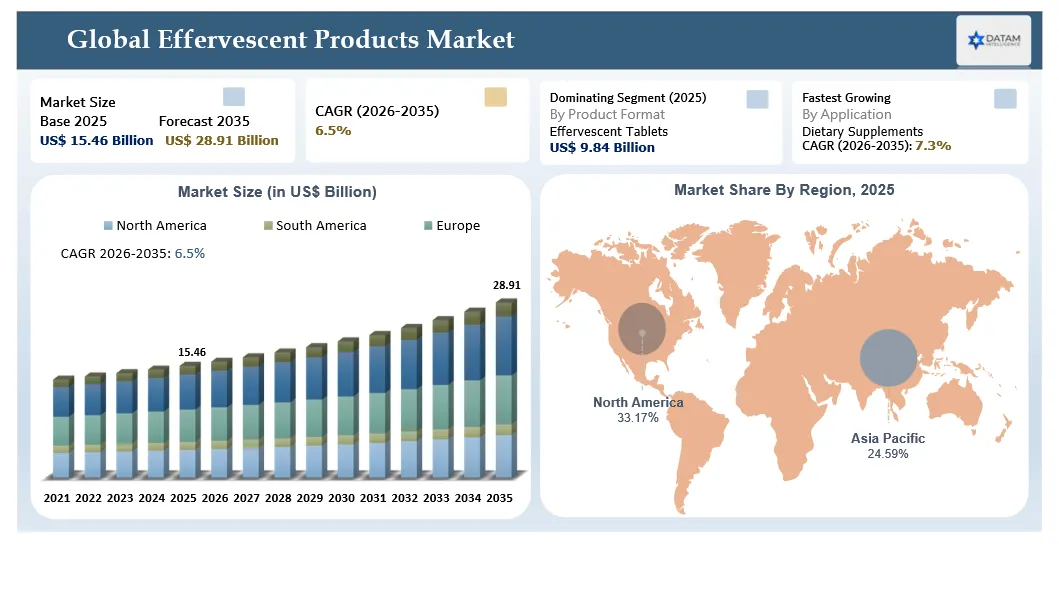
Effervescent tablets remain the largest product format because they support precise dosing, strong shelf presentation and rapid preparation. Vitamins and minerals represent the largest active category, while sports nutrition, hydration and high-load soluble systems are growing faster. Product development is shifting toward sugar-free formulations, lower-sodium systems, clear solutions, waterless fizzy tabs and moisture-resistant packaging.
Europe holds a strong position through established pharmaceutical use, mature self-care brands and specialized contract manufacturers. North America benefits from expanding hydration and supplement demand. Asia-Pacific is expected to grow fastest as pharmacy access, sports nutrition, preventive health and local manufacturing capacity expand.
Effervescent Products Market Key Takeaways
- Effervescent tablets accounted for an estimated 58.7% of market value in 2025 and will remain the leading product format through 2035.
- Vitamins and minerals represented approximately 34.9% of demand in 2025, supported by multivitamin, vitamin C, magnesium and electrolyte products.
- Pharmaceutical applications held an estimated 42.6% share in 2025, led by analgesics, antacids, cold and flu products and prescription therapies.
- Direct compression accounted for about 47.8% of formulation-technology revenue in 2025 because it reduces processing steps and supports high-volume production.
- Europe held approximately 28.86% of global revenue in 2025, supported by mature self-care markets and specialized manufacturing capacity.
- Asia-Pacific represented around 24.59% of revenue in 2025 and is expected to record the fastest regional CAGR of 8.0%.
- Sports nutrition and hydration applications are projected to grow at a 9.1% CAGR as consumers seek portable electrolyte, creatine and recovery products.
- Competitive differentiation increasingly depends on fast dissolution, clear solutions, taste masking, lower sodium, moisture stability and reliable packaging.
Effervescent Products Industry Trends and Strategic Insights
- The market is shifting from conventional vitamin C tablets toward broader portfolios covering magnesium, electrolytes, creatine, collagen, probiotics, analgesics and respiratory care.
- Waterless instant fizzy tabs are creating a new convenience tier for consumers who want a sensory experience without carrying a bottle or preparing a drink.
- Clear-solution technologies are improving acceptance of traditionally insoluble ingredients such as creatine and collagen while reducing sediment and grittiness.
- Lower-sodium acid-base systems, sugar-free sweeteners and natural flavors are becoming important for metabolic-health positioning and wider age suitability.
- Moisture-resistant tubes, foil laminates, desiccants and unit-dose packaging remain critical because humidity can trigger premature reaction and reduce shelf life.
- CDMOs with direct compression, granulation, flavoring and packaging capabilities are gaining strategic value as brands seek faster launches and lower technical risk.
Effervescent Products Market Scope
| Metrics | Details |
| 2025 Market Size | US$ 15.46 Billion |
| 2035 Projected Market Size | US$ 28.91 Billion |
| CAGR (2026-2035) | 6.5% |
| Largest Market | North America |
| Fastest Growing Market | Asia-Pacific |
| By Product Format | Effervescent Tablets, Powders, Granules, Sachets and Sticks, Instant Fizzy Tabs, Capsules and Specialty Formats |
| By Active Category | Vitamins and Minerals, Analgesics, Cold and Flu, Digestive Health, Electrolytes, Sports Nutrition, Probiotics, Oral Care and Other Actives |
| By Application | Pharmaceuticals, Dietary Supplements, Sports Nutrition, Hydration, Oral Care, Household and Institutional Cleaning |
| By Formulation Technology | Direct Compression, Wet Granulation, Dry Granulation, Twin-Screw Melt Granulation, Microencapsulation and Coating |
| By End User | Pharmaceutical Companies, Supplement Brands, CDMOs, Hospitals, Sports Nutrition Companies, Retail and Private Label |
Why does this report matter in 2026?
In 2026, the Effervescent Products market is entering a broader innovation cycle. The format is moving beyond conventional vitamins and analgesics into high-load sports nutrition, collagen, probiotics, hydration and waterless fizzy tabs. New solubility technologies and melt-granulation methods are addressing long-standing issues around poor dispersion, grittiness and manufacturing efficiency.
The report matters because effervescent performance depends on more than the active ingredient. Commercial success requires balanced acid-base chemistry, moisture control, taste masking, compression strength, packaging integrity and channel-specific positioning. The study separates value pools across pharmaceutical, nutraceutical, sports, oral-care and household applications and identifies where formulation capability creates a durable competitive advantage.
Decisions made in 2026 on manufacturing investment, excipient partnerships, packaging qualification and regional market entry will shape competitive position through the remainder of the decade. The report supports portfolio planning, partner identification and capacity decisions across brands, CDMOs, ingredient suppliers and investors.
Effervescent Products Market White Space & Investment Opportunities
- High-load creatine, collagen and amino-acid products that dissolve clearly without residue.
- Lower-sodium and sugar-free effervescent systems for older adults and metabolic-health consumers.
- Waterless fizzy tabs that deliver rapid oral dissolution and improve portability.
- Pediatric and geriatric formulations designed for consumers with swallowing difficulty.
- Probiotic and enzyme systems protected through microencapsulation and controlled moisture exposure.
- Recyclable or lower-plastic moisture-barrier packaging that preserves shelf life.
Regional CDMO capacity in Asia-Pacific, the Middle East and Latin America for local brands and private label.
The market will increasingly organize around life-stage ecosystems rather than isolated products. A reproductive-health platform may combine a multivitamin, iron, menstrual support, fertility nutrition and microbiome products, while a midlife platform may include sleep, stress, bone, metabolic and intimate-health solutions. Brands that build trust at one consumer group can extend customer relationships over many years, reducing acquisition costs and increasing lifetime value.
Personalization will expand through questionnaires, subscriptions, biomarker testing and digital health integration. The most effective models will avoid superficial personalization and instead use clear rules for nutrient adequacy, contraindications and evidence-based recommendations. Retail and practitioner channels will remain important because supplements intersect with medication use, family nutrition, fertility treatment and chronic conditions.
By 2035, category leaders are likely to combine formulation science, transparent sourcing, third-party testing, digital education and strong retail execution. Packaging sustainability, lower-sugar formats and convenient daily regimens will influence product development. Artificial intelligence may accelerate formulation screening and consumer support, but human clinical oversight will remain essential for safety and trust.
Effervescent Products Market Buyer Decision-Making Criteria
Buyers prioritize dissolution time, absence of residue, taste, active stability, sodium and sugar content, tablet hardness, packaging integrity and cost per dose. Pharmaceutical buyers place additional weight on pharmacopeial compliance, batch reproducibility, validation and regulatory documentation. Supplement brands focus on sensory quality, claim flexibility, speed to market and minimum order quantities.
CDMO selection depends on technical breadth across direct compression, granulation, flavor systems, coating and tube or sachet packaging. Procurement teams also assess humidity controls, desiccant performance, supplier redundancy and the ability to source food-grade or pharmaceutical-grade acids, bicarbonates and excipients.
Effervescent Products Market Economic & Investment Analysis
Effervescent products typically command a price premium over conventional tablets because they require specialized formulation, humidity-controlled manufacturing and moisture-barrier packaging. The premium is highest for pharmaceutical products, high-load sports formulations and formats using proprietary solubility or taste-masking systems. Profitability depends on plant utilization, packaging efficiency, active cost and the ability to reuse flavor and process platforms across multiple SKUs.
Investment is flowing toward CDMOs that can provide end-to-end formulation, clinical or regulatory documentation and finished-product packaging. Capacity additions are attractive where local brands lack technical capability or where imported finished products face high logistics costs. Ingredient companies are investing in direct-compression excipients, low-moisture carriers and clear-solution systems that simplify formulation and shorten development cycles.
Investors should separate mature pharmaceutical demand from faster-growing nutraceutical and sports applications. Pharmaceutical products offer recurring demand and higher compliance barriers, while consumer products provide faster innovation cycles and broader brand entry. Scenario analysis should model active-category mix, channel pricing, packaging inflation, humidity-related scrap and regional regulatory timelines.
Effervescent Products Investment Trends in the Market
- CDMOs are expanding direct-compression, wet-granulation and high-speed tube-packaging capacity to support outsourced consumer-health and supplement programs.
- Capital is moving into high-load, clear-solution systems for creatine, collagen, magnesium and other ingredients that traditionally leave sediment.
- Manufacturers are investing in humidity control, in-line moisture monitoring and desiccant packaging to reduce premature reaction and batch loss.
- Waterless fizzy tabs and instant oral formats are attracting innovation spending because they address pill fatigue and portability.
- Lower-sodium, sugar-free and natural-flavor systems are receiving R&D funding as brands pursue healthier positioning.
- Regional manufacturing in India, Southeast Asia, Eastern Europe and the Middle East is expanding to serve private-label and local pharmaceutical demand.
Strategic Indicators for the Effervescent Products Market
High Regulation Impact
Effervescent medicines must meet pharmaceutical quality, labeling and stability requirements, while supplements are governed by food or dietary-supplement rules that differ by country. Sodium declarations, sweetener permissions, active claims and packaging specifications can affect formulation. Products sold across several regions often require country-specific active levels, flavors and dossiers.
High Investment Activity
Investment is strongest in specialized CDMOs, clear-solution technologies, sports hydration, low-sodium systems and moisture-barrier packaging. Buyers favor platforms that can support several active categories and move quickly from pilot batches to commercial scale.
Supply Chain Disruption
Citric acid, bicarbonates, sweeteners, flavors, specialty excipients and aluminum or plastic tubes can face price and availability changes. Because the reaction system is sensitive to ingredient grade and moisture, switching suppliers requires qualification rather than simple substitution.
Pricing Volatility
Pricing is affected by active ingredients, acids, bicarbonates, flavors, sweeteners, packaging resin, aluminum and energy. Tube packaging and desiccants can represent a meaningful share of finished-product cost, especially for lower-dose consumer products.
Procurement Pressure
Pharmaceutical and private-label buyers demand validated processes, reliable shelf life, low defect rates and rapid capacity access. Procurement decisions increasingly include contingency plans for excipients, flavors and packaging components.
New Technology Adoption
Direct-compression platforms, twin-screw melt granulation, low-moisture cyclodextrins, microencapsulation, process analytics and clear-solution systems are improving manufacturability and active flexibility.
Regional Expansion Opportunity
Asia-Pacific offers the fastest expansion through local pharmaceutical manufacturing, rising supplement use and sports nutrition. Europe remains a high-value manufacturing and self-care hub, while North America provides strong opportunities in hydration and direct-to-consumer supplements.
Government Policy Support
Self-care policies, preventive-health programs and local pharmaceutical manufacturing incentives can support demand. However, stricter supplement claims and sodium or sugar labeling can require reformulation.
Pricing Intelligence
Pharmaceutical effervescents generally sustain higher prices than mass-market vitamin products. Premiums are strongest for proprietary active combinations, rapid-dissolving systems, sugar-free positioning and clinically supported formulations.
AI Impact Analysis of Effervescent Products Market
AI can accelerate formulation by predicting acid-base balance, dissolution time, flavor interactions, active stability and compression behavior. Machine-learning models can screen combinations of acids, carbonates, binders, sweeteners and lubricants before pilot production, reducing trial batches and development cost.
In manufacturing, AI-enabled process analytics can identify moisture drift, tablet-weight variation, capping risk and packaging defects. Demand forecasting can also improve flavor planning, tube inventory and regional SKU allocation. Adoption will depend on high-quality process data and regulatory acceptance of model-supported development.
Disruption Analysis of Effervescent Products Market
Clear-solution and waterless fizzy technologies are disrupting the traditional boundary between tablets, powders and functional beverages. They allow brands to deliver high active loads in more portable formats and create a stronger sensory experience than conventional pills.
Private-label growth and turnkey CDMO platforms are lowering entry barriers for retailers and digital brands. At the same time, packaging innovation and sustainability pressure are challenging the established plastic-tube model. Companies that solve moisture protection with less material could reshape procurement preferences.
Effervescent Products Market BCG Matrix: Company Evaluation
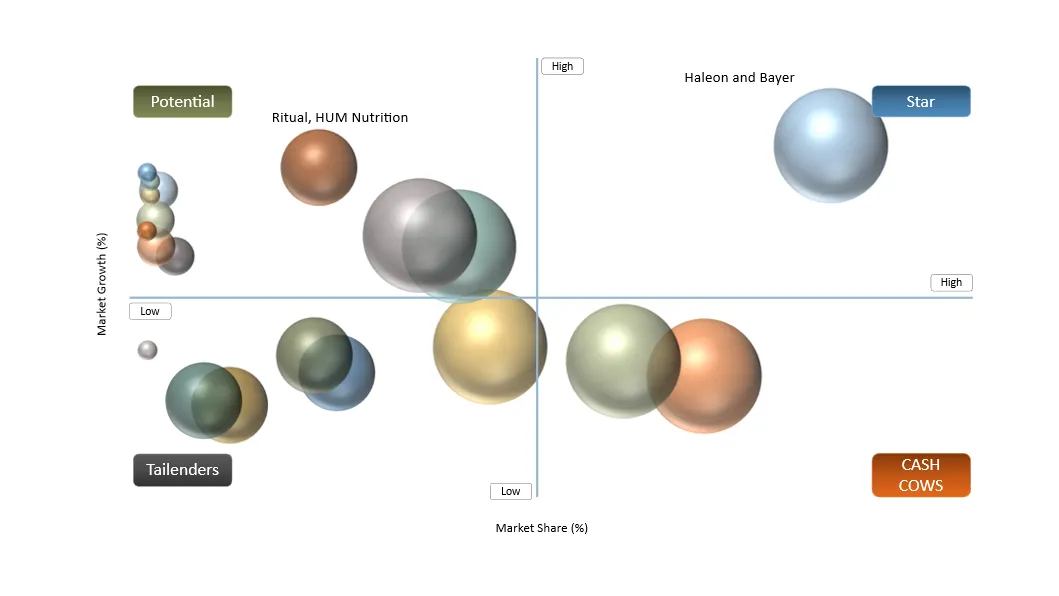
STAR: Haleon and Bayer are positioned as Stars because they combine large consumer-health portfolios, strong pharmacy distribution and established effervescent brands. Hermes Pharma and SIRIO Pharma are positioned as Potential players through specialized formulation and contract-manufacturing capabilities. Perrigo and Reckitt represent Cash Cows in mature self-care categories, while smaller regional manufacturers are Tailenders unless they differentiate through technology, cost or local access.
POTENTIAL: Ritual, HUM Nutrition, Thorne, MegaFood and specialist consumer wellness brands represent Potential players. They benefit from premium positioning, transparent ingredients, digital education and rapid category innovation. Their ability to become Stars depends on maintaining retention, broadening channels and converting brand credibility into sustained profitability. Mature mass-market multivitamin lines function as Cash Cows, while small undifferentiated brands with weak evidence and high paid-media dependence remain Tailenders.
Effervescent Products Market Dynamics
Driver Impact Analysis
| Driver | Growth Impact | Demand Concentration | Impacted Use Case | Strategic Impact |
| Pill fatigue and swallowing difficulty | High | Older adults, children and self-care users | Pharmaceutical and supplement products | Supports drinkable and rapidly dissolving dosage forms. |
| Growth of hydration and sports nutrition | High | Athletes and active consumers | Electrolytes, creatine and recovery | Expands high-frequency consumer use. |
| Formulation technology advances | Medium-High | Brands and CDMOs | High-load and clear-solution products | Broadens active categories and improves sensory quality. |
| Expansion of pharmacies and e-commerce | Medium | Global consumers | OTC and supplement distribution | Improves product discovery and access. |
Driver: Demand for Convenient, Fast-Dissolving Products Expands Category Use
Effervescent products address consumers who dislike swallowing tablets, want rapid preparation or prefer a drinkable experience. The format is particularly relevant for older adults, children, self-care users and active consumers. Growth in hydration, magnesium, vitamin C, creatine and cold-remedy products is expanding usage beyond traditional pharmaceutical niches. The same convenience supports premium positioning and repeat purchase when taste and dissolution performance are consistent.
Restraint Impact Analysis
| Restraint | Drag on Growth | Primary Impact Area | Impacted Use Case | Strategic Impact |
| Moisture sensitivity | High | Manufacturing and shelf life | All effervescent formats | Requires controlled humidity and barrier packaging. |
| High packaging cost | Medium-High | Unit economics | Tubes, sachets and sticks | Raises cost relative to conventional tablets. |
| Taste and sodium constraints | Medium | Consumer acceptance | Daily-use products | Limits active load and formulation flexibility. |
| Regulatory complexity | Medium | Market entry | Pharmaceutical and supplement launches | Requires country-specific claims and dossiers. |
Restraint: Moisture Sensitivity and Specialized Manufacturing Raise Cost
Effervescent systems can react prematurely when exposed to humidity, making controlled manufacturing, low-moisture ingredients and high-barrier packaging essential. These requirements increase capital cost, quality-control effort and packaging expense. Active ingredients may also interact with acids or bicarbonates, while high sodium, poor taste or residue can reduce acceptance. Companies must balance dissolution speed, tablet strength, shelf life and sensory quality without compromising dose accuracy.
Effervescent Products Market Segment Analysis
The global Effervescent Products market is segmented based on Active Category, Product Type, Ingredient Category, Dosage Form, End User, Distribution Channel and region.
By Product Format
Effervescent Tablets Will Remain the Largest Format While Instant Fizzy Tabs Grow Fastest
Effervescent tablets will remain the largest format because they provide precise dosing, strong shelf recognition and compatibility with pharmaceutical and supplement actives. Powders and sachets offer flexibility for larger doses and sports products. Instant fizzy tabs that dissolve directly on the tongue are expected to grow fastest from a small base because they remove the need for water and provide a differentiated sensory experience.
By Active Category
Vitamins and Minerals Will Retain the Largest Revenue Base
Vitamins and minerals lead through established demand for vitamin C, multivitamins, magnesium, calcium, zinc and electrolyte products. Analgesics, cold remedies and antacids remain important pharmaceutical categories. Sports ingredients such as creatine and amino acids are expanding rapidly as solubility and taste technologies improve.
By Application
Pharmaceuticals Will Lead While Sports Nutrition and Hydration Accelerate
Pharmaceutical applications lead because effervescence is well established in analgesics, antacids, respiratory care and prescription products. Dietary supplements form the largest consumer-growth pool. Sports nutrition and hydration are expected to grow fastest as brands launch electrolyte, creatine and recovery products with improved clarity and portability.
By Formulation Technology
Direct Compression Will Lead While Melt Granulation and Coating Gain Adoption
Direct compression leads because it reduces process steps and supports high-volume production when excipients have suitable flow and compressibility. Wet and dry granulation remain important for difficult actives. Twin-screw melt granulation, microencapsulation and coating are gaining attention because they can improve stability, reduce fines, mask taste and protect moisture-sensitive ingredients.
By End User
Pharmaceutical Companies Will Lead While Supplement Brands and CDMOs Grow Fastest
Pharmaceutical companies remain the largest end users because effervescent medicines require validated manufacturing and established distribution. Nutraceutical brands and CDMOs are growing faster as the format expands into hydration, sports nutrition and preventive health. Retailers also use private-label effervescent lines to compete in magnesium, immunity and electrolyte categories.
By Distribution Channel
Online and Direct-to-Consumer Channels Will Gain Share
Pharmacies remain the leading channel for medicines and established consumer-health products. Supermarkets and mass retail support vitamins, minerals and hydration. Online and direct-to-consumer channels are gaining share because they enable rapid product education, flavor-based merchandising and subscription purchasing. B2B channels remain central for CDMO, private-label and institutional contracts.
Effervescent Products Market Geographical Penetration
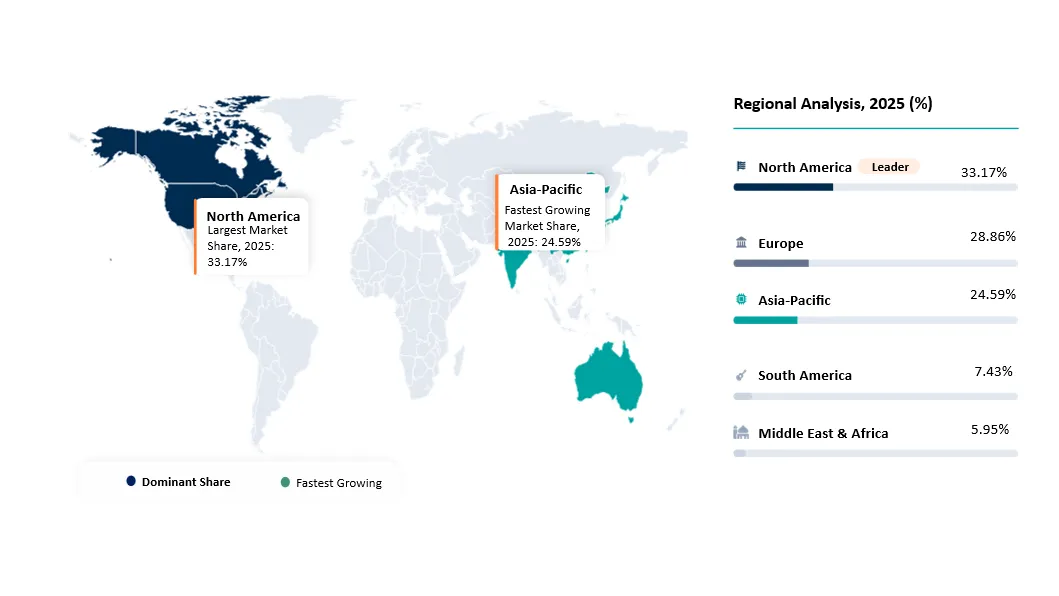
Regional performance differs according to supplement penetration, disposable income, pharmacy structure, regulation, e-commerce adoption and cultural attitudes toward consumers’s health. North America is the largest market, Europe has strong pharmacy and natural-health channels, and Asia-Pacific is the fastest-growing region. South America and Middle East and Africa offer selective opportunities through urban retail, pharmacies and digital commerce.
U.S. Effervescent Products Market Landscape
The U.S. market is expanding through electrolyte powders, sports supplements, magnesium products and direct-to-consumer wellness brands. Tablets remain important in vitamins and OTC products, but sticks and powders are growing faster. Opportunities are strongest in high-load creatine, sugar-free hydration and private-label retail.
Canada Effervescent Products Market Outlook
Canada benefits from pharmacy-led consumer health, sports nutrition and strong demand for convenient vitamin and hydration formats. Bilingual labeling and natural-health-product requirements shape launch planning. Online channels support premium and imported products.
Germany Effervescent Products Market Trends
Germany is one of the most mature effervescent markets, supported by pharmacies, drugstores, private label and specialized manufacturers. Consumers are familiar with vitamin, mineral and analgesic tablets. Growth is shifting toward magnesium, sports nutrition, sugar-free products and sustainable packaging.
UK Effervescent Products Market Outlook
The UK market is supported by pharmacies, supermarkets and e-commerce. Vitamin C, multivitamins, hydration and cold remedies remain important. Retailers are expanding own-label products, while brands differentiate through taste, lower sugar and targeted benefit claims.
France Effervescent Products Market Trends
France has strong pharmaceutical and self-care demand, including analgesics, vitamins and digestive products. Pharmacy distribution and established consumer trust support premium formulations. Opportunities are increasing in sports hydration and high-load supplement products.
Japan Effervescent Products Market Trends
Japan has a smaller traditional effervescent-tablet base than Europe but offers growth in functional foods, sports hydration and convenient oral formats. Compact packaging, flavor quality and on-the-go use are important. Waterless fizzy tabs may fit local preferences for portable functional products.
China Effervescent Products Market Outlook
China is expanding through vitamin C, electrolytes, sports products and online consumer-health sales. Domestic manufacturers are increasing capacity, while imported brands retain premium positioning. Growth depends on regulatory compliance, quality assurance and strong digital marketing.
India Effervescent Products Market Trends
India is a fast-growing manufacturing and consumption market. Pharmaceutical companies, supplement brands and sports-nutrition businesses are launching vitamin, mineral, hydration and immunity products. Local CDMO capacity and lower production costs support export potential.
Australia Effervescent Products Market Outlook
Australia has established pharmacy and supplement channels, with demand for vitamins, electrolytes, magnesium and sports recovery. Consumers value clean labels, lower sugar and evidence-based formulations. E-commerce and practitioner channels support premium products.
Brazil Effervescent Products Market Outlook
Brazil offers growth through pharmacies, sports nutrition, vitamins and hydration. Price sensitivity favors local manufacturing and private label. Opportunities exist in tropical flavors, electrolyte products and broader distribution beyond major cities.
Middle East and Africa Effervescent Products Market Outlook
The region offers demand for hydration, vitamins and self-care products, particularly in Gulf countries and South Africa. Hot climates support electrolyte positioning, while imported products remain important. Local packaging, affordability and pharmacy partnerships are critical.
Effervescent Products Market Competitive Landscape
- Competition includes multinational consumer-health companies, pharmaceutical manufacturers, specialist effervescent CDMOs, excipient suppliers and private-label producers.
- Haleon, Bayer, Reckitt and Perrigo compete through established OTC and supplement brands, while Hermes Pharma, SIRIO and Aenova provide specialized formulation and manufacturing capabilities.
- Differentiation depends on dissolution performance, active-load capability, flavor, sodium and sugar profile, packaging integrity, regulatory support and speed to market.
- Contract manufacturers are strengthening turnkey services that combine formulation, pilot production, scale-up, packaging and dossier support.
- Ingredient suppliers are competing through direct-compression excipients, low-moisture carriers, solubility enhancement and taste masking.
- Regional producers retain advantages in price, local registration and retailer relationships, but must meet rising quality and sustainability expectations.
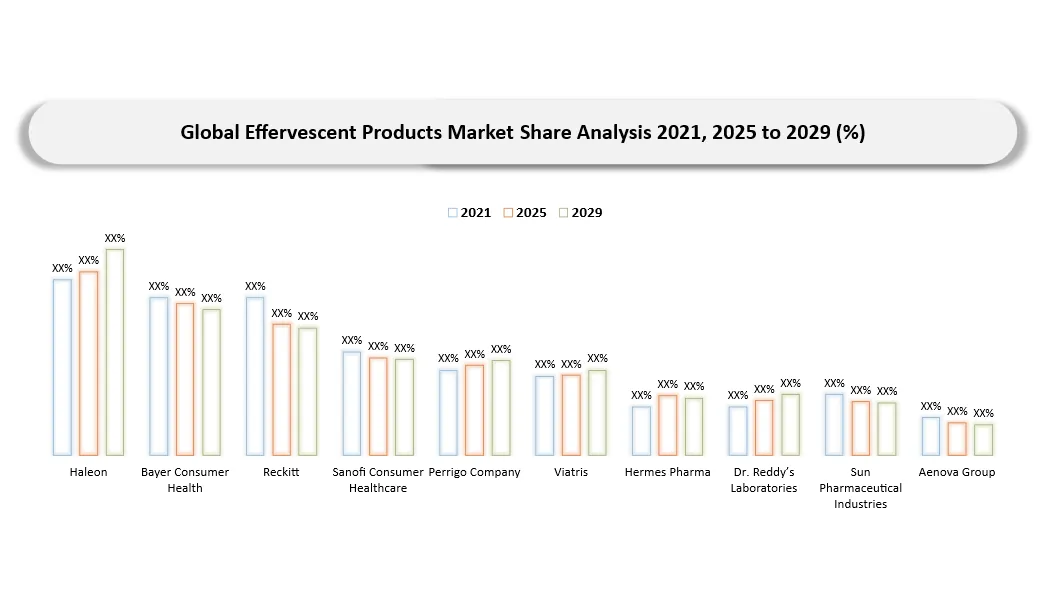
Key Companies of Effervescent Products Market
- Haleon
- Bayer Consumer Health
- Reckitt
- Perrigo Company
- Sanofi Consumer Healthcare
- Viatris
- Hermes Pharma
- SIRIO Pharma
- Aenova Group
- Losan Pharma
- Tower Laboratories
- Nutrilo
- Kendy Pharma
- Laboratoires Famar
- Biofarma Group
- Krka
- Dr. Reddy’s Laboratories
- Sun Pharmaceutical Industries
- Roquette
- SPI Pharma
Effervescent Products Market Major Pain Points
- Moisture sensitivity and risk of premature reaction.
- Higher packaging cost than conventional tablets or powders.
- Taste, sodium and sugar constraints in daily-use products.
- Difficulty achieving clear solutions with high active loads.
- Tablet capping, friability and dissolution variability during scale-up.
- Limited availability of specialized manufacturing in some regions.
- Complex regulatory classification across medicines, supplements and foods.
- Sustainability pressure on plastic tubes and multilayer laminates.
Effervescent Products Market Recent Developments
- June 2026: SIRIO Europe launched a full FizzyBits portfolio of ten instant fizzy-tab formulations spanning metabolic support, joint care, cognition and iron nutrition.
- May 2025: TSI Group introduced OptiClear, an effervescent solubility platform designed to improve clarity, taste and stability for ingredients such as creatine, collagen, vitamins and minerals.
- May 2025: Research published in Pharmaceutics demonstrated twin-screw melt granulation of effervescent tablets using sorbitol as a melt binder, highlighting a potential continuous-manufacturing route.
- April 2025: Roquette introduced KLEPTOSE F 7%, a low-moisture beta-cyclodextrin positioned for dry processing and moisture-sensitive oral formats including effervescent tablets.
- 2025-2026: Consumer-health and supplement manufacturers continued expanding sugar-free, electrolyte, magnesium and sports-nutrition effervescent portfolios across pharmacies and online channels.
- 2025-2026: Brands increased investment in low-sugar gummies, personalized packs, clinically documented probiotics and life-stage-specific formulations.
Analyst View / Opinion on Effervescent Products Market
The Effervescent Products market will continue expanding because the format solves practical issues around swallowing, rapid preparation and sensory engagement. The strongest growth will come from products that move beyond basic vitamin C into magnesium, electrolytes, sports nutrition, high-load actives and waterless formats.
- Effervescent tablets will remain the commercial anchor, but powders, sticks and instant fizzy tabs will gain share.
- Europe will remain the largest market, while Asia-Pacific will lead growth through manufacturing scale and rising self-care demand.
- Clear-solution capability and moisture stability will become more important than novelty alone.
- CDMOs with integrated formulation and packaging will gain negotiating power as brands outsource technical risk.
- Lower-sodium and sustainable-packaging solutions represent meaningful white space.
- Long-term leadership will depend on repeatable sensory quality, regulatory execution and cost-efficient scale.
Effervescent Products Market Target Audience
| Industry | Who Should Buy This Report? | Reason to Buy |
| Pharmaceutical Companies | Portfolio, formulation, commercial and business-development teams | Assess dosage-form opportunities, CDMO partners and regional demand. |
| Nutraceutical Brands | Innovation, product development and category teams | Identify high-growth actives, formats and channels. |
| CDMOs | Strategy, capacity planning and sales teams | Evaluate outsourcing demand and technology investment. |
| Excipient Suppliers | Technical service, sales and application-development teams | Prioritize direct-compression, solubility and moisture-control opportunities. |
| Packaging Companies | Tube, sachet, stick-pack and desiccant suppliers | Assess high-barrier packaging demand and sustainability gaps. |
| Retailers and Distributors | Private-label, pharmacy and e-commerce teams | Develop differentiated assortments and sourcing strategies. |
| Investors and Consultants | Private equity, venture capital and advisory firms | Evaluate market growth, competitive positioning and investment white space. |
Why Choose DATAM?
- Data-driven forecasts combining consumer penetration, spend, life-stage demand, channel mix and product economics.
- Post-purchase analyst consultations for portfolio strategy, market entry, partner identification and custom modeling.
- Annual updates covering launches, regulation, retail expansion, partnerships and competitive changes.
- Specialized focus on emerging markets and country-level channel dynamics.
- Actionable analysis connecting formulation, evidence, consumer need and commercial execution.
What DATAM Uniquely Provides
- Ten-year forecasts across functional benefit, product type, ingredient, dosage form, consumer group, channel and region.
- Life-stage analysis separating reproductive, prenatal, active lifestyle, weight-management support, healthy aging and healthy-aging demand.
- Buyer-focused analysis of evidence, quality, pricing, retention and channel economics.
- Country-level views linking consumer behavior, regulation, retail and e-commerce.
- Strategic recommendations for portfolio development, partnerships and market entry.
Questions This Report Answers
- How will the global Effervescent Products market evolve through 2035?
- Which functional benefits and product types offer the strongest growth?
- How quickly will healthy aging, microbiome and personalized nutrition categories expand?
- Which ingredients and dosage forms are gaining adoption?
- How are online, direct-to-consumer and pharmacy channels changing competition?
- Which regions offer the strongest growth and profitability?
- How should companies build life-stage portfolios and evidence strategies?


























































