


Edge AI Microcontroller Market Size and Overview
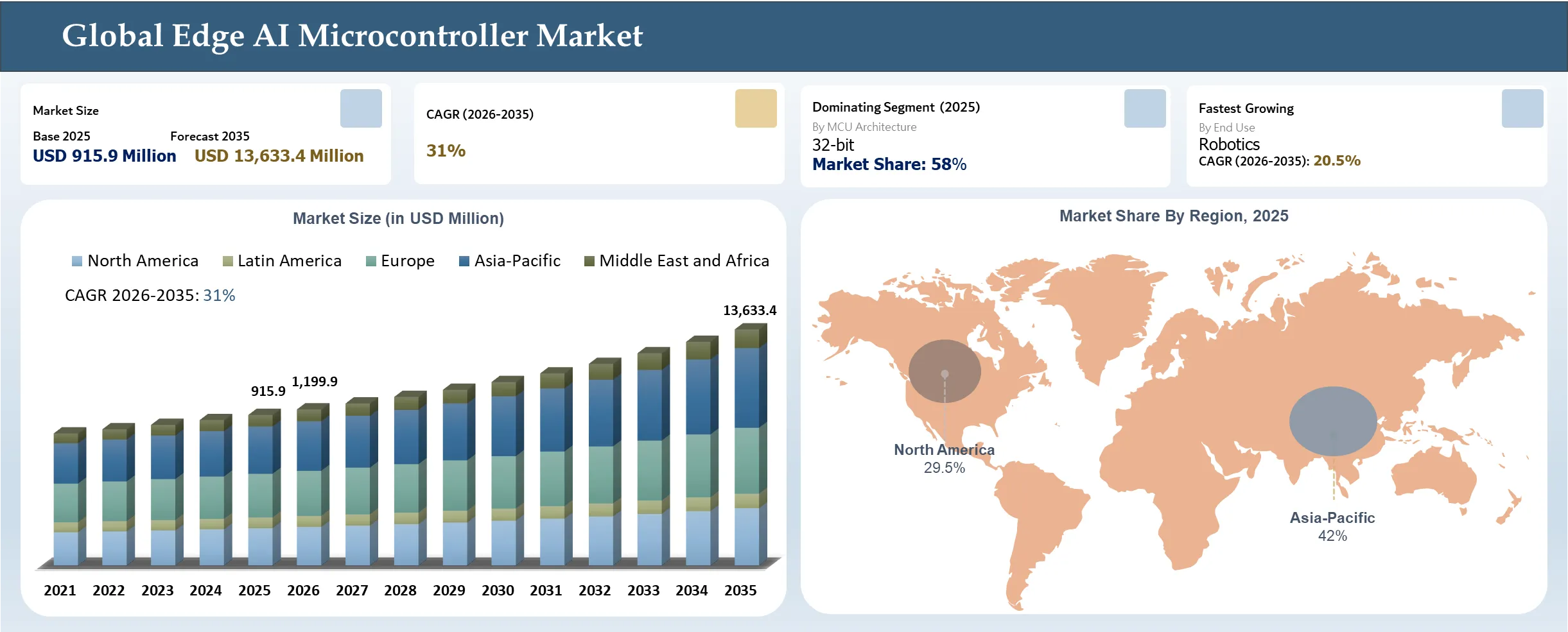
The global edge AI microcontroller market reached USD 915.9 million in 2025 and is expected to reach USD 13,633.4 million by 2035, growing with a CAGR of 31% during the forecast period 2026-2035. The market is expanding as manufacturers integrate dedicated neural-processing capabilities into microcontrollers to execute AI inference locally with lower latency and power consumption. The technology is becoming popular in automotive electronics, industrial automation, smart sensors, consumer electronics, and Internet of Things devices that require real-time processing without depending on cloud computing.
Automotive use cases are emerging as an important field of application for edge AI microcontrollers because of the need for localised intelligence in vehicles, as software-defined cars need sensing, controlling, and predicting capabilities. In February 2026, STMicroelectronics introduced the Stellar P3E, which is an automotive microcontroller that includes the company’s ST Neural-ART Accelerator that processes AI-based workloads.
According to STMicroelectronics, this device provides AI inference processing at microsecond speeds and 30x the efficiency of typical MCU cores, enabling always-on, low-power AI for applications in predictive maintenance and smart sensing. The microcontroller features 500 MHz Arm Cortex-R52+ cores, delivering more than 8,000 points of CoreMark performance, while the device's AI acceleration enables sub-millisecond decision-making for edge vehicle intelligence.
White-Space Opportunities for Edge AI Microcontroller Market Through Government Investment in AI Hardware, Inference Chips, and Semiconductor Innovation
In June 2026, the UK Government announced a more than £1.1 billion (USD 1.47 billion) AI Hardware Plan to strengthen domestic AI-chip and semiconductor capabilities, creating opportunities across AI hardware innovation, next-generation processors, inference chips, semiconductor skills, prototyping, testing, procurement, and commercialisation. The highest investment area is the national AI supercomputer, receiving £750 million (USD 1.00 billion), including £400 million (USD 534 million) for next-generation AI chips, of which £150 million (USD 200 million) is committed to purchasing novel inference chips from innovative startups and UK chip-design companies.
Another major opportunity is the £120 million (USD 160 million) AI Hardware Innovation Programme, supporting chip design, development, prototyping, collaborative R&D, testing, and commercialisation, with at least £20 million (USD 27 million) allocated to expand the Scaling Inference Lab. The government is also providing £150 million (USD 200 million) through the British Business Bank as a cornerstone investment in a new UK AI-hardware venture fund led by Playground Global, while £80 million (USD 107 million) is being made available for AI-hardware and semiconductor skills, including £45 million (USD 60 million) in new skills support.
The investment is expected to create opportunities for companies across the AI-hardware and semiconductor ecosystem, particularly in chip design, AI accelerators, inference computing, semiconductor IP, advanced connectivity, and AI-compute infrastructure. Arm can benefit in processor architecture, CPU IP and chip-design capabilities, while Graphcore can support opportunities in AI accelerator and inference-processing technologies.
Fractile can benefit from its work on AI inference hardware and specialised AI computing, while Olix can participate in advanced AI-chip development and inference applications. Oriole Networks can benefit in optical interconnects and high-speed data movement between processors, while Callosum can gain opportunities in heterogeneous computing and specialised AI hardware.
EnSilica and Alphawave Semi can benefit from semiconductor design, connectivity IP and custom silicon development, while Imagination Technologies can support AI acceleration through its processor and semiconductor IP technologies. XMOS can benefit in edge AI, intelligent processing and low-power embedded computing, creating a closer connection with the edge-AI hardware ecosystem.
Edge AI Microcontroller Market Key Takeaways
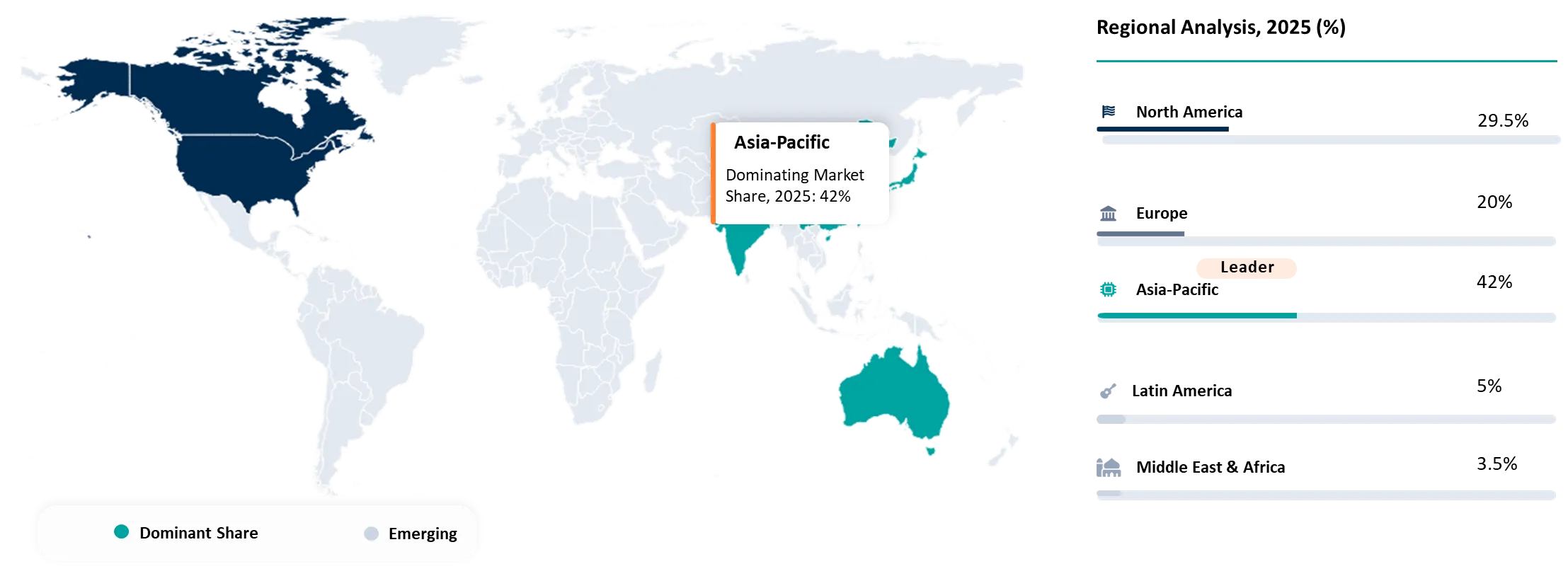
- Asia-Pacific led the global market with a 42% share in 2025, supported by extensive semiconductor manufacturing and electronics production.
- The 32-bit MCU architecture held the dominant position with a 58% market share in 2025 due to its superior computational capacity.
- Growing demand for real-time on-device AI processing accounts for a 25% market growth impact across key sectors like industrial automation and IoT.
- The UK Government launched a £1.1 billion (USD 1.47 billion) AI Hardware Plan in June 2026 to boost domestic chip capabilities.
Edge AI Microcontroller Market Industry Trends and Strategic Insight
- NPU integration is becoming a core MCU architecture strategy. Manufacturers are embedding dedicated neural-processing accelerators directly into MCU architectures to execute AI workloads without displacing deterministic control functions.
- MCUs are moving from control-centric devices toward heterogeneous AI platforms. New architectures increasingly combine real-time CPU cores, AI acceleration, sensing, memory, connectivity, security, and control peripherals within a unified device.
- TinyML is driving model optimisation for resource-constrained endpoints. Developers are prioritising compact neural networks, quantization, optimised inference pipelines, and memory-efficient models so AI can operate within the restricted power and memory budgets of embedded MCUs.
- Edge AI ecosystems are becoming increasingly partner-driven. Semiconductor companies are expanding relationships with AI-model developers, embedded software providers, deployment specialists, and system integrators to address the complete AI lifecycle from model creation and optimisation through production deployment.
- In-memory and sensor-level computing represent the next architectural frontier. MCU development is increasingly exploring architectures that minimise data movement by bringing computation closer to memory and sensing elements, addressing the energy and latency penalties associated with repeatedly transferring sensor data to external processors.
Edge AI Microcontroller Market Scope
| Metrics | Details | |
| 2025 Market Size | USD 915.9 Million | |
| 2035 Projected Market Size | USD 13,633.4 Million | |
| CAGR (2026-2035) | 31% | |
| Largest Market | Asia-Pacific | |
| Fastest Growing Market | Asia-Pacific | |
| By MCU Architecture | 8-bit, 16-bit, 32-bit | |
| By Processor | Arm Cortex-M0/M0+, Arm Cortex-M4, Arm Cortex-M7, Arm Cortex-M33, Arm Cortex-M55/M85, Others | |
| By Connectivity | Wi-Fi, Bluetooth, Ethernet, Zigbee / Thread, Others | |
| By Power Consumption | Ultra-Low Power, Low Power, Standard Power | |
| By End Use | Smart Appliances, Industrial Automation, Automotive Electronics, Security & Surveillance, Robotics, IoT, Energy & Utilities, Others | |
| By Region | North America | U.S., Canada, Mexico |
| Europe | Germany, UK, France, Spain, Italy, Poland, Netherlands, Switzerland | |
| Asia-Pacific | China, India, Japan, Australia, South Korea, Indonesia, Malaysia | |
| Latin America | Brazil, Argentina | |
| Middle East and Africa | UAE, Saudi Arabia, South Africa, Israel, Türkiye | |
| Report Insights Covered | Competitive Landscape Analysis, Company Profile Analysis, Market Size, Share, Growth | |
Edge AI Microcontroller Market Disruption Analysis
Transition from Conventional MCUs to Production-Ready Full-Stack Edge AI Platforms
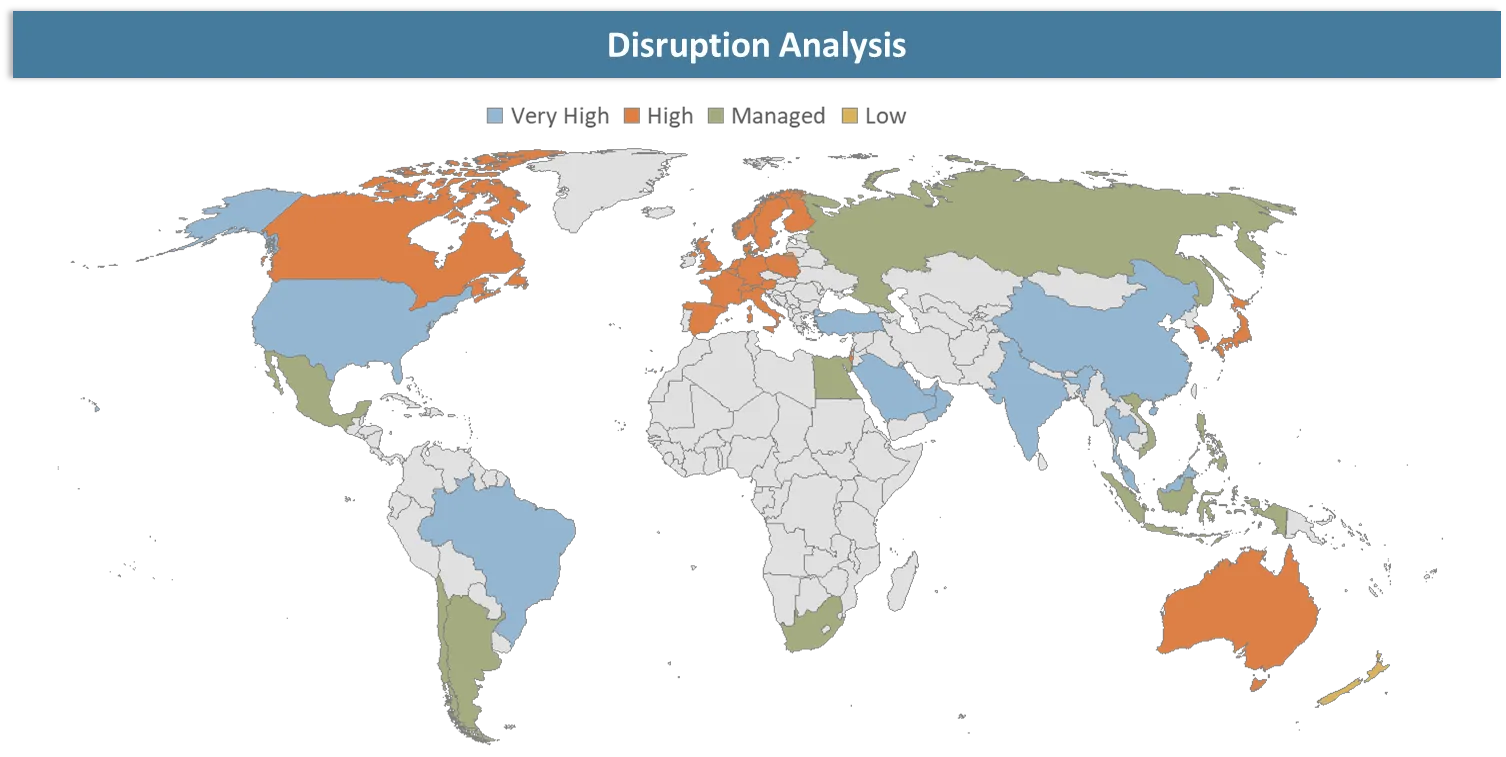
The market disruption is mostly driven by the transition from conventional control-oriented microcontrollers toward intelligent endpoint devices capable of sensing, processing, and making decisions locally. Such an evolution reduces the reliance of latency-sensitive applications on centralised processing systems as well as cloud infrastructure, and helps move the AI capabilities closer to sensors, actuators, motors, and other such data-producing devices.
The emergence of production-ready full-stack edge AI platforms that are ready for production is helping accelerate this disruption because of their ability to shorten the difference between AI models’ development and deployment on constrained microcontrollers. In February 2026, Microchip Technology introduced full-stack Edge AI platforms featuring silicon, software, development tools, pre-trained deployable models, and application code, with applications falling into four categories: arc-fault detection in electrical devices, prediction of equipment failure, facial recognition together with liveness detection, and keyword spotting. The company also showed a development path in which an AI system can be developed from proof-of-concept projects using 8-bit MCUs to production systems using 16-bit and 32-bit MCUs.
Edge AI Microcontroller Market BCG Matrix: Company Evaluation
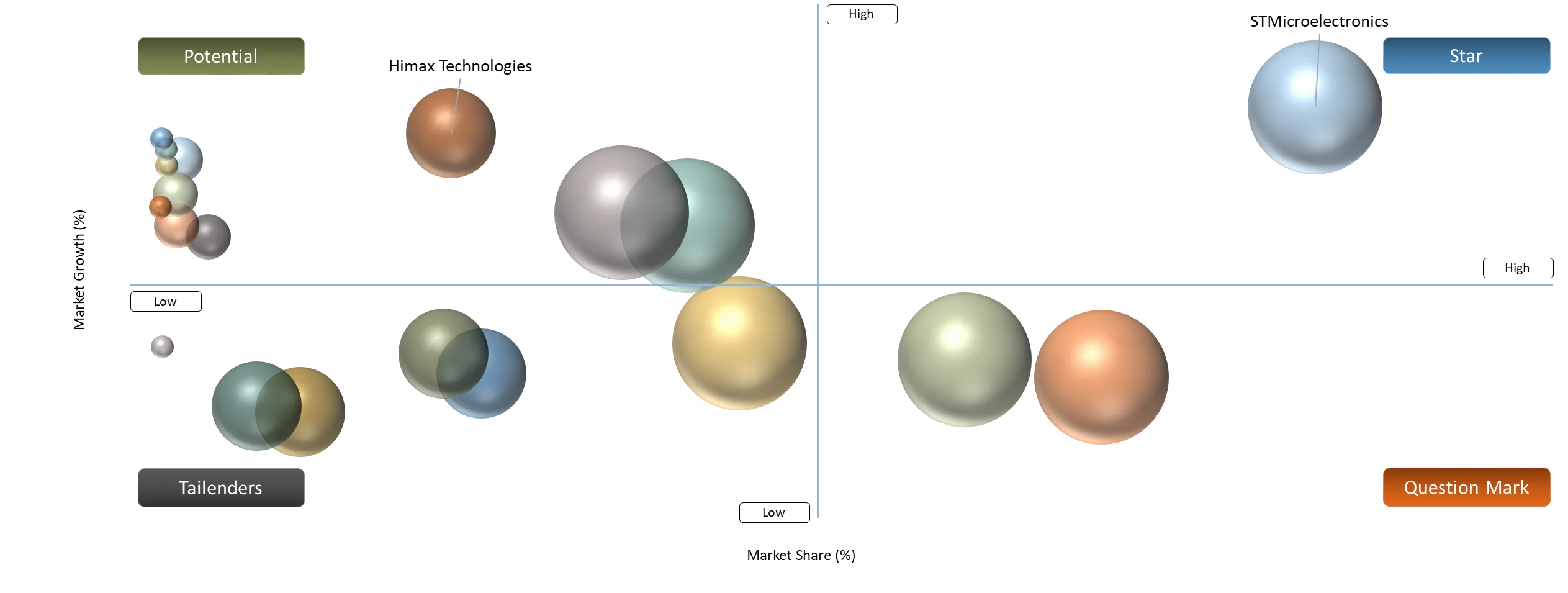
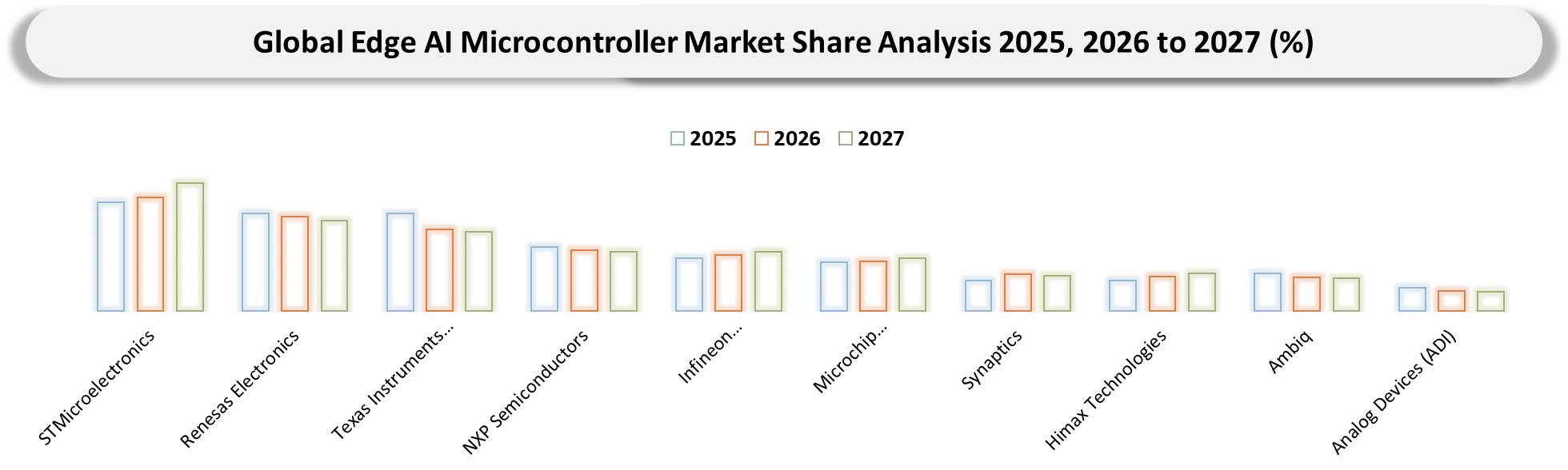
Stars include STMicroelectronics, Renesas Electronics, Texas Instruments (TI), NXP Semiconductors, and Infineon Technologies, as these companies have established strong positions in AI-enabled MCU architectures while actively expanding NPU integration, software ecosystems, and application coverage. Question Marks include Microchip Technology and Synaptics, which are making substantial investments in Edge AI but are competing in a rapidly developing market where long-term MCU market positioning is still evolving.
Potential includes Himax Technologies and Ambiq, which have differentiated Edge AI MCU technologies but operate with comparatively narrower market coverage than the leading diversified MCU suppliers. Tailenders include Analog Devices (ADI) within this selected top-10 comparison because its Edge AI microcontroller presence is more specialised around low-power inference applications rather than broad-based MCU market coverage.
Edge AI Microcontroller Market Dynamics
Driver Impact Analysis
| Driver | Market Growth Impact (%) | Demand Concentration | Impacted Use Case | Strategic Impact |
Growing demand for real-time on-device AI processing is driving adoption of Edge AI microcontrollers. | 25% | High concentration in industrial automation, IoT, consumer electronics, automotive, and smart devices | Real-time sensing, predictive maintenance, smart appliances, wearables, robotics, automotive monitoring | Shifts AI inference from cloud/central processors toward localised, low-latency and power-efficient endpoint intelligence, increasing demand for AI-capable MCUs. |
Integration of dedicated NPUs and AI accelerators into microcontrollers is increasing AI inference performance. | 24% | High concentration in AI-enabled industrial equipment, vision systems, robotics, wearables, and intelligent control | Computer vision, voice recognition, anomaly detection, adaptive motor control, sensor analytics | Makes AI inference practical on resource-constrained MCUs by improving latency, energy efficiency, and processing capability, encouraging migration from conventional MCUs. |
Rising deployment of AI-enabled IoT devices is expanding demand for compact microcontrollers capable of performing local sensing, analytics, and intelligent control. | 22% | High concentration in smart home, industrial IoT, connected buildings, consumer devices, and smart sensing | Smart appliances, environmental sensing, security devices, industrial sensors, connected controllers | Expands the addressable application base for Edge AI MCUs by embedding intelligence into smaller, lower-power, and continuously operating endpoints. |
Advances in AI software development ecosystems for MCUs are reducing the complexity of deploying machine-learning models and accelerating commercial adoption of Edge AI microcontrollers. | 17% | High concentration among embedded developers, industrial OEMs, consumer electronics manufacturers, and IoT solution providers | Model training and deployment, anomaly detection, keyword spotting, image classification, AI-enabled control | Reduces development barriers through integrated AI tools, model libraries, software frameworks and deployment environments, shortening the path from prototype to commercial Edge AI products. |
Growing demand for real-time on-device AI processing is driving adoption of Edge AI microcontrollers
The increasing need for immediate intelligence at the device level is accelerating the adoption of edge AI microcontrollers across industrial automation, smart sensing, consumer electronics, automotive systems, and IoT applications. While traditional microcontrollers only perform control-related functions, Edge AI microcontrollers can handle sensor data, perform machine learning operations, and make decisions locally. Such an approach minimises cloud and computing dependencies as well as enhances the performance of time-sensitive applications.
In parallel, the developments in AI accelerator technology are enhancing the capability of microcontrollers to carry out real-time inference in power- and resource-constrained devices. In March 2026, Texas Instruments (TI) introduced new microcontrollers equipped with TinyEngine NPU, which offers up to 90 times less latency and over 120 times less energy consumption per AI inference as compared to other MCUs without the accelerator. TI has additionally enhanced its CCStudio Edge AI Studio ecosystem to offer more than 60 AI models and application use cases, through which developers can choose, train, optimise, and deploy AI models on embedded devices.
Restraint Impact Analysis
| Restraint | Drag on Market Growth (%) | Primary Impact Area | Impacted Use Case | Strategic Impact |
Limited memory and computational resources constrain the ability of Edge AI microcontrollers to run increasingly complex AI models and data-intensive workloads. | 26% | Memory capacity, compute performance, model size, and AI workload complexity | Computer vision, multimodal sensing, advanced anomaly detection, industrial AI, intelligent IoT | Drives demand for larger on-chip memory, NPUs, model compression, quantisation, and external-memory interfaces to execute more complex AI workloads within MCU constraints. |
Strict power and thermal constraints limit the performance of AI inference in compact, battery-powered microcontroller-based devices. | 23% | Power consumption, thermal management, battery life, and sustained inference | Wearables, portable medical devices, smart sensors, battery-powered IoT, always-on voice/vision devices | Encourages adoption of ultra-low-power NPUs, duty-cycled processing, heterogeneous cores, and hardware acceleration to maintain AI functionality without excessive energy consumption. |
Higher AI hardware and development costs can restrict adoption where manufacturers require dedicated AI accelerators, additional memory, or specialized system components. | 18% | Bill of materials, AI accelerator integration, memory, and product development | Cost-sensitive IoT devices, consumer electronics, smart appliances, industrial sensors | Creates pressure for integrated single-chip AI solutions and lower-cost AI-enabled MCUs that reduce external components and system-level costs. |
Higher AI hardware and development costs can restrict adoption where manufacturers require dedicated AI accelerators, additional memory, or specialised system components. | 18% | Development complexity, model optimisation, software tools, and engineering resources | AI-enabled embedded products, industrial automation, predictive maintenance, intelligent sensing | Increases the strategic importance of integrated AI development ecosystems, model-optimisation tools, reference designs, and ready-to-deploy software. |
Limited memory and computational resources constrain the ability of Edge AI microcontrollers to run increasingly complex AI models and data-intensive workloads
Limited memory capacity and computational resources remain a significant restraint on the adoption of edge AI microcontrollers as AI models become increasingly complex and data-intensive. Microcontrollers are not capable of running complex AI models, unlike cloud or HPC environments, since the former is resource-constrained. Implies that the microcontroller lacks the capacity to run complex neural networks, vision models with high resolution, and multimodal AI systems in real time. The sophistication of AI systems has shifted from basic functionalities such as classification and keyword detection towards continuous sensing, vision, and multimodal reasoning.
In addition, the memory architecture required to support AI workloads creates trade-offs between processing performance, power consumption, and available memory capacity. In December 2025, Infineon Technologies highlighted that the PSoC Edge architecture includes two 512 KB SRAM sections, 5,120 KB of System SRAM, 512 KB of RRAM, and 256 KB each of instruction and data tightly coupled memory (ITCM and DTCM). The MCU also supports external memory expansion through its Serial Memory Interface, with each SMIF interface addressing up to 64 MB and two interfaces providing up to 128 MB of external memory.
Edge AI Microcontroller Market Segment Analysis
The global edge AI microcontroller market is segmented based on MCU architecture, processor, connectivity, power consumption, end use, and region.
Growing Integration of AI Acceleration in 32-bit MCUs Strengthening Their Dominance in Edge AI Applications
The 32-bit MCU architecture segment dominates the edge AI microcontroller market, with a 58% market share in 2025, due to the rising need for increased processing power, more memory space, real-time control, and artificial intelligence functions in intelligent edge devices. 32-bit microcontrollers, in contrast to 8-bit and 16-bit microcontrollers, offer enough computational capacity to run machine learning algorithms along with other functions such as sensing, connectivity, security, and control. The use of 32-bit MCU architecture in industrial automation, smart appliances, robotics, automotive electronics, surveillance, and IoT has boosted its position.
The transition of 32-bit MCUs to become dedicated AI accelerators is going to be yet another reason for 32-bit MCUs to dominate the edge AI microcontroller market. In July 2025, Renesas Electronics introduced the RA8P1 family of MCUs, featuring a 1 GHz Arm Cortex-M85 CPU, a 250 MHz Cortex-M33 CPU, and an Arm Ethos-U55 NPU. It is capable of delivering over 7,300 CoreMarks of CPU processing power and up to 256 GOPS of AI processing power at 500 MHz, while the Ethos-U55 can deliver up to 35× more inferences per second than the Cortex-M85 processor alone, depending on the neural network used. Other key features include 2 MB of SRAM and 1 MB of on-chip MRAM along with 4 MB and 8 MB of external Flash SIP.
Edge AI Microcontroller Market Geographical Penetration
Accelerating Edge AI Investment and Semiconductor Ecosystem Expansion in Asia-Pacific Strengthening Regional Dominance
The Asia-Pacific region dominates the edge AI microcontroller market, accounting for a 42% market share in 2025, supported by its concentration of semiconductor manufacturing, MCU development, electronics production, and rapidly expanding AI and IoT ecosystems across China, Taiwan, Japan, South Korea, and Southeast Asia. The region benefits from an established semiconductor supply chain spanning IC design, wafer manufacturing, packaging, testing, and electronics assembly, creating favourable conditions for the commercialisation of AI-enabled microcontrollers.
The Asia-Pacific Edge AI Microcontroller market is witnessing growing adoption of AI-integrated, low-power MCU architectures designed to enable real-time intelligence at the device level. In October 2025, Nuvoton Technology Corporation (Taiwan), a semiconductor and microcontroller manufacturer, launched its NuMicro M55M1 AI MCU, an endpoint-AI microcontroller integrating an Arm Cortex-M55 core operating at up to 220 MHz and an Arm Ethos-U55 NPU delivering up to 110 GOPS of AI computing power. The 32-bit MCU provides up to 1.5 MB SRAM and 2 MB Flash, with applications spanning AI data recognition, intelligent audio, predictive maintenance, medical sensing, image recognition, and other edge-AI use cases.
China Edge AI Microcontroller Market Trends
China holds a dominant position in the Asia-Pacific edge AI microcontroller market due to its extensive electronics manufacturing base, large semiconductor ecosystem, and rapid commercialisation of AI-enabled consumer, industrial, automotive, and IoT devices. The country's combination of semiconductor design, MCU development, electronics manufacturing, and downstream application industries provides a broad environment for deploying microcontrollers with local AI processing capabilities.
China’s Edge AI Microcontroller market is advancing through the commercialisation of RISC-V-based MCUs with integrated NPU acceleration for intelligent embedded applications. In November 2025, Suzhou C*Core Technology Co., Ltd., a China-based semiconductor and embedded-chip design company, reported that its CCR4001S AI MCU had entered mass production and shipment for commercial air-conditioning applications. The chip uses a 230 MHz RISC-V CRV4H core and integrates a 0.3 TOPS@INT8 NPU, enabling real-time AI functions such as object recognition, target detection, and image classification for edge-AI applications.
Japan Edge AI Microcontroller Market Outlook
Japan is a significant country in the Asia-Pacific edge AI microcontroller market, supported by its established semiconductor industry, strong automotive and industrial electronics base, and presence of leading MCU manufacturers such as Renesas Electronics. The country is increasingly shifting from conventional embedded control toward AI-capable microcontrollers that can perform inference and real-time analytics locally.
Japan’s Edge AI Microcontroller market is advancing toward high-performance MCU architectures with integrated AI acceleration for real-time endpoint intelligence. In July 2025, Renesas Electronics Corporation, a Japan-based semiconductor and microcontroller manufacturer, launched its RA8P1 AI microcontroller series for edge and endpoint AI applications. The 32-bit MCUs combine a 1 GHz Arm Cortex-M85, optional 250 MHz Cortex-M33, and Arm Ethos-U55 NPU, delivering more than 7,300 CoreMarks and up to 256 GOPS of AI performance; the NPU can provide up to 35× more inferences per second than the Cortex-M85 alone.
Accelerating Semiconductor Investment and Edge AI Commercialisation Strengthening North America's Market Position
The North America region accounts for a 29.5% share of the edge AI microcontroller market in 2025, supported by its strong semiconductor design ecosystem, high concentration of embedded-processing companies, and early commercialization of AI-enabled industrial, automotive, consumer, and IoT applications. The region benefits from established MCU and semiconductor developers, including Texas Instruments and Microchip Technology, alongside a large base of AI, robotics, data-center, and industrial automation companies.
North America’s Edge AI Microcontroller market is advancing through ultra-low-power processing architectures optimised for always-on, on-device intelligence. In October 2025, Ambiq Micro, Inc., a U.S.-based ultra-low-power semiconductor and AI solutions company, launched its Apollo510 Lite SoC series for always-on Edge AI applications. The SoCs feature an Arm Cortex-M55 processor operating at up to 250 MHz, 2 MB RAM and 2 MB non-volatile memory, and deliver more than 16× faster performance and up to 30× better AI energy efficiency than comparable Cortex-M4/M33 solutions.
U.S. Edge AI Microcontroller Market Trends
The U.S. holds a dominant position in the North America edge AI microcontroller market due to its strong semiconductor design ecosystem, established MCU manufacturers, advanced AI-development capabilities, and early commercialisation of intelligent embedded systems. The presence of major U.S.-based semiconductor companies such as Texas Instruments and Microchip Technology supports continuous innovation in AI-enabled microcontrollers, while demand from industrial automation, automotive electronics, robotics, consumer devices, and connected systems is accelerating the deployment of local AI inference.
North America’s Edge AI Microcontroller market is witnessing strategic consolidation around AI-native, low-power processing platforms designed for intelligent edge applications. In September 2026, Analog Devices, Inc. (ADI), a U.S.-based semiconductor company, announced the acquisition of Alif Semiconductor, a U.S.-based Edge AI microcontroller and fusion-processor company, for USD 1.35 billion in cash, with up to USD 200 million in additional contingent consideration. Alif’s AI-native platform integrates low-power neural processing, NPUs, connectivity, security, and intelligent power management, supporting real-time sensor fusion and on-device AI inference across industrial, robotics, healthcare, and wearable applications.
Edge AI Microcontroller Market Competitive Landscape
- The market is characterised by three key participant groups: leading MCU manufacturers with integrated AI acceleration, AI-native microcontroller specialists, and semiconductor companies expanding intelligent edge-processing capabilities. STMicroelectronics, Renesas Electronics, Texas Instruments (TI), NXP Semiconductors, and Infineon Technologies lead the market through broad MCU portfolios, dedicated AI accelerators or NPUs, and established embedded software ecosystems. Renesas Electronics is strengthening AI-enabled MCU performance through its RA8P1 platform, while Infineon Technologies is combining PSoC Edge MCUs with Cortex-M55 processors, Ethos-U55 microNPUs, and AI model-development workflows. Companies such as Microchip Technology extend the market through full-stack Edge AI solutions, while Synaptics, Himax Technologies, and Ambiq focus on AI-native, vision, sensing, and ultra-low-power endpoint applications. Analog Devices (ADI) complements the landscape through embedded AI and intelligent sensing solutions.
- Key players include STMicroelectronics (Switzerland), Renesas Electronics (Japan), Texas Instruments (U.S.), NXP Semiconductors (Netherlands), Infineon Technologies (Germany), Microchip Technology (U.S.), Synaptics (U.S.), Himax Technologies (Taiwan), Ambiq (U.S.), and Analog Devices (U.S.).
Key Developments
- August 202: Renesas Electronics Corporation, a Japan-based semiconductor company specializing in microcontrollers, microprocessors, and embedded solutions, expanded its MCU/MPU portfolio for Edge AIoT applications with the RA8P1 AI MCU.
- October 2025: Qualcomm Technologies, Inc., a U.S.-based semiconductor and wireless technology company, announced plans to acquire Arduino S.r.l., an Italy-based open-source hardware and embedded development platform company, to expand access to Edge AI technologies.
- July 2025: Nota AI, a South Korea-based AI optimisation and on-device AI company, partnered with Renesas Electronics Corporation, a Japan-based semiconductor and microcontroller manufacturer, to deploy an optimised Driver Monitoring System (DMS) on Renesas’ RA8P1 MCU.
- September 2025: AiM Future, Inc., a South Korea-based AI semiconductor design company, signed an MOU with Franklin Wireless Corp., a U.S.-based wireless connectivity and IoT hardware/software company, to jointly develop a lightweight AI model for high-performance MCU platforms such as the STM32N6x7 series and a 1 TOPS AI SoC chipset.
- August 2026: Rutronik Elektronische Bauelemente GmbH, a Germany-based broadline electronic-component distributor, signed a franchise agreement with GigaDevice Semiconductor Inc., a Singapore-based fabless semiconductor company specialising in 32-bit microcontrollers, sensors, analogue products, and Flash memory.
Key Procurement Priorities and Buyer Evaluation Criteria
- Organisations procuring Edge AI microcontrollers increasingly select suppliers based on their ability to provide integrated AI acceleration, real-time processing, low-power operation, and sufficient memory resources within compact MCU architectures suitable for intelligent endpoint devices.
- The decision-making process is increasingly influenced by the growing deployment of on-device AI, TinyML, intelligent IoT, autonomous systems, industrial automation, robotics, automotive electronics, and smart appliances, requiring microcontrollers that can execute AI workloads locally while maintaining deterministic control and low latency.
- Buyers consider factors such as NPU or AI accelerator performance, CPU architecture, memory capacity, power consumption, inference efficiency, connectivity options, security features, operating-temperature range, product reliability, and development-tool compatibility when selecting an Edge AI microcontroller supplier.
Why Choose DataM?
- Technological Innovations: Explores advancements in Edge AI microcontrollers, including integrated NPUs, AI accelerators, heterogeneous processing architectures, TinyML optimisation, low-power inference, and AI-enabled 32-bit MCU platforms, supporting real-time intelligence across IoT, industrial automation, automotive, robotics, smart appliances, and connected devices.
- Product Performance & Market Positioning: Evaluates how different players differentiate Edge AI microcontrollers based on AI inference performance, processing architecture, memory capacity, power efficiency, latency, connectivity, security, and software support, highlighting how leading companies position solutions across ultra-low-power, general-purpose, industrial, automotive, and high-performance edge applications.
- Real-World Evidence: Highlights the deployment of Edge AI microcontrollers in predictive maintenance, intelligent sensing, voice and vision recognition, robotics, smart appliances, automotive electronics, wearables, and industrial control systems, demonstrating their ability to perform real-time inference locally while reducing dependence on cloud processing.
- Market Updates & Industry Changes: Tracks key developments such as new AI-enabled MCU launches, NPU integration, expanded AI software ecosystems, automotive Edge AI platforms, multimodal processing, and semiconductor technology advancements across Asia-Pacific, North America, and Europe, supporting analysis of the transition from conventional embedded control toward intelligent edge processing.
- Competitive Strategies: Analyses how leading companies strengthen their market positions through AI accelerator integration, MCU portfolio expansion, software and development-tool ecosystems, strategic partnerships, application-specific solutions, and hardware-software co-optimisation to address increasing demand for localised AI intelligence.
- Pricing & Market Access: Evaluates pricing differences based on MCU architecture, AI acceleration capability, memory capacity, power efficiency, connectivity, package configuration, and application requirements, along with market access through semiconductor manufacturers, distributors, embedded design ecosystems, development platforms, and technology partners.
- Market Entry & Expansion: Identifies growth opportunities driven by AI-enabled IoT, industrial automation, automotive electronics, robotics, smart appliances, wearables, intelligent sensors, and other resource-constrained edge devices, while outlining strategies such as low-power AI integration, NPU-enabled product development, software ecosystem expansion, application-specific optimisation, and regional semiconductor partnerships to scale Edge AI microcontroller adoption globally.
Target Audience 2026
- Microcontroller & Semiconductor Manufacturers
- AI & Embedded Technology Developers
- Industrial Automation & Manufacturing Companies
- Automotive OEMs & Tier-1 Suppliers
- Consumer Electronics & Smart Appliance Manufacturers
- IoT & Connected Device Companies
- Robotics & Intelligent Machine Developers


























































