


Dysprosium Market Size and Overview
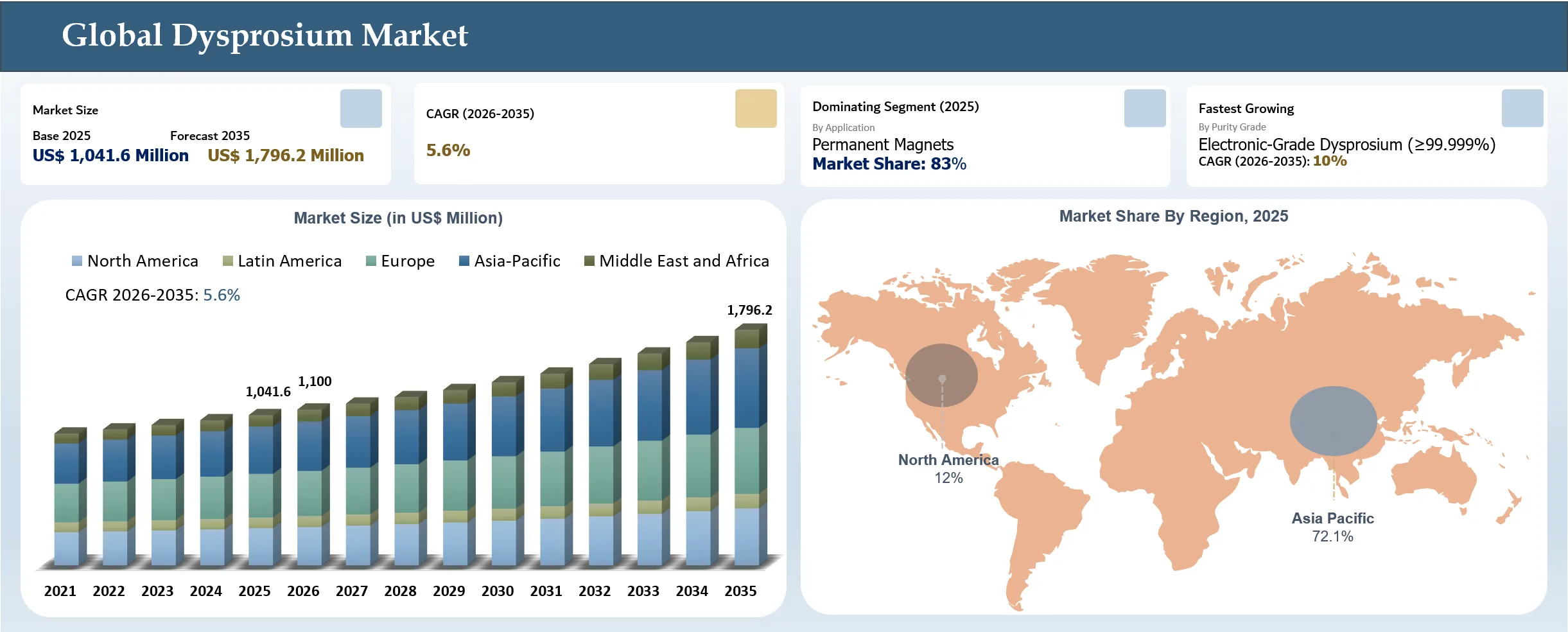
The global Dysprosium market reached USD 1,041.6 million in 2025 and is expected to reach USD 1,796.2 million by 2035, growing with a CAGR of 5.6% during the forecast period 2026-2035. Market growth is supported by increasing demand for high-coercive force permanent magnets utilized in electric vehicles' traction engines, offshore wind turbines, automation equipment, and sophisticated defense applications. In terms of electric vehicle growth, the IEA Global EV Outlook 2026 report states that the sales of electric cars amounted to over 20 million units in 2025, which was 25% of all new cars sold worldwide, and the Chinese share of global electric vehicle manufacturing was almost 75%, whereas the share of battery cells produced by the country was above 80%, thus driving the demand for heavy rare earth elements like dysprosium. Moreover, according to the IEA Global Critical Minerals Outlook 2026, the proportion of rare earth refining conducted in China was reduced from about 90% in 2023 due to increased rare earth processing outside China, but the country still remained the leading refiner of rare earths. Thus, together with investment in heavy rare earth refinement, permanent magnet recycling, and diversification of the dysprosium supply chain in 2025–2026, market expansion will keep being facilitated. Nonetheless, the shortage of heavy rare earths and separation complexity remain the crucial industry problems.
The sustained restrictions on exports from China have tightened the supply chain of heavy rare earths on an international scale, causing price hikes and difficulties for end users in sourcing rare earths. In June 2026, according to an article by The Oregon Group, prices of heavy rare earth elements have escalated following the introduction of restrictions on the export of these elements by China in April 2025. Prices of yttrium oxide had risen by about 140 x, and those of dysprosium oxide and terbium oxide had gone up by about 4-5 x, with dysprosium oxide pricing at about $1,450/kg. Exportation of yttrium, dysprosium, and terbium was found to be still about 50% lower than it was before the restrictions were introduced.
White-Space Opportunities for Dysprosium Production and Processing Investments
In January 2025, Australian Rare Earths Ltd (ASX: AR3) secured a A$5 million grant from the Australian Government under the International Partnerships in Critical Minerals (IPCM) Program to accelerate development of its Koppamurra Rare Earths Project in South Australia. Australian Rare Earths Ltd will provide an additional A$5 million matching investment, bringing the total project investment to A$10 million during 2025–2026. The majority of the funding is directed toward project development activities, including metallurgical testwork, rare earth extraction process optimization, Pre-Feasibility Study (PFS), and construction of a demonstration plant, with the highest investment focus on processing technology validation and project de-risking to establish a commercially viable rare earth supply chain. The demonstration program will support the production pathway for heavy and light rare earth elements, including dysprosium, terbium, neodymium, and praseodymium, which are essential for permanent magnets used in electric vehicles, wind turbines, robotics, aerospace, and defense applications.
The investment benefits multiple companies across the rare earth value chain, including Australian Rare Earths Ltd (Australia) as the project owner and primary recipient of government funding; Neo Performance Materials Inc. (Canada), a rare earth materials producer, through potential downstream offtake and supply chain integration opportunities; and Australian Nuclear Science and Technology Organization (ANSTO, Australia), which supports metallurgical research and processing technology development. In addition, future project execution is expected to create opportunities for engineering, mineral processing, laboratory testing, and technology providers involved in rare earth separation and refining activities. The investment strengthens Australia's critical minerals strategy by reducing dependence on Chinese rare earth supply chains and supporting domestic production capacity for strategically important dysprosium-based permanent magnet materials.
Dysprosium Market Key Takeaways
- The Asia-Pacific region dominated the global dysprosium market in 2025, commanding an estimated market share of 72.1%. China significantly contributed to this regional strength by reaching roughly 270,000 metric tons of REO equivalents in rare earth mine production in 2025.
- The permanent magnets segment represented the largest end-use category, accounting for approximately 83% of global dysprosium consumption in 2025. Demand in this segment was further driven by global renewable power capacity expanding by 585 GW in 2024 to reach a cumulative 4,448 GW.
- Export controls implemented by China drove dysprosium oxide prices up by 4-5x to approximately $1,450/kg by June 2026. Furthermore, exports of heavy rare earth elements including yttrium, dysprosium, and terbium remained about 50% lower than pre-restriction levels.
- China maintains control over 90% of global rare earth refining capacity along with nearly 60% of global mining output. Concurrently, battery electric vehicles accounted for 17.4% of total new car registrations in the EU in 2025, up 1.8% year-over-year.
Dysprosium Market Industry Trends and Strategic Insight
- Rising demand for heavy rare earth magnets driven by electrification and renewable energy deployment. Dysprosium consumption is increasingly linked to the expansion of high-performance NdFeB permanent magnets used in EV traction motors, wind turbine generators, robotics, and industrial automation systems.
- Electric vehicle production remains a major demand catalyst for dysprosium-containing magnets. The continued expansion of EV manufacturing is strengthening demand for dysprosium-enhanced permanent magnets that provide higher coercivity and thermal stability under high-load operating conditions.
- Supply chain diversification is becoming a strategic priority due to heavy rare earth concentration risks. Dysprosium supply remains highly exposed to geographic concentration, with China maintaining a dominant position across rare earth mining, separation, refining, and magnet manufacturing.
- Permanent magnet recycling is emerging as a strategic secondary supply source. Recycling of end-of-life NdFeB magnets from EV motors, wind turbines, hard disk drives, and industrial equipment is gaining attention as a method to recover dysprosium and reduce dependence on primary mining.
- Defense and aerospace applications are strengthening strategic demand for dysprosium. Dysprosium-enhanced magnets are essential for precision motors, actuators, guidance systems, and military electronics requiring high-temperature magnetic stability.
Dysprosium Market Scope
| Metrics | Details | |
| 2025 Market Size | USD 1,041.6 Million | |
| 2035 Projected Market Size | USD 1,796.2 Million | |
| CAGR (2026-2035) | 5.6% | |
| Largest Market | Asia-Pacific | |
| Fastest Growing Market | North America | |
| By Product Form | Dysprosium Oxide (Dy₂O₃), Dysprosium Metal, Dysprosium Compounds, Dysprosium Alloys, Others | |
| By Purity Grade | Standard Purity Dysprosium, High-Purity Dysprosium (≥99.9%), Ultra-High Purity Dysprosium (≥99.99%), Electronic-Grade Dysprosium (≥99.999%), Others | |
| By Application | Permanent Magnets, Phosphors and Luminescent Materials, Ceramics and Advanced Materials, Neutron Absorbers in Nuclear Reactors, Dysprosium-Doped Laser Crystals, Magnetostrictive Materials, Alloy Additives & Metallurgical Applications, Others | |
| By End-Use | Automotive, Renewable Energy, Aerospace & Defense, Industrial Equipment, Electronics & Semiconductor, Medical Equipment, Research Institutes & Laboratories, Others | |
| By Region | North America | U.S., Canada, Mexico |
| Europe | Germany, UK, France, Spain, Italy, Poland | |
| Asia-Pacific | China, India, Japan, Australia, South Korea, Indonesia, Malaysia | |
| Latin America | Brazil, Argentina | |
| Middle East and Africa | UAE, Saudi Arabia, South Africa, Israel, Türkiye | |
| Report Insights Covered | Competitive Landscape Analysis, Company Profile Analysis, Market Size, Share, Growth | |
Dysprosium Market Disruption Analysis
Shift Toward Dysprosium-Reduced Permanent Magnet Technologies Reshaping Rare Earth Supply Dynamics
The Disruption within the Dysprosium Market is related to the quick shift towards low-dysprosium and dysprosium-free NdFeB permanent magnets used by the automotive industry and other industries as they try to decrease their reliance on the restricted heavy rare earth elements. The growing need for electric vehicles, wind turbines, and highly efficient motors has created anxiety about the scarcity and fluctuating prices of dysprosium, thus prompting the adoption of advanced magnet technologies like grain boundary diffusion, low-dysprosium doping, and optimum alloy composition. The shift towards dysprosium-reduced magnets is altering the dynamics of dysprosium demand through the alteration of the link between the growth of the end-use markets and demand for dysprosium. As the growth of EVs and renewable energy contributes to the continuous rise in total NdFeB magnets' demand, progress in manufacturing processes for magnets leads to a reduction in the amount of dysprosium needed for each unit of magnets.
In addition, firms throughout the permanent magnet value chain are changing their sourcing practices through innovations that include grain boundary diffusion, rare earth heavy recycling, and alternative magnet formulations to preserve performance levels while mitigating the risk associated with dysprosium availability. The technological change is anticipated to affect the dysprosium market by reducing material intensity, increasing the need for high-purity dysprosium materials, and driving innovation in the rare earth magnet industry.
Dysprosium Market BCG Matrix: Company Evaluation
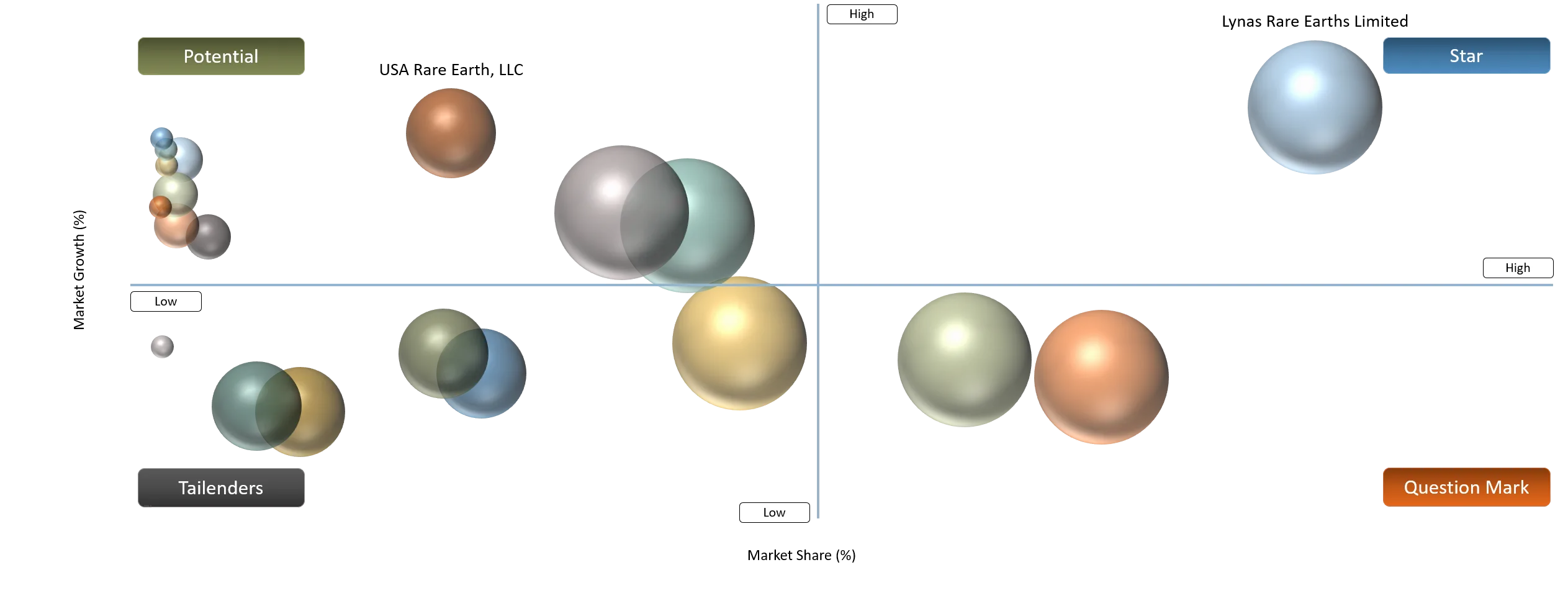
Stars include Lynas Rare Earths Limited and Energy Fuels Inc. because these companies are strengthening non-China dysprosium supply chains through commercial rare earth separation capabilities and advanced processing developments. Lynas Rare Earths has established itself as the leading non-China rare earth producer with separated rare earth oxide production and is expanding heavy rare earth processing capabilities to support dysprosium supply diversification. Question Mark companies such as Iluka Resources Limited, Northern Minerals Limited, and Arafura Rare Earths Limited are positioned because they hold significant potential in the future dysprosium supply chain but are still progressing through project development and commercialization stages.
Potential includes USA Rare Earth, LLC, Western Minmetals (SC) Corporation, and Jiangsu Guosheng New Materials Co., Ltd. because these companies have capabilities in rare earth processing, high-purity material production, or planned supply chain participation but currently hold a smaller position in global dysprosium production compared with established producers. Tailender companies such as Zhongxi Tianma New Material Technology Co., Ltd. are categorized because their dysprosium-related activities are primarily focused on specialty material manufacturing and high-purity rare earth product supply rather than large-scale upstream dysprosium production.
Dysprosium Market Dynamics
Driver Impact Analysis
| Driver | Market Growth Impact (%) | Demand Concentration | Impacted Use Case | Strategic Impact |
Rising Electric Vehicle (EV) Production Increasing Demand for Dysprosium-Based Permanent Magnets. | 35% | Concentrated in China, Europe, North America, and Japan due to EV manufacturing hubs and NdFeB magnet supply chains | EV traction motors, hybrid vehicle motors, high-efficiency electric drivetrains | Accelerates demand for dysprosium-enhanced NdFeB magnets while increasing focus on dysprosium-efficient magnet technologies, recycling, and alternative supply sources. |
Expansion of Wind Energy Installations Supporting Dysprosium Magnet Demand. | 25% | Concentrated in China, Europe, and the U.S., where offshore and high-capacity wind projects are expanding | Permanent magnet generators (PMG), offshore wind turbines, high-efficiency renewable energy systems | Strengthens long-term dysprosium demand by increasing adoption of high-performance magnets capable of maintaining efficiency under variable temperature and load conditions. |
Growing Demand for High-Performance NdFeB Permanent Magnets Across Industries. | 30% | Concentrated in China, Japan, South Korea, Germany, and the U.S. due to magnet manufacturing and advanced industrial equipment production | Robotics, industrial motors, automation systems, aerospace equipment, electronics | Expands dysprosium consumption beyond EVs by supporting advanced magnet applications requiring high coercivity, durability, and thermal resistance. |
Rising Need for High-Temperature Resistant Magnetic Materials. | 20% | Concentrated in automotive, aerospace, defense, and industrial automation markets in developed economies | High-temperature motors, precision actuators, aerospace systems, defense electronics | Enhances the strategic importance of dysprosium as a performance-critical material, supporting demand for high-purity dysprosium products. |
Government Initiatives to Develop Critical Mineral Supply Chains. | 25% | Concentrated in North America, Europe, Japan, Australia, and India through critical mineral strategies and domestic processing programs | Rare earth mining, dysprosium refining, permanent magnet manufacturing, recycling infrastructure | Reduces supply chain dependency on concentrated sources by promoting new refining capacity, recycling projects, and regional dysprosium supply networks. |
Rising Electric Vehicle (EV) Production Increasing Demand for Dysprosium-Based Permanent Magnets
The rapid expansion of electric vehicle (EV) manufacturing is accelerating the demand for dysprosium-neodymium-iron-boron (NdFeB) permanent magnets, which are critical for high-efficiency traction motors of electric vehicles and need to perform well at high temperatures. Dysprosium can help improve the coercivity and heat resistance of NdFeB magnets, thus allowing the electric vehicles' motor to give better output power density and greater reliability and efficiency. As per the European Automobile Manufacturers Association (ACEA), battery electric vehicles comprised 17.4% of new EU car registrations in 2025, while there was a growth of 1.8% in new EU car registrations compared to the same period last year.
As more EVs are manufactured, greater amounts of NdFeB permanent magnets will be used, which require the addition of dysprosium to improve thermal resistance and magnetism at higher operating temperatures. In November 2025, as per an Electronics360 report, the growing adoption of electric vehicles has led to increased demand for rare earth permanent magnets in the manufacture of highly efficient motors. As per this report, which cites Benchmark Mineral Intelligence, rare earth demand from EV motors was at 37 kilotons in 2024 and is forecasted to rise to 43 kilotons in 2025. The PMSMs and axial flux motors, which make use of rare earth magnets, were the dominant share of the EV motor market, accounting for more than 86% in 2024.
Restraint Impact Analysis
| Restraint | Drag on Market Growth (%) | Primary Impact Area | Impacted Use Case | Strategic Impact |
High Supply Concentration in Limited Geographies Restricting Dysprosium Availability. | 22% | Global supply chain security and price stability | NdFeB permanent magnets for electric vehicle motors, wind turbines, robotics, and defense systems | Increases dependence on concentrated suppliers, encouraging governments and manufacturers to develop diversified rare earth supply chains. |
Complex and Costly Heavy Rare Earth Separation Processes Limiting Production Expansion. | 20% | Production capacity expansion and processing economics | High-performance dysprosium-added magnets requiring advanced separation and purification technologies | Slows new capacity development due to high capital requirements, technical complexity, and longer project timelines. |
Limited Global Dysprosium Reserves Constraining Long-Term Supply Growth. | 18% | Resource availability and long-term market sustainability | EV traction motors, renewable energy generators, aerospace, and military applications | Creates concerns over future supply shortages, accelerating research into dysprosium reduction technologies and alternative magnet materials. |
Limited Commercial-Scale Dysprosium Recycling Infrastructure Restricting Secondary Supply Growth. | 12% | Circular supply chain development and raw material recovery | Recycling of end-of-life EV motors, wind turbine generators, and industrial magnets | Restricts secondary dysprosium availability and increases reliance on primary mining and refining sources. |
High Supply Concentration in Limited Geographies Restricting Dysprosium Availability
One of the key constraints that has been limiting the expansion of the dysprosium market is the supply sources within a limited number of geographies, which creates many risks in terms of the supply chain for this resource. Dysprosium is usually mined as a by-product of heavy rare earth elements, with most of the mining and refining capacity located in a few countries such as China. As per USGS Mineral Commodity Summaries 2026, China continued to be the leading supplier and refiner of rare earth elements in 2025, holding the bulk of the world’s capacity for rare earth separation and refining processes.
Due to the high presence of rare earth extraction and processing within a few selected areas, there is a risk of dysprosium shortage and instability in prices, which would pose a challenge in terms of sourcing. In April 2026, according to the CleanTechnica article, the rare earth supply chain on a global scale is still very much concentrated, which poses several dangers for the availability of critical materials, including dysprosium. As the article pointed out, China controls 90% of the global rare earth refining capacity, and almost 60% of the rare earth mining production, making the industries dependent on exports and subject to geopolitical issues. The article also stressed the necessity of developing new mining projects and partnerships internationally.
Dysprosium Market Segmentation Analysis
The global dysprosium market is segmented based on product form, purity grade, application, end-use, and region.
Permanent Magnets Segment Dominating the Dysprosium Market Due to Expanding EV and Renewable Energy Demand
The Permanent Magnets segment dominates the dysprosium market, accounting for approximately 83% of global dysprosium consumption in 2025, due to the extensive application of dysprosium in neodymium-iron-boron (NdFeB) permanent magnets. Dysprosium is added to NdFeB magnets to enhance coercivity, thermal stability, and magnetic performance, allowing magnets to maintain efficiency under high-temperature operating conditions. In 2025, the increasing adoption of electric vehicles (EVs), wind power systems, industrial motors, and robotics continued to drive demand for dysprosium-containing permanent magnets, making this segment the primary revenue contributor in the dysprosium market.
The continued electrification of transportation, expansion of renewable energy infrastructure, and increasing adoption of automation technologies are expected to sustain the Permanent Magnets segment. As per IRENA Renewable Capacity Statistics 2025, the world's renewable power capacity was 4,448 GW last year, with the addition of renewables standing at 585 GW, creating long-term demand for NdFeB permanent magnets, which contain dysprosium.
Dysprosium Market Geographical Penetration
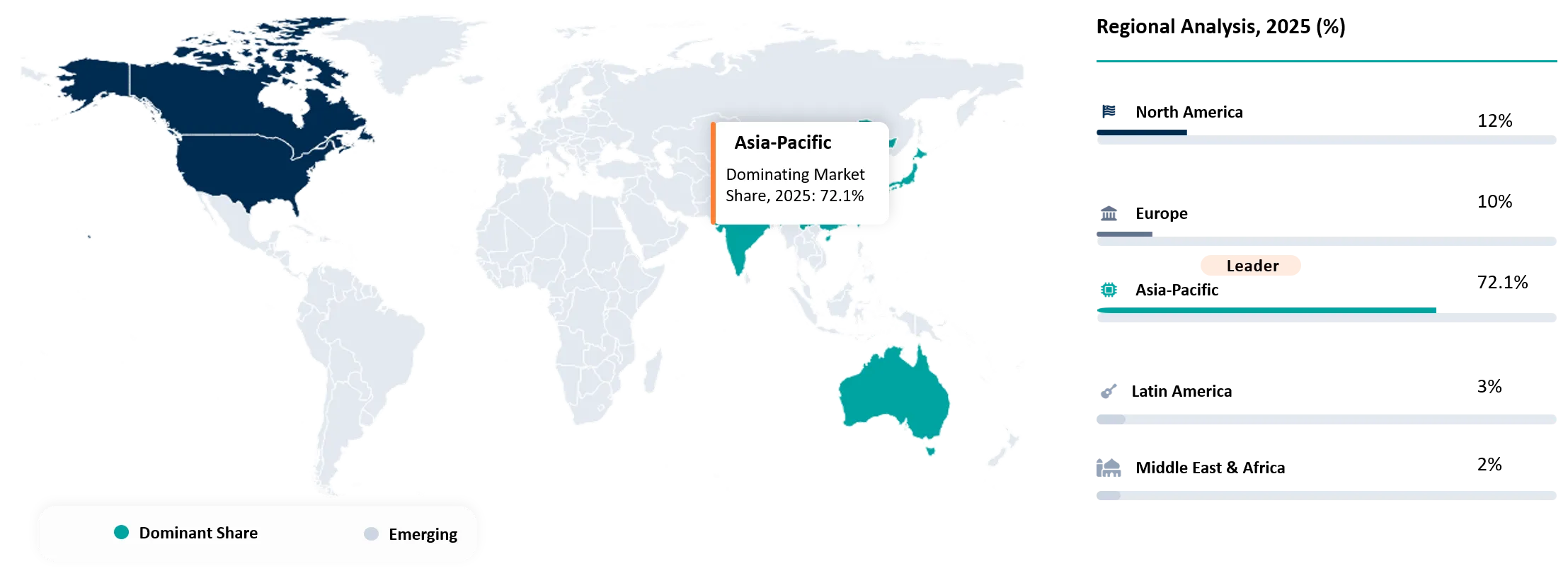
Asia-Pacific Region Dominating the Dysprosium Market Due to Rare Earth Processing Leadership and Permanent Magnet Demand
Asia-Pacific region dominates the dysprosium market, with an estimated 72.1% market share in 2025 due to its dominant performance in rare earth mining, separation, refining and manufacture of permanent magnets. The domination is mainly attributed to the rare earth processing industry in countries like China, Japan and South Korea, where dysprosium finds extensive use in NdFeB permanent magnets for applications in electric vehicles, wind power generation and other electronics. The availability of the rare earth value chain in terms of raw material processing and magnet manufacturing makes Asia-Pacific dominate the dysprosium market globally.
The Japan-Malaysia rare earth refining partnership will assist regional efforts toward diversifying from rare earth supply chains that are highly concentrated within China. In March 2026, Japan and Malaysia initiated cooperation to strengthen rare earth refining capabilities and diversify Asia-Pacific rare earth supply chains. Under the project, Japan will provide technical support, environmentally friendly refining technologies, and resource processing expertise through the Japan International Cooperation Agency (JICA), while approximately 10 Malaysian mineral processing specialists are expected to receive training in Japan.
China Dysprosium Market Trends
China maintains a dominating position in the Asia-Pacific dysprosium market owing to its control over the supply chain of rare earth elements from mining, processing of heavy rare earth elements, rare earth separation and purification to permanent magnet manufacturing. The major application for dysprosium is NdFeB permanent magnets used for EV traction motors, wind generator turbines, robots and industrial motors. As per the USGS Mineral Commodity Summaries 2026, China was still the biggest rare earth producer in 2025, with its rare earth mine production hitting around 270,000 metric tons of REO equivalents.
The acquisition ensures that China achieves rare earth security from its upstream resources through having access to foreign mineral resources. In October 2025, Shenghe Resources Holding Co., Ltd. Announcement Regarding the Progress of its Acquisition of Equity Interest in Peak Rare Earths Limited, Shenghe Resources Holding Co., Ltd., a China-based company, completed the acquisition of 100% equity interest in Peak Rare Earths Limited, a Australia-based company, through its Singapore subsidiary Shenghe Resources (Singapore) Pte. Ltd. The transaction value was adjusted to A$195 million (approximately RMB 916.5 million) from the earlier agreed value of A$158 million (approximately RMB 742.6 million).
India Dysprosium Market Outlook
India is emerging as a high-growth market in the dysprosium market as a result of increased emphasis on developing domestic capabilities in rare earth metals, increasing electric vehicle production, and investing in renewable energy. Increased investments in rare earth metals processing, permanent magnet manufacturing, and other material applications have been made possible by India’s emphasis on reducing reliance on imported critical minerals and establishing domestic value chains for rare earths. Dysprosium consumption in India is mainly motivated by the need to manufacture NdFeB permanent magnets for the use in electric vehicles, wind turbines, automation industries, and defense purposes.
The joint venture provides a rare earth value chain in India through a domestic recycling process for the vital magnets. This will reduce India's reliance on imported rare earth elements. In June 2025, American Resources Corporation (USA) through its subsidiary ReElement Technologies Corporation (USA) partnered with Exigo Battery Solutions Pvt. Ltd. (India) to establish a joint venture focused on recycling and refining rare earth magnets from end-of-life products. The partnership aims to recover rare earth elements from sources including electric vehicle motors, hard disk drives, wind turbines, and MRI machines, using ReElement’s chromatographic separation technology and Exigo’s rare earth material processing capabilities.
Dysprosium Market Competitive Landscape
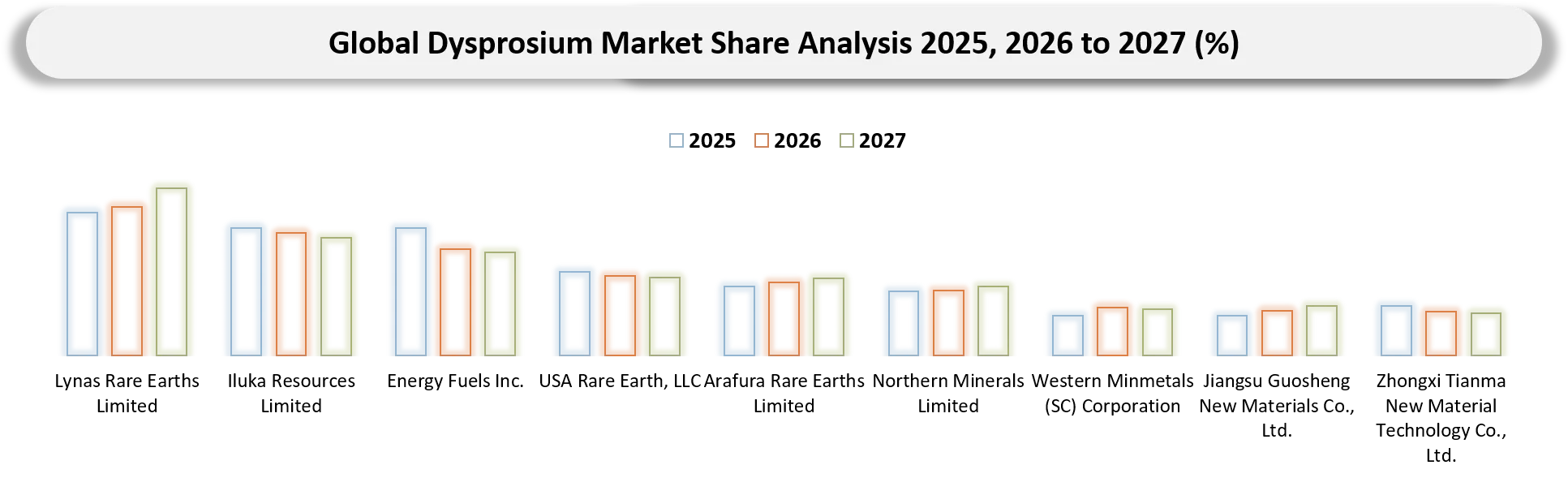
- The dysprosium market is characterized by three major participant groups: integrated rare earth producers, emerging non-China rare earth developers, and downstream dysprosium material and magnet manufacturers. Leading rare earth companies such as Lynas Rare Earths Limited, Iluka Resources Limited, and Energy Fuels Inc. are strengthening non-China supply chains through rare earth mining, separation, and refining projects. USA Rare Earth, LLC, Arafura Rare Earths Limited, and Northern Minerals Limited are developing new heavy rare earth projects focused on securing future dysprosium supply outside China. Meanwhile, Chinese downstream material producers including Western Minmetals (SC) Corporation, Jiangsu Guosheng New Materials Co., Ltd., and Zhongxi Tianma New Material Technology Co., Ltd. continue to support dysprosium demand through rare earth material processing and permanent magnet supply chains. This creates a supply-chain-driven competitive environment where resource security, heavy rare earth separation capability, processing technology, and customer access to NdFeB magnet manufacturers determine competitiveness.
- Key Players include Lynas Rare Earths Limited, Iluka Resources Limited, Energy Fuels Inc., USA Rare Earth, LLC, Arafura Rare Earths Limited, Northern Minerals Limited, Western Minmetals (SC) Corporation, Jiangsu Guosheng New Materials Co., Ltd., and Zhongxi Tianma New Material Technology Co., Ltd.
Recent Developments
- March 2026: Lynas Rare Earths Ltd., an Australia-based rare earth mining and processing company, entered into a partnership with LS Eco Energy Ltd., a South Korea-based energy infrastructure and rare earth metal processing company; a subsidiary of LS Cable & System, to develop a new rare earth metal-making facility in Vietnam.
- January 2026: Energy Fuels Inc., a US-based uranium, rare earth elements, and critical minerals producer, agreed to acquire Australian Strategic Materials Limited (ASM), an Australia-based rare earth metals and alloy producer, through a scheme of arrangement valued at approximately US$299 million (A$447 million).
- June 2026: Solvay S.A., a Belgium-based specialty chemicals and advanced materials company, entered into a Letter of Intent (LOI) with Viridis Mining and Minerals Ltd., an Australia-based rare earth exploration and development company, to establish a strategic supply agreement for rare earth materials from Brazil.
- December 2025: Blackboxstocks Inc. Merger Target REalloys Enters into Historic Partnership with the SRC to Establish North America’s First Commercial-Scale Heavy Rare Earth Production. REalloys Inc., a US-based, rare earth processing and mine-to-magnet technology company, entered into a strategic partnership with the Saskatchewan Research Council (SRC) (Canada, government-owned research and technology organization) to expand heavy rare earth refining capabilities at SRC’s Rare Earth Processing Facility in Saskatoon, Saskatchewan, Canada.
- October 2025: Sojitz Corporation, a Japan-based trading and investment company, started importing heavy rare earth elements (HREEs) produced by Lynas Rare Earths Ltd., an Australia-based integrated rare earth mining and processing company, into Japan for the first time from Australian-origin ore.
Key Procurement Priorities and Buyer Evaluation Criteria
- Dysprosium buyers are now preferring those sources that can offer stable and quality dysprosium materials with consistent purity, supply capability, and specifications necessary for NdFeB magnets, electric vehicle motors, wind turbine generators, aerospace technologies, and military operations.
- Dysprosium purchasing is becoming more and more dependent on supply chain diversification considerations, political factors, restrictions on the export of rare earth metals, and securing long-term sources beyond the concentrated areas of sourcing. Potential purchasers are assessing prospective suppliers in terms of their capacity for reliable supply of dysprosium through mining, separation, refining, and recycling operations.
- Dysprosium buyers take into account factors like dysprosium purity level, conversion from oxides to metals, ability to separate heavy rare earths, production scale, environmental issues, and reliability in terms of supplies when choosing suppliers of dysprosium products. High-grade dysprosium is primarily selected for use in modern permanent magnets, optical products, nuclear reactors, and specialty alloys.
Why Choose DataM?
- Supply Chain Intelligence & Critical Mineral Analysis: Evaluates the global dysprosium supply chain, including mining, separation, refining, and downstream magnet manufacturing activities, highlighting key factors such as geographic concentration, supply security risks, and diversification strategies across China, Australia, the U.S., and emerging rare earth supply regions.
- Market Demand & Application Positioning: Analyzes dysprosium demand across major applications, including NdFeB permanent magnets, electric vehicle motors, wind turbine generators, industrial equipment, nuclear applications, and advanced material systems, while assessing how dysprosium’s role in improving magnet coercivity and thermal stability supports high-performance technologies.
- Real-World Evidence & Industry Adoption: Highlights real-world adoption of dysprosium-containing materials in EV traction systems, renewable energy infrastructure, robotics, aerospace, and defense applications, demonstrating its importance in improving energy efficiency, operating performance, and durability of advanced magnetic systems.
- Market Updates & Industry Developments: Tracks key developments such as rare earth processing expansions, heavy rare earth separation projects, export control measures, recycling initiatives, and strategic investments by companies across China, Australia, the U.S., and other regions shaping the future dysprosium supply landscape.
- Competitive Landscape & Strategic Positioning: Evaluates strategies of leading dysprosium market participants, including Lynas Rare Earths Limited, Iluka Resources Limited, Energy Fuels Inc., USA Rare Earth, Arafura Rare Earths Limited, Northern Minerals Limited, and Chinese rare earth producers, focusing on resource expansion, processing capabilities, supply chain integration, and long-term market positioning.
- Pricing Dynamics & Supply Access: Provides insights into dysprosium pricing variations influenced by rare earth supply availability, purity grade, processing complexity, geopolitical factors, and long-term procurement agreements. The analysis covers access channels through rare earth miners, separation facilities, metal producers, and permanent magnet manufacturers.
- Market Entry & Growth Opportunities: Identifies expansion opportunities driven by EV adoption, renewable energy deployment, industrial automation, and demand for high-performance permanent magnets, while evaluating strategies such as developing alternative supply sources, improving recycling capabilities, reducing dysprosium intensity, and establishing regional rare earth processing ecosystems.
Target Audience
- Rare Earth Mining and Processing Companies
- Permanent Magnet Manufacturers
- Electric Vehicle (EV) Manufacturers and Automotive Suppliers
- Renewable Energy Companies
- Aerospace and Defense Organizations
- Electronics and Semiconductor Companies
- Industrial Equipment and Automation Companies


























































