


Downhole Tools Market Size and Overview
The global Downhole Tools market reached an estimated US$ 5.18 billion in 2025 and is expected to reach approximately US$ 8.31 billion by 2035, growing at a CAGR of about 4.84% during 2026-2035. Demand is supported by sustained offshore project execution, longer unconventional laterals, increasing well complexity, mature-field intervention, geothermal drilling and higher adoption of tools that combine mechanical performance with real-time data and automation. The market remains cyclical, but the mix is shifting toward higher-value tools where reliability, telemetry, temperature tolerance and reduced nonproductive time justify premium pricing.
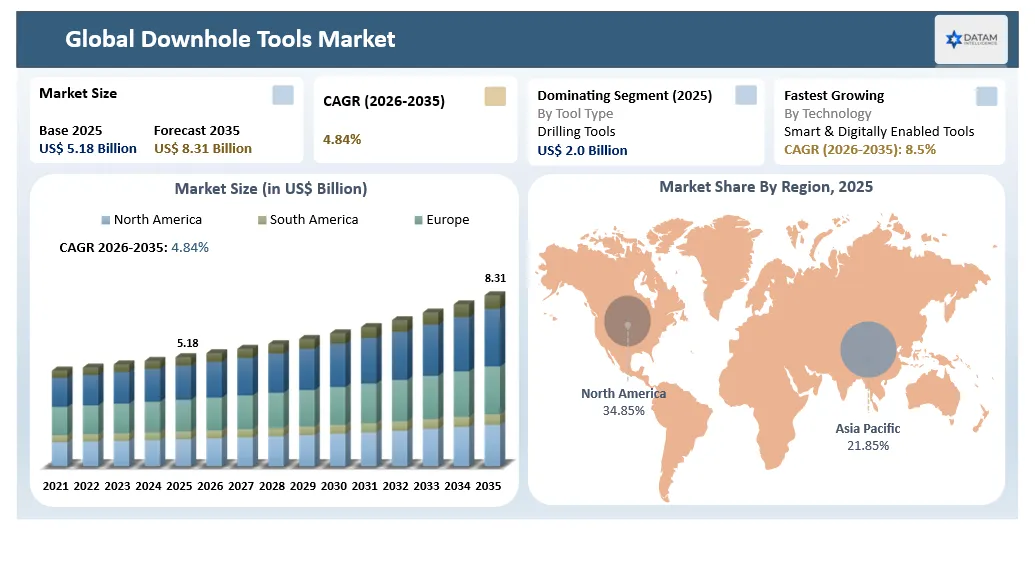
Drilling tools represent the largest product group because every well requires bottom-hole assembly components, directional systems, drilling motors, jars, reamers, stabilizers and related wear items. Well intervention and completion tools are gaining strategic importance as operators seek to extend production from mature assets and improve recovery without drilling a new well. Offshore and high-pressure/high-temperature applications command higher revenue per well because qualification, material specifications, logistics and failure consequences are more demanding.
North America remains the largest regional market through U.S. unconventional activity, Gulf of America offshore operations and a dense oilfield service ecosystem. The Middle East is a major long-cycle demand center, while Asia-Pacific and selected geothermal markets offer attractive growth. Technology differentiation is increasingly tied to wired drill pipe, real-time telemetry, automated downhole control, digital twins, condition-based maintenance and tools designed for high dogleg severity, high temperature and abrasive formations.
| Metric | Details |
| 2025 Market Size | US$ 5.18 Billion |
| 2035 Projected Market Size | US$ 8.31 Billion |
| CAGR (2026-2035) | 4.84% |
| Largest Market | North America |
| Fastest Growing Market | Asia-Pacific |
| Dominating Segment | Drilling Tools |
| Fastest Growing Technology | Smart & Digitally Enabled Tools |
| Study Period | 2024-2035 |
Downhole Tools Market Key Takeaways
- Drilling tools remain the largest revenue pool because bottom-hole assembly components experience recurring wear, redress and replacement across nearly all well construction programs.
- Offshore, deepwater and extended-reach wells generate disproportionate tool value due to high specifications, complex trajectories, high failure costs and strong demand for reliable telemetry.
- Well intervention is becoming a larger recurring market as operators prioritize mature-field productivity, recompletions, plug-and-abandonment preparation and lower-cost production optimization.
- Smart and digitally enabled tools are expected to outgrow conventional mechanical tools as real-time data, wired drill pipe and automation reduce uncertainty and nonproductive time.
- North America leads in revenue while the Middle East, Latin America and Asia-Pacific are important growth centers for long-cycle drilling, offshore development and national oil company investment.
- Geothermal drilling creates an adjacent opportunity for high-temperature motors, bits, measurement tools, jars and materials capable of surviving extreme thermal and abrasive conditions.
Downhole Tools Industry Trends and Strategic Insights
- Operators are consolidating tool vendors around integrated well construction packages, creating scale advantages for suppliers that combine downhole hardware, digital workflows and field service.
- Tool economics are moving toward lifecycle value: reliability, footage per run, rate of penetration, failure avoidance and faster tripping increasingly matter more than purchase price alone.
- Wired drill pipe and high-speed telemetry are turning the drillstring into a data network, enabling real-time imaging, closed-loop control and faster optimization of drilling parameters.
- High-specification metallurgy, elastomers, coatings and electronics are becoming core differentiators as wells become hotter, deeper, sourer and more abrasive.
- Rental and service-integrated models remain important because they transfer maintenance, inventory and redress complexity from operators to specialist suppliers.
Downhole Tools Market Scope
| Metrics | Details |
| By Tool Type | Drilling Tools; Flow & Pressure Control; Handling & Running; Completion; Fishing/Milling/Cutting; Formation Evaluation & Measurement; Others |
| By Operation | Drilling; Completion; Well Intervention; Production; Formation & Evaluation |
| By Technology | Conventional Mechanical; Smart & Digitally Enabled; Wired/Real-Time Systems; Automation-Ready Tools |
| By Well Type | Conventional; Unconventional; HPHT; Extended-Reach & Multilateral |
| By Location | Onshore; Offshore - Shallow, Deepwater, Ultra-Deepwater |
| By End Use | Oil & Gas Operators; Drilling Contractors; Oilfield Service Companies; Geothermal Developers; Mining & Other |
| By Deployment Model | Direct Purchase; Rental/Tool-on-Hire; Service-Integrated/Performance-Based |
| By Distribution Channel | Direct Sales; Distributors; Rental & Service Networks; Digital/B2B Platforms |
| Report Insights Covered | Market Size, Share, Growth, Pricing, Ecosystem, Competitive Landscape, Company Profiles and Country-Level Opportunity |
Why does this report matter in 2026?
2026 is a decision year for downhole tool suppliers because international and offshore activity remains structurally important even as near-term regional disruptions and capital discipline create uneven demand. Operators are balancing energy-security objectives with strict return thresholds, which favors technologies that shorten drilling time, improve well placement or reduce intervention risk.
The market is also being reshaped by consolidation and portfolio expansion among major oilfield service companies. Integrated suppliers are using acquisitions, digital platforms and broader completion portfolios to increase share of wallet. Smaller specialists still have opportunity where proprietary tools materially improve run life, telemetry, wellbore access or performance in difficult formations.
Downhole Tools Market White Space & Investment Opportunities
High-temperature geothermal tools are a major white-space opportunity because conventional oilfield electronics, elastomers and motors may not perform reliably at sustained extreme temperatures.
Extended-reach and high-dogleg wells create demand for friction-reduction tools, high-strength drillstring components, rotary steerable systems and real-time downhole measurements.
Mature-field intervention offers recurring demand for fishing, milling, cutting, plug setting, cleanout and conveyance tools as operators maximize existing infrastructure.
Digitally connected tools create software and analytics opportunities around predictive maintenance, run-life optimization and condition-based redress.
Downhole Tools Future Market Transformation
The market will move from standalone mechanical tools toward connected downhole systems that combine sensing, actuation, telemetry and surface analytics. More decisions will be automated around weight on bit, vibration, trajectory, circulation and tool health. Suppliers able to integrate hardware with digital workflows will capture a larger share of value.
Commercial models will also evolve. Performance-based contracts can link payment to footage drilled, rate of penetration, tool reliability or reduction in nonproductive time. This favors suppliers with large data sets, field-service scale and the ability to manage tool fleets across multiple basins.
Downhole Tools Market Buyer Decision-Making Criteria
Buyers prioritize reliability, mean time between failures, lost-in-hole exposure, temperature and pressure ratings, metallurgy, toolface control, telemetry quality, compatibility with existing bottom-hole assemblies and local redress capability. In offshore work, availability and logistics can be as important as unit price because rig time is expensive.
Procurement teams increasingly evaluate total cost per foot or per successful run. Vendors that demonstrate higher footage, fewer trips, faster drilling or fewer fishing events can defend premium pricing. Local technical support, inventory, repair turnaround and qualification history remain decisive for national oil companies and drilling contractors.
Downhole Tools Market Economic & Investment Analysis
Investment returns are tied to activity but also to tool intensity per well. Longer laterals, deeper targets, HPHT environments and complex completions raise revenue per well even if rig counts are stable. Suppliers with strong offshore, intervention and unconventional exposure can therefore grow faster than headline rig activity.
Manufacturing investment is shifting toward advanced materials, precision machining, electronics, sensor packaging, high-temperature components and automated inspection. Rental fleet investment requires disciplined utilization management because underused premium tools can depress returns. Strategic acquisitions are most attractive where they add proprietary technology, installed base, regional service infrastructure or a differentiated completion/intervention platform.
Downhole Tools Investment Trends in the Market
- Capital is concentrating on digital drilling, directional systems, intelligent completions and intervention technologies with measurable efficiency gains.
- Offshore service hubs and local-content manufacturing are receiving investment in Brazil, the Middle East, West Africa and Asia.
- Acquisition activity is being used to broaden completion and production portfolios, capture installed-base revenue and cross-sell tools through existing field-service networks.
- Geothermal and carbon-management applications are attracting adjacent investment in high-temperature drilling and well integrity technologies.
Strategic Indicators for the Downhole Tools Market
High Regulation Impact
Tool designs must meet pressure-control, well-integrity, explosive-atmosphere, materials and operational standards. Offshore and HPHT applications require extensive qualification, traceability and documentation, while sour-service environments increase metallurgy requirements.
High Investment Activity
Investment is strongest in offshore, digital drilling, intelligent downhole systems, completion technology and service infrastructure. Suppliers are selectively expanding manufacturing and rental fleets where utilization and backlog support returns.
Supply Chain Disruption
Specialty steels, tungsten carbide, elastomers, electronics, sensors and precision-machined parts can be vulnerable to geopolitical disruption, export restrictions and long lead times. Regional service inventories reduce downtime risk.
Pricing Volatility
Pricing depends on utilization, metallurgy, tool complexity, rental duration, redress intensity and basin-specific activity. Premium tools can sustain pricing when they demonstrably reduce rig time or failure risk.
Procurement Pressure
Large operators seek vendor consolidation, standardized qualification and multi-basin contracts. Suppliers must balance global pricing discipline with local content, inventory and service requirements.
New Technology Adoption
Wired drill pipe, high-speed telemetry, rotary steerable systems, downhole automation, real-time imaging and high-temperature electronics are moving from niche use toward broader adoption in complex wells.
Regional Expansion Opportunity
Brazil, the Middle East, Guyana, West Africa and selected Asia-Pacific markets offer strong long-cycle demand, while North America remains attractive for high-turn unconventional tools and intervention.
Government Policy Support
Energy-security policies, national oil company investment, local-content rules and geothermal incentives influence capital deployment and supplier localization.
Pricing Intelligence
Buyers compare cost per run, cost per foot, redress cost and nonproductive-time exposure. Service-integrated contracts can support higher margins when suppliers share performance risk.
Disruption Analysis of Downhole Tools Market
The most important disruption is the shift from mechanical tool selection toward data-enabled closed-loop drilling. High-speed telemetry and wired drill pipe increase the value of software, sensors and automation while reducing the differentiation of undigitized commodity tools. At the same time, portfolio consolidation among large service companies is changing customer access and creating stronger bundled offerings.
Geopolitical conflict and export restrictions can disrupt field activity, logistics and specialty-material supply. Operators are responding through local inventory, dual sourcing and regional manufacturing. The market is also exposed to cyclical drilling reductions, but intervention, offshore backlog and production optimization can partially offset slower greenfield drilling.
Downhole Tools Market Ecosystem
| Value Chain Sector | Role | Representative Companies / Organizations |
| Raw Materials & Specialty Inputs | Specialty steel, nickel alloys, tungsten carbide, PDC cutters, elastomers, electronics, sensors | Alleima, Sandvik, Kennametal, Element Six, Carpenter Technology |
| Precision Manufacturing & Components | Machining, coatings, bearings, connectors, seals, electronics packaging | SKF, Timken, TE Connectivity, Parker Hannifin, regional machine shops |
| Downhole Tool OEMs | Drilling, completion, intervention, formation evaluation and pressure-control tools | SLB, Halliburton, Baker Hughes, Weatherford, NOV, Hunting, SBO |
| Directional / Digital Platforms | RSS, MWD/LWD, telemetry, wired drill pipe, automation and analytics | SLB, Halliburton, Baker Hughes, NOV, Nabors |
| Rental & Service Networks | Tool-on-hire, redress, fishing, intervention and field support | Major OFS companies, Expro, Innovex, regional rental specialists |
| Drilling Contractors | Rig operations and tool deployment | Nabors, Patterson-UTI, Helmerich & Payne, Transocean, Valaris |
| Operators / End Users | Oil & gas, geothermal and subsurface project owners | Saudi Aramco, ExxonMobil, Chevron, Petrobras, ADNOC, Shell, geothermal developers |
| Testing / Certification / Standards | Qualification, NDT, pressure testing, API/ISO standards | API, ISO, DNV, TÜV, SGS, Intertek |
Downhole Tools Market BCG Matrix: Company Evaluation
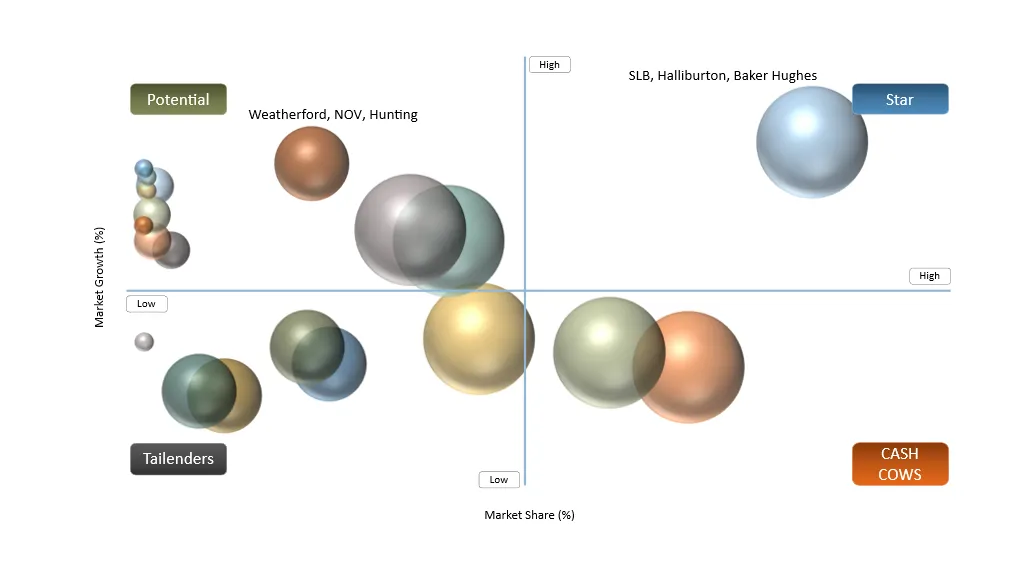
STAR
SLB, Halliburton and Baker Hughes are positioned as Stars due to broad global service networks, deep technology portfolios, high R&D intensity and the ability to bundle downhole tools with drilling, evaluation, completion and digital services. Their scale allows rapid deployment of new technology across multiple basins and customer groups.
POTENTIAL
Weatherford, NOV, Hunting, Schoeller-Bleckmann and Innovex represent high-potential players in selected niches. Their upside depends on portfolio focus, offshore and international exposure, intervention demand, high-specification products and the ability to translate specialized engineering into repeatable global revenue.
Downhole Tools Market Dynamics
Driver Impact Analysis
| Driver | Market Growth Impact | Demand Concentration | Impacted Use Case | Strategic Impact |
| Offshore and complex well development | High | Brazil, Gulf of America, Middle East, West Africa | Deepwater drilling and completion | Raises tool value per well and favors premium reliability |
| Longer unconventional laterals | High | U.S., Canada, Argentina | Directional drilling and BHA tools | Increases wear, run length and need for vibration control |
| Mature-field intervention | Medium-High | Global producing basins | Fishing, milling, cleanout and recompletion | Creates recurring demand less dependent on new-well drilling |
| Digital drilling adoption | Medium-High | High-spec rigs and complex wells | Telemetry, wired drill pipe, automation | Shifts value toward connected tools and software |
Driver: Rising Offshore and Complex Well Development
Deepwater, HPHT and extended-reach wells require higher-specification downhole assemblies and impose much greater economic penalties for failure. As offshore backlogs convert into drilling activity, demand rises for directional systems, reamers, drilling motors, pressure-control tools, completion assemblies and real-time measurements. Suppliers with offshore-qualified fleets, local service bases and robust reliability data are best positioned to capture premium pricing.
Restraint Impact Analysis
| Restraint | Drag on Market Growth | Primary Impact Area | Impacted Use Case | Strategic Impact |
| Volatile drilling activity | High | Equipment utilization | Onshore drilling and rentals | Creates inventory and fleet underutilization risk |
| Tool failure / lost-in-hole risk | High | Reliability and qualification | Complex and offshore wells | Lengthens qualification and increases warranty exposure |
| High material and machining costs | Medium | Manufacturing margin | HPHT and sour-service tools | Supports redesign, localization and supplier diversification |
| Customer consolidation and bundled procurement | Medium | Vendor access | Integrated well construction | Raises scale requirements for smaller suppliers |
Restraint: Volatility in Drilling Activity and Capital Spending
Downhole tool utilization can change quickly when operators reduce rig activity, defer exploration or shift capital between basins. Rental fleets and manufacturing capacity are therefore exposed to cyclical underutilization. Suppliers mitigate this risk through geographic diversification, intervention exposure, aftermarket revenue, variable manufacturing capacity and a greater mix of service-integrated contracts.
Downhole Tools Market Segmentation Analysis
The global Downhole Tools market is segmented based on Tool Type, Operation, Technology, Well Type, Location, End Use, Deployment Model, distribution channel, and region.
By Tool Type
Drilling Tools Will Remain the Largest Segment
Drilling tools lead because bottom-hole assembly components are required throughout well construction and face recurring wear, shock, vibration and replacement. Directional drilling, long laterals and complex trajectories sustain demand for motors, jars, reamers, stabilizers and related tools. Formation evaluation and intelligent control tools will grow faster from a smaller base.
By Operation
Well Intervention Will Outgrow the Market
Intervention demand benefits from mature-field optimization, workovers, recompletions, plug-and-abandonment preparation and production recovery. Operators can often add barrels at lower capital intensity through intervention than through new wells, supporting demand for fishing, milling, cutting, cleanout and conveyance tools.
By Technology
Smart & Digitally Enabled Tools Will Gain Share
Connected tools create value through real-time measurements, automated steering, vibration management, predictive maintenance and faster decision-making. Adoption is strongest in expensive wells where avoiding a single trip or failure can justify a large technology premium.
By Well Type
Unconventional and Extended-Reach Wells Increase Tool Intensity
Long laterals increase drilling hours, tool wear, friction, vibration and steering demands. This supports premium downhole motors, friction-reduction tools, high-strength components and real-time measurements.
By Location
Offshore Generates Higher Revenue per Well
Onshore remains larger by activity count, but offshore wells generate higher tool value because they are deeper, more complex and have higher rig-time costs. Deepwater projects favor qualified suppliers with strong logistics and service support.
By Deployment Model
Rental and Service-Integrated Models Remain Important
Rental transfers inventory, maintenance and redress burden to the supplier and gives operators access to premium tools without owning low-utilization assets. Performance-based models can increase supplier value when reliability and drilling efficiency are measurable.
Downhole Tools Market Geographical Penetration
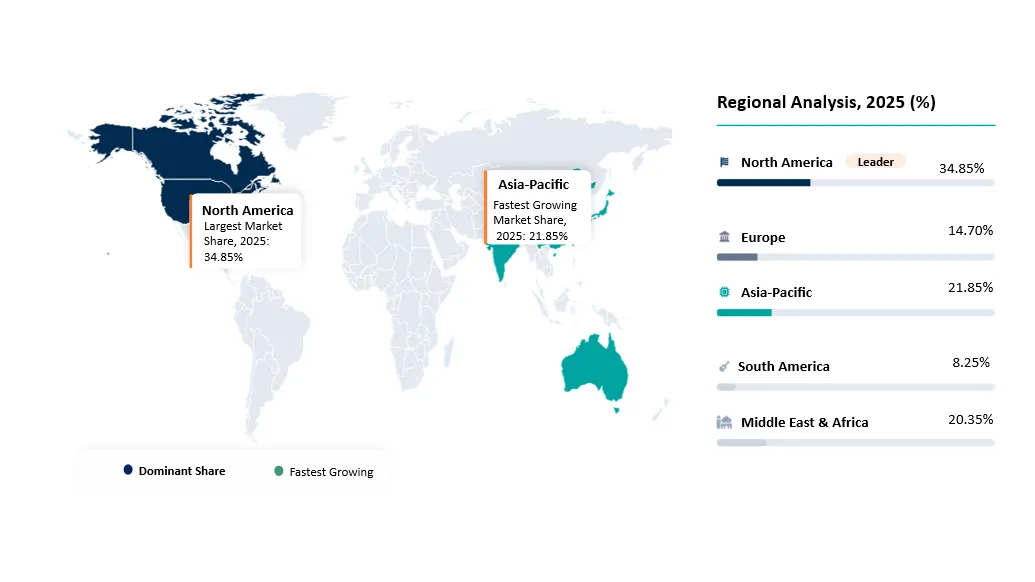
U.S. Downhole Tools Market Landscape
The U.S. remains a core demand center because unconventional drilling requires high tool turnover, directional capability and rapid redress. Longer laterals and efforts to reduce drilling days support rotary steerable systems, high-performance motors, shock and vibration tools and downhole automation. Gulf of America offshore activity adds a premium deepwater component.
Brazil Downhole Tools Market Outlook
Brazil is one of the most attractive offshore markets because deepwater and pre-salt developments require high-specification drilling, completion and intervention tools. Local service capacity and content requirements influence vendor positioning, while long project cycles support durable demand.
Saudi Arabia Downhole Tools Market Trends
Saudi Arabia remains strategically important through national oil company investment in drilling, well construction and production optimization. Suppliers compete on localization, reliability, inventory availability and technology transfer. High-temperature and complex carbonate wells create demand for premium downhole systems.
China Downhole Tools Market Outlook
China combines domestic oil and gas drilling, unconventional development and a growing local equipment base. Domestic suppliers compete strongly in conventional tools, while high-end directional, measurement and HPHT applications remain areas of technology differentiation.
Norway and North Sea Market Outlook
North Sea operations emphasize reliability, safety, harsh-environment qualification and intervention efficiency. Mature fields support workover and well-integrity demand while selected new projects sustain premium drilling and completion activity.
Middle East and Africa Market Outlook
The Middle East is a major long-cycle market driven by national oil company programs, while Africa offers selective offshore growth in Namibia, Nigeria, Angola and other basins. Political and logistics risk increases the value of local inventory and service capability.
Downhole Tools Market Competitive Landscape
- Competition is led by diversified oilfield service companies that combine downhole tools with directional drilling, evaluation, completion, intervention and digital services.
- Specialist suppliers compete effectively in premium niches such as drilling motors, jars, wired drill pipe, completion tools, intervention systems, high-temperature equipment and specialty materials.
- Acquisitions are an important route to portfolio expansion because installed base and field-service coverage create cross-selling opportunities and recurring aftermarket revenue.
- Competitive differentiation increasingly depends on reliability data, digital integration, local redress capacity, service response time and the ability to support high-specification wells globally.
Public Company Q1-Q2 2026 Performance Comparison
| Public Company | Q1-Q2 2026 Performance | Profitability / KPI | Growth Drivers Relevant to Downhole Tools | Interpretation |
| SLB | Q2 revenue US$8.97bn; +3% QoQ, +5% YoY | Q2 adjusted EBITDA US$1.90bn | Higher offshore activity, U.S. unconventional rebound, Production Systems growth, ChampionX contribution, digital adoption | Strongest scale and integrated technology position; Middle East disruption remained a headwind |
| Halliburton | Q2 revenue US$5.7bn vs US$5.4bn in Q1 | Q2 operating income US$778m | Higher stimulation, well construction, drilling services, wireline and completion tool sales in selected regions | International pipeline and North American recovery support downhole tool demand |
| Baker Hughes | Q2 revenue US$6.74bn; +2% QoQ | Q2 adjusted EBITDA US$1.23bn | OFSE revenue +7% QoQ; international activity, subsea/surface orders, productivity and pricing | Broad portfolio benefits from offshore and international activity despite regional disruption |
| Weatherford | Q2 revenue US$1.105bn; -4% QoQ | Q2 adjusted EBITDA US$223m, 20.2% margin | Completions expansion, MPD contracts, integrated completion awards; NCS Multistage acquisition announced | Portfolio expansion improves intervention/completions exposure, but activity softness affected revenue |
| NOV Inc. | Q1 revenue US$2.05bn; Q2 outlook called for 4-6% YoY revenue decline | Q1 adjusted EBITDA US$177m | Strong drill-bit/digital performance, Energy Equipment backlog, wired drill pipe and Downhole Broadband Systems | Q2 release not used in this draft; Q1 indicated Middle East disruption but stronger long-term capital-equipment cycle expectations |
Source note: Company Q1/Q2 2026 investor releases and earnings materials. Financial metrics are company-wide or segment-level and should not be interpreted as standalone downhole tools revenue unless explicitly disclosed by the company.
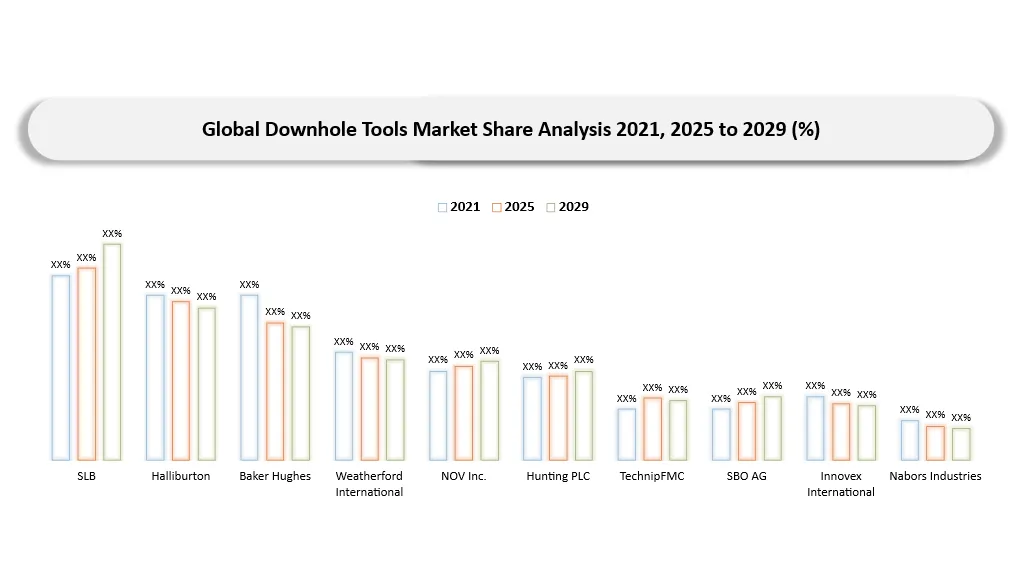
Key Companies
- SLB
- Halliburton
- Baker Hughes
- Weatherford International
- NOV Inc.
- Hunting PLC
- Schoeller-Bleckmann Oilfield Equipment AG
- Expro Group
- TechnipFMC
- Innovex International
- Nabors Industries
- Sandvik
- Varel Energy Solutions
- Rubicon Oilfield International
- Dril-Quip / Innovex Legacy Portfolio
- Regional specialist tool manufacturers and rental companies
Company Profiles
SLB
SLB is the largest integrated oilfield technology provider in the market, with downhole exposure across drilling, reservoir performance, production systems and digital operations. Its competitive strength lies in global scale, directional drilling and measurement capability, integrated workflows and the ability to deploy technology across offshore and land markets. The ChampionX acquisition increased production-related breadth and strengthens cross-selling across the well lifecycle.
Competitive priorities include reliability, qualification, regional service coverage, digital integration, lifecycle economics and the ability to support complex wells with rapid field response.
Halliburton
Halliburton has a broad portfolio spanning drilling and evaluation, completion tools, well intervention, production enhancement and digital solutions. The company benefits from a strong North American position and extensive international service infrastructure. Technology differentiation centers on well construction efficiency, directional drilling, completion systems and integrated execution.
Competitive priorities include reliability, qualification, regional service coverage, digital integration, lifecycle economics and the ability to support complex wells with rapid field response.
Baker Hughes
Baker Hughes participates through Oilfield Services & Equipment, including drilling, evaluation, completion, intervention and production technologies. Its offshore and international footprint is important, while integration with subsea and surface systems creates opportunities for broader well and field packages.
Competitive priorities include reliability, qualification, regional service coverage, digital integration, lifecycle economics and the ability to support complex wells with rapid field response.
Weatherford International
Weatherford has meaningful positions in drilling, managed pressure drilling, tubular running, completions and intervention. The announced NCS Multistage acquisition broadens completions and unconventional exposure. The company competes on differentiated engineering, international service intensity and targeted portfolio expansion.
Competitive priorities include reliability, qualification, regional service coverage, digital integration, lifecycle economics and the ability to support complex wells with rapid field response.
NOV Inc.
NOV supplies drilling and wellbore technologies including drill bits, wired drill pipe, Downhole Broadband Solutions, drilling equipment and intervention-related products. Its installed base, rig-equipment relationships and digital downhole network create a platform for real-time imaging and control applications.
Competitive priorities include reliability, qualification, regional service coverage, digital integration, lifecycle economics and the ability to support complex wells with rapid field response.
Hunting PLC
Hunting is a precision-engineering supplier with exposure to well completion, intervention, OCTG accessories, subsea and perforating systems. Its strategy emphasizes higher-value engineered products, subsea growth and selective acquisitions.
Competitive priorities include reliability, qualification, regional service coverage, digital integration, lifecycle economics and the ability to support complex wells with rapid field response.
Schoeller-Bleckmann Oilfield Equipment AG
SBO specializes in high-precision components and oilfield equipment used in directional drilling and completion applications. Its expertise in non-magnetic materials, precision machining and high-specification components provides differentiation in demanding downhole environments.
Competitive priorities include reliability, qualification, regional service coverage, digital integration, lifecycle economics and the ability to support complex wells with rapid field response.
Expro Group
Expro provides well construction, flow management, subsea well access and intervention services. Its downhole relevance is strongest in well intervention, completion support and integrated well access, especially in offshore markets.
Competitive priorities include reliability, qualification, regional service coverage, digital integration, lifecycle economics and the ability to support complex wells with rapid field response.
TechnipFMC
TechnipFMC is primarily a subsea and surface systems company, but its integrated offshore position influences demand for well completion and intervention technologies around complex developments. Its installed base supports recurring service and life-of-field opportunities.
Competitive priorities include reliability, qualification, regional service coverage, digital integration, lifecycle economics and the ability to support complex wells with rapid field response.
Innovex International
Innovex combines well construction, completion and production technologies with a focus on engineered products and field support. Its portfolio consolidation provides an opportunity to cross-sell across drilling and completions.
Competitive priorities include reliability, qualification, regional service coverage, digital integration, lifecycle economics and the ability to support complex wells with rapid field response.
Nabors Industries
Nabors combines drilling rigs, automation, directional drilling and digital technologies. Its downhole relevance is tied to integrated drilling execution, automation and technologies that connect rig systems with subsurface decision-making.
Competitive priorities include reliability, qualification, regional service coverage, digital integration, lifecycle economics and the ability to support complex wells with rapid field response.
Sandvik
Sandvik provides advanced materials, rock tools and engineered components with relevance to drilling, geothermal and hard-rock applications. Materials expertise supports high-wear and high-temperature performance.
Competitive priorities include reliability, qualification, regional service coverage, digital integration, lifecycle economics and the ability to support complex wells with rapid field response.
Varel Energy Solutions
Varel Energy Solutions is known for drill bits and downhole drilling products. It competes through application engineering, cutter technology, product performance and regional customer support.
Competitive priorities include reliability, qualification, regional service coverage, digital integration, lifecycle economics and the ability to support complex wells with rapid field response.
Rubicon Oilfield International
Rubicon and related specialist brands participate in drilling and intervention tools, emphasizing engineering responsiveness, rental/service models and performance in niche well conditions.
Competitive priorities include reliability, qualification, regional service coverage, digital integration, lifecycle economics and the ability to support complex wells with rapid field response.
Dril-Quip / Innovex Legacy Portfolio
Legacy Dril-Quip products contribute engineered wellhead, completion and related technologies within the broader Innovex platform. The combination expands product breadth and offshore customer relationships.
Competitive priorities include reliability, qualification, regional service coverage, digital integration, lifecycle economics and the ability to support complex wells with rapid field response.
Downhole Tools Market Major Pain Points
- Tool failure and lost-in-hole events can create very high nonproductive-time costs.
- Cyclical drilling activity creates utilization and inventory risk for manufacturers and rental fleets.
- Long qualification cycles slow adoption of new tools in offshore, HPHT and national oil company programs.
- Specialty materials, electronics and precision components can face long lead times and geopolitical supply risk.
- Extreme temperature, pressure, vibration, abrasion and sour-service conditions shorten tool life.
- Fragmented field data can make it difficult to prove lifecycle value across basins and drilling programs.
Downhole Tools Market Recent Developments
- July 2026: SLB reported second-quarter revenue growth supported by offshore activity, U.S. unconventional recovery and higher Production Systems revenue, while continuing to integrate ChampionX capabilities.
- July 2026: Halliburton reported sequential revenue growth, including higher drilling-related services and improved completion tool sales in selected international markets.
- July 2026: Baker Hughes reported higher OFSE revenue sequentially, supported by international activity and continued subsea and surface equipment demand.
- July 2026: Weatherford reported second-quarter results and highlighted portfolio expansion through the announced acquisition of NCS Multistage, strengthening completions exposure.
- April 2026: NOV highlighted advances in Downhole Broadband Solutions, including real-time high-resolution borehole imaging through wired drill pipe and a smart-wired circulating sub for downhole control.
Analyst View / Opinion on Downhole Tools Market
- The market should grow steadily rather than explosively, but revenue quality can improve as the mix shifts toward complex wells, offshore, intervention and connected tools.
- Downhole tools are increasingly a productivity market rather than a simple rig-count market. Longer laterals, deeper wells and higher specification requirements can lift spend per well even when activity is flat.
- Integrated service majors will retain structural advantages in digital workflows and bundled contracting, while specialists can win where proprietary hardware materially improves run life or solves a difficult well problem.
- Geothermal is strategically important as an adjacent market because it rewards high-temperature engineering and can diversify suppliers away from pure oil and gas cycles.
- Long-term leadership will depend on reliable hardware, real-time data, local service infrastructure and commercial models that demonstrate lower cost per foot or lower nonproductive time.
Downhole Tools Market Target Audience
| INDUSTRY | WHO SHOULD BUY THIS REPORT? | REASON TO BUY THIS REPORT |
| Oil & Gas Operators | Drilling, completion, intervention, procurement and technology teams | Benchmark tool markets, vendor strategies, technology adoption and regional availability. |
| Oilfield Services | Service-line leaders, product managers and business development teams | Identify portfolio gaps, acquisition targets and high-growth applications. |
| Drilling Contractors | Rig operators, performance teams and procurement managers | Assess tool integration, automation and reliability trends. |
| Tool Manufacturers | OEM executives, engineering and commercial teams | Evaluate segment growth, regional expansion and competitive positioning. |
| Geothermal | Developers, drilling contractors and technology providers | Identify high-temperature tool opportunities and transferable oilfield technologies. |
| Investors & Consulting | Private equity, public-market investors and strategy firms | Assess market cycles, company exposure, consolidation and investment white space. |
Why Choose DATAM?
- Data-driven insights combining drilling activity, well complexity, pricing, company disclosures and technology adoption.
- Post-purchase analyst consultations for market entry, acquisition screening, vendor benchmarking and custom segmentation.
- Annual report updates covering contract awards, acquisitions, technology launches and changes in drilling activity.
- Specialized focus on emerging markets, local content and country-level oilfield service infrastructure.
- Actionable analysis linking tool technology to buyer economics, rig time and nonproductive-time reduction.
What DATAM Uniquely Provides
- Ten-year forecasts across eight segmentation categories and five major regions.
- Market ecosystem mapping from specialty materials and precision manufacturing to OEMs, rental networks, drilling contractors and operators.
- Public-company H1 2026 comparison focused on growth drivers relevant to downhole tools.
- Technology analysis covering wired drill pipe, telemetry, automation, HPHT tools and intervention systems.
- Country-level views connecting drilling activity, offshore backlog, national oil company spending and local service capacity.



























































