


Direct Lithium Extraction Market Size
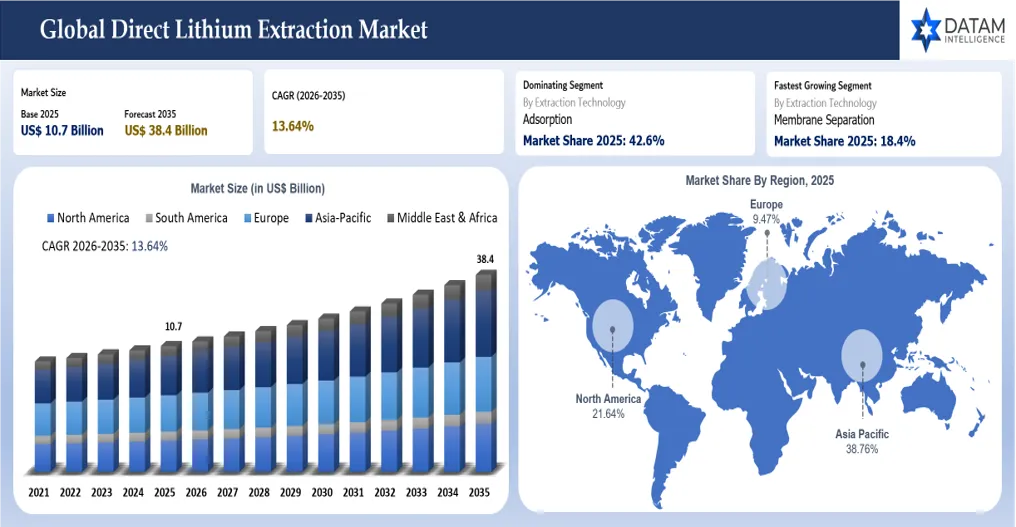
The global Direct Lithium Extraction market reached US$ 10.7 billion in 2025 and is expected to reach US$ 38.4 billion by 2035, growing with a CAGR of 13.64% during the forecast period 2026-2035.
The market expansion is supported by growing development of DLE projects focusing on geothermal and other lithium-rich brines, as was noted by the US Department of Energy, where DLE could use 99% less water per ton of lithium, provide higher lithium extraction rate, shorten extraction time and have smaller footprint compared to traditional lithium mining process; in addition, in April 2026, the DOE announced USD 69 million in funding to support advanced technologies for the production of domestic critical materials, including mineral extraction technologies coupled with geothermal power generation. In May 2026, according to Eramet, its Centenario plant in Argentina began operating in 2025, making the company's facility the first industrial facility in the world to use Direct Lithium Extraction technology to produce lithium carbonate specifically designed for electric vehicle batteries. In addition, Eramet aims at reducing its absolute Scope 1 and 2 emissions by 42% by 2035 versus the 2023 level and its Scope 3 emissions intensity by 31%. These events demonstrate further development of the industry towards lower-impact lithium production.
Strategic partnerships are playing a crucial role in the adoption of DLE technology in the lithium brine sector, particularly across Argentina’s lithium-rich deposits. In December 2025, according to Nasdaq, Argentina Lithium & Energy Corp. announced an MOU with Xi’an Lanshen New Material Technology Co., Ltd., a DLE technology developer, for the Rincon West Lithium Brine Project in Argentina. Per the agreement, Lanshen will offer proprietary DLE systems, pilot-plant technology, engineering, process design and equipment development at the feasibility level. The project has been scoped for 5,000 tonnes per year capacity for a lithium carbonate plant for batteries, with a possible scaling up to 15,000-20,000 tonnes per year. Lanshen technology uses ion-exchange resins that are selective to lithium.
Direct Lithium Extraction Market Key Takeaways
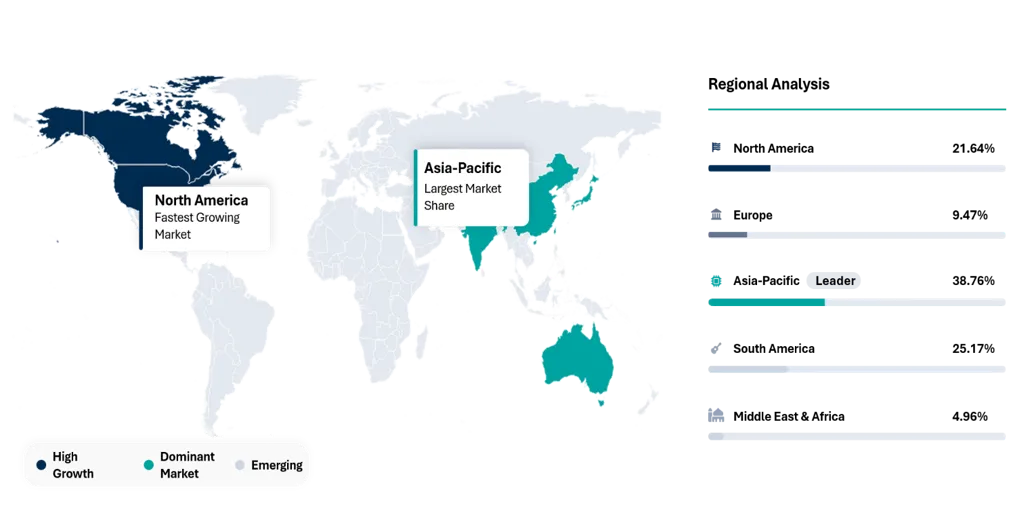
- Asia-Pacific dominated the market with a 38.76% global revenue share in 2025. Growth across the region is fueled by global lithium demand rising by roughly 25% annually over the preceding two years.
- Lithium-ion battery manufacturing led all application segments in 2025, accounting for 68.5% of total DLE market share. Demand is driven by global battery consumption exceeding 1.5 TWh in 2025, growing at more than 35% year-over-year.
- The Lanshen-Argentina Lithium partnership aims for an initial 5,000 tonnes per year capacity, scalable to 15,000–20,000 tonnes per year. Similarly, Lilac Solutions secured USD 100 million in DOE funding to build a Great Salt Lake DLE plant producing 5,000 metric tons annually by 2028.
- DLE processes can utilize up to 99% less water per ton of lithium compared to traditional evaporation methods. To accelerate deployment, the U.S. DOE announced USD 69 million in April 2026 to support mineral extraction coupled with geothermal power.
- There are also increasing government efforts to facilitate commercialization of DLE technologies, especially in the United States, through funding initiatives targeting advanced extraction methods of minerals and those integrating lithium recovery with geothermal energy.
Direct Lithium Extraction Market Scope
| Metrics | Details | |
| 2025 Market Size | US$ 10.7 Billion | |
| 2035 Projected Market Size | US$ 38.4 Billion | |
| CAGR (2026-2035) | 13.64% | |
| Largest Market | Asia-Pacific | |
| Fastest Growing Market | Asia-Pacific | |
| By Extraction Technology | Adsorption, Ion Exchange, Solvent Extraction, Membrane Separation, Electrochemical Extraction, Other Technologies | |
| By Brine Source | Salt Lake / Salar Brine, Geothermal Brine, Oilfield Brine, Seawater Brine, Other Lithium-Bearing Brines | |
| By Application | Lithium-Ion Battery Manufacturing, Ceramics and Glass Manufacturing, Lubricants and Greases, Air Treatment, Pharmaceuticals and Healthcare, Metallurgical Applications, Other Applications | |
| By Region | North America | U.S., Canada, Mexico |
| Europe | Germany, UK, Russia, France, Spain, Italy, Poland | |
| Asia-Pacific | China, India, Japan, Australia, South Korea, Indonesia, Malaysia, Singapore, Vietnam, Thailand, Philippines, Taiwan | |
| South America | Brazil, Argentina | |
| Middle East and Africa | UAE, Saudi Arabia, South Africa, Israel, Turkiye, Nigeria | |
| Report Insights Covered | Competitive Landscape Analysis, Company Profile Analysis, Market Size, Share, Growth | |
Direct Lithium Extraction Market White Space & Investment Opportunities
- Commercial-scale DLE deployment: The large-scale commercialization of technologies that have already been proven at the pilot or demonstration scale provides a great investment opportunity in finding solutions for the reliable and efficient extraction of lithium.
- Unconventional brine resources: There is potential in exploring geothermal, oilfield and other brine sources that are not traditional to the lithium industry.
- Brine-specific DLE technologies: Development of advanced sorbents, membranes and ion-exchange materials provides a significant technology development and investment opportunity.
- Integrated lithium production projects: These would include projects that integrate DLE with concentration, purification and converting into battery grade lithium carbonate or lithium hydroxide.
- Low-impact and energy-efficient extraction: Any technology that reduces water usage, the use of chemicals, energy intensity and waste is a great option for more sustainable lithium production.
Direct Lithium Extraction Market Buyer Decision-Making Criteria
The buyers of the Direct Lithium Extraction technologies, comprising lithium producers, miners, chemical companies, energy firms and developers, take into account several criteria for assessing DLE technologies. These include high lithium extraction rates, selectivity, product quality, scalability and economic efficiency of operation. The compatibility of the technology with certain types of brine is particularly critical since lithium content, magnesium-to-lithium ratio, calcium presence and other impurities may impact process performance. Other factors taken into account include water and energy usage, reagents, environmental characteristics, technology development level, commercial record, financing and technical support from suppliers.
Major Buyer Decision-Making Criteria
- Lithium Recovery Rate
- Lithium Selectivity and Impurity Rejection
- Technology Compatibility with Brine Chemistry
- Operating and Capital Costs
- Scalability and Throughput
- Technology Maturity and Commercial Track Record
- Water and Energy Consumption
- Battery-Grade Product Quality
- Environmental and Regulatory Compliance
- Supplier Technical Expertise and Support
Direct Lithium Extraction Market BCG Matrix: Company Evaluation
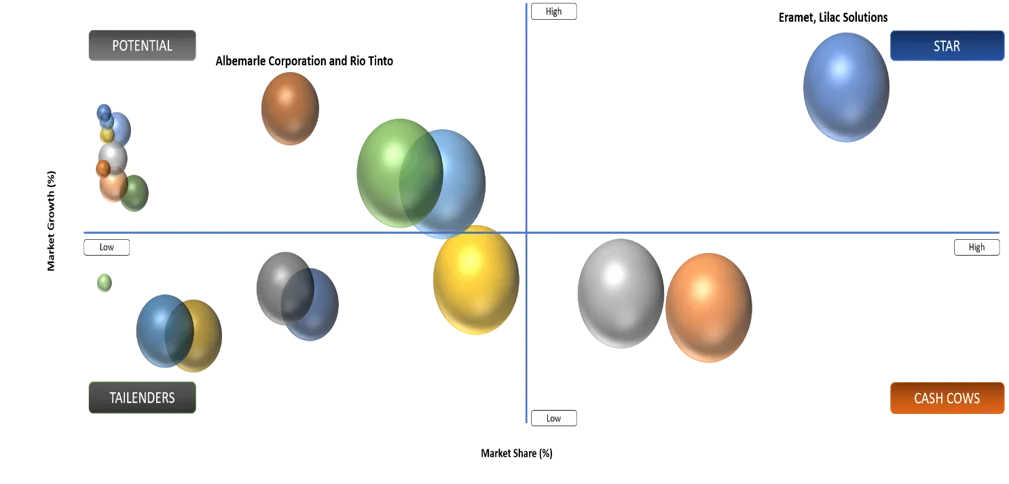
STAR
Stars include Eramet, Lilac Solutions, Standard Lithium and International Battery Metals (IBAT) because these companies have established advanced DLE platforms or progressed toward commercial-scale deployment, supported by active lithium-resource projects and technology development. Eramet has demonstrated industrial-scale DLE through its Centenario operation, while Lilac Solutions is advancing ion-exchange DLE for complex brines. Question Marks include EnergyX, SLB, E3 Lithium and Sunresin New Materials Co., Ltd., as these companies possess significant DLE technology capabilities and project pipelines but are still expanding commercial deployment and seeking broader market penetration.
POTENTIAL
Potential includes Albemarle Corporation and Rio Tinto, which have substantial lithium-resource, processing and mining capabilities and can leverage their existing industrial infrastructure to participate in DLE commercialization. However, their competitive positioning is more strongly associated with established lithium extraction and processing activities than with pure-play DLE technology, placing them in a potential-growth position as DLE becomes more commercially established. Tailenders include ExxonMobil and Vulcan Energy Resources, whose DLE activities are strategically relevant but remain concentrated around specific resource or integrated-energy projects rather than broad DLE technology commercialization.
Direct Lithium Extraction Market Dynamics
Driver Impact Analysis
| Driver | Market Growth Impact (%) | Demand Concentration | Impacted Use Case | Strategic Impact |
Rapid growth in lithium demand from electric vehicles and energy storage systems is driving the need for faster and more scalable lithium production technologies. | 24% | Very High - EV batteries, grid-scale storage, stationary energy storage | Battery-grade lithium carbonate and lithium hydroxide production | Accelerates commercialization of DLE projects and encourages producers to prioritize scalable, high-throughput extraction technologies to secure battery-lithium supply. |
Declining availability of high-grade conventional lithium resources is encouraging producers to adopt direct lithium extraction technologies. | 20% | High - unconventional and lower-concentration brines | Lithium recovery from complex salar, Smackover, geothermal and other brines | Expands the economically addressable lithium-resource base and shifts competition toward recovery efficiency, impurity rejection and brine adaptability. |
Higher lithium recovery rates and shorter extraction cycles compared with conventional evaporation-based methods are accelerating DLE technology adoption. | 19% | High -commercial brine-processing operations | Continuous lithium extraction, concentration, purification and battery-grade chemical production | Strengthens the business case for replacing or complementing evaporation-based systems and encourages investment in continuous DLE process infrastructure. |
Growing demand for domestic and regional lithium supply chains is increasing investments in direct lithium extraction projects to reduce dependence on imported lithium. | 21% | High - North America and other supply-security-focused markets | Domestic battery-material production and integrated lithium supply chains | Strengthens government-backed DLE deployment and encourages vertically integrated projects linking brine extraction, lithium conversion and battery-grade product supply. |
Expansion of lithium-rich geothermal and oilfield brine resources is creating new feedstock opportunities for direct lithium extraction projects. | 16% | Medium-to-High - geothermal, oilfield and unconventional brines | Lithium recovery from geothermal fluids, produced water and non-salar brines | Broadens the geographic and resource base for lithium production and enables integration of DLE with existing geothermal and energy infrastructure. |
Driver: Declining availability of high-grade conventional lithium resources is encouraging producers to adopt direct lithium extraction technologies.
The declining availability of easily accessible, high-grade conventional lithium resources is strengthening the case for direct lithium extraction (DLE) as producers seek to recover lithium from lower-grade and more chemically complex brines. According to the International Energy Agency (IEA), the lithium industry is expected to become increasingly concentrated and therefore there is a need to develop additional sources of supply to meet the growing demands for batteries. The situation encourages companies to consider the use of unconventional resources such as geothermal, oilfield and low-concentration brines, where conventional evaporation is not economically viable. DLE technologies address this constraint by selectively recovering lithium directly from brine rather than relying on lithium concentration through prolonged evaporation.
Growing pressure to improve the cost-effectiveness of lithium production has led to an increased interest in more affordable lithium extraction methods, including brine extraction and Direct Lithium Extraction processes. In July 2025, according to Advanced Energy Materials, a study on the techno-economic assessment of virgin and recycled lithium had been carried out by researchers from Argonne National Laboratory. The findings showed that the cheapest routes to produce lithium carbonate or lithium hydroxide suitable for batteries are brine and Direct Lithium Extraction (DLE), which have costs of about USD 3.39–6.20/kg, while the other routes, such as ore-based and recycling, cost between USD 4.17–53.41/kg. The researchers also assessed a commercial Direct Lithium Extraction (DLE) facility in Tibet that produces 50,000 tons of lithium carbonate per year, with an estimated decrease in lithium content of the brine from 780 mg/L to 36 mg/L during 35 years of operation.
Restraint Impact Analysis
| Restraint | Drag on Market Growth (%) | Primary Impact Area | Impacted Use Case | Strategic Impact |
Complexity of extracting lithium selectively from brines with varying chemical compositions. | 18% | Process efficiency & selectivity | Lithium recovery from high-Mg, high-Ca and complex geothermal/oilfield brines | Requires brine-specific pretreatment, selective sorbents/membranes and process optimization, increasing development time and operating complexity. |
Limited large-scale commercial operating history of DLE technologies creates performance and bankability risks for investors and lithium producers. | 16% | Commercial scalability & investment | Large-scale battery-grade lithium production | Limited long-term commercial data increases technology and financing risk, encouraging investors and producers to favor proven extraction methods or phased DLE deployments. |
High energy and chemical requirements in certain DLE processes. | 12% | Operating cost & environmental performance | Lithium chloride concentration and battery-grade Li₂CO₃/LiOH production | High energy, freshwater and reagent requirements can reduce the cost and sustainability advantage of DLE, particularly for dilute brines and projects in water-stressed regions. |
Challenges in managing and reinjecting residual brine and process waste streams. | 9% | Environmental compliance & water management | Brine-based lithium extraction and reinjection | Requires robust hydrogeological modeling, reinjection infrastructure and monitoring to maintain reservoir integrity and meet environmental requirements, potentially increasing permitting and project-development timelines. |
Restraint: Complexity of extracting lithium selectively from brines with varying chemical compositions
One of the key restraints limiting the wider adoption of direct lithium extraction (DLE) is the difficulty of maintaining high lithium selectivity when brines contain different concentrations of competing ions and impurities. DLE processes must account for such variables as magnesium, calcium, sodium, potassium, silica, iron and many other substances that are dissolved in the brine before selective lithium recovery can take place. The necessity to develop such capabilities was stressed by the U.S. Department of Energy (DOE) in 2026 via the Great Salt Lake pre-pilot project, which aims at recovering lithium, potassium and magnesium from the same brine flow.
The complicated chemical nature of the brine containing lithium poses many technical hurdles to selectively extract lithium and produce battery-grade products. In February 2025, as per MDPI Membranes, scientists analyzed the purification of a complex solution of LiCl formed by Direct Lithium Extraction (DLE). The complex solution had a concentration of less than 0.1% lithium, along with other impurities such as Na, K, Mg and Ca, thus needing to concentrate the solution to 1% lithium concentration before moving forward with Li₂CO₃ or LiOH formation. During electrodialysis, the scientists have observed a magnesium elimination rate of 99.8%, calcium elimination of 98.0% and lithium recovery of 96–99%. Nonetheless, the purification process consumed considerable energy ranging from 20.28 to 27.33 kWh/kg of Li during electrodialysis and 22.21 to 33.46 kWh/kg of Li during membrane electrolysis. The study also found that the best membrane had an upper limit of lithium recovery of just 14.43% in the membrane electrolysis process, underscoring the difficulties of purifying the lithium from the DLE lithium solution.
Direct Lithium Extraction Market Geographical Penetration
U.S. Direct Lithium Extraction Market Landscape
The U.S. holds a dominant position in the North American direct lithium extraction (DLE) market owing to its strong ecosystem of lithium technology developers, substantial unconventional lithium resources, government support for critical-mineral supply chains and growing demand for domestically produced battery-grade lithium. The availability of lithium-rich brines in regions such as Utah, Arkansas, California and Nevada provides opportunities for DLE technologies to expand beyond conventional hard-rock and evaporation-based production. The U.S. government has also increasingly prioritized domestic lithium production to reduce reliance on overseas supply chains.
Strategic acquisitions of proven DLE technologies are accelerating the commercialization and integration of advanced lithium extraction solutions in the U.S. market. In September 2025, Aquatech, a U.S.-based water-treatment and critical-minerals technology company, acquired the Direct Lithium Extraction (DLE) business of Koch Technology Solutions (KTS), a U.S.-based technology and engineering company within Koch Industries. The acquisition transferred KTS’s Li-Pro Lithium Selective Sorption (LSS) technology, intellectual property, licenses, agreements and ongoing lithium projects into Aquatech’s PEARL technology platform, creating an integrated solution covering lithium extraction, refining and purification. The Li-Pro technology had completed more than 12,000 operational cycles at its demonstration plant with average lithium recovery above 95%, while Aquatech’s first U.S. commercial license supports the 22,500-tonnes-per-year South West Arkansas lithium project.
Japan Direct Lithium Extraction Market Outlook
Japan is emerging as a key player in the Asia-Pacific direct lithium extraction (DLE) market because of its advanced battery-manufacturing ecosystem, strong technological capabilities and growing focus on securing stable supplies of critical minerals. Although Japan has limited domestic lithium resources compared with China and Australia, its large downstream battery industry and dependence on imported lithium are encouraging investment in alternative extraction and supply technologies. The strong growth of lithium demand globally is further increasing this strategic importance; the International Energy Agency (IEA) reported that global battery demand exceeded 1.5 TWh in 2025, increasing by more than 35%, while lithium demand increased by around 25% annually over the preceding two years.
Strategic investments in proprietary DLE technologies are strengthening cross-border technology transfer and accelerating the commercialization of selective lithium-recovery solutions. In October 2025, Kurita Water Industries Ltd., a Japan-based water-treatment and environmental engineering company, advanced a strategic alliance with Evove Ltd., a UK-based filtration and membrane technology company, through an investment aimed at obtaining exclusive worldwide rights to use Evove’s Direct Lithium Extraction (DLE) technology. The partnership focuses on commercializing Evove’s DLE technology for lithium recovery from brines, with the technology intended to support high-selectivity lithium extraction and resource recovery.
Direct Lithium Extraction Market Competitive Landscape
- Technology differentiation: The competition is based on differential abilities of each technology in terms of the rate of lithium extraction, selectivity, speed of extraction, rejection of impurities and compatibility with different brines.
- Commercialization and scale-up: The leading players are moving towards commercialization through development beyond the pilot and demonstration stages and scalability and reliable operation become crucial aspects of competitiveness.
- Strategic partnerships and investments: Companies are engaging in partnerships with lithium producers, resource developers, energy companies and investors to ensure access to brine resources and funding.
- Expansion into unconventional brines: Solutions to tap into geothermal, oilfield and other non-salar brines are becoming more prevalent, providing differentiation via specific capabilities of extraction and impurity removal.
- Cost and sustainability optimization: Increasingly, competitive advantage is based on minimizing water, energy and chemicals used while maintaining efficient recovery rates and product quality.
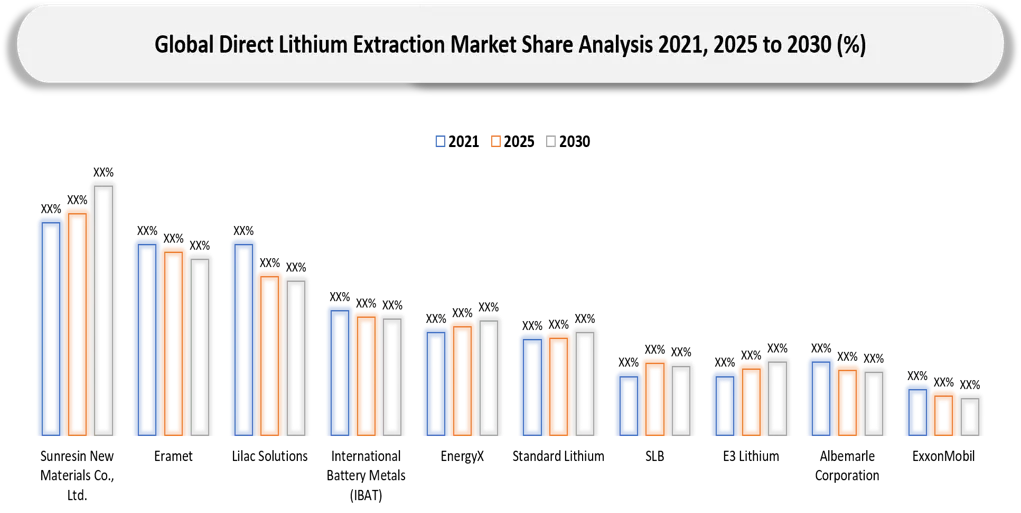
Key Companies of the Direct Lithium Extraction Market
- Sunresin New Materials Co., Ltd.
- Eramet
- Lilac Solutions
- International Battery Metals (IBAT)
- EnergyX
- Standard Lithium
- SLB
- E3 Lithium
- Albemarle Corporation
- ExxonMobil
- Rio Tinto
- Vulcan Energy Resources
Direct Lithium Extraction Market Recent Developments
- September 2026 - Lawrence Berkeley National Laboratory: Scientists from the Molecular Foundry created a polyoxoniobate molecular "sponge" that is able to extract magnesium from lithium solutions in a selective way. The new technology was able to remove 99.9% of magnesium from the solution in less than one minute while preserving lithium content.
- August 2026 - Lilac Solutions: Lilac Solutions received a grant worth $100 million from the U.S. Department of Energy aimed at their Great Salt Lake Lithium project which will enable production of battery grade lithium carbonate using DLE technology.
- July 2026 - Eramet: Eramet announced that its lithium plant, Centenario, had seen steady growth in production, with output now at about 90% of its rated capacity in June 2026, aiding in its further commercialization efforts in its lithium production using DLE technology.
- June-July 2026 - E3 Lithium: The Canadian government committed up to C$36.5 million in non-refundable funding to E3 Lithium’s Phase 3 Demonstration Facility and Clearwater Project feasibility study as well as proceeded with a partnership with Tees Valley Lithium to refine battery-grade lithium hydroxide.
- June 2026 - EnergyX: The U.S. Army awarded EnergyX with a conditional long-term lease to create a lithium-processing plant within the Red River Army Depot to expand the domestic lithium-processing capabilities of the U.S.
What DATAM Uniquely Provides
- Benchmarking of DLE technologies with a focus on adsorption, ion-exchange, solvent extraction, membrane separation, electrochemical extraction and others.
- Source-brine-specific assessment for salar brines, geothermal brines, oilfield brines, seawater brines and others.
- Mapping of technologies and applications from extraction technologies to lithium recovery and purification to lithium chemical manufacturing for batteries.
- Detailed monitoring of all DLE projects/activities, such as pilot-scale projects, demonstration-scale projects, commercial-scale projects, joint ventures, investments and technology advancements.
- Thorough competitive landscape analysis of key DLE technology providers/lithium producers by analyzing technology strengths, project pipeline, initiatives taken and commercialization activities.


























































