


Dilution Refrigerator Market Size and Overview
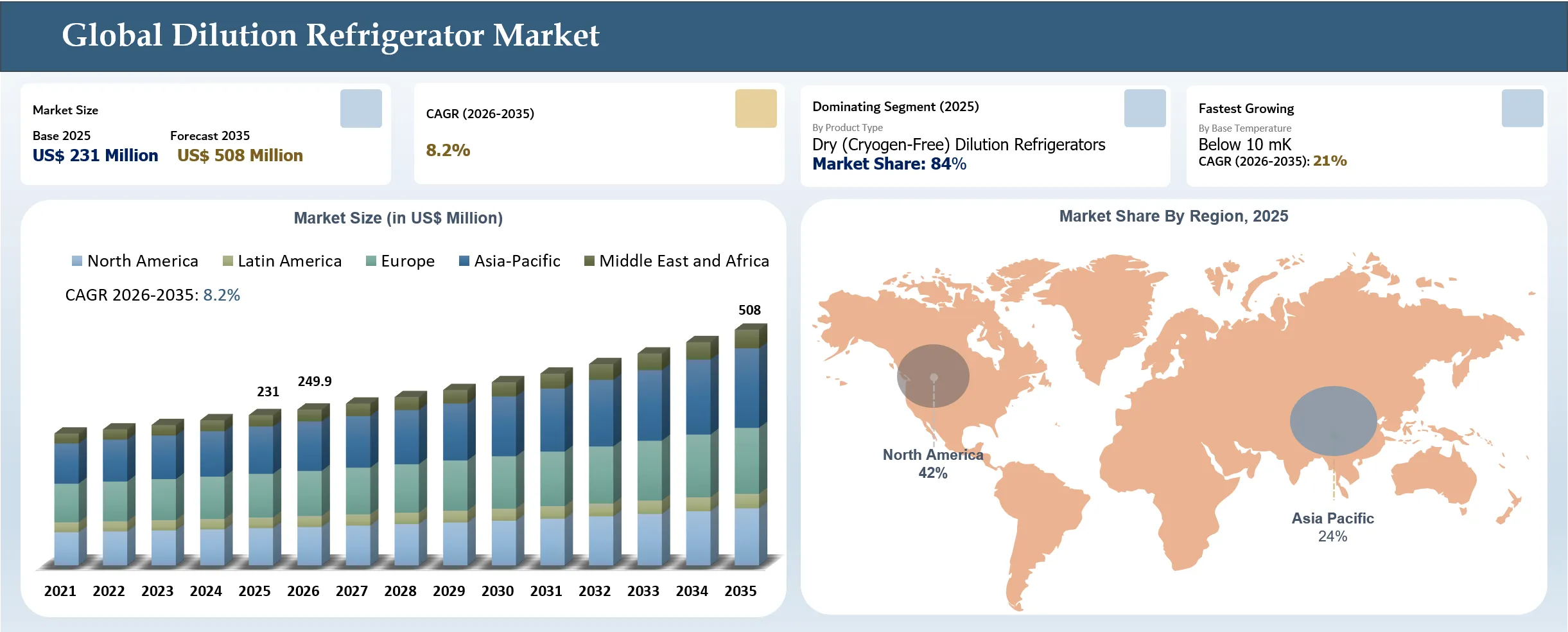
The global Dilution Refrigerator market reached USD 231 million in 2025 and is expected to reach USD 508 million by 2035, growing with a CAGR of 8.2% during the forecast period 2026-2035. The market is expanding rapidly due to the growing commercialization of quantum technologies, where the global quantum technology market reached USD 1.9 billion in 2025, while private venture capital investments amounted to USD 4.9 billion, and there were government investments worth USD 12.7 billion in 2025, as reported in the QED-C State of the Global Quantum Industry 2026. Moreover, in the last five years, the European Union and EU member states committed more than US$ 12.53 billion (€11 billion) of public money into quantum technologies development, increasing the demand for cryogenic equipment used in quantum technologies. The mentioned investments are driving the deployment of superconducting quantum processors, cryogenic electronics, and quantum networking systems, and increasing the deployment of high-capacity dilution refrigerators. Manufacturers such as Bluefors, Oxford Instruments, and JanisULT constantly develop more powerful cryogen-free cryogenic systems capable of supporting larger quantum computing systems. Nevertheless, the limited supply of helium-3, the cost of the systems, and millikelvin systems engineering complexity remain important barriers on the way to further market expansion.
This release is an indicator of the rising demand for small, high-capacity dilution fridges that make it easier to test quantum computers without compromising their super-low temperature capacity. In March 2026, according to Nasdaq, FormFactor, Inc. launched the Flatiron Dilution Refrigerator, which is a bench-top millikelvin system designed to speed up the development, characterization, and hardware validation of quantum devices. It has a base temperature of about 30 mK, and other attributes include a horizontal bench-top design to facilitate quick sample change, an area of roughly 150 cm × 80 cm, and four cryogenic optical windows to conduct optical and electro-optical measurements.
White-Space Opportunities for Government Procurement of Dilution Refrigerator Systems Supporting Quantum Computing
In May 2025, UKRI-4747 Cryogen-Free Bottom-Loading Dilution Refrigerator System procurement represents a strategic government-funded research infrastructure opportunity. The UK Research & Innovation (UKRI) Future Leaders Fellowship, approximately £204,000 (excluding VAT), was allocated for the acquisition of a cryogen-free bottom-loading dilution refrigerator system, with the contract ultimately awarded to ICE Oxford Ltd for £203,990 (excluding VAT). The investment is primarily directed toward expanding the United Kingdom's quantum technology and cryogenic research infrastructure, particularly for the Science and Technology Facilities Council (STFC) Particle Physics Department and the QUEST-DMC dark matter experiment, where ultra-low-temperature operation of approximately 20 mK is essential for next-generation photosensor development. Beyond the refrigerator itself, the procurement supports investments in cryogenic laboratory infrastructure, quantum measurement capabilities, particle physics instrumentation, ultra-low-temperature electronics, installation and commissioning services, system integration, maintenance, and long-term scientific research capacity, creating broader opportunities across the cryogenic equipment supply chain.
The procurement is expected to generate commercial opportunities for companies involved in dilution refrigeration, cryogenic engineering, quantum research instrumentation, and laboratory integration. ICE Oxford Ltd directly benefits through the supply, installation, commissioning, and long-term servicing of the cryogen-free dilution refrigerator system. Bluefors and Oxford Instruments NanoScience are well positioned to benefit from future opportunities in dilution refrigerator manufacturing, cryogenic platforms, and quantum computing infrastructure, while Lake Shore Cryotronics and Janis Research (Lake Shore Cryotronics) can benefit through the supply of cryogenic measurement systems, temperature controllers, and low-temperature instrumentation. Zurich Instruments and Quantum Machines are likely to gain demand for quantum control electronics, readout systems, and measurement solutions used alongside dilution refrigerators.
Dilution Refrigerator Market Key Takeaways
- North America held the largest market share at 42% in 2025 due to heavy concentration in quantum computing hardware development. Meanwhile, the Asia-Pacific region is projected to be the fastest-growing market during the forecast period.
- Dry (cryogen-free) dilution refrigerators dominated the market with an 84% market share in 2025. Their market lead is driven by closed-cycle pulse tube cryocooler technology that eliminates liquid helium refilling.
- The U.S. DOE awarded USD 125 million over five years-including USD 25 million in year one-to the SQMS Center. The center connects over 300 scientists across 43 organizations to develop scalable quantum systems with a 100+ qudit processor.
- UKRI allocated £204,000 to purchase a cryogen-free bottom-loading system, awarding the contract to ICE Oxford Ltd for £203,990. The system operates at an ultra-low temperature of approximately 20 mK to support photosensor research for dark matter experiments.
Dilution Refrigerator Market Industry Trends and Strategic Insight
- Commercial-scale quantum computing is reshaping dilution refrigerator design priorities. Manufacturers are transitioning from laboratory-oriented systems to high-cooling-power.
- Cryogen-free, closed-cycle refrigeration has become the preferred system architecture. Integration of pulse tube cryocoolers eliminates dependence on liquid helium refilling, reduces operating costs, improves system uptime, and enables deployment.
- Higher cooling power at millikelvin temperatures is emerging as a primary competitive differentiator. Vendors are developing dilution refrigerators with greater cooling capacity to accommodate increasing thermal loads generated by quantum processors, cryogenic control electronics, microwave components, and high-density signal interconnects.
- Automation is reducing operational complexity in ultra-low-temperature systems. Advanced monitoring software, automated cooldown procedures, remote diagnostics, and intelligent cryogenic control are improving operational reliability while minimizing manual intervention in research and commercial environments.
- Domestic manufacturing capabilities are becoming strategically important. Governments and quantum ecosystem developers are encouraging regional production of dilution refrigerators to reduce dependence on a limited number of global suppliers and strengthen national quantum technology supply chains.
Dilution Refrigerator Market Scope
| Metrics | Details | |
| 2025 Market Size | USD 231 Million | |
| 2035 Projected Market Size | USD 508 Million | |
| CAGR (2026-2035) | 8.2% | |
| Largest Market | North America | |
| Fastest Growing Market | Asia-Pacific | |
| By Product Type | Dry (Cryogen-Free) Dilution Refrigerators, Wet (Liquid Helium-Cooled) Dilution Refrigerators | |
| By Cooling Power | Below 100 µW, 100–400 µW, above 400 µW | |
| By Base Temperature | Below 10 mK, 10–20 mK, above 20 mK | |
| By Application | Quantum Computing, Cryogenic Electronics, Quantum Sensing & Detectors, Condensed Matter Physics Research, Particle Physics Research, Space & Astronomy Instrumentation, Superconducting Device Testing, Others | |
| By Region | North America | U.S., Canada, Mexico |
| Europe | Germany, UK, France, Spain, Italy, Poland | |
| Asia-Pacific | China, India, Japan, Australia, South Korea, Indonesia, Malaysia | |
| Latin America | Brazil, Argentina | |
| Middle East and Africa | UAE, Saudi Arabia, South Africa, Israel, Türkiye | |
| Report Insights Covered | Competitive Landscape Analysis, Company Profile Analysis, Market Size, Share, Growth | |
Dilution Refrigerator Market Disruption Analysis
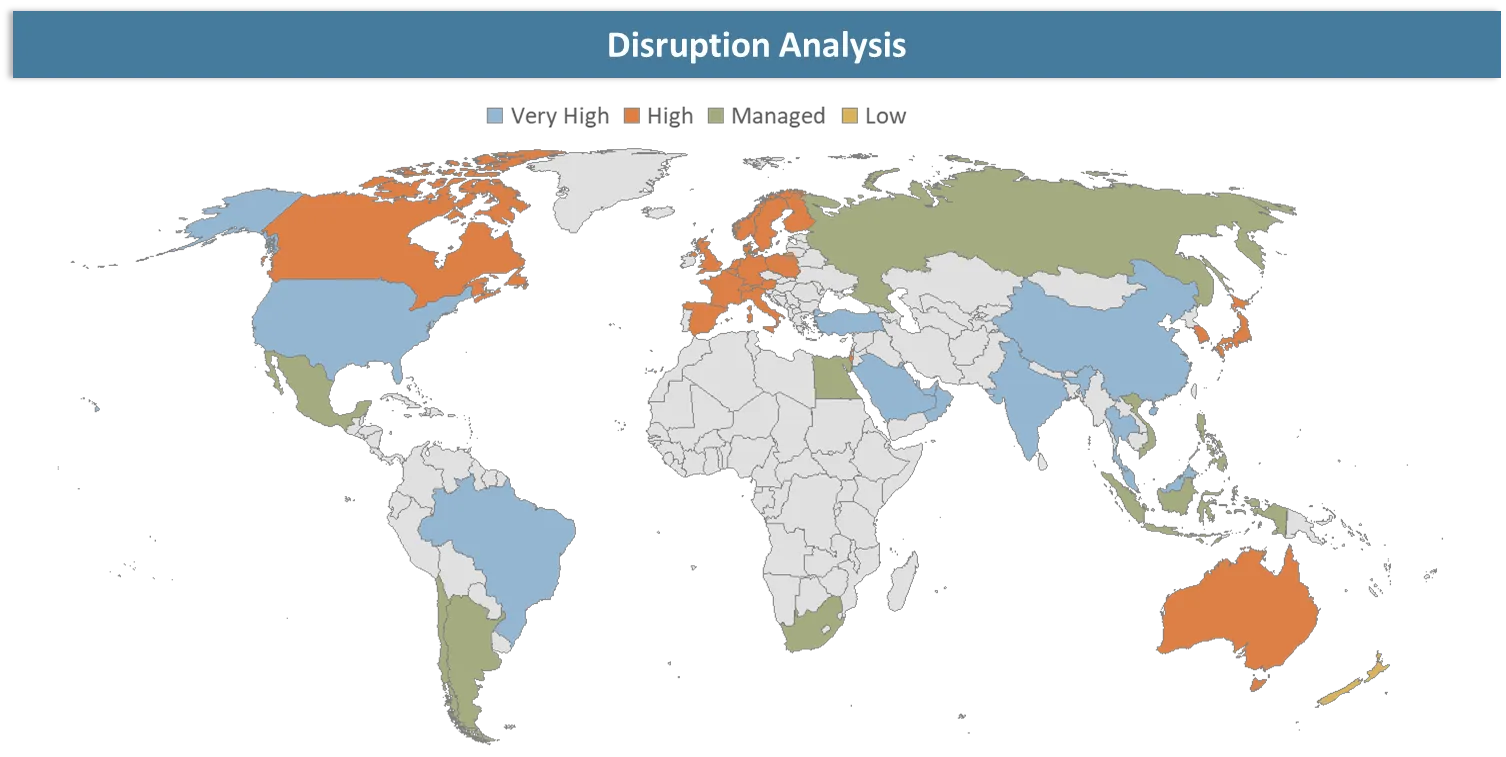
Transition Toward Commercial-Scale Quantum Computing Infrastructure Reshaping Cryogenic Refrigeration Requirements
The disruption in the dilution refrigerator market is being driven by the transition from cryogenic lab equipment to commercially viable quantum computing solutions. With the rise in density of qubits in superconducting quantum processors, the traditional dilution refrigerators, which were used for academic research purposes, have been replaced by higher-cooling-capacity, cryogen-free dilution refrigerators with increased experimental volume, modularity, and enhanced microwave connections. IBM introduced its Quantum Starling roadmap in June 2025, which aims to design a fault-tolerant quantum computer that will perform 20,000 times more tasks than currently available quantum computers, thus creating an increased demand for scalable millikelvin cryogenic solutions.
In addition, the growing use of cryogenic electronics, quantum control equipment, and quantum computing platforms is driving changes in the needs for cryogenic systems that go beyond the scope of physics labs in cryogenic temperatures. The manufacturers of these systems are improving the helium-3 supply chain, automating their systems further, and designing new dilution refrigerators with greater cooling capacity, lower vibration, and increased thermal stability.
Dilution Refrigerator Market BCG Matrix: Company Evaluation
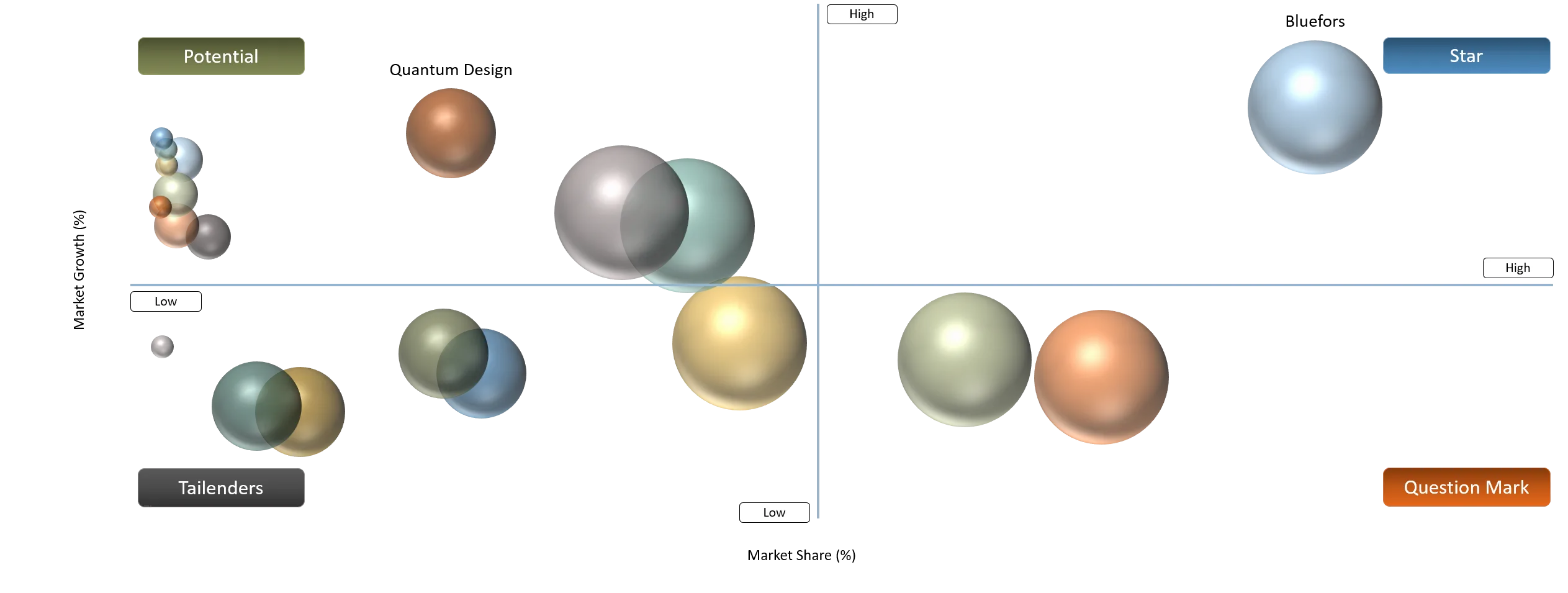
Stars include Bluefors, Oxford Instruments NanoScience, and Air Liquide Advanced Technologies because they hold leading positions in the dilution refrigerator market with broad commercial portfolios, global installation bases, and strong partnerships with quantum computing companies, national laboratories, and research institutions. Question Marks include FormFactor, ULVAC CRYOGENICS, and Leiden Cryogenics, as they possess strong cryogenic engineering capabilities and are expanding their presence in quantum computing and advanced research applications but face intense competition from established market leaders.
The Potential category includes Quantum Design and Cryomagnetics, which maintain established positions in cryogenic instrumentation and scientific research equipment while progressively expanding their dilution refrigerator offerings. Tailenders category includes ICE Oxford because its dilution refrigerator business is primarily focused on custom-engineered and specialized cryogenic solutions for research applications rather than high-volume commercial deployment.
Dilution Refrigerator Market Dynamics
Driver Impact Analysis
| Driver | Market Growth Impact (%) | Demand Concentration | Impacted Use Case | Strategic Impact |
Increasing government funding for quantum technology infrastructure is driving procurement of advanced cryogenic systems by national laboratories and research institutions. | 30% | High in North America, Europe, and East Asia | National quantum laboratories, academic research, superconducting quantum computing | Accelerates procurement of next-generation dilution refrigerators and strengthens long-term public-sector demand. |
Growing deployment of cryogenic electronics is expanding the adoption of dilution refrigerators for ultra-low-temperature device characterization and operation. | 22% | High in semiconductor R&D and quantum hardware development | Cryogenic electronics, superconducting circuits, device characterization | Expands commercial adoption beyond research laboratories into advanced semiconductor and quantum electronics development. |
Continuous scaling of superconducting qubit counts is creating demand for dilution refrigerators with larger experimental volumes and higher cooling capacities. | 32% | Very High among quantum computing developers | Large-scale quantum processors, qubit testing, quantum computing infrastructure | Drives innovation in high-cooling-power, modular dilution refrigerator platforms and increases system value per installation. |
Increasing utilization of low-temperature physics and condensed matter research is driving replacement of legacy liquid-helium cryostats with cryogen-free dilution refrigerators. | 14% | Moderate in universities and government laboratories | Condensed matter physics, materials science, fundamental physics research | Supports replacement demand while accelerating the transition toward cryogen-free cryogenic infrastructure. |
Advancements in closed-cycle pulse tube cryocooler technology are improving system reliability and reducing operational complexity, supporting broader commercial adoption. | 17% | High across commercial and research installations | Quantum computing, cryogenic electronics, scientific instrumentation | Improves operational efficiency, lowers lifecycle costs, and expands adoption in industrial and research environments. |
Increasing government funding for quantum technology infrastructure is driving procurement of advanced cryogenic systems by national laboratories and research institutions
With the increased investments by the government in quantum technology infrastructure, the need for dilution refrigerators has increased owing to the development of cryogenic labs dedicated to quantum computing, quantum sensing, and physics at low temperatures. In 2025, UK Research and Innovation (UKRI) procured a cryogen-free bottom-loading dilution refrigerator system for its dedicated cryogenic lab working on the QUEST-DMC dark matter research project.
This investment reinforces the growing role of governmental funding towards quantum research facilities, which will increase the need for advanced dilution refrigerators and cryogenic facilities. In November 2025, according to Fermilab, the U.S. Department of Energy (DOE) Office of Science has awarded US$125 million in funding over five years to the Superconducting Quantum Materials and Systems (SQMS) Center, with an additional funding of US$25 million in the first year, to promote advancements in quantum computing, quantum communications, and quantum sensing. The SQMS Center comprises over 300 scientists from 43 partnering organizations and will help build scalable quantum systems, along with a quantum processor of 100+ qudits in one dilution refrigerator.
Restraint Impact Analysis
| Restraint | Drag on Market Growth (%) | Primary Impact Area | Impacted Use Case | Strategic Impact |
Limited global availability of helium-3 (³He) increases procurement costs and constrains large-scale deployment of dilution refrigerators. | 22% | Cryogenic supply chain and operating cost management | Superconducting quantum computers, quantum research laboratories, ultra-low-temperature physics experiments | Increases system costs, creates supply-chain dependency, and encourages development of helium-3 recycling technologies, alternative cooling approaches, and strategic isotope sourcing partnerships. Helium-3 scarcity remains a key concern because dilution refrigerators require ³He/⁴He mixtures to reach millikelvin operating temperatures. |
Complex system installation, calibration, and maintenance require highly specialized cryogenic expertise, limiting widespread commercialization. | 18% | Deployment capability and operational complexity | Academic quantum labs, enterprise quantum computing facilities, national research centers | Slows adoption outside specialized environments by increasing installation time, skilled workforce requirements, and lifecycle costs. Drives demand for automated calibration, modular refrigerator designs, and service-based cryogenic solutions. |
Scaling cooling performance for high-qubit quantum processors presents significant engineering and thermal management challenges. | 25% | Scalability, thermal management, and system architecture | Fault-tolerant quantum computers, large-scale quantum data centers | Limits transition from experimental quantum systems to industrial-scale quantum computing due to restricted cooling power, heat-load management issues, wiring complexity, and vibration control challenges. |
Dependence on specialized cryogenic supply chains increases vulnerability to component shortages and extended procurement cycles. | 15% | Manufacturing ecosystem and equipment availability | Quantum computing hardware production, cryogenic instrumentation, research infrastructure | Creates longer delivery timelines and increases reliance on limited suppliers of cryogenic components, pumps, compressors, and specialty materials. Encourages regional supply-chain localization and supplier diversification. |
Limited global availability of helium-3 (³He) increases procurement costs and constrains large-scale deployment of dilution refrigerators
The limited global supply of helium-3 (³He) is one of the major restraints in the global dilution refrigerator Market, as helium-3 is a critical component in the creation of millikelvin temperatures in the continuous dilution refrigerator process. Helium-3 is produced in very small amounts compared to other industrial gases, which leads to increased lead times and higher costs for companies producing these refrigerators. In May 2025, the DOE Isotope Program of the United States of America announced its intentions to increase its domestic production of isotopes, including helium-3 production. However, worldwide availability of helium-3 is still constrained in comparison with demand from quantum computers and scientific research.
The initiative highlights growing governments ' efforts to bolster their internal helium-3 production line, which will alleviate the problem of bottlenecks in the important raw material required for the operation of dilution refrigerators in quantum technology applications. In November 2025, Interlune, the company, secured a U.S. Air Force AFWERX SBIR Direct-to-Phase II contract worth US$1.25 million to develop a domestic helium-3 (³He) separation system that will be used in various quantum research and development programs. The initiative seeks to tackle the severe lack of helium-3 through the deployment of innovative technology at one of the currently available helium liquefaction facilities, which will result in almost doubling the current yearly production of helium-3 in the country.
Dilution Refrigerator Market Segment Analysis
The global Dilution Refrigerator market is segmented based on product type, cooling power, base temperature, application, and region.
Adoption of Cryogen-Free Cooling Technology Accelerates Deployment of Quantum Computing Infrastructure
The Dry (Cryogen-Free) Dilution Refrigerators segment holds a dominant position in the Dilution Refrigerator Market and held 84% of the market share in 2025, due to their capability to provide uninterrupted millikelvin-level cooling without requiring any replenishment of liquid helium. The dry type of dilution refrigerators uses closed-cycle pulse tube cryocooler technology, thus cutting down on operational cost and making their installation easier and allowing continuous use, which is why these are preferred in quantum computing labs, national research centers, and quantum data centers.
The rapid expansion of quantum computing infrastructure during 2025–2026 has further strengthened demand for dry dilution refrigerators. Leading companies such as Bluefors, Quantum Design, and Oxford Instruments have been developing their cryogen-free refrigerator line-ups capable of supporting the next-generation superconducting quantum computers featuring high numbers of qubits during 2025–2026. Investments in quantum computing infrastructure and transition to maintenance-friendly and helium-saving refrigeration technology have been keeping Dry (Cryogen-Free) Dilution Refrigerators on top of the market product range.
Dilution Refrigerator Market Geographical Penetration
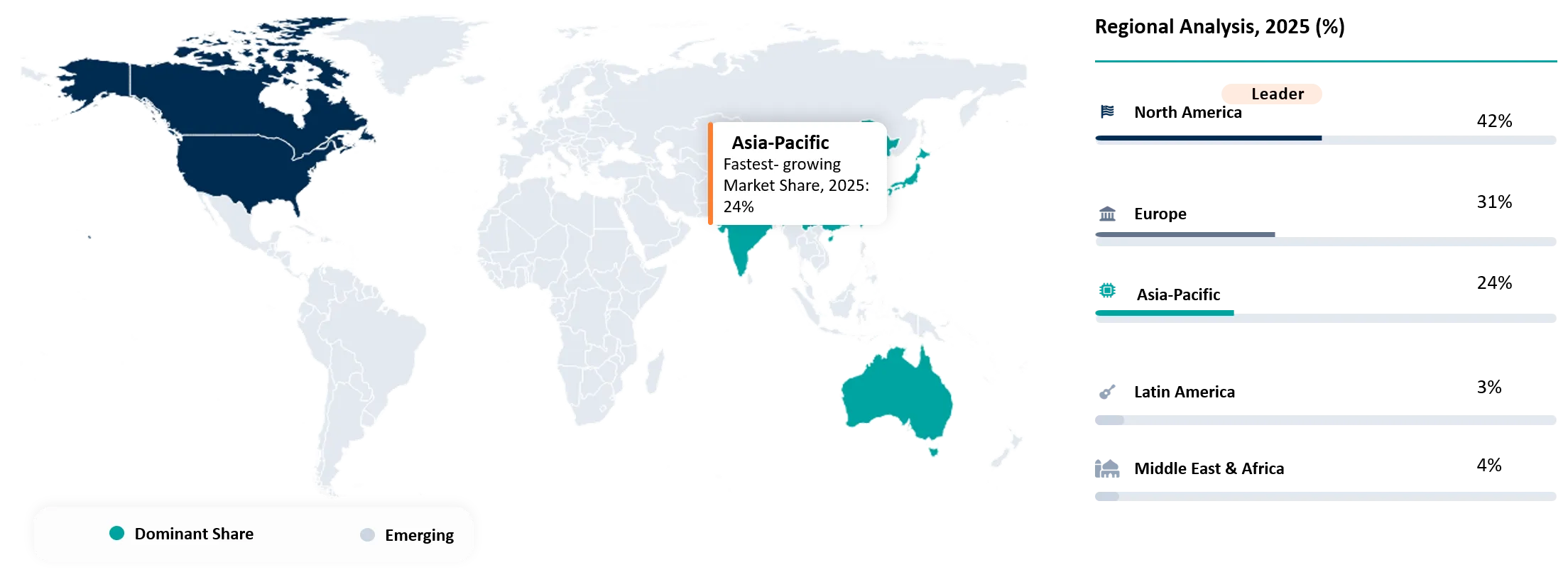
Rapid Expansion of Quantum Computing Infrastructure Strengthens North America's Leadership in the Dilution Refrigerator Market
North America region is dominating the Dilution Refrigerator Market, with a 42% market share in 2025. North America is considered to be the largest regional market for dilution refrigerators owing to its high concentration of quantum computing firms, government laboratories, government-sponsored R&D projects, and cutting-edge providers of cryogenic technology. There are huge investments in superconducting quantum computers in North America, wherein dilution refrigerators are needed for creating millikelvin temperatures. Leading quantum computer hardware makers such as IBM, Google Quantum AI, Rigetti Computing, and various research institutions continue to contribute to the demand for high-end dry dilution refrigerators.
This deal gives Quantum Design an edge in the increasingly competitive quantum cryogenics market by adding more dilution refrigerators and sophisticated cryogenic research systems to its product range. In June 2025, Oxford Instruments, a UK-based public scientific instrumentation company, announced the sale of its Oxford Instruments NanoScience business to Quantum Design, a U.S.-based private scientific instrumentation company, for 60 million (roughly US$81.5 million), further developing its portfolio of ultra-low-temperature equipment for dilution refrigerators and more, including quantum research. During the Financial Year 2025, Oxford Instruments NanoScience reported around £59 million (US$80.1m) revenue and £1million (US$1.35m) adjusted operating profit.
U.S. Dilution Refrigerator Market Trends
The U.S. holds the dominant position in the North American Dilution Refrigerator Market owing to its supremacy in the field of quantum computing research, a huge amount of governmental spending, and availability of the best manufacturers of quantum hardware and cryogenic equipment. A vibrant ecosystem has been developed in the country, which comprises national labs, research institutions, quantum start-ups, and other companies working on the basis of dilution refrigerators for the creation of millikelvin temperatures for superconducting qubits, cryogenic electronics, and physical experiments. The development of the infrastructure of quantum computers and the commercialization of fault-tolerant quantum computing systems have cemented the U.S.'s supremacy in terms of revenue generation in the regional market.
The expansion strengthens Bluefors’ capacity to meet the needs of an expanding quantum computing community in the U.S., thanks to offering local access to advanced dilution refrigerators and cryogenic measuring equipment. In May 2026, Bluefors, a Finland-based private cryogenic technology company, expanded its U.S. presence by opening its second Bluefors Lab facility at the UChicago Science Incubator in Chicago, which has bolstered the quantum technology research capability infrastructure throughout North America. This new laboratory facility covers an area of 580 sq ft and is fitted with the LD400He Measurement System, while it adds to the existing 320 sq ft laboratory facility of the company in Chicago.
Canada Dilution Refrigerator Market Outlook
Canada is emerging as the fastest-growing country in the North American Dilution Refrigerator Market owing to the rapid growth of the quantum technologies industry, government backing of quantum technologies, and commercial use of superconducting and photonic quantum computers. Canada has positioned itself as a global center for quantum research through partnerships between universities, national research centers, and quantum companies. Investments in the development of cryogenic infrastructure have increased the adoption of dilution refrigerators in laboratories as well as commercial quantum computers that require millikelvin temperatures.
This partnership illustrates the increasing synergy between the application of dilution refrigerators and quantum computers that can provide scalable, out-of-the-box superconducting quantum computing systems. In March 2026, Zero Point Cryogenics, a Canada-based private cryogenic technology company, joined forces with Rigetti Computing, a U.S.-based public quantum computing company, to introduce the "QPU-Ready" Model L dilution refrigerator via the Rigetti Novera™ QPU Partner Program at the APS Global Physics Summit 2026. The platform integrates Rigetti's 9-qubit Novera™ Quantum Processing Unit (QPU) with the Model L dilution refrigerator from Zero Point Cryogenics. The partnership will also help Canada in installing its first full-stack quantum computer in the Prairies region of the country.
Dilution Refrigerator Market Competitive Landscape
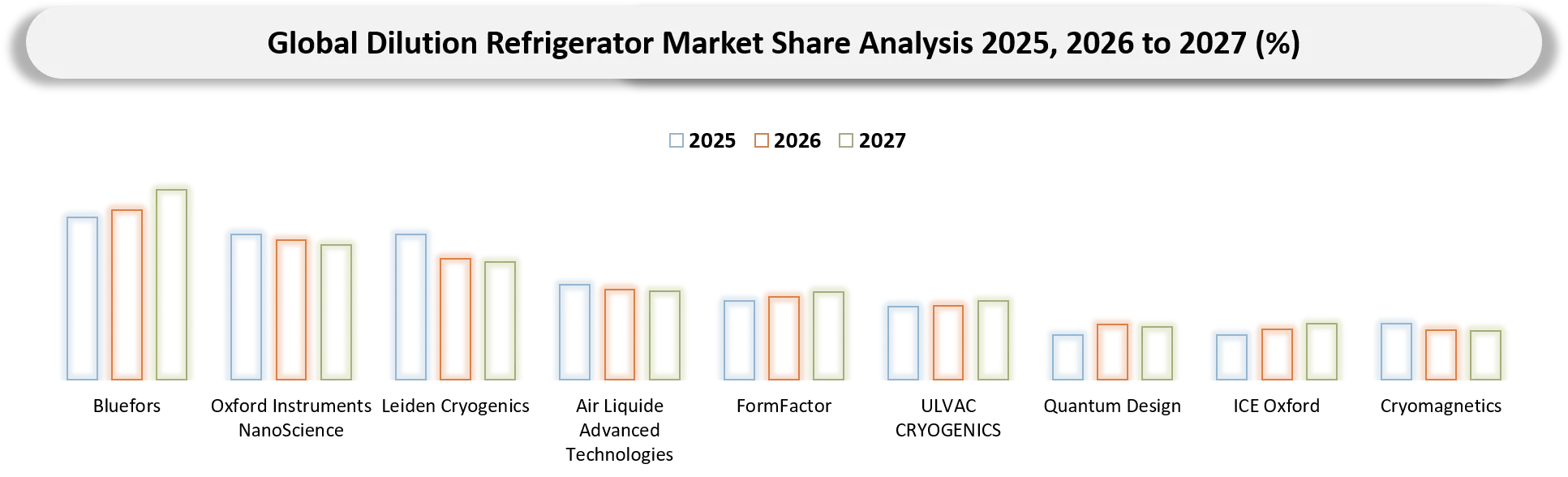
- The Dilution Refrigerator Market is characterized by three key participant groups: specialized cryogenic refrigeration manufacturers, quantum technology infrastructure providers, and cryogenic measurement & instrumentation companies. Bluefors, Oxford Instruments NanoScience, and Leiden Cryogenics dominate the market with broad portfolios of cryogen-free dilution refrigerators deployed across quantum computing, condensed matter physics, and national research laboratories. Air Liquide Advanced Technologies and ULVAC CRYOGENICS strengthen the market through industrial cryogenic engineering and customized ultra-low-temperature systems, while Quantum Design, FormFactor, ICE Oxford, and Cryomagnetics provide integrated cryogenic platforms, measurement solutions, and superconducting research equipment. The market remains highly technology-driven, where cooling performance below 10 mK, higher cooling power, vibration isolation, scalability for large-qubit quantum processors, and long-term service capabilities are the primary competitive differentiators. The top five manufacturers collectively account for approximately 75–80% of the global dilution refrigerator market in 2025, reflecting a highly consolidated competitive landscape driven by technological expertise and long-standing collaborations with quantum computing companies and research institutions.
- Key players include Bluefors, Oxford Instruments NanoScience, Leiden Cryogenics, Air Liquide Advanced Technologies, FormFactor, ULVAC CRYOGENICS, Quantum Design, ICE Oxford, and Cryomagnetics.
Key Developments
- September 2025: Bluefors, a Finland-based private cryogenic technology company, entered a strategic partnership with Delft Circuits, a Netherlands-based private quantum hardware company, to integrate Cri/oFlex® quantum I/O technology into Bluefors' dilution refrigerator systems.
- March 2025: Bluefors, a Finland-based private cryogenic technology company, signed a Memorandum of Understanding (MoU) with Qblox, a Netherlands-based private quantum computing control systems company) to accelerate the development of integrated quantum computing solutions.
- March 2025: ULVAC, Inc., a Japan-based public vacuum and cryogenic equipment manufacturer, announced that it is developing a next-generation dilution refrigerator for quantum computing in collaboration with IBM, a U.S.-based public technology company, with commercial deployment targeted for early 2026.
- March 2026: Leiden Cryogenics, a Netherlands-based private cryogenic systems manufacturer, partnered with Orange Quantum Systems (OrangeQS), a Netherlands-based private quantum testing and measurement technology company, to develop Quper, a compact tabletop dilution refrigerator for rapid quantum chip testing.
- August 2025: Entanglement, Inc., a U.S.-based private quantum computing and artificial intelligence company, signed a strategic Memorandum of Understanding (MoU) with Maybell Quantum, a U.S.-based private quantum infrastructure company, to deploy Maybell's dilution refrigerators and cryogenic I/O systems across Entanglement's quantum laboratories and innovation hubs, including its new facility in Vienna, Austria.
- February 2025: Bluefors, a Finland-based private cryogenic technology company, announced the commercial availability of its Ultra-Compact LD Dilution Refrigerator System, an all-in-one cryogenic measurement platform designed for laboratories with limited space and high-performance computing environments.
Key Procurement Priorities and Buyer Evaluation Criteria
- Organizations investing in the Dilution Refrigerator Market are opting for suppliers who can provide dilution refrigerators that offer cryogen-free (dry) dilution refrigerators with reliable millikelvin cooling, high cooling capacity, low vibration, and scalable architecture that can facilitate the upcoming generation of quantum computers and scientific research. Companies with expertise in installing and maintaining the system, in addition to using less helium, are favored for research infrastructure projects.
- The procurement decision-making process is driven by the quick commercialization of superconducting quantum computers, the growth of quantum data centers, the development of cryogenic electronics, and the increased investment in national quantum projects from 2025 to 2026. The customers give preference to the suppliers who have the ability to supply their modular systems with better thermal stability and scalability.
- Buyers evaluate suppliers based on factors such as base temperature (below 10 mK), capability to cool, temperature stability, vibration insulation, helium-3 effectiveness, operational time, compatibility with quantum hardware, efficiency, and convenience of installation and maintenance. Service agreements, diagnostic capabilities, and reliable continuous performance are other important factors that determine purchase decisions.
Why Choose DataM?
- Technological Innovations: Explores advancements in cryogen-free dilution refrigeration, high-cooling-power platforms, ultra-low vibration pulse tube technology, helium-3 recycling, automated cryogenic control systems, and scalable millikelvin cooling architectures that enable reliable operation of superconducting quantum processors, cryogenic electronics, and next-generation quantum computing systems.
- Product Performance & Market Positioning: Evaluates how leading manufacturers differentiate their dilution refrigerator platforms based on base temperature, cooling power, temperature stability, vibration isolation, helium efficiency, energy consumption, system scalability, and ease of integration with quantum computing hardware and scientific research infrastructure.
- Real-World Evidence: Highlights the deployment of dilution refrigerators across quantum computing, cryogenic electronics, quantum sensing, condensed matter physics, superconducting device testing, particle physics, and space instrumentation, demonstrating improvements in qubit coherence, thermal stability, measurement accuracy, and long-duration experimental performance.
- Market Updates & Industry Changes: Tracks key developments including new cryogen-free system launches, strategic partnerships, acquisitions, manufacturing expansions, and government investments in quantum technologies across North America, Europe, and Asia-Pacific, providing insights into the commercialization of quantum computing infrastructure during 2025–2026.
- Competitive Strategies: Analyzes how leading companies such as Bluefors, Oxford Instruments NanoScience, Leiden Cryogenics, Air Liquide Advanced Technologies, Quantum Design, FormFactor, ULVAC CRYOGENICS, ICE Oxford, and Cryomagnetics compete through technological innovation, higher cooling capacities, modular system architectures, global service capabilities, and strategic collaborations with quantum computing companies and research institutions.
- Pricing & Market Access: Explains pricing variations based on cooling power, base temperature, system configuration, helium-3 requirements, automation level, and customization, along with procurement through direct manufacturers, scientific instrumentation distributors, and integrated cryogenic solution providers serving academic, government, and commercial customers.
- Market Entry & Expansion: Identifies growth opportunities driven by the rapid commercialization of quantum computing, expansion of national quantum initiatives, increasing investments in cryogenic research infrastructure, and the scaling of high-qubit superconducting processors, while outlining strategies such as product innovation, regional manufacturing expansion, strategic partnerships, and lifecycle service offerings to strengthen global market presence.
Target Audience
- Dilution Refrigerator Manufacturers
- Cryogenic Equipment & Scientific Instrumentation Companies
- Quantum Computing Hardware Developers
- Superconducting Quantum Processor Manufacturers
- Cryogenic Electronics Manufacturers
- Quantum Sensing & Detector Developers
- Superconducting Device Testing Laboratories


























































