


Digital Product Passport Market Size and Overview
The global digital product passport market reached US$ 1.20 billion in 2025 and is expected to reach US$ 9.09 billion by 2035, growing with a CAGR of 22.6% during the forecast period 2026-2035.
The Global Digital Product Passport (DPP) Market is on trend due to the fact that product-level traceability is moving from an optional sustainability program into a regulatory and supply chain obligation, especially in Europe. The EU Ecodesign for Sustainable Products Regulation (ESPR), which came into effect in July 2024, mandates the DPP as a digital identity of the regulated product containing information about materials, durability, reparability, performance, reuse and recycling. There has been a sudden increase in momentum since 2026: in July 2026, the European Commission introduced harmonized DPP standards, and the DPP Registry went live on 20 July 2026, thereby building the fundamental digital infrastructure for data exchange related to products. The first key compliance trigger is looming as battery passports will become mandatory as of 18 February 2027 for batteries used in electric vehicles, batteries for light means of transport and industrial batteries above 2 kWh.
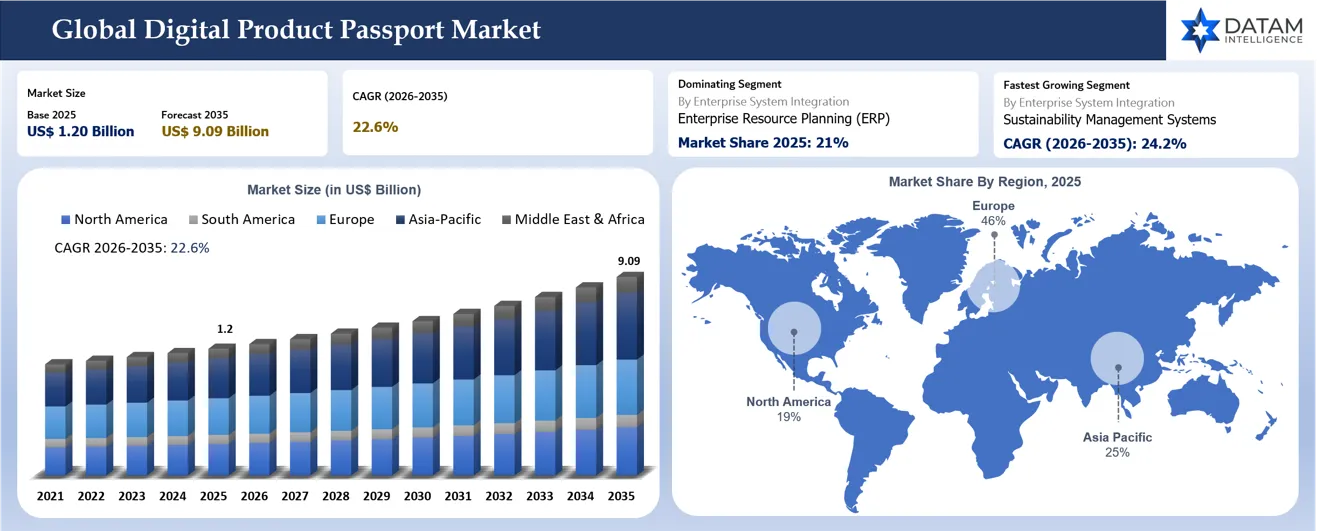
In the European Commission's ESPR Working Plan 2025-2030, there is a specific focus on steel and aluminum, textiles, furniture, tyres, and mattresses where DPP regulations are being worked on, with varying implementation schedules for each individual sector. It is already evident that regulatory readiness is creating a large amount of business activity since companies need to integrate disparate datasets for raw materials, manufacturing, carbon footprint, product composition, repair, reuse and end-of-life treatment. In April 2025, the European Commission has started a dedicated consultation with DPP service providers regarding data storage, management and certification needs, signaling that the ecosystem is progressing from policy making to actual infrastructure building. Consumer demand is driving this forward, with 77% of EU citizens preferring to repair products rather than replace them and more than two-thirds stating uncertainty or lack of trust in sustainability data. This is creating an even greater imperative for standardised and verifiable product-level data, and thus DPP is becoming a digital layer of infrastructure that connects manufacturers, suppliers, retailers, consumers, repairers, recyclers, customs and regulators in increasingly circular supply chains.
Digital Product Passport Market Key Takeaways
- North America is emerging as a leading region in the global Digital Product Passport (DPP) market, supported by increasing adoption of product traceability, circular-economy initiatives, and digital supply-chain infrastructure, while Europe remains at the forefront of regulatory-driven DPP deployment through the European Union’s Ecodesign for Sustainable Products Regulation and related product-specific requirements.
- In 2025, battery and automotive-related applications are among the leading areas of digital product passport adoption, driven by stringent requirements for battery information, material traceability, sustainability reporting, and lifecycle management.
- Textile and apparel applications represent one of the fastest-expanding DPP use cases, as brands and manufacturers increasingly invest in digital traceability, product-level sustainability information, recycled-content verification, and circular business models.
- The growing focus on regulatory compliance, supply-chain transparency, circularity, and product-level sustainability data is a major driver accelerating Digital Product Passport adoption across automotive, batteries, textiles, electronics, and consumer goods industries.
- SAP, Siemens, and Avery Dennison have established strong positions in the Digital Product Passport ecosystem through investments in digital supply-chain infrastructure, product traceability platforms, data-management capabilities, connected identification technologies, and strategic collaborations supporting enterprise-scale DPP implementation.
Digital Product Passport Market Scope
| Metrics | Details | |
| 2025 Market Size | US$ 1.20 Billion | |
| 2035 Projected Market Size | US$ 9.09 Billion | |
| CAGR (2026-2035) | 22.6% | |
| Largest Market | Europe | |
| Fastest Growing Market | Asia-Pacific | |
| By Offering | DPP Creation & Management Platforms, DPP Data Management Platforms, DPP Compliance Management, DPP Traceability Platforms, DPP Analytics | |
| By DPP Infrastructure | Cloud-Based DPP, On-Premises DPP | |
| By Data Category | Product Identification Data, Material Data, Manufacturing Data, Environmental Data, Lifecycle Data, Compliance Data | |
| By Enterprise System Integration | Enterprise Resource Planning (ERP), Product Lifecycle Management (PLM), Manufacturing Execution Systems (MES), Supply Chain Management (SCM), Warehouse Management Systems (WMS), Customer Relationship Management (CRM), Sustainability Management Systems, Enterprise Asset Management, Quality Management Systems, IoT Platforms, Digital Twin Platforms | |
| By End-Use Industry | Automotive, Batteries & Energy Storage, Textiles & Apparel, Electronics, Electrical Equipment, Chemicals & Plastics, Construction, Furniture, Consumer Goods, Machinery & Industrial Equipment, Others | |
| By Organization Size | Large Enterprises, Small & Medium Enterprises | |
| By Region | North America | U.S., Canada, Mexico |
| Europe | Germany, UK, France, Spain, Italy, Poland | |
| Asia-Pacific | China, India, Japan, Australia, South Korea, Indonesia, Malaysia, Singapore, Vietnam, Thailand, Philippines, Taiwan | |
| South America | Brazil, Argentina | |
| Middle East and Africa | UAE, Saudi Arabia, South Africa, Israel, Turkiye | |
| Report Insights Covered | Competitive Landscape Analysis, Company Profile Analysis, Market Size, Share, Growth | |
Why does this report matter in 2026?
The global digital product passport market will witness a significant period of commercialization and adoption by regulators in 2026, as all parties involved continue their efforts to build clear and trackable product information ecosystems. The growing emphasis of regulators on product sustainability, circular economy considerations, supply chain visibility, and responsibility throughout the lifecycle-particularly within the European Union-is driving investment in Digital Product Passport technologies, platforms, identification mechanisms, and compliance tools. This trend is fast turning the market from a sustainability and traceability initiative into an essential digital infrastructure layer for product value chains.
Fast developments in cloud-based product data platforms, traceability through blockchain, connectivity via the Internet of Things, digital identity solutions, QR/NFC identification, and AI-based data management are changing the dynamics of competitive positioning within the ecosystem. Buyers, investors, manufacturers, and technology providers need greater clarity on regulatory readiness, data interoperability, supplier-level traceability, product life cycle, cybersecurity, standards compliance, integration abilities, and cross-border scalability to assess the sustainability of the solution and make it commercially competitive.
White Space & Investment Opportunities
- DPP data-integration platforms remain undersupplied as manufacturers face growing requirements to connect ERP, PLM, MES, supplier and sustainability data into interoperable product records. The European Commission’s DPP framework is moving into operational implementation, with the DPP Registry becoming operational in July 2026 and additional standards and sector-specific requirements progressing through 2026-2029.
- Battery and EV supply-chain DPP solutions offer significant white space because the EU battery passport becomes mandatory from 18 February 2027 for EV batteries, light means of transport batteries and industrial batteries above 2 kWh. The Commission's August 2026 guidance identifies 71 data points across battery categories, increasing demand for automated data collection, validation and lifecycle-management capabilities.
- Supplier-level data orchestration represents an attractive investment area because DPP implementation requires information from multiple tiers, certifications, production sites and lifecycle stages rather than isolated product databases. Platforms capable of consolidating supplier information into a single product record can become strategically embedded in manufacturers' compliance and traceability workflows.
- India, Southeast Asia, Mexico and Eastern Europe present localization opportunities as exporters increasingly need DPP-ready product identification and traceability capabilities to maintain access to European supply chains. Investment in regional implementation partners, data-validation services and localized onboarding can reduce adoption barriers for SMEs.
- DPP verification, authentication and lifecycle services remain underdeveloped as companies move beyond basic QR-code access toward machine-readable, interoperable and continuously updated product information. GS1's 2026 standards activity-including its updated DPP provisional application and Digital Link developments-indicates increasing demand for standardized identification and data-carrier infrastructure.
Future Market Transformation
By 2035, the market for the Digital Product Passport will likely function as part of the core digital infrastructure of industry rather than as an isolated application used for compliance purposes. DPP companies will integrate their services by integrating product identity, supplier visibility, raw material origins, carbon and sustainability information, repair data, recycling information, conformity evidence, and lifecycle information into continuously updated digital product histories. The market will evolve from basic QR code-based solutions to more interoperable ecosystems that connect to ERP, PLM, MES, SCM, and IoT systems. Implementation in various sectors will grow beyond batteries to include textiles, construction products, tires, aluminum, furniture, and other regulated products. Leading companies will offer interoperability of standards, cybersecurity, data management, supplier connectivity, and automated validation through enterprise integration.
Buyer Decision-Making Criteria
Manufacturers and brands are now evaluating DPP service providers based on their compliance with regulations, interoperability, data security, integratability, vendor connectivity, scalability, and implementation services. The interoperability feature is gaining significance as a necessary criterion since the ESPR mandates DPP data to be in an interoperable and machine-readable format free of any vendor lock-in. The buyers now prefer a platform that can integrate fragmented information of suppliers with the existing ERP, PLM, MES, and sustainability platforms than creating yet another database. Compatibility with standards is also gaining importance especially when GS1 is making efforts in developing digital link and other DPP standards.
Economic & Investment Analysis
The macroeconomic factors driving the DPP market include regulatory compliance spending, localization of the supply chain, costs related to sustainability reporting, digital transformation expenditures, costs related to cybersecurity and product traceability economics. EU regulations are making DPP from an optional sustainability practice to an obligatory practice with technological aspects, where batteries will be the first big mandatory use case starting from February 2027. This leads to quite an exceptional business model - companies are investing not only in creation of consumer-oriented product information, but in building a data foundation to enable regulatory access, supplier validation and circularity management. As a result, the capital inflow will go to API data integrations, automatic data collection, product identification, supplier onboarding, cybersecurity measures, data validation and DPP repository interoperability. The business potential is especially high for those platforms that could minimize the costs associated with collection of scattered information from a global supply chain. The DPP usage is also expected to lead to recurrent expenses on data management, regulatory updates and product verification instead of a single software implementation.
Investment Trends in the Market
- DPP data platforms and API integration connecting ERP, PLM, MES, SCM and sustainability systems.
- Battery passport infrastructure, driven by the February 2027 mandatory requirement and the Commission's defined data requirements.
- Standards-compliant identification and data carriers, including GS1 Digital Link, 2D barcodes, RFID and other interoperable technologies.
- Automated supplier data collection and validation to reduce manual documentation and improve product-level traceability.
- Circularity and material-provenance platforms, including recycled-content verification, repair, reuse and recycling information.
Digital Product Passport Market Disruption Analysis
Under the EU’s Ecodesign for Sustainable Products Regulation, the DPP rules have been defined for the products covered under this regulation, whereas the European Commission introduced the functional DPP Registry and Testing Platform in July 2026. This has affected the competitive basis of the market because businesses are not analyzing DPP in terms of sustainability or engagement anymore; rather, they now need to think of DPP as a means of market access and compliance. The disruption has created value in terms of interoperability, standardized identification, data management, and lifecycle connections. GS1 has been working on making the identification and data exchange technologies standardized for implementation of DPP, and the Commission is working on how DPP providers should manage their data and the need for certification.
Another disruption relates to the transition from document-based compliance to machine-readable product identities that link producers, suppliers, consumers, repairers, recyclers, and regulators. DPP data may cover origin, material content, durability, reparability, environmental impact, reuse, and recycling, providing possibilities to relate compliance with resell, repair, resource recovery, and closed-loop supply chain operations. The competition environment is thus broadening beyond sustainability software to digital identification, RFID/QR/NFC technology, enterprise software, PLM, ERP, blockchain, cloud platforms, and digital twins. The example of the launch of 2026 ReadyDPP by Avery Dennison shows how this combination of software, digital identification, physical label, hardware, and professional service can all be included in DPP solution. Sector sequencing will contribute more to disruption: the sectors that move along the predefined regulation path include textiles, tyres, iron and steel, aluminum, furniture, ICT and energy products.
Digital Product Passport BCG Matrix: Company Evaluation

STAR
Avery Dennison, GS1, Siemens, and Circularise constitute the best-positioned Stars in the DPP environment due to their combination of enterprise competence and exposure to the emerging DPP infrastructure. Avery Dennison has developed an end-to-end stack ranging from digital identification and software to labels, hardware, consulting, and tech support services. It has already rolled out ReadyDPP for garments in June 2026. GS1 enjoys the advantages of its participation in product identification, data carriers and interoperability standards, while the DPP architecture created by the European Commission emphasizes the importance of standardized identifiers and decentralized data exchange. Circularise positions itself well in relation to supply chain transparency and material-level sustainability data, while Siemens can take advantage of industrial software, digital twin, and enterprise data capabilities. The Star segment is distinguished by strong regulatory compliance, wide range of technologies, ecosystem connections and scalability across several product categories from batteries through textiles, metals, tires, furniture, ICT products, and energy-related goods.
POTENTIAL
Kezzler, OPTEL, iPoint-systems, Billon Group, as well as other players specializing in DPP technology, fall under the category of Potential Players, since they have the necessary traceability, product-data, serialization, blockchain or compliance competencies, but their reach across the ecosystem is smaller compared to those infrastructure-oriented players. There is great potential here because of the growing implementation of the DPP systems, which is going beyond pilot tests towards real compliance implementation. In July 2026, the European Commission started the DPP Registry, thus providing real infrastructure needed to register unique product identifier along with its metadata. It makes the need arise for specific platforms, which can link manufacturers, suppliers, recyclers, retailers and regulators at the same time controlling the data access and its interoperability. Finally, GS1’s standards indicate that DPP system should provide for common identification and data sharing mechanisms, not only isolated proprietary databases. It means that Potential Players can shift to Star positioning through specialization in complex verticals, creation of API-driven interoperability, multinational client base expansion and DPP integration with ERP, PLM, MES, supply chain and circular economy platforms.
Digital Product Passport Market Dynamics
Driver Impact Analysis
| Driver | Market Growth Impact (%) | Demand Concentration | Impacted Use Case | Strategic Impact |
Increasing Regulatory Push for Product-Level Sustainability and Traceability | 5.20% | European Union, Germany, France, Netherlands, and Nordic markets | Battery passports, textiles, electronics, automotive components, sustainable product compliance | Accelerates DPP adoption by making structured product data and lifecycle traceability integral to regulatory compliance |
Expanding EU Ecodesign and Digital Product Passport Requirements | 5.60% | European Union, particularly automotive, batteries, textiles, electronics, and construction value chains | Product compliance, circularity reporting, repairability, recycling, carbon-footprint disclosure | Creates mandatory data infrastructure requirements and positions Europe as the primary DPP deployment catalyst |
Rising Demand for Supply Chain Transparency and Product Traceability | 4.70% | Europe, North America, Japan, South Korea, and multinational manufacturing hubs | Raw-material provenance, supplier verification, product authentication, lifecycle tracking | Encourages manufacturers to digitize fragmented product information and improve supply-chain visibility |
Increasing Collaboration Between Manufacturers, Technology Providers, and Industry Consortia | 4.30% | European industrial ecosystems and global automotive, electronics, battery, and textile value chains | DPP platforms, interoperable data exchange, product lifecycle management, circular-economy applications | Accelerates interoperability, standard development, and scalable DPP implementation across complex multinational supply chains |
Regulatory Mandates Accelerate DPP Adoption
Regulation is the primary demand accelerator for the global digital product passport ecosystem. The EU's ESPR provides the overarching framework, while sector-specific legislation is creating individual implementation pathways. The regulation requires products covered by applicable delegated acts to have a DPP available before being placed on the EU market or put into service, with information required to remain accurate, complete and up to date. Importantly, DPP requirements apply to both EU manufacturers and non-EU economic operators placing covered products on the European market, meaning companies headquartered in Asia, North America, Latin America and other regions must increasingly prepare their global product-data infrastructure for European compliance.
The regulatory pipeline is already becoming measurable. The Commission's current implementation schedule includes 2026 iron and steel, 2027 textiles/tyres/aluminium, 2028 furniture and 2029 mattresses and ICT products, alongside energy-related products across 2026-2029. The EU has also established a DPP Registry intended to store unique identifiers and other specified information, while a public web portal will allow stakeholders to search and compare relevant DPP information according to access rights. This creates demand not only for DPP software but also for identifier management, data carriers, registry integration, compliance software, API infrastructure, authentication, cybersecurity and data-quality services.
Restraint Impact Analysis
| Restraint | Drag on Market Growth (%) | Primary Impact Area | Impacted Use Case | Strategic Impact |
Lack of Harmonized Data Standards and Interoperability | 4.30% | Data exchange, system interoperability and supplier integration | Cross-border product tracking, multi-tier supply-chain data sharing | Delays DPP ecosystem integration and increases implementation complexity across fragmented supply chains |
High Implementation Costs and Digital Infrastructure Requirements | 4.00% | Technology investment and operational scalability | Enterprise DPP platforms, product-level traceability and data management | Restricts adoption among SMEs and suppliers with limited digital infrastructure and investment capacity |
Limited Availability and Quality of Product-Level Supply-Chain Data | 3.80% | Data completeness, accuracy and verification | Material traceability, recycled-content verification and sustainability reporting | Reduces DPP reliability and creates additional supplier-data collection and validation burdens |
Limited Supplier Readiness and Digital Capability Across Global Value Chains | 3.60% | Supplier onboarding and ecosystem participation | Automotive, textiles, electronics and battery supply-chain traceability | Slows DPP deployment across fragmented supplier networks and increases compliance-management costs |
Security, Data Governance and Interoperability Become Major Challenges
Security and data governance represent one of the most important barriers to large-scale DPP deployment. A DPP may contain commercially sensitive information about suppliers, materials, manufacturing processes, recycled content and product performance. Consequently, companies must determine which information is publicly accessible, which information is available only to business partners and which information must remain restricted to regulators or authorized stakeholders.
The ESPR explicitly requires DPP systems to provide data authentication, reliability and integrity, while ensuring a high level of security and privacy and preventing fraud. It also restricts modification and updating rights according to defined access rights. Furthermore, personal customer data cannot be stored in the DPP without explicit consent under applicable data-protection requirements.
Interoperability is equally important. If every manufacturer, retailer, recycler and technology provider builds an incompatible product-data architecture, the DPP ecosystem could reproduce the fragmentation it is intended to solve. GS1's ongoing work illustrates the industry's movement toward common identification and data-carrier standards. Its June 2026 DPP provisional application update specifically aims to help organizations meet regulatory requirements concerning identification and data carriers. The commercial opportunity therefore extends beyond DPP applications into API interoperability, master-data management, identity resolution, data validation, access-control technologies and cybersecurity.
Digital Product Passport Market Segment Analysis
The global digital product passport market is segmented based on the Offering, DPP Infrastructure, Data Category, Enterprise System Integration, End-Use Industry, Organization Size and region.
Retail, Consumer Goods and Product Transparency Gain Momentum
Consumer-facing applications are becoming an increasingly important DPP use case because digital passports can convert sustainability information from corporate disclosures into product-level information accessible at the point of purchase. The European Commission expects DPPs to make sustainability, durability and other product information accessible to consumers and businesses, while also potentially hosting instructions and conformity documentation.
This creates an opportunity for retailers and brands to use DPPs for more than regulatory compliance. Product passports can support authenticity verification, repair guidance, warranty information, resale, product-history management, recycling instructions and sustainability claims. In premium consumer goods, apparel, electronics and automotive products, DPPs can also strengthen product authentication and secondary-market transparency.
However, the business value depends on the quality and usefulness of the information. The World Economic Forum highlighted in March 2026 that information alone cannot create circularity and that limitations in repair infrastructure, skilled technicians, spare parts, secondary-material availability and reverse logistics can remain binding constraints. Therefore, leading DPP implementations are likely to integrate passport information with actual circular-economy services rather than treating the passport as a standalone digital label.
Textiles and Apparel Become a Major Next-Wave Application
Textiles and apparel represent one of the most strategically important future application areas because the EU's current implementation plan places textiles in the 2027 product group, alongside tyres and aluminium. DPPs can potentially connect apparel products with information on fibre composition, recycled content, production processes, durability, repairability, environmental characteristics and end-of-life treatment.
For global apparel companies, this means DPP readiness will increasingly require supplier-level material data and product-level traceability across geographically dispersed manufacturing networks. Brands sourcing from South Asia, Southeast Asia, China, Türkiye and other manufacturing hubs will need to obtain reliable information from upstream suppliers and convert it into structured, auditable product records.
The strategic opportunity is particularly significant for organizations already investing in digital supply-chain platforms because DPP compliance can be integrated into existing product-lifecycle and supplier-data architectures. Conversely, manufacturers relying heavily on spreadsheets, manual declarations and fragmented supplier documentation may face higher compliance and implementation costs.
Digital Product Passport Market Geographical Penetration

U.S. Digital Product Passport Market Landscape
The United States is emerging as a strategically important market for Digital Product Passport (DPP) solutions, although its development is being driven more by export compliance, supply-chain traceability, battery circularity, and industry-led standards than by a single federal DPP mandate. U.S. companies selling into Europe increasingly need to prepare for the EU’s DPP framework: the U.S. Trade Representative has explicitly identified the EU Ecodesign for Sustainable Products Regulation and its DPP requirements as a trade issue affecting U.S. exporters. The EU framework entered into force on July 18, 2024, while sector-specific requirements are being phased in from 2026 onward. This creates a significant compliance-driven opportunity for U.S. manufacturers in batteries, automotive, electronics, metals, textiles, machinery, and consumer products to establish product-level data infrastructure capable of supporting material composition, recycled content, carbon-related information, repairability, traceability, and end-of-life data. The U.S. National Institute of Standards and Technology (NIST) is also active in the underlying standards ecosystem, listing work on circular-economy standards, supply-chain traceability, and GS1-related Digital Product Passport activities.
Battery traceability is particularly important because U.S. public-sector work is already moving toward data structures compatible with DPP requirements. The U.S. Environmental Protection Agency's battery-related work has examined digital passports as an emerging mechanism for providing lifecycle information, while its 2025 battery material traceability work includes information covering battery chemistry, extraction, manufacturing, processing, components and critical materials and explicitly states that the standard is organized to harmonize with the EU Digital Product Passport for batteries. This alignment is strategically important for U.S. battery, EV and recycling ecosystems because the EU battery-passport requirement becomes mandatory for relevant electric-vehicle, light-transport and industrial batteries from February 18, 2027. Consequently, the U.S. DPP landscape is developing around interoperability rather than isolated domestic compliance, with companies increasingly needing standardized identifiers, QR/data carriers, secure product records and auditable supply-chain information. A further indication of the strategic relevance of product-passport infrastructure came from 2025 U.S. trade discussions, where a digital North American product passport was proposed as a mechanism to improve supply-chain mapping, rules-of-origin verification and regional sourcing transparency.
Japan Digital Product Passport Market Outlook
Japan is developing a structured DPP ecosystem through its circular-economy, manufacturing, battery, textile and digital-architecture initiatives, with government agencies increasingly viewing product-level data as infrastructure for resource circulation and international regulatory alignment. Japan's Ministry of Economy, Trade and Industry (METI) has specifically examined DPP requirements in connection with the EU's sustainable-product framework and identifies resource-circulation information-including parts-reuse information and recycled-material information-as an important data-sharing target under Digital Product Passport initiatives. METI's earlier DPP materials also describe the concept as electronically recording product information and enabling access to information throughout a product's lifecycle, including environmental impact, circularity, substances of concern, reuse, remanufacturing and recycling information. This positions Japan differently from markets where DPP is primarily a compliance technology: Japanese manufacturers are increasingly treating it as a digital infrastructure layer connecting product design, manufacturing, supply-chain management, aftermarket services and resource recovery. The country's strong automotive, electronics, machinery, chemicals and textile manufacturing bases provide substantial practical use cases, particularly where exporters need to demonstrate product-level sustainability and traceability information to overseas customers.
The transition is also becoming tangible through commercial implementation. The Japan Partnership for Circular Economy (J4CE), supported by Japan's environmental-policy ecosystem, identifies Japan's first implementation of a Digital Product Passport in medical apparel, developed by Working Hasegawa and Chaintope, with commercial sales beginning in July 2025. Each item uses a QR code that allows purchasers to access product information through a smartphone, while the underlying system is designed through an API-enabled architecture that can be adapted for other businesses and industries. Japan is also paying increasing attention to battery-passport requirements and international interoperability, with METI documentation explicitly connecting Japanese battery-passport development with overseas battery-passport regulations and automotive lifecycle-data requirements. This is particularly significant because Japanese companies are deeply integrated into global automotive and electronics supply chains and therefore face indirect DPP requirements even when domestic legislation does not impose a universal passport obligation. Japan's DPP trajectory is consequently characterized by government-industry collaboration, lifecycle-data sharing, QR-enabled product identification, circular-economy applications and export-oriented compliance. The emergence of real-world textile implementation in 2025 suggests that DPP adoption is moving beyond policy studies toward practical product-level deployment.
China Digital Product Passport Market Trends
China is rapidly institutionalizing Digital Product Passport capabilities through national standardization, product identification, digital trade and supply-chain traceability, making it one of the most strategically significant DPP ecosystems in Asia. In June 2025, China's national standards authority initiated the development of “Digital Product Passport (DPP)-General Requirements”, covering general principles, business processes, participating parties, identifiers and carriers, data requirements, information sharing, data storage and security, and data authentication. The initiative subsequently progressed into a dedicated national standardization structure: China's State Administration for Market Regulation announced in March 2026 the formal establishment of SAC/SWG 41, the National Product Digital Passport Standardization Working Group, describing it as the country's first national technical standardization organization specifically focused on DPP. The working group is responsible for foundational, identification/carrier and interoperability standards, while its membership spans government, research institutions and major companies across batteries, textiles, consumer electronics and other industries. This is particularly important for Chinese exporters because DPP requirements emerging in Europe can influence product-data architecture far beyond the EU market.
China is also strengthening the physical-digital identification infrastructure required to operationalize DPPs at scale. A revised national Commodity QR Code standard became effective in July 2025, enabling a single QR code to connect consumers with information such as product identity, production batch, digital labels and environmental data, while supporting international use for export products. The development directly complements DPP architecture because product passports require reliable identifiers and data carriers capable of linking physical products with digital records. China's national DPP standard proposal is explicitly designed for implementation in the country's digital-trade environment and addresses information security, authentication, interoperability and data-sharing requirements. The establishment of SWG41 in 2026 further signals that China is moving from fragmented company-level traceability projects toward a nationally coordinated DPP standards framework. The strategic priority is especially strong for industries exposed to European sustainability requirements, including batteries, automotive components, textiles, electronics, machinery and consumer goods. China's approach therefore combines regulatory preparedness with export competitiveness: standardized DPP infrastructure can help manufacturers demonstrate material provenance, product attributes, environmental information and lifecycle data while reducing the risk of incompatible data systems across international markets.
Digital Product Passport Competitive Landscape
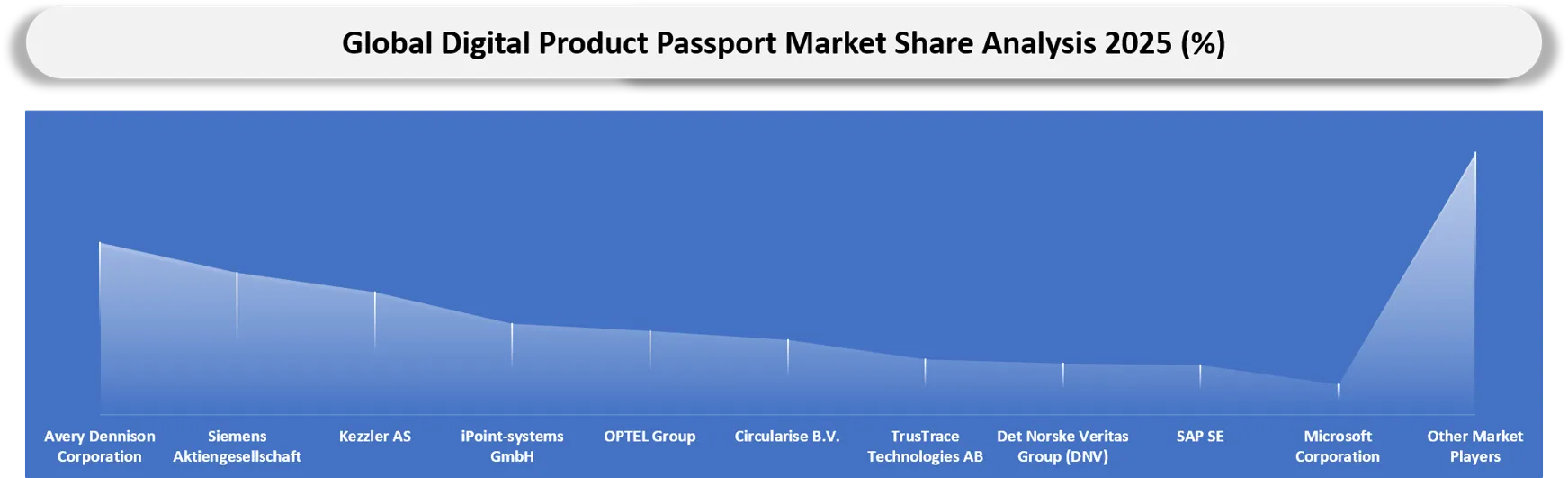
- The global digital product passport ecosystem is highly fragmented and increasingly converging across enterprise software, product-information management, supply-chain traceability, sustainability technology, identification standards and industrial IoT.
- Key ecosystem participants include SAP, Siemens, IBM, Microsoft, GS1, Thales, Eviden, Circularise, iPoint, Kezzler, Avery Dennison, Scantrust and other specialized traceability and product-data providers.
- Companies are differentiating through product-level data management, supply-chain connectivity, digital identity, QR/NFC/RFID data carriers, lifecycle traceability, carbon and sustainability data, API integration, cloud architecture and regulatory compliance. The EU's requirement for secure, interoperable and vendor-neutral DPP infrastructure is likely to favor platforms capable of integrating multiple enterprise systems rather than closed, single-purpose passport applications.
- The most important strategic shift is that DPP is evolving from a sustainability-labeling initiative into a foundational product-data infrastructure layer. The operational launch of the EU DPP Registry in July 2026, the imminent February 2027 battery-passport requirement, the 71 battery data points already identified by the Commission, and the planned expansion into metals, textiles, tyres, aluminium, furniture, mattresses and ICT products demonstrate that implementation is moving rapidly toward enterprise-scale deployment.
- Overall, the winning DPP providers will be those that can combine regulatory compliance, trusted product identity, interoperable data exchange, supplier-data orchestration, cybersecurity and circular-economy functionality-not simply those offering QR-code-based product pages.
Key Companies
- Avery Dennison Corporation
- Siemens Aktiengesellschaft
- Kezzler AS
- iPoint-systems GmbH
- OPTEL Group
- Circularise B.V.
- TrusTrace Technologies AB
- Det Norske Veritas Group (DNV)
- SAP SE
- Microsoft Corporation
- International Business Machines Corporation (IBM)
- Spherity GmbH
- LyondellBasell Industries N.V.
- Arianee SAS
- Circulor Limited
- Narravero GmbH
- Protokol Group Ltd.
- OPTEL GROUP / Optchain
- Scantrust SA
- Qliktag Software Inc.
Major Pain Points
- Fragmented Data Across Supply Chains - Product, material, sustainability, and lifecycle data remain distributed across manufacturers, suppliers, logistics providers, recyclers, and other value-chain participants.
- Lack of Interoperable Data Standards - Differences in data formats, identifiers, taxonomies, vocabularies, and system architectures complicate seamless DPP data exchange.
- High Implementation and Integration Costs - Companies face significant expenditure for data infrastructure, ERP/MES integration, data carriers, cybersecurity, software, and ongoing DPP management.
- Unclear and Evolving Regulatory Requirements - Sector-specific DPP obligations are being introduced progressively, creating uncertainty around compliance priorities, required data fields, and implementation timelines.
- Poor Data Quality and Reliability - Incomplete, inconsistent, outdated, or non-standardized product information can undermine DPP accuracy and regulatory credibility.
- Supplier-Level Data Collection Challenges - Obtaining verified environmental, material-origin, recycled-content, and lifecycle information from fragmented global supplier networks remains difficult.
- Data Ownership and Confidentiality Concerns - Manufacturers and suppliers may hesitate to disclose commercially sensitive information while determining appropriate access rights across the value chain.
- Cybersecurity and Data Integrity Risks - Centralized access points, APIs, identifiers, and interconnected DPP systems create additional requirements for authentication, secure data exchange, and tamper resistance.
- Lifecycle Data Maintenance Complexity - Companies must keep DPP information accurate throughout product lifecycles, including repair, refurbishment, remanufacturing, reuse, and recycling stages.
- Cross-Border and Multi-Regulation Complexity - Products moving across jurisdictions may encounter different documentation, regulatory, technical, and interoperability requirements, increasing compliance complexity for global manufacturers.
Recent Developments
- July 2026: iPoint highlighted the EU DPP Registry launch, enabling businesses to prepare registrations before mandatory product-specific deadlines under ESPR.
- May 2026: Siemens emphasized product-data readiness, linking lifecycle records, materials, supply-chain information, sustainability metrics, repair, and end-of-life guidance.
- April 2026: Circulor reported EU DPP standards adoption and anticipated ISO/IEC international standardization for cross-sector DPP interoperability from September 2026.
- February 2026: Kezzler highlighted JRC textile technical milestones, supporting forthcoming mandatory apparel DPP requirements under the ESPR framework.
- September 2025: Kezzler detailed a scalable platform combining Digital Product Passport and Battery Passport compliance, supporting QR-based sustainability claims and lifecycle services.
- September 2025: Avery Dennison supported GS1 and RAIN Alliance work standardizing identifiers and RAIN RFID approaches for Digital Product Passports.
Analyst View / Opinion
- Regulation-led adoption is moving from preparation to implementation, with the EU DPP Registry already operational from July 2026 and sector-specific requirements progressively entering the market.
- Battery passports represent the first major commercial deployment wave, with mandatory DPP requirements for EV, light means of transport, and qualifying industrial batteries beginning 18 February 2027.
- The DPP market is shifting from standalone compliance software toward enterprise-wide product-data infrastructure, connecting manufacturers, suppliers, recyclers, repairers, regulators, and consumers through standardized product information.
- Data interoperability will become a critical competitive differentiator, as EU requirements emphasize open, machine-readable, structured, searchable, transferable data and interoperable exchange without vendor lock-in.
- Automotive and battery value chains are likely to remain the strongest early-adopter ecosystem, because manufacturers must manage detailed information covering battery identity, performance, durability, sustainability, repair, reuse, and recycling.
Target Audience
| INDUSTRY | WHO SHOULD BUY THIS REPORT? | REASON TO BUY THIS REPORT |
Automotive & EV Manufacturers | Sustainability Heads, Regulatory Compliance Teams, Digital Product Managers, Supply Chain Directors | Assess DPP readiness, regulatory requirements, traceability needs and data infrastructure across vehicles, batteries and automotive components |
Consumer Electronics & Electrical Manufacturers | ESG Leaders, Product Compliance Managers, Digital Transformation Teams, Supply Chain Managers | Evaluate DPP requirements for electronics, product traceability, material disclosure, repairability and circularity data management |
Apparel, Textile & Footwear Companies | Sustainability Managers, Product Compliance Teams, Circularity Leads, Supply Chain Heads | Identify DPP implementation requirements for textile traceability, recycled content, environmental information and product lifecycle transparency |
Battery & Energy Storage Manufacturers | Battery Compliance Managers, Sustainability Directors, Product Lifecycle Teams, Regulatory Affairs Heads | Analyze DPP requirements for battery composition, carbon footprint, sourcing, performance, recycling and end-of-life traceability |
Chemical & Materials Manufacturers | Product Stewardship Teams, Regulatory Managers, ESG Directors, Digital Product Teams | Evaluate opportunities to digitize material composition, hazardous-substance information, sustainability attributes and downstream product data |
Industrial Machinery & Equipment Manufacturers | Digital Transformation Heads, Product Lifecycle Managers, Compliance Teams, Engineering Directors | Understand DPP integration across industrial equipment, component traceability, maintenance records, product documentation and circular-economy requirements |
Retailers, Brands & E-Commerce Companies | Sustainability Directors, Product Information Managers, Procurement Heads, Digital Commerce Teams | Assess how DPPs can improve product transparency, consumer engagement, authentication, sustainability claims and circular resale models |
Technology, Software & DPP Platform Providers | Product Strategy Teams, CTOs, Digital Identity Specialists, Partnership Managers | Benchmark DPP technology architectures, data-sharing models, interoperability requirements and emerging opportunities for DPP platforms and services |
Recycling, Waste Management & Circular Economy Companies | Circular Economy Managers, Recycling Operations Heads, Data & Traceability Teams, Business Development Managers | Identify opportunities to leverage DPP data for product sorting, material recovery, recycling decisions, secondary markets and end-of-life management |
Investors, Private Equity & Consulting Firms | Investment Analysts, ESG Consultants, Strategy Directors, Market Intelligence Teams | Evaluate DPP-driven investment opportunities, regulatory exposure, technology adoption, competitive positioning and emerging digital traceability business models |
Why Choose DATAM?
- Data-Driven insights: Dive into detailed analyses with granular insights such as pricing, market shares and value chain evaluations, enriched by interviews with industry leaders and disruptors.
- Post-Purchase Support and Expert Analyst Consultations: As a valued client, gain direct access to our expert analysts for personalized advice and strategic guidance, tailored to your specific needs and challenges.
- White Papers and Case Studies: Benefit quarterly from our in-depth studies related to your purchased titles, tailored to refine your operational and marketing strategies for maximum impact.
- Annual Updates on Purchased Reports: As an existing customer, enjoy the privilege of annual updates to your reports, ensuring you stay abreast of the latest market insights and technological advancements. Terms and conditions apply.
- Specialized Focus on Emerging Markets: DataM differentiates itself by delivering in-depth, specialized insights specifically for emerging markets, rather than offering generalized geographic overviews. The approach equips our clients with a nuanced understanding and actionable intelligence that are essential for navigating and succeeding in high-growth regions.
- Value of DataM Reports: Our reports offer specialized insights tailored to the latest trends and specific business inquiries. The personalized approach provides a deeper, strategic perspective, ensuring you receive the precise information necessary to make informed decisions. The insights complement and go beyond what is typically available in generic databases.
What DATAM Uniquely Provides
- Regulatory-to-revenue mapping linking each DPP obligation with affected industries, procurement cycles and commercial opportunities.
- Country-level DPP readiness assessment combining legislation, industrial exposure, technology adoption and supply-chain maturity.
- Vendor capability benchmarking across data architecture, AI, interoperability, identifiers, compliance automation and deployment scalability.
- Real-time development tracking covering 2025-2026 launches, acquisitions, partnerships, pilots, standards and regulatory milestones.
- DPP supply-chain intelligence identifying supplier-data bottlenecks, physical data-carrier dependencies and technology adoption constraints.
- Impex proxy intelligence separating genuine DPP software economics from physical QR, RFID, NFC and label trade flows.
- Investment opportunity mapping identifying regulatory-driven white spaces across batteries, textiles, steel, automotive, electronics and circularity ecosystems.


























































