


Digital Lending Market Size and Overview
The global Digital Lending market reached an estimated US$ 18.7 billion in 2025 and is expected to reach approximately US$ 96.4 billion by 2035, growing at a CAGR of 17.8% during the forecast period 2026-2035. The market includes software platforms, AI-enabled underwriting, digital onboarding, loan origination and servicing systems, embedded-credit infrastructure and technology-enabled lending models that reduce application friction and automate credit decisions.
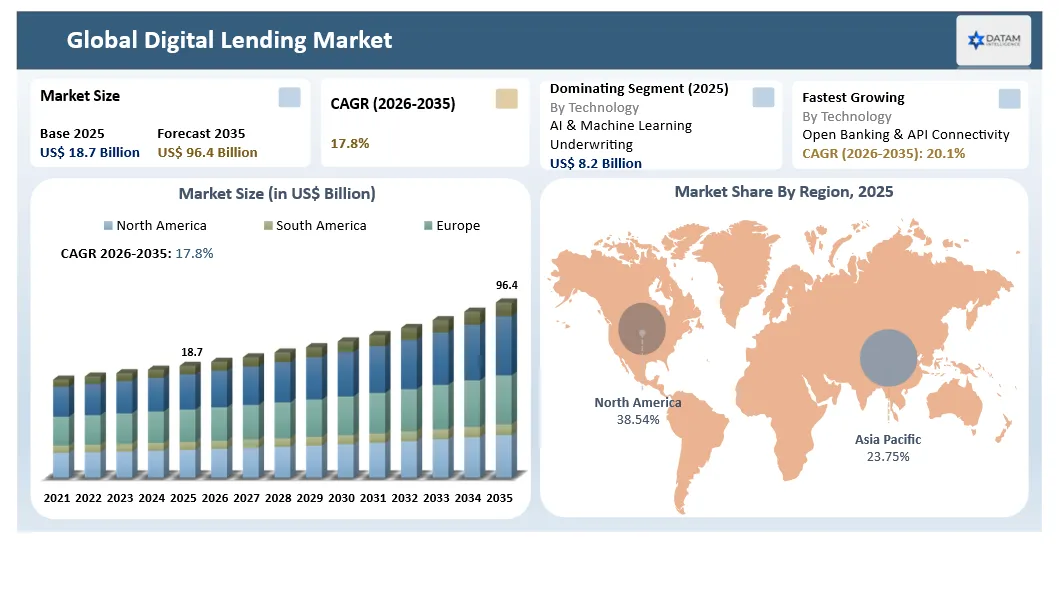
Growth is being driven by mobile-first banking, open APIs, instant payments, alternative data and a shift by banks toward cloud-based loan-origination and decisioning. Digital-native lenders are broadening from unsecured personal loans into auto, home-equity, small-business and revolving credit, while banks are increasingly using fintech platforms to improve conversion without rebuilding every part of the technology stack internally.
AI is becoming a core competitive layer. Models increasingly use cash-flow, transaction and behavioral signals to supplement bureau data, helping lenders price thin-file borrowers and reduce manual underwriting. At the same time, model governance, explainability, fair-lending compliance and fraud prevention are moving from back-office issues into procurement criteria. Funding resilience is equally important because growth can slow rapidly when securitization spreads widen or warehouse capacity contracts.
North America remains the largest market through mature consumer credit, high fintech penetration and deep capital markets. Asia-Pacific is expected to grow fastest, supported by India’s digital public infrastructure, Southeast Asian mobile finance, China’s large online-credit ecosystem and rapid SME digitization.
Digital Lending Market Key Takeaways
- AI-based underwriting and automated decisioning are moving from niche fintech capabilities into mainstream bank and credit-union infrastructure.
- Embedded lending is expanding the addressable market by placing credit inside e-commerce, payroll, vertical SaaS, banking and merchant workflows.
- Funding and credit performance remain the most important cyclical constraints for digital-native lenders, especially unsecured consumer lenders.
- Open banking and cash-flow underwriting improve visibility into affordability and are creating new pathways for thin-file consumers and small businesses.
- Banks are increasingly combining their low-cost deposits and regulatory infrastructure with fintech technology, producing hybrid partnership models.
- Fraud prevention, identity verification, responsible AI and model explainability are becoming major determinants of platform selection and regulatory approval.
Digital Lending Industry Trends and Strategic Insights
- The market is shifting from point solutions toward modular lending operating systems that combine onboarding, decisioning, pricing, servicing and collections through APIs.
- Loan platforms are diversifying into secured and revolving products to reduce dependence on unsecured personal-credit cycles.
- Alternative data is becoming more important as regulators and lenders seek better affordability signals, but governance requirements are increasing alongside usage.
- Capital-light marketplace and partner-funded models are regaining strategic value because they allow origination growth without equivalent balance-sheet expansion.
- Bank-fintech partnerships are becoming more structured, with explicit responsibilities for underwriting policy, compliance, customer communications, funding and servicing.
Digital Lending Market Scope
| Metrics | Details |
| 2025 Market Size | US$ 18.7 Billion |
| 2035 Projected Market Size | US$ 96.4 Billion |
| CAGR (2026-2035) | 17.8% |
| Largest Market | North America |
| Fastest Growing Market | Asia-Pacific |
| By Component | Solutions and Services |
| By Deployment | Cloud-Based, On-Premises and Hybrid |
| By Loan Type | Personal, Business/SME, Mortgage/Home Equity, Auto, Student, POS/Installment and Others |
| By Lending Model | Balance-Sheet, Marketplace/Partner-Funded, Embedded/LaaS, P2P and BNPL |
| By Technology | AI/ML, Rule-Based Decisioning, Open Banking/APIs, Alternative Data, Digital Identity/Fraud Analytics |
| By Borrower Type | Consumers, Micro & Small Businesses, Mid-Market Enterprises, Self-Employed/Gig Workers |
| By End User | Banks, NBFCs, Fintech Lenders, Credit Unions, Marketplaces & Platforms |
| By Distribution Channel | Direct Digital, Partner/Affiliate, Embedded/Merchant, Broker/Aggregator |
| Report Insights Covered | Market Size, Share, Growth, Competitive Landscape, Ecosystem, Company Profiles and Country-Level Opportunity |
Why does this report matter in 2026?
The year 2026 is a transition point for digital lending because lenders are scaling AI decisioning at the same time that regulators are formalizing expectations around model governance, consumer protection, data use and digital-lending apps. Capital markets have reopened unevenly, making funding diversification and deposit access important strategic advantages. Public digital lenders are showing strong origination growth, while bank-led digital platforms are using technology to defend market share and lower acquisition and servicing costs.
The report matters because the category is no longer defined only by faster online applications. Competitive advantage depends on funding structure, data quality, model performance, automation, product breadth and regulatory resilience. The analysis therefore separates platform software from digital-native lending economics and evaluates where recurring technology revenue, transaction fees, lending spreads and partner-funded origination models create different risk-return profiles.
Digital Lending Market White Space & Investment Opportunities
- Embedded SME credit inside accounting, payroll, procurement and vertical SaaS platforms creates access to high-intent borrowers with lower acquisition friction.
- Cash-flow underwriting can expand credit access to thin-file consumers and microbusinesses where traditional bureau data is incomplete.
- Home-equity, auto and secured lending provide diversification opportunities for platforms historically concentrated in unsecured personal loans.
- Fraud orchestration, synthetic-identity detection and AI governance tools can become independent high-growth infrastructure layers within lending stacks.
- Regional lending-as-a-service models can help mid-sized banks and credit unions digitize without replacing their entire core architecture.
Digital Lending Future Market Transformation
Digital lending is expected to evolve into an always-on credit infrastructure layer in which application, identity, underwriting, pricing, funding and servicing operate in real time. Borrowers will increasingly receive pre-qualified offers based on permissioned transaction data rather than repeatedly entering the same information. Lenders will use adaptive models that update pricing and credit limits while preserving documented governance and audit trails.
Embedded finance will also change distribution. A growing share of credit will be originated inside non-bank journeys such as merchant checkout, payroll, home improvement, automotive retail, procurement and software platforms. The winners will be providers that combine API flexibility with funding access, compliant underwriting and efficient servicing rather than relying on consumer acquisition alone.
Digital Lending Market Buyer Decision-Making Criteria
Banks and lenders prioritize time to decision, approval-rate uplift, credit performance, fraud loss, integration effort, model explainability, compliance controls, system uptime and total cost of ownership. Institutions increasingly require modular deployment because they want to modernize specific stages of lending without replacing core banking systems. Buyers also evaluate data residency, auditability, cybersecurity, vendor financial stability and the ability to support multiple products and jurisdictions.
Digital Lending Market Economic & Investment Analysis
Investment economics vary sharply by business model. Software platforms can generate recurring subscription and transaction revenue with limited credit exposure, while direct lenders earn spread and fee income but require funding capacity, loss reserves and risk capital. Marketplace and partner-funded models sit between these structures by monetizing origination and servicing while transferring part of the credit risk to banks or institutional investors.
Interest rates influence borrower demand, affordability and funding costs, while unemployment and delinquency trends determine loss performance. Investors should therefore assess origination growth together with contribution margin, funding mix, credit vintage performance, securitization execution, customer acquisition cost and repeat borrowing. Strong platforms are increasingly valued for data-network effects and product expansion rather than raw loan volume alone.
Digital Lending Investment Trends in the Market
- Capital is shifting toward AI underwriting, fraud prevention and alternative-data platforms that can demonstrate measurable approval or loss-rate improvement.
- Banks are investing in cloud-native loan origination and servicing modernization to lower cost per account and improve launch speed.
- Private-credit funds and asset managers are forming forward-flow and purchase agreements with digital lenders to create scalable off-balance-sheet funding.
- Embedded-lending providers are attracting investment because distribution is integrated into commerce and business workflows.
- M&A interest is increasing around identity, decisioning, servicing and collections capabilities that can be integrated into end-to-end lending platforms.
Strategic Indicators For Digital Lending Market
High Regulation Impact
Digital lending is heavily influenced by fair-lending rules, consumer disclosures, interest-rate limits, privacy laws, model governance and bank-partnership oversight. Regulation can accelerate trust but raises compliance cost and limits poorly governed growth.
High Investment Activity
AI credit models, lending-as-a-service, fraud technology, embedded finance and digital servicing continue to attract strategic and venture capital because institutions are still replacing manual and legacy credit workflows.
Funding & Capital Market Sensitivity
Warehouse lines, deposits, securitizations, whole-loan buyers and private-credit partnerships determine how quickly digital lenders can scale. Funding diversification is a key resilience metric.
Pricing Volatility
Borrower APRs and platform economics move with benchmark rates, credit spreads, acquisition costs and expected losses. Risk-based pricing must adjust quickly without weakening conversion.
Procurement Pressure
Banks demand measurable ROI, strong cybersecurity, regulatory support, explainable models and integration compatibility. Long sales cycles favor vendors with proven bank references and implementation partners.
New Technology Adoption
Generative AI, cash-flow underwriting, open banking, biometrics, synthetic-identity detection and real-time decision engines are redefining digital lending architecture.
Regional Expansion Opportunity
India, Southeast Asia, Latin America and parts of Africa offer strong long-term opportunity because digital identity, instant payments and mobile distribution can bypass legacy branch infrastructure.
Government Policy Support
Digital identity, open banking, instant-payment systems and financial-inclusion policy can materially accelerate digital-credit adoption when paired with borrower-protection frameworks.
Pricing Intelligence
Platform pricing increasingly combines subscriptions, per-application or per-funded-loan fees, usage-based API charges and performance-linked arrangements. Direct lenders optimize APR, fee and funding economics by risk tier.
AI Impact Analysis of Digital Lending Market
AI improves applicant ranking, income estimation, fraud detection, pricing, collections prioritization and customer-service automation. The strongest near-term value comes from combining bureau data with transaction and cash-flow signals to improve approval rates at a given loss target. Generative AI can automate document review and banker workflows, but core credit decisions still require controlled, testable and explainable governance frameworks.
Disruption Analysis of Digital Lending Market
The market is being disrupted by embedded credit, bank-fintech partnerships, open banking and AI-based decisioning. These forces reduce the importance of branch distribution and place greater value on data access, API integration and real-time funding. At the same time, regulatory intervention is forcing the market away from opaque or aggressive growth models and toward transparent pricing, auditable underwriting and stronger borrower-protection processes.
Digital Lending Market BCG Matrix: Company Evaluation
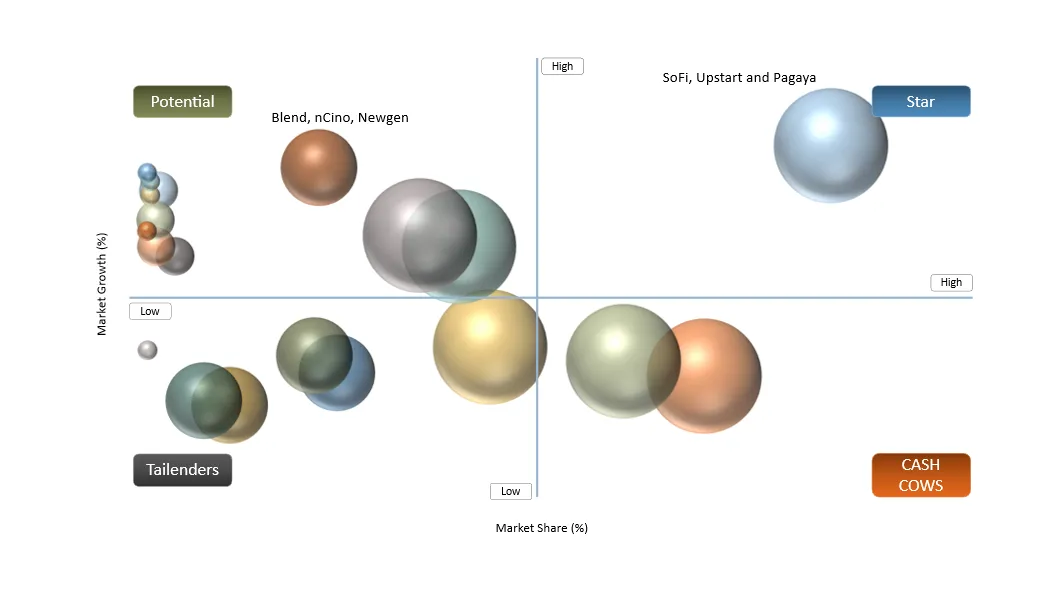
STAR
SoFi, Upstart and Pagaya are positioned as high-growth digital-credit platforms because they combine data-driven underwriting, expanding product breadth and scalable digital distribution. Their strategic advantage depends on maintaining funding access and credit performance while broadening beyond single-product concentration.
POTENTIAL
Blend, nCino, Newgen, Zest AI and modular decisioning providers represent potential high-growth infrastructure players. Their opportunity is driven by bank modernization, open banking and demand for composable lending stacks, though sales cycles and integration complexity can slow adoption.
Digital Lending Market Dynamics
Driver Impact Analysis
| Driver | Market Growth Impact | Demand Concentration | Impacted Use Case | Strategic Impact |
| AI-based underwriting and automation | 34% | North America, Europe, APAC | Personal and SME lending | Raises approval speed and lowers manual underwriting cost |
| Embedded finance and API distribution | 27% | Global digital commerce | POS, merchant and platform lending | Creates lower-friction distribution and new origination channels |
| Open banking and alternative data | 22% | Europe, India, North America | Thin-file and cash-flow underwriting | Improves affordability assessment and credit inclusion |
| Bank digital transformation | 17% | Global banks and credit unions | Loan origination modernization | Supports recurring software and service spending |
Driver: AI-Based Underwriting and Automation
AI-based lending models can evaluate more variables and automate a larger portion of applications than traditional manual or scorecard workflows. This can reduce decision time from days to minutes and help lenders serve borrowers who lack long conventional credit histories. The commercial value is strongest when higher approval rates are achieved without deterioration in loss performance.
Restraint Impact Analysis
| Restraint | Drag on Market Growth | Primary Impact Area | Impacted Use Case | Strategic Impact |
| Funding and securitization volatility | 31% | Digital-native lenders | Origination capacity | Encourages deposits, forward-flow agreements and diversified funding |
| Regulatory and responsible-AI requirements | 27% | All lenders and vendors | Underwriting and customer communication | Raises governance, explainability and compliance costs |
| Fraud and synthetic identities | 23% | Instant digital channels | Onboarding and disbursement | Increases spending on identity and behavioral analytics |
| Credit-cycle deterioration | 19% | Unsecured consumer and SME credit | Loss performance | Can reduce approvals and increase pricing or reserves |
Restraint: Funding, Regulation and Credit-Cycle Risk
Digital lending growth can reverse quickly when capital becomes expensive or expected losses rise. Providers therefore need multiple funding channels and robust vintage monitoring. Regulation also limits purely algorithmic scaling because lenders must demonstrate fairness, adverse-action explainability, data provenance and borrower protections. These requirements favor companies with mature compliance infrastructure rather than growth-at-any-cost models.
Digital Lending Market Segment Analysis
The global Digital Lending market is segmented based on Component, Deployment Model, Loan Type, Lending Model, Technology, Borrower Type, End User, distribution channel, and region.
By Component
Solutions Will Retain the Largest Share
Software platforms lead because lenders require loan origination, decisioning, identity, document, servicing and analytics capabilities that can be integrated into existing bank stacks. Services remain important for implementation, model validation, integration and managed operations, particularly among regional banks and credit unions.
By Deployment Model
Cloud-Based Lending Platforms Will Record the Fastest Growth
Cloud deployment supports faster releases, elastic capacity and API connectivity. Regulated institutions increasingly use hybrid architectures that keep sensitive systems controlled while moving decisioning, customer experience and analytics into cloud environments.
By Loan Type
Personal and SME Lending Remain the Core Digital Use Cases
Personal loans remain a major digital volume pool because applications can be highly automated. SME lending is growing quickly as bank-account and payment data make cash-flow underwriting more practical for smaller businesses that lack extensive financial statements.
By Lending Model
Embedded Lending Will Gain Share
Embedded lending integrates financing into commerce, software and banking journeys, reducing acquisition friction. Balance-sheet lenders retain economics and control but face capital intensity, while marketplace models can scale faster when institutional funding is available.
By Technology
AI & Machine Learning Underwriting Will Lead Growth
AI-based risk models are the highest-growth technology layer because they can combine bureau, transaction, income and behavioral data. Adoption depends on explainability, stability across cycles and strong model-risk governance.
By Borrower Type
Consumers Lead, While Small Businesses Offer High Growth
Consumers account for the largest digital-credit volumes, but micro and small businesses are strategically attractive because digital data can lower underwriting cost for borrowers historically underserved by traditional bank processes.
By End User
Banks Are Becoming the Largest Technology Buyers
Fintech lenders drove early innovation, but banks are increasingly the largest buyers of digital lending infrastructure because they combine low-cost deposits, regulatory licenses and large customer bases with a need to modernize legacy workflows.
By Distribution Channel
Embedded and Partner Channels Will Outgrow Direct Acquisition
Direct digital channels remain important, but customer-acquisition costs encourage lenders to originate through merchants, banks, payroll providers, affiliates and vertical software platforms where borrower intent is already established.
Digital Lending Market Geographical Penetration
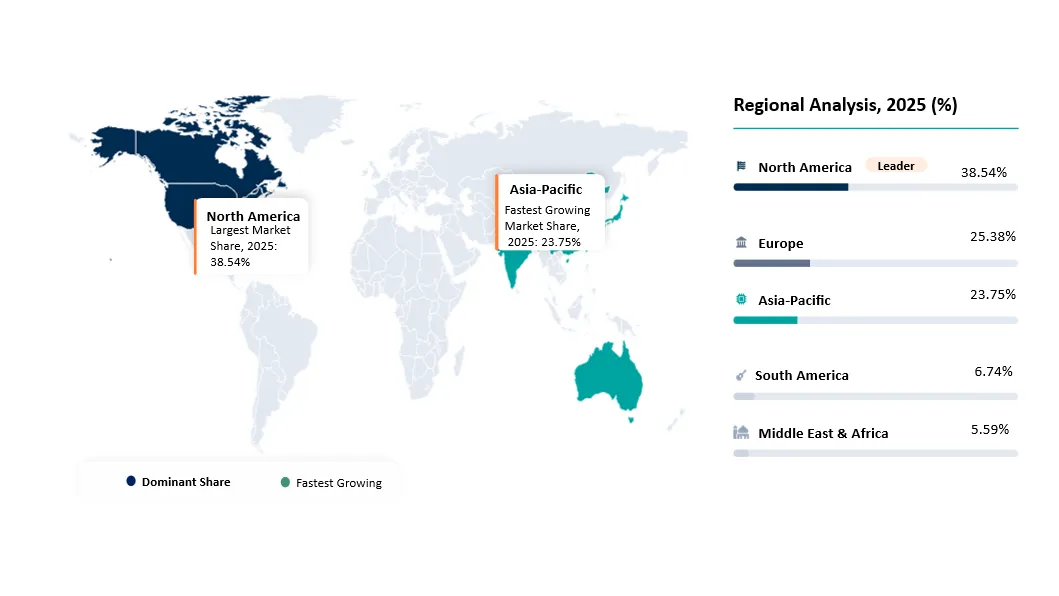
U.S. Digital Lending Market Landscape
The U.S. is the largest national market because it combines deep consumer credit, sophisticated securitization and private-credit markets, strong fintech adoption and a large base of banks and credit unions. Growth is being driven by AI underwriting, digital banking, home-equity expansion and bank-fintech funding partnerships.
India Digital Lending Market Outlook
India is one of the fastest-growing markets because Aadhaar, UPI, Account Aggregator infrastructure and widespread smartphone adoption reduce onboarding and payment friction. Regulatory oversight of digital lending apps is increasing, which favors licensed and well-governed lenders.
UK Digital Lending Market Trends
The UK benefits from mature open banking and a strong alternative-lending ecosystem. SME finance, consumer credit and embedded lending are key growth areas, while FCA affordability and consumer-duty requirements raise compliance expectations.
China Digital Lending Market Outlook
China has a large digital-credit ecosystem embedded in mobile commerce and payments. Growth is increasingly shaped by platform regulation, bank partnerships and tighter controls on consumer lending and data usage.
Brazil Digital Lending Market Outlook
Brazil offers strong opportunity through digital banks, PIX payments and large underbanked populations. Competitive intensity is high as neobanks, traditional banks and fintech lenders compete across consumer and SME credit.
Middle East and Africa Digital Lending Market Outlook
Digital lending is expanding through mobile wallets, open-finance initiatives and digital banks. Gulf markets offer high-value bank modernization opportunities, while African markets emphasize mobile-first microcredit and SME finance, subject to affordability and data-quality constraints.
Digital Lending Market Competitive Landscape
- Competition spans global banking-software vendors, cloud-native lending platforms, AI decisioning specialists and digital-native lenders.
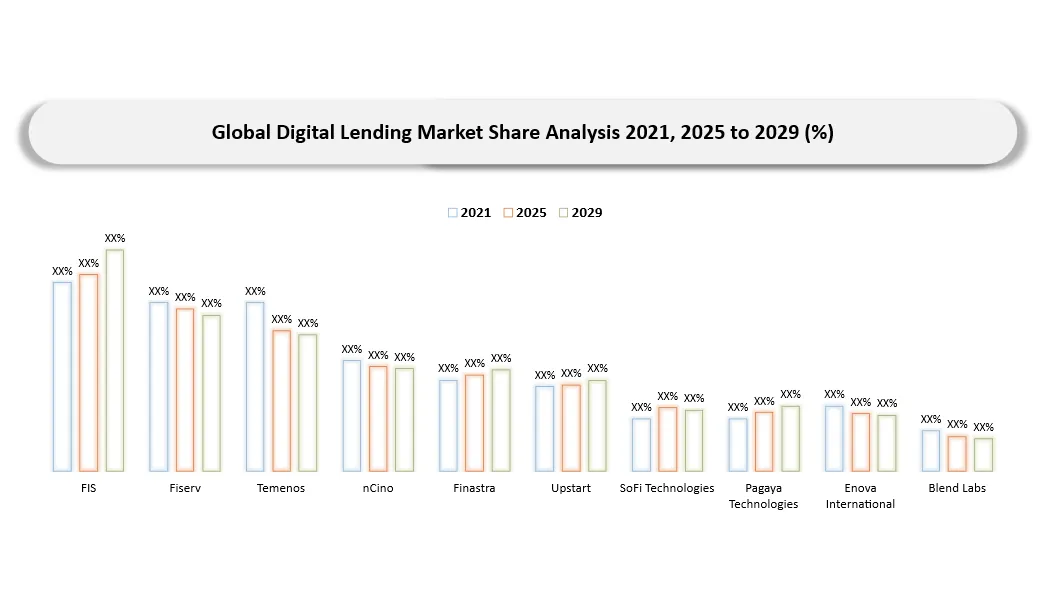
- FIS, Fiserv, Temenos, Finastra and nCino compete for institutional lending modernization, while Blend and Newgen emphasize digital workflows and configurable origination.
- Upstart, SoFi, Pagaya, Happen and Enova demonstrate how underwriting technology, direct distribution and capital partnerships can be combined into scalable digital-credit models.
- Differentiation increasingly depends on approval-rate uplift, funding access, fraud loss, model explainability, product breadth, integration speed and compliance support.
- Partnership networks are central because no single vendor controls identity, bureau data, open-banking connectivity, core banking, funding and servicing across all markets.
Digital Lending Market Ecosystem
| Value Chain Sector | Representative Companies / Organizations | Role in Market |
| Digital Identity & KYC | Socure, Trulioo, Persona, Jumio, Onfido/Entrust | Identity verification, biometrics, AML/KYC and fraud screening |
| Credit Bureaus & Data | Experian, Equifax, TransUnion, Plaid, MX | Bureau files, bank transaction data, income and cash-flow signals |
| Decisioning & AI | Upstart, Zest AI, Provenir, FICO, Taktile | Risk models, decision engines, pricing and policy orchestration |
| Loan Origination / Lending Software | FIS, Fiserv, Finastra, Temenos, nCino, Newgen, Blend | Digital application, workflow, document, underwriting and origination systems |
| Digital Lenders / Marketplaces | SoFi, Upstart, Happen, Enova, Pagaya, Affirm | Direct lending, marketplace lending, partner-funded and embedded credit |
| Bank & Credit Union Funding | JPMorgan Chase, Capital One, regional banks, credit unions | Deposits, bank-partner funding, balance-sheet capital and loan purchases |
| Institutional Funding | Apollo, BlackRock, Fortress, private-credit funds, securitization investors | Forward-flow, warehouse, ABS and whole-loan capital |
| Payments & Disbursement | Visa, Mastercard, Stripe, Adyen, ACH/instant-payment networks | Disbursement, repayment, merchant settlement and embedded-credit rails |
| Servicing & Collections | FIS, Fiserv, Amount, LoanPro, TrueAccord | Account servicing, statements, payments, delinquency management and collections |
| Regulators & Standards | CFPB, OCC, FDIC, FCA, RBI, EBA and local financial regulators | Consumer protection, bank oversight, data/privacy and digital-lending rules |
Public Company Q1-Q2 2026 Performance Comparison
| Public Company | Period | Q1-Q2 2026 Performance | Growth Drivers | Digital Lending Exposure |
| SoFi Technologies | Q2 2026 | Adjusted net revenue ~US$1.219B, +40% YoY; members ~15.8M | Lending revenue +63% YoY; product cross-sell, member growth, deposit-funded lending and expansion into small-business/home lending | Direct digital bank and lender |
| Pagaya Technologies | Q2 2026 | Total revenue & other income US$387M, +19% YoY; network volume US$3.5B, +33% | More partner volume, multi-product adoption, AI underwriting network effects and scaled institutional funding | AI-driven partner lending network |
| Enova International | Q2 2026 | Revenue ~US$929M, +22% YoY; originations ~US$2.3B, +27% | Strong small-business and consumer demand, machine-learning underwriting and healthy credit performance | Direct online consumer & SMB lender |
| Happen (formerly LendingClub) | Q2 2026 | Net revenue ~US$262.9M, +6% YoY; net income US$58.1M, +52% | Origination growth, deposit-funded bank model, loan-sale economics and improving operating leverage | Digital-first bank and marketplace lender |
| Upstart | Q1-Q2 2026 | Q1 revenue US$308M, +44% YoY; Q2 originations US$4.23B | AI model improvements, >100 bank/credit-union partners, growth in personal, auto and home products; national bank charter initiative | AI lending marketplace |
Key Companies of Digital Lending Market
- FIS
- Fiserv
- Temenos
- nCino
- Finastra
- Upstart
- Happen (formerly LendingClub)
- SoFi Technologies
- Pagaya Technologies
- Enova International
- Blend Labs
- Newgen Software
- Pegasystems
- Experian
- Zest AI
Company Profiles
FIS
FIS supplies banking and lending technology used by financial institutions for origination, servicing, payments and core integration. Its competitive strength is breadth across regulated bank infrastructure and the ability to connect lending workflows with broader transaction-processing systems.
Fiserv
Fiserv provides digital banking, payments and loan technology to banks and credit unions. Its large installed base creates cross-sell opportunities for digital origination, decisioning and servicing capabilities, particularly among mid-sized institutions.
Temenos
Temenos offers cloud-native banking software with lending modules spanning origination, servicing and product configuration. It competes on composability, multi-country coverage and the ability to support banks modernizing legacy core and lending stacks.
nCino
nCino specializes in cloud banking and lending workflows, with strong exposure to commercial, SME, mortgage and consumer origination. Its value proposition centers on workflow standardization, CRM integration and faster bank implementation.
Finastra
Finastra provides lending, core banking and treasury software across large and mid-sized financial institutions. Its lending franchise benefits from deep domain functionality but competes in a market moving toward more modular cloud architectures.
Upstart
Upstart operates an AI lending marketplace connecting borrowers with more than 100 banks and credit unions. The company uses proprietary models to automate underwriting and has expanded beyond personal loans into auto, home-equity and revolving credit.
Happen (formerly LendingClub)
Happen combines a digital-first bank balance sheet with marketplace loan sales. Deposit funding gives it a structural funding advantage over non-bank lenders, while origination growth and loan-sale execution support fee and spread income.
SoFi Technologies
SoFi operates an integrated digital financial-services platform with personal, student, home and other lending products. Its bank charter and deposit base support lower funding costs, while member growth and cross-sell reduce reliance on single-product acquisition economics.
Pagaya Technologies
Pagaya provides AI-driven underwriting and capital-markets infrastructure to lending partners. Its B2B2C model evaluates applications across partner networks and uses institutional funding to facilitate credit without relying primarily on direct consumer acquisition.
Enova International
Enova is a machine-learning-powered online lender focused on consumers and small businesses underserved by traditional banks. Its strengths include proprietary analytics, repeat-customer relationships and diversified product brands.
Blend Labs
Blend provides digital origination software used by banks and mortgage lenders. The company has expanded from mortgage workflows into broader consumer-banking products and benefits from demand for configurable, bank-grade digital journeys.
Newgen Software
Newgen provides low-code process automation, content management and lending workflow solutions. It is particularly relevant in emerging markets where banks need configurable origination and document automation across multiple credit products.
Pegasystems
Pegasystems supports decisioning, case management and customer engagement for large financial institutions. Its real-time decisioning and workflow capabilities can be applied to credit offers, servicing and collections.
Experian
Experian is a core data and analytics provider to the lending ecosystem, supplying bureau data, identity, fraud, decisioning and income-verification capabilities. Its data position gives it a central role in digital underwriting and risk management.
Zest AI
Zest AI develops machine-learning underwriting technology for banks and credit unions. Its strategic focus is improving approval rates and fairness while providing explainable models that fit regulated lending environments.
Digital Lending Market Major Pain Points
- Funding volatility and dependence on securitization or institutional loan buyers.
- Rising synthetic-identity and first-party fraud in instant digital channels.
- Responsible-AI, fair-lending and adverse-action explainability requirements.
- High integration complexity with legacy core banking and servicing systems.
- Customer acquisition costs for direct-to-consumer lenders.
- Data-consent, privacy and cross-border data-residency constraints.
- Credit-cycle deterioration that can reduce approvals and widen funding spreads.
- Fragmented regulation across countries and states for digital-lending apps and bank partnerships.
Digital Lending Market Recent Developments
- July 2026: Upstart received conditional approval from the U.S. OCC to establish Upstart Bank, potentially expanding control over funding and product delivery if final conditions are satisfied.
- July 2026: Pagaya reported record Q2 performance with US$3.5 billion of network volume, reflecting deeper partner usage of its AI-driven lending network.
- July 2026: SoFi reported Q2 adjusted net revenue of about US$1.22 billion and continued rapid growth in lending and member adoption.
- July 2026: LendingClub completed its rebrand to Happen Bank, emphasizing a broader digital-first banking strategy alongside marketplace lending.
- July 2026: Enova reported Q2 originations of nearly US$2.3 billion, supported by consumer and small-business demand and strong credit performance.
- June 2026: SoFi expanded into small-business loans, increasing product breadth within its digital financial-services ecosystem.
Analyst View / Opinion on Digital Lending Market
- Digital lending has moved from a fintech disruption story into core banking infrastructure. Banks are now adopting the same automation, AI and API capabilities that initially differentiated digital-native lenders.
- The most defensible business models combine technology advantage with resilient funding. AI alone does not create durable value if lenders cannot fund originations through changing credit cycles.
- Embedded lending will be one of the strongest long-term growth vectors because distribution occurs inside high-intent workflows and can materially reduce customer-acquisition costs.
- Cash-flow underwriting and open-banking data can broaden access, but regulatory scrutiny will force providers to demonstrate fairness, consent, explainability and stable model performance.
- Public digital lenders are increasingly diversifying across personal, auto, home and small-business credit, reducing concentration and improving cross-sell economics.
- Long-term market leadership will depend on compliance infrastructure, funding diversity, product breadth, fraud control and measurable credit outcomes rather than origination growth alone.
Digital Lending Market Target Audience
| Industry | Who Should Buy This Report? | Reason to Buy This Report |
| Banks & Credit Unions | Digital banking leaders, lending heads, CIOs, risk teams | Assess modernization priorities, vendors, AI adoption and partnership models. |
| Fintech Lenders | Founders, product leaders, credit and capital teams | Benchmark growth models, funding structures and product expansion opportunities. |
| Software & Data Providers | Loan-platform vendors, credit bureaus, identity and AI providers | Identify white spaces, integration opportunities and buyer requirements. |
| Private Credit & Investors | Asset managers, venture capital, private equity and institutional investors | Evaluate origination growth, funding resilience, credit economics and platform value. |
| Merchants & Platforms | E-commerce, vertical SaaS, payroll and marketplace operators | Assess embedded-lending opportunities and partner selection. |
| Consulting & System Integration | Advisory firms, technology integrators and implementation partners | Map transformation spending and partner ecosystems. |
| Regulators & Policy Bodies | Central banks, financial supervisors and consumer-protection agencies | Understand technology, borrower protection and responsible-AI implications. |
Why Choose DATAM?
- Data-driven insights combining market sizing, digital-origination trends, technology spending, funding economics and country-level adoption.
- Post-purchase analyst consultations for vendor selection, partnership strategy, market entry and custom modeling.
- Annual updates covering regulation, funding markets, platform launches, partnerships, M&A and public-company performance.
- Specialized focus on emerging digital-credit markets rather than generalized BFSI regional summaries.
- Actionable analysis that connects technology capability with underwriting economics, distribution, funding and compliance.
What DATAM Uniquely Provides
- Ten-year forecasts across eight segmentation categories and five major regions.
- Combined analysis of software platforms and digital-native lending business models.
- Market ecosystem mapping from identity and data through decisioning, funding, servicing and collections.
- Public-company Q1-Q2 2026 comparison focused on digital lending exposure and growth drivers.
Country-level views linking digital identity, open banking, mobile adoption, regulation and capital availability.


























































