


Data Center Testing and Commissioning Market Overview
The global data center testing and commissioning market reached US$ 5.18 billion in 2025 and is expected to reach US$ 14.73 billion by 2035, growing at a CAGR of 11.0% during 2026-2035. Growth is driven by the expansion of hyperscale, colocation, edge and AI infrastructure, together with higher rack densities, more complex power trains and the rapid adoption of liquid cooling. Commissioning has become a core risk-control function because owners need evidence that redundant systems perform correctly during utility loss, equipment failure, software change, thermal excursions and emergency conditions.
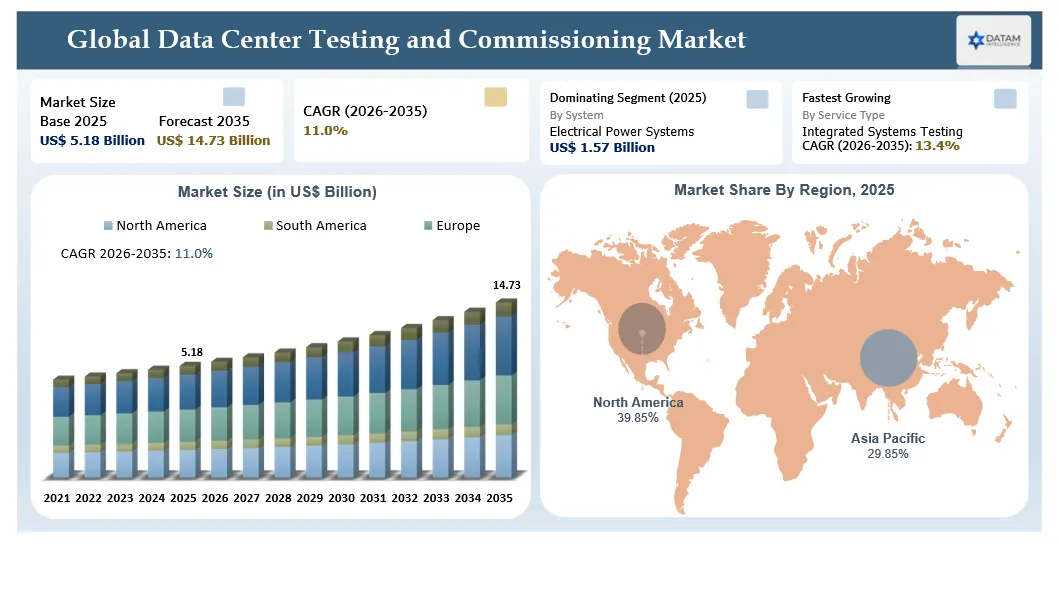
The market extends from early design review to factory witness testing, site acceptance, pre-functional inspection, functional performance testing and Level 5 integrated systems testing. High-value projects increasingly require simultaneous validation of generators, UPS systems, batteries, switchgear, cooling plants, controls, leak detection, fire protection and operational procedures. The value of commissioning rises with criticality because the cost of delayed capacity or an avoidable outage can exceed the service fee by a wide margin. Uptime Institute reported that 54% of respondents whose organizations experienced a significant, serious or severe outage said the latest event cost more than US$ 100,000, while one in five reported a cost above US$ 1 million.
| Metric | Detail |
| 2025 Market Size | US$ 5.18 Billion |
| 2035 Projected Market Size | US$ 14.73 Billion |
| CAGR 2026-2035 | 11.0% |
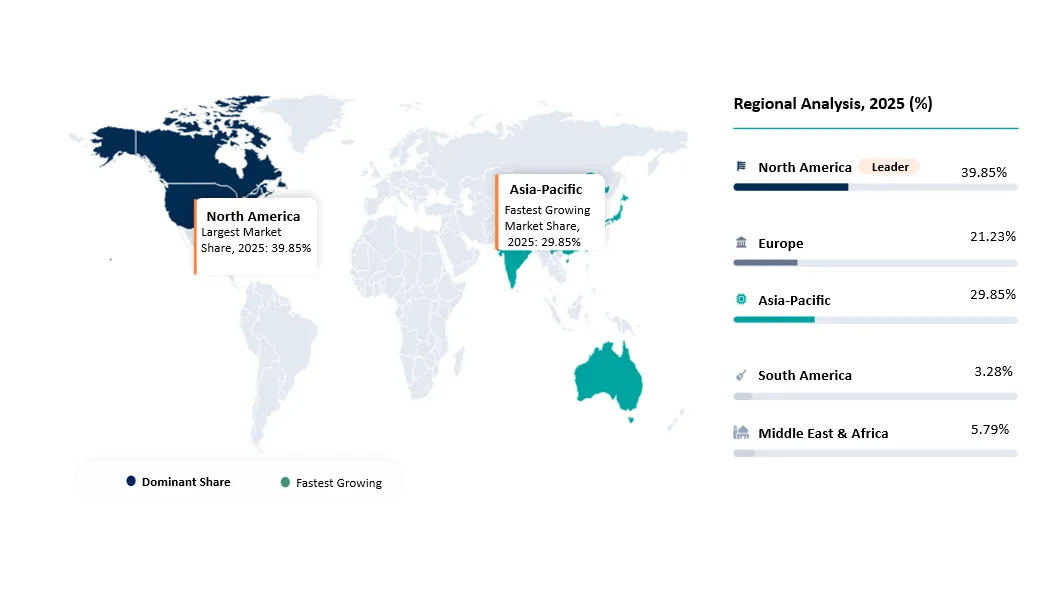
| Largest Region | North America |
| Fastest Growing Region | Asia-Pacific |
| Leading Service | Functional Performance and Integrated Systems Testing |
| Primary Growth Theme | AI-ready power and cooling verification |
Data Center Testing and Commissioning Market Key Takeaways
- North America held approximately 41.8% of global market revenue in 2025 due to hyperscale construction, mature owner standards and widespread use of independent commissioning authorities.
- Functional performance and integrated systems testing represented the largest service pool because owners require verification of failover, redundancy, controls logic and response under combined fault conditions.
- HPC and AI data centers are the fastest-growing facility category because higher density increases thermal, electrical and controls interaction and makes liquid-cooling commissioning essential.
- Electrical systems account for the largest system share, while mechanical and liquid-cooling testing are expected to record the fastest growth.
- Ongoing commissioning is moving from a discretionary optimization service toward a recurring risk-management model supported by analytics, digital twins and continuous performance verification.
Data Center Testing and Commissioning Industry Trends and Strategic Insights
- Owners are engaging commissioning teams during concept and design phases to reduce late-stage change, identify sequence-of-operations conflicts and align test scripts with operational risk.
- Integrated systems testing is becoming more scenario-based, combining utility failure, generator response, UPS transfer, cooling degradation, controls alarms and operator actions within one coordinated test event.
- AI-ready facilities require validation of direct-to-chip liquid cooling, coolant distribution units, leak detection, water quality, pressure stability and response to rapid workload changes.
- Modular and prefabricated facilities are shifting part of the commissioning workload to factories, increasing demand for witness testing, repeatable digital records and module-to-site interface verification.
- Owners are standardizing commissioning templates across portfolios, but local grid rules, climate conditions, labor practices and equipment lead times still require regional adaptation.
- Commissioning data is increasingly retained as a digital operational baseline for warranty management, preventive maintenance and future recommissioning.
Data Center Testing and Commissioning Market Scope
| Metrics | Details |
| By Service Type | Planning and design review, factory testing, pre-functional testing, functional testing, integrated systems testing, handover and ongoing commissioning |
| By Commissioning Level | Levels 1 through 5 |
| By System | Electrical, mechanical and cooling, controls, fire and life safety, network support and security |
| By Facility Type | Hyperscale, colocation, enterprise, edge, modular, HPC and AI |
| By Project Type | Greenfield, expansion, retrofit, live-site upgrade and recommissioning |
| By Size | Small, medium, large and mega campuses |
| By End User | Cloud, colocation, BFSI, government, telecom, healthcare and other enterprises |
| By Region | North America, Europe, Asia-Pacific, South America, Middle East and Africa |
Why does this report matter in 2026?
In 2026, data center delivery is constrained by power availability, equipment lead times, skilled labor and accelerated AI schedules. These pressures increase the probability that design assumptions, factory configurations, controls logic and installed conditions diverge. Testing and commissioning provide the structured process needed to expose those differences before revenue service. The market is therefore tied to both construction growth and the cost of schedule or reliability failure. Commissioning also supports lender, insurer and customer confidence by creating traceable evidence that critical systems perform under expected and abnormal conditions.
The report helps owners understand where commissioning intensity is increasing, which systems create the greatest risk and which provider capabilities matter for AI-ready facilities. It supports engineering firms and specialist providers in selecting target geographies, service lines and partnership models. Equipment manufacturers can identify demand for factory testing, field integration and digital verification. Investors can assess recurring revenue from ongoing commissioning, while contractors can use the analysis to improve test readiness and reduce rework.
Data Center Testing and Commissioning Market White Space & Investment Opportunities
- Independent commissioning for high-density AI campuses that require coordinated testing of electrical infrastructure, liquid cooling, controls and workload simulation.
- Factory-based commissioning of prefabricated power and cooling modules, followed by structured interface testing after site installation.
- Ongoing commissioning platforms that combine sensor data, issue tracking, analytics and periodic functional verification across multi-site portfolios.
- Retrocommissioning of older enterprise and colocation facilities being upgraded for higher rack density, lithium-ion batteries or alternative cooling architectures.
- Commissioning services for emerging data center markets where local contractor capacity and owner-standard familiarity remain limited.
- Specialized cybersecurity and controls validation for BMS, EPMS, PLC and remote operations systems that influence critical infrastructure performance.
Data Center Testing and Commissioning Future Market Transformation
The market will shift from document-heavy project closeout toward continuous evidence-based verification. Digital commissioning platforms will capture equipment data, test procedures, deficiencies, approvals and trend logs in a common environment. Owners will use these records as the baseline for operations, warranty claims and future modifications. Factory and site commissioning will become more connected as modularization increases, allowing test results to follow equipment through transport, assembly and energization.
Commissioning scope will also broaden. Mechanical validation will increasingly include direct-to-chip loops, immersion systems, heat-reuse interfaces and water-quality controls. Electrical testing will expand around grid-interactive operation, battery systems and on-site generation. Scenario testing will place greater emphasis on software configuration, network dependencies and operator decision-making because Uptime Institute continues to identify procedure and human-error failures as major outage contributors.
Data Center Testing and Commissioning Market Buyer Decision-Making Criteria
Owners assess providers on independence, technical depth, safety performance, data center experience and the ability to work across electrical, mechanical and controls systems. Provider selection is also influenced by geographic coverage, access to qualified test engineers, digital issue-management capability and familiarity with owner standards. Hyperscale and colocation buyers often prefer firms that can scale across several projects while maintaining consistent documentation and escalation procedures.
The strongest providers demonstrate early design involvement, disciplined test-script development, effective coordination with contractors and clear issue closure. Buyers also value the ability to test under live-site constraints and to separate commissioning authority from installation responsibility. Price remains relevant, but schedule risk and outage exposure generally carry greater weight. For complex AI facilities, proven liquid-cooling expertise and integrated controls testing are becoming decisive selection criteria.
Data Center Testing and Commissioning Market Economic & Investment Analysis
Commissioning represents a small share of total project capital cost but has disproportionate influence on schedule certainty, system reliability and operational readiness. The economic case is strongest where delayed energization prevents contracted capacity from generating revenue or where a fault could affect customer service. Owners therefore allocate greater commissioning budgets to larger, denser and more redundant facilities. Investment is also increasing in digital tools, test equipment, temporary load banks and specialist labor.
Recurring revenue is developing through ongoing commissioning, recommissioning and portfolio standardization. Providers can create higher-value relationships by maintaining performance baselines, supporting seasonal tests and validating post-handover changes. Acquisition interest is likely to focus on firms with mission-critical expertise, regional engineering talent and proprietary workflows. Barriers include labor scarcity, project cyclicality and dependence on construction schedules, but the long-term capacity pipeline supports sustained demand.
Data Center Testing and Commissioning Investment Trends in the Market
- Expansion of specialist commissioning teams in major hyperscale and colocation clusters.
- Investment in digital issue tracking, automated test records and analytics-enabled ongoing commissioning.
- Acquisition of electrical testing, controls and liquid-cooling capabilities by multidisciplinary engineering firms.
- Growth of load-bank fleets, temporary power systems and factory witness-testing services.
- Partnerships between commissioning providers, OEMs, general contractors and modular-equipment manufacturers.
- Creation of regional training programs to address shortages of experienced commissioning engineers and technicians.
Strategic Indicators for Data Center Testing and Commissioning Market
High Reliability Impact
Commissioning has a direct relationship with data center reliability because it verifies redundancy, controls sequences and operator response before production service. Power remains the leading cause of serious and severe outages, while IT and network-related failures are increasing. This makes coordinated testing across electrical, controls and communication layers increasingly important. Providers that can translate design intent into realistic failure scenarios are positioned to capture premium work.
High Investment Activity
Capital spending on data centers is increasing quickly as cloud and AI demand expands. Each new megawatt creates testing requirements for utility interfaces, generation, UPS systems, cooling and controls. Investment is especially strong in North America, Europe, India, Southeast Asia and the Gulf. Commissioning providers are adding staff, opening regional offices and acquiring specialist capabilities to participate in larger programs.
Supply Chain Disruption
Long lead times for transformers, switchgear, generators, chillers and controls can compress commissioning windows. Late equipment substitutions create further risk because sequences and test scripts must be revised. Providers mitigate disruption by participating in submittal review, attending factory tests and maintaining flexible staffing. Owners increasingly require commissioning teams to identify long-lead testing dependencies early in the project schedule.
Pricing Volatility
Service pricing depends on facility size, redundancy, location, test level, schedule and the amount of after-hours work. Level 5 integrated systems testing commands premium pricing because it requires detailed coordination and can expose the facility to controlled risk. Labor shortages and accelerated schedules increase rates, while portfolio agreements and repeatable owner standards can reduce unit cost. Retesting caused by incomplete work is a major source of commercial dispute.
Procurement Pressure
Owners need commissioning teams early, but procurement is often delayed until construction is advanced. Late engagement reduces design-review value and creates pressure to complete testing within fixed energization dates. Leading buyers use prequalified provider panels, multiyear agreements and clear responsibility matrices. Contractors also seek earlier clarity on test readiness, temporary equipment and issue closure to avoid schedule claims.
New Technology Adoption
AI facilities are accelerating adoption of liquid cooling, high-voltage distribution, lithium-ion batteries, modular power rooms and software-defined controls. Each technology introduces new interfaces and failure modes. Commissioning providers are adopting digital test scripts, automated trend analysis, infrared scanning, power-quality monitoring and workload emulation. Technology improves evidence quality, but experienced engineering judgment remains essential for safe test design and interpretation.
Regional Expansion Opportunity
Emerging markets are adding capacity quickly but may lack experienced mission-critical engineers. This creates opportunities for international providers that combine local delivery with global owner standards. India, Malaysia, Indonesia, the Gulf and selected Latin American markets are particularly attractive. Success requires local licensing, contractor relationships, safety compliance and the ability to mobilize specialist personnel during critical test periods.
Government Policy Support
Government policy affects the market through data-sovereignty requirements, energy efficiency rules, grid connection standards and public-sector digital infrastructure. ASHRAE Guideline 0 describes a commissioning process from predesign through occupancy, while Standard 90.4-2025 establishes energy requirements for data centers. Public authorities increasingly expect evidence of energy, water and safety performance, which strengthens the role of documented testing and verification.
Pricing Intelligence
Commissioning fees are usually structured as lump-sum project scopes, time-and-materials assignments or portfolio agreements. Pricing rises with megawatt capacity, system count, test depth and schedule risk. Factory testing and specialist electrical tests may be separately priced, while ongoing commissioning can use annual subscriptions or retainer models. Buyers should compare scope boundaries carefully because low bids may exclude retesting, after-hours work, temporary equipment or seasonal verification.
AI Impact Analysis of Data Center Testing and Commissioning Market
AI can improve commissioning by analyzing trend data, identifying abnormal sequences, comparing measured performance with expected behavior and prioritizing deficiencies. Digital platforms can use machine learning to detect repeated issues across portfolios, predict test readiness and support automated evidence capture. AI is also useful for reviewing large quantities of controls data during integrated systems testing, where human teams may otherwise struggle to identify timing problems across several systems.
The near-term value lies in decision support rather than autonomous testing. Commissioning still requires controlled procedures, safety planning, witness participation and engineering interpretation. Poor-quality data or incomplete point mapping can produce misleading results. Providers that combine AI tools with disciplined test design and experienced engineers will create the strongest value. Owners will also demand clear data governance because commissioning records can reveal sensitive infrastructure configurations.
Disruption Analysis of Data Center Testing and Commissioning Market
The first disruption is the movement of testing upstream into factories and modular assembly environments. Prefabricated electrical and cooling systems can be tested before shipment, reducing site work but increasing the importance of interface verification. The second disruption is the move toward ongoing commissioning, where owners use permanent sensors and analytics to detect drift after handover. This creates recurring service models and extends the provider relationship beyond project completion.
A third disruption is the rise of AI and liquid-cooled infrastructure. Conventional checklists are insufficient when thermal performance depends on coolant chemistry, pressure control, firmware and workload behavior. Providers need multidisciplinary teams and realistic operating scenarios. The market may consolidate around firms that combine commissioning authority, electrical testing, controls, analytics and global delivery. Smaller specialists can remain competitive by focusing on liquid cooling, live-site work or regional owner support.
Data Center Testing and Commissioning Market BCG Matrix: Company Evaluation
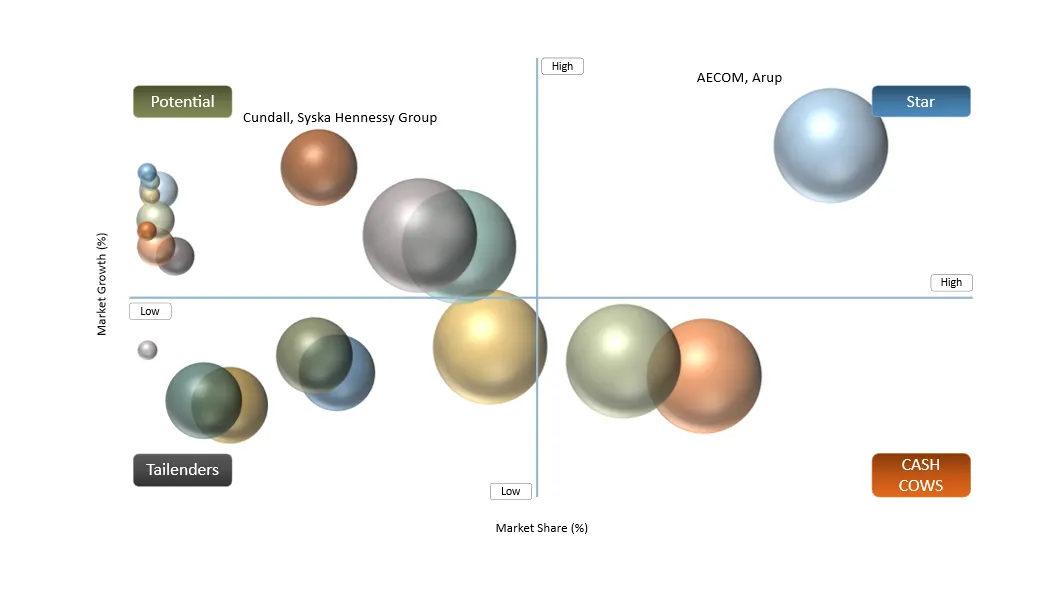
STAR
AECOM, Arup, Jacobs, WSP, HDR, CBRE and JLL occupy strong positions because they combine global delivery, mission-critical engineering and owner relationships. Vertiv, Schneider Electric, Siemens and Eaton also hold influential positions through equipment expertise and field-service capabilities. Their scale supports multi-site programs, factory testing and integrated technical support.
POTENTIAL
Cundall, Syska Hennessy Group, NV5, Salute, EYP Mission Critical Facilities, PM Group and specialist regional providers represent high-potential participants. They can grow by deepening liquid-cooling expertise, expanding into emerging markets and creating digital ongoing-commissioning services. Their competitive position depends on talent retention, safety performance and access to large owner programs.
Data Center Testing and Commissioning Market Dynamics
Driver Impact Analysis
| Driver | Market Growth Impact (%) | Demand Concentration | Impacted Use Case | Strategic Impact |
| AI and hyperscale capacity expansion | 29% | North America, Europe and Asia-Pacific | New facility commissioning | Expands commissioned megawatts and test complexity. |
| Higher reliability and uptime requirements | 24% | Global | Integrated systems testing | Increases test depth and independent verification. |
| Liquid cooling and high-density infrastructure | 19% | North America and Asia-Pacific | Mechanical and controls commissioning | Creates specialized testing requirements. |
| Portfolio standardization and certification | 15% | Global | Multi-site commissioning | Supports repeatable programs and recurring work. |
Driver: Rapid Data Center Expansion and Rising Reliability Requirements
The strongest growth driver is the simultaneous expansion of capacity and increase in technical complexity. AI workloads require denser racks, larger power blocks and more dynamic cooling, while hyperscale and colocation operators continue to build across several regions. Every project must demonstrate that power and cooling systems can support contracted load and recover from component failure. Outage economics further support commissioning because even a short disruption can create substantial customer, regulatory and reputational costs. Early design review, factory witness testing and Level 5 integrated systems testing are therefore becoming standard on critical projects.
Restraint Impact Analysis
| Restraint | Drag on Growth (%) | Primary Impact Area | Impacted Use Case | Strategic Impact |
| Shortage of experienced commissioning staff | 21% | Workforce | Large multi-site programs | Limits provider capacity and raises rates. |
| Compressed schedules and late test readiness | 19% | Project delivery | Functional and integrated testing | Creates retesting and incomplete scope risk. |
| Fragmented documentation and controls data | 15% | Quality assurance | Sequence verification | Reduces test efficiency and issue traceability. |
| Safety and live-site constraints | 12% | Operations | Retrofits and upgrades | Restricts test windows and increases planning effort. |
Restraint: Skilled Labor Shortage and Compressed Project Schedules
The market is constrained by the limited number of professionals who understand mission-critical electrical, mechanical and controls systems and can lead safe integrated tests. Rapid construction growth has intensified competition for experienced commissioning managers and technicians. At the same time, late equipment delivery and incomplete installation frequently compress the test period. Providers may be asked to validate systems before documentation, controls tuning or contractor checks are complete. This creates retesting, commercial disputes and risk to quality. Better readiness gates, early mobilization and standardized documentation are essential to protect commissioning value.
Data Center Testing and Commissioning Market Segment Analysis
The market is segmented by service type, commissioning level, system, facility type, project type, data center size, end user and region. The report provides one focused strategic write-up for the leading or fastest-growing subsegment in each category, matching the report-description structure used in the reference format.
By Service Type
Integrated Systems Testing Will Lead Value Creation
Integrated systems testing is expected to remain the highest-value service because it verifies how the entire facility responds to coordinated events. Tests may combine utility loss, generator start, UPS transfer, cooling degradation, controls alarms, fire-system interfaces and operator procedures. The work requires detailed scripts, safety planning and participation from several contractors. AI facilities increase value further because electrical and thermal systems are tightly coupled. Providers with strong scenario design, controls analysis and issue closure can command premium pricing.
By Commissioning Level
Level 5 Testing Will Record the Fastest Growth
Level 5 commissioning is growing rapidly as owners demand proof of resilience under real or simulated failure. Unlike component-level checks, Level 5 testing examines the facility as an operating system. The approach is especially important for colocation service-level agreements, hyperscale owner standards and high-density AI clusters. Growth is also supported by lender and customer requirements. The main constraint is schedule readiness because Level 5 tests can only succeed after preceding levels are complete and documentation is current.
By System
Mechanical and Liquid-Cooling Systems Will Expand the Fastest
Electrical systems remain the largest commissioning category, but mechanical and liquid-cooling testing will grow faster. Direct-to-chip cooling, coolant distribution units, plate heat exchangers, pumps, controls and leak detection create interfaces that conventional air-cooled testing does not address. Commissioning must verify flow, pressure, water quality, redundancy, alarm logic and response to rapid load changes. Providers with fluid-system expertise and digital trend-analysis capability are increasingly important to AI data center delivery.
By Facility Type
HPC and AI Data Centers Will Be the Fastest-Growing Facility Segment
HPC and AI facilities require higher commissioning intensity because rack densities, power transients and thermal loads are greater. Many projects use new equipment configurations and accelerated delivery methods, increasing the likelihood of interface issues. Owners also need evidence that cooling and electrical systems can support phased deployment and future density increases. The segment creates demand for workload simulation, liquid-cooling verification, controls testing and ongoing performance monitoring.
By Project Type
Greenfield Construction Will Retain the Largest Share
Greenfield projects generate the largest revenue because commissioning can begin during design and continue through handover. The service scope includes document review, factory testing, installation verification, functional testing and integrated systems testing. Early engagement allows providers to identify design conflicts and prepare test plans before construction is complete. Expansions and retrofits are growing faster in mature markets, but greenfield campuses remain the principal source of large multiyear assignments.
By Data Center Size
Mega and Gigawatt-Scale Campuses Will Drive Premium Service Demand
Mega campuses create high commissioning value because they contain multiple buildings, large substations, complex utility interfaces and phased energization. Providers must manage repeatable standards while adapting tests to each block. The scale supports dedicated on-site teams, digital issue platforms and portfolio-level analytics. Gigawatt-scale development also raises grid, water and environmental interfaces, extending commissioning beyond conventional building systems.
By End User
Cloud and Hyperscale Operators Will Continue to Dominate
Cloud and hyperscale operators lead demand due to rapid capacity expansion and rigorous internal standards. These buyers use commissioning to protect schedule, standardize performance and support repeatable global delivery. They often require detailed evidence, issue tracking and scenario testing that exceeds minimum code requirements. Their programs create attractive volume but also demand substantial staffing, geographic coverage and consistent quality from providers.
Data Center Testing and Commissioning Market Geographical Penetration
U.S. Data Center Testing and Commissioning Market Landscape
The U.S. is the largest national market, supported by hyperscale investment, colocation development and mature commissioning practices. Northern Virginia, Texas, Phoenix, Atlanta, Ohio and the Pacific Northwest remain important clusters, while new markets are emerging around available power. Owners frequently require independent commissioning, factory witness testing and Level 5 integrated systems testing. The market is also moving toward liquid cooling, on-site generation and large battery systems, increasing specialist demand. Labor shortages and grid delays can compress schedules, making early commissioning engagement critical.
Germany Data Center Testing and Commissioning Market Outlook
Germany is a major European market because of Frankfurt’s colocation cluster, strict engineering expectations and growing demand for sovereign and AI infrastructure. Commissioning providers must address energy performance, grid interfaces, fire safety and complex controls. Supply-chain constraints and sustainability requirements encourage early design review and documented performance verification. Retrofit and modernization work is important because existing facilities are being upgraded for higher density and new cooling technologies.
India Data Center Testing and Commissioning Market Trends
India is one of the fastest-growing markets as cloud adoption, data localization and AI infrastructure expand. Mumbai, Chennai, Hyderabad, Bengaluru, Noida and Pune are key clusters. International owners bring detailed commissioning standards, but local delivery depends on qualified engineers, contractors and OEM support. Opportunities are strongest for firms that can combine global procedures with local project execution. Power quality, water availability, monsoon conditions and accelerated construction schedules shape testing priorities.
UAE and Saudi Arabia Market Opportunity
The Gulf is expanding data center capacity through sovereign cloud, AI investment and digital-economy programs. Projects often use high-capacity cooling, on-site generation and demanding environmental design. Commissioning must validate performance under high ambient temperatures and dust exposure. International providers can benefit from large programs, but local licensing, safety compliance and partner networks are important. The region also offers recurring opportunities through operational readiness and portfolio standardization.
Additional Country-Level Market Insights
Canada
Canada benefits from strong cloud demand, renewable power availability in selected provinces and growing colocation development in Toronto, Montreal and Calgary. Commissioning requirements emphasize winter operation, utility coordination and repeatable owner standards. Montreal projects may also require close attention to hydropower interfaces and heat-recovery opportunities. International providers compete with local engineering firms, and demand is rising for factory witness testing and portfolio-level documentation.
United Kingdom
The UK market is centered on London and expanding regional clusters. Grid constraints, sustainability expectations and live-site upgrades create demand for early design review and staged commissioning. Operators frequently require detailed integrated systems testing, energy metering validation and evidence for customer acceptance. Growth in AI infrastructure and sovereign compute will increase the need for liquid-cooling expertise and high-voltage power-system verification.
Netherlands and Ireland
The Netherlands and Ireland remain important European data center markets but face strict scrutiny of grid capacity, energy use and environmental impact. Commissioning therefore includes strong attention to energy meters, controls sequences, water systems and grid interfaces. Existing campuses also require recommissioning as owners improve efficiency or adapt to higher density. Providers with local regulatory knowledge and multinational owner relationships are best positioned.
France
France is expanding through Paris and regional capacity supported by cloud, colocation and sovereign digital programs. Nuclear-backed electricity and evolving efficiency requirements influence project strategy. Commissioning demand covers electrical resilience, chilled-water systems, fire safety and operational documentation. Growth in AI infrastructure will increase demand for liquid cooling and phased energization tests. French-language delivery and familiarity with local contractors are valuable competitive advantages.
Japan
Japan has a mature, reliability-focused market with major clusters in Tokyo and Osaka. Seismic requirements, constrained sites and high owner expectations create rigorous testing needs. Commissioning must address generator and UPS response, cooling performance, controls integration and disaster-recovery procedures. International operators often combine global standards with local engineering partners. Retrofit and high-density upgrade projects provide attractive opportunities alongside new construction.
Australia
Australia is experiencing strong data center growth in Sydney, Melbourne and emerging regional locations. Power, water and planning constraints are increasing scrutiny of new projects. Commissioning providers must validate performance under high ambient temperatures, bushfire risk and changing grid conditions. Modular construction and renewable-energy integration are important trends. Owners also value commissioning evidence that supports sustainability commitments and operational readiness.
Singapore and Malaysia
Singapore remains a premium market with strict sustainability and resource-efficiency requirements, while Johor and other Malaysian locations are absorbing large spillover demand. Cross-border portfolios create opportunities for providers that can maintain common standards across both markets. Commissioning priorities include high-efficiency cooling, water management, grid interfaces and rapid delivery. Malaysia also faces a growing need for trained local commissioning engineers as project volumes rise.
Brazil
Brazil is the largest South American market, led by São Paulo and expanding cloud and colocation investment. Commissioning demand is shaped by grid quality, generator systems, tropical climate and the need for reliable controls. International owners often require global test standards, creating opportunities for firms with regional teams. Currency volatility and imported equipment lead times can compress schedules and increase factory-testing importance.
South Africa
South Africa’s market is supported by Johannesburg and Cape Town, with power reliability making on-site generation, UPS and fuel systems especially important. Commissioning must verify extended backup operation, transfer sequences and controls response during unstable grid conditions. Water constraints also influence cooling selection and testing. Providers with strong electrical expertise and local safety capability are well positioned for growth.
Nordic Countries
The Nordics attract data centers through renewable power, cooler climates and available land. Commissioning priorities include free-cooling controls, heat-reuse systems, utility interfaces and performance under seasonal conditions. Seasonal testing can be particularly important because summer and winter operating modes differ substantially. The region offers opportunities for providers with sustainability verification, district-heating interface and large-campus experience.
Operational Readiness and Handover Considerations
Operational readiness is the final bridge between technical acceptance and stable service. Commissioning teams increasingly verify staffing, emergency procedures, alarm escalation, maintenance access, spare-parts readiness and the completeness of systems manuals. Training should be based on actual test events rather than classroom content alone, allowing operators to observe failure response and recovery. Owners also benefit when unresolved issues are ranked by operational consequence and transferred into a controlled post-handover plan. This approach reduces the risk that minor deficiencies accumulate into larger reliability problems after customer load is introduced.
Handover quality depends on the consistency of asset data, controls point lists, test evidence, as-built drawings and warranty information. Digital turnover platforms can improve traceability, but only when contractors submit accurate information and owners define required formats early. Commissioning providers can create additional value by validating that records match installed conditions and by linking deficiencies to equipment and locations. A well-structured handover also creates the baseline for ongoing commissioning, preventive maintenance and future capacity upgrades, turning project data into a long-term operational asset.
Workforce Development and Certification
Workforce development will determine how quickly the market can scale. Providers need engineers who understand electrical protection, rotating equipment, cooling hydraulics, controls logic, safety and data center operations. Structured training should combine classroom instruction, supervised field testing and progressive responsibility across commissioning levels. Professional credentials can support buyer confidence, but practical mission-critical experience remains decisive. Large owners are likely to favor providers that demonstrate documented competency matrices, succession planning and consistent test leadership across regions. Investment in training also reduces dependence on a small number of senior specialists and improves the ability to mobilize parallel project teams without weakening quality or safety performance.
Schedule Integration
Commissioning schedules should be linked directly to procurement, energization, controls completion and contractor self-checks. Readiness gates reduce wasted mobilization and clarify when systems can progress from component verification to integrated testing. Owners that track these dependencies early are better able to protect customer delivery dates, allocate temporary equipment and resolve defects before they affect final acceptance.
Data Center Testing and Commissioning Market Competitive Landscape
- Competition is shifting from general building commissioning toward mission-critical specialists with deep electrical, controls and liquid-cooling capability.
- Global engineering firms compete through geographic reach and multidisciplinary teams, while specialist firms differentiate through commissioning authority independence and field execution.
- OEMs participate through factory and site testing, but owners often retain independent providers to verify integrated performance across several manufacturers.
- Digital issue management, standardized test libraries and portfolio analytics are becoming important differentiators.
- Partnerships with contractors, load-bank providers, controls specialists and modular manufacturers improve delivery capacity during peak project periods.
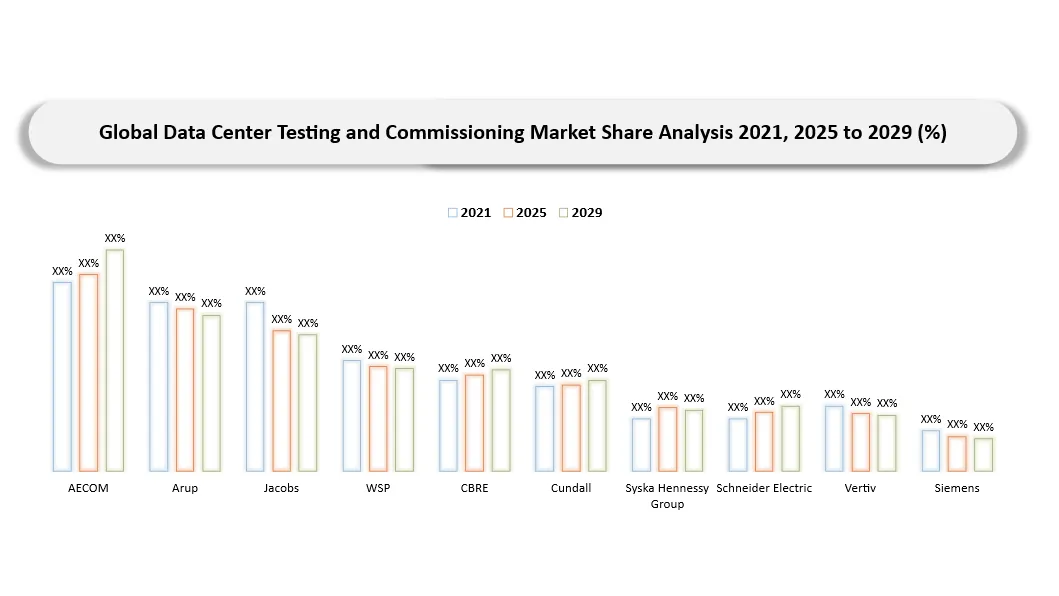
Key Companies of Data Center Testing and Commissioning Market
- AECOM
- Arup
- Jacobs
- WSP
- HDR
- CBRE
- JLL
- Cundall
- Syska Hennessy Group
- NV5 Global
- Salute
- EYP Mission Critical Facilities
- PM Group
- Linesight
- Turner & Townsend
- Vertiv
- Schneider Electric
- Siemens
- Eaton
- Bureau Veritas
Selected Company Profile Analysis
AECOM
AECOM provides program management, engineering and commissioning support for complex mission-critical infrastructure. Its global reach and multidisciplinary teams position it for hyperscale and public-sector programs.
Arup
Arup combines data center design, sustainability and commissioning expertise. Its strength lies in integrated engineering, complex cooling systems and owner advisory work across major regions.
Jacobs
Jacobs serves large technology and infrastructure clients through engineering, program management and commissioning. It can support multi-site programs and complex utility interfaces.
WSP
WSP provides building-services engineering and commissioning across global data center markets. Its geographic reach supports portfolio delivery and regional adaptation.
HDR
HDR has mission-critical engineering and commissioning capability, particularly in North America. It benefits from strong electrical and mechanical design integration.
CBRE
CBRE combines project management, technical services and operational relationships with data center owners. This supports commissioning and recurring facility-performance services.
JLL
JLL participates through project development, technical consulting and operations support. Its customer relationships create opportunities for portfolio-level commissioning and optimization.
Cundall
Cundall is known for specialist building-services engineering, sustainability and mission-critical commissioning. It is well positioned for high-performance and energy-focused projects.
Syska Hennessy Group
Syska Hennessy Group focuses on mission-critical engineering and commissioning, with strong experience in electrical, mechanical and controls coordination.
NV5 Global
NV5 offers testing, inspection, engineering and commissioning services. Acquisitions and multidisciplinary capability support expansion in data center quality assurance.
Salute
Salute combines data center lifecycle services, operations and commissioning support. Its workforce model and operational focus can strengthen handover and readiness programs.
EYP Mission Critical Facilities
EYP Mission Critical Facilities brings specialist design and commissioning knowledge for high-availability environments and complex technical systems.
PM Group
PM Group provides engineering, construction management and commissioning across advanced facilities. Its presence in Europe and Asia supports data center delivery.
Linesight
Linesight is active in cost management, program controls and project delivery for data centers. Its role can complement commissioning through schedule and readiness governance.
Turner & Townsend
Turner & Townsend supports large data center programs through project controls, cost management and advisory services, creating opportunities to coordinate quality and commissioning milestones.
Vertiv
Vertiv provides power and cooling equipment with factory and field service capabilities. Its installed base gives it a central role in equipment testing and integrated support.
Schneider Electric
Schneider Electric offers electrical distribution, UPS, controls and digital management systems. It supports factory testing, site integration and operational analytics.
Siemens
Siemens supplies electrification, automation and building-control technologies. Its role spans equipment testing, controls integration and digital infrastructure.
Eaton
Eaton provides switchgear, UPS, power distribution and related services. Its expertise supports factory acceptance, field testing and power-system commissioning.
Bureau Veritas
Bureau Veritas provides testing, inspection and certification services with global coverage. It can support independent verification, compliance and quality assurance.
Data Center Testing and Commissioning Market Major Pain Points
- Insufficiently mature design documents and sequences of operation at the start of commissioning.
- Late equipment delivery and incomplete installations that compress functional and integrated testing windows.
- Shortage of engineers with combined electrical, mechanical, controls and mission-critical experience.
- Inconsistent issue ownership and slow closure across designers, contractors, OEMs and operators.
- High safety exposure during energized testing, generator runs and intentional fault scenarios.
- Limited availability of temporary load banks, measurement equipment and specialist technicians.
- Weak transfer of commissioning records into operations, reducing the long-term value of project data.
- Difficulty testing realistic AI workloads and fast thermal transients before full IT deployment.
Data Center Testing and Commissioning Market Recent Developments
- May 2025: Uptime Institute’s Annual Outage Analysis reported that power remained the leading cause of impactful outages and that procedure-related human error continued to represent a major reliability opportunity.
- 2025: ASHRAE published Guideline 1.1-2025 for applying the commissioning process to new HVAC&R systems, strengthening technical guidance relevant to data center mechanical commissioning.
- 2025: ASHRAE published Standard 90.4-2025, expanding the energy-efficiency framework for new data centers, additions and modifications.
- 2026: Rapid growth in AI data center pipelines increased demand for integrated power, cooling and controls verification before phased capacity release.
- 2026: Greater use of liquid-cooled AI clusters accelerated demand for coolant-loop flushing, water-quality verification, leak testing and controls validation.
Analyst View / Opinion on Data Center Testing and Commissioning Market
- The market will grow faster than conventional building commissioning because data center capacity and system complexity are increasing simultaneously.
- Integrated systems testing will remain the most strategically important service because it validates interactions that component testing cannot reveal.
- Liquid cooling and high-density AI infrastructure will create a new premium skills category and widen the gap between generalist and specialist providers.
- Ongoing commissioning will become a recurring service as owners use digital baselines to detect performance drift and validate post-handover changes.
- Provider scale will matter for hyperscale portfolios, but specialist firms can outperform in live-site work, controls analysis and liquid-cooling verification.
- Long-term leadership will depend on talent development, safety performance, digital evidence quality and the ability to work across factory, site and operational phases.
Data Center Testing and Commissioning Market Target Audience
| Industry | Who Should Buy This Report? | Reason to Buy This Report |
| Data Center Owners | Developers, operators, reliability leaders | Benchmark commissioning scope, provider selection and emerging risks. |
| Commissioning Providers | Commissioning authorities and testing firms | Identify growth segments, regions and capability gaps. |
| Engineering Firms | Electrical, mechanical and controls consultants | Assess service expansion and partnership opportunities. |
| OEMs | Power, cooling and controls manufacturers | Understand factory and field-testing demand. |
| Construction Firms | General contractors and trade contractors | Improve test readiness and reduce rework. |
| Investors | Private equity, infrastructure funds and lenders | Evaluate provider economics and project-risk controls. |
| Government | Digital infrastructure and standards bodies | Assess quality, safety and energy-performance requirements. |
| Insurance and Risk | Insurers, brokers and technical advisors | Understand commissioning evidence and outage-risk mitigation. |
Why Choose DATAM?
- Data-driven insights covering market size, pricing, value chain, provider positioning and regional opportunity.
- Post-purchase analyst support for project-specific questions and strategic interpretation.
- Quarterly white papers and case studies linked to purchased reports.
- Annual report updates subject to applicable terms and conditions.
- Specialized coverage of emerging markets and infrastructure bottlenecks.
- Actionable analysis designed around commercial, investment and operational decisions.
What DATAM Uniquely Provides
- Detailed ten-year forecasts by service type, commissioning level, system, facility type, project type, size, end user and region.
- Competitive analysis spanning global engineering firms, commissioning specialists, OEM service organizations and technical testing providers.
- Assessment of integrated systems testing, liquid cooling, modular construction, digital commissioning and ongoing verification.
- Strategic insights through AI impact, disruption, BCG Matrix, pricing, trade, investment and risk analysis.
- White-space analysis for AI campuses, emerging regions, factory commissioning and recurring portfolio services.
- Country-level recommendations for providers, owners, investors, contractors and equipment suppliers.
Questions This Report Answers
- How will AI and hyperscale capacity expansion affect commissioning demand through 2035?
- Which service, system, project and facility segments offer the strongest revenue opportunity?
- How are liquid cooling, modular construction and digital tools changing test scope?
- Which regions face the largest shortage of experienced commissioning capability?
- Which providers are best positioned to win multi-site and integrated systems assignments?
- Where are the most attractive investment opportunities in ongoing commissioning and specialist testing?


























































