


Data Center Piping Market Size and Overview
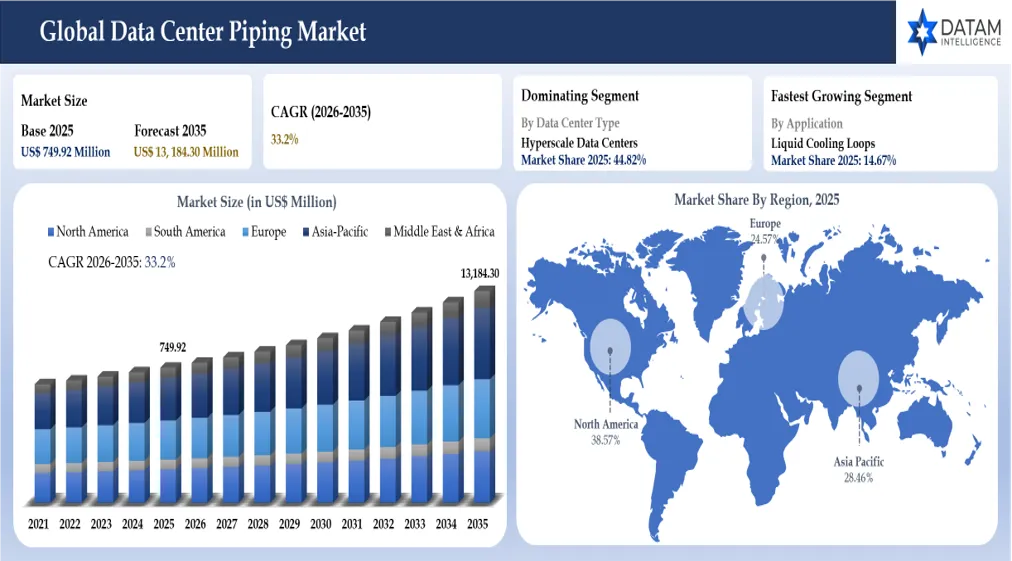
The global data center piping market reached US$ 749.92 million in 2025 and is expected to reach US$ 13,184.30 million by 2035, growing with a CAGR of 33.2% during the forecast period 2026-2035.
The rapid deployment of AI and high-performance computing infrastructure is reshaping the market as it leads to higher rack power densities and a movement away from traditional air cooling solutions towards solutions such as direct-to-chip and other forms of liquid-cooling technologies. This is increasing the need for chilled-water distribution, liquid-cooling loops, cooling distribution units, manifolds, flexible hoses, valves and heat rejection piping among others which is especially pronounced in hyperscale and colocation facilities. The transition will also result in a rise in demand for corrosion-resistant thermoplastic, pre-insulated and engineered pipe systems capable of handling increased flow rates.
When it comes to data centers, there is a rising demand, which is not limited to construction of new buildings. It also includes refurbishment of existing facilities to cater to the needs of high density racks and artificial intelligence workloads. Companies smart enough to redesign their facilities will find many benefits of using prefabricated modular pipe systems as they will not need to shut down and will ensure fast and easy installation, while the technology for tracking leaks, monitoring flow and smart fluid management solutions will assist to protect sensitive IT equipment.
Data Center Piping Market Key Takeaways
- The Hyperscale Data Centers segment captured the largest market share in the global data center piping market during 2025, representing 44.82% of the market, owing to advanced cooling-water loops, high-capacity heat rejection system and increasing liquid-cooling loops for AI and High-performance Computing applications.
- The Liquid Cooling Loops is anticipated to grow at a very fast pace and is expected to grow at a CAGR of 38.6% during 2026–2035. Industry experts suggest that there will be exceptionally high liquid cooling adoption and industry forecast suggests that liquid cooling can reach 70% of AI data center deployments by 2030.
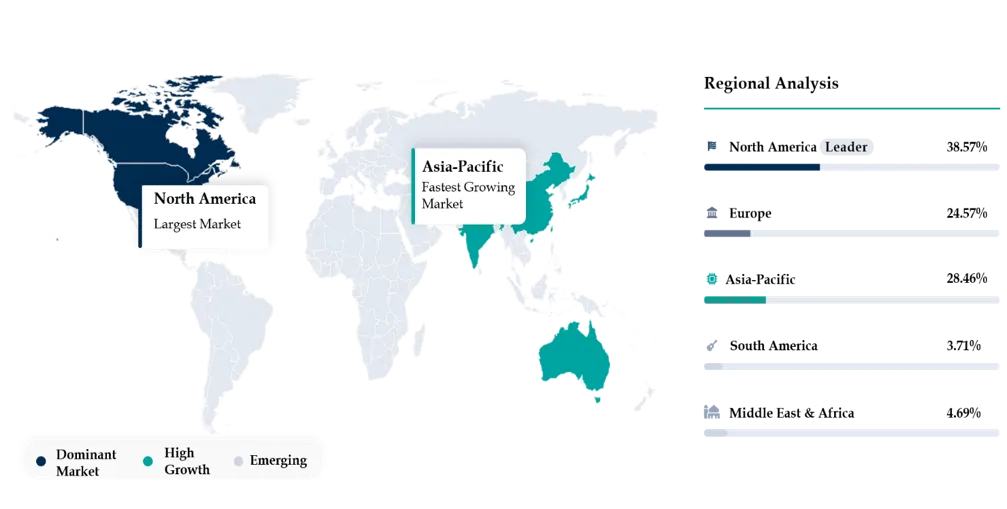
- The North American region held the largest share of the global data center piping market in 2025 at 38.57%, owing to substantial investment in hyperscale and artificial intelligence (AI) data centers, along with adoption of liquid cooling solutions in the market.
- Increasing demand for preassembled and modular piping systems is resulting in the adoption of preassembled piping modules, standard connections and fluid management solutions to overcome complexities in the process of installation and commissioning.
- Increasing demands from AI data centers, hyperscale data centers, colocation data centers and retrofit data centers are creating opportunities for specialized piping systems that provide high flow rate capabilities, corrosion resistance, leak protection, thermal performance and CDU integration.
Data Center Piping Industry Trends and Strategic Insights
- Higher AI and GPU rack density is resulting in the shift from traditional air cooling methods to direct-to-chip cooling and liquid cooling architecture, thereby driving the need for custom-designed piping and hoses and manifold products for distribution of coolant fluid.
- Factory-assembled piping modules and standardized connecting systems are more and more frequently employed by data center builders to speed up the installation process, minimize the labor needed and simplify the installation procedure.
- Data centers already installed are being equipped with extra chilled-water and liquid cooling tubing for high-density tasks; this opens up possibilities for the design of small and modular piping systems that can be added to the existing facility without interrupting its operations.
- Leak detection, flow sensors, pressure sensors and automated valves are being incorporated in piping systems as measures to increase system reliability and prevent damage to IT assets due to water problems.
- Corrosion-resistant thermoplastics, pre-insulated tubing and engineered piping materials are being used by data center operators for fluid compatibility, easy maintenance, thermal efficiency and durability.
Data Center Piping Market Scope
| Metrics | Details | |
| 2025 Market Size | US$ 749.92 Million | |
| 2035 Projected Market Size | US$ 13, 184.30 Million | |
| CAGR (2026-2035) | 33.2% | |
| Largest Market | North America | |
| Fastest Growing Market | Asia-Pacific | |
| By Pipe Type | Rigid Pipes, Flexible Pipes or Hoses, Pre-Insulated Pipes, Others | |
| By Material Type | Carbon Steel, Stainless Steel, Copper, Plastics, Others | |
| By Data Center Type | Hyperscale Data Centers, Colocation Data Centers, Enterprise Data Centers, Others | |
| By Application | Cooling Water Distribution, Heat Rejection, Liquid Cooling Loops, Others | |
| By Installation Type | New, Retrofit or Upgradation | |
| By Diameter Size | Small Diameter (<2 inches), Medium Diameter (2–6 inches), Large Diameter (>6 inches) | |
| By Region | North America | U.S., Canada, Mexico |
| Europe | Germany, UK, Russia, France, Spain, Italy, Poland | |
| Asia-Pacific | China, India, Japan, Australia, South Korea, Indonesia, Malaysia, Singapore, Vietnam, Thailand, Philippines, Taiwan | |
| South America | Brazil, Argentina | |
| Middle East and Africa | UAE, Saudi Arabia, South Africa, Israel, Turkiye, Nigeria | |
| Report Insights Covered | Competitive Landscape Analysis, Company Profile Analysis, Market Size, Share, Growth | |
Why does this report matter in 2026?
Data center piping market is growing to be significant in 2026 owing to increasing density of computing workloads, especially involving AI processing and high-density GPUs, which makes it impossible to continue using air-cooling systems for cooling data center racks. This is causing the industry to invest heavily in direct to chip cooling, chilled water piping, cooling distribution units, manifolds, flexible piping, valves and heat rejection piping. The report assists the stakeholders to understand how this change is impacting pipe specification, materials, design and demand for hyperscale, colocation and enterprise data centers.
The report has particular significance in 2026 due to the ongoing effort by data center designers to expand AI-capable data centers while upgrading current sites to allow for more dense computing environments. It is thus important to know that piping companies will be competing for installation efficiency, corrosion resistance, leak prevention, pre-fabrication, fluid resistance and smart monitoring capabilities as opposed to just pipe supply. Comprehending such transformations is key for manufacturers, cooling system suppliers, EPC firms, investors and data center owners who want to determine the high-growth markets and technologies within the changing landscape of liquid-cooling infrastructure.
Data Center Piping Market White Space & Investment Opportunities
- The increasing use of artificial intelligence and high-density computing is leading to the development of advanced piping systems that can support direct chip cooling.
- Insulated pipes provide investment opportunities through decreasing the losses of heat, condensation and saving installation time in data center cooling systems.
- The retrofitting of existing data centers becomes an interesting investment opportunity in changing the traditional cooling systems to the liquid cooling.
- Opportunities for corrosion resistant thermoplastic piping systems in data center cooling are increasing due to their light weight and their ability to withstand water exposure.
- Piped assemblies and smart pipes with built-in leak detection, sensor monitoring features provide avenues for enhancing efficiency and effectiveness in installation and maintenance.
Data Center Piping Future Market Transformation
The market for piping systems in data centers is anticipated to convert from traditional systems for the distribution of cooling water to systems for the distribution of liquid cooling systems due to growing use of AI and GPU processing units and increased power density in racks. Future capabilities will include direct-to-chip cooling, advanced cooling distribution units, high-flow manifolds, quick connectors, flexible hoses, leak detection systems and sensors for flow monitoring that will be integrated into modular and prefabricated piping systems. New piping systems are expected to be based on lightweight materials resistant to corrosion and compatible with the fluids to be transported, while the viability of systems for retrofitting plays an important role in upgrading existing data centers without interfering with their operation. Therefore, manufacturers of pipes will leverage their competitive edge by providing integrated fluid management solutions rather than solely producing pipes.
Data Center Piping Market Buyer Decision-Making Criteria
Data center owners, designers and EPC contractors assess piping systems based on their capacity to handle high density cooling requirements, constant operation and reliability over time as opposed to just their cost alone. Increasingly, buying decisions take into account compatibility with chip-level liquid cooling and chilled water systems, pressure and temperature range, possibility of leaks, fast installation times, long term durability, fit with CDUs and manifolds and the vendor's capability to design and fabricate these products for either new constructions or retrofits.
Major Decision-Making Criteria
- Liquid-Cooling Compatibility
- Pressure and Temperature Performance
- Leak Prevention and System Reliability
- Material and Corrosion Resistance
- Flow Capacity and Thermal Performance
- Compatibility with CDUs, Manifolds and Valves
- Installation Speed and Prefabrication Capability
- Retrofit and Space-Constraint Adaptability
- Lifecycle Cost and Maintenance Requirements
- Supplier Engineering Support and Global Availability
Data Center Piping Market Economic & Investment Analysis
The economic prospects of the data center piping market are associated with growing capital expenditure on hyperscale, colocation and artificial intelligence data centers. Growing density is driving investments into chilling water solutions, direct to chip liquid cooling, heat rejection technology, CDUs, manifolds, valves and pipes. Even though sophisticated piping systems may be costly at the start of the project, they add value when considering cooling efficiency, asset protection and reliability.
Growing investments are going into the adoption of liquid cooling retrofits, prefabricated pipe systems, corrosion-proof materials and smart fluid management technology. There is more focus among data centers to adopt methods that can reduce installation times and operational interruptions, thus opening up chances for companies that are developing modular and integrated pipe systems. In addition, investments are increasing in regional manufacturing and logistics capabilities to ensure the fast delivery of special piping products for data center constructions.
Data Center Piping Investment Trends in the Market
- More investments are being made into liquid-cooled piping systems because of increasing density of power used by artificial intelligence and high performance computing systems.
- There are more investments being made into prefabricated and modular piping systems in order to make installation shorter and minimize on-site manpower requirements.
- Corrosion-resistant thermoplastics and engineering piping materials have seen more investment due to their longer lifespans and reduced maintenance.
- The capital allocation is increasingly tilting towards pipe systems that are ready for retrofits, which will enable existing data centers to move from traditional air-cooling systems to liquid-cooled systems without any significant downtime.
- Investors and data center managers have been investing more money into developing intelligent systems that deal with fluids, including systems to detect leaks, monitor flows and control valves and pipelines with sensors.
Strategic Indicators for Data Center Piping Market
High Regulation Impact
The data center piping market is witnessing a growing trend of regulations pertaining to water efficiency, energy efficiency, fire safety, pressure safety, material specifications, handling of coolants and environmental performance. It is necessary for data center pipes to conform to the relevant building and mechanical codes while also ensuring the right level of pressure safety, leakage prevention and protection of critical IT infrastructure from any water hazards. Higher standards of sustainability have also pushed operators into using efficient cooling water systems with closed circuits along with leak detection systems and environmentally friendly material compositions, making compliance with regulations an important aspect of pipe system design and selection.
High Investment Activity
The data center piping market is witnessing increased investments, as hyperscale, colocation and AI-oriented data center developers invest more in their budgets towards liquid cooling and high-density thermal infrastructures. This includes direct to chip cooling systems, cooling distribution units, pre-assembled piping systems, high-quality valves and fittings, anti-corrosion piping systems, leak detection systems and retrofit solutions. Manufacturers are also making investments in terms of increasing manufacturing capacity and developing engineering and logistics network capabilities in order to cater to shorter project cycles and demand for specialized piping systems.
Supply Chain Disruption
The data center piping market faces the risks of potential disruption within its supply chain due to shortages within specialty polymer material, stainless steel, copper, valves, fittings, flexible hoses and pre-insulated piping material necessary for cooling infrastructure. Rapid AI data-center construction could result in temporary shortages and delays in the delivery of high-performance piping and liquid cooling components, with logistics challenges, material cost fluctuations and a shortage of specialized manufacturing facilities driving up costs and potentially causing project delays. This situation is putting pressure on data center builders and piping suppliers to become more diverse in their sources of supply, carry higher inventories closer to home and manufacture more locally.
Pricing Volatility
The fluctuations in the prices of copper, stainless steel, carbon steel, plastics, valves, fittings and liquid-cooling components are among the main factors contributing to volatility of prices in the data center piping industry. In 2026, copper prices reached a peak above US$11,000 per ton putting upward pressure on copper piping prices despite the generally high sensitivity of prices of metal and polymer products to energy issues, sourcing, logistics and other factors. The rise in AI data center construction has resulted in the rising demand for specialized piping systems and cooling components which exacerbates the issue of pricing. In the rushing market conditions brought by the increased demand, buyers try to hedge fluctuations in pricing by implementing pricing strategies based on fixed supplies contracts, securing supplies from multiple sources and favorable conditions for local sourcing.
Procurement Pressure
There is increasing procurement pressure within the data center piping market, especially due to the need to work under tight construction schedules and meet rising demand for AI compatible cooling systems along with limited supply of specialized pipes for liquid cooling and hoses, valves, fittings, manifolds and pre-insulated piping systems. The buyers need to evaluate quality of the material, capacity and pressure ratings, coolant compatibility, leak protection, installation time and lifetime costs while ensuring that adequate quantities are available to fulfill their requirements. Lead time for specialized components could influence the schedule for the commissioning process, prompting data center managers and EPC contractors to have various suppliers qualified, install pre-assembled piping systems, source locally and develop frame agreements for important piping components.
New Technology Adoption
Technology uptake in the data center piping market is on the rise due to growing demand for AI and dense computing which need better thermal management systems. The growing trend is towards using direct-to-chip liquid cooling, sophisticated cooling distribution units, high-flow manifolds, quick connect fittings, pre-assembled pipe systems, flow monitoring using sensors and automatic leak detection systems. Thermoplastics and corrosion-resistant materials are becoming popular since these materials are capable of reducing the system’s weight and facilitating easy installation. These developments have been driving the market from traditional piping solutions towards modular, intelligent and integrated fluid management systems for future cooling systems at data centers.
Regional Expansion Opportunity
The opportunities for regional expansion in the data center piping market lie mainly in Asia Pacific and the Middle East regions and also emerging data center markets in South America, where the uptake of cloud services, AI infrastructure development and the opening up of hyperscale data centers are driving the need for advanced cooling systems. There is potential in India, Southeast Asia and Australia for chilled water and liquid cooling pipes, while Saudi Arabia and the UAE require a massive infrastructure that uses high-performing fluid management solutions. Companies will enhance their business in the region by setting up manufacturing and distribution operations, ensuring that the region’s materials and standards are met and offering prefabricated modular and ready-to-fit piping solutions.
Government Policy Support
The Governmental Policies favoring digital infrastructure build-up, efficient data centers, water conservation and sustainable cooling are improving the business environment of data center piping market. The incentives towards increased data center capacity, renewable energy adoption and efficient cooling technology adoption are motivating developers to build their infrastructure including chilled water and liquid-cooled infrastructure, whereas the construction norms, water efficiency and mechanical norms are dictating the piping material, pressure rating, insulation, leakage prevention and overall design of the piping systems. As the governments start prioritizing the AI Infrastructure and sustainable digital infrastructures, policy support is providing the scope for the development of highly efficient liquid cooling systems and closed loop piping system.
Pricing Intelligence
Pricing intelligence for the data center piping market now relies more heavily on total cost of installation and value through performance rather than price of pipe alone. Piping systems can be evaluated based on criteria such as material grade, diameter, pressure rating, heat transfer efficiency, thermal insulation needs, fitting needs, valve needs, installation effort, prefabrication extent and cost of maintenance. In the case of cooling applications, manufacturers of the piping systems have the potential to generate more value with manifolds, quick connection options and leak detection. This trend is motivating equipment manufacturers and EPC companies to implement specific pricing models based on the total lifecycle costs of piping systems for both new and retrofit data center projects.
| HS Code | Reporter | Trade Flow | 2025 Trade Value | Interpretation |
| 3917 | Germany | Export | US$5 Billion | Germany is the leading exporter in the selected trade category, highlighting its strong manufacturing and export base for plastic tubes, pipes, hoses and fittings used across data-center cooling and fluid-management infrastructure. |
| 3917 | China | Export | US$4.9 Billion | China's substantial exports reflect its large-scale plastics manufacturing capacity and established supply base for piping products used in construction, industrial and data-center applications. |
| 3917 | United States of America | Import | US$3.5 Billion | The high import value indicates strong U.S. demand for plastic piping products, supported by continued investment in data centers, cooling infrastructure and industrial facilities. |
| 3917 | Germany | Import | US$2.8 Billion | Germany's significant import value indicates an integrated international supply chain in which domestic manufacturers and infrastructure projects also rely on imported plastic piping products and components. |
Note: HS Code 3917 covers tubes, pipes, hoses and fittings thereof (for example, joints, elbows, flanges), of plastics. The trade values represent the broader HS 3917 product category and are not limited exclusively to data center piping.
AI Impact Analysis of Data Center Piping Market
There has been an increase in the need for high performance piping systems in data centers due to the fact that AI server and GPU clusters consume energy at much higher levels compared to regular computing machines. With increased rack densities, traditional methods of cooling through air become ineffective and as a result there is a need for direct to chip cooling, cooling distribution units, manifolds, chilled water systems, flexible hoses and heat rejection piping. This trend is moving the focus towards pipe systems that can accommodate increased flow, pressure and temperature changes and operate continuously with good control of fluid leakage and quality.
Expansion of the data centers using AI is also transforming the design and investment strategies in the piping industry. New data centers have started using pre-engineered piping assemblies, liquid cooling modules, flow sensors and automatic leak detectors for faster and reliable performance. Meanwhile, current data centers are being upgraded with more piping to meet AI requirements, presenting a new retrofitting opportunity. As a result, AI is not only driving the quantity of piping material required in each data center but also pushing towards greater use of advanced piping materials and solutions.
Disruption Analysis of Data Center Piping Market
The movement from conventional air cooling to the use of liquid cooling systems, including direct-to-chip software, is having an impact on the requirements for piping within data centers. Increasing rack density of AI and GPUs is leading to the use of smaller yet highly efficient fluid distribution networks, proven with the help of chilled fluid distribution units, branch systems, flexible pipes, quick-connecting systems, special valves and high-capacity discharge piping. The transition is altering competition from traditional water distribution systems to integrated solutions that can offer high flow rates, precise pressure control and leak prevention along with continuous operation.
The emergence of prefabrication, modularization and new fluid management principles are heralding a second wave of revolution in the field of piping design and installation for data centers. Modularized piping systems, flow sensors for fluid monitoring, automated leak detection and modular connections are some innovations which can help cut down the installation and commissioning time as well as minimize risks involved. This set of technologies has a disruptive impact on retrofits where lack of space and the need to keep facilities operational makes the installation of the system difficult using the traditional approach. Hence, pipe and fluid management companies have an upper hand over their competitors who supply pipes alone.
Data Center Piping Market BCG Matrix: Company Evaluation
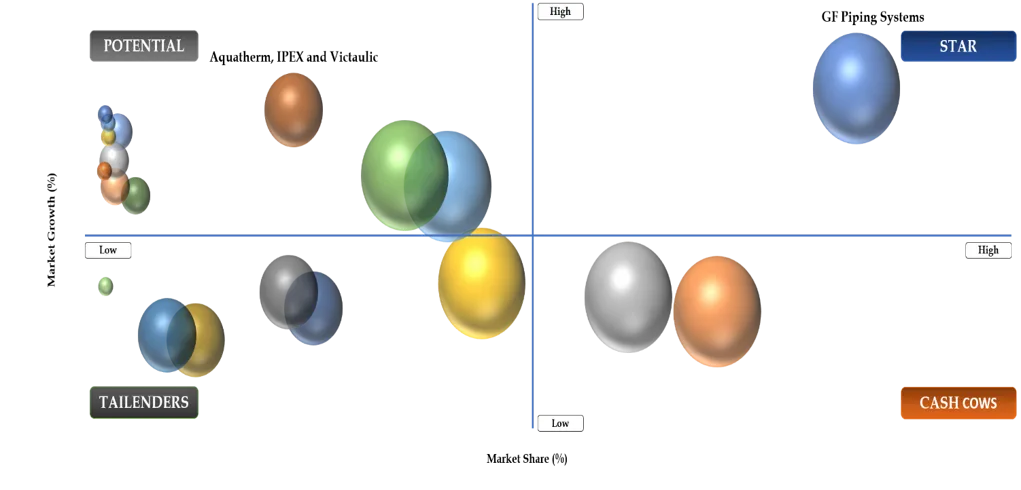
STAR
GF Piping Systems can be categorized as a Star due to the company’s strong position within the engineered thermoplastic piping, valves, fittings and fluid management products, coupled with the increasing awareness for artificial intelligence-based liquid cooling and high-density data center infrastructure solutions. The direct to chip cooling systems, pre-assembled systems and high purity piping capabilities of the company offer excellent synergy with the fast growing market needs.
POTENTIAL
Aquatherm, IPEX and Victaulic are seen as growing companies as the demand for liquid cooling increases among data-center operators, which, in turn, leads them towards the utilization of reliable, scalable piping and joining solutions. While Aquatherm gained from the use of polypropylene piping in cooling-water applications, IPEX benefited from the variety of its thermoplastic piping and Victaulic from its advanced technology related to mechanical joining, valves and prefabricated piping. Their chances of raising their market share depend on the need for new application of technologies as well as the development of project cooperation.
Data Center Piping Market Dynamics
Driver Impact Analysis
| Driver | Market Growth Impact (%) | Demand Concentration | Impacted Use Case | Strategic Impact |
Rapid Expansion of AI and Hyperscale Data Centers | 32% | Hyperscale Data Centers | High-Density Cooling Infrastructure | Drives large-scale deployment of advanced piping networks and higher-capacity cooling systems. |
Shift Toward Liquid Cooling for High-Density Racks | 28% | AI/GPU Data Centers | Liquid Cooling Loops | Accelerates demand for flexible hoses, engineered piping and specialized fluid-distribution systems. |
Growing Data Center Construction and Capacity Expansion | 23% | North America, Europe, Asia Pacific | Cooling Water Distribution | Creates sustained demand for new piping installations across hyperscale, colocation and enterprise facilities. |
Increasing Energy-Efficiency and Sustainability Requirements | 17% | Hyperscale and Colocation Data Centers | Heat Rejection and Cooling Water Distribution | Encourages adoption of efficient, insulated and corrosion-resistant piping systems that reduce cooling losses and operating costs. |
Driver: Rapid Adoption of Liquid Cooling in AI Data Centers
The swift installation of AI servers and high-performance computing devices, has resulted in an increase in rack power density that goes beyond the limits of what air-based systems can cool effectively. There is now a more urgent need to find alternatives, such as direct-to-chip or other forms of liquid-cooling technology. Consequently, there is a heightened need for chilled-water distribution piping systems, flexible hoses, connections, valves and fittings, the term referring to the entire range of infrastructure needed for liquid-based cooling, which is thus determining growth in the data center piping market.
Restraint Impact Analysis
| Restraint | Drag on Market Growth (%) | Primary Impact Area | Impacted Use Case | Strategic Impact |
High Initial Installation and Infrastructure Costs | 30% | Capital Expenditure | New Data Center Construction | Increases upfront project costs and can delay or phase piping-system deployment. |
Complexity of Retrofitting Existing Data Centers | 27% | Retrofit Projects | Liquid Cooling Upgrades | Space constraints, shutdown requirements and integration challenges can limit adoption in existing facilities. |
Risk of Leakage, Corrosion and System Failures | 23% | System Reliability | Cooling Water Distribution | Drives demand for higher-quality materials, monitoring and preventive maintenance, increasing total system costs. |
Limited Availability of Skilled Installation and Maintenance Expertise | 20% | Installation and Maintenance | Advanced Cooling Systems | Skilled-labor shortages can increase installation time, project costs and commissioning complexity. |
Restraint: High Cost and Complexity of Retrofitting Existing Data Centers
The retrofit of existing data centers with liquid-cooling piping faces restrictions due to limited space for mechanical installations, already established pipework configurations, operation facility conditions and the necessity to incorporate new pipework with pumps, CDUs, heat exchangers and existing cooling systems. Such additional expenses may raise the cost of the project substantially and discourage fast replacement of the traditional cooling system infrastructure.
Data Center Piping Market Segment Analysis
The global data center piping market is segmented based on the pipe type, material type, data center type, application, installation type, diameter size and region.
By Datta Center Type
Hyperscale Data Centers Lead Demand for High-Capacity Piping Infrastructure
Hyperscale Data Centers had a market share of 44.82% in 2025, which can be attributed to its large scale chilled water delivery systems, heat rejection systems and liquid cooling solutions that enable AI and HPC workloads. It requires very dense rack systems which have very complex piping systems to allow CDU, direct-to-chip cooling, manifolds and valves to function at high flow rates.
By Application
High-Density AI Computing Accelerates Demand for Liquid Cooling Loops
It has been forecast that Liquid Cooling Loops will record a 38.6% CAGR between 2026 and 2035, mainly owing to the growing adoption of AI/GPU servers featuring higher rack power density, along with the change from regular air cooling systems to direct-to-chip or other liquid-cooled systems. It is driving the demand for cooling-water piping, hoses, manifolds, quick-connects, CDUs and flow control components for data centers.
Data Center Piping Market Geographical Penetration
U.S. Data Center Piping Market Landscape
The US data center piping market is evolving due to the fast hyperscale and AI data center builds, where higher rack power density is driving the shift from traditional air cooling to chilled-water and direct-to-chip liquid cooling systems. There is an increasing need for piping materials that have high performance capabilities in terms of handling higher flow rates and pressure as well as heat removal. Retrofitting also provides substantial opportunities for the data center piping market, as there will be an increased demand for retrofit piping as current facilities enhance their cooling system to deal with AI loads without causing major disruptions to operations. Key players distinguish themselves in terms of modularized piping systems, corrosion-resistant thermoplastics, leakage detection system and fluid management, whereas data centers’ owners focus on fast installation, reliability, maintainability and efficient cooling.
Japan Data Center Piping Market Outlook
The Japan data center piping market is being fueled by the development of hyperscale, cloud and AI data center infrastructure, especially in major centers like Tokyo and Osaka. With increased rack density, there will be a rising demand for chilled water distribution systems, liquid-cooled direct to chip systems, heat rejection piping systems and flexible hoses. The focus on energy efficiency, compact design and reliability within Japan is also driving the adoption of non-corrosive and pre-fabricated piping systems. New retrofitting options are also arising from the need for upgraded cooling infrastructure for existing data centers to run AI workloads, along with the rise in stringent requirements for quality valves, fittings and leak prevention and monitoring.
China Data Center Piping Market Trends
The china data center piping market is experiencing growth due to fast development of hyperscale, cloud and artificial intelligence computing systems, especially in major technology and digital cities. Rising rack densities have increased the need for piping systems that distribute chilled water, direct chip cooling, heat rejection piping, flexible hose systems, valves and high-flow fluid management systems. The need for efficient and energy-saving data center systems in China has been promoting the use of thermoplastic and corrosion-resistant piping systems. There is also an increase in the use of standardized and prefabricated piping systems. Upgrading of existing data centers with increased capacity cooling systems, leak detection and flow control systems is a growing market opportunity.
India Data Center Piping Market Analysis
India data center piping market has experienced exponential growth due to increased capacity by hyperscale, cloud and colocation data center operators within key cities like Mumbai, Chennai, Hyderabad and Bengaluru. Increasing AI processing demands, alongside increased rack density have contributed to the demand for chill water piping, liquid coolants for direct chip cooling, cooling distribution units, heat rejection piping, flexible hoses, valves and high flow fluid management. Energy efficiency in data center infrastructures in India is also driving the use of corrosion-resistant thermoplastic as well as pre-insulated piping, whereby modular and prefabricated piping systems can play an important role in overcoming tight deadlines and labor challenges. Opportunities for retrofits are arising as existing facilities begin to upgrade their cooling infrastructures in order to meet high density computing needs.
Data Center Piping Market Competitive Landscape
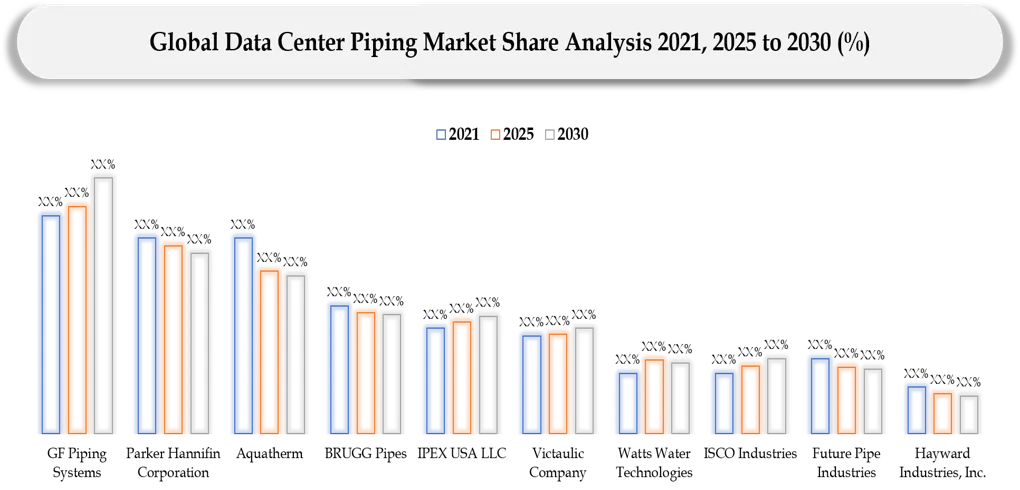
- There exists intense competition in the market between thermoplastic piping providers, metal piping providers, mechanical jointing service providers and fluid management organizations, where GF Piping Systems, Aquatherm and IPEX are some of the dominant players when it comes to engineering piping solutions.
- Competitive advantage for leading firms is being gained through the application of liquid cooling, high-density cooling and piping systems that are specific to data centers to meet the needs of AI and hyperscale environments.
- Competitive focus has now shifted to the properties of materials, especially corrosion resistance, pressure resistance, thermal capabilities and material compatibility with cooling fluids.
- Prefabricated pipe assemblies, modular installation systems, valve and fitting technology and integrated fluid management systems are helping firms differentiate on the basis of shortened installation times and improved reliability of the data centers.
- Firms are also competing strategically through engineering alliances, project specifications, regionally based manufacturing capability and customization for new and retrofit data center cooling projects.
Public Company Q1-Q2 2026 Performance Comparison
The following table contains a comparison between five publicly traded companies which have either direct or strategic involvement in the market for data center pipes and cooling facilities. The financial metrics used are corporate or segment-based rather than being restricted to the revenues of data center piping alone. Growth drivers therefore distinguish corporate performance from from direct data center piping exposure.
| Company | Q1–Q2 2026 Performance | Data Center Piping Exposure | Key Performance Driver |
| GF Piping Systems (GF Flow Solutions) | US$1.84 Billion revenue | High-purity thermoplastic piping, valves, fittings and fluid-management systems used in data-center cooling and semiconductor applications. | Strong infrastructure, semiconductor and high-purity fluid-management demand; Q2 organic growth accelerated significantly. |
| IPEX USA LLC (Aliaxis Group) | US$2.10 Billion revenue | PVC, CPVC and engineered piping systems used across commercial, industrial and infrastructure applications, including data-center cooling. | North American capacity expansion, pricing discipline, CPVC integration and resilient infrastructure demand. |
| Hayward Industries, Inc. | US$573.4 Million revenue | Pumps, valves, controls and fluid-management equipment applicable to cooling and water-management systems. | Strong North American sales, aftermarket demand, smart controls and energy-efficient equipment adoption. |
| Watts EMEA Holding B.V. | US$246.4 Million revenue | Valves, flow-control, pressure-management and water-management solutions relevant to data-center cooling-water systems. | Commercial renovation, water safety and growing demand for liquid-cooling infrastructure. |
| Parker Hannifin Corporation | US$11.26 Billion revenue | Fluid connectors, hoses, fittings, valves and thermal-management technologies used in liquid-cooling and data-center fluid-management systems. | Aerospace & defense growth, industrial demand, semiconductor expansion and liquid-cooling applications. |
Note: Company-level revenue should not be interpreted as data center piping revenue unless separately disclosed. Financial periods and reporting currencies differ because companies follow different fiscal calendars.
Key Companies of Data Center Piping Market
- GF Piping Systems
- Aquatherm
- BRUGG Pipes
- IPEX USA LLC (Aliaxis Group)
- ISCO Industries
- Victaulic Company
- Hayward Industries, Inc.
- Watts EMEA Holding B.V.
- Valex
- Harrington Industrial Plastics LLC
- Collins Companies, Inc.
- Parker Hannifin Corporation
- Fixotec
- Future Pipe Industries
- AGRU Kunststofftechnik GmbH
Company Profiles of Data Center Piping Market
GF Piping Systems
GF Piping Systems is a prominent provider of thermoplastic piping systems, valves and fittings and fluids management services, having a good exposure to semiconductors, industrial and data center cooling sectors. The company offers high purity piping systems, water cooling systems and engineered components that can ensure fluid management in critical infrastructures.
Competitive priorities consist of widening the use of cooling technology in data centers, promoting the use of high-purity and anti-corrosion pipe systems and finding solutions for liquid-cooled infrastructure systems.
IPEX
IPEX is a well-known Canadian-based producer of thermoplastic piping systems that include PVC, CPVC and engineered piping systems for water distribution and infrastructure purposes. The company’s product line includes chances in designing cooling-water systems of data centers and managing related fluids.
Competitive priorities are increasing production capacities in North America, enhancing engineered piping systems, growing the company’s market share in cooling systems of commercial and industrial facilities and constructing data center facilities.
Victaulic Company
Victaulic is one of the biggest suppliers of mechanical pipe joining systems, pipe couplings, fittings and flow control valves. This company’s technology can be especially useful for data center cooling systems which require fast installation, flexibility and reliability of the piping connection.
The competitive priorities for Victaulic can be development of products for the infrastructure of data center cooling, implementation of mechanical grooving technology, implementation of prefabricated systems and solutions for high density liquid cooling.
Aquatherm
Aquatherm specializes in the manufacture of polypropylene piping products, which have applications in areas like chilled water distribution, cooling systems and fluid management needs in data centers. The polypropylene piping products from Aquatherm provide anti-corrosion properties, easy installation and extended life.
Competitive priorities encompass developing data center and high performance cooling business, promoting the use of polypropylene pipes, high density liquid cooling initiatives and enhancing engineering and specification relations with data center developers.
Parker Hannifin Corporation
Parker Hannifin is a diversified provider of motion and control technology with capabilities in fluid connectors, hoses, fittings, valves, thermal management systems and engineered fluid-handling products. Parker products facilitate liquid-cooling and fluid distribution needs in high-density data center environments.
Competitive priorities include developing liquid-cooling and thermal management solutions for AI and high-density computing applications; integration of advanced fluid connectors and manifolds; and customer relationship development for data centers and semiconductors.
Watts Water Technologies
Water solutions provided by Watts Water Technologies include valves, flow-control, pressure-management, water quality management and fluid management technologies that are useful for commercial and industrial water systems.
Competitive considerations consist of increasing usage of its products in data centers, developing advanced technologies related to water and fluid management, improving efficiency and reliability of the system and penetrating into commercial and industrial infrastructure projects.
Data Center Piping Market Major Pain Points
- Materials and accessories for specialized pipes, valves and insulating and installing requirements add up to the initial cost of the data center cooling system.
- The lack of room, the design of the pipes already in place, operating continuity requirements and possible shut down pose challenges in retrofitting the data center for liquid cooling.
- Equipment used in information technology is sensitive to leakage, condensation and joint failure and poses a considerable risk of damage to the operations and finances of critical data centers.
- The design and commissioning and maintenance of pipe systems coupled with cooling distribution units, manifolds, pumps, heat exchangers and direct-to-chip cooling become more complex.
- Selecting materials for piping that can endure pressure, temperatures, chemical properties of coolant fluid and corrosion is an extremely difficult task.
Data Center Piping Market Recent Developments
- September 2026 - Schneider Electric: Introduced the WCDU coolant distribution unit with both liquid and air cooling for AI data centers with high density. The system is capable of generating up to 3.5 MW per unit, making it easier to install and retrofit.
- August 2026 - Schneider Electric: Mentioned the expansion of India’s liquid cooling chain supply, which includes the production of CDUs and direct-to-chip cooling equipment at Schneider’s Bengaluru facility and pointed out the inclusion of piping, controls and other aspects in the liquid cooling process.
- July 2026 - GF Piping Systems & Parker Hannifin: A combined plug-and-play coupling of GF's Quick Connect Valve 700 and Parker's E-Z Form hose was launched to enable straightforward direct liquid cooling connections between distribution headers as well as IT racks.
- July 2026 - GF Piping Systems: Announced that direct-to-chip liquid-cooling order intake for data-center end-use applications reached twice its H1 2026 level due to increasing use of polymer piping, valves, instrumentation as well as prefabricated LiquidCore modules.
- July 2026 - Schneider Electric: Presented a summary of the direct liquid cooling usage risk assessment for AI data centers, highlighting the increasing role of piping, coolant flow, leak prevention, dedicated cooling loops, pressure control and flow balancing amidst the increased rack density.
Analyst View / Opinion on Data Center Piping Market
- The industry is set to benefit from the fast growth in the adoption of AI and hyperscale data centers, where increased rack densities are leading to a growing requirement for sophisticated piping solutions for liquid cooling purposes.
- Direct-to-chip liquid cooling will be increasingly important as a demand driver, thus providing new opportunities for special pipes, flexible hoses, manifolds, valves and distribution systems of fluids.
- Lightweight piping systems, which have thermoplastics and are corrosion resistant, will be more widely used by data-center operators due to their specific needs.
- Retrofit and upgradations will be an important avenue for growth, as existing facilities move away from traditional air-based cooling systems to more sophisticated liquid-cooled systems.
- Differentiation will occur through combined piping systems including fittings, valves, leak detection systems, monitoring and fabrication, rather than simple pipe products.
Target Audience of Data Center Piping Market
| INDUSTRY | WHO SHOULD BUY THIS REPORT? | REASON TO BUY THIS REPORT |
| Data Center Operators & Hyperscalers | Hyperscale, Colocation and Enterprise Data Center Operators | Assess piping requirements for high-density cooling, liquid cooling, heat rejection and data center capacity expansion. |
| Data Center Developers & Infrastructure Companies | Data Center Developers and Infrastructure Owners | Evaluate piping technologies, material selection, installation requirements and opportunities across new data center projects. |
| Piping System Manufacturers | Pipe, Fitting, Valve and Piping System Manufacturers | Identify demand trends, high-growth applications, material preferences and opportunities in data center cooling infrastructure. |
| Cooling System & HVAC Companies | Cooling Equipment Manufacturers and HVAC System Integrators | Understand demand for cooling-water distribution, liquid-cooling loops and heat-rejection piping systems. |
| Engineering, Procurement & Construction (EPC) | EPC Contractors, Engineering Consultants and System Integrators | Support piping-system design, technology selection, procurement planning and data center construction projects. |
| Material & Component Suppliers | Metal, Plastic, Polymer and Specialty Material Suppliers | Identify opportunities across carbon steel, stainless steel, copper, plastics and pre-insulated piping materials. |
| Liquid Cooling & Fluid Management Companies | Liquid Cooling, Fluid Management and Thermal Management Companies | Track adoption of advanced liquid-cooling systems and fluid-distribution technologies for high-density data centers. |
| Distributors & Channel Partners | Piping, Valve, Fitting and Industrial Equipment Distributors | Identify high-demand products, regional opportunities and evolving requirements from data center customers. |
| Investors & Private Equity Firms | Institutional Investors, Private Equity Firms and Infrastructure Investors | Evaluate market growth, investment opportunities, competitive positioning and expansion potential. |
| Government & Regulatory Organizations | Energy, Infrastructure and Data Center Regulatory Bodies | Assess data center infrastructure development, energy-efficiency requirements and sustainability trends affecting cooling systems. |
Why Choose DATAM?
- Data-Driven insights: Dive into detailed analyses with granular insights such as pricing, market shares and value chain evaluations, enriched by interviews with industry leaders and disruptors.
- Post-Purchase Support and Expert Analyst Consultations: As a valued client, gain direct access to our expert analysts for personalized advice and strategic guidance, tailored to your specific needs and challenges.
- White Papers and Case Studies: Benefit quarterly from our in-depth studies related to your purchased titles, tailored to refine your operational and marketing strategies for maximum impact.
- Annual Updates on Purchased Reports: As an existing customer, enjoy the privilege of annual updates to your reports, ensuring you stay abreast of the latest market insights and technological advancements. Terms and conditions apply.
- Specialized Focus on Emerging Markets: DataM differentiates itself by delivering in-depth, specialized insights specifically for emerging markets, rather than offering generalized geographic overviews. The approach equips our clients with a nuanced understanding and actionable intelligence that are essential for navigating and succeeding in high-growth regions.
- Value of DataM Reports: Our reports offer specialized insights tailored to the latest trends and specific business inquiries. The personalized approach provides a deeper, strategic perspective, ensuring you receive the precise information necessary to make informed decisions. The insights complement and go beyond what is typically available in generic databases.
What DATAM Uniquely Provides
- The report offers an extensive analysis of piping demand in data centers on account of cooling water distribution, heat rejection and liquid cooling.
- The report studies the impact of AI and high-density computing on the rise in demand for sophisticated piping systems and the change in the cooling requirements of data centers.
- The report analyzes the opportunity to adopt rigid pipes, flexible hoses, pre-insulated pipes and other piping materials in data center infrastructure.
- The report analyzes the opportunity created by the construction of new data centers and the retrofitting or upgrading of existing data centers.
- The report offers an assessment of competition among piping manufacturers, fluid management companies, cooling systems providers and others.


























































