


Data Center Grid Connection Services Market Size and Overview
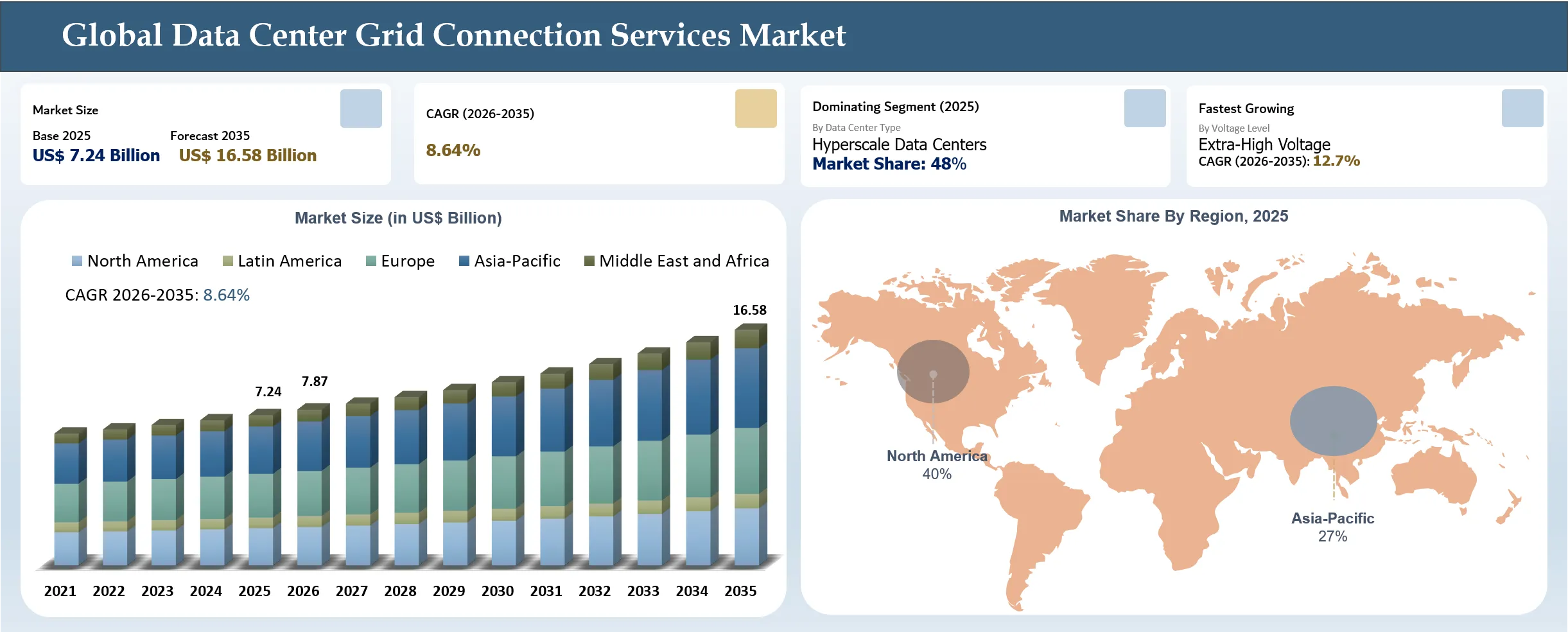
The global data center grid connection services market reached USD 7.24 billion in 2025 and is expected to reach USD 16.58 billion by 2035, growing with a CAGR of 8.64% during the forecast period 2026-2035. The market is expanding rapidly due to the increase in data center electricity requirements, with the International Energy Agency (IEA) reporting that global data center electricity consumption increased by 17% in 2025, while electricity consumption from AI-focused data centers increased by 50% during the year. The IEA projects global data center electricity consumption to approximately double from 485 TWh in 2025 to 950 TWh by 2030, with AI-focused data center electricity consumption expected to triple over the same period. The IEA also reported that capital expenditure by major technology companies exceeded USD 400 billion in 2025 and is expected to increase by another 75% in 2026, reinforcing the scale of data center infrastructure deployment. In the United States, the U.S. Energy Information Administration (EIA) estimated that data center servers accounted for 7% of commercial-sector electricity consumption in 2025, while its 2026 outlook identifies data center load as the dominant driver of long-term U.S. electricity growth. Globally, more than 2,500 GW of projects, including large-load projects such as data centers, remain stalled in grid connection queues, while the IEA estimates that annual grid investment needs to increase by approximately 50% from today's USD 400 billion by 2030 to meet projected electricity demand. These capacity constraints are strengthening demand for grid capacity assessments, interconnection studies, dedicated substations, transmission and distribution upgrades, utility coordination, protection engineering, and commissioning services, positioning grid connection infrastructure as a critical bottleneck in data center deployment.
The UK's efforts to reform its grid connection process are increasing the provision of transmission capacity for major data center projects. In December 2025, according to Data Centre Dynamics (DCD), the UK's National Energy System Operator (NESO) completed reforms to the grid connection process by adopting a readiness-based approach for better capacity allocation and faster processes. According to these reforms, more than 100 GW of large-demand projects are in the pipeline, mostly data centers, with about 13 GW of firm-demand projects expected to be connected before 2030 and 86 GW from 2030 to 2035. Hyperscale data center developments require grid connections, with an average connection lead time of 5-10 years in the UK. The reforms therefore support faster and more structured grid access for data center developments.
White-Space Opportunities in Data Center Grid Connection Services Driven by UK Grid-Connection Reforms
In April 2025, the UK government announced that grid-connection reforms are creating significant opportunities in data center grid connection services, with the highest investment opportunity concentrated around data center and AI-related grid connections, as more than USD 51.3 billion (£38 billion) of new data-center investment has been announced in the UK since July 2024 and grid access remains the single biggest challenge for these projects. Additional investment areas include clean-energy generation and electricity transmission infrastructure, with the UK’s Clean Power 2030 plan requiring around USD 54.0 billion (£40 billion) of investment annually between 2025 and 2030, comprising approximately USD 40.5 billion (£30 billion) per year in generation assets and USD 13.5 billion (£10 billion) per year in electricity transmission network assets. Other high-value areas include offshore wind, where faster grid connections could unlock up to USD 20.24 billion (£15 billion) of investment, while the broader reforms are expected to unlock around USD 54.0 billion (£40 billion) of mainly private investment annually across clean energy and infrastructure. These investment flows create opportunities for grid connection feasibility, capacity assessment, connection application management, network planning, project-readiness assessment, and accelerated connection services for data centers and other large electricity-demand projects.
The reforms are also opening opportunities across major grid and clean-energy infrastructure projects, creating demand for specialized connection and network services. National Grid is benefiting from the USD 5.80 billion (£4.3 billion) Eastern Green Link 2, the largest-ever UK electricity transmission investment, creating opportunities in transmission planning, engineering, grid integration, and connection infrastructure; Statera Energy secured USD 533.0 million (£395 million) in financing for Thurrock Flexible Generation, supporting grid-balancing and flexible-power infrastructure; Copenhagen Infrastructure Partners committed approximately USD 1.08 billion (£800 million) to the Coalburn 2 and Devilla battery-storage projects, creating opportunities in battery-grid integration and connection services; OnPath Energy announced ambitions to invest USD 1.35 billion (£1 billion) in UK clean-energy projects; and Quinbrook Infrastructure Partners closed USD 322.5 million (£239 million) in financing for Cleve Hill Solar Park, the UK's largest solar and battery-storage project under construction. These investments expand the addressable opportunity for providers supporting data-center connections, transmission connections, renewable-energy integration, battery-storage connections, grid studies, capacity optimization, and project-readiness assessments.
Data Center Grid Connection Services Market Strategic Takeaways
- North America dominated regional demand in 2025, accounting for 40% of the overall global market share. The Asia-Pacific region held the second-largest share at 27%.
- Hyperscale data centers led the market segment with a 48% global revenue share in 2025. In North America, users took up 2,497.6 MW of capacity in 2025, with 5,994.4 MW remaining under active development.
- Global data center electricity consumption rose by 17% in 2025, with AI-focused data centers surging by 50%. Overall consumption is expected to nearly double from 485 TWh in 2025 to 950 TWh by 2030.
- Over USD 51.3 billion (£38 billion) in new data center investments have been announced in the UK. Grid connection reforms in the region are addressing a massive demand pipeline exceeding 100 GW.
Data Center Grid Connection Services Market Industry Trends and Strategic Insight
- Data center developers are increasingly evaluating transmission availability, substation proximity, interconnection feasibility, and utility capacity before finalizing sites, shifting power availability from an infrastructure consideration to a core development determinant.
- High-density AI facilities create concentrated and rapidly varying electrical loads, requiring more sophisticated load modelling, transient analysis, harmonic studies, protection coordination, and substation design than conventional data center projects.
- Lengthy grid-connection queues are increasing demand for specialized consultants capable of managing interconnection applications, grid-impact studies, utility negotiations, permitting, connection agreements, and project sequencing.
- Developers and utilities are moving toward earlier technical coordination to determine feasible connection points, network reinforcement requirements, operating constraints, and staged energization strategies before construction commitments are finalized.
- The strongest opportunity for engineering and infrastructure providers is moving beyond individual grid studies toward integrated services covering site power assessment → interconnection application → utility coordination → substation and transmission design → equipment procurement → construction → commissioning → grid compliance.
Data Center Grid Connection Services Market Scope
| Metrics | Details | |
| 2025 Market Size | USD 7.24 Billion | |
| 2035 Projected Market Size | USD 16.58 Billion | |
| CAGR (2026-2035) | 8.64% | |
| Largest Market | North America | |
| Fastest Growing Market | Asia-Pacific | |
| By Grid Connection Type | New Grid Connection, Grid Expansion & Upgrade, Temporary/Backup Grid Connection, Others | |
| By Service Type | Grid Feasibility & Capacity Assessment, Grid Interconnection Studies, Connection Design & Engineering, Utility Coordination & Permitting, Substation & Grid Infrastructure Design, Transmission & Distribution Upgrades, Protection & Control Engineering, Testing & Commissioning, Grid Compliance Services, Others | |
| By Data Center Type | Hyperscale Data Centers, Colocation Data Centers, Enterprise Data Centers, Edge Data Centers, Others | |
| By Voltage Level | Low Voltage, Medium Voltage, High Voltage, Extra-High Voltage | |
| By Region | North America | U.S., Canada, Mexico |
| Europe | Germany, UK, France, Spain, Italy, Poland | |
| Asia-Pacific | China, India, Japan, Australia, South Korea, Indonesia, Malaysia | |
| Latin America | Brazil, Argentina | |
| Middle East and Africa | UAE, Saudi Arabia, South Africa, Israel, Türkiye | |
| Report Insights Covered | Competitive Landscape Analysis, Company Profile Analysis, Market Size, Share, Growth | |
Data Center Grid Connection Services Market Disruption Analysis
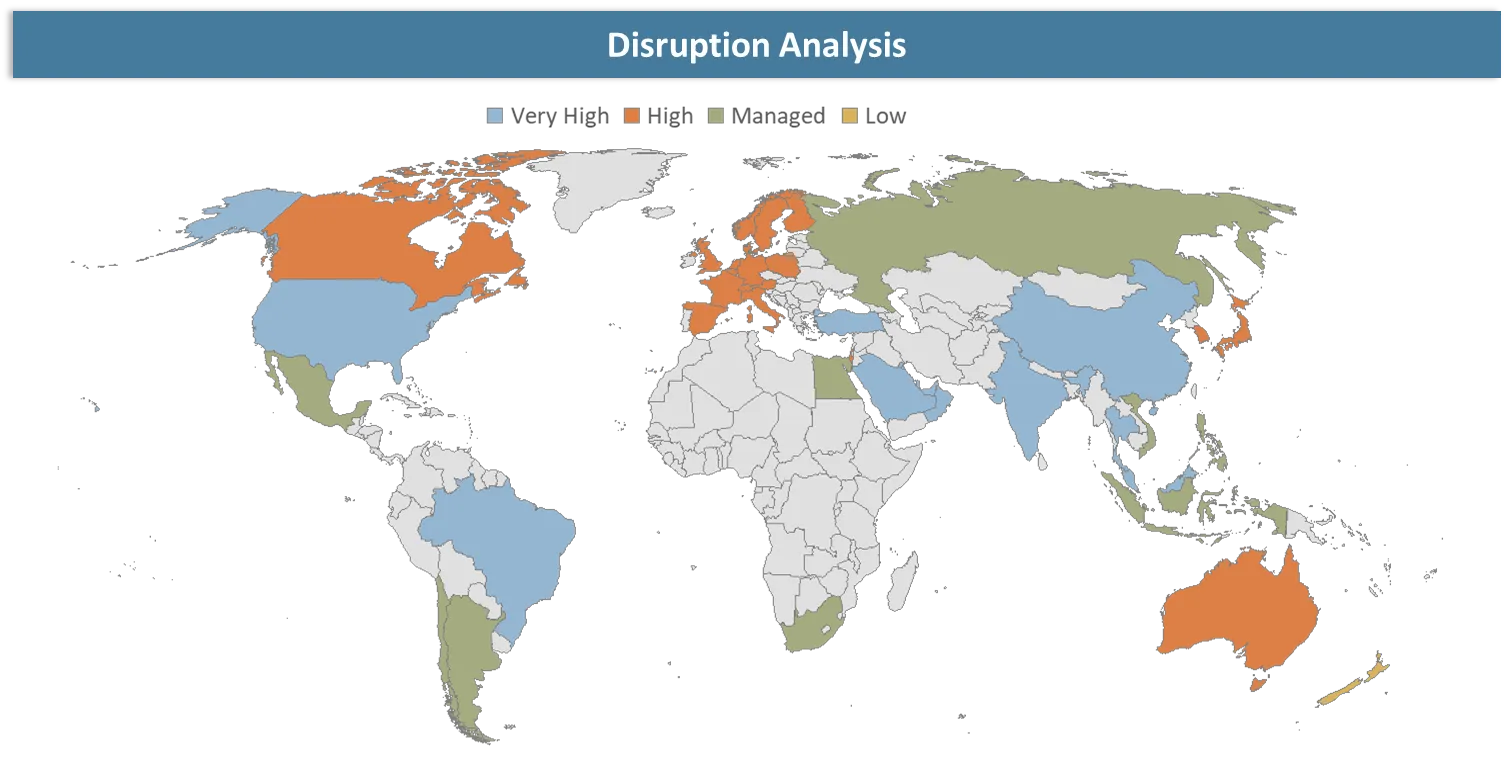
AI-Driven Power-Density Escalation and Grid Constraints Reshaping Data Center Grid Connection Services
Disruption in the data center grid connection services market is largely due to the fast-rising demands for grid capacity of AI data centers, which cannot be met due to the inefficiency of the conventional process of grid connection. The conventional system, which entails grid connection before facility energization, is becoming less and less viable due to rising waiting times for connection, transmission limitations, and the requirement for extensive network upgrades. According to the UK government in 2026, the transmission demand connection wait list increased by 460% in six months, necessitating reform in strategic projects like AI data centers. Consequently, instead of relying exclusively on traditional utility connections, developers of data centers are now developing new ways of power access through onsite generation, battery storage, hybrid systems, phased energization, and flexible grid interconnection. Guidance for the industry in 2026 pointed out that onsite generation was one of the solutions to grid constraint problems, and new “connect-and-manage” models were allowing huge AI data centers to interconnect under certain operating conditions.
This disruption is changing the nature of the services required by creating demand for speed-to-power services incorporating studies of the technical feasibility of the grid, coordination with the utilities, substation design, generation integration, energy storage, protection, power quality, and phased energization of the grid. This implies that competition will be based on securing, optimizing, and accelerating access to power rather than just the traditional grid connection.
Data Center Grid Connection Services Market BCG Matrix: Company Evaluation
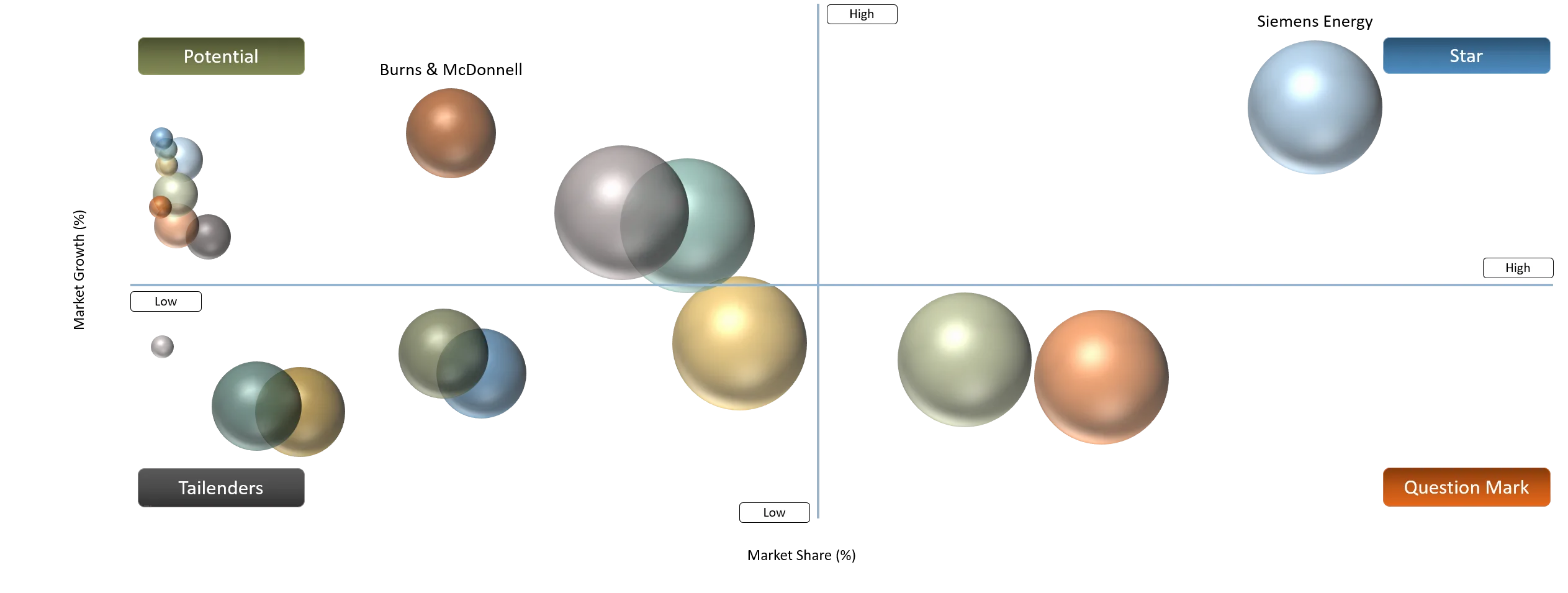
Stars include Siemens Energy, GE Vernova, and Hitachi Energy, as these companies have strong positions across high-voltage grid connections, substations, transmission infrastructure, grid integration, and data-center electrification. Their ability to deliver integrated solutions spanning grid assessment, interconnection, substations, protection and control, and commissioning gives them strong positioning as hyperscale and AI data centers require increasingly complex power connections. Schneider Electric and Eaton are positioned in the Question Mark category because they have substantial data-center power infrastructure portfolios and are expanding their grid-interconnection and power-management capabilities, but their positioning in the narrowly defined grid-connection services market remains less specialized than the leading grid-infrastructure providers.
The Potential category includes Burns & McDonnell, Jacobs, and Black & Veatch, which benefit from established capabilities in utility engineering, grid-interconnection studies, transmission and distribution planning, substation engineering, and large-load infrastructure. AECOM, WSP, HDR, and Quanta Services belong to the Tailenders category because their capabilities across infrastructure consulting, engineering, transmission/distribution construction, and utility services are substantial, but their exposure to the specific data center grid connection services value chain is comparatively less concentrated than the leading companies.
Data Center Grid Connection Services Market Dynamics
Driver Impact Analysis
| Driver | Market Growth Impact (%) | Demand Concentration | Impacted Use Case | Strategic Impact |
Rapid expansion of AI and hyperscale data centers is increasing requirements for high-capacity grid interconnections, dedicated substations, and network reinforcement services. | 28% | High — concentrated in North America, Europe, and Asia Pacific, particularly around hyperscale and AI data-center clusters | High-capacity grid interconnection, dedicated substations, transmission upgrades | Drives service providers toward end-to-end grid connection solutions covering interconnection studies, substation engineering, utility coordination, and commissioning. |
Escalating electricity loads from high-density computing are driving more complex grid-impact studies, capacity assessments, and transmission-level connection requirements. | 24% | High — concentrated among AI/HPC campuses and large hyperscale facilities requiring transmission-level power | Load-flow studies, capacity assessment, transmission interconnection, power-system analysis | Increases demand for advanced grid modelling and transmission engineering, shifting service value toward technically complex large-load connection projects. |
Limited available grid capacity is increasing demand for specialized interconnection planning, grid-upgrade engineering, and capacity optimization services. | 22% | Very High — concentrated in power-constrained data-center hubs with limited transmission and distribution headroom | Grid-capacity assessment, network reinforcement, connection-point optimization | Encourages developers to engage grid specialists earlier during site selection and increases the value of capacity optimization and grid-upgrade planning. |
Growing interconnection bottlenecks and connection queues are increasing demand for utility coordination, interconnection management, and accelerated grid-connection solutions. | 20% | High — particularly concentrated in mature data-center markets experiencing long utility connection timelines | Interconnection applications, utility negotiations, permitting, phased energization | Creates opportunities for providers offering accelerated interconnection management, utility coordination, and phased connection strategies rather than conventional engineering alone. |
Rising grid congestion and power-system reliability requirements are increasing demand for protection coordination, stability analysis, power-quality assessment, and grid-compliance engineering. | 16% | Moderate–High — concentrated around large-load clusters connected to constrained transmission networks | Protection coordination, harmonic analysis, stability studies, grid compliance, commissioning | Expands demand for specialized power-system engineering and compliance services, increasing the technical depth and recurring value of grid connection projects. |
Escalating electricity loads from high-density computing are driving more complex grid-impact studies, capacity assessments, and transmission-level connection requirements
The rapid deployment of AI-based and high-performance computing centers is leading to an increase in the magnitude of energy requirements of individual data center sites, thereby leading to the need for higher grid capacities and better interconnection engineering capabilities. In 2026, the capacity of data centers in India stands at around 1,500 MW, compared to approximately 375 MW in 2020, as reported by the Ministry of Electronics & Information Technology in India. The rapid growth of computing centers across Mumbai, Navi Mumbai, Hyderabad, Bengaluru, Noida, and Jamnagar is making it imperative to assess the grid capacities of the respective locations.
Rapid data center and AI growth are exacerbating problems of grid reliability and increasing the complexity of data-center interconnections. In March 2026, as per the IEEE Standards Association (IEEE SA), rapid data center and AI growth are creating infrastructural constraints and compromising electrical-grid reliability. IEEE mentioned USD 580 billion in forecasted global investments in data centers in 2025, which is even higher than that in global oil resources at USD 40 billion more. As far as its grid readiness activities are concerned, IEEE pointed towards the need for standards related to the interconnection processes in data centers, performance criteria, interconnection with co-located generation, and the modeling of data centers in power system studies.
Restraint Impact Analysis
| Restraint | Drag on Market Growth (%) | Primary Impact Area | Impacted Use Case | Strategic Impact |
Limited transmission and distribution capacity restricts the availability of suitable grid connection points for large data-center loads, constraining new connection projects. | 28% | Grid capacity availability | Large-load grid interconnection; dedicated substation connections | Encourages providers to develop capacity-optimization, alternative connection-point, and network-reinforcement solutions to overcome constrained grid access. |
Shortages of transformers, switchgear, and other high-voltage equipment can extend grid-connection project timelines and delay infrastructure commissioning. | 22% | High-voltage equipment availability | Substation construction; transmission and distribution upgrades; connection commissioning | Increases the importance of early equipment procurement, supply-chain planning, and alternative equipment sourcing within grid-connecti
on projects. |
Complex utility permitting and regulatory requirements increase the time and engineering effort required to secure large-load grid connections. | 18% | Permitting and regulatory approvals | Interconnection applications; utility coordination; connection approvals | Drives demand for specialized regulatory, permitting, and utility-interface expertise and encourages earlier engagement with network operators. |
Grid congestion in established data-center clusters limits connection availability and forces developers to consider alternative locations or additional network reinforcement. | 20% | Network congestion and site selection | Grid-capacity assessment; transmission reinforcement; site-power feasibility | Shifts data-center development toward power-available locations and increases demand for pre-development grid assessments and transmission-upgrade planning. |
Limited transmission and distribution capacity restricts the availability of suitable grid connection points for large data-center loads, constraining new connection projects
Limited transmission and distribution are increasingly restricting the availability of suitable points of connection for major data centers, especially in locations with already developed digital networks, where the current capacity of the network is about to be used up. In July 2026, Ofgem reported that applications for connection of data centers accounted for at least 80 GW of Britain’s demand for connection applications, indicating the extent of competition in terms of limited capacity of the network. The resultant pressure is leading the utilities and regulators to re-evaluate their priorities for connecting these projects and fast-track infrastructure development for them.
Expansion of the data center at a rapid pace increases the strain on the grid capacity, construction time, and availability of electricity in key markets. In January 2026, according to Latitude Media, the global data-center capacity is projected to reach 200 GW by 2030, which cites the source as JLL, almost double what was seen in the last five years, requiring around USD 3 trillion worth of investments in real estate and IT equipment. Lack of grid capacity has emerged as another big obstacle, with data center developers taking over four years to secure grid capacity in leading markets, while 57% of data center projects witnessed construction delays of three months in 2025. However, the article states that 97% of data centers have been occupied by the end of 2025, while 77% of data centers currently being constructed had commitments from tenants. To cope with the power shortage problem, hyperscalers are increasingly resorting to behind-the-meter generation and colocated battery storage capacity; meanwhile, battery storage costs globally are expected to drop below USD 90/MWh in 2026, and solar costs will reduce below USD 30/MWh by 2035.
Data Center Grid Connection Services Market Segment Analysis
The global Data Center Grid Connection Services market is segmented based on grid connection type, service type, data center type, voltage level, and region.
Hyperscale Data Centers Driving High-Capacity Grid Connection Service Demand
Hyperscale Data Centers segment dominates the data center grid connection services market because hyperscale facilities require substantially larger and more concentrated power connections than enterprise and edge facilities. Hyperscale Data Centers represented a 48% share of the total global market in 2025. The extent to which hyperscale data centers are being deployed can be seen from North America, where CBRE stated that 2,497.6 MW of data center capacity was taken up by users in 2025, while 5,994.4 MW was under development at the end of the year. Northern Virginia alone had 4,039.6 MW of capacity due to the addition of 1 GW of capacity in 2025, demonstrating the scale of infrastructure requiring high-capacity electrical connections.
The segment is also being strengthened by the accelerating investments in AI infrastructure by the hyperscaler companies. In 2026, JLL stated that five major hyperscaler companies made around USD 710 billion worth of capital expenditure plans for 2026, which would provide 35 gigawatts worth of data centers. At such an extensive level of capacity planning, the need for grid feasibility studies, interconnection at high voltage/extra-high voltage, substations, transmission augmentation, protection & controls engineering, and utilities coordination has increased. Therefore, hyperscale sites will continue to be the primary driver of demand for grid interconnection services as the operators try to procure enough power capacity for their AI and cloud campuses.
Data Center Grid Connection Services Market Geographical Penetration
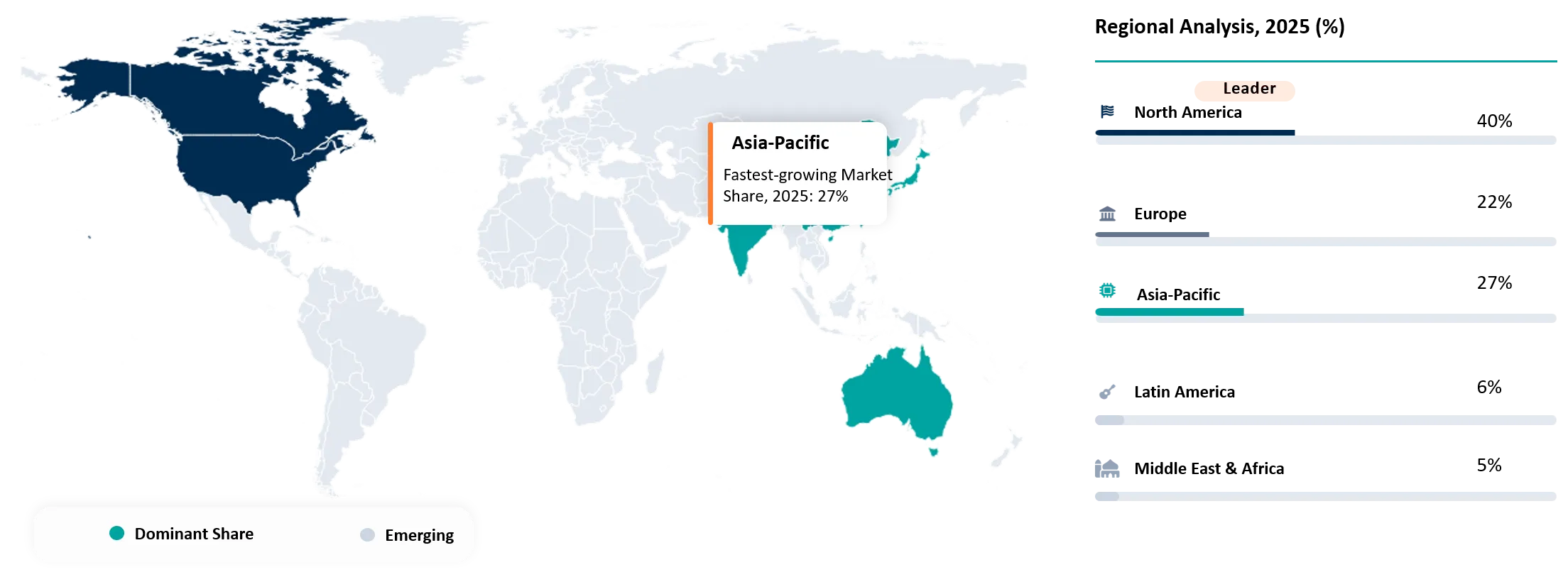
North America’s Grid-Connection Infrastructure Expansion and Hyperscale Capacity Driving Market Leadership
North America is a dominant region in the data center grid connection services market because of the presence of a high number of hyperscale, cloud, and artificial intelligence-based data centers and the growing need for large-scale electricity connections in this area. It was estimated that North America occupied 40% of the total global market share in 2025 due to the existence of developed infrastructure in terms of electricity transmission and distribution systems. In addition, there is increasing demand for power supply among big electricity consumers; for example, the U.S. EIA predicted that total consumption would reach 4,268 billion kWh in 2026, reinforcing the requirement for additional grid capacity and infrastructure to accommodate expanding data-center loads.
Rapid AI and data-center expansion is driving major utility-scale power capacity and grid infrastructure requirements across North America. In May 2026, NextEra Energy, Inc., a U.S.-based electric utility and energy infrastructure company, and Dominion Energy, Inc., a U.S.-based regulated electric utility, announced a proposed all-stock combination aimed at strengthening North America’s power infrastructure to meet rapidly growing AI and large-load electricity demand. The combined company is expected to have approximately 110 GW of generation capacity, a 130+ GW large-load pipeline, and a USD 138 billion regulated rate base, expected to grow at approximately 11% annually through 2032. The companies also expect approximately USD 59 billion in average annual capital expenditure from 2027–2032, supporting generation, transmission, and grid infrastructure required for large-load customers such as data centers.
U.S. Data Center Grid Connection Services Market Trends
The U.S. is leading in the data center grid connection services market because of the prevalence of AI and hyperscale innovation, and consequently, there is a need for extensive grid connection services in the region. As per SGX Links, in 2025, the U.S. data center market capacity is projected to be around 251.9 GW of total capacity, out of which only 13.6% of capacity is in operation, while 55.0% of capacity is in the development pipeline phase. This unusually large development pipeline indicates substantial future requirements for grid-capacity assessment, utility interconnection, substations, and transmission and distribution upgrades.
Growing demand for high-density computing is driving expansion of data-center capacity and interconnection infrastructure across the U.S. In April 2025, CoreSite, a U.S.-based interconnection data center platform and subsidiary of American Tower, acquired the Denver Gas and Electric Building and related operating businesses in Denver, Colorado, strengthening its position in the U.S. Rocky Mountain data-center market. The acquired facility serves as the primary point of interconnection in the Rocky Mountain region, and CoreSite plans to add approximately 3 critical megawatts (CMW) of data-center capacity, nearly doubling the existing DE1 space and power footprint. The transaction also adds approximately 100 customers and expands access to the Google Cloud Platform dedicated interconnect onramp and CoreSite’s Any2Denver peering exchange. In addition, CoreSite is developing its DE3 facility in Denver, planned to provide 97,000 square feet and 18 CMW, supporting high-performance and high-density computing requirements.
Canada Data Center Grid Connection Services Market Outlook
Canada is emerging as an important country in the data center grid connection services market, supported by its expanding AI ecosystem, abundant sources of emission-free electricity, and availability of electricity at relatively low cost. According to the 2026 report from the Government of Canada, the expected demand for electricity from data centers will increase from 3 TWh in 2025 to 11 TWh in 2030. Additionally, the government is working on building sovereign AI data centers on a large scale through its 2026 program.
Rapid AI and hyperscale data-center development is increasing demand for large-scale power capacity and grid infrastructure across Canada. In July 2025, CPP Investments (Canada; pension investment manager) committed C$225 million (approximately USD 160 million) in construction financing for a 54 MW hyperscale AI data center in Cambridge, Ontario, representing 50% of the total USD 322.81 million (C$450 million) construction loan, with Deutsche Bank Private Credit & Infrastructure, a Germany-based private-credit and infrastructure investment business, providing the remaining 50%. The project is being developed by Related Digital, a U.S.-based data-center development and investment platform, TowerBrook Capital Partners, a U.S.-based investment firm, and Ascent, a Canada-based data-center operator, and is fully pre-leased to a market-leading GPU-focused AI cloud-computing provider. Related Digital reported a near-term USD 45 billion, 5 GW development pipeline across the U.S. and Canada, while CPP Investments’ broader data-center portfolio spans North America, Europe, and Asia-Pacific.
Rapid Data-Center Expansion and Grid-Infrastructure Investment Strengthening Asia-Pacific Market Position
The Asia-Pacific region is a major growth center for the data center grid connection services market, supported by accelerating AI adoption, cloud infrastructure deployment, and large-scale data-center development across China, India, Japan, Australia, Malaysia, and Southeast Asia. Asia-Pacific accounted for an estimated 27% of the global market in 2025, reflecting the region's expanding requirement for high-capacity electricity connections, dedicated substations, transmission upgrades, and utility interconnection services. According to the International Energy Agency (IEA), China accounted for approximately 58% of the increase in global electricity demand in 2025, while electricity demand is forecast to grow at an average of 4.9% annually in China, 6.4% in India, and 5.3% in Southeast Asia during 2026–2030, creating a substantial infrastructure requirement for new large electricity loads.
Accelerating AI and cloud adoption is driving large-scale data-center capacity expansion across Asia-Pacific and other major digital infrastructure markets. In February 2026, KKR, a U.S.-based global investment firm, and Singtel, a Singapore-based communications technology and digital infrastructure company, agreed to acquire the remaining 82% stake in ST Telemedia Global Data Centres (STT GDC) from ST Telemedia, a Singapore-based investment company, for approximately USD 5.1 billion, implying an enterprise value of approximately USD 10.9 billion. Upon completion, KKR and Singtel will own 75% and 25%, respectively, of STT GDC. Headquartered in Singapore, STT GDC, a data-center colocation services provider, has approximately 2.3 GW of design capacity across 12 major markets in Asia-Pacific and the UK and Europe, with its development pipeline increasing from 1.4 GW in 2024 to more than 1.7 GW following the consortium’s earlier approximately USD 1.3 billion investment.
Japan Data Center Grid Connection Services Market Trends
Japan is one of the key players in the Asia-Pacific data center grid connection services market due to the already developed digital infrastructure, dependable power grid, and increased construction of data centers that utilize artificial intelligence. According to METI, in 2025, electricity demand in Japan will start growing due to the presence of new data centers and semiconductor plants related to the process of digital transformation. Additionally, the Japanese Strategic Energy Plan 2025 states that increasing the construction of electricity infrastructure becomes particularly relevant as the lack of such might limit investments in data centers and semiconductor plants.
Accelerating AI and cloud adoption is driving large-scale data-center capacity expansion across Japan and the broader Asia-Pacific region. In July 2025, Stonepeak, a U.S.-based alternative investment firm specializing in infrastructure and real assets, agreed to make a USD 1.3 billion preferred-equity investment in Princeton Digital Group (PDG), a Singapore-based data-center developer and operator, to accelerate greenfield development and M&A across Asia-Pacific. The investment followed PDG’s USD 1.2 billion debt financing, bringing its total capital raised in 2025 to USD 2.5 billion. PDG operates a portfolio exceeding 1.1 GW across six countries, including Japan, India, Indonesia, China, Malaysia, and Singapore, while Stonepeak manages approximately USD 73 billion in assets and focuses on infrastructure, digital infrastructure, energy and energy transition, and real estate.
Data Center Grid Connection Services Market Competitive Landscape
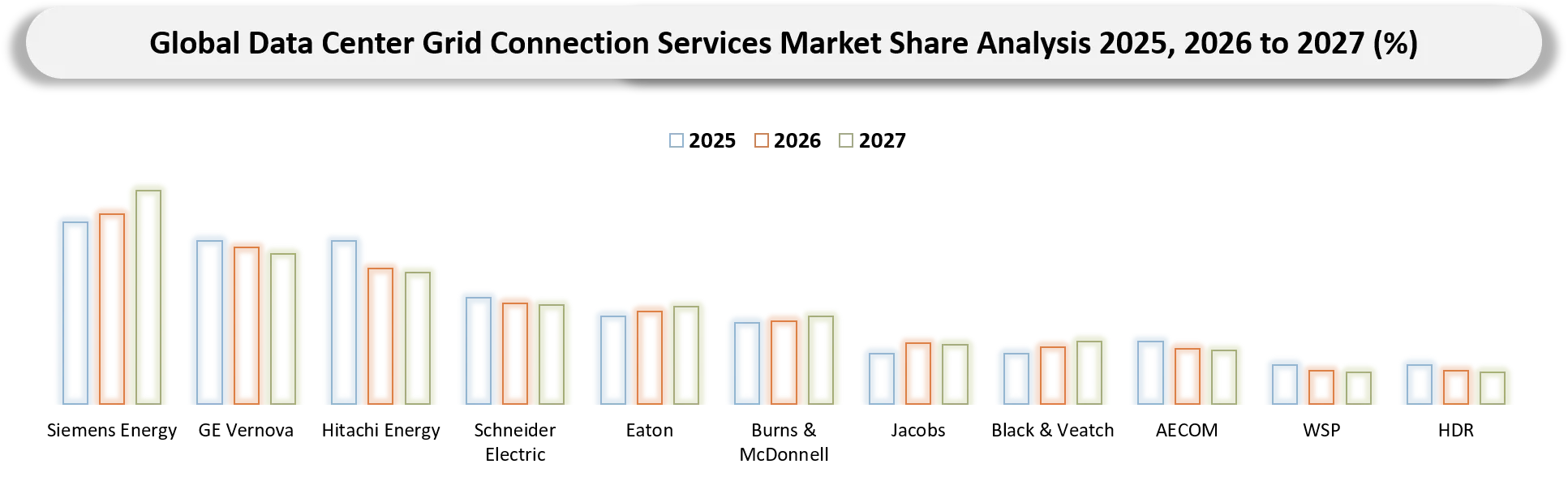
- The market can be described based on three major participants: grid technology and electric infrastructure vendors, engineering and consulting companies, and transmission and distribution infrastructure contractors. Siemens Energy, GE Vernova, Hitachi Energy, Schneider Electric, and Eaton offer grid systems, substations, transformers, switchgear, protection, and high-voltage infrastructure; Burns & McDonnell, Jacobs, Black & Veatch, AECOM, WSP, and HDR work on grid design and interconnection studies, engineering, and permitting; whereas Quanta Services offers transmission, distribution, and substation construction services. The robust backlogs of GE Vernova and Quanta Services in 2025 indicate the ongoing demand for power grid equipment, engineering, and construction solutions. Competition is defined by companies’ ability to offer comprehensive grid integration solutions incorporating feasibility studies, interconnection studies, grid connection design, utility coordination, substation design and construction, T&D upgrade, protection and control systems engineering, testing, and commissioning. The growing needs of big AI/hyperscale data centers are driving preference for companies that have wide grid infrastructure expertise, good utility connections, and can handle complicated HV grid connection projects.
- Key players include Siemens Energy, GE Vernova, Hitachi Energy, Schneider Electric, Eaton, Burns & McDonnell, Jacobs, Black & Veatch, AECOM, WSP, HDR, and Quanta Services.
Key Developments
- July 2026: National Grid Ventures, a U.K.-based energy infrastructure and investment business of National Grid plc, agreed to invest USD 1.75 billion for a 35% stake in Joulent LLC, a U.S.-based power infrastructure and energy solutions company, to accelerate power solutions for U.S. data centers and AI-driven large-load customers.
- March 2025: GE Vernova, a U.S.-based energy technology and infrastructure company, and Amazon Web Services (AWS), a U.S.-based cloud computing and digital infrastructure provider, expanded their collaboration to address rising global electricity demand from data centers and AI workloads.
- October 2025: Entero Therapeutics, Inc., a U.S.-based biotechnology company, launched Grid AI Corp., a U.S.-based grid-edge artificial intelligence and energy-management company, to develop technologies that help AI infrastructure connect more efficiently to the power grid.
- October 2025: Voltus, a U.S.-based virtual power plant operator and distributed energy resource platform, launched its Bring Your Own Capacity (BYOC) product to accelerate data-center grid interconnection by allowing developers to use existing grid flexibility and market-accredited capacity as an alternative pathway to power.
- September 2025: Cologix, a Canada-based data-center and network interconnection services provider, acquired full ownership of TOR4, a hyperscale data center in Markham, Ontario, from CIM Group, a U.S.-based real estate and infrastructure investment firm, while simultaneously acquiring TOR5, CIM Group’s 105 Clegg Road data center.
- March 2026: the U.S. Department of Energy (DOE), a U.S.-based federal government energy agency, announced up to USD 35 million in funding through ARPA-E, a U.S.-based government energy-technology research agency, for 12 projects under the DC-GRIDS program, targeting technologies capable of tripling U.S. transmission capacity while improving grid reliability.
Key Procurement Priorities and Buyer Evaluation Criteria
- Organizations procuring Data Center Grid Connection Services increasingly prioritize providers with proven capabilities in high-capacity interconnections, dedicated substations, transmission and distribution upgrades, and reliable energization of hyperscale and AI data-center facilities.
- The procurement decision is increasingly influenced by grid-capacity constraints, accelerated AI data-center deployment, utility interconnection queues, high-density electrical loads, and requirements for faster power availability, making early-stage grid feasibility and connection planning critical to supplier selection.
- Buyers evaluate providers based on grid-study accuracy, interconnection engineering capability, utility coordination, permitting expertise, high-voltage infrastructure experience, protection and control capabilities, and ability to manage network-reinforcement requirements when selecting a grid connection partner.
Why Choose DataM?
- Technological & Grid Infrastructure Advancements: Explores developments in high-capacity grid interconnections, dedicated substations, transmission upgrades, advanced protection systems, flexible grid connections, and power-management architectures supporting AI, hyperscale, and high-density data-center facilities.
- Service Performance & Market Positioning: Evaluates how providers differentiate through grid-capacity assessment, interconnection engineering, utility coordination, transmission planning, substation design, commissioning, and grid-compliance capabilities, highlighting their ability to deliver reliable and scalable connections for large electricity loads.
- Real-World Project Evidence: Assesses data-center grid connection projects across North America, Europe, and Asia-Pacific, examining how utilities, engineering firms, and infrastructure providers address constrained grid capacity, large-load interconnections, network reinforcement, and accelerated energization requirements.
- Market Updates & Industry Changes: Tracks developments in data-center power demand, grid interconnection reforms, transmission investment, utility connection queues, substation expansion, and large-load connection frameworks, identifying how changes in electricity infrastructure are reshaping data-center development strategies.
- Competitive Strategies: Analyzes how leading providers strengthen their market positions through end-to-end grid engineering, strategic utility partnerships, transmission and distribution capabilities, equipment integration, acquisitions, and expansion of high-voltage infrastructure services for hyperscale and AI data centers.
- Procurement & Market Access: Evaluates buyer priorities including connection capacity, project execution timelines, utility coordination, regulatory compliance, equipment availability, engineering expertise, reliability, and commissioning capability, while assessing how service providers access large data-center projects through utilities, developers, hyperscalers, and engineering-procurement-construction relationships.
- Market Entry & Expansion: Identifies opportunities created by AI-driven power-density increases, hyperscale campus expansion, constrained grid capacity, transmission modernization, and emerging data-center locations, while outlining strategies such as early grid feasibility assessment, alternative connection planning, regional utility partnerships, and integrated transmission-substation solutions.
Target Audience
- Data Center Developers & Owners
- Hyperscale & AI Infrastructure Operators
- Electric Utilities & Grid Operators
- Engineering, Procurement & Construction (EPC) Firms
- Grid Engineering & Consulting Firms
- Electrical Equipment & Grid Infrastructure Manufacturers
- Data Center Investment & Infrastructure Funds


























































