


Data Center Chip Market Overview
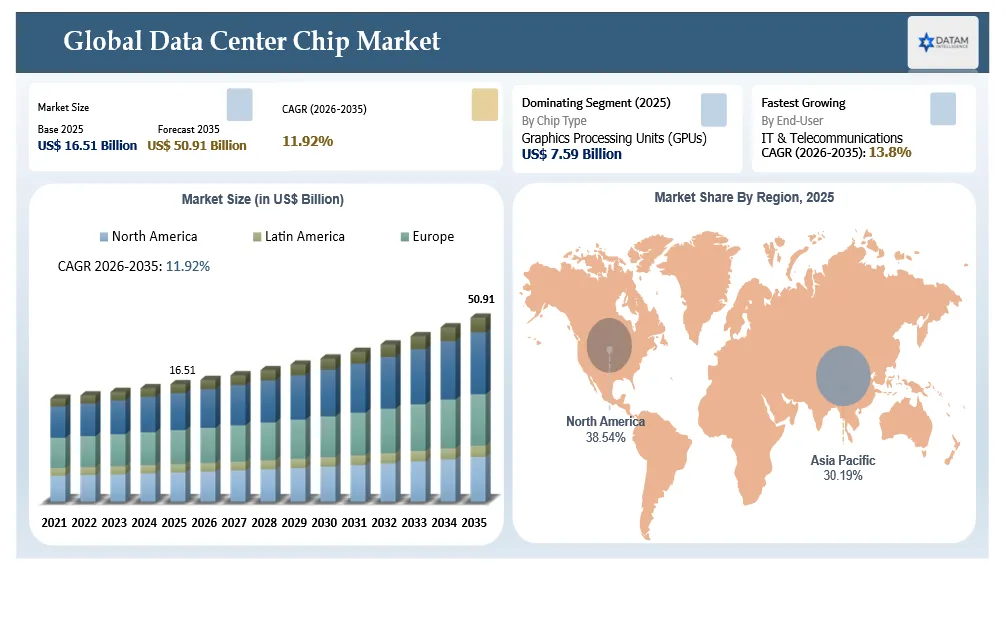
The global data center chip market reached US$ 16.51 billion in 2025 and is expected to reach US$ 50.91 billion by 2035, growing with a CAGR of 11.92% during the forecast period 2026-2035.
The market is seeing a great deal of growth due to the widespread adoption of AI infrastructure and next-generation hyperscale data centers across the globe. Some of the major cloud providers have launched several gigawatt-scale AI data center projects in North America, Europe, and the Asia-Pacific regions, which will boost the need for innovative semiconductors in the coming years. An AI server generally contains 4-8 high-speed GPUs or AI accelerators, whereas a rack-scale AI server can comprise 72 AI accelerators, which means a higher semiconductor usage than the regular server architecture. Moreover, the shipment of AI servers in the global market is expected to register a strong double-digit growth rate during the forecast period.
Market is experiencing significant growth due to massive adoption of AI infrastructure and the latest generation of hyperscale data centers across the globe. The key players in cloud services have unveiled numerous AI data center facilities of gigawatts scale in North America, Europe, and Asia Pacific regions, leading to a substantial rise in the demand for cutting-edge semiconductors. Usually, AI servers comprise 4-8 GPUs/AI accelerators, whereas rack-scale AI servers use up to 72 AI accelerators, making their semiconductor content much more than that of traditional server models. In addition, the shipment of AI servers is expected to show double-digit growth in the coming years.
Data Center Chip Market Key Takeaways
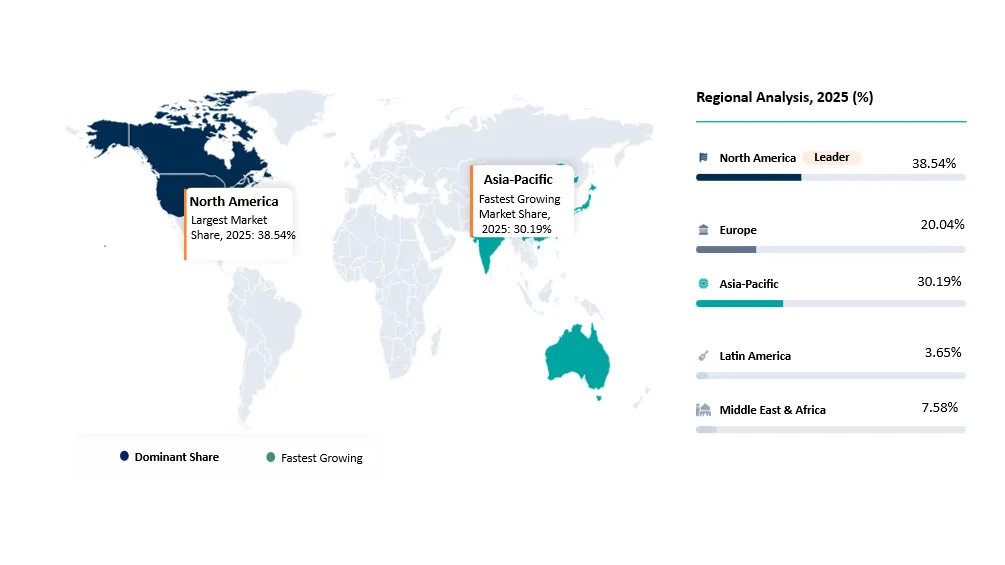
- North America has been contributing 38.54% towards the total global market during the year 2025 due to the significant investments by hyperscale cloud vendors along with the presence of semiconductor giants that are creating next-generation chips using artificial intelligence and data centers.
- Graphics Processing Unit (GPU) has captured a market share of 46.0% in 2025, and GPU is the dominant chip due to its extensive usage for generative AI, large language models (LLM) training, and high-performance computing in hyperscale data centers.
- IT & Telecommunication segment is expected to grow at a CAGR of 13.8% during 2026-2035 due to the growing infrastructure of 5G technology and AI network virtualization.
- There has been a swift move towards adopting heterogeneous computing models that combine CPUS, GPUs, AI accelerators, DPUS, networking silicon, and HBM to improve performance and scalability for AI-based applications.
- Sub-3 nm processes, chiplet design, and innovative packaging such as CoWoS and 2.5D/3D integration are some key factors driving developments and improving the competitiveness of the Data Center Chips market.
Data Center Chip Industry Trends and Strategic Insights
- AI-first infrastructure is transforming the landscape of products by semiconductor companies focusing on GPUs, AI accelerators, DPUs and custom ASICs, rather than server-first CPUs to handle generative AI and LLM workloads.
- The hyperscale cloud players are building their own silicon to help firms like AWS, Google, Microsoft, Meta and ByteDance deliver high AI performance at lower costs without being highly dependent on merchant semiconductor firms.
- New generations of packaging and memory solutions have become major competitive advantages since chiplets, CoWoS, 2.5D and 3D integration, as well as HBM have led to more powerful processors, increased speed of data exchange and better energy efficiency.
- There is a shift toward heterogenous architecture that combines CPUs, GPUs, AI accelerators, DPUs, networking silicon and CXL memory in one platform with the aim of delivering maximum performance in AI, cloud computing and HPC.
- Regional production of semiconductors and diversification of supply chains have become strategic tasks due to investments in state-of-the-art production and infrastructure in order to ensure technology sovereignty and meet rapidly rising demand for data center chips.
Data Center Chip Market Scope
| Metrics | Details | |
| 2025 Market Size | US$ 16.51 Billion | |
| 2035 Projected Market Size | US$ 50.91 Billion | |
| CAGR (2026-2035) | 11.92% | |
| Largest Market | North America | |
| Fastest Growing Market | Asia-Pacific | |
| By Chip Type | Central Processing Units (CPUs), Graphics Processing Units (GPUs), AI Accelerators, Application-Specific Integrated Circuits (ASICs), Field-Programmable Gate Arrays (FPGAs), Data Processing Units (DPUs) / Infrastructure Processing Units (IPUs), Networking & Interconnect Chips, Storage Controller Chips, Security Chips / Trusted Platform Modules (TPMs), Power Management ICs (PMICs) and Others | |
| By Process Node | 1 nm, 2 nm, 3 nm, 4 nm, 5 nm, 6 nm, 7 nm, 10 nm, 14 nm and 16 nm & Above | |
| By Deployment Type | On-Premises Data Centers, Cloud Data Centers, Hybrid Data Centers and Edge Data Centers | |
| By Data Center Type | Hyperscale Data Centers, Enterprise Data Centers, Colocation Data Centers, Edge Data Centers, Modular Data Centers and Others | |
| By Connectivity Type | Within Rack and Between Racks | |
| By Data Center Tier | Tier I, Tier II, Tier III and Tier IV | |
| By Data Center Cooling Type | Air Cooling, Liquid Cooling, Hybrid Cooling and Others | |
| By Application | Artificial Intelligence (AI) & Machine Learning, High-Performance Computing (HPC), Cloud Computing, Big Data Analytics, Database Processing, Networking & Security, Storage & Backup, Content Delivery, Scientific Computing and Others | |
| By End-User | Cloud Service Providers, IT & Telecommunications, BFSI, Government & Defense, Healthcare & Life Sciences, Manufacturing, Retail & E-commerce, Media & Entertainment, Education & Research, Energy & Utilities and Others | |
| By Memory Type | DRAM, High Bandwidth Memory (HBM), NAND Flash, SRAM, Emerging Memory (MRAM, ReRAM, PCM) and Others | |
| By Region | North America | U.S., Canada, Mexico |
| Europe | Germany, UK, France, Spain, Italy, Poland | |
| Asia-Pacific | China, India, Japan, Australia, South Korea, Indonesia, Malaysia, Singapore, Vietnam, Thailand, Philippines, Taiwan | |
| South America | Brazil, Argentina | |
| Middle East and Africa | UAE, Saudi Arabia, South Africa, Israel, Turkiye | |
| Report Insights Covered | Competitive Landscape Analysis, Company Profile Analysis, Market Size, Share, Growth | |
Why does this report matter in 2026?
The Data Center Chip Market will be at an important juncture in 2026, as investments in generative AI, hyperscale cloud architecture and AI factories keep growing globally. Companies, cloud computing service providers and government organizations are making substantial investments in GPUs, AI processors, innovative server CPUs and high bandwidth memory (HBM), which can cater to the next generation of AI applications. On the other hand, developments in semiconductor node technology, innovative packaging techniques and custom silicon are impacting the competitive dynamics of the market.
The report offers relevant information about the latest technology trends, competitive positioning, investment options, supply chain dynamics and consumer demand in the data center chips market. With semiconductor companies and hyperscale cloud companies competing to provide superior performance, power efficiency and AI computing platforms, the report enables decision-makers with valuable knowledge that would help them in making the right decisions related to investment, product development and business growth in one of the most dynamic semiconductor markets in the world.
Data Center Chip Market White Space & Investment Opportunities
- Custom AI silicon for the enterprise and sovereign AI platform represent a massive investment opportunity as more enterprises and governments begin to look for chips that can be customized for their private AI workloads.
- Advanced packaging such as chiplets, CoWoS, 2.5D/3D and silicon photonics still represent a low-penetrated field with substantial investment opportunities due to growing demands for denser computational performance and higher memory bandwidths.
- High Bandwidth Memory (HBM), memory expansion through CXL and future interconnects represent promising areas for investments since AI servers need better speed and increased memory bandwidth.
- Low-latency inference chips, telecommunications chips, industrial automation chips and self-driving car chips for edge AI data centers constitute a rising white space in terms of expanding edge computing architecture throughout the world.
- Processors that are energy efficient and chip designs that are optimized for liquid cooling are becoming important investment opportunities, fueled by the higher energy requirements of AI applications and the need to enhance performance per wattage in hyperscale data centers.
Data Center Chip Future Market Transformation
In the coming decade, the market for Data Center Chip is going to see a remarkable shift owing to the evolution of artificial intelligence, heterogeneity in computing solutions and advanced semiconductor technology trends. The upcoming data centers would need more of integrated computing solutions that would include CPUs, GPUs, AI accelerators, DPUs, HBM and high-speed connectivity, thereby effectively handling all aspects of AI training and inference, cloud-native workloads and high performance computing. With advancements in chiplet-based architecture, advanced packaging solutions such as 2.5D/3D integration, silicon photonic technology and sub-2nm process technology, there would be improvements in terms of compute density, memory bandwidth and power efficiency.
There will also be a change in the competitive environment, where the hyperscale cloud companies will start using proprietary AI processors together with merchant silicon to drive a diversified semiconductor market. In addition to this, there will be faster development of sustainable solutions based on efficient chip architecture, liquid-cooled processors and workload accelerators. The regional semiconductor production efforts, resilient supply chain strategies and investments into AI infrastructure will further transform the industry, with the data center chips serving as a backbone for future intelligent cloud and AI infrastructure.
Data Center Chip Market Buyer Decision-Making Criteria
Chips used in the data centers are selected mainly based on their efficiency, scalability and TCO. Hyperscale cloud vendors, enterprises and colocation firms look for those chips which can provide very high throughput for AI training, inference, cloud computing and HPC while providing very high efficiency in terms of performance per watt. The chip's compatibility with existing server hardware architecture, software ecosystem such as CUDA and open AI frameworks, network infrastructure and memory like High Bandwidth Memory (HBM) becomes quite important as well.
Major Buyer Decision-Making Criteria
- AI Computing Performance (Training and Inference Capabilities)
- Performance per Watt and Energy Efficiency
- Scalability Across Hyperscale and Enterprise Data Centers
- Total Cost of Ownership (TCO) and Return on Investment (ROI)
- Compatibility with CPUs, GPUs, DPUs, and Existing Server Architectures
- Support for High-Bandwidth Memory (HBM) and Advanced Interconnect Technologies
- Software Ecosystem and Developer Support (CUDA, Open Standards, AI Frameworks)
- Supply Chain Reliability and Product Availability
- Security Features and Data Center Workload Optimization
- Vendor Roadmap, Technical Support, and Long-Term Upgradeability
Beyond performance, procurement decisions take into account the reliability of the supply chain, availability of products, long-term roadmaps and support for an ecosystem. Some of these factors include the sophistication of packaging, security measures, interoperability with CPUs, GPUs, DPUs and networking silicon and support for future AI loads from the vendor. With the growing spend on AI infrastructure, customers prefer semiconductor companies offering platforms of hardware and software, consistency in product availability and a long-term roadmap.
Data Center Chip Market Economic & Investment Analysis
Data Center Chips market sees considerable investments being made as the global demand for artificial intelligence (AI), cloud computing and high-performance computing (HPC) keeps rising. Cloud companies that are hyperscale in nature, chip makers and even governments are making significant investments in AI infrastructure, semiconductor manufacturing technology that is more advanced and new packaging technology. Public policies such as the CHIPS and Science Act of the United States and those in Europe and Asia Pacific regions are promoting domestic production, reducing dependence on outside supply chains and driving future growth in the industry.
The investment environment has been moving in favor of AI accelerators, HBM, advanced process nodes, chiplets and high-speed interconnects to achieve improved compute and energy efficiency. In addition, hyperscalers have made large investments for developing custom AI processors that can help improve cloud infrastructure and lower operational costs. Despite the high levels of capital expenses and continued supply challenges in advanced packaging and memory, the sector continues to provide great investment opportunities because of continuous AI adoption and technological innovation.
Data Center Chip Investment Trends in the Market
- The hyperscaler clouds are pouring more capital into AI infrastructure by making investments in GPUs, AI accelerators, DPUs and custom silicon to enable large-scale AI training and inference operations.
- Semiconductor manufacturing and packaging investments that involve sub-3 nanometer process nodes, chiplets, CoWoS and 2.5/3D integration are becoming increasingly common to keep pace with the growing requirement for performance-oriented data center semiconductor chips.
- The memory makers are ramping up their HBM production capabilities owing to the critical role that HBM plays in next-generation AI server and GPU processing.
- The governments in North America, Europe and the Asia-Pacific region have been making significant investments in their respective domestic semiconductor value chains through fabrications, packaging facilities and R&D programs.
- The cooperation and investment of semiconductor firms, hyperscalers, foundries and networking suppliers in the design of custom AI processors, fast interconnects and computing platforms are growing.
Strategic Indicators For Data Center Chip Market
High Regulation Impact
The data center chip market is greatly impacted by changes in semiconductor trade laws, export regulations and state technology safety laws. Export bans on advanced AI chips and semiconductor fabrication devices mainly in the top economies of the world are prompting changes in global value chains as well as raising investments into local semiconductor manufacturing. The U.S. CHIPS and Science Act, the EU Chips Act and the semiconductor support programs being developed in Japan, South Korea and China all provide support for local fabrication, advanced packaging and research developments. Moreover, new regulations in the areas of data sovereignty, cyber security, energy efficiency and environmental sustainability change the schemes and technologies of chip design, production and application. As AI infrastructure becomes a national asset, the regulatory environment will still matter for accessing the market, technologies and investments as well as maintaining competitiveness.
High Investment Activity
Investment activities are at very high levels in the Data Center Chip Market due to the rapid increase in investment by hyperscalers and semiconductor manufacturers along with governments on AI hardware and future semiconductor technology. Investments are being made in cutting-edge semiconductor fabrication facilities, High-Bandwidth Memory (HBM), chiplets, advanced packaging technology like CoWoS and 2.5D/3D stacking technology and AI-specific silicon chip development. Collaborations among chip manufacturers, foundry partners, cloud services providers and networking solutions are propelling innovations as well as increasing capacity in order to fulfill rising demands for AI and cloud services.
Supply Chain Disruption
The industry is experiencing continued issues related to disruption within the supply chain due to constrained capacity of advanced packaging, limited availability of High Bandwidth Memory (HBM), geopolitics and export controls on advanced semiconductors. The industry’s reliance on a few state-of-the-art foundries and advanced packaging suppliers has resulted in bottlenecks in the manufacture of AI chips due to long lead times and higher costs of procurement. In response, chip makers and governments have been seeking to diversify their sources and develop more resilient supply chains.
Pricing Volatility
The Data Center Chip market has shown high price volatility owing to growing demand for AI infrastructure, shortage of High Bandwidth Memory (HBM) and a shortage in advanced packaging. The prices for high-end AI processors have stayed high, with expensive AI processors used in data centers usually priced between 20% and 40% more than normal prices when there is a shortage. Advanced packaging costs have gone up by 15% to 25%, while HBM pricing has been on the rise by 20% to 35% due to strong demand for AI infrastructure from AI servers. While continuous development in fabrication and advanced packaging should help with supply in the long run, pricing will stay volatile in the short term due to increasing demand for AI infrastructure.
Procurement Pressure
The data center chip market is undergoing tremendous procurement pressure as the demand for AI accelerators, high-performance GPUs, HBM (High Bandwidth Memory) and networking chips is outstripping the current market availability. There have been cases where hyperscale cloud firms and enterprises have placed long-term procurement contracts and have been ordering ahead of schedule in order to lock in manufacturing capacity, leading to lengthy delivery lead times that may take from 6 to 12 months for certain top-end AI chips. There is an increasing trend towards buyers valuing supplier stability and multi-sourcing.
New Technology Adoption
Next-generation semiconductor technologies have been embraced at a quick pace by the market in order to keep up with increasing performance demands posed by AI and cloud computing applications. Top industry players have been quick to embrace sub-3 nm process technology, chiplet design, CoWoS and 2.5D/3D package, High-Bandwidth Memory (HBM3E and beyond HBM), expanding memory with CXL, silicon photonic technology, PCIe Gen 6 and 800G/1.6T networking technology. On the other hand, heterogeneous computing systems with CPUs, GPUs, DPUs, AI accelerators and custom ASICs have become the go-to platform choice for hyperscale data centers due to increased computational density, efficiency and scalability.
Regional Expansion Opportunity
The Data Center Chips market offers huge growth potential from a regional perspective as there are increased investments from government and private organizations in the field of artificial intelligence infrastructure, cloud computing and semiconductor manufacturing. The North American region is leading when it comes to hyperscale AI, while the Asia Pacific region is witnessing the highest growth rate owing to increased investments in cloud computing data centers and semiconductors in countries such as China, Japan, South Korea, Taiwan and India. The European region is also improving their semiconductor environment by investing in manufacturing and artificial intelligence.
Government Policy Support
The policies of governments have become an important factor in promoting the fast expansion of the Data Center Chip Market through monetary support, semiconductor manufacturing efforts and AI infrastructure development. Policies like the CHIPS and Science Act of the United States, European Chips Act and various incentive policies for semiconductors manufacturing in Japan, South Korea, China and India are helping to manufacture chips locally, package them, conduct research and develop the skilled workforce needed for these purposes. Moreover, the AI policies, data center expansion policies and HPC investments of the government are promoting the increased adoption of advanced data center chips.
Pricing Intelligence
The pricing dynamics in the market for Data Center Chips is increasingly influenced not only by the cost of chip manufacture but also by AI compute performance, memory design, advanced packaging and the value of software ecosystems. Advanced AI accelerators that use High-Bandwidth Memory (HBM) and sophisticated interconnect technologies tend to be priced up to 2x–5x times above standard data center GPUs or servers processors thanks to their enhanced AI training and inference capabilities. Moreover, supply contracts for these high-end AI chips with major cloud players make up between 60% to 70% of shipments, creating stable pricing, whereas spot-market prices fluctuate owing to limited availability. The increase in manufacturing capacity for advanced processes and HBM should gradually stabilize the market, yet the prices for premium AI chips will stay elevated on account of ongoing demand and technological innovations.
| HS Code | Reporter | Trade Flow | 2025 Trade Value | Interpretation |
| 8542 | Chinese Taipei (Taiwan) | Exports | US$ 164.7 Billion | Taiwan remained the leading exporter of advanced integrated circuits used in AI servers and data center processors. |
| 8542 | Republic of Korea | Exports | US$ 119.8 Billion | South Korea maintained strong exports of memory chips and digital integrated circuits for AI and data center applications. |
| 8542 | China | Imports | US$ 386.5 Billion | China continued to be the world's largest importer of integrated circuits, reflecting robust demand from electronics manufacturing and data center infrastructure. |
| 8542 | United States | Imports | US$ 41.3 Billion | The U.S. imported advanced processors, GPUs, AI accelerators and other integrated circuits to support expanding cloud and AI data centers. |
AI Impact Analysis of Data Center Chip Market
The Artificial Intelligence has been identified to be the biggest driver of the Data Center Chip Market because of demand for computing infrastructure has transformed due to the use of AI. The increased usage of generative AI, LLMs, AI Inference and HPC applications has seen the increase in the adoption of GPUs, AI Accelerators, DPUs, advanced Server CPUs and HBM. As companies have continued to scale their AI applications, they have seen the need to adopt heterogeneous computing infrastructure which can perform better in terms of performance and energy consumption.
AI is also having an impact on competition through the creation of innovative technologies related to the development of advanced semiconductor process nodes, chiplet design technology, CoWoS, 2.5D and 3D packaging and high-performance interconnects. Apart from existing semiconductor companies, hyperscale players including AWS, Google, Microsoft, Meta and ByteDance are now actively designing their own AI processors in order to improve the efficiency of cloud infrastructure and cut down dependency on merchant silicon suppliers.
Disruption Analysis of Data Center Chip Market
There are notable changes happening in the data center chip market because the industry has moved from the traditional CPU-based server architecture to heterogeneous computing that is optimized for AI and HPC. With the increase in usage of generative AI, there has been a rising need for GPU, AI accelerators, DPU and even ASICs. This has compelled semiconductor companies to innovate the architecture of their chips based on compute density, memory bandwidth and power efficiency. Meanwhile, innovations like the use of chiplet architecture, advanced packaging (CoWoS and 2.5D/3D) and HBM have changed the performance metrics of the new data center infrastructure.
A further significant disruption is the growing use of proprietary silicon by hyperscale cloud players such as AWS, Google, Microsoft, Meta and ByteDance. These firms are designing AI chips for their respective cloud ecosystems, making themselves less reliant on merchant semiconductor companies and increasing competitive pressures. On the other hand, geopolitical pressures, export restrictions and supply chain disruptions are leading to regional semiconductor investments and manufacturing diversifications. The changes in technology, competition and geopolitics are essentially transforming product development, supply chains and competitive dynamics within the Data Center Chip Market.
Data Center Chip Market BCG Matrix: Company Evaluation
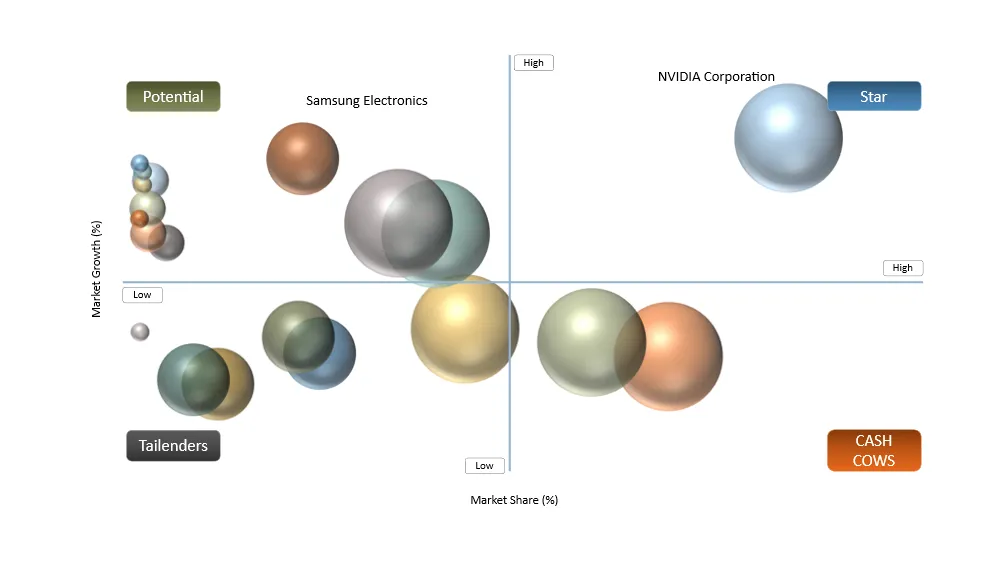
STAR
The NVIDIA Corporation continues to be the foremost Star in the Data Center Chip Market owing to its domination of AI GPUs, CUDA software ecosystem, and AI infrastructure portfolio, which includes Blackwell GPUs, NVLink, and DGX platforms. The AMD Corporation is bolstering its competitive position through the growing portfolio of its Instinct AI accelerators, while the Intel Corporation continues to be in a dominant position owing to its Xeon server processors and growing AI accelerators. Broadcom and Marvell Technology support the Star segment by being at the forefront of custom AI silicon, networking chips, fast interconnects, and cloud infrastructure solutions.
POTENTIAL
Samsung Electronics, SK hynix, and Micron Technology have good prospects for the future because of the increasing demand for High-Bandwidth Memory (HBM), which is employed by AI servers. Start-up firms that produce AI chips, namely Cerebras Systems, Groq, and Tenstorrent, are becoming popular due to the development of AI acceleration technology. On the other hand, hyperscalers like Amazon Web Services (AWS), Google, Microsoft, Meta Platforms, and ByteDance are making significant investments in AI processors, which will allow them to capture more market share in the future.
Data Center Chip Market Dynamics
Driver Impact Analysis
| Driver | Market Growth Impact (%) | Demand Concentration | Impacted Use Case | Strategic Impact |
Rising adoption of Generative AI and Large Language Models (LLMs) | 32% | Hyperscale Cloud Providers | AI Training & Inference | Accelerates demand for GPUs, AI accelerators and HBM-enabled processors |
Expansion of hyperscale cloud data centers | 27% | North America & Asia-Pacific | Cloud Computing | Increases deployment of high-performance CPUs, DPUs and networking chips |
Growing demand for High-Performance Computing (HPC) | 22% | Research Institutions & Enterprises | Scientific Computing & Simulations | Drives investment in advanced CPUs, GPUs and interconnect solutions |
Rising edge AI and enterprise digital transformation | 19% | Enterprise & Telecom | Edge Computing & Real-Time Analytics | Boosts adoption of energy-efficient AI chips and custom accelerators |
Driver: Surging Demand for Generative AI and Hyperscale AI Infrastructure Accelerates Data Center Chip Adoption
The fast uptake of generative AI, LLMs and enterprise software applications powered by artificial intelligence has emerged as the key growth factor for the Data Center Chip Market. Cloud hyperscalers and enterprises have been investing in AI infrastructure to handle compute-heavy workloads, which is fuelling the demand for powerful graphics processing units, AI accelerators, server CPUs, DPUs and high bandwidth memory. The growth of AI training clusters, inference systems and cloud-based AI solutions will fuel the demand for next-generation data center chips that offer improved computational capability, memory bandwidth and efficiency.
Restraint Impact Analysis
| Restraint | Drag on Market Growth (%) | Primary Impact Area | Impacted Use Case | Strategic Impact |
High semiconductor design and fabrication costs | 29% | Chip Manufacturing | Advanced AI Processors | Increases development costs and limits market entry for new vendors |
Advanced packaging and HBM supply constraints | 26% | Supply Chain | AI Servers | Restricts shipment volumes of high-performance AI chips |
Geopolitical tensions and export restrictions | 24% | Global Trade | AI & HPC Deployments | Disrupts cross-border semiconductor supply chains and technology access |
High power consumption and thermal management challenges | 21% | Data Center Infrastructure | AI Training Clusters | Raises operational costs and necessitates advanced cooling technologies |
Restraint: Limited Availability of High-Bandwidth Memory (HBM) and Advanced Packaging Capacity Constrains AI Chip Supply
Although there is high demand in the market, several major obstacles are expected due to the unavailability of HBM and semiconductor packaging technology, including CoWoS and 2.5D/3D packaging technologies. The growth of AI chips has resulted in shortages of memory and semiconductor packages, leading to delays in manufacturing new-age AI processors. These logistical barriers will raise the cost of manufacturing processes, slow down hyperscale data center deployments and limit the ability of semiconductor companies to cater to rising demands.
Data Center Chip Market Segmentation Analysis
The global data center chip market is segmented based on chip type, process node, deployment type, data center type, connectivity scope, data center tier, data center cooling type, application, end-user, memory type, and region.
By Chip Type
Graphics Processing Units (GPUs) Remain the Leading Chip Type
The segment of Graphics Processing Unit held the highest market share in the Data Center Chip market in 2025 and is predicted to hold its leadership position during the forecast period as well. The major drivers behind the domination of the GPUs are the fast adoption of generative AI, large language models (LLMs), HPC and AI services through the cloud platforms, which all need parallel computing. GPU accelerated servers are being used extensively by hyperscaler cloud service providers and businesses to train AI, infer information, simulate sciences and analyze data. Increasing usage of NVIDIA Blackwell GPU and other competitive AI GPUs of AMD have played a major role in the leadership of this segment. On the other hand, AI Accelerators are set to grow at a faster pace during the forecast period owing to growing demand for AI chips that are built for AI inference, recommendations, autonomous applications and edge AI applications.
By End-User
IT & Telecommunications Drives Future Market Expansion
The IT and Telecommunications verticals are expected to be the fastest-growing segment owing to the quick deployment of 5G technology, growth in edge data centers, rise in NFV implementations and investment in AI-based telecom technology. Telecom players and IT solution providers use high-end CPUs, GPUs, DPUs, AI accelerators and network processors for enabling low latency and cloud native networks. The growing need for edge AI, private 5G solutions and distributed clouds will further fuel the adoption of data center chips in the IT and telecommunications domain.
Data Center Chip Market Geographical Penetration
U.S. Data Center Chip Market Landscape
The dominance of the U.S. in the global data center chip market stems from the nation's prowess in AI innovations, cloud computing and chip designing. America has many chip providers like NVIDIA, Intel, AMD, Broadcom, Marvell, Micron, Cisco and Qualcomm, as well as hyperscaler cloud providers like Amazon Web Services (AWS), Microsoft Azure, Google Cloud and Meta, which have been pouring their resources into designing AI silicon chips. The growing deployment of generative AI tasks has increased the need for GPU, AI accelerator, DPU, networking chips and high bandwidth memory chips in hyperscale data centers. Moreover, the passage of the CHIPS and Science Act along with ongoing efforts to develop more advanced semiconductor manufacturing and packaging will further enhance chip production in America.
Japan Data Center Chip Market Outlook
Japan is becoming an increasingly strategic market for data center processors driven by increasing investments in semiconductor production, cloud infrastructure and AI computing. Domestic players like Fujitsu, NEC, SoftBank and Rapidus are working together with world leaders in technology to develop next-gen processors and state-of-the-art semiconductor processing technologies. Increasing usage of cloud computing by enterprises, building more HPC data centers and government programs to boost the domestic semiconductor industry are providing new market opportunities for server processors, AI chips and network processors. Additionally, Japan's strengths in semiconductor material production and manufacturing equipment make Japan an important player in the value chain of data center processors.
China Data Center Chip Market Trends
The country is still witnessing strong growth in the data center chip market owing to the growing adoption of artificial intelligence, hyperscale cloud infrastructures and national efforts for promoting semiconductor independence. Major technology companies in the region such as Huawei, Alibaba, ByteDance, Tencent and Baidu are designing their own artificial intelligence chips and server chips that would help them offer cloud computing and generative artificial intelligence services. Domestic semiconductor makers such as Cambricon are also making major investments in AI accelerators to be used in the enterprises and cloud data centers. The growing demand for AI training clusters, rising development of hyperscale data centers and national efforts to promote indigenous semiconductor development have contributed significantly to the rise in the use of domestically designed chips.
Data Center Chip Market Competitive Landscape
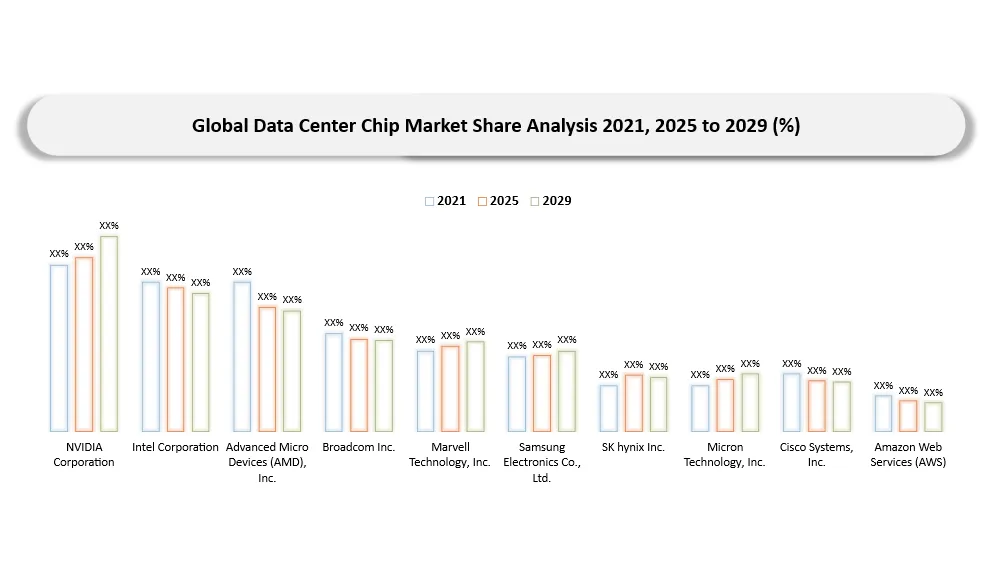
- NVIDIA maintains its market leadership with its holistic AI ecosystem that brings together its Blackwell GPUs, CUDA software, NVLink interconnects and DGX platforms, thus establishing a solid competitive edge in AI training and inference.
- AMD, Intel, Broadcom, Marvell, Cisco, Samsung Electronics, SK hynix and Micron Technology are enhancing the competition with their active developments of server CPUs, artificial intelligence accelerators, networking silicon, PCIe solutions and high-bandwidth memory (HBM) technologies, which contribute to improvements in various aspects of data center hardware.
- The competitive environment in the industry is gradually moving toward heterogeneous computing, which involves the joint deployment of CPUs, GPUs, DPUs, ASICs and AI accelerators to enhance the performance of computing processes, memory bandwidth and energy efficiency.
- New packaging technologies, such as chiplets, CoWoS and 2.5D/3D packaging, are becoming significant differentiators in competition, allowing for more computing density and quicker processing of AI in the future generation of data centers.
- Hyperscalers like AWS, Google, Microsoft, Meta Platforms and ByteDance are driving the development of proprietary AI chips and custom silicon while increasing competition with traditional semiconductor vendors.
| Company | CPUs | GPUs | AI Accelerators | Networking Chips | HBM/ Memory | Custom AI Chips |
| NVIDIA Corporation | ✗ | ✓ | ✓ | ✓ | ✗ | ✓ |
| Intel Corporation | ✓ | ✓ | ✓ | ✓ | ✗ | ✓ |
| Advanced Micro Devices (AMD), Inc. | ✓ | ✓ | ✓ | ✗ | ✗ | ✓ |
| Broadcom Inc. | ✗ | ✗ | ✓ | ✓ | ✗ | ✓ |
| Marvell Technology, Inc. | ✓ | ✗ | ✓ | ✓ | ✗ | ✓ |
Key Companies of Data Center Chip Market
- NVIDIA Corporation (U.S.)
- Intel Corporation (U.S.)
- Advanced Micro Devices (AMD), Inc. (U.S.)
- Broadcom Inc. (U.S.)
- Marvell Technology, Inc. (U.S.)
- Qualcomm Incorporated (U.S.)
- Arm Holdings plc (U.K.)
- Samsung Electronics Co., Ltd. (South Korea)
- SK hynix Inc. (South Korea)
- Micron Technology, Inc. (U.S.)
- Cisco Systems, Inc. (U.S.)
- Amazon Web Services, Inc. (AWS) (U.S.)
- Google LLC (U.S.)
- Meta Platforms, Inc. (U.S.)
- Microsoft Corporation (U.S.)
- ByteDance Ltd. (China)
- Huawei Technologies Co., Ltd. (China)
- Cerebras Systems Inc. (U.S.)
- Groq Inc. (U.S.)
- Tenstorrent Inc. (Canada)
Data Center Chip Market Major Pain Points
- The lack of sufficient availability of HBM and advanced packaging capacity is affecting the ability to manufacture and deploy AI accelerators despite the high demands in the market.
- Increasing energy and thermal challenges posed by performance AI chips is affecting the operation costs of data centers and necessitating the use of advanced liquid cooling systems.
- The lengthy chip development cycle and huge investment in R&D make it difficult for new semiconductor firms to compete with the market incumbents due to the barrier of entry.
- The geopolitical conflict and other issues related to exporting control have hindered access to the manufacturing technologies, raw material and production capacity of the semiconductor industry.
- Heterogeneous computing platforms pose problems with regard to software optimization and orchestration because of increasing complexity with CPUs, GPUs, DPUs, AI accelerators, silicon networking and memory.
Data Center Chip Market Recent Developments
- June 2026: Intel launched its Crescent Island AI data center GPU at Computex 2026 which is aimed to deliver AI inference performance and provides a capability to hold 480 GB of LPDDR5X memory capacity. Customer sampling is scheduled to occur in the second half of 2026.
- July 2026: Microsoft revealed its intentions to adopt the AI accelerator platform from AMD, including Helios racks along with MI455X GPUs and EPYC Venice processors to be used in Azure data centers for future AI loads.
- March 2026: Marvell presented its portfolio of end-to-end AI data center connectivity solutions at OFC 2026 that includes custom silicon, optical interconnect, and fast networking components.
- July 2026: NVIDIA offered more information about its Vera Rubin AI computing platform, combining Vera CPUs and Rubin GPUs to build future AI factories and hyperscale data centers to be rolled out by the end of 2026.
- March 2026: Broadcom introduced new products for its AI infrastructure portfolio featuring next generation fast connectivity and silicon solutions tailored for complex AI clusters and hyperscale data centers.
- June 2025: Advanced Micro Devices (AMD), Inc. introduced the Instinct MI350 Series AI accelerators along with next-generation AI infrastructure for hyperscale data centers to speed up AI training and inference.
- May 2025: NVIDIA Corporation launched NVLink Fusion to allow partners to connect their own CPUs and AI accelerators to NVIDIA GPUs using the high-bandwidth NVLink interconnect for developing semi-custom AI infrastructure.
- March 2025: NVIDIA Corporation released the Blackwell Ultra AI Factory Platform consisting of the GB300 NVL72 rack-scale system and the HGX B300 platform.
- March 2025: Marvell Technology, Inc. showed off the first 2nm silicon platform made using the TSMC 2nm process technology for custom AI accelerators, CPUs and networking devices intended for cloud and AI infrastructures.
- February 2025: Broadcom Inc. introduced the commercial availability of its full-featured PCIe Gen 6 solution set, including high port switches and retimers that would improve connectivity and bandwidth for AI server and next-generation data centers.
Analyst View / Opinion on Data Center Chip Market
- The rise of generative AI has seen a transformation in the demands of data center chips from conventional CPUs to the need for heterogeneous computing platforms that include GPUs, AI accelerators, DPUs and HBM.
- Custom chips built by hyperscaler companies like Amazon, Google, Microsoft, Meta and ByteDance will transform the competitive dynamics by lowering dependence on merchant processors for certain AI and cloud applications.
- Emerging advanced packaging technologies such as CoWoS, chiplet designs and 2.5D/3D packaging will become as strategically significant as improvements in technology nodes for achieving greater compute density and memory bandwidth in AI servers.
- The supply challenges will be more related to advanced packaging capabilities and HBM availability than wafer fabrication, with memory vendors and packaging providers becoming indispensable for scaling up AI data centers despite continuous investments in semiconductors manufacturing.
- In the coming years, differentiation will come to be more about performance per watt, memory bandwidth, interconnect speed and software ecosystem support as opposed to computing performance alone, as data center owners look for energy efficiency and total cost of ownership in addition to AI processing capacity.
Data Center Chip Market Target Audience
| INDUSTRY | WHO SHOULD BUY THIS REPORT? | REASON TO BUY THIS REPORT |
| Semiconductor Manufacturing | Chip Manufacturers & Foundries | Understand demand trends, technology roadmaps and competitive positioning in the data center chip ecosystem. |
| Cloud Computing | Cloud Service Providers (CSPs) | Evaluate processor adoption trends and optimize investments in AI and cloud infrastructure. |
| Data Center Infrastructure | Data Center Operators & Colocation Providers | Assess future demand for compute, networking and accelerator chips to support capacity expansion. |
| Artificial Intelligence | AI Hardware Developers & Solution Providers | Identify growth opportunities in AI accelerators, inference processors and next-generation computing platforms. |
| Networking & Telecommunications | Network Equipment Manufacturers & Telecom Operators | Analyze demand for DPUs, SmartNICs and high-speed networking silicon in modern data centers. |
| Enterprise IT | CIOs, IT Infrastructure Managers & System Integrators | Support procurement strategies for servers, storage and enterprise computing infrastructure. |
| Financial Services | Investment Firms, Venture Capitalists & Private Equity | Evaluate investment opportunities, market growth potential and competitive landscape of semiconductor companies. |
| Government & Defense | Government Agencies & Defense Organizations | Assess semiconductor supply chain resilience and strategic technology development for national infrastructure. |
| Electronics & OEMs | Server OEMs, ODMs & Hardware Manufacturers | Understand processor technology trends to develop next-generation AI servers and computing systems. |
| Research & Academia | Universities, Research Institutes & Industry Analysts | Gain insights into emerging chip architectures, process technologies and future data center computing trends. |
Why Choose DATAM?
- Data-Driven insights: Dive into detailed analyses with granular insights such as pricing, market shares and value chain evaluations, enriched by interviews with industry leaders and disruptors.
- Post-Purchase Support and Expert Analyst Consultations: As a valued client, gain direct access to our expert analysts for personalized advice and strategic guidance, tailored to your specific needs and challenges.
- White Papers and Case Studies: Benefit quarterly from our in-depth studies related to your purchased titles, tailored to refine your operational and marketing strategies for maximum impact.
- Annual Updates on Purchased Reports: As an existing customer, enjoy the privilege of annual updates to your reports, ensuring you stay abreast of the latest market insights and technological advancements. Terms and conditions apply.
- Specialized Focus on Emerging Markets: DataM differentiates itself by delivering in-depth, specialized insights specifically for emerging markets, rather than offering generalized geographic overviews. The approach equips our clients with a nuanced understanding and actionable intelligence that are essential for navigating and succeeding in high-growth regions.
- Value of DataM Reports: Our reports offer specialized insights tailored to the latest trends and specific business inquiries. The personalized approach provides a deeper, strategic perspective, ensuring you receive the precise information necessary to make informed decisions. The insights complement and go beyond what is typically available in generic databases.
What DATAM Uniquely Provides
- Gathering complete market size and projections over ten years with precise differentiating according to chip type, process technology, capacity, deployment model, data center classification, type of cooling and geographical location.
- Competitive analysis and competition with leading vendors in the semiconductor industry, hyperscalers, young companies engaged in its manufacture, product range, strategic moves and tendencies in the field of innovations.
- Thorough analysis of technology and logistics paying attention to AI accelerators, advanced type of packaging, high-speed memory chips (HBM), modern types of semiconductor processing and the state of the industry as a whole.
- Practical managerial and strategic advice based on research of market growth stimuli, negative factors, chances for growth, price policy, imports, legislative issues and possibilities for investments.
- Market research at the regional and country level to provide insights into demand trends, data center expansion, hyperscale investments, semiconductor policies of governments and growth opportunities in key markets.
Questions This Report Answers
- What are the major growth drivers in the global market for data center chips, and how are the quick uptake of artificial intelligence and hyperscale cloud computing impacting demand?
- Which types of chips (CPUs, GPUs, AI chips, DPUs, ASICs and networking chips) and end-user verticals will register the highest growth during the forecast period?
- Which companies dominate the data center chips market, and what competitive strategies, innovations in products and collaborations are dominating the market?
- How are developments in semiconductor process nodes, high bandwidth memory (HBM), advanced packaging and custom silicon technologies impacting data centers' performance and energy efficiency?
- Which geographical areas are expected to dominate the market for Data Center Chips and record the highest growth during the forecast period?


























































