


Dark Fiber Network Market Size and Overview
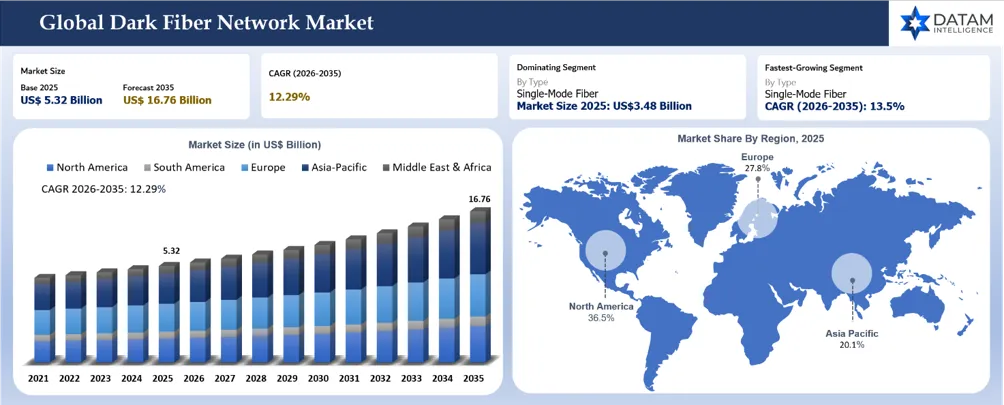
The global dark fiber network market reached US$5.32 billion in 2025 and is expected to reach US$16.76 billion by 2035, growing with a CAGR of 12.29% during the forecast period 2026-2035.
Market growth is being shaped by hyperscale data-center development, artificial intelligence workloads, cloud-region expansion, 5G densification and rising enterprise requirements for secure, dedicated connectivity. Dark fiber allows customers to illuminate leased fiber pairs using proprietary optical equipment, providing greater control over bandwidth, latency, security and network architecture. Single-mode fiber remains the dominant type because of its suitability for long-distance, high-capacity transmission across metropolitan, intercity and international routes. Nevertheless, substantial construction costs, lengthy permitting processes and uncertain utilization outside established digital corridors continue to constrain network expansion.
Artificial intelligence infrastructure represents the market’s principal growth vector. Training clusters and distributed inference environments require continuous movement of large datasets between graphics processing units, storage platforms and geographically dispersed facilities. This demand is encouraging network operators to deploy high-fiber-count cables, geographically diverse routes and direct connections between hyperscale campuses, carrier hotels, cloud availability zones and power-rich data-center locations. Metro dark fiber is gaining strategic importance as data-center clusters expand across Northern Virginia, Dallas, Phoenix, Atlanta, London, Frankfurt, Singapore and Sydney.
The next value-creation cycle will center on AI-ready long-haul corridors, metropolitan network densification, edge connectivity and cross-border infrastructure. Competitive advantage will increasingly depend on route ownership, available fiber inventory, provisioning speed, network redundancy and direct data-center access. Long-term leases and indefeasible rights-of-use agreements will remain important commercial models, providing operators with contracted revenue visibility while enabling customers to control future capacity expansion. Providers combining metropolitan density, long-haul reach and hyperscaler partnerships will be best positioned to capture premium opportunities.
Dark Fiber Network Market Key Takeaways
- Sustained Market Expansion Through 2035: The global dark fiber network market reached US$5.32 billion in 2025 and is projected to reach approximately US$16.96 billion by 2035, registering a CAGR of 12.29% during 2026-2035.
- Single-Mode Fiber Maintains Market Leadership: Single-mode fiber accounted for an estimated 65.4% market share in 2025, equivalent to approximately US$3.48 billion, supported by its long-distance, high-bandwidth and low-attenuation transmission capabilities.
- Metro and AI Data-Center Networks Become the Primary Growth Engine: Demand is accelerating for high-fiber-count metropolitan routes connecting hyperscale campuses, graphics processing unit clusters, cloud availability zones, carrier hotels and emerging artificial intelligence data-center corridors.
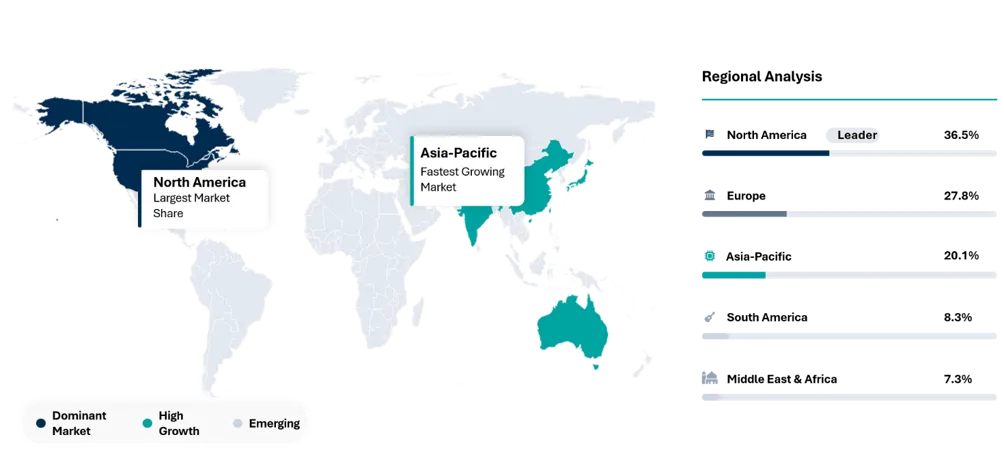
- North America Maintains Regional Dominance: North America accounted for approximately 36.5% of the global market in 2025, equivalent to around US$1.94 billion, supported by hyperscale investments, extensive carrier infrastructure and strong cloud interconnection demand.
- Infrastructure Ownership Reshapes Competitive Strategy: Future market leadership will depend on route ownership, fiber-pair availability, metropolitan density, geographic redundancy and provisioning speed. Providers securing hyperscaler contracts and connecting power-rich data-center locations will be best positioned to capture market share.
Dark Fiber Network Market Scope
| Metrics | Details | |
| 2025 Market Size | US$5.32 Billion | |
| 2035 Projected Market Size | US$16.76 Billion | |
| CAGR (2026-2035) | 12.29% | |
| Largest Market | North America | |
| Fastest Growing Market | Asia-Pacific | |
| By Type | Single-Mode Fiber, Multimode Fiber | |
| By Network | Metro Dark Fiber, Long-Haul Fiber, Subsea Dark Fiber, Regional and Intercity Fiber | |
| By Lease Model | Indefeasible Right of Use, Long-Term Lease, Short-Term Lease | |
| By Deployment Mode | Underground, Aerial, Subsea, Hybrid | |
| By End-User | Banking, Financial Services and Insurance, Information Technology and Telecom, Government and Defense, Energy and Utilities, Healthcare, Education and Research, Media and Entertainment, Transportation and Logistics, Others | |
| By Region | North America | U.S., Canada, Mexico |
| Europe | Germany, UK, France, Spain, Italy, Poland | |
| Asia-Pacific | China, India, Japan, Australia, South Korea, Indonesia, Malaysia, Singapore, Vietnam, Thailand, Philippines, Taiwan | |
| South America | Brazil, Argentina | |
| Middle East and Africa | Israel, Saudi Arabia, UAE, Turkiye, South Africa, Nigeria | |
| Report Insights Covered | Competitive Landscape Analysis, Company Profile Analysis, Market Size, Share, Growth | |
Dark Fiber Network Market White Space & Investment Opportunities
- AI-Ready High-Fiber-Count Corridors: Invest in dedicated long-haul and metropolitan fiber routes connecting hyperscale campuses, graphics processing unit clusters, cloud availability zones and emerging artificial intelligence facilities. High-count cables and diverse routing can address rapidly increasing east-west data traffic.
- Connectivity for Emerging Power-Rich Data-Center Markets: Develop dark fiber infrastructure in secondary markets offering available electricity, land and renewable-energy access. Connecting these locations with established cloud hubs can generate early-mover advantages as data-center development expands beyond congested metropolitan clusters.
- Carrier-Neutral Metro Fiber Networks: Build open-access metropolitan networks connecting data centers, carrier hotels, enterprises, mobile aggregation points and edge facilities. Carrier-neutral models can improve asset utilization by serving multiple hyperscalers, telecommunications operators, cloud providers and public-sector customers.
- Subsea and Cross-Border Route Diversification: Invest in terrestrial backhaul, cable-landing-station connectivity and alternative international routes that reduce dependence on congested or geopolitically exposed corridors. Customers increasingly require geographically diverse infrastructure supporting business continuity, data sovereignty and low-latency international traffic.
- Network Intelligence and Automated Fiber Management: Develop digital route inventories, geographic information systems, automated availability checks, predictive maintenance and customer-facing provisioning platforms. Improved infrastructure visibility can shorten sales cycles, accelerate service activation, reduce fiber outages and improve monetization of underutilized strands.
- Flexible Leasing and Infrastructure-Sharing Models: Expand beyond traditional long-duration indefeasible rights-of-use agreements by offering phased capacity commitments, managed dark fiber, shared conduit arrangements and build-to-suit contracts. Flexible structures can broaden adoption among enterprises and regional data-center operators while reducing upfront investment and utilization risk.
Dark Fiber Network Market Buyer Decision-Making Criteria
Major Buyer Decision-Making Criteria:
- Route Availability and Geographic Coverage
- Direct Connectivity to Required Data Centers and Cloud Hubs
- Physical Route Diversity and Network Redundancy
- Available Fiber-Pair Count and Future Expansion Capacity
- Latency, Signal Loss and Optical Performance
- Fiber Type, Cable Specifications and Infrastructure Quality
- Network Ownership and Control Over Underlying Assets
- Service Availability and Restoration Commitments
- Mean Time to Repair and Maintenance Responsiveness
- Deployment Lead Time and Provisioning Flexibility
- Indefeasible Right of Use and Lease-Term Options
- Upfront Charges, Recurring Fees and Total Cost of Ownership
- Access to Ducts, Conduits, Carrier Hotels and Cable Landing Stations
- Network Security, Physical Protection and Data-Sovereignty Compliance
- Provider Financial Stability, Technical Expertise and Geographic Support Coverage
Dark Fiber Network Market BCG Matrix: Company Evaluation
STAR
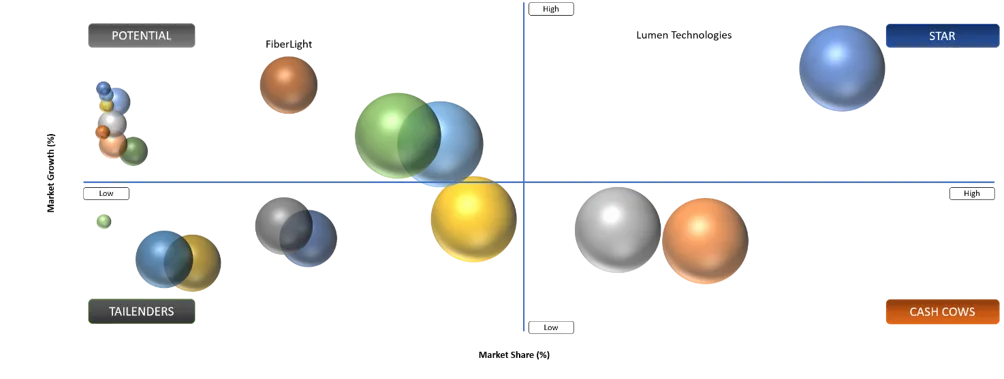
Lumen Technologies, Zayo Group, Colt Technology Services, Arelion, euNetworks and EXA Infrastructure are positioned in the Star category based on their extensive fiber footprints, established enterprise and wholesale customer relationships, strong data-center connectivity and ability to support high-capacity international routes. Lumen and Zayo maintain significant North American infrastructure, while Colt, euNetworks and EXA Infrastructure possess dense metropolitan and long-haul networks connecting major European digital hubs. Arelion strengthens this group through its global backbone and connectivity across Europe, North America and Asia.
Zayo’s acquisition of Crown Castle’s Fiber Solutions business substantially strengthened its metropolitan reach and access to enterprise locations. Star-category companies are benefiting from hyperscale data-center development, artificial intelligence workloads, cloud interconnection, mobile backhaul and demand for secure private networks. Maintaining leadership will depend on route expansion, network diversity, rapid service provisioning, fiber-pair availability, cable-landing-station access and sustained infrastructure investment. Providers capable of combining metropolitan density with long-haul and cross-border connectivity will retain the strongest competitive positioning.
POTENTIAL
FiberLight, Lightpath, FirstLight Fiber, Bandwidth Infrastructure Group, Relined Fiber Network, RETN, Eurofiber, Neos Networks and Cirion Technologies are positioned in the Potential category because of their expanding regional footprints, specialized metropolitan networks and growing exposure to data-center, hyperscaler, government and enterprise connectivity requirements.
FiberLight, Lightpath, FirstLight Fiber and Bandwidth Infrastructure Group are strengthening high-capacity fiber coverage across selected United States markets. Relined Fiber Network, Eurofiber and Neos Networks provide differentiated infrastructure across European markets, while RETN connects important routes spanning Europe and Asia. Cirion Technologies offers considerable growth potential across Latin America through its regional fiber and data-center connectivity platform. Progression toward the Star category will depend on geographic expansion, additional data-center connections, higher network utilization, international route development, customer diversification and capital availability. Strategic acquisitions, hyperscaler partnerships and customized fiber construction agreements could accelerate their movement toward stronger market leadership.
Dark Fiber Network Market Dynamics
Driver Impact Analysis
| Driver | Market Growth Impact (%) | Demand Concentration | Impacted Use Case | Strategic Impact |
Expansion of AI Data-Center Corridors Requiring Dedicated High-Fiber-Count Connectivity | 18.7% | High across the United States, Western Europe and selected Asia-Pacific data-center clusters | AI model training, distributed inference, graphics processing unit clusters and data-center interconnection | Accelerates deployment of high-count, low-latency dark fiber routes connecting hyperscale campuses, power-rich locations and cloud availability zones |
Rising East-West Data Traffic Between Hyperscale and Colocation Facilities | 16.9% | Concentrated in Northern Virginia, Dallas, Phoenix, London, Frankfurt, Amsterdam, Singapore and Sydney | Cloud interconnection, data replication, disaster recovery and multi-cloud workload transfer | Encourages carriers to expand metro fiber rings, direct data-center routes and geographically diverse connections with scalable customer-controlled capacity |
5G Densification and Edge Infrastructure Driving Fiberized Backhaul and Fronthaul | 14.8% | Strong across North America, China, South Korea, Japan, Western Europe and major urban markets | Macro-cell backhaul, small-cell fronthaul, edge computing and private mobile networks | Creates recurring demand for dedicated fiber pairs connecting towers, edge facilities, aggregation points and core telecommunications networks |
Growing Requirement for Physically Dedicated, Sovereign and Resilient Networks | 13.6% | High among governments, financial institutions, defense agencies, healthcare systems and critical infrastructure operators | Secure communications, low-latency trading, regulated-data transfer and business continuity | Supports premium dark fiber contracts offering route control, physical isolation, network redundancy, predictable performance and compliance with data-sovereignty requirements |
Driver: Expansion of AI Data-Center Corridors Requiring Dedicated High-Fiber-Count Connectivity
The rapid development of artificial intelligence infrastructure is creating concentrated demand for dedicated, high-capacity connectivity between hyperscale campuses, cloud regions, colocation facilities and power-rich data-center locations. Artificial intelligence training clusters continuously transfer exceptionally large datasets among graphics processing units, storage platforms and geographically distributed computing environments. Conventional managed-bandwidth services can restrict scalability, increase recurring costs and provide limited control over network configuration. Dark fiber enables hyperscalers and data-center operators to deploy proprietary optical equipment, scale transmission capacity incrementally and maintain predictable latency across critical routes. Demand is consequently increasing along major artificial intelligence corridors in the United States, Europe and Asia-Pacific.
This shift is influencing network investment strategies and commercial models across the dark fiber ecosystem. Providers are installing higher-count fiber cables, constructing geographically diverse routes and extending networks into emerging data-center markets where electricity and land remain available. Long-term leases and indefeasible rights-of-use agreements provide operators with contracted revenue visibility while allowing customers to control capacity expansion. Competitive advantage will increasingly depend on route ownership, rapid delivery, network redundancy, data-center density and assured fiber availability. Providers connecting established cloud hubs with new artificial intelligence campuses will capture disproportionate growth opportunities.
Restraint Impact Analysis
| Restraint | Drag on Market Growth (%) | Primary Impact Area | Impacted Use Case | Strategic Impact |
High Upfront Construction Costs and Extended Payback Periods Outside Core Digital Corridors | 17.4% | Network expansion economics, capital allocation and project viability | Long-haul routes, secondary cities, rural connectivity and emerging data-center locations | Restricts deployment to routes with committed anchor customers, high fiber utilization and sufficient long-term leasing visibility |
Fragmented Rights-of-Way, Permitting and Municipal Approval Requirements | 15.8% | Construction timelines, deployment costs and route planning | Metropolitan fiber rings, cross-border networks, railway corridors and street-level data-center connections | Extends project completion schedules, creates unpredictable costs and reduces providers’ ability to respond rapidly to customer capacity requirements |
Risk of Stranded Fiber Capacity from Uncertain Data-Center Location and Power Availability | 14.6% | Asset utilization, investment returns and network monetization | Artificial intelligence campuses, hyperscale developments and power-constrained data-center markets | Increases the possibility that constructed routes remain underutilized when data-center projects are delayed, relocated or constrained by electricity availability |
Customer Dependence on Proprietary Optical Equipment and Specialized Network Expertise | 12.9% | Adoption costs, network operations and customer readiness | Enterprise private networks, healthcare systems, government agencies and mid-sized data-center operators | Limits dark fiber adoption among organizations lacking the capital, engineering capabilities and operational resources required to illuminate and manage dedicated fiber |
Restraint: High Upfront Construction Costs and Extended Payback Periods Outside Core Digital Corridors
Dark fiber deployment requires substantial upfront investment in route design, trenching, ducts, fiber-optic cables, splicing, regeneration facilities, rights-of-way and ongoing network maintenance. These costs become particularly challenging outside established data-center and telecommunications corridors, where customer density and near-term capacity demand may remain insufficient to support attractive returns. Construction expenses can also increase because of difficult terrain, long distances between connection points, limited access to existing conduit and fragmented municipal permitting requirements. Unlike managed connectivity services, dark fiber projects frequently depend on long-term leases or indefeasible rights-of-use agreements, extending the period required for infrastructure providers to recover invested capital.
Consequently, operators increasingly prioritize routes supported by hyperscalers, telecommunications carriers, government agencies or other anchor customers capable of providing predictable contracted revenue. Secondary cities, rural markets and emerging data-center locations may experience delayed deployment despite demonstrating longer-term demand potential. Providers can mitigate investment risk through phased construction, shared infrastructure agreements, pre-commitment contracts and partnerships with utilities, railway operators and public authorities. Nevertheless, uncertain network utilization and extended payback periods may constrain geographic expansion, reinforce infrastructure concentration around established digital hubs and limit competitive dark fiber availability in underserved regions.
Dark Fiber Network Market Segmentation Analysis
The global dark fiber network market is segmented based on production type, network, lease model, deployment mode, end-user, and region.
Rising Demand for Scalable, High-Capacity Network Infrastructure Drives Information Technology and Telecom Growth
With more than 20% market share, information technology and telecom is the leading end-user of dark fiber network, as there is a growing need for scalable and high-capacity network infrastructure that can support new digital workloads. The demand for dark fiber network is also boosted by its capability to deliver carriers complete control over transmission equipment and protocols, providing them with a competitive advantage over lit networks.
It is reflected in major infrastructure deals and developments aimed at enhancing connectivity for advanced computing applications. For instance, in 2025, Verizon and Amazon Web Services (AWS) expanded their partnership to develop high-capacity fiber networks that interconnect AWS data centers, particularly to support next-generation AI workloads that require rapid and reliable data exchange between cloud regions. The initiative illustrates how telecom companies leverage fiber infrastructure, especially ultra-fast dark fiber connectivity, within overall IT enablement strategies for hyperscale cloud infrastructure.
Dark Fiber Network Market Geographical Penetration
U.S. Dark Fiber Network Market Landscape
The U.S. dark fiber network market is entering an infrastructure-intensive expansion cycle as artificial intelligence, hyperscale cloud and distributed data-center architectures reshape bandwidth requirements. Demand is concentrated across Northern Virginia, Dallas, Phoenix, Atlanta, Chicago, Silicon Valley and emerging power-rich markets in Texas and the Midwest. Hyperscalers increasingly prefer dedicated fiber pairs because they provide control over optical equipment, capacity scaling, latency and route diversity. In July 2026, Verizon secured a dark fiber agreement valued at more than USD 1 billion to connect Google data centers, demonstrating the growing commercial importance of dedicated infrastructure for artificial intelligence workloads.
Competition is intensifying among national providers such as Zayo, Lumen and Uniti and regional specialists including FiberLight, Lightpath, FirstLight Fiber and BIG Fiber. Zayo’s acquisition of Crown Castle’s Fiber Solutions business strengthened its metropolitan density and enterprise reach. In August 2026, Zayo announced that it was building more than 8,000 miles of new long-haul fiber across major U.S. artificial intelligence corridors in collaboration with NVIDIA. Competitive differentiation increasingly depends on fiber availability, construction speed, route ownership, network redundancy and direct access to hyperscale campuses.
Japan Dark Fiber Network Market Outlook
Japan’s dark fiber network market is positioned for sustained expansion as artificial intelligence, cloud computing and disaster-resilient digital infrastructure increase demand for dedicated, low-latency connectivity. Tokyo and Osaka remain the principal network hubs, supported by dense enterprise demand, carrier-neutral data centers and international subsea cable access. However, limited power availability, expensive land and concentration risk are encouraging operators to evaluate locations including Hokkaido, Kyushu and Toyama. In 2025, approximately 85% of Japan’s data centers were concentrated around Tokyo and Osaka, highlighting the opportunity for new fiber corridors connecting secondary markets.
The competitive environment is anchored by NTT, KDDI, SoftBank and Colt Technology Services, alongside utilities, railway companies and regional infrastructure providers possessing valuable conduit and rights-of-way assets. Dark fiber adoption will be strongest among hyperscalers, financial institutions, telecommunications operators and artificial intelligence platforms requiring control over optical equipment and network capacity. SoftBank’s planned Osaka artificial intelligence data center is expected to provide approximately 150 megawatts of capacity when operations begin in 2026, strengthening connectivity demand outside Tokyo. Future growth will depend on regional data-center development, renewable-power access, subsea connectivity, permitting efficiency and geographically diverse network routes.
Dark Fiber Network Market Competitive Landscape
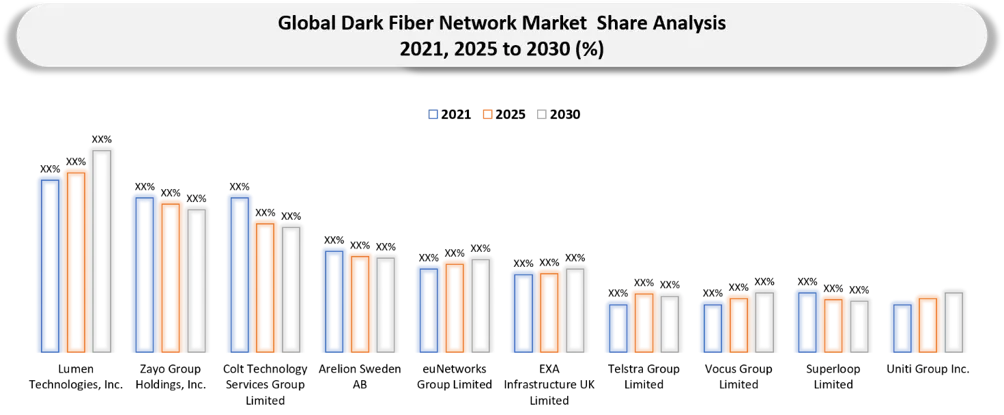
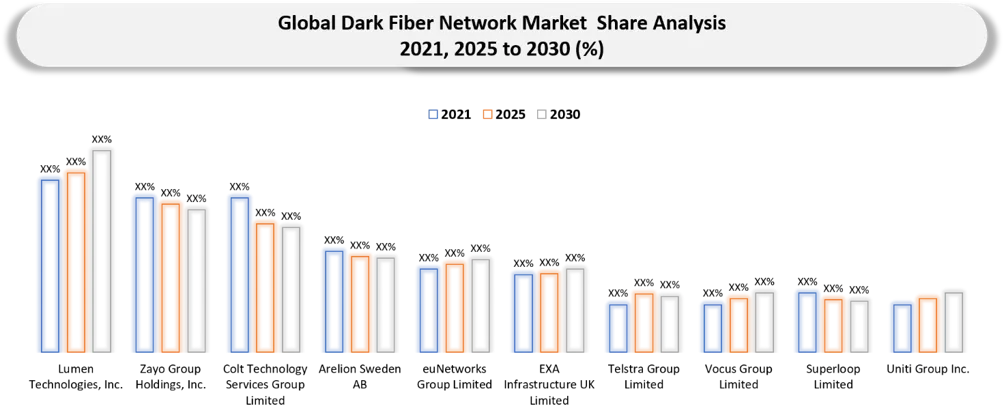
- The global dark fiber network market presents a fragmented yet increasingly consolidating competitive environment comprising multinational telecommunications operators, carrier-neutral fiber platforms and specialized metropolitan network providers. Major participants such as Lumen Technologies, Zayo Group, Colt Technology Services, Arelion, euNetworks and EXA Infrastructure compete through extensive fiber footprints, route diversity, low-latency connectivity and direct access to data centers, cloud platforms and cable landing stations. Telstra, Vocus and Superloop maintain strong positions in Australia, while Eurofiber, Relined Fiber Network and Neos Networks provide differentiated regional coverage across Europe. Competition is increasingly determined by network ownership, available fiber-pair inventory, service-level commitments, geographic redundancy and the ability to construct customer-specific routes.
- Market consolidation and infrastructure investment are reshaping competitive positioning as providers seek greater metropolitan density and long-haul reach. Zayo’s 2026 acquisition of Crown Castle’s Fiber Solutions business significantly expanded its North American footprint, while the Uniti-Windstream combination created a broader integrated fiber platform. Providers are prioritizing connectivity for artificial intelligence clusters, hyperscale data centers, cloud regions, financial institutions, mobile backhaul and government networks. Competitive advantage increasingly depends on rapid provisioning, scalable leasing structures, secure dedicated infrastructure, transparent network visibility and partnerships with data-center operators. Regional specialists remain competitive through route customization and underserved-market coverage.
Key Companies of Dark Fiber Network Market
- Lumen Technologies, Inc. (United States)
- Zayo Group Holdings, Inc. (United States)
- Colt Technology Services Group Limited (United Kingdom)
- Arelion Sweden AB (Sweden)
- euNetworks Group Limited (United Kingdom)
- EXA Infrastructure UK Limited (United Kingdom)
- Telstra Group Limited (Australia)
- Vocus Group Limited (Australia)
- Superloop Limited (Australia)
- Uniti Group Inc. (United States)
- FiberLight, LLC (United States)
- Lightpath (United States)
- FirstLight Fiber, Inc. (United States)
- Bandwidth Infrastructure Group (United States)
- Relined Fiber Network B.V. (Netherlands)
- RETN Capital Ltd. (United Kingdom)
- Eurofiber Group N.V. (Netherlands)
- Neos Networks Limited (United Kingdom)
- Orange S.A. (France)
- Cirion Technologies (United States)
Dark Fiber Network Market Recent Developments
- September 2026: Verizon and Corning Incorporated entered a multi-year, multibillion-dollar supply agreement covering more than 80 million miles of high-density optical fiber and connectivity solutions between 2027 and 2032. The infrastructure will support nationwide broadband expansion and the long-haul network capacity required by artificial intelligence hyperscalers.
- August 2026: Zayo Group expanded its strategic supply agreement with Corning Incorporated to secure a significant portion of the optical-fiber cable required for its long-haul network expansion. The agreement supports Zayo’s plan to add approximately 15,000 route miles by 2030.
- August 2026: Zayo Group announced a collaboration with NVIDIA to provide critical network capacity for artificial intelligence infrastructure. Zayo is constructing more than 8,000 miles of new long-haul fiber across major United States artificial intelligence corridors while increasing capacity across its existing network.
- July 2026: Verizon secured an agreement valued at more than USD 1 billion with Google to provide dedicated dark fiber connectivity for Google’s data centers. The agreement demonstrates growing hyperscaler demand for privately controlled, high-capacity fiber infrastructure supporting artificial intelligence and cloud workloads.
- July 2026: Zayo Group reported that long-haul fiber demand doubled during 2025, while metropolitan fiber demand increased by as much as twentyfold. The findings highlight accelerating infrastructure requirements across artificial intelligence clusters, hyperscale data centers and major metropolitan connectivity corridors.
What DATAM Uniquely Provides
- In-depth segmentation of the dark fiber network market by fiber type, network type, lease model, deployment mode, end-user industry, country and region, supported by market size, growth and attractiveness analysis.
- Competitive analysis of leading dark fiber network providers covering route miles, fiber-pair availability, metropolitan density, long-haul reach, data-center connectivity, network ownership, geographic diversity, service-level commitments, pricing models and expansion strategies.
- Comprehensive assessment of demand from hyperscale data centers, cloud providers, telecommunications operators, financial institutions, government agencies, utilities, healthcare organizations, research institutions, media companies and transportation networks.
- Actionable intelligence on indefeasible rights-of-use agreements, long-term leasing structures, construction costs, rights-of-way, permitting requirements, fiber utilization, route economics, provisioning timelines, infrastructure partnerships, mergers, acquisitions and investment opportunities.
- Analyst forecasts highlighting high-growth network corridors, emerging data-center locations, AI-driven capacity requirements, metropolitan and long-haul expansion opportunities, subsea connectivity needs and competitive threats across single-mode fiber, metro dark fiber, intercity routes and carrier-neutral infrastructure platforms.


























































