


Cybersecurity Testing Market Size and Overview
The global cybersecurity testing market reached US$ 6.84 billion in 2025 and is expected to reach US$ 24.55 billion by 2035, growing with a CAGR of 13.63% during the forecast period 2026-2035.
There is an evolution in the security market away from periodic vulnerability assessments to continuous security validation and risk-proportional testing as businesses hide to safeguard larger areas of attack surfaces across APIs, cloud workloads, containers, IoT/OT systems and AI-based applications. The 2025 ISC2 Cybersecurity Workforce Study specifies that 59% of cybersecurity professionals in the study based their evaluation on significant or crucial skill gaps hence, creating hurdles for enterprises in obtaining the much-needed specialized expertise in-house. The need for third-party penetration testing, managed security testing, automated vulnerability validation and specialized red-team services has increased due to cloud, application and emerging technology surroundings.
AI is not only automating current cybersecurity test methods - it is also introducing completely new levels of testing. A report by ISC2 shows that 41% of respondents mentioned AI as the most needed cybersecurity skill in 2025, followed by cloud security with 36% and application security with 28%. The demand for LLM security testing, prompt-injection testing, AI red teaming, model-data security testing and AI supply-chain validation continues to grow because of these capability gaps, whereas cloud and application security remain the most important testing methods.
Cybersecurity Testing Market Key Takeaways
- Application Security Testing represented 50% of the global Cybersecurity Testing Market in 2025 due to heightened security needs for web applications, mobile applications, APIs and cloud environments.
- AI and ML Security Testing is predicted to have 21.1% CAGR for the timeframe 2026–2035 because of the rapid introduction of generative AI, LLMs and AI agents and increasing requests for prompt-injection testing, AI red teaming, model defendants and AI supply-chain verifications.
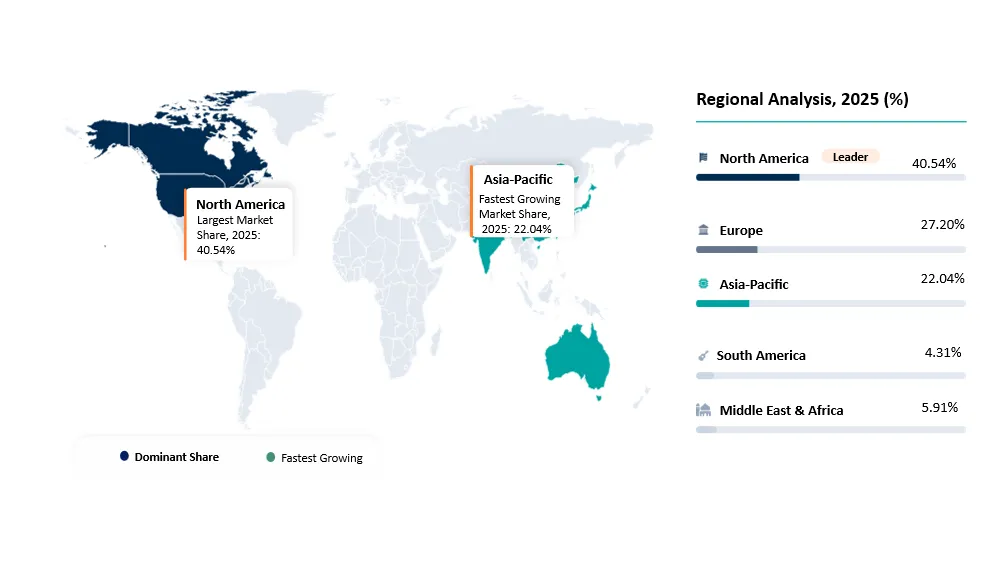
- North America held the largest market share of the Cybersecurity Testing Market at 40.54%, supported by high spending on cybersecurity among enterprises, strict regulatory compliances, developed testing infrastructure and extensive use of cloud computing.
- The rising trend of continuous security validation and automated testing allows companies to test their rapidly changing cloud workloads, APIs, containerized systems and hybrid IT environments more often than with conventional periodic testing.
- Increasing interest in managed security testing, artificial intelligence-enabled testing and red teaming opens up business prospects for testing service vendors amid a shortage of cyber security skills and an ever-growing digital attack surface.
Cybersecurity Testing Industry Trends and Strategic Insights
- Shift Toward Continuous Testing and PTaaS: Organizations are gradually making the shift from periodic testing to continual validation and penetration testing as a service to address rapidly changing attack surfaces.
- AI-Assisted Vulnerability Discovery and Automated Testing: AI technology allows automation of the processes of reconnaissance, finding vulnerabilities, attack path analysis, establishing test priorities and exploitation, which enables a wider testing scope with a lesser amount of manual labor.
- Emergence of AI/LLM Security Testing: Generative and autonomous AI have introduced the need for new methods of testing, as they will now need testing for prompt injection, leakage of data, model manipulation, incorrect tool usage and adversarial activities.
- Integration of Security Testing into DevSecOps and Cloud-Native Development: Implementing Static Application Security Testing (SAST), Dynamic Application Security Testing (DAST), API Testing, Container Testing, Dependency Scanning and Infrastructure as Code (IaC) Testing within continuous integration and continuous delivery platforms (CI/CD).
- Expansion of API, Attack-Surface, and External Exposure Testing: The rising use of APIs, cloud solutions through applications and a growing distributed digital infrastructure is increasing the need for external attack-surface discovery and API security testing.
Cybersecurity Testing Market Scope
| Metrics | Details | |
| 2025 Market Size | US$ 6.84 Billion | |
| 2035 Projected Market Size | US$ 24.55 Billion | |
| CAGR (2026-2035) | 13.63% | |
| Largest Market | North America | |
| Fastest Growing Market | Asia-Pacific | |
| By Testing Type | Network Security Testing, Application Security Testing, Cloud Security Testing, Penetration Testing, Device & Endpoint Security Testing, IoT Security Testing, OT/ICS Security Testing and AI/ML Security Testing | |
| By Testing Execution | Manual Testing, Automated Testing and Hybrid Testing | |
| By Testing Strategy | Continuous Testing, Risk-Based Testing, Adversarial Testing, Breach and Attack Simulation, Bug Bounty Testing and Others | |
| By Deployment | On-Premises, Cloud-Based and Hybrid | |
| By Organization Size | Large Enterprises and Small & Medium-Sized Enterprises | |
| By Service Model | In-House Security Testing, Third-Party Security Testing and Managed Security Testing as a Service | |
| By Assset / Environment | Enterprise Networks, Web Applications, Mobile Applications, Cloud Infrastructure, Endpoints, Databases, IoT Devices, Industrial Control Systems, APIs, Containers and Kubernetes, 5G Infrastructure and Others | |
| By End Use Industry | BFSI, IT & Telecommunications, Healthcare & Life Sciences, Government & Defense, Retail & E-Commerce, Manufacturing, Energy & Utilities, Automotive, Aerospace, Transportation & Logistics, Education, Media & Entertainment, Travel & Hospitality, Professional Services and Others | |
| By Region | North America | U.S., Canada, Mexico |
| Europe | Germany, UK, Russia, France, Spain, Italy, Poland | |
| Asia-Pacific | China, India, Japan, Australia, South Korea, Indonesia, Malaysia, Singapore, Vietnam, Thailand, Philippines, Taiwan | |
| South America | Brazil, Argentina | |
| Middle East and Africa | UAE, Saudi Arabia, South Africa, Israel, Turkiye, Nigeria | |
| Report Insights Covered | Competitive Landscape Analysis, Company Profile Analysis, Market Size, Share, Growth | |
Why does this report matter in 2026?
As we move into 2026, the Cybersecurity testing market will change from being focused on periodic vulnerability assessments to becoming more focused on continuous and automated security testing due to the need to test dynamic attack surfaces within the cloud architecture, APIs, web and mobile apps, IOT devices, containers and hybrid environments. With the rising trend towards generative AI and agentic AI, there is an additional need for testing of prompt injection, model manipulation, data leaks, insecure integrations of AI models and unauthorized use of tools.
The importance of this report lies in the changing nature of cybersecurity testing from an episodic to a continuous activity. Increasing regulatory pressure, increasing digital assets, DevSecOps and advanced cyberattacks have led companies to shift towards PTaaS, automated testing and risk-based security validation. This report gives insight regarding the technology, service model, testing of applications, infrastructure and the areas that have high growth potential through 2035.
Cybersecurity Testing Market White Space & Investment Opportunities
- AI and LLM Security Testing: The increased adoption of generative and agentic AI opens up possibilities in security testing solutions designed to handle prompt injection, model manipulation, data exfiltration, misuse of tools and agent attack surfaces.
- Continuous Penetration Testing and PTaaS: Market dynamics favoring subscriptions and continuous testing have created openings in the form of platforms that offer automated discovery of vulnerabilities and manual verification of those findings.
- API and External Attack-Surface Testing: Growing API networks, cloud resources and internet-facing applications present opportunities for investment in API discovery, exposure monitoring, attack path identification and automated security validation.
- Cloud-Native and Kubernetes Security Testing: The rise in the usage of containerized applications, Kubernetes, serverless technologies and multi-cloud infrastructures is driving the need for advanced testing capabilities to test cloud-native configurations and workloads.
- OT, IoT and Connected-Device Security Testing: The increasing trend of connectivity and deployment of connected devices provides a new opportunity for specialized testing of IoT ecosystems, industrial control systems, OT and embedded devices.
Cybersecurity Testing Future Market Transformation
The Cybersecurity testing market will evolve from occasional and manual-intensive assessments to become an intelligent and risk-oriented security validation system. More tasks will be automated with the help of AI, including reconnaissance, vulnerability identification, exploitation, attack path analysis and test prioritization. Human testers will be engaged in business logic vulnerability testing and attack simulations where human expertise is critical. The scope of testing will go beyond traditional network and application assessment and will embrace APIs, cloud-native workloads, containerization, Kubernetes infrastructure, IoT, OT/ICS and AI/LLM environments, calling for dedicated testing approaches in more distributed and complex ecosystems. PTaaS and subscription models will find wider acceptance.
The market will also see increased integration between DevSecOps practices, software chain security, continuous attack surface management and compliance processes. Artificially generated code, autonomous systems and APIs will create new vectors of attack which may not be fully evaluated by current vulnerability scanning solutions, leading to need for AI-powered red teaming, adversarial testing, model security assessment and attack simulation capabilities. In parallel, security testing vendors will be competing on the basis of real-time validation, risk-prioritized analysis, automatic remediation feedback and integration with security infrastructure, changing the nature of competition from detection of vulnerabilities to resilience against simulated attacks.
Cybersecurity Testing Market Buyer Decision-Making Criteria
In the Cybersecurity testing market, customers judge vendors on the basis of their capacity to perform a precise, scalable and constant identification of potential weaknesses in the digital world. Decisions to purchase products from certain vendors depend on the level of testing coverage, the validation of potential weaknesses, the use of automation and AI tools, integrations with existing security and DevSecOps systems, availability of testing experts, compliance issues, deployment options, reporting and cost-effectiveness. Companies prefer cybersecurity testing products that can test cloud systems, APIs, apps, networks, IoT/OT systems, containers and AI systems.
Major Decision-Making Criteria:
- Testing Accuracy and Vulnerability Validation
- Breadth of Attack-Surface Coverage
- AI and Automation Capabilities
- Continuous Testing and PTaaS Availability
- Integration with DevSecOps and Security Infrastructure
- Expertise of Security Testers and Researchers
- Cloud, Hybrid and Multi-Cloud Scalability
- Compliance and Regulatory Reporting
- Risk Prioritization and Reporting Quality
- Total Cost of Ownership and ROI
Cybersecurity Testing Market Economic & Investment Analysis
There is a fundamental change in spending dynamics for the cybersecurity testing market with organizations shifting focus from the annual pen test approach to continuous validation of vulnerabilities in cloud workloads, APIs, applications, containers, endpoints and connected devices. There are fundamental changes in the economics of the cybersecurity testing market from one-time projects to ongoing PTaaS and subscription models as AI-driven reconnaissance, exploitation validation and attack path analysis are helping service providers to cover more ground through testing without a proportional increase in the labor costs. There is a particular concentration of spending on cybersecurity testing in those environments that may have substantial financial or operational risks from security breaches.
Opportunities for investment are becoming more and more niche to specific testing abilities, rather than traditional vulnerability testing alone. Security testing of AI/LLMs, API attack path validation, cloud native/Kubernetes security testing, external attack surface testing and OT/ICS security testing are all spaces where differentiation can be found as traditional testing solutions continue to commoditize. Other considerations under investigation by investors and cybersecurity firms alike include recurring contract opportunity, integration into DevSecOps processes, machine-driven testing depth, proprietary vulnerability intelligence and the capability to blend machine-discovered vulnerabilities with manual penetration testing.
Cybersecurity Testing Investment Trends in the Market
- Consolidation of Security Testing Capabilities: Investments are being made in platforms that integrate vulnerability management, penetration testing, application security, attack surface management and security validation into one cohesive solution.
- Growth of Recurring Security-Service Models: Investors are allocating funds towards business models that provide recurring revenue through subscription services and long-term engagements from enterprise clients via continuous testing and assessment.
- Automation-Driven Operating Models: Investments are being focused on automation, which cuts down manual efforts of reconnaissance, repeated scanning, test execution, gathering of evidence and reporting.
- Strategic Expansion Through Partnerships and Acquisitions: Cybersecurity test providers are resorting to strategic alliances, technology partnerships and acquisitions to scale up testing capabilities, enlarge the customer base and tap specialized expertise in security.
- Enterprise-Grade Platform Integration: Increasingly, investments have been going into platform integration with SIEM, SOAR, vulnerability management, CI/CD, cloud security and GRC platforms.
Strategic Indicators For the Cybersecurity Testing Market
High Regulation Impact
Regulatory and compliance requirements are progressively compelling to embark on documented, repeatable, auditable cybersecurity testing due to the need to prove the security controls effectiveness in application, network, cloud and third-party systems according to existing frameworks and regulations like DORA, NIS2, PCI DSS, HIPAA-related security measures and CMMC norms. Such demand for cybersecurity testing, penetration testing, vulnerability tests, security validation and evidence-based reporting has to be translated into reality in sectors like BFSI, healthcare, government, armed forces and critical infrastructure, where compliance exposure and third-party risk affect the costs and frequency of cybersecurity testing.
High Investment Activity
The investments that have been made in the cybersecurity testing market are becoming more centered on automation, platform unification and scalable test platforms compared to individual vulnerability scanners. Security firms are focusing on making investments for using AI-powered test execution, exploit verification, attack surface identification, as well as integration with DevSecOps and security operation platforms to enhance efficiency and recurring income generation. There are also investments made for acquiring technologies and forming strategic alliances to help the firms expand their portfolio of testing and offer services for large hybrid environments.
Supply Chain Disruption
The Supply Chain Disruption in the cybersecurity testing market has become more of software dependencies, open source elements, cloud systems, APIs and cybersecurity skill shortage instead of traditional physical supply shortage. Any vulnerability generated due to software dependencies and third-party integration would spread across various connected enterprise infrastructures, which makes testing of software supply chains, dependency assessment, API security verification and third-party assessment a necessity. On the other hand, there would be a skill shortage of qualified penetration testers and security professionals who could carry out comprehensive testing procedures. Therefore, it would prolong the process and increase dependency on automated testing.
Pricing Volatility
The cost of cybersecurity testing services depends on various factors, including the size of the organization involved, the testing methods used, the nature of the assets being tested and the qualifications of the testers. Penetration testing services in 2025 cost between US$5,000 and US$30,000, while extensive assessments can cost over US$60,000. The pricing of web application testing ranges from US$5,000 to US$15,000; on the other hand, an API assessment costs from US$10,000 to US$25,000 while an enterprise application assessment may come at a price payer needs to be ready to shell out anything within the range of US$30,000 to US$60,000.
Increased price volatility can be observed as well due to the changing dynamics within the market between manual testing, automated testing and PT-as-a-service approaches. Specialist evaluations of the cloud environment, APIs, OT/ICS systems and AI/LLM applications tend to be more expensive due to the need for specific knowledge and thorough testing. In turn, automated vulnerability assessments and subscription testing will allow for reducing costs of each individual evaluation, making prices more predictable.
Procurement Pressure
The pressure for procurement in the cybersecurity testing market is growing as organizations seek to broaden the scope of testing at the same time they control their budgets and the number of vendors. Organizations are becoming more inclined towards acquiring integrated platforms or managed services to perform penetration testing, vulnerability scanning, application security, cloud security testing and continuous verification rather than purchasing different point solutions. The procurement department is also focusing more on risk reduction, frequency of testing, automation, compliance and predictable subscription pricing as key factors when evaluating the solution to be acquired. This is putting pressure on vendors to deliver ROI, reduced false positives, quicker validation of vulnerabilities and scalable testing models.
New Technology Adoption
The adoption of new technology is transforming the cybersecurity testing market as businesses implement cloud-native applications, APIs, containers, Kubernetes, Internet of Things (IoT) devices and generative AI in their production environment. Testing vendors are reacting by offering artificial intelligence-driven discovery of vulnerabilities, automatic exploit verification, continuous attack surface testing, AI / large language model (LLM) red teaming, cloud configuration testing and testing of APIs for security vulnerabilities. The use of new technologies is also driving an increase in the demand for testing tools that directly integrate into continuous integration / continuous deployment (CI/CD) pipelines and security operations platform, allowing for the early detection of vulnerabilities and continuous verification instead of isolated test cycles.
Regional Expansion Opportunity
The Cybersecurity testing market has strong regional expansion opportunities in economies which are rapidly adopting cloud technology, digital payments, software development and security spending. The Asia Pacific region has high potential as India, China, Japan, Singapore and South Korea are building their cloud infrastructure and 5G capabilities and making significant investments in fintech, e-commerce and connected devices. The regions in the Middle East, especially the UAE and Saudi Arabia, have expansion opportunities owing to digital government initiatives, financial sector transformation and critical infrastructure security needs. Latin America is emerging as a market with demand being generated in the areas of banking, telecommunications and e-commerce. European markets have opportunities due to increased compliance testing in light of NIS2 and DORA regulation. North America has strong opportunities in AI/LLM, cloud native and continuous testing solutions.
Government Policy Support
The Cybersecurity testing market is gaining momentum with the adoption of various policies in the form of mandates for security validation, vulnerability management, incident preparation and third-party risk management. The NIS2 directive adds to the growing responsibilities for cybersecurity among critical and important entities within the EU, while DORA adds ICT risk management and resilience responsibilities to financial institutions and in the United States, CMMC mandates for cybersecurity compliance among defense contractors dealing with confidential information. All these policy frameworks promote regular penetration testing, vulnerability assessment, application and cloud testing, security validation and remediation documentation, along with the growing need for cybersecurity testing driven by cybersecurity strategies and public sector digitization programs in various nations.
Pricing Intelligence
The pricing model for the cybersecurity testing market is shifting from the cost of performing one test to its actual value. Buyers measure vendors’ services based on several metrics including cost per application tested, number of assets covered per engagement, testing frequency, cost per hour of automatic versus manual testing, vulnerability validation rate and time required for remediation. In particular, an illustrative yearly cost of US$60,000 for PTaaS covering 120 applications is equal to US$500 per application per year; and US$120,000 program covering 500 assets equals to US$240 per asset per year. Additionally, buyers measure quarterly vs. continual testing approaches, costs of platform integrations and tester hours per cycle, which makes the cost per validated asset and cost per testing cycle the important factors for buying decisions.
| HS Code | Reporter | Trade Flow | 2025 Trade Value | Interpretation |
8517.62 (Data Transmission & Networking Equipment) | United States | Import | ~US$18.50 Billion | Broad proxy for networking and data-communication equipment supporting enterprise IT, cloud and cybersecurity infrastructure; not cybersecurity-testing specific. |
8517.62 (Data Transmission & Networking Equipment) | China | Export | ~US$24.10 Billion | Reflects China's substantial exports of switches, routers and related networking equipment supporting global digital infrastructure and security environments. |
8471 (Automatic Data-Processing Machines & Units) | European Union | Import | ~US$15.80 Billion | Proxy for computing infrastructure supporting enterprise IT, cloud environments, security operations, testing laboratories and digital services. |
8471 (Automatic Data-Processing Machines & Units) | Taiwan | Export | ~US$12.30 Billion | Reflects Taiwan's major role in global computing-hardware supply chains supporting data centers, enterprise infrastructure and cybersecurity-related environments. |
AI Impact Analysis of the Cybersecurity Testing Market
The Cybersecurity testing market is revolutionized with AI in that it helps automate tasks such as reconnaissance, discovery of vulnerabilities, attacks, path analyses and test prioritization in applications, APIs, cloud workloads and networks. With AI-based testing, it becomes possible for testers to examine large attack surfaces and dynamically establish links among different vulnerabilities which are not established by traditional scanners and hence allow them to focus on exploitable attack chains and vulnerabilities related to business logic. Generative and agentic AI have introduced another form of testing that includes prompt injection, manipulation of models, leaking of sensitive data, misuse of tools, permission issues and code vulnerabilities in AI.
In addition to this, AI is transforming the economic models and service delivery of security testing by minimizing repetitive manual operations like asset inventory, test case creation, data collection and initial report creation. This helps the industry to continuously validate its security posture and deliver PTaaS services by enabling the testing firms to perform testing of varying cloud and software environments more frequently without having to scale up their manual workforce at the same rate. Yet, AI-driven discoveries would need to be validated by humans for exploitability and business impact, resulting in a mixed market model where AI scales the service delivery and humans validate the discoveries.
Disruption Analysis of Cybersecurity Testing Market
A disruption in the cybersecurity testing market is brought about by the transition from regular and consultant-led security assessments to ongoing and automated security validation using platforms. The traditional form of penetration testing tends to be a scoped-out process, while PTaaS platforms are capable of continuously evaluating evolving applications, APIs, clouds and attack surfaces. The use of artificial intelligence to perform reconnaissance and automated validation of exploits and attack paths together with vulnerability prioritization has significantly lowered the number of repetitive tasks that need to be performed during each security assessment.
The second form of disruption comes from AI-based software and self-driving AI where attack vectors are being created that cannot be fully assessed by current vulnerability scanners and penetration testing techniques. In response to this, testing providers are building their capacities for red teaming of AI/LLM systems, injection testing, agent permissions checking, model data discovery and security of AI-generated software. On top of that, the growing automation of testing tools is enabling access to mid-market companies that could only afford specialized services before. That is generating a split between generic automated testing of vulnerabilities and expert-level testing of more sophisticated attack vectors, business logic, AI systems and critical infrastructure.
Cybersecurity Testing Market BCG Matrix: Company Evaluation
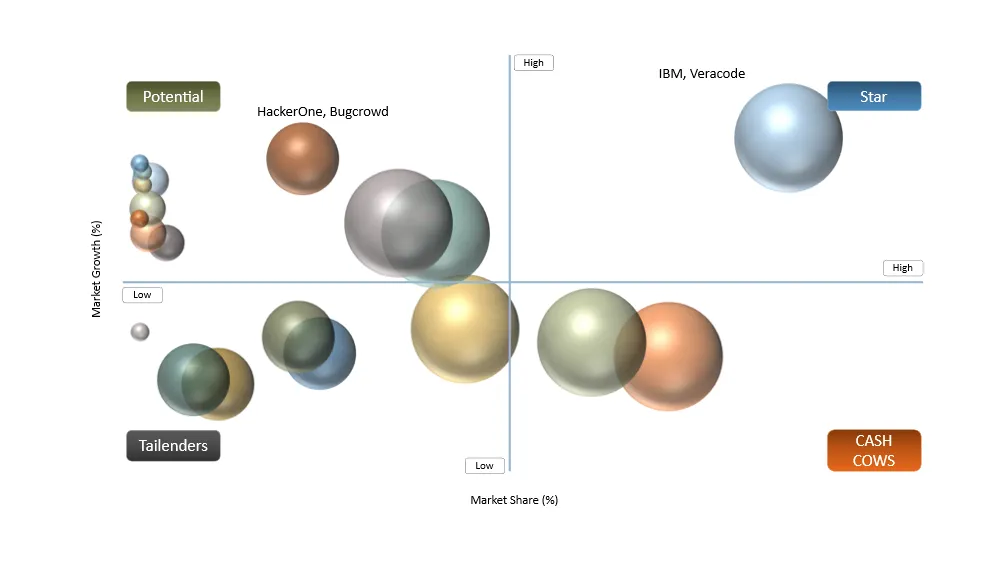
STAR
The IBM, Veracode, Rapid7, Tenable and Checkmarx companies are considered Stars in the Cybersecurity Testing Market because of their significant presence in application security, vulnerability assessment, penetration testing and continuous security validation services along with the increasing demand for cloud, API and automated security testing services. The wide range of enterprise clients and their testing solutions, together with the capability to incorporate testing within the DevSecOps and continuous security validation processes, provides good competitive advantage for the companies.
POTENTIAL
HackerOne, Bugcrowd, Cobalt, ImmuniWeb, Pen Test Partners and Contrast Security can be considered as Potential companies that offer great prospects to gain more market share in light of the growing demand for crowdsourced security testing, penetration testing, application security testing, AI-powered testing and red teaming. Despite their ability to address specific emerging needs (API security, AI/ML security testing, cloud-native apps, etc.), their size and penetration in the enterprise market are relatively smaller compared to the biggest industry players.
Cybersecurity Testing Market Dynamics
Driver Impact Analysis
| Driver | Market Growth Impact (%) | Demand Concentration | Impacted Use Case | Strategic Impact |
Rising frequency and sophistication of cyberattacks | 8.60% | BFSI, Government, Healthcare, IT | Penetration Testing & Vulnerability Assessment | Drives recurring security testing and increases enterprise testing budgets |
Rapid adoption of cloud and hybrid infrastructure | 7.90% | Cloud-intensive Enterprises, IT & Telecom | Cloud Security & Configuration Testing | Expands demand for continuous testing across multi-cloud environments |
Expansion of DevSecOps and CI/CD pipelines | 7.40% | Software, SaaS, Technology Companies | SAST, DAST, IAST & SCA | Shifts testing toward automated and continuous application security |
Increasing API, mobile and web application exposure | 6.90% | Digital Banking, E-Commerce, SaaS | API, Web & Mobile Application Testing | Increases demand for specialized application and API penetration testing |
Driver: Rising Complexity of Enterprise Attack Surfaces
The explosive growth in cloud workloads, APIs, web/mobile applications, containers, Kubernetes environment, IoT devices, remote access solutions and hybrid IT architectures is driving the need to continuously test a much larger variety of assets. While in the past testing could be primarily performed against static network and application assets, today’s environments have dynamic assets, exposed APIs, third-party integrations, cloud workloads that come and go and access points that present potential vulnerabilities between assessment intervals. The adoption of DevSecOps and continuous deployments of applications and code further drive the exposure by making more applications enter production more often. Consequently, enterprises are allocating more budget toward penetration testing, API security testing, cloud security assessments, attack surface discovery, vulnerability validation and continuous security testing, thereby ensuring the consistent need for automated platforms and manual penetration testing services to test modern complex environments at higher cadence.
Restraint Impact Analysis
| Restraint | Drag on Market Growth (%) | Primary Impact Area | Impacted Use Case | Strategic Impact |
Shortage of skilled cybersecurity testing professionals | 6.80% | Enterprise Security Teams | Penetration Testing & Red Teaming | Increases testing costs and limits the frequency of comprehensive assessments |
High cost of advanced testing tools and services | 5.90% | SMEs & Mid-Sized Enterprises | Automated & Continuous Security Testing | Encourages organizations to prioritize high-risk assets and adopt managed testing services |
Complexity of testing cloud, hybrid and multi-cloud environments | 5.40% | Cloud Infrastructure | Cloud Security Testing | Requires specialized expertise and increases testing time across distributed environments |
Disruption risks associated with security testing | 4.70% | Critical Infrastructure & Production Systems | Network, Application & OT Testing | Encourages controlled testing windows, staging environments and risk-based testing approaches |
Restraint: Shortage of Skilled Cybersecurity Testing Professionals
One of the main factors restraining the growth of the cybersecurity testing market is the dearth of professional penetration testers, ethical hackers, application security experts, cloud security experts and security testing researchers for artificial intelligence (AI)/large language models (LLMs). Advanced testing involves more than simple automated scanning and the need for validation of exploitations, attack chains, business logic flaws and risks associated with cloud, API, application, OT and AI infrastructure demands more skilled cybersecurity professionals than are currently available. As testing is expanding its scope and becoming more frequent, there will be shortages of personnel that might result in delays in testing cycles, cost escalation of services and difficulties in scaling up expert-led engagements. It is especially challenging in new fields such as AI agent security testing and cloud-native testing due to the lack of standardized skills for the testing field.
Cybersecurity Testing Market Segment Analysis
The global cybersecurity testing market is segmented based on the Testing Type, Testing Execution, Testing Strategy, Deployment, Organization Size, Service Model, asset/environment, end-use industry, and region.
By Testing Type
Application Security Testing Emerges as the Primary Testing Requirement for Digital Applications
The Application Security Testing Segment represented 50% of the worldwide Cybersecurity Testing Market in 2025, making it the most dominant market segment. The segment's dominance is bolstered by the fast-growing trends of web and mobile applications, APIs, cloud-native software and DevSecOps ecosystems, where there is a growing need for constant discovery of vulnerabilities throughout the software development lifecycle. The growth in demand for static application security testing, dynamic application security testing, interactive application security testing, software composition analysis, API security testing and secure code review is helping further strengthen the segment.
By Testing Type
AI/ML Security Testing Gains Traction as Organizations Strengthen AI Risk Controls
The segment of AI/ML Security Testing is projected to grow at a compound annual growth rate (CAGR) of about 21.1% in the period of 2026–2035, which makes it one of the fastest-growing segments of cybersecurity testing. The developmental pace is achievable because of fast-paced rollout of generative AI, LLMs, AI agents and AI-based applications that create security concerns that are impossible to handle with traditional application testing and network testing. Organizations are turning their attention to getting services such as prompt-injection testing, AI red teaming, adversarial testing, model-data security assessment, model poisoning detection, RAG security testing and AI supply-chain validation. As a result, AI has inevitably entered into business processes, including the process of testing AI technology.
Cybersecurity Testing Market Geographical Penetration
U.S. Cybersecurity Testing Market Landscape
U.S. Cybersecurity testing market can be referred to as a very matured and technology-driven market owing to high adoption of cloud infrastructure, APIs, DevSecOps, artificial intelligence implementations and hybrid IT architecture that constantly increases enterprise attack surfaces. The demand in this market is driven primarily by BFSI, healthcare, defense, government, technology, telecommunications and critical infrastructure sectors where penetration testing, application and cloud security testing, vulnerability assessment and third-party assessment are bolstered through the use of CMMC, PCI DSS and federal cybersecurity standards. This market is also witnessing rapid adoption of PTaaS, AI-enabled cybersecurity testing, exploit validation and continuous attack surface testing, thus making the US a key market for cybersecurity testing technologies.
Japan Cybersecurity Testing Market Outlook
The Japan Cybersecurity testing market is driven by rising digitization in manufacturing, automobile, financial services, healthcare, telecom and government sectors, along with rising use of cloud computing, connected devices, industrial networking and IoT. The large industrial and technology environment in the country is driving the need for penetration testing, application/API testing, cloud computing security testing and OT/IoT security testing, especially in cases where the connected production systems pose additional attack surfaces. Japan’s focus on cybersecurity resilience and supply chain security is also driving companies to improve their third party assessments and ongoing vulnerability testing. On the other hand, the use of AI-enabled testing, automated vulnerability identification and continuous security testing is opening up avenues for advanced testing providers that can cater to the needs of Japan’s increasingly complex environment.
China Cybersecurity Testing Market Trends
China’s Cybersecurity testing market is influenced by the fast-growing use of cloud computing, industrial internet, connected devices and applications in various sectors including manufacturing, finance, telecommunications and government systems. There is an increasing need for services such as network and application penetration testing, vulnerability testing, API testing, cloud security testing, data security testing and ICS testing as enterprises build more interconnected systems. In addition, due to the importance placed on cybersecurity, data security and critical information infrastructure protection, there is increasing demand for security assessment and compliance testing. Furthermore, there is an increasing number of AI systems and automated security technology in use, hence, the rising need for vulnerability discovery, continuous security validation and AI application testing.
Cybersecurity Testing Market Competitive Landscape
- The market is intensely competitive and fragmented, with diversified cybersecurity vendors including IBM, Rapid7, Qualys, Tenable and OpenText competing with other vendors who specialize in application security testing, penetration testing, crowdsource security and automation testing.
- Application security testing is one of the key areas of competition in the market, with vendors using SAST, DAST, IAST, SCA, API security testing and secure code review to differentiate themselves.
- Continuously and automatically validating security is becoming a new dimension of competition for vendors as businesses are increasingly demanding solutions that help them find out vulnerabilities on an ongoing basis in cloud computing environments, APIs, containers, endpoints and software development processes.
- Penetration Testing and crowdsourced security have become more significant, with firms like HackerOne, Bugcrowd, Cobalt and Pen Test Partners vying for superiority by leveraging their strengths in ethical hackers community, targeted penetration testing, red teaming, vulnerability finding and application/API security testing.
- AI/ML Security testing has become another new front where players are moving ahead to compete with each other in areas like LLM security testing, prompt injection testing, AI red teaming, adversarial testing, model/data security and AI supply chain validation.
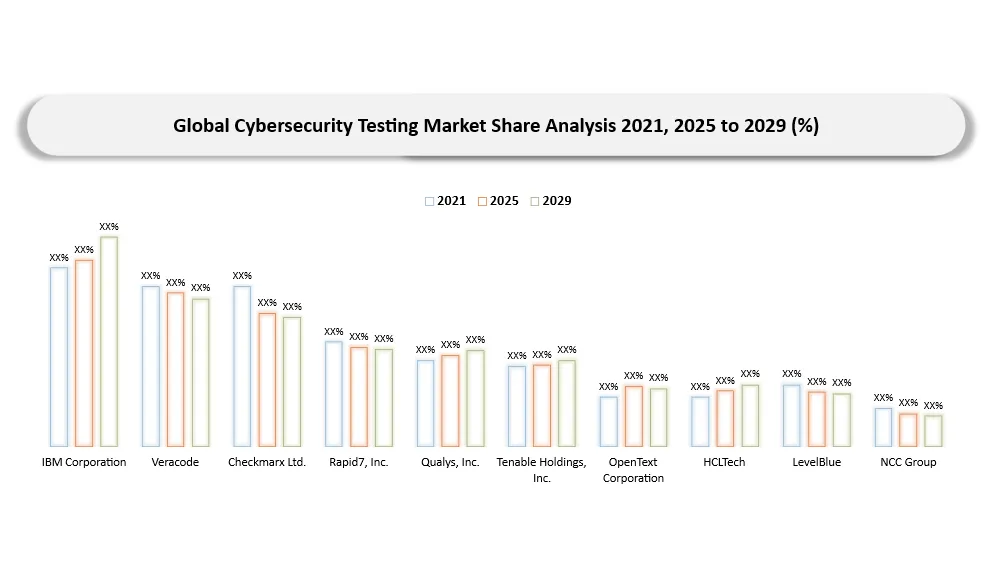
Key Companies of the Cybersecurity Testing Market
- IBM Corporation (United States)
- Veracode (United States)
- Checkmarx Ltd. (Israel)
- Rapid7, Inc. (United States)
- Qualys, Inc. (United States)
- Tenable Holdings, Inc. (United States)
- OpenText Corporation (Canada)
- HCLTech (India)
- LevelBlue (United States)
- NCC Group (United Kingdom)
- Contrast Security (United States)
- PortSwigger Ltd. (United Kingdom)
- Invicti Security (United States)
- HackerOne (United States)
- Bugcrowd (United States)
- Cobalt (United States)
- ImmuniWeb (Switzerland)
- Parasoft Corporation (United States)
- Black Duck (United States)
- Pen Test Partners (United Kingdom)
Cybersecurity Testing Market Major Pain Points
- Limited Skilled Testing Capacity: There is an acute shortage of experts for conducting penetrative tests, ethical hacking, cloud security and security in AI/LLMs, thereby limiting the capabilities to carry out comprehensive testing.
- High False-Positive Volume: Automated tools may produce several low-risk findings that can be redundant, causing more burden on analysts and slowing down the process of finding exploitable vulnerabilities.
- Rapidly Changing Attack Surfaces: Cloud workloads, APIs, containers, ephemeral infrastructure and continuously deployed applications may change rapidly compared to the periodic testing cycles.
- Difficulty Validating Complex Attack Chains: Conventional tools can spot individual vulnerabilities but will have difficulty showing how these can be exploited together as an attack chain, especially in business logic, identity and privilege escalation scenarios.
- Fragmented Testing Across Enterprise Environments: Enterprise security testing is done through different tools from different vendors, including application testing, API testing, cloud testing, network testing, IOT/OT testing and AI testing.
Cybersecurity Testing Market Recent Developments
- May 2025-IBM Corporation: IBM developed additional capabilities for AI Red Teams via IBM X-Force to improve automated testing and assessment of generative AI and LLMs.
- March 2025-Checkmarx Ltd.: Checkmarx upgraded its Checkmarx One product line with capabilities of security testing with AI specifically aimed at finding vulnerabilities of LLM applications, injection attacks on prompts and supply chain AI software.
- February 2025-Veracode: Veracode introduced additional AI-based remediation capabilities to Veracode Fix allowing automated fixing of vulnerabilities found by security testing and scanning.
- January 2025-Tenable Holdings, Inc.: Tenable added features like AI-powered attack path analysis and exposure management to Tenable One to make the exploitation of vulnerabilities easier to prioritize.
- February 2026-PortSwigger Ltd.: PortSwigger made significant upgrades to Burp Suite Enterprise that increased its automated testing, scanning and verification capabilities for APIs.
Analyst View / Opinion on Cybersecurity Testing Market
- Continuous Testing Will Outpace Periodic Assessments: The market is leaning towards Continuous Security Validation and PTaaS due to rapid changes within cloud environments, APIs, applications and attack surfaces.
- AI Will Reshape Testing Economics, Not Eliminate Expert Testers: AI can be used to automate tasks such as reconnaissance, creation of test cases, vulnerabilities identification and validation of exploits, but experts are still needed to address flaws in logic, complex attack vectors and risk assessment.
- API and Cloud Testing Will Become Core Enterprise Requirements: Growth of APIs, containers, Kubernetes and multi-cloud architectures will result in integration of API and cloud testing into enterprise testing programs.
- AI/LLM Testing Will Become a Distinct Testing Category: Increased use of generative and agentic AI will drive continuous need for prompt injection tests, model security testing, permission tests for agents, data leakage testing and AI red teams.
- Testing Vendors Will Compete on Validation Quality Rather Than Scan Volume: With automation-based vulnerability scanning becoming more of a commodity, vendors will be competing in terms of exploit validation, attack path validation, risk management and validation expertise.
Cybersecurity Testing Market Target Audience
| INDUSTRY | WHO SHOULD BUY THIS REPORT? | REASON TO BUY THIS REPORT |
| Cybersecurity & Security Services | CISOs, cybersecurity service providers, penetration testing firms | Assess market size, service demand, competitive positioning and emerging testing requirements |
| IT & Software | CIOs, CTOs, application security leaders, software companies | Evaluate demand for application, API, cloud and DevSecOps security testing |
| BFSI | Banks, insurers, fintech companies, security decision-makers | Identify security testing priorities driven by digital banking, APIs, payment systems and regulatory requirements |
| Healthcare & Life Sciences | Healthcare providers, health-tech companies, medical device manufacturers | Assess cybersecurity testing demand for connected medical devices, healthcare applications and sensitive data environments |
| Government & Defense | Government agencies, defense organizations, cybersecurity contractors | Evaluate testing requirements for critical infrastructure, government networks, cloud systems and defense applications |
| Telecommunications | Telecom operators, 5G providers, network security teams | Analyze opportunities in network, 5G, API, IoT and infrastructure security testing |
| Cloud & Data Center | Cloud providers, data center operators, infrastructure security teams | Identify demand for cloud penetration testing, vulnerability assessment, configuration testing and continuous security validation |
| Manufacturing & Industrial | Manufacturers, OT security teams, industrial technology providers | Assess opportunities in OT/ICS testing, IoT security testing and connected manufacturing environments |
| Retail & E-Commerce | E-commerce platforms, retailers, digital payment providers | Understand demand for web, mobile, API, payment and customer-data security testing |
| Technology Investors & Financial Institutions | Private equity firms, venture capital firms, investment analysts | Evaluate market growth opportunities, competitive landscapes, emerging technologies and investment potential |
Why Choose DATAM?
- Data-Driven insights: Dive into detailed analyses with granular insights such as pricing, market shares and value chain evaluations, enriched by interviews with industry leaders and disruptors.
- Post-Purchase Support and Expert Analyst Consultations: As a valued client, gain direct access to our expert analysts for personalized advice and strategic guidance, tailored to your specific needs and challenges.
- White Papers and Case Studies: Benefit quarterly from our in-depth studies related to your purchased titles, tailored to refine your operational and marketing strategies for maximum impact.
- Annual Updates on Purchased Reports: As an existing customer, enjoy the privilege of annual updates to your reports, ensuring you stay abreast of the latest market insights and technological advancements. Terms and conditions apply.
- Specialized Focus on Emerging Markets: DataM differentiates itself by delivering in-depth, specialized insights specifically for emerging markets, rather than offering generalized geographic overviews. The approach equips our clients with a nuanced understanding and actionable intelligence that are essential for navigating and succeeding in high-growth regions.
- Value of DataM Reports: Our reports offer specialized insights tailored to the latest trends and specific business inquiries. The personalized approach provides a deeper, strategic perspective, ensuring you receive the precise information necessary to make informed decisions. The insights complement and go beyond what is typically available in generic databases.
What DATAM Uniquely Provides
- Testing-Segment-Level Market Intelligence: Highly granular analysis covering penetration testing, vulnerability assessment, application security testing, cloud security testing, API testing, red teaming and continuous security validation.
- AI/LLM Testing Opportunity Mapping: Detailed assessment of future requirements for AI red teaming, prompt injection testing, agent security testing, AI-generated code testing and vulnerability discovery.
- Attack-Surface Demand Analysis: Analysis of testing demand for APIs, cloud workloads, applications, containers, IoT/OT systems and hybrid attack surfaces to determine where enterprise security testing spending is moving.
- Competitive and Service-Model Benchmarking: Comparative evaluation of testing vendors, automation platforms, managed service providers and PTaaS models in terms of capabilities, delivery modes, enterprise integrations and strategic positioning.
- Regional and Investment Opportunity Prioritization: Analysis and selection of top prospects for investment in geographies, testing markets, technology categories, procurement practices and themes in demand.


























































