


Cyber Risk Insurance Market Overview
The global cyber risk insurance market is estimated at US$ 16.30 billion in 2025 and is expected to reach US$ 44.26 billion by 2035, expanding at a CAGR of 10.50% during 2026-2035. The market is moving from a specialist liability product toward a core resilience instrument that combines risk transfer, security assessment, incident response, legal support and business recovery. Munich Re estimated the 2025 global cyber risk insurance market at approximately US$16.3 billion and expects premium volume to more than double by 2030, while cyber remains below 1% of global property and casualty premium. This gap underlines the commercial opportunity in underinsured mid-market companies, SMEs and emerging economies.
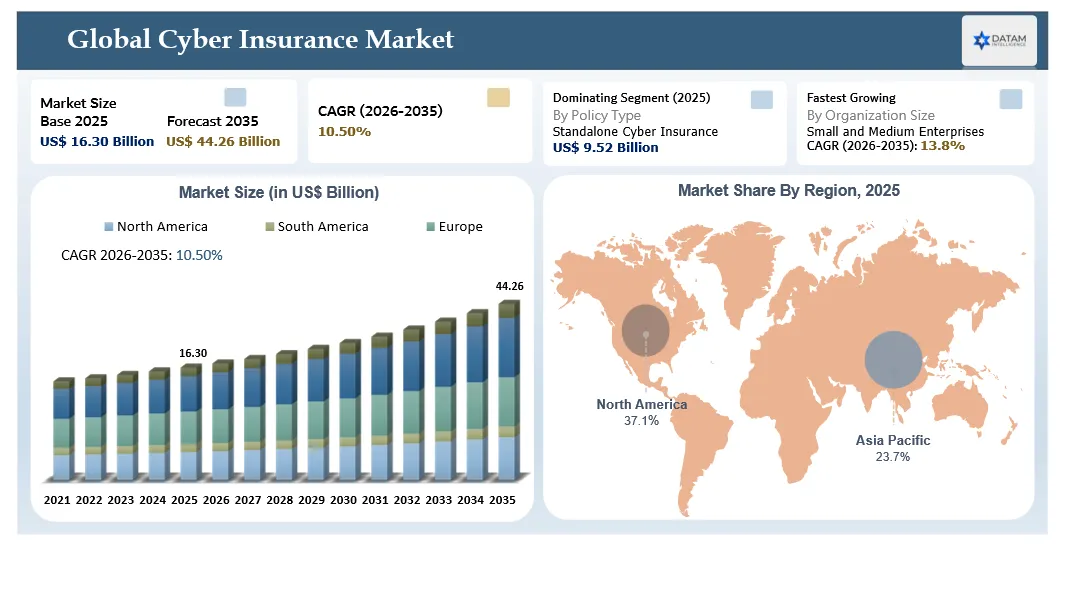
Loss drivers are becoming broader. Verizon analysed more than 22,000 security incidents and 12,195 confirmed breaches in its 2025 study. Third-party involvement doubled to 30%, vulnerability exploitation increased 34% and ransomware was present in 44% of breaches. Allianz Commercial reported that ransomware represented around 60% of the value of large cyber claims in the first half of 2025, while business interruption accounted for more than half of cyber claim value. Contingent business interruption claims linked to suppliers and technology dependencies increased to 15% of large claim value from 6% in 2024.
The economic case for coverage remains strong. IBM reported a global average data breach cost of US$ 4.44 million in 2025 and a US average of US$ 10.22 million. Healthcare remained the highest-cost industry at US$ 7.42 million per breach. Extensive use of AI in security was associated with US$ 1.9 million in savings compared with organisations that did not use those tools. These findings are changing underwriting conversations from questionnaires toward evidence-based security posture, continuous monitoring and measurable recovery capability.
The market outlook through 2035 will be shaped by SME penetration, stricter privacy and resilience rules, cloud concentration, AI-enabled fraud, operational technology exposure and the ability of insurers to manage accumulation. Capacity is currently competitive, but the line remains exposed to correlated events affecting cloud, software, payment or security infrastructure. Future winners will combine disciplined underwriting, responsive claims service, portfolio modelling and technology partnerships.
Market Snapshot
| Metric | Details |
|---|---|
| 2025 Market Size | US$ 16.30 Billion |
| 2035 Projected Market Size | US$ 44.26 Billion |
| CAGR, 2026-2035 | 10.50% |
| Largest Region | North America |
| Fastest Growing Region | Asia-Pacific |
| Largest Policy Type | Standalone Cyber Insurance |
| Fastest Growing Buyer Segment | Small and Medium Enterprises |
| Largest Industry | Banking, Financial Services and Insurance |
| Fastest Growing Risk Category | Cloud, Third-Party and AI-Related Risk |
| Core Report Coverage | Premium, coverage, buyer criteria, pricing, claims, regulation, regional opportunity and competitive landscape |
Cyber Risk Insurance Market Key Takeaways
- The market is estimated at US$ 16.30 billion in 2025 and projected to reach US$ 44.26 billion by 2035, supported by digital dependency, breach severity, regulation and underinsurance.
- North America remains the largest market. Munich Re reported that North America represented 69% of global cyber premium in 2024, while Europe accounted for 21%.
- Asia-Pacific is expected to expand fastest as India, Japan, Australia, Singapore and South Korea strengthen data protection, operational resilience and cyber governance requirements.
- Ransomware remains a major loss driver, accounting for around 60% of the value of large cyber claims during the first half of 2025 in Allianz Commercial data.
- Business interruption represents more than half of cyber claim value, making recovery time, backup quality and crisis coordination central underwriting factors.
- Third-party involvement reached 30% of breaches in the 2025 Verizon study and doubled from the prior year, increasing demand for contingent business interruption and supply-chain cover.
- Large-company claim severity declined by more than 50% and the frequency of claims above EUR 1 million fell around 30% in the first half of 2025, showing that security investment and insurer-led controls can improve loss outcomes.
- Cyber pricing entered a competitive phase. Marsh reported US cyber rates declined 3% in the fourth quarter of 2025, marking the eleventh consecutive quarterly decline.
- SMEs remain the largest protection gap because many smaller companies lack security teams, incident response retainers and sufficient insurance limits.
- AI expands both threat and underwriting opportunity. IBM found that 63% of organisations lacked AI governance policies and 97% of organisations with an AI-related incident lacked proper AI access controls.
Cyber Risk Insurance Market Scope
| Scope Item | Coverage |
|---|---|
| By Policy Type | Standalone cyber insurance, packaged endorsements, personal cyber and parametric cover |
| By Coverage Type | First-party, third-party, business interruption, cyber extortion, incident response, privacy liability and technology E&O |
| By Organization Size | Large enterprises, mid-market, SMEs and micro businesses |
| By Industry | BFSI, healthcare, manufacturing, retail, technology, professional services, energy, transport, public sector and education |
| By Distribution Channel | Brokers, direct insurers, MGAs, digital platforms, embedded channels, banks and technology partners |
| By Risk Category | Ransomware, data breach, cloud outage, supply chain, social engineering, operational technology and AI risk |
| By Service Component | Risk assessment, policy administration, continuous monitoring, incident response, claims and portfolio analytics |
| By Region | North America, Europe, Asia-Pacific, South America, Middle East and Africa |
Why does this report matter in 2026?
Cyber insurance matters in 2026 because boards are being asked to prove resilience while threat actors use automation and AI to accelerate attacks. The 2026 Verizon DBIR reported that vulnerability exploitation became the leading breach entry point at 31%, third-party supply-chain breaches rose to 48% and unapproved shadow AI use reached 45%. These risks affect both loss probability and accumulation, creating demand for underwriting that evaluates identity controls, software exposure, AI governance, vendor dependency and recovery readiness.
The report helps insurers identify profitable segments, helps brokers benchmark coverage and helps buyers understand what controls affect terms. It also supports investors assessing MGAs, cyber risk analytics, claims platforms, incident response networks and embedded distribution. The strongest opportunities are found where risk transfer is integrated with prevention, monitoring and recovery rather than sold as a stand-alone annual contract.
Cyber Risk Insurance Market White Space and Investment Opportunities
- SME products that combine insurance with managed detection, employee training, backup validation and incident response.
- Cloud outage and contingent business interruption cover supported by service dependency mapping and event triggers.
- AI risk cover for model misuse, data leakage, algorithm failure, intellectual property claims and AI-enabled fraud.
- Operational technology cyber cover for manufacturing, energy, logistics and infrastructure with physical damage extensions.
- Embedded cyber insurance distributed through banks, payment providers, SaaS platforms, managed service providers and accounting software.
- Portfolio accumulation analytics covering cloud, software, identity, payment, telecommunications and security infrastructure dependencies.
- Claims automation and breach-response orchestration that reduce time to containment, legal cost and business interruption.
Cyber Insurance Future Market Transformation
Cyber insurance will move toward continuous underwriting. Annual questionnaires provide a static view, while externally observable attack surface, endpoint telemetry, identity controls, patching performance and backup status change continuously. Insurers and MGAs are therefore investing in scanning, security integrations and policyholder risk services. The commercial model will increasingly reward measurable control improvement through lower retentions, broader cover or renewal guarantees.
Products will also separate event types more clearly. Cloud outage, ransomware, privacy litigation, social engineering and AI risk have different accumulation and claims characteristics. Parametric structures may be used where event duration or service unavailability can be independently verified. Public-private mechanisms may become more important for extreme systemic events that exceed private-market capacity.
Cyber Risk Insurance Market Buyer Decision-Making Criteria
Buyers compare policy wording, exclusions, sublimits, retention, insurer financial strength, breach-response panel quality, ransomware consent requirements, privacy coverage, dependent business interruption, social engineering treatment and territorial scope. Claims reputation is especially important because the product is tested during operational crisis. Buyers increasingly prefer insurers that provide pre-loss services and allow access to established legal, forensic and negotiation specialists.
Underwriters evaluate multifactor authentication, privileged access management, endpoint detection, backup segregation, patching, incident response plans, vendor controls, email security and governance. Buyers with mature controls can obtain better terms, while weak controls may lead to higher retentions, exclusions or reduced limits. The report links buyer requirements with the product and regional segments where those requirements create the strongest commercial opportunity.
Cyber Risk Insurance Market Economic and Investment Analysis
Cyber insurance is attractive because the protection gap remains large and premium is supported by structural digital growth. Munich Re estimated cyber premium at less than 1% of global property and casualty premium in 2025. The line also offers recurring annual revenue and opportunities for security, analytics and claims-service cross-selling. Investment is concentrated in MGAs, cyber risk models, continuous monitoring, embedded distribution and incident response.
Risk remains material. Correlated outages, widely used software vulnerabilities and common cloud dependencies can create losses across many insureds at once. Model uncertainty is higher than in mature insurance lines because technology and threat behaviour change rapidly. The most attractive platforms combine differentiated data, disciplined capacity relationships, strong renewal retention and proven claims outcomes.
Cyber Insurance Investment Trends in the Market
- Capital deployment into technology-enabled MGAs that combine underwriting with continuous security monitoring.
- Reinsurer investment in accumulation models, scenario testing and cloud dependency analytics.
- Broker expansion in cyber advisory, limit modelling, claims advocacy and incident response preparation.
- Insurer partnerships with managed security service providers, endpoint vendors, identity platforms and backup providers.
- Acquisition interest in specialty cyber portfolios, highlighted by the proposed 2026 Zurich acquisition of Beazley at approximately GBP 8 billion.
- Expansion of embedded cyber products for SMEs through banks, SaaS vendors and digital commercial insurance platforms.
Strategic Indicators for Cyber Risk Insurance Market
High Regulation Impact
Privacy laws, operational resilience rules and incident reporting create stronger board accountability and increase demand for insurance, legal support and breach response.
High Investment Activity
Capital is moving toward cyber MGAs, analytics, security partnerships, claims technology and specialty insurer consolidation.
Supply Chain Disruption
Cloud, software, managed service and security-provider dependencies can generate correlated losses across many insured organisations.
Pricing Volatility
Cyber pricing is currently competitive, but a major systemic event can rapidly tighten capacity and increase retentions.
Procurement Pressure
Boards and contractual counterparties increasingly ask for evidence of limits, coverage, security controls and incident response capability.
New Technology Adoption
Continuous scanning, AI-based underwriting, security telemetry and claims orchestration are changing the product from annual risk transfer to an active service.
Regional Expansion Opportunity
Asia-Pacific, Latin America and the Middle East offer underpenetrated growth as regulation and digital adoption increase.
Government Policy Support
Regulators are strengthening incident reporting, resilience testing and third-party risk management, indirectly supporting coverage demand.
Pricing Intelligence
| Pricing Factor | Buyer Impact | Strategic Interpretation |
|---|---|---|
| Security controls | MFA, EDR, backup and patching affect eligibility and retention | Insurers can use control improvement to create more stable portfolios |
| Industry exposure | Healthcare, finance, technology and critical infrastructure attract tighter underwriting | Sector-specific products and claims expertise support premium pricing |
| Revenue and data volume | Larger businesses and sensitive data increase expected severity | Limit and attachment structure must reflect realistic event cost |
| Third-party dependency | Cloud and software concentration increase contingent loss risk | Dependency mapping is becoming a core underwriting requirement |
| Claims history | Prior ransomware, breach or outage events affect terms | Remediation quality matters more than event count alone |
| Market capacity | Competition can reduce rates during benign loss periods | Systemic events may reverse pricing quickly |
AI Impact Analysis of Cyber Risk Insurance Market
AI affects cyber insurance on both sides of the balance sheet. Attackers use generative AI for phishing, social engineering and vulnerability exploitation, while insured organisations adopt AI without complete access control and governance. IBM found that 63% of organisations lacked AI governance policies and 97% of organisations reporting an AI-related incident lacked proper AI access controls. These gaps create new underwriting questions covering model access, training data, prompt injection, shadow AI and third-party AI services.
Insurers use AI for submission triage, external risk scoring, policy wording review, claims classification and fraud detection. Extensive AI use in security was associated with US$ 1.9 million lower breach cost in IBM data, supporting insurance incentives for automated detection and response. However, model error and opaque decision-making create governance obligations. Human oversight remains essential for coverage interpretation, claims decisions and portfolio accumulation.
Disruption Analysis of Cyber Risk Insurance Market
The market is being disrupted by the convergence of insurance and cybersecurity. MGAs and insurers increasingly provide scanning, alerting, employee training and incident response before a claim. This changes competition because providers are judged on risk reduction and claims outcome as well as price. Embedded distribution is also lowering acquisition cost for small businesses that have historically been difficult to reach through specialist brokers.
A second disruption is the shift from individual-company risk to shared digital infrastructure risk. Cloud, identity, software and telecommunications failures can affect many insureds simultaneously. The ability to model concentration and structure reinsurance will determine how much capacity the market can provide. A third disruption is AI, which creates new threat vectors and coverage questions across cyber, technology E&O, crime and professional liability.
Cyber Risk Insurance Market BCG Matrix: Company Evaluation
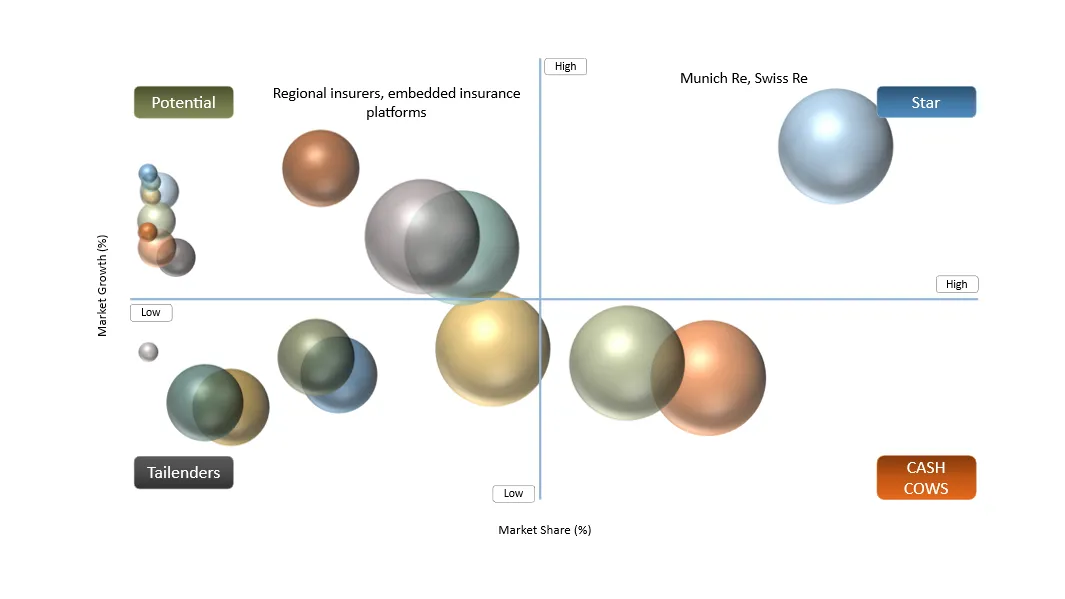
STAR: Munich Re, Swiss Re, Chubb, Beazley, AIG, Allianz Commercial, AXA XL, Zurich and Travelers are positioned as leading players due to underwriting scale, reinsurance capability, claims expertise and global distribution. Coalition, At-Bay, CFC, Cowbell, Resilience and Corvus represent high-growth technology-enabled platforms that combine underwriting with security data and services.
POTENTIAL: Regional insurers, embedded insurance platforms, cyber analytics providers and specialist MGAs can gain share through SME distribution, sector-specific products, local claims networks and differentiated data. Their success depends on stable capacity and disciplined portfolio management.
Cyber Risk Insurance Market Dynamics
Driver Impact Analysis
| Driver | Market Growth Impact (%) | Demand Concentration | Impacted Use Case | Strategic Impact |
|---|---|---|---|---|
| Rising breach and business interruption cost | 27% | Global, large and mid-market | First-party, business interruption and incident response | Raises demand for realistic limits and rapid recovery services |
| Regulation and board accountability | 23% | Europe, North America, Asia-Pacific | Privacy liability, regulatory defence and resilience | Moves cyber insurance into enterprise risk governance |
| Third-party and cloud dependency | 19% | Technology, finance, retail and manufacturing | Contingent business interruption | Creates demand for supplier and infrastructure coverage |
| SME digitalisation and underinsurance | 17% | SMEs across all regions | Packaged and embedded cyber cover | Expands policy count and digital distribution opportunity |
| AI-enabled threat and AI governance gaps | 14% | Technology-intensive sectors | AI risk, social engineering and data leakage | Creates new underwriting and product design requirements |
Driver: Rising Financial Severity of Cyber Events and Business Interruption
Cyber events create material recovery, legal, forensic and interruption costs. IBM reported a global average breach cost of US$ 4.44 million in 2025 and US$ 10.22 million in the United States. Healthcare breaches averaged US$ 7.42 million. Allianz Commercial reported that business interruption represented more than half of cyber claim value, while ransomware accounted for around 60% of the value of large claims in the first half of 2025. These data points support demand for higher first-party limits, incident response, data restoration and business interruption cover.
Severity is influenced by detection time and recovery maturity. Allianz reported that an attack reaching data theft and encryption can cost up to 1,000 times more than an incident contained early. This creates a direct commercial connection between insurance and security services. Insurers can improve loss ratios by helping buyers deploy endpoint detection, privileged access control, backup testing and response exercises. Buyers gain value through reduced downtime and a lower probability that an incident reaches destructive stages.
Driver: Regulatory Accountability and Contractual Insurance Requirements
Operational resilience and privacy rules are increasing board responsibility for cyber risk. The EU Digital Operational Resilience Act and NIS2 strengthen governance, incident reporting and third-party risk expectations. Comparable requirements are expanding in the UK, U.S., Australia, Singapore, India and other markets. Regulation does not always require cyber insurance directly, but it increases the cost of non-compliance and creates demand for breach counsel, notification, forensic work and regulatory defence.
Contractual requirements are also important. Customers, lenders, investors and supply-chain partners increasingly request evidence of cyber insurance and minimum limits before awarding contracts. This is particularly relevant for technology providers, professional services, healthcare vendors and managed service providers. Insurance therefore supports both risk transfer and commercial access. Brokers and insurers that provide certificates, coverage mapping and contract review can strengthen buyer retention.
Restraint Impact Analysis
| Restraint | Drag on Market Growth (%) | Primary Impact Area | Impacted Use Case | Strategic Impact |
|---|---|---|---|---|
| Systemic accumulation and cloud concentration | 24% | Insurer and reinsurer capacity | Cloud outage and widespread software events | Restricts limits and drives exclusions or event caps |
| Coverage complexity and buyer trust gap | 20% | Policy uptake and claims satisfaction | Ransomware, crime and technology failure | Creates uncertainty around what is insured |
| Limited SME security maturity | 17% | Eligibility and affordability | SME standalone and embedded cover | Raises underwriting friction and retention levels |
| Sparse historical data and model uncertainty | 15% | Pricing and portfolio management | Emerging AI and operational technology risk | Increases capital and reinsurance requirements |
| Competitive rate pressure | 12% | Underwriting profitability | Large account renewals | Can weaken discipline during benign loss periods |
Restraint: Accumulation Risk and Uncertainty Around Systemic Cyber Events
Cyber risk can accumulate through shared software, cloud, identity, payment and telecommunications infrastructure. A single event may affect thousands of insureds, making loss correlation more important than the risk of one company. Munich Re cited modelled industry accumulation potential of approximately US$ 20 billion to US$ 46 billion for severe scenarios with return periods up to 200 years. The uncertainty around extreme events limits capacity and can lead to sublimits, exclusions and event definitions that buyers find difficult to compare.
The market needs stronger dependency data and scenario standards. Insurers are mapping cloud providers, software versions, security vendors and critical suppliers, but many organisations cannot fully identify fourth-party dependencies. Reinsurance and capital markets can support growth, although investors require confidence in event definition and loss modelling. Public-private structures may be needed for the most severe systemic scenarios.
Restraint: Coverage Complexity, Exclusions and Buyer Trust Gaps
Cyber policies vary in treatment of war, infrastructure failure, ransomware payment, social engineering, technology errors, privacy fines and prior known incidents. Buyers may assume a loss is covered when it falls under crime, property, errors and omissions or another policy. Recent debate around high claim closure rates and uninsured loss categories shows that misunderstanding can reduce trust. Clear wording, broker advice and pre-loss coverage workshops are required to reduce disputes.
Complexity is especially difficult for SMEs. Smaller buyers may not have dedicated risk or legal teams and may purchase low limits or narrow endorsements. Digital products need plain-language coverage, rapid claims access and transparent exclusions. Providers that simplify policy design without weakening underwriting can expand penetration and improve renewal rates.
Cyber Risk Insurance Market Segment Analysis
The global cyber risk insurance market is segmented by policy type, coverage type, organisation size, industry, distribution channel, risk category, service component and region. Each segmentation lens reflects a different commercial decision. Policy type determines product structure, coverage type determines loss transfer, organisation size affects limits and distribution; industry determines severity and regulation, while service components determine how effectively the insurer reduces and manages loss.
By Policy Type: Standalone Cyber Insurance Will Remain the Largest Product Structure
Standalone policies remain the largest segment because they provide dedicated limits, specialist wording and access to cyber claims services. Large and mid-market buyers need coverage across breach response, business interruption, privacy liability, extortion and dependent service outages. Standalone policies also allow insurers to apply sector-specific underwriting and accumulation controls. Munich Re estimated global cyber premium near US$ 16.3 billion in 2025, with large corporations still accounting for the majority of premium. Packaged endorsements remain important for SMEs, but they often provide lower limits and narrower coverage. Parametric products are emerging for measurable cloud or network outages, although trigger design and basis risk remain challenges.
By Coverage Type: Business Interruption and Incident Response Are Gaining Strategic Weight
First-party coverage represents the core value proposition because cyber incidents create forensic, legal, restoration, extortion and interruption costs. Allianz Commercial reported that business interruption represented more than half of cyber claim value and that ransomware generated around 60% of large claim value in the first half of 2025. Contingent business interruption is growing as supplier-related claims represented 15% of large claim value in H1 2025 compared with 6% in 2024. Third-party liability remains essential for privacy, regulatory and network security claims. Buyers increasingly request broader waiting periods, longer indemnity periods and coverage for cloud, software and managed-service dependencies.
By Organization Size: SMEs Represent the Largest Uninsured Growth Pool
Large enterprises generate the largest premium because they purchase higher limits, layered programmes and global coverage. Their security maturity has improved, contributing to a decline of more than 50% in claim severity and around 30% in large-claim frequency in Allianz data for the first half of 2025. SMEs are the fastest-growing opportunity because they face ransomware, phishing and vendor compromise but often lack dedicated security teams. Digital distribution, pre-configured limits and bundled security services can reduce acquisition and underwriting cost. Insurers must manage adverse selection by requiring essential controls such as multifactor authentication, endpoint protection and tested backups.
By Industry: BFSI Leads Premium While Manufacturing and Healthcare Drive Severity Concerns
BFSI remains the largest industry segment because of high data sensitivity, digital transaction dependence, regulation and concentration of financial assets. Healthcare attracts high limits and strict underwriting because IBM reported an average breach cost of US$ 7.42 million in 2025, the highest across industries for the fourteenth consecutive year. Manufacturing accounted for 33% of large cyber claim value in Allianz analysis since 2020, reflecting operational technology exposure and production interruption. Professional services represented 18%, while retail represented 9%. Sector-specific underwriting and incident response expertise are therefore becoming more important than generic policy design.
By Distribution Channel: Brokers Retain Leadership While Embedded Channels Expand SME Reach
Insurance brokers remain the largest distribution channel because cyber coverage requires limit modelling, wording comparison, programme design and claims advocacy. Large accounts often use layered placements involving several insurers and reinsurers. MGAs are important because they combine specialist underwriting, capacity and technology. Digital platforms and embedded channels are growing faster among SMEs. Banks, SaaS platforms, managed service providers and accounting software can offer cyber cover at the point where business customers already manage digital risk. Embedded distribution can lower acquisition cost, but providers need clear consent, appropriate advice and efficient claims support.
By Risk Category: Third-Party, Cloud and AI Risks Are Expanding the Coverage Agenda
Ransomware remains a leading risk category, present in 44% of breaches in Verizon 2025 data and accounting for around 60% of large claim value in Allianz data. Third-party involvement doubled to 30% of breaches, while contingent business interruption rose sharply as a share of large claims. Cloud and software events create accumulation risk because a common dependency can affect many policyholders. AI creates new exposure through shadow AI, data leakage, deepfake fraud, prompt injection and model failure. The 2026 Verizon study reported shadow AI use at 45% and third-party supply-chain involvement at 48%, making vendor and AI governance central underwriting questions.
By Service Component: Continuous Monitoring and Claims Response Will Outgrow Standalone Policy Administration
Risk assessment and underwriting remain the largest service components, but continuous monitoring and incident response are expanding faster. External scanning, endpoint telemetry, identity data and backup validation allow insurers to identify risk changes between renewals. Claims services include breach counsel, forensics, notification, negotiation, public relations and recovery. Rapid access to these services can materially reduce loss. IBM reported US$ 1.9 million lower breach cost among organisations with extensive AI-based security use. Insurers that demonstrate measurable loss reduction can improve renewal retention and defend pricing even in competitive markets.
Additional Segmentation by Policy Limit and Retention Structure
Cyber programmes can also be segmented by primary limit, excess limit, captive participation and retention. SMEs typically purchase lower primary limits, while large enterprises use towers with several insurers. Retention is a key pricing lever because it determines how much frequent loss remains with the buyer. Captives are increasingly used by large companies to retain predictable cyber loss and access reinsurance. The report evaluates how limit availability and retention differ by sector, region and security maturity.
Additional Segmentation by Underwriting Maturity
Buyers can be grouped into questionnaire-led, control-validated and continuously monitored underwriting models. Questionnaire-led products are efficient for smaller risks but can suffer from inaccurate self-reporting. Control validation uses scans, interviews and documentary evidence. Continuous models use ongoing external or internal security data. The latter can support dynamic risk services and faster renewal, but requires data governance and clear treatment of false positives.
Cyber Risk Insurance Market Geographical Penetration
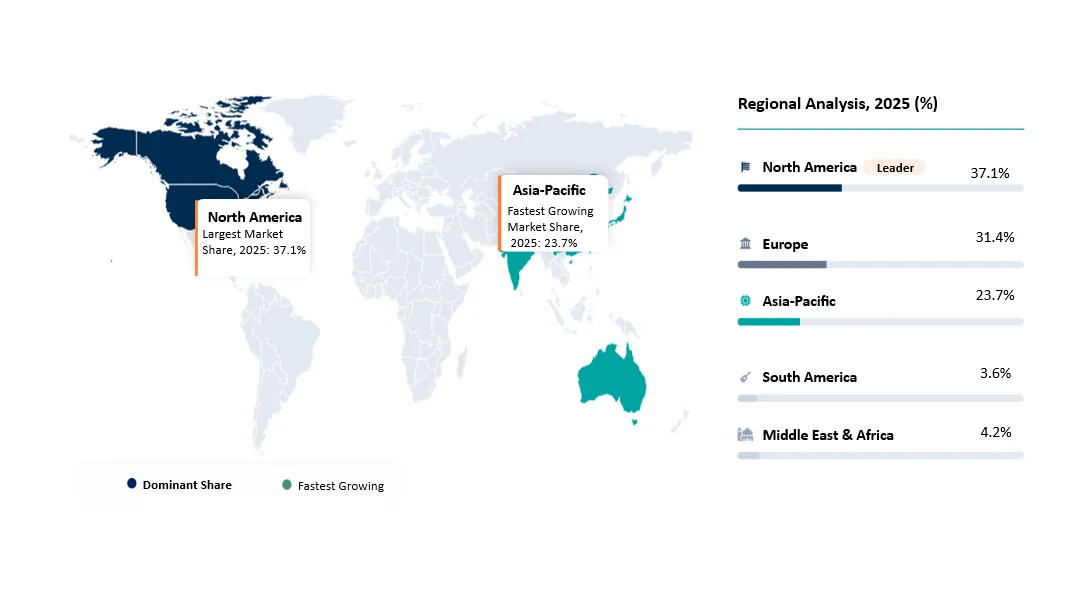
North America remains the largest market due to mature broker distribution, high limits, strong insurer capacity and contractual demand. Europe is the second-largest region, supported by privacy and resilience regulation. Asia-Pacific is the fastest-growing region as digital economies and regulatory frameworks mature. South America and Middle East and Africa remain smaller premium pools but offer significant underinsured opportunity.
North America Cyber Risk Insurance Market Outlook
North America represented 69% of global cyber premium in Munich Re data for 2024 and remains the centre of global capacity, brokerage and claims expertise. The United States has the highest breach cost, at US$ 10.22 million on average in IBM 2025 data. Buyers benefit from competitive capacity, with Marsh reporting a 3% decline in US cyber rates in the fourth quarter of 2025 and an eleventh consecutive quarterly decrease. Future growth will come from SMEs, cyber-physical coverage, higher contingent interruption limits and integration of security telemetry.
| Country | Opportunity | Buyer-Intent Insight |
|---|---|---|
| U.S. | Large programme capacity, SME platforms, cloud outage, privacy, ransomware and cyber-physical cover | Buyers prioritise claims reputation, broad wording, limits and pre-loss services |
| Canada | Privacy liability, critical infrastructure, financial services and public-sector cover | Demand is supported by regulatory accountability and cross-border operations |
| Mexico | Manufacturing, financial services and nearshoring supply chains | Local claims support and affordable packaged products are important |
Europe Cyber Risk Insurance Market Outlook
Europe accounted for 21% of global cyber premium in 2024 and recorded a 26% CAGR between 2020 and 2024 according to Munich Re. DORA, NIS2, GDPR and national resilience rules are increasing demand for incident response and third-party risk coverage. The UK remains a major specialty insurance centre, while Germany, France, the Netherlands and Switzerland have strong corporate demand. Capacity is available, but underwriters closely assess systemic dependencies and ransomware controls.
| Country | Opportunity | Buyer-Intent Insight |
|---|---|---|
| UK | Specialty underwriting, MGAs, brokers, technology firms and critical infrastructure | Buyers value broad market access and claims expertise |
| Germany | Manufacturing, automotive, healthcare and mid-market companies | Operational technology and supply-chain exposure are key |
| France | Financial services, healthcare, retail and public entities | Privacy, ransomware and business interruption drive demand |
| Netherlands | Technology, logistics, cloud and international trade | Cross-border programmes and contingent interruption are important |
| Switzerland | Financial services, pharmaceuticals and multinational headquarters | High limits, captive structures and global coverage are common |
Asia-Pacific Cyber Risk Insurance Market Outlook
Asia-Pacific is the fastest-growing region because cyber insurance penetration remains low relative to digital exposure. Verizon reported that system intrusion caused 80% of APAC breaches, malware was present in 83% and ransomware in 51%. India recorded an average breach cost of INR 220 million in 2025, 13% above 2024. Australia, Japan and Singapore have mature corporate demand, while India and Southeast Asia offer large SME and mid-market opportunities. Regional products need local-language claims support and alignment with national data rules.
| Country | Opportunity | Buyer-Intent Insight |
|---|---|---|
| India | BFSI, technology services, healthcare, manufacturing and SME cover | INR 220 million average breach cost and stronger data governance support demand |
| Japan | Manufacturing, automotive, financial services and supply-chain coverage | Buyers value insurer stability and local claims coordination |
| Australia | Mid-market, professional services, healthcare and critical infrastructure | Board accountability and ransomware exposure are strong triggers |
| Singapore | Regional headquarters, finance, logistics and technology | Cross-border programmes and regulatory compliance are important |
| South Korea | Technology, manufacturing, gaming and e-commerce | Data breach and business interruption are key buying themes |
South America Cyber Risk Insurance Market Outlook
South America is underpenetrated but benefits from digital banking, e-commerce and privacy regulation. Brazil is the largest market, supported by LGPD compliance and large financial, retail, healthcare and industrial sectors. Argentina, Chile and Colombia offer selective opportunities. Buyers often face limited local capacity and rely on brokers to structure multinational programmes. Products with incident response, legal support and ransomware assistance can improve adoption.
Middle East and Africa Cyber Risk Insurance Market Outlook
Demand in the Middle East is rising through financial services, oil and gas, aviation, healthcare, smart-city investment and data regulation. UAE and Saudi Arabia are the principal growth markets. South Africa has the most developed African corporate insurance market and significant financial, mining and retail exposure. Israel contributes cyber technology and risk analytics capability. Growth depends on buyer education, local underwriting and regional incident response networks.
Cyber Risk Insurance Market Competitive Landscape
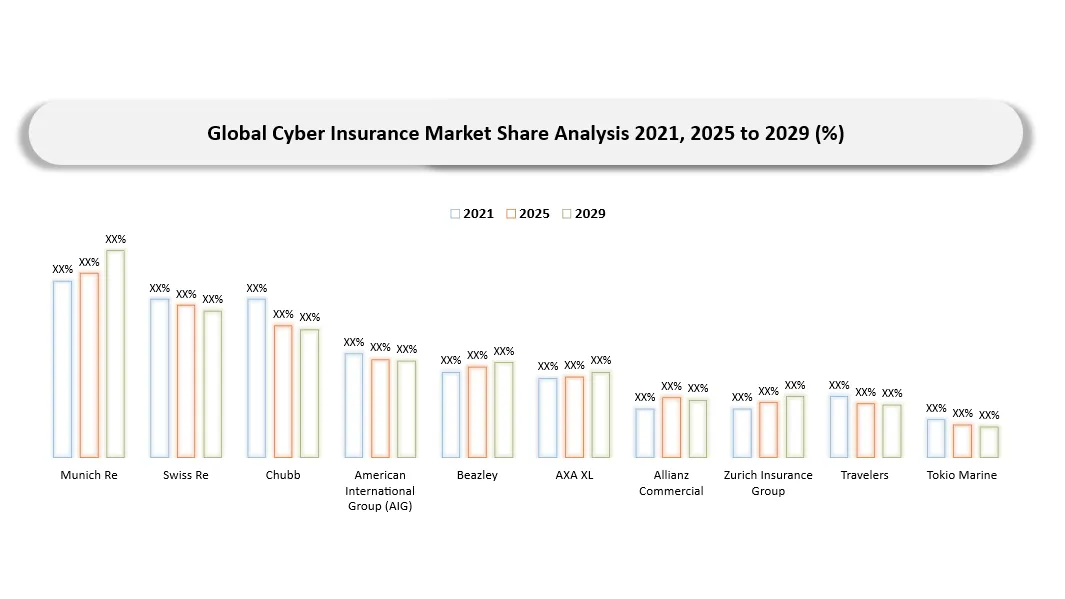
- Competition is moving from price and limit capacity toward underwriting data, claims response and prevention services.
- Global insurers and reinsurers compete through capital, global programme capability and accumulation modelling.
- MGAs compete through faster underwriting, security telemetry, digital distribution and specialist SME products.
- Brokers are expanding cyber advisory, limit modelling, policy wording comparison, claims advocacy and incident response preparation.
- Consolidation is increasing, illustrated by Zurich’s proposed 2026 acquisition of Beazley at approximately GBP 8 billion.
- Partnerships with security, identity, backup, cloud and incident response providers are becoming core competitive assets.
Key Companies of Cyber Risk Insurance Market
- Munich Re
- Swiss Re
- Chubb
- AIG
- Beazley
- AXA XL
- Allianz Commercial
- Zurich Insurance Group
- Travelers
- Tokio Marine
- Sompo
- CFC
- Coalition
- At-Bay
- Cowbell
- Resilience
- Corvus Insurance
- Marsh McLennan
- Aon
- Howden
Cyber Risk Insurance Market Major Pain Points
- Uncertainty around correlated cloud, software and infrastructure events.
- Inconsistent policy language across war, crime, ransomware, privacy fines and technology failure.
- Limited SME security maturity and low awareness of coverage value.
- Difficulty obtaining accurate third-party dependency and software exposure data.
- Rapid threat evolution that can make historical loss data less predictive.
- Rate competition that may weaken underwriting discipline.
- Claims disputes caused by misunderstanding of sublimits, exclusions and policy interaction.
- Shortage of cyber underwriting, actuarial, forensic and claims expertise in emerging markets.
Cyber Risk Insurance Market Recent Developments
- April 2026: Munich Re released its Global Cyber Risk and Insurance Survey covering more than 9,500 respondents in 20 countries and estimated the 2025 market at nearly US$ 15 billion, with premium expected around US$ 28 billion by 2030.
- February 2026: Zurich agreed an approximately GBP 8 billion transaction to acquire Beazley, strengthening specialty and cyber insurance capability, subject to completion conditions.
- May 2026: Verizon published its 2026 DBIR, reporting vulnerability exploitation at 31% of breach entry points, third-party involvement at 48% and shadow AI use at 45%.
- Q4 2025: Marsh reported US cyber rates declined 3% for the eleventh consecutive quarter, while capacity remained stable and reinsurers increased focus on technical underwriting.
- September 2025: Allianz Commercial reported cyber claim severity fell more than 50% and large-claim frequency declined around 30% in H1 2025, while supply-chain losses gained share.
- August 2025: IBM reported India’s average breach cost reached INR 220 million, with phishing, third-party compromise and vulnerability exploitation as leading attack vectors.
Analyst View / Opinion on Cyber Risk Insurance Market
- Cyber insurance will remain one of the fastest-growing commercial insurance lines because digital exposure and regulation continue to outpace coverage penetration.
- Price competition is likely to continue in the near term, but a large systemic event can rapidly change capacity and terms.
- SME growth will depend on simplified products, embedded distribution and bundled security services.
- Continuous underwriting and claims-response capability will become more important than annual questionnaires.
- Third-party, cloud and AI risks will determine the next generation of policy wording and accumulation models.
- Long-term leadership will depend on combining capital, data, security partnerships and trusted claims execution.
Cyber Risk Insurance Market Target Audience
| Industry | Who Should Buy This Report? | Reason to Buy This Report |
|---|---|---|
| Insurers and Reinsurers | Cyber heads, underwriters, actuaries and product teams | Assess premium pools, loss drivers, product gaps and regional expansion |
| MGAs and Insurtechs | Founders, capacity teams and product leaders | Identify SME, embedded and technology-enabled underwriting opportunities |
| Brokers | Cyber practices, placement teams and claims advocates | Benchmark coverage, capacity, pricing and buyer criteria |
| Cybersecurity Providers | MSSPs, EDR, identity, backup and risk analytics firms | Identify insurer partnerships and insurance-linked distribution |
| Corporate Buyers | CISOs, risk managers, finance and legal teams | Evaluate coverage structure, controls, limits and supplier selection |
| Investors and Consultants | Private equity, venture capital and strategy teams | Screen MGAs, analytics, claims and cyber service platforms |
Why Choose DATAM?
- Data-driven insights covering premium, pricing, claims, capacity, buyer requirements and regional adoption.
- Post-purchase analyst support for market entry, partner selection, product positioning and acquisition screening.
- White papers and case studies covering ransomware, cloud outage, AI risk, SME distribution and accumulation.
- Annual updates reflecting threat, regulation, pricing and competitive developments.
- Specialised focus on emerging markets including India, Southeast Asia, Middle East, Latin America and Africa.
- Value of DataM Reports through actionable buyer and competitor intelligence rather than market size alone.
What DATAM Uniquely Provides
- Detailed ten-year market predictions by policy type, coverage, organisation size, industry, channel, risk category, service component and region.
- Cyber buyer decision intelligence covering policy limits, exclusions, retention, security controls and claims service.
- Claims and threat analysis linked to ransomware, business interruption, supply chain, cloud, privacy and AI.
- Strategic analysis through AI impact, disruption, BCG Matrix, pricing, investment and white-space evaluation.
- Country-level opportunity recommendations for insurers, MGAs, brokers, security vendors and investors.
- Customised analysis through DMI Insights and DMI Connect based on client strategy and target segments.
Questions This Report Answers
- How will cyber insurance premium evolve through 2035?
- Which policy and coverage types will create the strongest growth?
- How are ransomware, cloud and supply-chain losses changing underwriting?
- Where is the largest SME protection gap?
- How will AI affect cyber risk, policy wording and claims?
- Which regions offer the best expansion opportunity?
- Which companies are best positioned and what strategies are they using?


























































