


CXL Memory Market Size and Overview
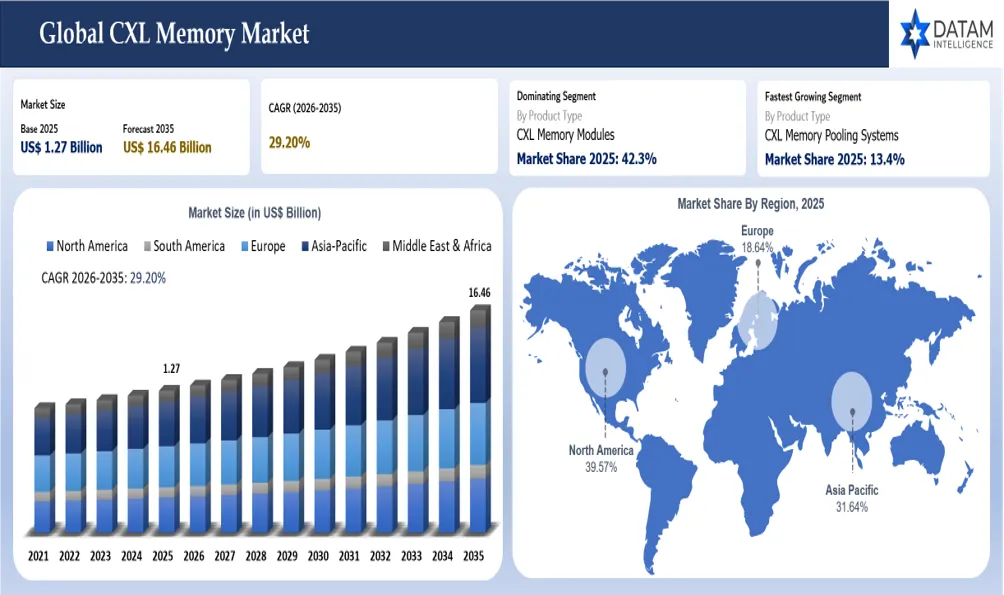
The global CXL memory market reached US$ 1.27 billion in 2025 and is expected to reach US$ 16.46 billion by 2035, growing with a CAGR of 29.20% during the forecast period 2026-2035.
The growing need for scalable memory capacity in AI, high-performance computing, cloud and data-heavy workloads is shaping the CXL memory market. CXL allows servers to incorporate memory beyond the usual CPU-connected DRAM interfaces through PCIe, allowing for advanced memory configurations with more capacity and versatility. The commercial CXL memory products consist of low-level capabilities of 128GB and 256GB, while their multi-module configurations can increase the memory by an amount of 2TB per server. The launch of Samsung CXL 3.2 memory devices, which offer memory with a capacity of 256GB, highlights the shift toward higher-density memory expansion in the next-generation servers.
The industry is transitioning from a model of direct-attached memory expansion to CXL 3.x memory pooling, sharing and disaggregation. CXL 3.2 utilizes PCIe 6.x at a maximum speed of 64 GT/s. Current CXL memory controllers support DDR5 with speeds of more than 8000 MT/s. These technological advances are important for AI and hyperscale data centers since they are struggling to meet memory demand and traditional DDR capacities could be insufficient. Thus, we can say that currently CXL is transforming from a memory-expansion interface to an infrastructure layer for dynamic allocation and scag of memory resources.
CXL Memory Market Key Takeaways
- CXL Memory Modules led the global CXL memory market in 2025, capturing a market share of 42.3%, based on demand for high memory expansion in AI servers, hyperscale data centers, HPCs and memory-intensive enterprise applications.
- CXL Memory Pooling Systems were anticipated to experience the highest growth among the product segments, with a CAGR of 34.8%, owing to the capability of CXL 3.x for multi-host memory sharing, capacity allocation and memory disaggregation.
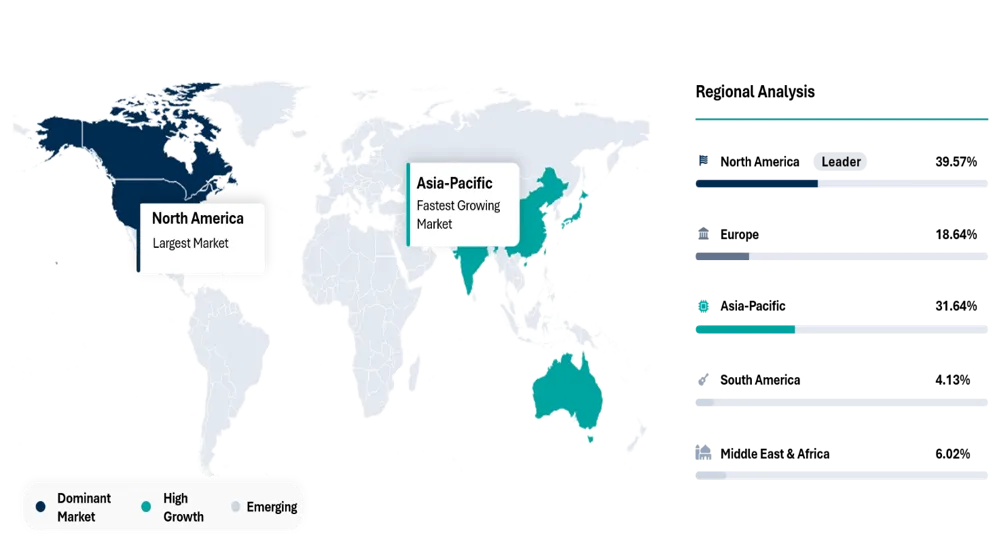
- North America led the global CXL memory market with 39.57% of the total market share in 2025, owing to a high presence of hyperscale data centers, AI infrastructure spending, cloud service providers and server-platform innovation.
- The rise in use of CXL 3.x and CXL 3.2 is contributing to the shift from direct-attach memory expansion to memory pooling, memory sharing, capacity devices and composable memory at the rack scale.
- Increasing demands on AI and HPC in terms of memory are leading to more requirements for 128 GB, 256 GB, 512 GB, 1 TB and multi-terabyte CXL implementations, which allow CXL-attached memory to become a part of the solution along with HBM and DDR.
CXL Memory Industry Trends and Strategic Insights
- CXL 3.x is driving the move away from point-to-point memory expansion towards pooled memory and composable memory designs which allow several compute nodes to have access to dynamically assigned memory pools.
- The need for large CXL memory comes mainly from the AI and HPC use cases that require large capacities of CXL memory as the capacity of the DDR5 memory attached to the processors cannot keep up with the rising sizes of models and datasets.
- CXL memory is becoming an essential component of memory architecture, acting as a middle tier between local DDR and high-bandwidth memory and enabling system architects to optimize volume, bandwidth, delay and cost in heterogeneous memory.
- Memory disaggregation is acquiring significance from a strategic point of view in hyperscale data centers, as memory capacity can be allocated dynamically depending on the needs of the workloads, avoiding, in turn, stranded memory capacity.
- CXL memory providers are emphasizing on the development of large memory capacity, memory pooling and software-defined tiering technologies and in that way, they see CXL as infrastructure technology for memory usage, not just as an expansion technology for memory.
CXL Memory Market Scope
| Metrics | Details | |
| 2025 Market Size | US$ 1.27 Billion | |
| 2035 Projected Market Size | US$ 16.46 Billion | |
| CAGR (2026-2035) | 29.20% | |
| Largest Market | North America | |
| Fastest Growing Market | Asia-Pacific | |
| By Component | Hardware, Software and Services | |
| By Memory Type | DDR5 DRAM, DDR6 DRAM, Persistent Memory and Other Memory Technologies | |
| By Product Type | CXL Memory Modules, CXL Memory Appliances, CXL Memory Expanders, CXL Memory Pooling Systems and Others | |
| By CXL Generation | CXL 1.x, CXL 2.0, CXL 3.0/3.1, CXL 3.2 and CXL 4.0 & Above | |
| By Deployment Architecture | Direct-Attached Memory Expansion, Switched Memory Expansion, Memory Pooling, Memory Sharing, Memory Disaggregation and Rack-Scale Composable Memory | |
| By Form Factor | EDSFF E3.S, EDSFF E3.L, PCIe Card, Rack-Mounted and Other Form Factors | |
| By Memory Capacity | Up to 512 GB, 513 GB-1 TB, 1-2 TB, 2-4 TB and Above 4 TB | |
| By Application | Artificial Intelligence & Machine Learning, High-Performance Computing, Cloud Computing, In-Memory Databases, Big Data & Analytics, Virtualization, Enterprise Computing, Edge Computing and Others | |
| By End-User | Cloud Service Providers & Hyperscalers, Enterprise Data Centers, Telecommunications, BFSI, Healthcare & Life Sciences, Manufacturing, Government & Research and Others | |
| By Region | North America | U.S., Canada, Mexico |
| Europe | Germany, UK, Russia, France, Spain, Italy, Poland | |
| Asia-Pacific | China, India, Japan, Australia, South Korea, Indonesia, Malaysia, Singapore, Vietnam, Thailand, Philippines, Taiwan | |
| South America | Brazil, Argentina | |
| Middle East and Africa | UAE, Saudi Arabia, South Africa, Israel, Turkiye, Nigeria | |
| Report Insights Covered | Competitive Landscape Analysis, Company Profile Analysis, Market Size, Share, Growth | |
Why does this report matter in 2026?
In 2026, CXL memory is becoming more and more relevant to AI and advanced data center structures due to growing model sizes and data workloads that contribute to limitation in traditional CPU-based memory systems. The report discusses the acceptance of CXL memory expansion, pooling and disaggregation as other alternative solutions for memory scaling.
The report gives essential information about the use of CXL 3.x, the creation of memory modules with high memory capacity, wide-scale usage, strategies of competitors and the development of new types of memory architectures. These points will help investors realize where commercial success of CXL memory happens.
CXL Memory Market White Space & Investment Opportunities
- High-Capacity CXL Memory Modules for AI Servers: Progress will be made in creating CXL memory modules that range between 512 GB and upwards of 1 TB which can fulfill the increasing capacity needs for AI training, inference and other workloads that require intensive memory on servers.
- Multi-Host CXL Memory Pooling Solutions: Funds will be directed toward CXL-based pooled-memory solutions that can facilitate the shared memory access among numerous CPU processors, with the aim to deploy the systems in hyperscale data centers.
- Persistent and Flash-Based CXL Memory: There is an opportunity to create cost-effective CXL memory which is more capacious using persistent or flash memory instead of DRAM memory where increasing memory would be unaffordable.
- CXL 3.x/4.x Rack-Scale Memory Infrastructure: Investment opportunities in new generation CXL memory fabric architecture for multi-host, dynamically configurable capacity and rack-scale memory disaggregation.
- CXL-Aware Memory Tiering Software: Development of software that efficiently organizes and distributes data into various types of memory such as HBM, local DDR and CXL-attached memory.
CXL Memory Future Market Transformation
CXL memory is anticipated to revolutionize the design of servers as memory moves from being a static and CPU-local component to becoming a scalable and shareable component. The innovations in CXL 3.x and beyond will pave the way for multi-host memory pooling, dynamic capacity provisioning and rack scale memory disaggregation, enabling data centers to allocate memory irrespective of the individual CPUs and improve overall memory utilization.
The market is expected to move towards heterogeneous memory architectures that include multiple tiers of both HBM and DDR and CXL-attached memory, with each tier catering to different levels of performance and capacity. As AI, HPC and hyperscale workloads continue to grow, we expect CXL to evolve from mere memory expansion to a programmable memory infrastructure layer supporting composable computing and workload-aware memory allocation.
CXL Memory Market Buyer Decision-Making Criteria
CXL memory buyers judge offerings on the basis of whether they can increase memory capacity while keeping latency, bandwidth, compatibility and operational overhead at acceptable levels. For hyperscalers, AI infrastructure vendors and enterprise data centers, the decision goes beyond memory module capacity to support for CXL generation, platform compatibility, workload performance, memory pooling abilities, power savings and total cost of ownership.
Major Buyer Decision Criteria
- CXL Version & Protocol Compatibility
- Memory Capacity & Scalability
- Memory Bandwidth & Latency
- Host CPU & Server Compatibility
- Memory Pooling & Disaggregation Support
- Workload Performance
- Interoperability
- Power Consumption & Thermal Requirements
- Reliability & Data Integrity
- Total Cost of Ownership
CXL Memory Market Economic & Investment Analysis
CXL memory economics are based on the growing expense of scaling regular server memory along with AI and data-centric applications. CXL makes it possible to scale memory capacity independent of CPU memory and pool and disaggregate memory to make more effective use of the installed memory capacity. These aspects can be especially important for hyperscale data centers where memory capacity and utilization along with infrastructure costs influence the total cost of ownership.
Investments are increasingly concentrated on CXL memory modules of higher capacity, CXL 3.x memory pools architecture and software solutions for memory allocation and tiering. The market attractiveness is driven by data center capital expenditure on AI, price and availability of DRAM, server platform integration of CXL, interoperability requirements and capabilities of CXL architecture to bring noticeable performance improvement.
CXL Memory Investment Trends in the Market
- Investing is focused on CXL DRAM modules with a larger capacity as a response to the demand for increased server memory for AI, HPC and data-intensive applications.
- Hyperscalers investment efforts concentrate on CXL memory pooling and disaggregation techniques, which allow for a better allocation of memory resources across computing nodes.
- Semiconductors have started investing more in development and testing of CXL 3.x and new memory technologies characterized by larger capacity, better bandwidth and better memory management.
- The investment is focused on the development of CXL fabric infrastructure, which includes the use of certain controllers, switches and other components necessary to connect many hosts with shared memory on the rack level.
- Increasing financial support is being directed towards the development of CXL memory software and other management platforms, especially the programs that help optimize the use of memory in HBM, DDR and CXL connected systems.
Strategic Indicators for the CXL Memory Market
High Regulation Impact
Industry standards and compliance regulations for interoperability of memory products, reliability of memory technology and high-speed connectivity have a major impact on the growth of the CXL memory market. Adherence to the CXL Consortium specifications, PCI-SIG PCIe standards and JEDEC memory standards is mandatory to achieve compatibility for the devices of CXL memory. Moreover, specifications for ECC and RAS, firmware security, electromagnetic compatibility and data integrity are also important for assessing and certifying products for use in enterprise and hyperscale data centers.
High Investment Activity
The investments happening in the CXL memory market are now turning towards high-density memory modules, CXL 3.x pooling and memory disaggregation technologies in order to fulfill the increasing demand for memory in AI servers and hyperscale data centers. Businesses are creating products with more powerful CXL memory and technology to ensure that the memory capacity of the product is maximized.
Investments are also expanding into the CXL memory ecosystem, which encompasses advanced memory packaging, CXL controllers, fabric technology and software that enables dynamic memory allocation and tiering. The move towards rack-scale and composable memory is generating more investment needs, as data centers consider using CXL for memory management at scale.
Supply Chain Disruption
CXL memory supply chain risks exist due to the fact that CXL memory devices are built using advanced DRAMs, semiconductor packaging, CXL controller chips and other components used to build PCIe interfaces and high-density memory modules. Any disruption within the DRAM wafers production, advanced semiconductor packaging and semiconductor logistics can influence CXL memory modules production and pricing. The relatively narrow supplier list of advanced memory components makes CXL memory manufacturers more vulnerable to geopolitical risks and capacity allocation towards AI memory chips, making supply availability a key consideration for CXL memory manufacturers and data-center customers.
Pricing Volatility
The price of CXL memory is substantially impacted by the price of DRAM for servers which is a primary component of DRAM-based CXL memory solutions. For the third quarter of 2026, TrendForce anticipates that conventional DRAM prices will rise by 13-18% quarter-over-quarter after an increase of about 58-63%. The quarter-on-quarter prices will go up owing to limited supplies and AI server demand. Therefore, the changes in prices of DRAM memory, along with the growth of competition between other advanced memory technologies such as HBM and conventional server DRAM, can have an impact on CXL memory module prices.
Procurement Pressure
The procurement challenges for the CXL memory market are on the rise due to the competition arising from AI data center growth that will compete with the already constrained high density DRAM, advanced packaging capacity and other memory components for CXL modules. There are additional challenges arising due to lack of enough suppliers, CXL platform validations and qualification. The competition for memory capacity between HBM and traditional server DRAM can add to the challenges of availability, making supply assurance and component diversification key considerations for any CXL memory implementation.
New Technology Adoption
The CXL memory market is advancing towards memory pooling based on CXL 3.x technology, Dynamic Capacity Devices (DCD) and multi-host memory disaggregation, which allow for dynamic memory allocation across computational resources. The market is also evolving towards CXL implementations based on PCIe 6.0 technology and higher memory modules. Besides, heterogeneous architectures are expected to increasingly integrate HBM memory or CXL memory with local DDR memory to achieve bandwidth, latency and capacity balance. Experts agree that the adoption of such technologies is especially relevant to AI, HPC and hyperscale data center systems, as the conventional memory architectures cannot cope with the increase in scale.
Regional Expansion Opportunity
Expansion within the CXL memory market in regions would be facilitated by the presence of DRAM producers, server platform manufacturers and AI data center infrastructure investments in major technology regions. Opportunities for expansion can be found in South Korea, Taiwan, Japan, China and the U.S. in terms of production, module design and AI infrastructure implementation. India and Singapore represent new opportunities that can emerge due to growing data center and cloud infrastructure development. Europe presents opportunities for CXL adoption through HPC, enterprise and advanced computing infrastructures.
Government Policy Support
Government assistance for the CXL memory market is largely indirect in nature owing to initiatives related to manufacturing incentives and investments in the area of advanced packaging, AI infrastructure and data center development. Various programs, such as the U.S. CHIPS and Science Act, semiconductor policy measures of South Korea, semiconductor investment policy of Japan, development policies of semiconductors in Taiwan and Semiconductor Mission of India, can boost the supply chain in the memory, packaging and semiconductors. These policies contribute to the increase in domestic semiconductor capabilities, considerable resilience in supply chains and grow AI computing infrastructure, creating conditions favorable for implementation of CXL memory technologies without creating subsidies that are entirely based on CXL technologies.
Pricing Intelligence
The pricing of CXL memory is determined by factors such as memory density, CXL version, architecture of the module and the price of extra memory capacity. Nowadays, commercial CXL modules with memory capacity up to 128 GB, 256 GB and above are on the market, for instance Micron CZ120 line of products features 128 GB and 256 GB models and provides servers with up to 2 TB of memory capacity when the module is used in multiplications. Hence, the analysis of pricing should refer to cost per GB of memory and cost per GB of added memory, taking into account controllers, elements of the module, validation, power consumption and infrastructure for pooling or disaggregation. Furthermore, as CXL 3.x systems mature, higher-capacity modules and pooled memory setups are expected to lead to transitions from focusing on the price of the module towards overall total cost of memory used.
| HS Code | Reporter | Trade Flow | 2025 Trade Value | Interpretation |
| 8542.32 | China | Exports | US$96.05 Billion | Indicates China's substantial role in global memory-component manufacturing and supply. |
| 8542.32 | South Korea | Exports | US$94.61 Billion | Highlights South Korea's major position in the global DRAM and memory-component supply chain relevant to CXL memory. |
| 8542.32 | Taiwan | Exports | US$20.38 Billion | Reflects Taiwan's significant memory IC export base, supporting the broader semiconductor and memory ecosystem. |
| 8542.32 | Taiwan | Imports | US$62.75 Billion | Shows substantial memory-component demand and dependence on imported memory, including DRAM used in AI-related semiconductor production. |
Note: HS 8542.32 covers electronic integrated circuits classified as memories and does not specifically identify CXL memory products. Therefore, the trade values are used as a proxy for the underlying memory-component supply chain supporting CXL memory.
AI Impact Analysis of CXL Memory Market
Memory needs for AI applications, especially large language models, generative AI and large volumes of inference, exceed the capabilities of conventional CPU-attached DDR. CXL memory adds extra memory that can be accessed via PCIe/CXL, allowing the server with an AI application to increase its memory capacity independently of CPU memory channels. Thus, an alternative architecture is created, where HBM is used for high-speed memory for the accelerator, DDR is used for CPU applications and CXL memory is used for increased memory capacity.
Additionally, the requirements for CXL memory pooling and disaggregation are growing due to the higher demand from AI applications, especially in hyperscale environments. CXL 3.x facilitates multi-host memory sharing and flexible capacity allocation. The heterogeneity of AI clusters is raising the need for higher-capacity CXL modules, aggregated memory infrastructure, flexible-capacity devices and memory-tiering software, making CXL transition from purely memory extenders to a flexible memory infrastructure for AI.
Disruption Analysis of CXL Memory Market
CXL has changed the conventional architecture of memory in servers because it separates memory size from fixed memory connections with CPUs. Where the traditional approach places all the memory inside each server, CXL allows system memory to be expanded outside the server. This also gives rise to the latest generation of CXL technologies that makes it possible to connect multiple servers to a memory resource. Thus, it becomes more convenient for the data center operators to allocate memory depending on the workloads, thus preventing situations when valuable resources remain underused or even idle.
CXL is changing the competitive landscape of the memory ecosystem by expanding value creation beyond DRAM manufacturers to include CXL memory modules, memory expansion devices, pooling systems and memory management software. Instead of replacing HBM or DDR, CXL is adding another layer of memory that will work alongside both technologies, allowing for a heterogeneous memory architecture to be created for AI, HPC and hyperscale applications. This development could result in changes to the design, purchase and scaling of future servers in terms of memory.
CXL Memory Market BCG Matrix: Company Evaluation
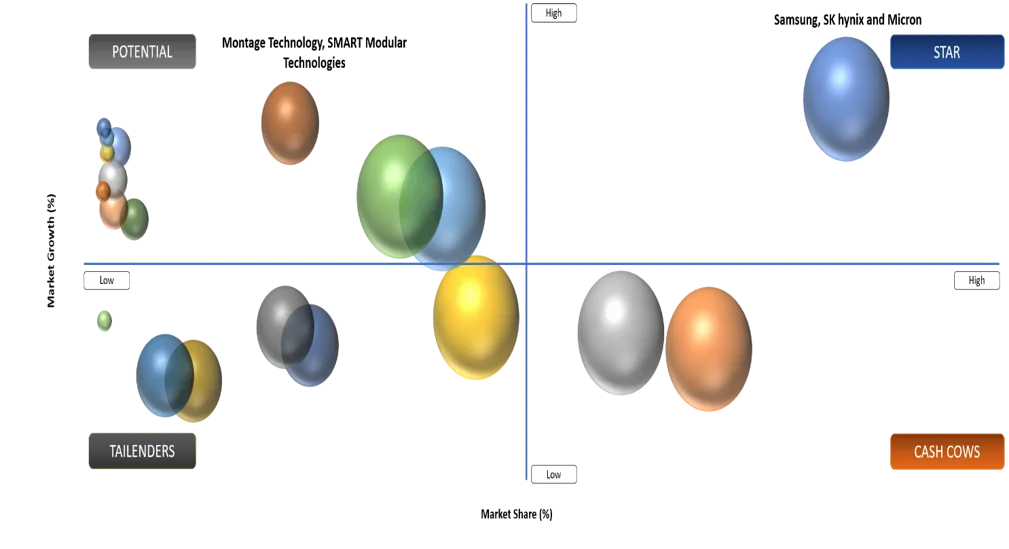
STAR
Companies placed in the Star quadrant of the CXL memory market are committed to utilizing their fundamental semiconductor or data-center infrastructural capabilities to maximize their participation in the expanding CXL memory market. Samsung Electronics, SK hynix, Micron Technology, Astera Labs and Marvell Technology take meaningful steps by occupying the important position in terms of CXL memory modules, memory controllers, switches and the entire memory-expansion infrastructure. Such companies as Samsung, SK hynix and Micron utilize their well-developed DRAM technologies to fulfill the growing need for CXL-related memory production while simultaneously keeping pace with making use of HBM and DDR technologies. Meanwhile, both Astera Labs and Marvell improve the state of this infrastructure via developing CXL-related memory controllers and switches and working on memory-expansion, pooling and disaggregation technologies.
POTENTIAL
Companies positioned in the Potential quadrant are equipped with specialized CXL technologies or products that act as a catalyst for them to expand their presence in the market when the CXL adoption starts leaning towards higher-capacity expansion, pooling and disaggregated memory architecture. Companies such as Montage Technology, SMART Modular Technologies, Innodisk, FADU, Microchip Technology, Panmnesia, Enfabrica, MemVerge, Rambus, ScaleFlux and Kioxia are involved in the sectors of CXL memory modules, memory-expansion controllers, CXL connectivity, memory management software and fabric-based architectures. Opportunities that those companies have especially depend upon the transition from direct-attached CXL memory to multi-host pooling, dynamic memory allocation and rack-scale composable memory. The increased demand for AI and HPC infrastructure, the growing need for providing memory capacity beyond CPU-attached DRAM incorporation of the latest CXL generations may give rise to further business avenues for those specialized companies.
CXL Memory Market Dynamics
Driver Impact Analysis
| Driver | Market Growth Impact (%) | Demand Concentration | Impacted Use Case | Strategic Impact |
Rising AI and Machine Learning Workloads Driving High-Capacity Memory Demand | 25% | Hyperscale & AI Data Centers | AI Model Training & Inference | Accelerates adoption of high-capacity CXL memory to complement HBM and DDR |
Increasing Adoption of Memory Expansion and Pooling in Data Centers | 20% | Cloud & Hyperscale Data Centers | Memory Expansion & Pooling | Enables flexible memory allocation and improves memory utilization across compute resources |
Growing Demand for Memory Disaggregation and Composable Infrastructure | 15% | Large-Scale Data Centers | Multi-Host Memory Disaggregation | Expands CXL from direct-attached expansion toward pooled and rack-scale memory architectures |
Increasing Need to Scale Server Memory Capacity Beyond CPU-Attached DRAM | 12% | Enterprise & High-Performance Computing | HPC & Data-Intensive Computing | Creates demand for CXL-attached memory as an additional scalable memory tier |
Driver: Rising AI and Machine Learning Workloads Driving High-Capacity Memory Demand
The rapid growth of AI model training, generative AI and high-volume inference is increasing the need for larger memory capacity in servers and data-center infrastructure. Conventional CPU-attached DDR memory can face capacity and scalability constraints as AI workloads expand, creating demand for CXL-based memory expansion. CXL enables additional memory to be connected through the PCIe interface, allowing systems to scale memory capacity independently of CPU memory channels. This is particularly relevant for AI and HPC environments where CXL-attached memory can complement high-bandwidth HBM and conventional DDR, supporting larger datasets and more flexible memory allocation, supporting larger datasets and more flexible memory allocation.
Restraint Impact Analysis
| Restraint | Drag on Market Growth (%) | Primary Impact Area | Impacted Use Case | Strategic Impact |
High Cost of CXL memory Modules and Infrastructure | 10% | System Economics | AI & HPC Memory Expansion | Increases deployment costs and extends adoption timelines |
Higher Latency Compared with Local DDR and HBM | 8% | Workload Performance | Latency-Sensitive Computing | Restricts CXL adoption for performance-critical memory workloads |
CXL Platform Compatibility & Qualification Challenges | 7% | System Integration | Enterprise & Hyperscale Servers | Increases validation requirements and deployment complexity |
Limited Multi-Vendor Interoperability for Advanced Pooling | 5% | Ecosystem Integration | Multi-Host Memory Pooling | Delays broader adoption of disaggregated CXL memory architectures |
Restraint: High Cost of CXL Memory Modules and Supporting Infrastructure
CXL memory modules are expensive, which can act as an impediment to their adoption. CXL solutions might involve dedicated memory modules, controllers and other infrastructure components, which means that the total cost of deployment is higher than in case of normal memory expansion. The cost considerations are impacted by the cost of DRAM and the presence of competition for high-density memory in HBM and server DRAM from the field of artificial intelligence. As a consequence, CXL will be considered a priority to implement for customers when the advantages of scalability, pooling and better memory management make it worthwhile.
CXL Memory Market Segment Analysis
The global CXL memory market is segmented based on the component, memory type, product type, CXL generation, deployment architecture, form factor, memory capacity, application, end-user and region.
By Product Type
CXL Memory Modules Represent the Leading Product Segment
In 2025, CXL memory modules represented 42.3% of the global CXL memory market, thus remaining the most lucrative segment in the product category. The increasing need for high-capacity memory expansion in AI-based servers, hyperscale data centers, HPC and enterprise computing is fueling the segment’s growth. CXL memory modules provide servers with an option to increase the amount of memory beyond the traditional DRAM connected to CPU, permitting the handling of memory-heavy workloads like AI and analytics.
By Product Type
CXL Memory Pooling Systems Drive Future Market Growth
CXL Memory Pooling Systems are anticipated to register the highest growth rate in terms of products with 34.8% CAGR throughout the forecasted period. The growth of such technologies is fostered through the use of CXL 3.x functionality, which includes memory sharing across multiple hosts, capacity allocation and memory disaggregation. Such systems are of special importance for AI and hyperscale data centers that need to optimize memory usage and capacity allocation across multiple compute systems.
CXL Memory Market Geographical Penetration
U.S. CXL Memory Market Landscape
The growth of the CXL memory market in the United States can be attributed to the high volume of hyperscale data centers within the country. This, combined with a healthy AI ecosystem, cloud computing power and ongoing innovations in server platforms, is a major driver. Rising adoption of AI accelerators and other memory-intensive tasks is contributing to demand for memory types that can go beyond traditional DDR connected to CPUs. The United States has a well-established CXL technology ecosystem, consisting of noteworthy players like Micron, Intel, AMD, Astera Labs and SMART Modular, which work on memory technologies, processors and connectivity and expansion technologies. Increasing implementation of CXL 3.x memory pooling is paving the way for rack memory architectures.
Japan CXL Memory Market Outlook
The Japan CXL memory market is emerging through it's existing advanced memory ecosystem and HPC facilities along with the growing need for computing capabilities that support AI. The emergence of memory expansion technology compatible with CXL developed by Kioxia would bolster the domestic supply side ecosystem, while enterprise computing and research and AI infrastructure with data intensive applications require scalable memory capacity. This market is specifically geared towards high capacity CXL memory expandability and persistent/flash based CXL products, with the adoption expected to happen as Japanese datacenters begin using the latest CXL enabled servers.
China CXL Memory Market Trends
China's CXL memory market is being affected by the quick implementation of AI infrastructure, growth in data centers and efforts in improving the domestic capabilities in semiconductors. Local development of DRAM and CXL technologies is helping in the formation of a domestic supply chain, whereby CXMT is providing advanced DRAM technologies while Montage Technology is developing CXL memory expander controllers. The demand will be concentrated in CXL memory expansion of AI servers, cloud computing infrastructure and HPC systems, with domestic technology innovation and localizing the supply chain being significant factors impacting the future adoption of CXL in China.
South Korea CXL Memory Market Analysis
South Korea represents an important player within the CXL memory market because of its established DRAM production and earlier introduction of CXL memory devices by such manufacturers as Samsung Electronics and SK hynix. Both corporations are introducing CXL memory expansion systems for AI and data center usage based on South Korea's semiconductor fabrication and packaging experience. The growing demand for high-volume server memory, infrastructure for AI calculations and CXL memory expansions is fostering market growth, whereas new generations of CXL technologies offer memory pooling and heterogeneous HBM/DDR/CXL architecture designs.
CXL Memory Market Competitive Landscape
- The competition is moving away from individual memory modules towards complete CXL memory platforms, where differentiation is done by high-capacity memory modules, memory controllers, switches, pooling solutions and software-controlled memory management.
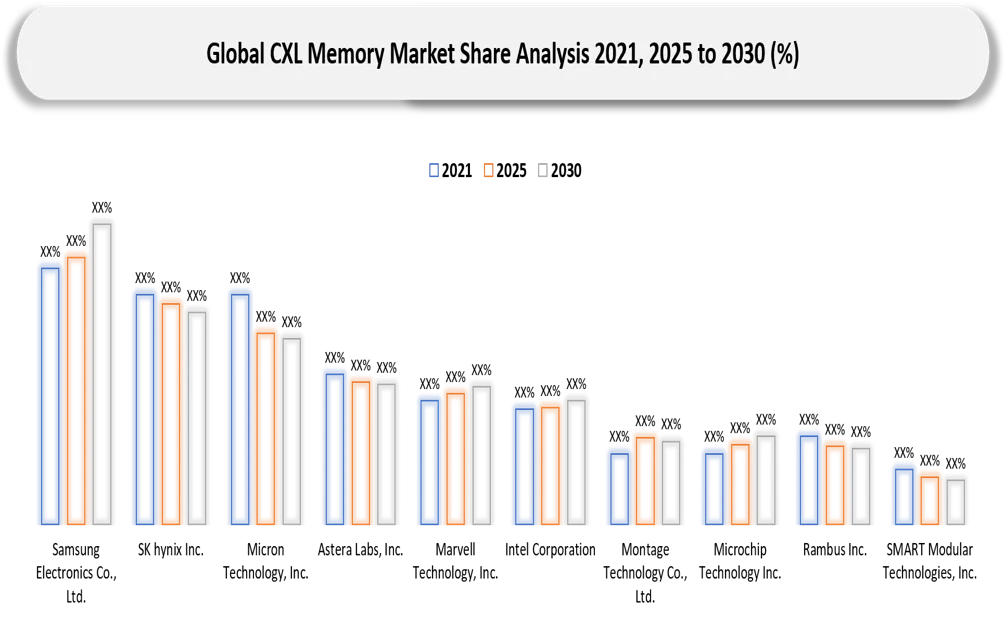
- The DRAM providers enjoy a significant competitive edge as CXL memory modules are primarily based on server DRAM, which gives Samsung Electronics, SK hynix and Micron advantages due to their manufacturing capacity and pre-existing customer base of AI servers.
- The features of CXL 3.x technology become an important part of the competitive edge especially for vendors offering multi-host memory pooling, capacity management, memory sharing and disaggregated memory solutions instead of simple expansion solutions.
- Data-center needs for AI are driving new competition within the products space, as providers begin to offer architectures that include HBM, local DDR and CXL-enabled memories. Competition is thus becoming one of matching capacity, bandwidth, latency, power and price per usable GB.
- The competitive landscape is expanding beyond traditional memory suppliers, with companies such as Astera Labs, Marvell, Montage Technology, Microchip, Panmnesia, Enfabrica and MemVerge are competing against one another in terms of controllers, CXL fabrics, memory expanders, memory pools and software-defined memory management, thus creating a wider ecosystem for CXL.
Public Company Q1-Q2 2026 Performance Comparison
The table below compares five publicly listed companies with direct or strategically relevant exposure to the CXL memory market. Financial metrics are company-wide or segment level because standalone CXL memory revenue is generally not separately disclosed. Growth drivers therefore distinguish overall corporate performance from direct CXL memory exposure.
| Company | Q1–Q2 2026 Performance | CXL Memory Exposure | Key Performance Driver |
| SK hynix Inc. | US$94.0 Billion revenue | CXL memory products and DDR5-based CXL memory supporting AI and data-center architectures | AI-driven HBM and high-value DRAM demand; first-half revenue exceeded KRW 100 trillion. |
| Samsung Electronics Co., Ltd. | US$222.0 Billion revenue | CXL memory modules, including DDR5-based CXL memory for memory expansion and data-center applications | Strong AI-server memory demand; Q2 2026 Memory Business revenue reached an all-time high. |
| Micron Technology, Inc. | US$65.32 Billion revenue | CXL memory and high-capacity memory solutions supporting AI/data-center memory expansion | Strong AI-driven memory demand and tight supply; fiscal Q2 revenue was US$23.86B and fiscal Q3 reached US$41.46B. |
| Astera Labs, Inc. | US$392.4 Million Q2 revenue | Leo CXL Smart Memory Controllers supporting memory expansion, sharing and pooling | AI infrastructure expansion and strong demand for CXL connectivity and memory infrastructure; Q2 revenue increased 104% YoY. |
| Marvell Technology, Inc. | US$5.16 Billion revenue | Structera CXL memory-expansion controllers, CXL switches and near-memory accelerators | AI-driven data-center demand; CXL portfolio expansion into memory expansion and rack-scale pooling. |
Note: Company-level revenue should not be interpreted as CXL memory revenue unless separately disclosed. The CXL exposure column reflects documented product or technology involvement rather than standalone CXL revenue. Financial periods differ because companies follow different fiscal calendars. For Marvell, the Q1-Q2 figure corresponds to its fiscal 2027 first two quarters; for Micron, it corresponds to fiscal Q2-Q3 2026.
Key Companies of CXL Memory Market
- Samsung Electronics Co., Ltd. (South Korea)
- SK hynix Inc. (South Korea)
- Micron Technology, Inc. (United States)
- SMART Modular Technologies, Inc. (United States)
- Innodisk Corporation (Taiwan)
- Kioxia Corporation (Japan)
- Intel Corporation (United States)
- Advanced Micro Devices, Inc. (AMD) (United States)
- FADU, Inc. (South Korea)
- ScaleFlux Inc. (United States)
- Astera Labs, Inc. (United States)
- Marvell Technology, Inc. (United States)
- Montage Technology Co., Ltd. (China)
- MemVerge Inc. (United States)
- Microchip Technology Inc. (United States)
- Rambus Inc. (United States)
- Panmnesia Inc. (South Korea)
- Enfabrica Inc. (United States)
Company Profiles of CXL Memory Market
Samsung Electronics
Samsung Electronics is one of the key memory semiconductor suppliers, whose products are directly related to the CXL memory market by means of CXL DRAM portfolio and memory expansion solutions. The CXL memory solutions offered by Samsung include DDR5 EDSFF memory modules aimed at expansion of server memory outside the CPU-attached DRAM memory.
The competitive advantages include increased density of CXL memory, advanced compatibility with more recent CXL generations, enhanced bandwidth and latency, as well as embedding of CXL memory into AI-server and hyperscale systems together with HBM and DDR.
SK Hynix
SK hynix is an industry leader in DRAM and HBM memory, which is developing a range of memory products using the CXL protocol for memory expansion in AI and data-center systems. SK hynix CXL memory products will be based on the company's high-density DRAM memory technologies and will enable extra server memory and CPU-attached memory scaling.
The key priorities in the competition include increasing CXL modules' capacity, implementing CXL 3.x memory expansion and pooling, integrating CXL with AI server memory architecture and using its DRAM and HBM technology platform.
Micron Technology
Micron Technology is involved in the CXL memory market with the use of high-density CXL memory sticks that allow server memory expansion irrespective of the processor DRAM. The firm’s CXL memory technology is specifically aimed at increasing server memory capacity for data-intensive processes such as AI, analytics, cloud computing and others.
The strategic priorities of the company will involve raising the density of CXL memory modules, boosting memory bandwidth and energy efficiency, widening the scope of compatible servers and making CXL memory a supplementary layer of AI architecture along with HBM and DDR memory types.
Astera Labs
Astera Labs is a semiconductor connectivity company that has established itself in CXL memory infrastructure with the help of its portfolio called Leo CXL Smart Memory Controller. The company's technology allows adding more memory and memory sharing as well as pooling based on CXL to solve scalability issues of memory resources in AI and cloud data centers.
The competitive priorities of Astera Labs include the development of high-performance CXL controllers, support for new CXL generations, multi-host memory architectures, interoperability between server platforms and memory pooling/disaggregation in AI infrastructure.
Marvell Technology
Marvell Technology is involved in the CXL memory market through the manufacture of memory expansion controllers, switches and other infrastructure technologies. The CXL portfolio of the company enables memory expansion, pooling and sharing for facilitating the adoption of flexible memory systems in data centers.
The competitive priorities include scaling up of the CXL switching and memory expansion technology, CXL 3.x architecture support, rack scale memory pooling and integration of CXL infrastructure in AI and hyperscale data centers.
Montage Technology
Montage Technology is a semiconductor company and its unique role in CXL memory expansion is based on its CXL memory eXpander Controller products. They provide connectivity to the extra DDR memory that can be attached to the CXL systems, creating high-memory configurations required for data centers and artificial intelligence.
The competitive issues are related to increasing the performance of CXL controller and memory capacity, developing CXL 3.x compliance, improving memory pooling functionality and growing presence in servers and data center platforms communities.
CXL Memory Market Major Pain Points
- CXL Platform Compatibility Gaps: There are variances in CXL generations, processor capabilities, BIOS/firmware capabilities and OS implementations that may make testing for compatibility more difficult to CXL memory solutions.
- High Cost per Added Memory Capacity: Due to their high cost relative to DDR, CXL solutions can be costly options for organizations looking to boost their capacity.
- Higher Latency Than Local Memory: Latency of CXL-attached memory is usually higher than that of DDR/HBM-attached processors. Therefore, CXL-attached memory cannot be used for workloads with minimum memory latency requirements.
- Multi-Vendor Interoperability Challenges: Interoperability of CXL memory devices, processors, switches, firmware and management software may pose complexities in the integration and qualification of systems.
- Complexity of Memory Pooling and Disaggregation: The pooling and disaggregation capabilities of CXL memory demand advanced resource management techniques, posing complexities in their deployment.
CXL Memory Market Recent Developments
- September 2026 - Astera Labs: Astera Labs extended its Leo Smart Memory Controller portfolio by adding the Leo X-Series, Leo 2 E-Series and Leo 2 P-Series, which are capable of handling CXL 3.2. This is for CPU-attached expansion, rack-scale memory and fabric-attached memory for AI applications.
- September 2026 - Marvell Technology: Marvell reported CXL interoperability of its Structera X memory expansion controller and NVIDIA Vera, bolstering its CXL platform compatibility in AI infrastructure. Marvell offers memory expansion, near-memory acceleration and rack-scale CXL memory pooling solutions.
- August 2026 - Kioxia: Kioxia rolled out the XL1 Series of CXL-compatible memory expansion solution that utilizes the XL-FLASH technology. Evaluation units were planned to be available to the Kioxia ecosystem partners in August.
- July 2026 - Montage Technology: Montage unveiled its trial production of CXL 3.2 Memory eXpander Controller (MXC) that includes PCIe 6.x, dual DDR5 controllers at up to 8,000 MT/s and memory expansion, pooling and tiered memory technology. The CXL 3.2 MXC has already been adopted in the next-generation CXL products by Samsung and SK hynix.
- July 2026 - ScaleFlux: ScaleFlux launched the MC600 PCIe Gen6 CXL 3.2 Type-3 Memory Controller, intended for use with applications like AI, hyperscale cloud and enterprise infrastructure. The Controller is engineered to support high bandwidth memory expansion using the CXL protocol.
Analyst View / Opinion on CXL Memory Market
- CXL memory is evolving from a supplementary memory enhancement solution to a core element of scalable AI and data center architecture, especially as memory needs increase at a pace that outstrips existing CPU memory capability.
- Direct-attached CXL memory will continue to be a significant avenue of adoption, as it is able to increase memory capacity on servers without needing the complete architectural overhaul that pooled or disaggregated memory would entail.
- CXL will be used with HBM and DDR, not as an alternative to them, leading to heterogeneous memory hierarchies where CXL deals mostly with capacity and resources.
- The architecture of CXL 3.x and its successors marks a significant turning point for allowing multi-host pooling and dynamic memory allocation to alter the way memory resources are allocated at the rack level.
- Market competitiveness on a long-term basis will depend on economic factors as well as interoperability, as the capacity of the modules themselves will matter less when it comes to evaluating latency, cost per usable GB, energy usage and memory utilization advantages.
Target Audience of CXL Memory Market
| INDUSTRY | WHO SHOULD BUY THIS REPORT? | REASON TO BUY THIS REPORT |
| CXL Memory Manufacturers | Product Strategy & Business Development Teams | Assess CXL memory demand, module capacity trends and competitive positioning. |
| DRAM & Memory Manufacturers | Strategy & Product Management Teams | Evaluate opportunities to expand conventional memory portfolios into CXL-based products. |
| CXL Memory Module & Expansion Device Companies | Product Development & Market Intelligence Teams | Identify demand for higher-capacity modules and new CXL memory architectures. |
| Server & CPU Manufacturers | Platform Architecture & Product Planning Teams | Assess CXL memory compatibility and integration requirements for next-generation servers. |
| AI Infrastructure Providers | AI Infrastructure & Engineering Teams | Evaluate CXL memory requirements alongside HBM and DDR for AI workloads. |
| Hyperscale & Cloud Data Centers | Data Center Architecture & Procurement Teams | Assess memory expansion, pooling, disaggregation and utilization benefits. |
| HPC & Supercomputing Organizations | Infrastructure & Technology Decision-Makers | Identify CXL memory applications for capacity-intensive computing environments. |
| Enterprise Data Center Operators | IT Infrastructure & Procurement Teams | Evaluate CXL as a scalable approach to increasing server memory capacity. |
| Semiconductor & Advanced Packaging Companies | R&D, Strategy & Business Development Teams | Assess emerging CXL memory manufacturing, packaging and integration requirements. |
| Investors & Private Equity Firms | Investment & Due Diligence Teams | Evaluate market growth, competitive dynamics, technology adoption and investment opportunities. |
Why Choose DATAM?
- Data-Driven insights: Dive into detailed analyses with granular insights such as pricing, market shares and value chain evaluations, enriched by interviews with industry leaders and disruptors.
- Post-Purchase Support and Expert Analyst Consultations: As a valued client, gain direct access to our expert analysts for personalized advice and strategic guidance, tailored to your specific needs and challenges.
- White Papers and Case Studies: Benefit quarterly from our in-depth studies related to your purchased titles, tailored to refine your operational and marketing strategies for maximum impact.
- Annual Updates on Purchased Reports: As an existing customer, enjoy the privilege of annual updates to your reports, ensuring you stay abreast of the latest market insights and technological advancements. Terms and conditions apply.
- Specialized Focus on Emerging Markets: DataM differentiates itself by delivering in-depth, specialized insights specifically for emerging markets, rather than offering generalized geographic overviews. The approach equips our clients with a nuanced understanding and actionable intelligence that are essential for navigating and succeeding in high-growth regions.
- Value of DataM Reports: Our reports offer specialized insights tailored to the latest trends and specific business inquiries. The personalized approach provides a deeper, strategic perspective, ensuring you receive the precise information necessary to make informed decisions. The insights complement and go beyond what is typically available in generic databases.
What DATAM Uniquely Provides
- CXL Memory Market-Specific Sizing: Distinguishes the opportunity in CXL memory from the overall CXL semiconductor and connectivity markets for an analysis of addressable memory requirements.
- Module-Level Competitive Benchmarking: Assesses CXL memory vendors in terms of capacity, form factor, generation of CXL supported, availability of products and intended applications.
- Architecture-Level Demand Mapping: Measures the transition from direct attach CXL expansion to switchable, pooled and disaggregated memory architectures in important use cases.
- AI Memory Infrastructure Intelligence: Relates CXL adoption to AI server memory needs, HBM-DDR-CXL configurations, workload types and data-center deployment strategies to determine actual need drivers.
- Regional Supply-and-Demand Mapping: Assesses CXL memory opportunity in countries by relating memory manufacturing capacity, CXL product development, AI infrastructure spending and data-center deployment in key markets.


























































