


Cryogenic Pump Market Size and Overview
The global cryogenic pump market reached an estimated US$ 2.18 billion in 2025 and is projected to reach US$ 3.86 billion by 2035, growing at a CAGR of 5.9% during 2026-2035. Demand is supported by LNG liquefaction and regasification, industrial gas production, hydrogen infrastructure, semiconductor manufacturing, medical gas distribution and aerospace testing. Cryogenic pumps are mission-critical because they must transfer low-temperature liquids safely while managing thermal contraction, vapor formation, cavitation and material compatibility.
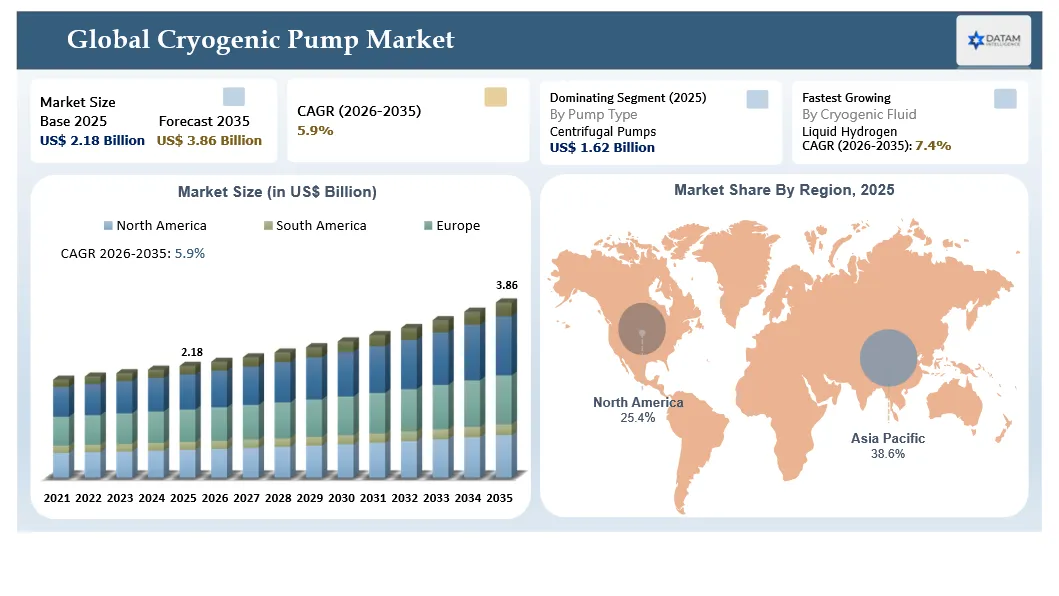
LNG remains the largest application base, using submerged motor and external motor pumps for storage transfer, ship loading, send-out and regasification. Industrial gas producers deploy cryogenic pumps in air separation, bulk storage, cylinder filling and process supply. Liquid hydrogen is a smaller segment but is attracting substantial engineering investment because its low density, extremely low temperature and susceptibility to boil-off require specialized hydraulic and sealing solutions. Asia-Pacific leads unit demand due to industrial expansion, gas infrastructure and manufacturing capacity, while North America and the Middle East are major project markets for LNG and hydrogen.
| Metric | Details |
| 2025 Market Size | US$ 2.18 Billion |
| 2035 Projected Market Size | US$ 3.86 Billion |
| CAGR 2026-2035 | 5.9% |
| Largest Region | Asia-Pacific |
| Fastest-Growing Region | Middle East and Africa |
| Largest Pump Type | Centrifugal Pumps |
| Fastest-Growing Fluid | Liquid Hydrogen |
Cryogenic Pump Market Key Takeaways
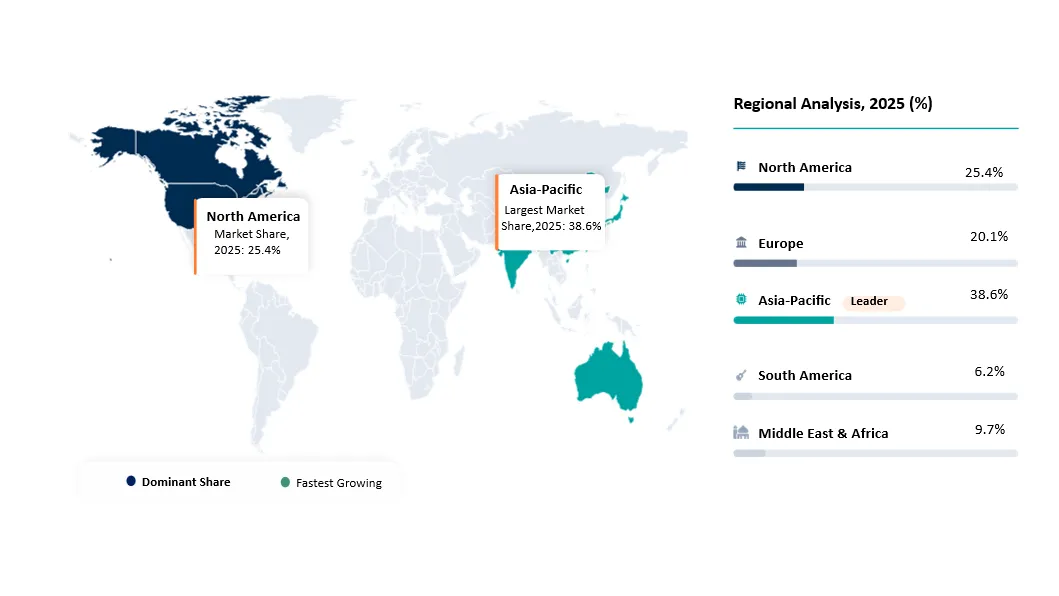
- Asia-Pacific accounted for an estimated 38.6% of global revenue in 2025, supported by LNG terminals, industrial gas plants, semiconductor fabs and domestic equipment manufacturing.
- Centrifugal pumps represented approximately 72% of the market because they are widely used for high-flow transfer, circulation and send-out applications.
- LNG generated the largest fluid-based demand, while liquid hydrogen is expected to record the fastest growth as fueling, mobility, energy storage and aerospace projects progress.
- Submerged motor designs are gaining share in LNG storage and regasification because they reduce shaft-seal exposure, improve compactness and support installation inside vessels or suction pots.
- Aftermarket service, condition monitoring, spare parts and retrofit programs are becoming larger sources of recurring revenue as operators seek to extend equipment life and avoid unplanned terminal outages.
Cryogenic Pump Industry Trends and Strategic Insights
- Pump suppliers are developing higher-efficiency hydraulics to reduce power consumption across LNG send-out and industrial gas duty cycles.
- Liquid hydrogen programs are driving research into ultra-low-temperature bearings, seals, materials and high-speed pumping architectures.
- FSRU conversions and modular LNG systems are creating demand for compact, configurable pumps with shorter engineering and delivery cycles.
- Digital vibration monitoring, motor-current analysis and predictive maintenance are being integrated into service contracts for critical pumps.
- Buyers increasingly favor vendors that can combine pump design, vessel integration, controls, commissioning and global aftermarket support.
- Localization is expanding in China, India, the Middle East and Southeast Asia as project owners seek faster service and lower supply-chain risk.
Cryogenic Pump Market Scope
| Dimension | Coverage |
| By Pump Type | Centrifugal and Positive Displacement Pumps |
| By Design | Submerged Motor and External Motor Pumps |
| By Cryogenic Fluid | LNG, Liquid Nitrogen, Liquid Oxygen, Liquid Hydrogen, Liquid Argon, Liquid Helium and Others |
| By Operation | Continuous Duty and Intermittent Duty |
| By Application | Transfer and Loading, Circulation and Boosting, Fueling and Dispensing, Process and Test Applications |
| By End-Use Industry | Oil and Gas and LNG, Industrial Gases, Chemicals and Petrochemicals, Healthcare, Aerospace and Defense, Energy and Hydrogen, Electronics and Semiconductors, Research and Others |
| By Sales Channel | Direct Sales, EPC and System Integrators, Distributors and Aftermarket Providers |
| Study Period | 2025 base year, forecast 2026-2035 |
Why does this report matter in 2026?
The market is entering a major project cycle. LNG export capacity, regasification terminals, FSRU conversions and industrial gas investments are increasing the number of pump packages that must be specified, qualified and supported. At the same time, hydrogen developers are moving from demonstration systems toward larger fueling, liquefaction and aerospace applications. These projects expose buyers to long lead times, specialized engineering requirements and a narrow supplier base. Procurement decisions increasingly combine hydraulic performance with lifecycle reliability, maintainability, energy consumption and the ability of the supplier to support commissioning, diagnostics and spare parts over long operating periods. Buyers also assess materials compatibility, cavitation margin, seal design, bearing life, motor efficiency and the vendor’s experience with the specific cryogenic fluid. These factors make application engineering and installed-base support central to competitive differentiation.
The report helps equipment manufacturers, EPC firms, investors and end users identify the most attractive fluid applications, pump designs, regional project clusters and service opportunities. It also explains how efficiency, reliability, qualification history and lifecycle support influence supplier selection. This is particularly important where pump failure can interrupt an LNG terminal, air separation unit, medical gas system or high-value test program. Procurement decisions increasingly combine hydraulic performance with lifecycle reliability, maintainability, energy consumption and the ability of the supplier to support commissioning, diagnostics and spare parts over long operating periods. Buyers also assess materials compatibility, cavitation margin, seal design, bearing life, motor efficiency and the vendor’s experience with the specific cryogenic fluid. These factors make application engineering and installed-base support central to competitive differentiation.
Cryogenic Pump Market White Space & Investment Opportunities
- Liquid hydrogen pumps for heavy-duty mobility, aviation ground support, marine fuel and high-throughput fueling stations.
- High-pressure LNG send-out pumps for regasification terminals, FSRUs and LNG-to-power projects in emerging markets.
- Small-scale and modular cryogenic pump skids for distributed LNG, biogas liquefaction and industrial gas users.
- Predictive maintenance platforms combining vibration, temperature, motor and hydraulic data for installed cryogenic pumps.
- Regional repair centers, spare-parts hubs and field-service teams in the Middle East, Southeast Asia, India and Latin America.
- Pump retrofits that improve efficiency, reduce cavitation risk and extend service life in older LNG and air-separation facilities.
Cryogenic Pump Future Market Transformation
The market will shift from stand-alone equipment sales toward integrated fluid-handling solutions. Pump manufacturers will combine hydraulic design, vessel engineering, motor systems, variable-frequency drives, controls, instrumentation and remote monitoring. This reduces interface risk for project owners and creates recurring service revenue. Modularization will also become more important as LNG and hydrogen projects seek shorter construction schedules and standardized packages.
Technology development will focus on higher efficiency, lower net positive suction head requirements, longer bearing life and compatibility with liquid hydrogen. Digital twins and condition-based maintenance will support performance optimization across changing duty cycles. Suppliers that can validate performance at full scale, provide local service and manage global spare parts will be positioned to win strategic frame agreements.
Cryogenic Pump Market Buyer Decision-Making Criteria
Buyers prioritize hydraulic performance, reliability, safety certification and proven operating references with the required cryogenic fluid. Pump efficiency and NPSH performance influence energy cost and cavitation margin, while material selection and thermal design determine durability. For submerged motor pumps, operators assess motor cooling, electrical integrity, bearing design and the ability to remove or service the unit without extended terminal disruption. Procurement decisions increasingly combine hydraulic performance with lifecycle reliability, maintainability, energy consumption and the ability of the supplier to support commissioning, diagnostics and spare parts over long operating periods. Buyers also assess materials compatibility, cavitation margin, seal design, bearing life, motor efficiency and the vendor’s experience with the specific cryogenic fluid. These factors make application engineering and installed-base support central to competitive differentiation.
Commercial decisions also depend on delivery time, engineering responsiveness, commissioning support, spare-part availability and field-service reach. EPC contractors value configuration flexibility and documentation quality. End users favor suppliers with installed-base experience and clear maintenance strategies. For hydrogen and aerospace applications, prototype testing, leakage control and fluid-specific qualification can outweigh initial price. Procurement decisions increasingly combine hydraulic performance with lifecycle reliability, maintainability, energy consumption and the ability of the supplier to support commissioning, diagnostics and spare parts over long operating periods. Buyers also assess materials compatibility, cavitation margin, seal design, bearing life, motor efficiency and the vendor’s experience with the specific cryogenic fluid. These factors make application engineering and installed-base support central to competitive differentiation.
Cryogenic Pump Market Economic & Investment Analysis
Investment in cryogenic pumps is closely linked to capital spending in LNG, industrial gases, hydrogen, semiconductors, healthcare and aerospace. A single LNG terminal or air-separation project can require multiple pump packages across storage, transfer, loading, circulation and backup duty. The economic value of the pump is therefore tied to the larger facility investment and to the cost of downtime. This supports premium pricing for proven designs and strong service capability. Procurement decisions increasingly combine hydraulic performance with lifecycle reliability, maintainability, energy consumption and the ability of the supplier to support commissioning, diagnostics and spare parts over long operating periods. Buyers also assess materials compatibility, cavitation margin, seal design, bearing life, motor efficiency and the vendor’s experience with the specific cryogenic fluid. These factors make application engineering and installed-base support central to competitive differentiation.
Manufacturers are directing capital toward test facilities, high-speed motors, submerged pump platforms, hydrogen-compatible materials and regional service centers. Investors also view aftermarket services as attractive because installed equipment generates recurring demand for inspections, spares, repairs and upgrades. Consolidation is likely where diversified industrial-equipment companies seek access to cryogenic technology, LNG customers and hydrogen growth platforms. Procurement decisions increasingly combine hydraulic performance with lifecycle reliability, maintainability, energy consumption and the ability of the supplier to support commissioning, diagnostics and spare parts over long operating periods. Buyers also assess materials compatibility, cavitation margin, seal design, bearing life, motor efficiency and the vendor’s experience with the specific cryogenic fluid. These factors make application engineering and installed-base support central to competitive differentiation.
Cryogenic Pump Investment Trends in the Market
- Expansion of submerged motor pump capacity for LNG regasification, FSRU conversion and storage-terminal projects.
- R&D investment in liquid-hydrogen pumps, high-speed rotating equipment, low-temperature bearings and leakage reduction.
- Creation of regional service centers to support installed equipment, reduce downtime and improve spare-parts availability.
- Investment in digital monitoring, remote diagnostics and predictive maintenance for critical cryogenic pump fleets.
- Partnerships between pump manufacturers, EPC contractors, industrial gas companies and hydrogen developers to qualify new systems.
Strategic Indicators For Cryogenic Pump Market
High Regulation Impact
Cryogenic pumps operate within facilities governed by pressure-equipment, hazardous-area, LNG, industrial gas and hydrogen safety standards. Compliance affects materials, electrical systems, testing, documentation and installation. Suppliers with established certification systems and strong quality records can shorten project approval and reduce integration risk. Procurement decisions increasingly combine hydraulic performance with lifecycle reliability, maintainability, energy consumption and the ability of the supplier to support commissioning, diagnostics and spare parts over long operating periods. Buyers also assess materials compatibility, cavitation margin, seal design, bearing life, motor efficiency and the vendor’s experience with the specific cryogenic fluid. These factors make application engineering and installed-base support central to competitive differentiation.
High Investment Activity
LNG export and regasification, industrial gas production and hydrogen infrastructure are generating sustained capital spending. Investment favors suppliers with scalable manufacturing, validated product platforms and global service coverage. New spending is also moving toward high-pressure LNG pumps and hydrogen-specific equipment. Procurement decisions increasingly combine hydraulic performance with lifecycle reliability, maintainability, energy consumption and the ability of the supplier to support commissioning, diagnostics and spare parts over long operating periods. Buyers also assess materials compatibility, cavitation margin, seal design, bearing life, motor efficiency and the vendor’s experience with the specific cryogenic fluid. These factors make application engineering and installed-base support central to competitive differentiation.
Supply Chain Disruption
Specialty alloys, precision bearings, motors, castings and instrumentation can face long lead times. Project delays may be amplified when a component requires fluid-specific qualification. Manufacturers are increasing dual sourcing, regional inventory and standardized designs to reduce exposure. Procurement decisions increasingly combine hydraulic performance with lifecycle reliability, maintainability, energy consumption and the ability of the supplier to support commissioning, diagnostics and spare parts over long operating periods. Buyers also assess materials compatibility, cavitation margin, seal design, bearing life, motor efficiency and the vendor’s experience with the specific cryogenic fluid. These factors make application engineering and installed-base support central to competitive differentiation.
Pricing Volatility
Pricing is influenced by metal costs, engineering complexity, pressure rating, test requirements and project customization. Large submerged pumps command premium prices because of vessel integration and qualification needs. Service and spare-parts pricing is shaped by urgency and outage risk. Procurement decisions increasingly combine hydraulic performance with lifecycle reliability, maintainability, energy consumption and the ability of the supplier to support commissioning, diagnostics and spare parts over long operating periods. Buyers also assess materials compatibility, cavitation margin, seal design, bearing life, motor efficiency and the vendor’s experience with the specific cryogenic fluid. These factors make application engineering and installed-base support central to competitive differentiation.
Procurement Pressure
EPC schedules and terminal construction milestones place pressure on delivery. Buyers increasingly request firm lead times, liquidated-damages protection, local spares and long-term support. Suppliers must balance customization with platform standardization. Procurement decisions increasingly combine hydraulic performance with lifecycle reliability, maintainability, energy consumption and the ability of the supplier to support commissioning, diagnostics and spare parts over long operating periods. Buyers also assess materials compatibility, cavitation margin, seal design, bearing life, motor efficiency and the vendor’s experience with the specific cryogenic fluid. These factors make application engineering and installed-base support central to competitive differentiation.
New Technology Adoption
High-efficiency hydraulics, active thrust balancing, variable-frequency drives, ceramic bearings, digital monitoring and advanced inducer designs are improving pump performance. Liquid hydrogen is accelerating development of new materials and pumping concepts. Procurement decisions increasingly combine hydraulic performance with lifecycle reliability, maintainability, energy consumption and the ability of the supplier to support commissioning, diagnostics and spare parts over long operating periods. Buyers also assess materials compatibility, cavitation margin, seal design, bearing life, motor efficiency and the vendor’s experience with the specific cryogenic fluid. These factors make application engineering and installed-base support central to competitive differentiation.
Regional Expansion Opportunity
The Middle East, North America and Asia-Pacific offer strong opportunities due to LNG and industrial gas investment. Southeast Asia, India and Latin America also need local service networks as installed bases grow. Procurement decisions increasingly combine hydraulic performance with lifecycle reliability, maintainability, energy consumption and the ability of the supplier to support commissioning, diagnostics and spare parts over long operating periods. Buyers also assess materials compatibility, cavitation margin, seal design, bearing life, motor efficiency and the vendor’s experience with the specific cryogenic fluid. These factors make application engineering and installed-base support central to competitive differentiation.
Government Policy Support
Energy security, clean hydrogen programs, industrial localization and healthcare infrastructure spending support demand. Policy uncertainty can affect project timing, but strategic gas and hydrogen programs continue to create long-term equipment needs. Procurement decisions increasingly combine hydraulic performance with lifecycle reliability, maintainability, energy consumption and the ability of the supplier to support commissioning, diagnostics and spare parts over long operating periods. Buyers also assess materials compatibility, cavitation margin, seal design, bearing life, motor efficiency and the vendor’s experience with the specific cryogenic fluid. These factors make application engineering and installed-base support central to competitive differentiation.
Pricing Intelligence
Standard transfer pumps compete more heavily on price, while high-pressure, submerged and hydrogen pumps are differentiated by performance and references. Lifecycle service agreements can reduce procurement focus on initial price. Procurement decisions increasingly combine hydraulic performance with lifecycle reliability, maintainability, energy consumption and the ability of the supplier to support commissioning, diagnostics and spare parts over long operating periods. Buyers also assess materials compatibility, cavitation margin, seal design, bearing life, motor efficiency and the vendor’s experience with the specific cryogenic fluid. These factors make application engineering and installed-base support central to competitive differentiation.
HS Code Reporter Trade Flow
| HS Code / Flow | 2025 Trade Direction | Interpretation |
| 8413 - China | Exporter | Large manufacturing base for industrial and cryogenic pumps, including regional LNG and gas applications. |
| 8413 - United States | Importer and Exporter | Strong demand from LNG, industrial gas, hydrogen and engineered process projects. |
| 8413 - Germany | Exporter | Advanced pump engineering and equipment exports to industrial and energy projects. |
| 8413 - Japan | Exporter | Specialized cryogenic and submerged pump technology serving global LNG and industrial gas customers. |
Commercialization and Service Model Outlook
Commercialization strategies are changing as customers seek fewer interfaces between the pump, vessel, controls and commissioning teams. A manufacturer that can supply an engineered package may capture a larger contract value and reduce integration disputes. This approach is especially relevant for FSRUs, LNG-to-power plants, hydrogen stations and modular industrial gas systems. Standardized documentation, digital configuration tools and repeatable factory testing can shorten quotation and project cycles while preserving application-specific performance. Suppliers can also use frame agreements with EPC contractors and industrial gas companies to improve forecast visibility and secure repeat orders across multiple sites.
The service model is moving toward planned lifecycle support. Operators want recommended spare-part lists, inspection intervals, remote diagnostics, performance reviews and access to trained field engineers. For submerged pumps, outage planning is critical because removal can require tank or vessel coordination. Regional repair centers reduce transport time and allow faster turnaround. Independent service providers will remain relevant for mixed fleets, although original equipment manufacturers retain an advantage when proprietary motor, bearing or hydraulic components are involved. Service capability will therefore influence equipment selection more strongly during the forecast period.
Replacement demand will also become more visible as LNG terminals, air separation units and bulk gas facilities age. Operators may choose a direct replacement, hydraulic rerate or full modernization depending on efficiency, reliability and spare-parts availability. Retrofit programs can include new impellers, upgraded bearings, improved motors, variable-speed drives and monitoring systems. These projects often move faster than greenfield facilities and can provide attractive margins because the supplier must understand the existing installation, operating history and outage window. Companies with detailed installed-base records and local service engineers are best placed to capture this recurring opportunity.
Global leading equipment market participants should also closely monitor standards development for hydrogen, methane emissions and equipment efficiency because these rules can change qualification requirements and project economics. Early engagement with standards bodies, operators and EPC firms can reduce redesign risk and improve specification influence.
AI Impact Analysis of Cryogenic Pump Market
AI is improving pump selection, condition monitoring and maintenance planning. Machine-learning models can combine vibration, motor current, pressure, flow and temperature data to identify anomalies before they become failures. In LNG and industrial gas facilities, this supports planned intervention and reduces the risk of unplanned shutdowns. AI-assisted engineering can also compare hydraulic configurations and operating envelopes during quotation and design.
Digital twins can simulate pump behavior across tank levels, fluid properties and variable duty cycles. Service teams can use these models to optimize operating points, predict bearing wear and recommend efficiency upgrades. Adoption will be strongest where operators have large installed fleets and high downtime costs, although data quality, cybersecurity and sensor reliability remain important constraints.
Disruption Analysis of Cryogenic Pump Market
The market is being disrupted by liquid hydrogen, modular LNG and digitally connected service models. Hydrogen requires new pumping approaches because of its very low boiling point, low density and leakage risk. Suppliers that establish references early may secure long-term positions in fueling, aviation and energy projects. Modular LNG systems are also changing product design by favoring standardized, compact and rapidly deployable packages.
A second disruption is the movement toward lifecycle performance contracts. Operators increasingly expect remote support, predictive maintenance and guaranteed availability rather than a simple equipment sale. This strengthens manufacturers with global service networks and installed-base data. It also creates opportunities for independent service providers that can support multi-brand fleets.
Cryogenic Pump Market BCG Matrix: Company Evaluation
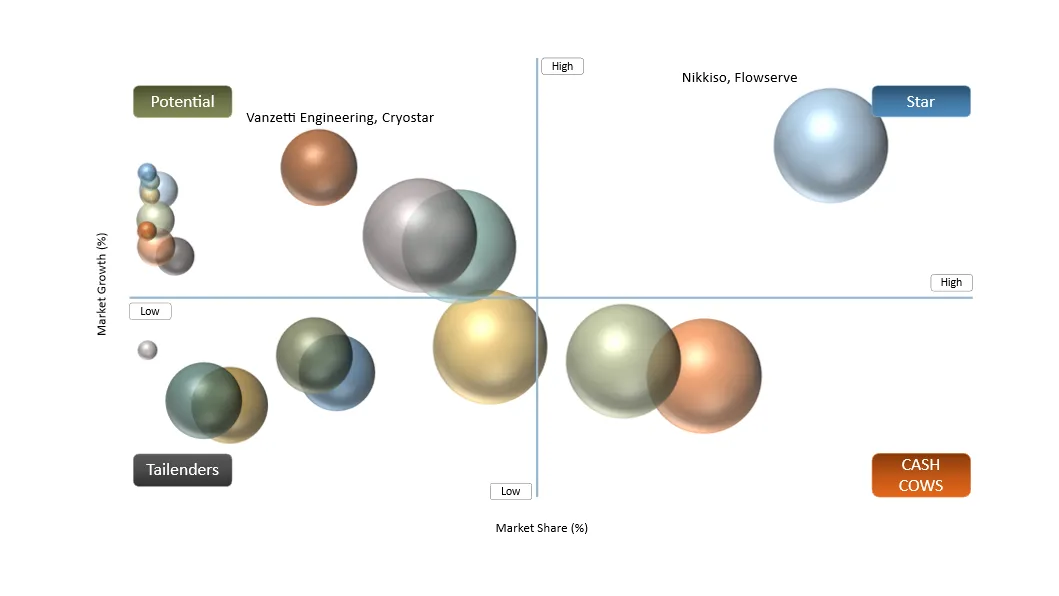
| Category | Representative Companies | Strategic Interpretation |
| Stars | Nikkiso, Flowserve, Ebara | Strong cryogenic portfolios, broad installed bases and exposure to LNG and hydrogen growth. |
| Potential | Vanzetti Engineering, Cryostar, Ruhrpumpen | Specialized technology and expansion opportunities in regional or application niches. |
| Cash Cows | Sulzer, KSB, Torishima | Established industrial pump businesses with recurring demand and selective cryogenic exposure. |
| Tailenders | Smaller regional fabricators | Compete on local pricing or basic transfer applications with limited global service reach. |
Cryogenic Pump Market Dynamics
Driver Impact Analysis
| Driver | Market Growth Impact | Demand Concentration | Impacted Use Case | Strategic Impact |
| LNG infrastructure expansion | High | Global | Liquefaction, storage and regasification | Increases demand for transfer and high-pressure send-out pumps. |
| Industrial gas investment | High | Asia-Pacific and North America | Air separation and bulk gas supply | Supports recurring equipment and aftermarket demand. |
| Hydrogen commercialization | Medium-High | North America, Europe and Asia | Liquefaction and fueling | Creates premium technology opportunities. |
| Semiconductor and healthcare growth | Medium | Asia-Pacific and global | High-purity gases and medical oxygen | Expands specialized low-flow and transfer applications. |
Driver: Expansion of LNG Liquefaction, Storage and Regasification Infrastructure
LNG infrastructure is the largest demand driver because cryogenic pumps are required at several points in the value chain. Liquefaction plants use pumps for refrigerant and LNG handling, storage tanks use in-tank transfer pumps, marine terminals require loading systems and regasification terminals use high-pressure send-out pumps. FSRU conversions add another demand stream because existing carriers must be equipped with specialized pumping and regasification systems. Procurement decisions increasingly combine hydraulic performance with lifecycle reliability, maintainability, energy consumption and the ability of the supplier to support commissioning, diagnostics and spare parts over long operating periods. Buyers also assess materials compatibility, cavitation margin, seal design, bearing life, motor efficiency and the vendor’s experience with the specific cryogenic fluid. These factors make application engineering and installed-base support central to competitive differentiation.
The business opportunity extends beyond initial equipment. LNG pumps operate in critical service and require inspections, spare parts, bearing replacement, motor support and performance upgrades. Suppliers with a large installed base can build recurring aftermarket revenue. New projects in North America, Qatar, Asia and emerging LNG-to-power markets support both large engineered pumps and modular systems. Procurement decisions increasingly combine hydraulic performance with lifecycle reliability, maintainability, energy consumption and the ability of the supplier to support commissioning, diagnostics and spare parts over long operating periods. Buyers also assess materials compatibility, cavitation margin, seal design, bearing life, motor efficiency and the vendor’s experience with the specific cryogenic fluid. These factors make application engineering and installed-base support central to competitive differentiation.
Restraint Impact Analysis
| Restraint | Drag on Growth | Primary Impact Area | Impacted Use Case | Strategic Impact |
| High capital and qualification costs | High | New product development | Hydrogen and high-pressure LNG | Limits entry and extends development cycles. |
| Cavitation and reliability risk | Medium-High | Operations | Tank transfer and send-out | Raises testing and maintenance requirements. |
| Long project lead times | Medium | Procurement | LNG and industrial gas projects | Creates scheduling and inventory pressure. |
| Skilled service shortage | Medium | Aftermarket | Remote and emerging markets | Can increase downtime and lifecycle cost. |
Restraint: High Capital Cost and Complex Qualification Requirements
Cryogenic pump development requires specialized engineering, test facilities and fluid-specific validation. Performance must be proven across low temperatures, variable tank levels and transient operating conditions. Submerged motor pumps add electrical and motor-cooling complexity, while hydrogen pumps require enhanced leakage control and materials compatibility. These requirements increase development cost and slow the entry of new suppliers. Procurement decisions increasingly combine hydraulic performance with lifecycle reliability, maintainability, energy consumption and the ability of the supplier to support commissioning, diagnostics and spare parts over long operating periods. Buyers also assess materials compatibility, cavitation margin, seal design, bearing life, motor efficiency and the vendor’s experience with the specific cryogenic fluid. These factors make application engineering and installed-base support central to competitive differentiation.
End users also place strong weight on references because pump failure can interrupt a terminal or process plant. New suppliers may struggle to obtain the first commercial installation without extensive demonstration testing. This creates a concentrated market for the most demanding applications and may contribute to longer lead times and premium pricing. Procurement decisions increasingly combine hydraulic performance with lifecycle reliability, maintainability, energy consumption and the ability of the supplier to support commissioning, diagnostics and spare parts over long operating periods. Buyers also assess materials compatibility, cavitation margin, seal design, bearing life, motor efficiency and the vendor’s experience with the specific cryogenic fluid. These factors make application engineering and installed-base support central to competitive differentiation.
Cryogenic Pump Market Segment Analysis
By Pump Type
Centrifugal Pumps Will Continue to Lead High-Flow Cryogenic Duty
Centrifugal pumps dominate because LNG terminals, storage facilities and industrial gas plants require high flow rates and continuous transfer. Multi-stage designs serve high-pressure send-out, while single-stage and in-tank pumps support transfer and circulation. Positive displacement pumps remain important for lower-flow, higher-pressure and metering applications, including cylinder filling and selected hydrogen systems. Procurement decisions increasingly combine hydraulic performance with lifecycle reliability, maintainability, energy consumption and the ability of the supplier to support commissioning, diagnostics and spare parts over long operating periods. Buyers also assess materials compatibility, cavitation margin, seal design, bearing life, motor efficiency and the vendor’s experience with the specific cryogenic fluid. These factors make application engineering and installed-base support central to competitive differentiation.
Market attractiveness is highest where qualification barriers, lifecycle service needs and operating criticality support stronger margins. Suppliers that can move from engineering studies through commissioning and long-term support are best placed to secure repeat business.
By Design
Submerged Motor Pumps Will Gain Share in LNG Storage and Regasification
Submerged motor pumps place the motor and hydraulic stages inside the cryogenic fluid, eliminating exposed shaft seals and enabling compact installation. They are widely used in LNG storage tanks, suction vessels and regasification systems. External motor pumps remain important where maintainability, flexible drive selection or process configuration favors a conventional arrangement. Procurement decisions increasingly combine hydraulic performance with lifecycle reliability, maintainability, energy consumption and the ability of the supplier to support commissioning, diagnostics and spare parts over long operating periods. Buyers also assess materials compatibility, cavitation margin, seal design, bearing life, motor efficiency and the vendor’s experience with the specific cryogenic fluid. These factors make application engineering and installed-base support central to competitive differentiation.
Market attractiveness is highest where qualification barriers, lifecycle service needs and operating criticality support stronger margins. Suppliers that can move from engineering studies through commissioning and long-term support are best placed to secure repeat business.
By Cryogenic Fluid
LNG Will Retain the Largest Revenue Base as Liquid Hydrogen Grows Fastest
LNG is the largest fluid segment because it supports global marine transport, storage and regasification. Liquid nitrogen and oxygen create broad industrial and healthcare demand, while argon supports metals and electronics. Liquid hydrogen is the fastest-growing niche because new mobility, aerospace and energy projects require specialized pumps with very low-temperature capability. Procurement decisions increasingly combine hydraulic performance with lifecycle reliability, maintainability, energy consumption and the ability of the supplier to support commissioning, diagnostics and spare parts over long operating periods. Buyers also assess materials compatibility, cavitation margin, seal design, bearing life, motor efficiency and the vendor’s experience with the specific cryogenic fluid. These factors make application engineering and installed-base support central to competitive differentiation.
Market attractiveness is highest where qualification barriers, lifecycle service needs and operating criticality support stronger margins. Suppliers that can move from engineering studies through commissioning and long-term support are best placed to secure repeat business.
By Operation
Continuous-Duty Pumps Will Account for the Largest Value Share
Continuous-duty pumps are designed for sustained transfer, circulation and process service in LNG terminals and industrial gas plants. Reliability, efficiency and bearing life are central purchasing criteria. Intermittent-duty pumps serve loading, unloading, backup, fueling and test applications where starts, stops and standby readiness become more important. Procurement decisions increasingly combine hydraulic performance with lifecycle reliability, maintainability, energy consumption and the ability of the supplier to support commissioning, diagnostics and spare parts over long operating periods. Buyers also assess materials compatibility, cavitation margin, seal design, bearing life, motor efficiency and the vendor’s experience with the specific cryogenic fluid. These factors make application engineering and installed-base support central to competitive differentiation.
Market attractiveness is highest where qualification barriers, lifecycle service needs and operating criticality support stronger margins. Suppliers that can move from engineering studies through commissioning and long-term support are best placed to secure repeat business.
By Application
Transfer and Loading Will Remain the Largest Application
Transfer and loading applications span storage tanks, road tankers, railcars, ships and process vessels. They generate high unit volumes across LNG and industrial gases. Circulation and boosting are more engineered and often higher value, while fueling and dispensing are gaining importance in LNG and hydrogen mobility. Test and process applications support aerospace, research and semiconductor systems. Procurement decisions increasingly combine hydraulic performance with lifecycle reliability, maintainability, energy consumption and the ability of the supplier to support commissioning, diagnostics and spare parts over long operating periods. Buyers also assess materials compatibility, cavitation margin, seal design, bearing life, motor efficiency and the vendor’s experience with the specific cryogenic fluid. These factors make application engineering and installed-base support central to competitive differentiation.
Market attractiveness is highest where qualification barriers, lifecycle service needs and operating criticality support stronger margins. Suppliers that can move from engineering studies through commissioning and long-term support are best placed to secure repeat business.
By End-Use Industry
Oil and Gas and LNG Will Lead, While Hydrogen and Electronics Accelerate
Oil and gas and LNG represent the largest end-use industry because cryogenic pumps are embedded throughout the LNG chain. Industrial gases provide stable recurring demand. Hydrogen is the fastest-growing emerging segment, and electronics benefits from semiconductor fabs that require high-purity nitrogen, argon and other gases. Healthcare demand is linked to oxygen production and distribution. Procurement decisions increasingly combine hydraulic performance with lifecycle reliability, maintainability, energy consumption and the ability of the supplier to support commissioning, diagnostics and spare parts over long operating periods. Buyers also assess materials compatibility, cavitation margin, seal design, bearing life, motor efficiency and the vendor’s experience with the specific cryogenic fluid. These factors make application engineering and installed-base support central to competitive differentiation.
Market attractiveness is highest where qualification barriers, lifecycle service needs and operating criticality support stronger margins. Suppliers that can move from engineering studies through commissioning and long-term support are best placed to secure repeat business.
By Sales Channel
Direct Sales Will Dominate Engineered Projects
Direct sales dominate large LNG, industrial gas and hydrogen projects because pump selection requires application engineering, testing, documentation and project management. EPC contractors and system integrators are influential specifiers and may purchase complete skids. Distributors and aftermarket providers are more important for standard pumps, spares and regional service. Procurement decisions increasingly combine hydraulic performance with lifecycle reliability, maintainability, energy consumption and the ability of the supplier to support commissioning, diagnostics and spare parts over long operating periods. Buyers also assess materials compatibility, cavitation margin, seal design, bearing life, motor efficiency and the vendor’s experience with the specific cryogenic fluid. These factors make application engineering and installed-base support central to competitive differentiation.
Market attractiveness is highest where qualification barriers, lifecycle service needs and operating criticality support stronger margins. Suppliers that can move from engineering studies through commissioning and long-term support are best placed to secure repeat business.
Cryogenic Pump Market Geographical Penetration
U.S. Cryogenic Pump Market Landscape
The U.S. is a major demand center due to LNG export capacity, industrial gas production, hydrogen programs, aerospace testing and semiconductor investment. Gulf Coast LNG projects require large transfer and send-out pumps, while hydrogen hubs and heavy-duty mobility pilots create new technology needs. Domestic service capability and rapid spare-parts support are important procurement advantages. Procurement decisions increasingly combine hydraulic performance with lifecycle reliability, maintainability, energy consumption and the ability of the supplier to support commissioning, diagnostics and spare parts over long operating periods. Buyers also assess materials compatibility, cavitation margin, seal design, bearing life, motor efficiency and the vendor’s experience with the specific cryogenic fluid. These factors make application engineering and installed-base support central to competitive differentiation.
Regional procurement increasingly values local commissioning, operator training and rapid response. Suppliers that combine global technology with regional service capability can reduce project risk and strengthen long-term customer relationships.
Germany and France Cryogenic Pump Market Outlook
Germany and France combine industrial gas, chemical, aerospace and hydrogen activity. European buyers place strong emphasis on efficiency, safety documentation and emissions reduction. The region also hosts specialized engineering and equipment suppliers. Growth opportunities include hydrogen mobility, LNG import infrastructure, research facilities and replacement of aging industrial gas pumps. Procurement decisions increasingly combine hydraulic performance with lifecycle reliability, maintainability, energy consumption and the ability of the supplier to support commissioning, diagnostics and spare parts over long operating periods. Buyers also assess materials compatibility, cavitation margin, seal design, bearing life, motor efficiency and the vendor’s experience with the specific cryogenic fluid. These factors make application engineering and installed-base support central to competitive differentiation.
Regional procurement increasingly values local commissioning, operator training and rapid response. Suppliers that combine global technology with regional service capability can reduce project risk and strengthen long-term customer relationships.
China, Japan and South Korea Cryogenic Pump Market Trends
East Asia is a major manufacturing and demand cluster. China invests in LNG terminals, industrial gases, chemicals and semiconductors while expanding domestic pump production. Japan has strong cryogenic engineering capability and emerging liquid-hydrogen projects. South Korea combines shipbuilding, LNG terminals, petrochemicals and hydrogen mobility, creating demand for marine and land-based systems. Procurement decisions increasingly combine hydraulic performance with lifecycle reliability, maintainability, energy consumption and the ability of the supplier to support commissioning, diagnostics and spare parts over long operating periods. Buyers also assess materials compatibility, cavitation margin, seal design, bearing life, motor efficiency and the vendor’s experience with the specific cryogenic fluid. These factors make application engineering and installed-base support central to competitive differentiation.
Regional procurement increasingly values local commissioning, operator training and rapid response. Suppliers that combine global technology with regional service capability can reduce project risk and strengthen long-term customer relationships.
India and Southeast Asia Market Opportunity
India and Southeast Asia are expanding LNG import terminals, city-gas infrastructure, industrial gas production and electronics manufacturing. These markets require both large engineered pumps and smaller modular systems. Local service networks, training and spare-parts inventory can differentiate suppliers because many projects are distant from established repair centers. Procurement decisions increasingly combine hydraulic performance with lifecycle reliability, maintainability, energy consumption and the ability of the supplier to support commissioning, diagnostics and spare parts over long operating periods. Buyers also assess materials compatibility, cavitation margin, seal design, bearing life, motor efficiency and the vendor’s experience with the specific cryogenic fluid. These factors make application engineering and installed-base support central to competitive differentiation.
Regional procurement increasingly values local commissioning, operator training and rapid response. Suppliers that combine global technology with regional service capability can reduce project risk and strengthen long-term customer relationships.
Middle East and Africa Growth Outlook
The Middle East is investing in LNG, gas processing, industrial gases, hydrogen and petrochemicals. Qatar, Saudi Arabia and the UAE are important project markets. Africa has smaller current demand but offers opportunities through LNG-to-power, medical oxygen and industrial gas infrastructure. Partnerships with EPC firms and local service companies can improve market access. Procurement decisions increasingly combine hydraulic performance with lifecycle reliability, maintainability, energy consumption and the ability of the supplier to support commissioning, diagnostics and spare parts over long operating periods. Buyers also assess materials compatibility, cavitation margin, seal design, bearing life, motor efficiency and the vendor’s experience with the specific cryogenic fluid. These factors make application engineering and installed-base support central to competitive differentiation.
Regional procurement increasingly values local commissioning, operator training and rapid response. Suppliers that combine global technology with regional service capability can reduce project risk and strengthen long-term customer relationships.
| Region | 2025 Share | 2035 Strategic Position |
| Asia-Pacific | 38.6% | Largest manufacturing and consumption base |
| North America | 25.4% | LNG exports, hydrogen and aerospace demand |
| Europe | 20.1% | Efficiency, industrial gases and hydrogen innovation |
| South America | 6.2% | LNG import and industrial gas expansion |
| Middle East and Africa | 9.7% | Fastest growth from LNG, gas processing and hydrogen |
Cryogenic Pump Market Competitive Landscape
- The market is moderately concentrated in high-performance LNG and submerged pump applications, where qualification history and installed references create entry barriers.
- Competition is based on hydraulic efficiency, NPSH performance, reliability, fluid compatibility, delivery time and lifecycle service rather than price alone.
- Leading companies are extending portfolios toward liquid hydrogen, high-pressure LNG and digitally monitored equipment.
- Regional manufacturers compete effectively in standard transfer pumps and domestic projects, while global suppliers retain advantages in large engineered systems.
- Partnerships with EPC contractors, industrial gas companies and terminal operators are central to project access and specification influence.
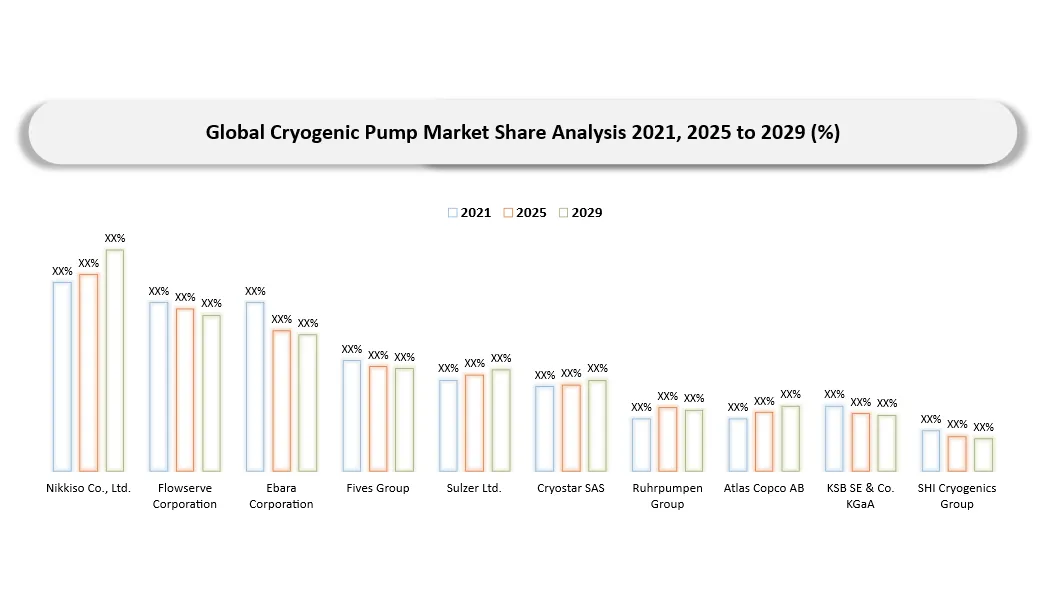
Key Companies of Cryogenic Pump Market
- Nikkiso Co., Ltd.
- Flowserve Corporation
- Ebara Corporation
- Fives Group
- Sulzer Ltd.
- Ruhrpumpen Group
- Vanzetti Engineering S.p.A.
- Cryostar SAS
- SHI Cryogenics Group
- PHPK Technologies
- Atlas Copco
- Barber-Nichols
- Huzhou Baihui Cryogenic Equipment
- Hangzhou Cryogenic Equipment
- Cryogenic Industries
- Wuxi Jierui Changjiang Cryogenic Technology
- Trillium Flow Technologies
- KSB SE & Co. KGaA
- Torishima Pump Mfg. Co., Ltd.
- Sehwa Tech
Cryogenic Pump Market Major Pain Points
- Long lead times for engineered submerged and high-pressure pumps.
- Cavitation, vapor handling and low NPSH conditions that can reduce reliability.
- Limited qualified suppliers for liquid hydrogen and specialized aerospace applications.
- High cost of full-scale performance testing and certification.
- Difficulty servicing pumps installed inside tanks or suction vessels.
- Shortage of experienced cryogenic technicians in emerging markets.
- Supply-chain dependence on precision bearings, motors and specialty alloys.
- Project delays that disrupt manufacturing schedules and working capital.
Cryogenic Pump Market Recent Developments
- November 2025: Nikkiso announced a contract to supply 12 bespoke cryogenic submerged pumps for three LNG carriers being converted into floating storage and regasification units.
- October 2025: Nikkiso reported successful performance testing of a second prototype pump designed for hydrogen aircraft applications.
- April 2025: Nikkiso received an order for a pump unit for hydrogen-fueled ships, supporting the expansion of maritime hydrogen technology.
- May 2025: Flowserve advanced its high-pressure cryogenic submerged motor pump platform for LNG regasification, emphasizing efficiency, thrust balancing and lower lifecycle cost.
Analyst View/Opinion on Cryogenic Pump Market
- LNG will remain the commercial foundation of the market through 2035 because each liquefaction, storage and regasification project requires multiple critical pump systems.
- Liquid hydrogen will create the strongest technology premium, although commercialization will depend on project scale, safety standards and infrastructure economics.
- Aftermarket capability will become a more important source of differentiation as operators prioritize availability and lower lifecycle cost.
- Submerged motor pumps will gain share in applications where compact design, seal elimination and in-vessel installation provide operating advantages.
- Asian manufacturers will increase global participation, while established suppliers will defend share through references, service networks and advanced engineering.
- Long-term winners will combine high-efficiency product platforms, fluid-specific qualification, digital monitoring and regional service coverage.
Cryogenic Pump Market Target Audience
| Industry | Who Should Buy This Report? | Reason to Buy |
| Cryogenic Pump Manufacturers | Strategy, product and business development teams | Assess demand, technology priorities and competitive positioning. |
| LNG and Gas Infrastructure | Terminal owners, operators and EPC contractors | Evaluate pump requirements, suppliers and project opportunities. |
| Industrial Gases | Air separation and bulk gas companies | Understand equipment demand and lifecycle service needs. |
| Hydrogen and Clean Energy | Developers, equipment integrators and investors | Identify liquid-hydrogen pumping opportunities and barriers. |
| Aerospace and Defense | Ground-support and test-system teams | Assess high-reliability cryogenic pump technologies. |
| Investors and Consultants | Private equity, corporate strategy and advisory teams | Evaluate market growth, consolidation and regional expansion. |
Why Choose DATAM?
- Data-driven insights covering market size, segmentation, pricing, installed-base dynamics and project demand.
- Post-purchase analyst support for supplier benchmarking, regional opportunity assessment and customer-specific questions.
- Annual updates reflecting LNG, hydrogen, industrial gas and technology developments.
- Specialized coverage of emerging markets and project-led equipment demand.
- Strategic analysis that links market growth with procurement, service and investment decisions.
What DATAM Uniquely Provides
- Ten-year forecasts by pump type, design, fluid, operation, application, end-use industry, sales channel and region.
- Competitive analysis covering global specialists, diversified pump companies and regional manufacturers.
- Assessment of liquid-hydrogen technology, LNG project cycles, aftermarket services and digital monitoring.
- Country-level insights for major LNG, industrial gas, hydrogen and semiconductor markets.
- White-space analysis for product development, local service, partnerships and investment.
Questions This Report Answers
- Which cryogenic pump segments will generate the strongest revenue growth through 2035?
- How will LNG, industrial gases and liquid hydrogen shape equipment demand?
- Which regions offer the most attractive manufacturing and service opportunities?
- How do pump efficiency, cavitation performance and lifecycle support influence buyer decisions?
- Which companies are best positioned in submerged motor and high-pressure cryogenic pumps?
- Where are the strongest opportunities for partnerships, localization and aftermarket expansion?


























































