


Cryogenic Electronics Market Size and Overview
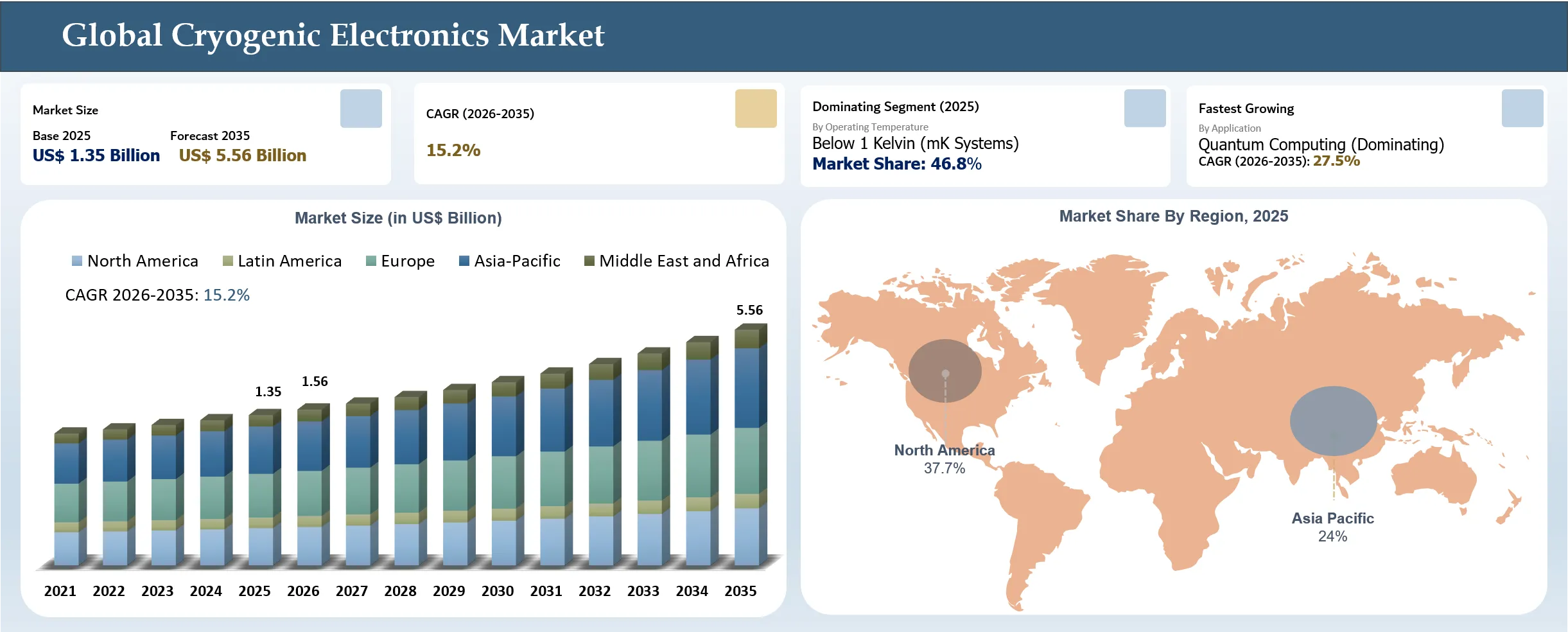
The global Cryogenic Electronics market reached USD 1.35 billion in 2025 and is expected to reach USD 5.56 billion by 2035, growing with a CAGR of 15.2% during the forecast period 2026-2035. The market is gaining momentum because of the rapid development of superconducting quantum computing, cryogenic semiconductor technology, and ultra-low noise electronic devices. IBM Quantum's roadmap for 2025 is the introduction of IBM Quantum Starling by 2029, which can perform 100 million gates on 200 logical qubits and will make 20,000 times more calculations than modern quantum computers, driving the need for scalable cryogenic electronics, such as Cryo-CMOS controllers, low-noise amplifiers, and quantum readouts. Also, according to IBM, the superconducting quantum computers from this company are functioning at 0.01 K above absolute zero, so they require cryogenic CMOS controllers, low-noise amplifiers, and readout electronics to operate properly. All these developments, along with the investments in quantum processors, scientific equipment, and superconducting devices, boost the demand for cryogenic electronics. Nevertheless, the high cost of infrastructure, difficult thermal management, and semiconductor integration represent some of the main barriers to the commercialization of cryogenic electronics.
This success demonstrates the rising commercial significance of cryogenic electronics that facilitate energy-efficient and high-performance computing capabilities in emerging quantum technology and space technology. In October 2025, according to Quantum Insider, SemiQon, in collaboration with VTT Technical Research Centre of Finland, won the “Impact Expected” Award from EARTO (European Association of Research and Technology Organizations) for their innovation in Cryo-CMOS chip technology developed for quantum computing and space purposes. This technology provides a 50-90% reduction in power consumption of space systems, reduces the cost of quantum computer readout systems by 30% in the short term and over 10 times in the long-term period, and could save $20-30 billion per year worldwide on supercomputing cooling costs. It has also been pointed out in the report that the Cryo-CMOS chips technology market is valued at over €3 billion in the global market and expected to be worth €10 billion by 2030.
White-Space Opportunities for Government Investments in Cryogenic Research Infrastructure and Quantum Electronics
In March 2026, the largest area of investment in the Cryogenic Electronics market is cryogenic research infrastructure and quantum computing hardware development, as governments increasingly fund facilities capable of supporting next-generation low-temperature electronics, superconducting devices, and quantum processors. The UK Research and Innovation (UKRI) has committed £51.2 million through the Infrastructure Fund to establish the National Cryogenic Facility (NCF), enabling researchers to perform experiments at temperatures below those found in deep space and significantly expanding the UK's capabilities in cryogenic testing, superconducting electronics, and quantum device validation. Complementing this initiative, Qubic Technologies secured a CAD 925,000 (approximately US$1 million) grant for a CAD 2.5 million project to develop cryogenic traveling-wave parametric amplifiers (TWPAs) based on quantum materials, addressing one of the key challenges in scalable quantum computing by dramatically reducing heat dissipation in cryogenic environments. In addition, the Government of India, under the National Quantum Mission, announced an expected investment of ₹720 crore for establishing Quantum Fabrication and Central Facilities, which include advanced cleanrooms, quantum chip fabrication infrastructure, and specialized cryogenic systems. These investments demonstrate that cryogenic infrastructure, quantum semiconductor fabrication, and cryogenic electronic components are receiving the highest levels of public funding, creating significant long-term growth opportunities across the global Cryogenic Electronics market.
The expanding investment landscape is expected to generate broad commercial opportunities across equipment manufacturers, semiconductor suppliers, quantum hardware developers, and research organizations supporting cryogenic technologies. Cryogenic system providers such as Bluefors, Oxford Instruments NanoScience, Lake Shore Cryotronics, Cryomech, and Air Liquide are well positioned to benefit from increasing procurement of dilution refrigerators, cryostats, ultra-low-temperature cooling systems, and precision cryogenic measurement equipment required by newly established research and fabrication facilities. Quantum computing companies including IBM Quantum, Google Quantum AI, Rigetti Computing, D-Wave Quantum, IQM Quantum Computers, and Quantinuum are expected to gain from improved access to advanced cryogenic infrastructure and next-generation cryogenic amplifiers that enhance quantum processor scalability and performance. Semiconductor research organizations and fabrication institutes such as VTT Technical Research Centre of Finland, imec, CEA-Leti, CSEM, and national laboratories are also likely to benefit through expanded development of Cryo-CMOS technologies, superconducting integrated circuits, quantum chips, and ultra-low-temperature electronic devices. Collectively, these government-backed investments are accelerating innovation, strengthening manufacturing capabilities, and creating substantial procurement and commercialization opportunities across the entire Cryogenic Electronics value chain.
Cryogenic Electronics Market Key Takeaways
- North America held the largest global market share in 2025 at 37.7%, backed by extensive quantum research infrastructure. Meanwhile, Asia-Pacific is highlighted as the fastest-growing regional market over the forecast period.
- Electronics operating at below 1 Kelvin (mK Systems) led the market with a 46.8% share in 2025. This temperature tier dominates due to strict requirements for maintaining quantum coherence and reducing thermal noise in quantum computing.
- A 40 nm Cryo-CMOS quantum controller IC consumes only 4.2 mW during rectangular pulse generation and 6.5 mW during sine-shaped DRAG pulse generation. It provides inter-channel interference suppression of 10 dB and achieves a spurious-free dynamic range exceeding 40 dBc.
- Public funding includes the UK's £51.2 million commitment for the National Cryogenic Facility and India's ₹720 crore allocation under its National Quantum Mission. Additionally, Qubic Technologies secured a CAD 925,000 grant toward a CAD 2.5 million project for cryogenic traveling-wave parametric amplifiers.
Cryogenic Electronics Market Industry Trends and Strategic Insight
- Cryo-CMOS is becoming the preferred control architecture for scalable quantum computing, as semiconductor companies are integrating cryogenic CMOS controllers directly inside dilution refrigerators to reduce wiring complexity, latency, and thermal losses between room-temperature electronics and superconducting qubits.
- Quantum processor scaling is accelerating demand for high-density cryogenic electronics. The transition from hundreds to thousands of physical qubits requires distributed cryogenic control, multiplexing, and readout electronics capable of operating reliably at 4 K and millikelvin temperatures while maintaining extremely low power consumption.
- Low-power circuit design is emerging as a primary technology differentiator, as cooling capacity inside dilution refrigerators remains limited.
- Cryogenic semiconductor device modeling is becoming a strategic R&D priority, with leading research organizations developing transistor models specifically for cryogenic temperatures to improve circuit predictability, reliability, and design automation for advanced CMOS process nodes.
- Superconducting electronics and cryogenic CMOS are increasingly being developed as complementary technologies, combining CMOS-based control circuits with superconducting logic and amplifiers to improve quantum processor performance, scalability, and energy efficiency.
Cryogenic Electronics Market Scope
| Metrics | Details | |
| 2025 Market Size | USD 1.35 Billion | |
| 2035 Projected Market Size | USD 5.56 Billion | |
| CAGR (2026-2035) | 15.2% | |
| Largest Market | North America | |
| Fastest Growing Market | Asia-Pacific | |
| By Component | Cryogenic Integrated Circuits (Cryo-CMOS), Low-Noise Amplifiers (LNAs), Cryogenic Control Electronics, Readout Electronics, Superconducting Electronic Components, Cryogenic Interconnects & Connectors, Others | |
| By Technology | Cryo-CMOS Technology, Superconducting Electronics, Single Flux Quantum (SFQ) Electronics, Josephson Junction-Based Electronics, Hybrid Cryogenic Electronics, Others | |
| By Operating Temperature | Below 1 Kelvin (mK Systems), 1K - 4K, 4K - 77K, Above 77K | |
| By Application | Quantum Computing, Scientific Instrumentation, Medical Imaging Systems, Space & Satellite Electronics, Particle Physics Experiments, Cryogenic Sensors & Detectors, High-Performance Computing (HPC), Radio Astronomy, Quantum Communication & Networking, Others | |
| By Region | North America | U.S., Canada, Mexico |
| Europe | Germany, UK, France, Spain, Italy, Poland | |
| Asia-Pacific | China, India, Japan, Australia, South Korea, Indonesia, Malaysia | |
| Latin America | Brazil, Argentina | |
| Middle East and Africa | UAE, Saudi Arabia, South Africa, Israel, Türkiye | |
| Report Insights Covered | Competitive Landscape Analysis, Company Profile Analysis, Market Size, Share, Growth | |
Cryogenic Electronics Market Disruption Analysis
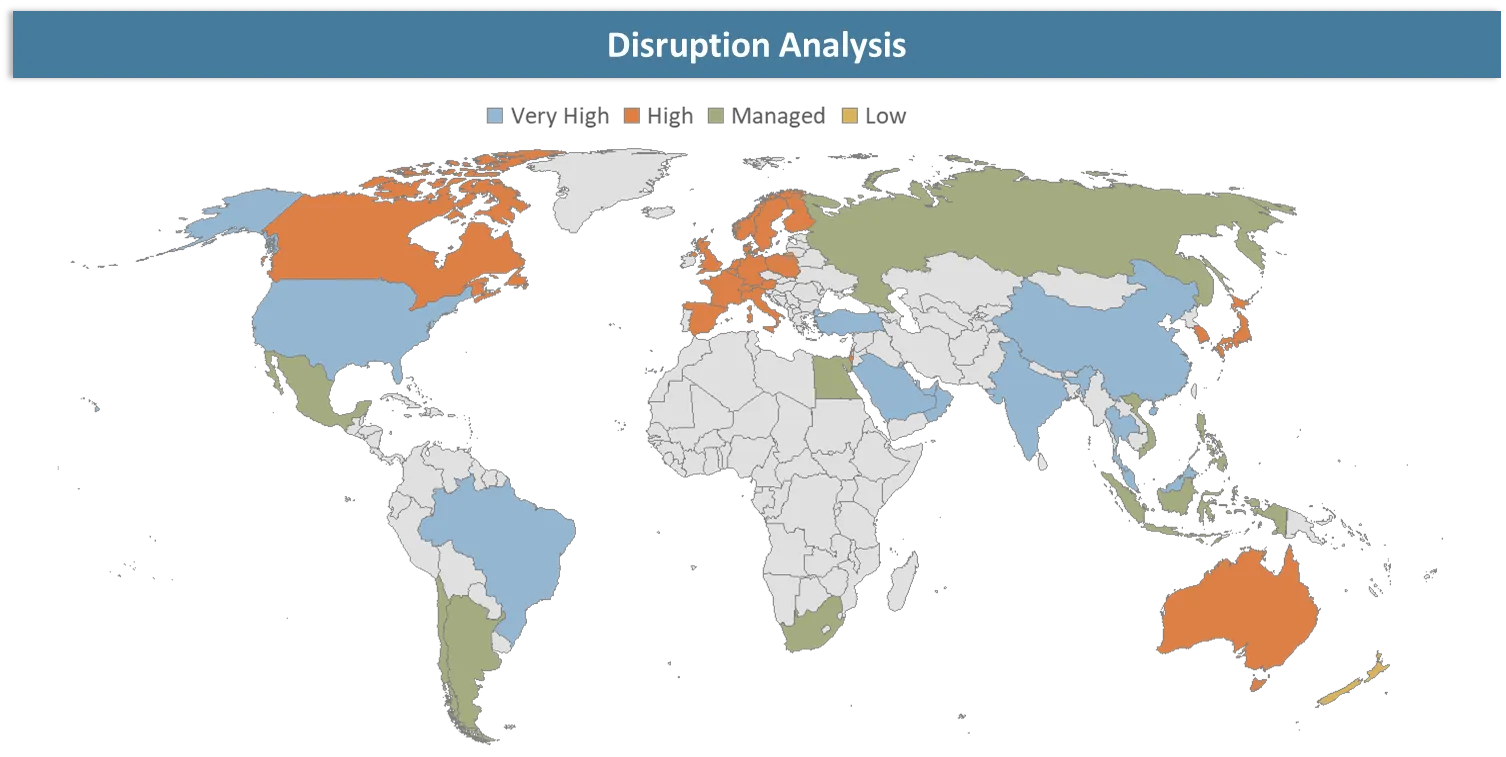
Transition Toward Fault-Tolerant Quantum Computing Reshaping Cryogenic Electronics Architecture
The primary disruption in the Cryogenic Electronics Market is the transition from conventional room-temperature control electronics to Cryo-CMOS circuitry that is embedded in the cryogenic environment itself. With the development of superconducting quantum processors toward fault-tolerant quantum computing, regular electronic control components are being increasingly limited by the problems associated with wiring, thermal load, and signal delay. This is causing an increasing move toward the use of cryogenic circuits and multiplexers as well as ultra-low power readout circuits closer to quantum processors.
The disruption gained momentum in 2025 with the developments in cryogenic semiconductor technologies. The researchers at IBM Research developed the first CMOS current reference with a documented temperature coefficient at cryogenic temperatures. The technology used was the 14 nm FinFET CMOS, and its operational temperature range was from 5.6 K to 100 K. The temperature coefficient achieved was 128 ppm/K, the chip size was 0.14 mm², it consumed 38 μA on a 1.4 V supply voltage, and had a cryogenic supply sensitivity of 0.06%/V, which was 6× better than the previous record of cryo-CMOS current or voltage references. These developments make cryogenic electronics much more stable and energy-efficient.
Cryogenic Electronics Market BCG Matrix: Company Evaluation
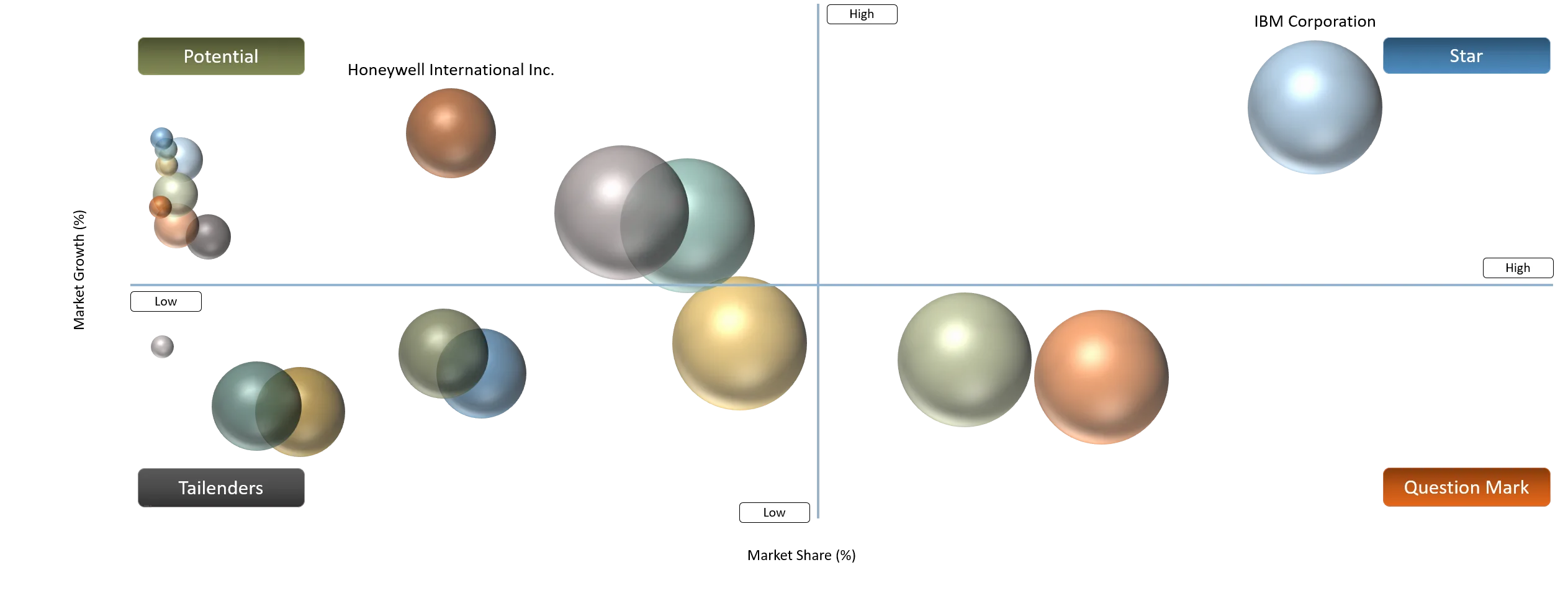
Stars include IBM Corporation, Intel Corporation, and Oxford Instruments plc because they are leading the commercialization of cryogenic electronics through extensive investments in Cryo-CMOS, superconducting quantum technologies, cryogenic control systems, and quantum computing infrastructure. IBM and Intel are advancing scalable cryogenic semiconductor architectures for superconducting quantum processors, while Oxford Instruments has established a strong position in cryogenic measurement and quantum research platforms. Question Marks include Infineon Technologies AG, Keysight Technologies, Inc., and Teledyne Technologies Incorporated because they possess strong semiconductor and electronic instrumentation capabilities but are still expanding their dedicated cryogenic electronics portfolios.
The Potential category comprises Honeywell International Inc., Toshiba Corporation, and Fujitsu Limited, supported by their growing activities in quantum computing, superconducting technologies, and advanced electronic systems. The Tailenders category includes AMETEK Inc., Low Noise Factory AB, and Lockheed Martin Corporation. While these companies contribute specialized cryogenic instrumentation, ultra-low-noise microwave amplifiers, and defense-oriented cryogenic electronic systems, their participation is concentrated in niche applications or proprietary projects rather than broad commercial cryogenic electronics manufacturing.
Cryogenic Electronics Market Dynamics
Driver Impact Analysis
| Driver | Market Growth Impact (%) | Demand Concentration | Impacted Use Case | Strategic Impact |
Rapid commercialization of superconducting quantum computing is accelerating demand for Cryo-CMOS controllers, cryogenic readout electronics, and ultra-low-temperature integrated circuits. | 32% | Very High | Quantum processors, Cryo-CMOS controllers, cryogenic readout systems | Accelerates commercialization of scalable quantum computing infrastructure and drives next-generation cryogenic semiconductor innovation. |
Increasing investments in quantum computing infrastructure and national quantum technology programs are driving the deployment of advanced cryogenic electronic systems. | 26% | High | Quantum data centers, superconducting control electronics, dilution refrigerator systems | Expands long-term demand for cryogenic electronic platforms through public funding and strategic quantum initiatives. |
Growing adoption of superconducting qubits is creating strong demand for low-power cryogenic control and signal-processing electronics capable of operating below 4 K. | 24% | High | Cryogenic control ICs, multiplexers, low-noise amplifiers | Drives development of ultra-low-power electronics required for large-scale fault-tolerant quantum processors. |
Rising development of cryogenic semiconductor technologies is enabling scalable electronic architectures for next-generation quantum processors. | 20% | Medium–High | Cryogenic integrated circuits, semiconductor devices, quantum interface electronics | Improves semiconductor scalability, reliability, and manufacturing readiness for cryogenic computing platforms. |
Advancements in Cryo-CMOS technology are reducing thermal loads and wiring complexity in dilution refrigerator-based quantum computing systems. | 18% | Medium | Cryogenic bias circuits, multiplexing electronics, quantum control modules | Reduces system complexity and cooling requirements while improving integration density and overall quantum system efficiency. |
Rapid commercialization of superconducting quantum computing is accelerating demand for Cryo-CMOS controllers, cryogenic readout electronics, and ultra-low-temperature integrated circuits
The rapid commoditization of quantum computers based on superconducting technology has tremendously driven up the demand for Cryo-CMOS controllers, cryogenic read-out electronics, low-noise amplifiers, and ultra-low temperature integrated circuits. With the scaling up of the size of quantum computers, there is increased pressure to reduce dissipated heat, minimize wiring complexity, and prevent signal attenuation, leading to the requirement of electronic circuits within the cryogenic environment. In turn, this trend is compelling the semiconductor firms to design highly stable and ultra-low power consumption cryogenic integrated circuits that can coexist with the superconducting qubits.
This technological development proves how low-power Cryo-CMOS controllers are surmounting key scalability and thermal management issues facing superconducting quantum computing technology. In August 2025, as per Semantic Scholar, the study describes a 40 nm Cryo-CMOS quantum controller IC to enhance the scalability of superconducting quantum computers by using an integrated DRAG (Derivative Removal by Adiabatic Gate) pulse generation technique. The controller provides suppression of the interference between channels by 10 dB, attains spurious-free dynamic range SFDR) of more than 40 dBc, and consumes total power of only 4.2 mW in the case of rectangular pulse generation, which increases to 6.5 mW in the case of sine-shaped DRAG pulse generation.
Restraint Impact Analysis
| Restraint | Drag on Market Growth (%) | Primary Impact Area | Impacted Use Case | Strategic Impact |
Limited cooling capacity of cryogenic systems restricts the integration density and scalability of cryogenic electronic components. | 28% | Thermal management & system scalability | Quantum computing, Cryo-CMOS controllers, cryogenic readout electronics | Limits qubit scaling and increases the need for ultra-low-power cryogenic circuit architectures. |
Lack of standardized semiconductor design models for ultra-low-temperature operation increases product development complexity and validation time. | 22% | Semiconductor design & circuit validation | Cryogenic integrated circuits, analog/RF electronics | Extends product development cycles and delays commercialization of cryogenic semiconductor technologies. |
Performance variability of conventional CMOS devices under cryogenic temperatures limits the adoption of existing semiconductor technologies. | 20% | Device reliability & process optimization | Cryo-CMOS ICs, quantum control electronics | Requires specialized cryogenic device characterization and redesign, increasing R&D investment and design complexity. |
Dependence on specialized cryogenic infrastructure, including dilution refrigerators and helium-based cooling systems, increases overall system costs. | 24% | Infrastructure & capital expenditure | Quantum computing systems, scientific instrumentation, superconducting electronics | Raises deployment costs and restricts adoption primarily to research institutions and high-value commercial applications. |
Limited cooling capacity of cryogenic systems restricts the integration density and scalability of cryogenic electronic components
One of the key limitations associated with the Cryogenic Electronics Market is the low cooling capability of cryogenic devices, especially the dilution refrigerators that operate at millikelvin temperatures. As superconducting quantum processors get more and more qubits, there will be increased heating from cryogenic control electronics in the cryostat. While the semiconductor electronics have been designed in such a way that they do not require cooling even at the chip level, in cryogenic electronics, every additional microwatt of power requires extra cooling. As a result, only a limited number of cryogenic circuits, multiplexers, and readout electronics can be used in one cryogenic cooling system.
The results indicate that the lack of cooling capacity and the increase in heat load continue to be key challenges that impede the adoption of more cryoelectronics in superconducting quantum computing architectures. In October 2025, as per Springer Nature, the study conducted a thermal analysis of the dense microwave interconnects utilized in superconducting quantum computers and determined the effects of an increased number of signal lines on the ability of cryogenic cooling. With the Bluefors XLD1000-SL dilution refrigerator being the base system, the authors observed that the design can theoretically accommodate up to 200 qubits, while the practical maximum is approximately 140 qubits when engineering safety factors and physical space for microwave readout circuitry are considered. The work also analyzed processor designs between 100 and 225 qubits, with thermal loading being one of the major limitations in scaling cryogenic electronics.
Cryogenic Electronics Market Segment Analysis
The global Cryogenic Electronics market is segmented based on component, technology, operating temperature, application, and region.
Below 1 Kelvin (mK Systems) Dominating the Operating Temperature Segment in Cryogenic Electronics Market Due to Quantum Computing and Superconducting Device Requirements
The Below 1 Kelvin (mK Systems) segment continues to dominate the operating temperature category in the Cryogenic Electronics Market, with a market share of 46.8% in 2025. The rising demand for ultra-cold electronic systems that will be utilized in quantum computing, superconducting circuits, and various scientific research purposes has been driving the growth of this portion. The use of mK cryogenic electronics is very important in order to ensure quantum coherence, minimize thermal noise, and enhance the performance of superconducting qubits and quantum sensors. It can be said that rapid developments in quantum computers have made mK cryogenic systems more popular than the rest of cryogenic electronics.
Highly recognized technology firms and research institutions, such as IBM Corporation, Intel Corporation, Google, and research laboratories, are currently making use of millikelvin cryogenic conditions for superconducting quantum processors and cryogenic control electronics. The development of quantum processor technology during 2025–2026 led to an increased demand for cryogenic integrated circuits, low-noise amplifiers, and readout electronics that can function at temperatures close to absolute zero. The growing commercialization of quantum computing technology, quantum research facilities, and the necessity of precise cryogenic measuring equipment will continue to keep Below 1 Kelvin (mK Systems) dominant in the Cryogenic Electronics Market.
Cryogenic Electronics Market Geographical Penetration
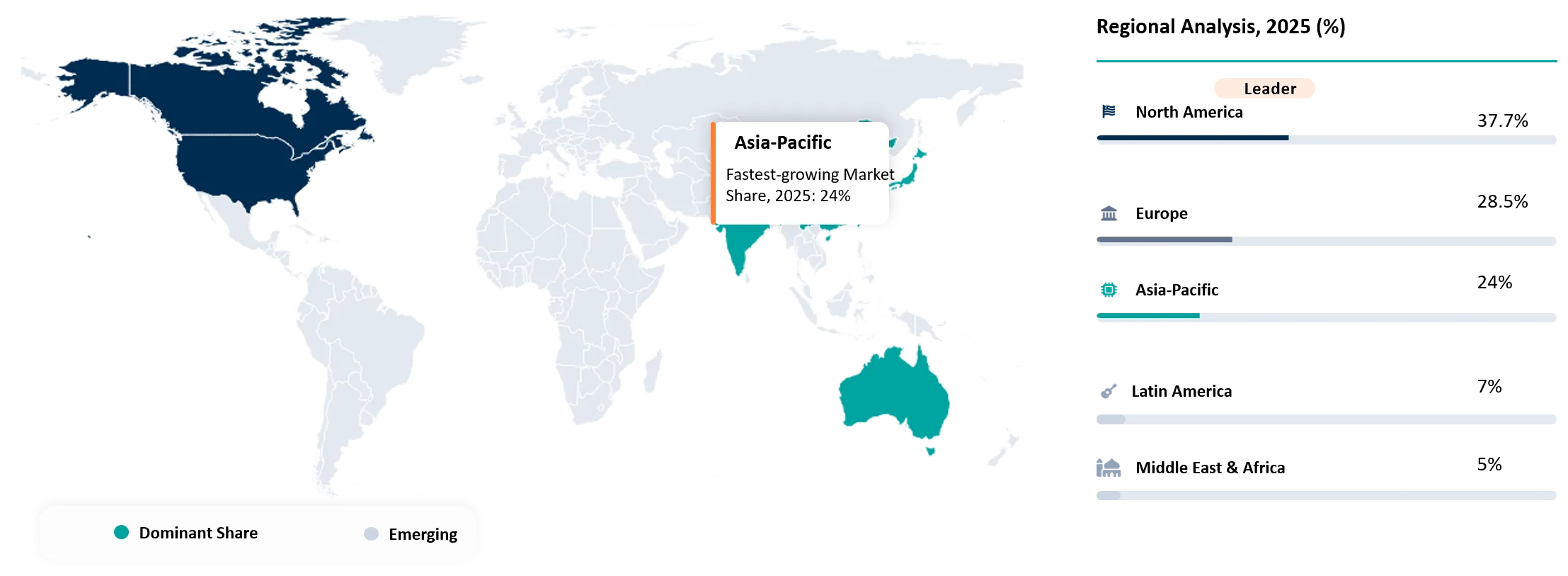
Strong Government Support and Quantum Computing Infrastructure Development Driving North America Leadership in Cryogenic Electronics Market
North America region dominates the Cryogenic Electronics Market, accounting for 37.7% of the total market share of the global market in 2025 because of heavy investments in quantum computers, superconducting electronics, cryogenic semiconductors, and advanced research facilities. The presence of prominent quantum technology developers, semiconductor manufacturers, national laboratories, and research institutes in the US and Canada has led to the adoption of cryogenic electronic devices in applications such as quantum computing, low-noise measurement devices, space electronics, and high-performance computing. Increased funding for quantum technology research and increased cryogenic testing facility developments have solidified the region's position as the most important hub for cryogenic technology.
The acquisition will enhance the cryogenic electronics landscape through the merger of complementary technologies that include ultra-cold temperature measurement systems, dilution refrigeration, and quantum research instrumentation that will help speed up the process of developing quantum computers. In June 2025, Quantum Design, Inc., a U.S.-based scientific instruments company, entered into a definitive agreement with respect to acquiring the NanoScience division of Oxford Instruments plc, a UK-based scientific instruments company. This acquisition was worth £60 million in total value, with up to £3 million of deferred consideration, and was focused on quantum scaling system revenue.
U.S. Cryogenic Electronics Market Trends
The U.S. dominates the North American Cryogenic Electronics Market owing to its quantum computing ecosystem, substantial government funding for quantum computing, and leading technology firms creating cryogenic controls and low-temperature electronic parts. Research facilities, government laboratories, semiconductor expertise, and academia-industry collaboration enable quick innovation and commercialization of cryogenic electronics for superconducting quantum computers, quantum communication networks, high-performance computers, and ultra-sensitive measurement systems. Investments in quantum infrastructure and futuristic computing architectures are further bolstering the dominance of the country in the area of cryogenic electronics innovation.
The collaboration demonstrates how important superconducting fabrication, cryogenic control electronics, and ultra-cold semiconductors have become in facilitating scalable quantum computing systems. In November 2025, SkyWater Technology, Inc., a U.S.-based pure-play semiconductor foundry company headquartered in Bloomington, Minnesota, USA, announced a collaboration with QuamCore, a U.S.-based deep-tech quantum computing startup focused on superconducting quantum processor architectures. The collaboration aims to reduce cabling requirements by up to 1,000× compared with conventional approaches and supports QuamCore’s roadmap toward developing a 1-million-qubit superconducting quantum computer, strengthening the U.S. cryogenic electronics and quantum semiconductor manufacturing ecosystem.
Canada Cryogenic Electronics Market Outlook
Canada is emerging as the fastest-growing country in the Cryogenic Electronics Market, attributed to the presence of an extensive quantum research environment in the nation, government-supported quantum technology programs, and the growing development of cryogenic electronics infrastructure for quantum computing and advanced electronic systems. The nation has secured its presence in the research field of low-temperature electronics owing to the availability of prominent quantum research institutions, specialized quantum technology firms, and partnerships that aim at the development of scalable quantum processing and cryogenic control architectures.
The new developments help to increase the demand for cryogenic electronics through the development of silicon spin qubit technology that relies on ultra-low temperature control, Cryo-CMOS circuits, and cryogenic readout. In January 2026, Quobly, a France-based quantum computing startup headquartered in Grenoble, France, established a Canadian subsidiary to accelerate the industrialization of its silicon spin qubit technology and strengthen its presence in North America. The expansion focuses on developing scalable quantum processors using semiconductor manufacturing approaches similar to conventional CMOS technologies to advance fault-tolerant quantum computing systems.
Cryogenic Electronics Market Competitive Landscape
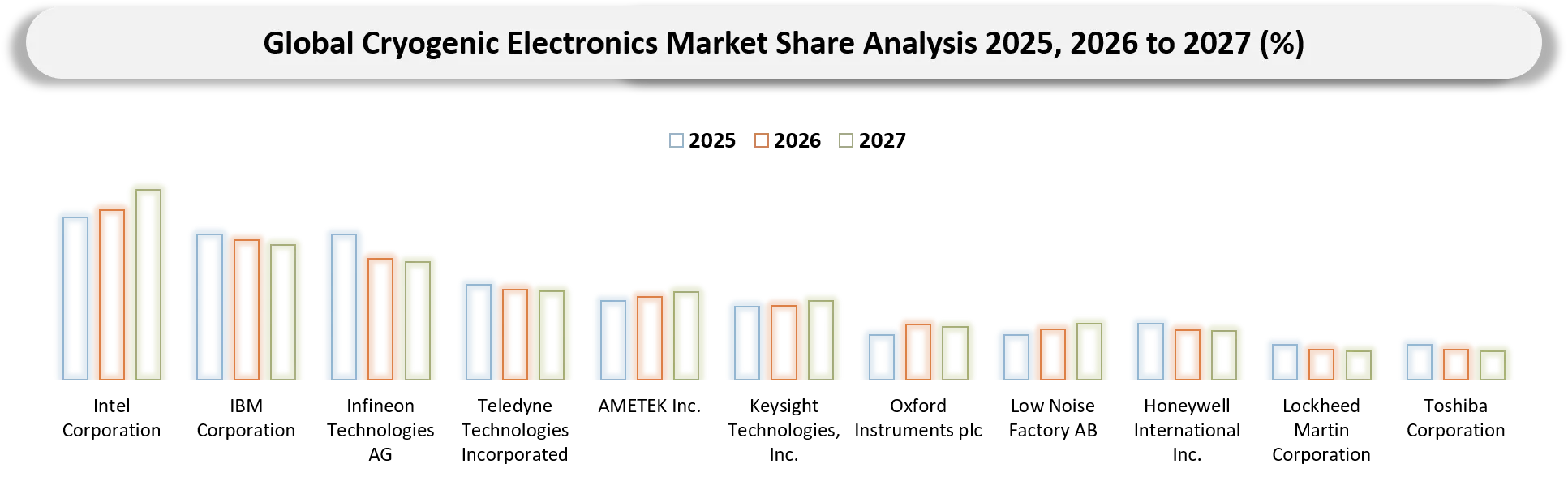
- The Cryogenic Electronics Market is characterized by three major participant groups: quantum computing and advanced semiconductor companies, cryogenic instrumentation and measurement technology providers, and defense/aerospace-focused technology companies. IBM Corporation, Intel Corporation, Infineon Technologies AG, and Toshiba Corporation are key technology developers integrating cryogenic electronics with quantum computing, superconducting devices, and advanced semiconductor architectures. Keysight Technologies, Inc., Teledyne Technologies Incorporated, AMETEK Inc., Oxford Instruments plc, and Low Noise Factory AB strengthen the ecosystem by providing cryogenic measurement systems, low-noise amplifiers, testing platforms, and precision instrumentation required for quantum research and low-temperature electronic applications. Meanwhile, Honeywell International Inc. and Lockheed Martin Corporation focus on cryogenic technologies for quantum sensing, defense, aerospace, and mission-critical applications. The competitive landscape is highly technology-driven, where cryogenic operating performance, quantum hardware integration, ultra-low-noise signal processing capability, and partnerships with research institutions determine market competitiveness.
- Key players include IBM Corporation, Intel Corporation, Infineon Technologies AG, Teledyne Technologies Incorporated, AMETEK Inc., Keysight Technologies, Inc., Oxford Instruments plc, Low Noise Factory AB, Honeywell International Inc., Lockheed Martin Corporation, Toshiba Corporation, and Fujitsu Limited
Key Developments
- September 2025: Maybell Quantum, a U.S.-based quantum infrastructure company, secured a $40 million Series B funding round led by Addition, a U.S.-based venture capital firm headquartered in New York, USA.
- July 2026: Zero-Point Cryogenics (ZPC), a Canada-based cryogenic technology company, announced the launch of its first U.S. Innovation and Service Hub at the Illinois Quantum and Microelectronics Park (IQMP) in Chicago, USA.
- May 2026: Bluefors Oy, a Finland-based quantum technology infrastructure company, introduced its Modular Cryogenic Platform, a scalable cryogenic system designed for next-generation quantum computing applications.
- May 2026: Sumitomo Heavy Industries Ltd. (SHI), a Japan-based industrial machinery and engineering company, established the Semiconductor Subsystems and Components R&D Center in San Jose, California, USA.
- March 2025: FormFactor, Inc., a U.S.-based semiconductor test and measurement solutions company, announced a strategic partnership with Delft Circuits, a Netherlands-based quantum hardware company, to advance quantum computing scalability through high-density cryogenic cabling solutions.
- July 2025: University of California, Berkeley (UC Berkeley), a U.S.-based public research university, partnered with YQuantum, a Switzerland-based quantum hardware company, to advance cryogenic hardware solutions for next-generation quantum computers.
- July 2026: QTREX Quantum Ltd., an Israel-based quantum computing infrastructure company, launched a Quantum Interconnect Research Program in collaboration with Northeastern University, a U.S.-based research university headquartered in Boston, Massachusetts, USA.
Key Procurement Priorities and Buyer Evaluation Criteria
- The growing trend among companies that are investing in the Cryogenic Electronics Market is to choose suppliers who will provide them with high-quality cryogenic electronics that will function effectively even at extremely low temperatures for use in areas like quantum computing and superconductor electronics.
- The decision-making process in procurement is increasingly affected by the need to scale up quantum computer architectures, cryo-CMOS integration, low-noise signal processing, and advanced cryogenic controls. The buyers prefer technology companies that can provide products capable of enhancing the performance of quantum computers, reducing thermal noise and minimizing signal loss.
- The evaluation of parameters such as operational stability at low temperatures, noise level, energy efficiency, signal integrity, reliability of components, thermal management capability, and suitability for integration with existing quantum hardware platforms is a common practice for buyers in choosing cryogenic electronics manufacturers. One of the key parameters of evaluation is the reliability of cryogenic components.
- While making decisions on the technology to buy, buyers take into consideration their partners' competence in cryogenic design, semiconductor production, incorporation of cryogenic CMOS, testing in low temperatures, and scalability for mass production. Suppliers that can provide technologies for developing quantum computers, quantum communication systems, high-performance computers, space electronics, particle physics experiments, and other sophisticated devices are becoming more popular.
- The procurement focus is moving towards cryogenic ecosystems as well, including cryogenic control electronics, low-noise amplifiers, readout, interconnect, and measurement technologies. Collaborations with firms that deliver complete end-to-end solutions along with excellent R&D skills and ongoing support are gaining importance for companies that move away from lab-based quantum computing to cryogenic computing platforms.
Why Choose DataM?
- Technological Innovations: Explores advancements in cryogenic electronics technologies, including Cryo-CMOS, superconducting electronics, Single Flux Quantum (SFQ) circuits, Josephson junction-based devices, and advanced cryogenic control systems, enabling improved quantum processor scalability, reduced signal losses, enhanced energy efficiency, and reliable operation at ultra-low temperatures for quantum computing and scientific applications.
- Product Performance & Market Positioning: Evaluates how different players deliver cryogenic electronic solutions based on operating temperature capability, noise performance, power efficiency, signal integrity, thermal stability, integration density, and system reliability, highlighting how leading companies differentiate through advanced cryogenic components for quantum computing, aerospace, medical imaging, and high-performance computing applications.
- Real-World Evidence: Highlights adoption of cryogenic electronics across quantum computing platforms, superconducting quantum processors, particle physics experiments, cryogenic sensors, radio astronomy systems, and space electronics, demonstrating benefits such as improved qubit stability, enhanced measurement accuracy, reduced thermal interference, and increased system performance at extremely low temperatures.
- Market Updates & Industry Changes: Tracks key developments such as cryogenic semiconductor innovations, quantum computing infrastructure expansion, research investments, new cryogenic control platforms, and collaborations between technology companies and research institutions across North America, Europe, and Asia-Pacific, supporting the transition from laboratory-based cryogenic systems toward commercial quantum computing applications.
- Competitive Strategies: Analyzes how leading companies expand through R&D investments, quantum technology partnerships, semiconductor integration, cryogenic system development, and strategic collaborations to strengthen their position in emerging markets such as quantum computing, quantum communication, advanced sensing, and next-generation computing infrastructure.
- Pricing & Market Access: Explains pricing variations based on component complexity, cooling requirements, operating temperature range, integration level, testing requirements, and application-specific customization, along with access through semiconductor manufacturers, quantum technology providers, scientific equipment suppliers, and specialized cryogenic system developers supporting global technology ecosystems.
- Market Entry & Expansion: Identifies growth opportunities driven by quantum computing commercialization, increasing demand for cryogenic control electronics, advanced semiconductor research, and high-precision sensing applications, while outlining strategies such as technology partnerships, regional R&D expansion, customized cryogenic solutions, and ecosystem development to support global market growth.
Target Audience
- Quantum Computing Companies & Technology Developers
- Semiconductor Manufacturers & Integrated Device Manufacturers (IDMs)
- Cryogenic Electronics Component Manufacturers
- Research Institutions, Universities & National Laboratories
- Cloud Computing & High-Performance Computing (HPC) Providers
- Aerospace, Defense & Space Technology Companies
- Medical Imaging & Healthcare Technology Companies


























































