


Creatine Gummies Market Size and Overview
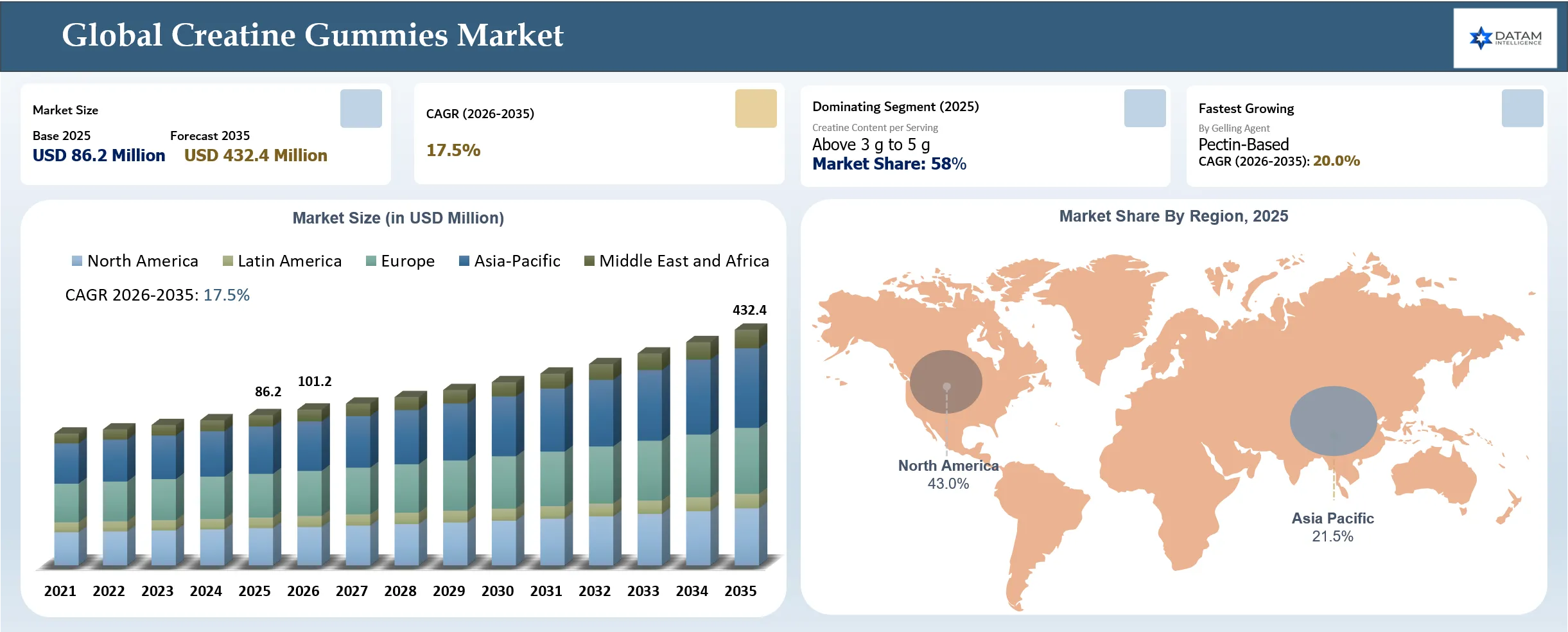
The global creatine gummies market was valued at US$86.2 million in 2025 and is projected to reach US$432.4 million by 2035, growing at a CAGR of 17.5% during 2026–2035. The creatine gummies market is driven by the growing demand for convenient and portable creatine supplementation, increasing consumer preference for easy-to-consume alternatives to powders and capsules, rising availability of high-dose and multifunctional gummy formulations, growing demand for sugar-free and vegan products, and increasing product innovation combining creatine with vitamins, minerals, and other functional ingredients.
The established 3–5 g daily creatine supplementation protocol supports the growth of the creatine gummies market by providing manufacturers with a well-defined dosage range for ready-to-consume products. NIH and the ISSN identify 3–5 g/day as a typical maintenance intake, which aligns with commercial gummies such as Applied Nutrition's 3 g per serving and Lemme's 5 g per serving. This allows consumers to obtain a commonly recommended daily creatine amount through a pre-portioned gummy format without measuring or mixing powder.
Creatine gummies are evolving toward multifunctional formulations that combine creatine with vitamins, minerals, and other active ingredients. Product development is also expanding across vegan, sugar-free, pectin-based, and gelatin-based formats. For instance, in October 2026, SIRIO Europe launched its Creatine+ portfolio, that combine creatine with magnesium, zinc, vitamin D, and other nutritional ingredients. The portfolio includes pectin-based, vegan, and sugar-free concepts designed to address muscle health, cognition, and women's wellness, alongside conventional creatine gummies available in pectin or gelatin formats.
Increasing Creatine Dose per Gummy While Reducing the Number of Gummies per Serving
Reducing the number of gummies required to achieve a full daily creatine dose creates an opportunity for manufacturers to improve product convenience and consumer adherence. Conventional creatine gummies can require several pieces to achieve a meaningful daily dose, increasing chewing burden and packaging volume. For instance, Optimum Nutrition offers 5 g of creatine monohydrate in three gummies, explicitly positioning the product around fewer gummies per serving.
Further formulation advances could enable 4–5 g or more in two gummies or a single larger-format gummy, provided manufacturers can maintain acceptable taste, texture, stability, and dosing consistency. This creates scope for differentiated products that combine higher creatine concentration with fewer pieces per serving, particularly for consumers taking creatine daily.
Creatine Gummies Market Key Takeaways
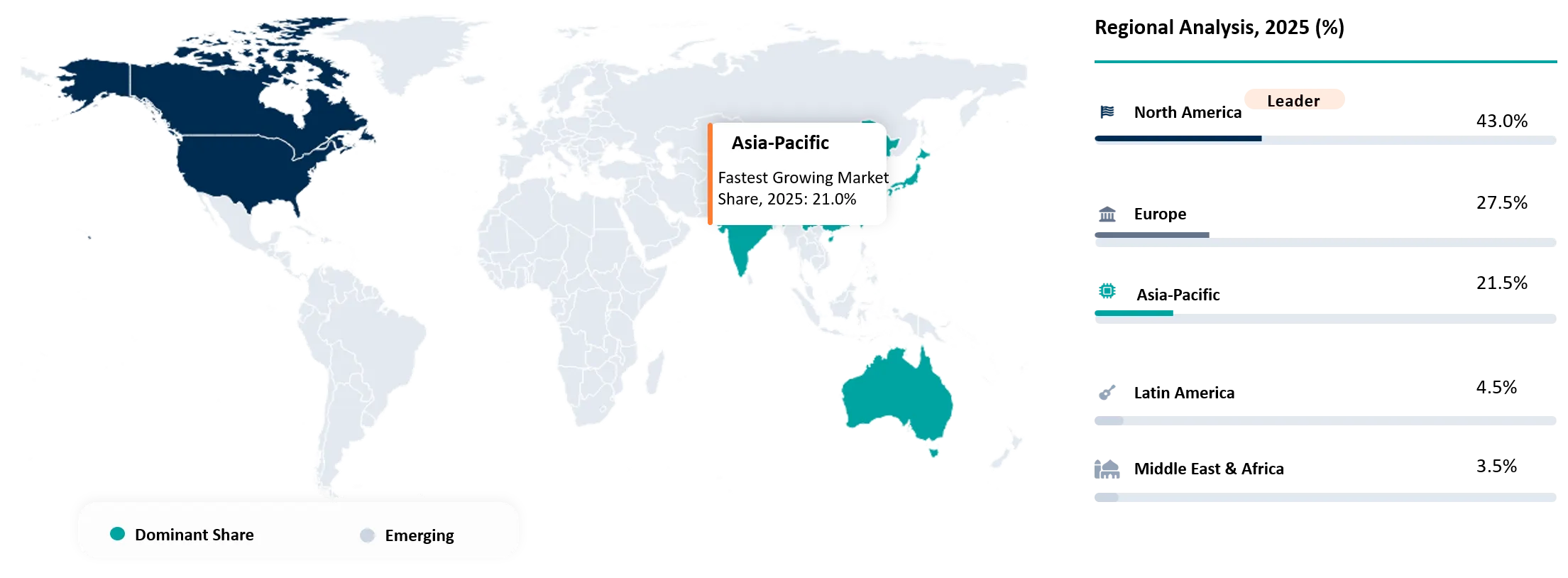
- North America held the largest regional market share, accounting for approximately 43.0% of the global creatine gummies market in 2025, supported by high consumer awareness of sports nutrition, widespread fitness and bodybuilding participation, established dietary supplement brands, and strong availability of convenient supplement formats through retail and e-commerce channels.
- Creatine content of above 3 g to 5 g per serving held the largest product-format share, accounting for approximately 58% of the global creatine gummies market in 2025, supported by consumer preference for clinically relevant creatine dosages, convenient daily supplementation, and the increasing availability of gummies formulated to deliver higher creatine quantities per serving.
- Pectin-Based gummies are projected to be the fastest-growing gelling-agent segment, registering an estimated CAGR of approximately 20.0% during 2026–2035, exceeding the overall market CAGR of 17.5%. Growth is supported by rising demand for vegan and vegetarian supplements, increasing preference for plant-based formulations, and the use of pectin as an alternative to animal-derived gelatin.
- Creatine gummies are reshaping sports-nutrition delivery formats, offering a portable and chewable alternative to powders and capsules while reducing the need for mixing with water. Product development is increasingly focused on improving taste, texture, dosage delivery, and flavor variety to support regular creatine consumption.
- Product innovation is accelerating in the creatine gummy category, with supplement manufacturers introducing higher-dose, vegan, and convenience-oriented formats as consumer interest shifts toward easier daily creatine supplementation. For instance, in 2026, Force Factor expanded its creatine gummy offering with its Force Factor Creatine Gummies, providing creatine in a chewable format designed for convenient daily supplementation.
Creatine Gummies Market Industry Trends and Strategic Insight
- Creatine gummy manufacturers are increasing creatine concentration per serving, with newer formulations targeting 3–5 g or more of creatine while reducing the number of gummies required to achieve the daily dose.
- Product development is shifting toward multifunctional creatine gummies, combining creatine with magnesium, zinc, vitamin D, electrolytes, amino acids, and other functional ingredients to address muscle health, recovery, cognition, and broader wellness needs.
- Vegan, pectin-based, and sugar-free formulations are gaining greater attention, as manufacturers respond to demand for plant-based products, reduced-sugar supplementation, and cleaner-label gummy formats.
- Creatine supplementation is expanding beyond traditional sports nutrition, with brands increasingly positioning gummies for daily wellness, healthy aging, cognitive performance, women's wellness, and menopause-related nutritional needs.
- Manufacturers are focusing on taste, texture, and formulation stability, as the high dose and distinctive sensory characteristics of creatine create challenges in developing gummies that remain palatable while maintaining consistent active-ingredient delivery.
- Product differentiation is increasingly centered on dosage, formulation, and functional positioning, with brands introducing products ranging from lower-dose daily gummies to high-dose formats and creatine combinations designed for specific consumer needs.
- Gummy format innovation is expanding, including different shapes, flavors, serving formats, and portable packaging designed to improve convenience and support regular daily consumption compared with powders that require mixing.
- Quality and dosage transparency are becoming more important in product development, encouraging manufacturers to emphasize clearly disclosed creatine content, ingredient traceability, third-party testing, and manufacturing quality standards as the category attracts a broader consumer base.
Creatine Gummies Market Scope
| Metrics | Details | |
| 2025 Market Size | USD 86.2 Million | |
| 2035 Projected Market Size | USD 432.4 Million | |
| CAGR (2026-2035) | 17.5% | |
| Largest Market | North America | |
| Fastest Growing Market | Asia-Pacific | |
| By Creatine Type | Creatine Monohydrate, Creatine Hydrochloride (HCl), Blended Creatine Formulations | |
| By Gelling Agent | Pectin-Based, Gelatin-Based, Agar-Agar-Based, Carrageenan-Based, Other Gelling Agents | |
| By Creatine Content per Serving | Up to 3 g, above 3 g to 5 g, above 5 g | |
| By Sugar Content | Regular / Sugar-Containing, Sugar-Free | |
| By Flavor | Berry / Mixed Berry, Strawberry, Watermelon, Cherry, Orange / Citrus, Apple, Grape, Raspberry, Lemon / Lemonade, Other Fruit Flavors | |
| By Consumer Group | Athletes & Competitive Sports Participants, Fitness & Gym Users, General Wellness Consumers, Others | |
| By Distribution Channel | E-Commerce, Specialty Sports Nutrition Stores, Supermarkets & Hypermarkets, Pharmacies & Health Stores, Other Retail Channels | |
| By Region | North America | U.S., Canada, Mexico |
| Europe | Germany, United Kingdom, France, Italy, Spain, Netherlands, Switzerland, Sweden, Norway, Denmark, Belgium, Poland, Austria, Ireland, Portugal, Greece, Finland, and Rest of Europe. | |
| Asia-Pacific | China, Japan, India, South Korea, Australia, New Zealand, Singapore, Malaysia, Thailand, Indonesia, Vietnam, Philippines, Taiwan, and Rest of Asia Pacific. | |
| Latin America | Brazil, Argentina, Rest of Latin America | |
| Middle East and Africa | UAE, Saudi Arabia, South Africa, Israel, Türkiye, Rest of Middle East and Africa | |
| Report Insights Covered | Competitive Landscape Analysis, Company Profile Analysis, Market Size, Share, Growth | |
Creatine Gummies Market Disruption Analysis
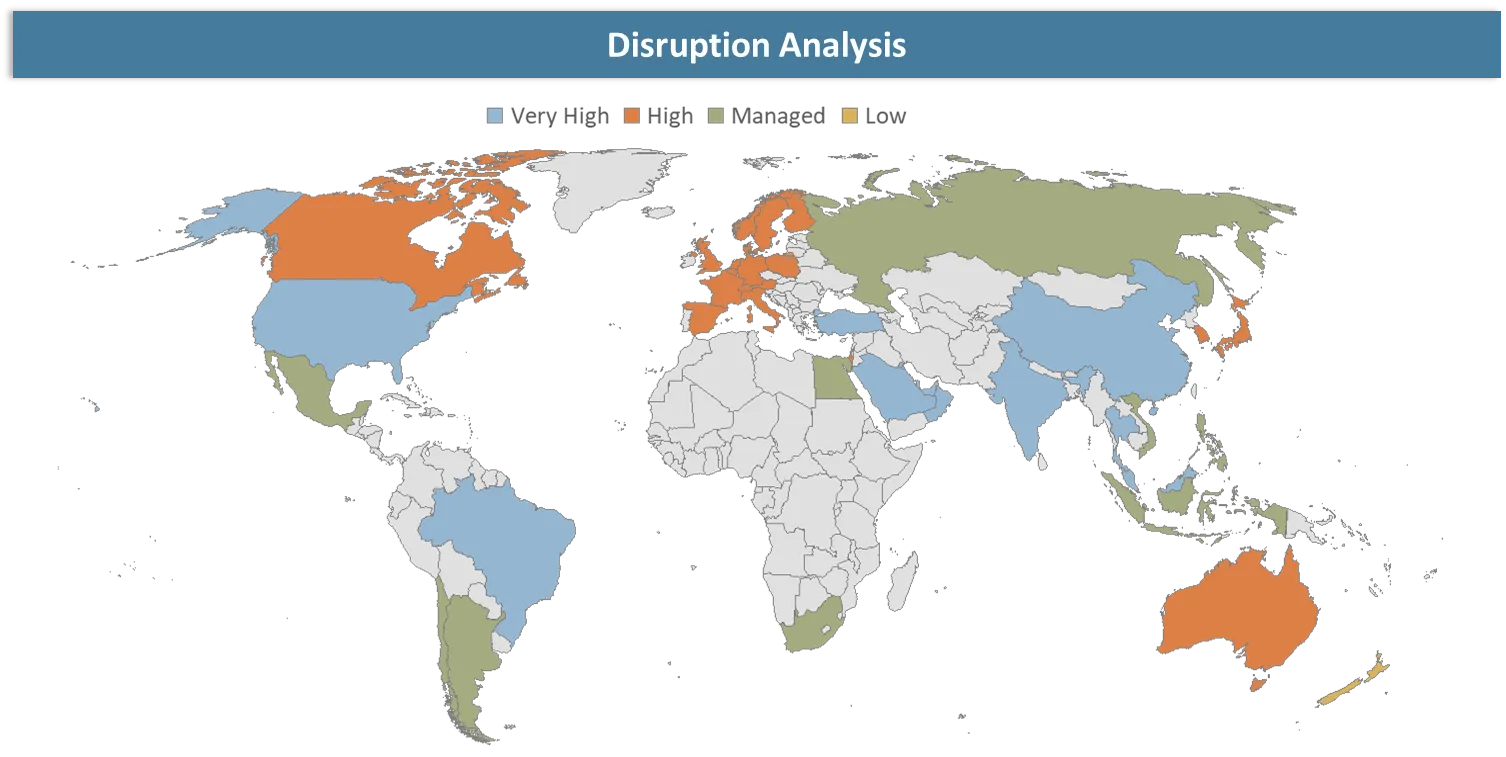
Delivery High-Dose Formulations Redefining Creatine Gummy Serving Sizes
The creatine gummies market is undergoing a shift toward higher-dose formulations that deliver greater amounts of creatine in fewer gummies, addressing one of the key formulation limitations of gummy products. For instance, in October 2025, TopGum introduced a high-dose creatine gummy containing 1.5 g of creatine monohydrate per gummy, allowing four gummies to provide a 6 g daily dose. The company developed the formulation to address the challenge of incorporating meaningful creatine quantities into gummies while maintaining taste and a low sugar load.
The development of higher-dose formats can disrupt existing product designs that require consumers to consume a larger number of gummies to reach their desired daily intake. Further advances in dose density and gummy formulation technology could enable 4–5 g or more of creatine to be delivered in two gummies or fewer, creating differentiation around serving convenience, portability, packaging efficiency, and daily adherence.
Creatine Gummies Market BCG Matrix: Company Evaluation

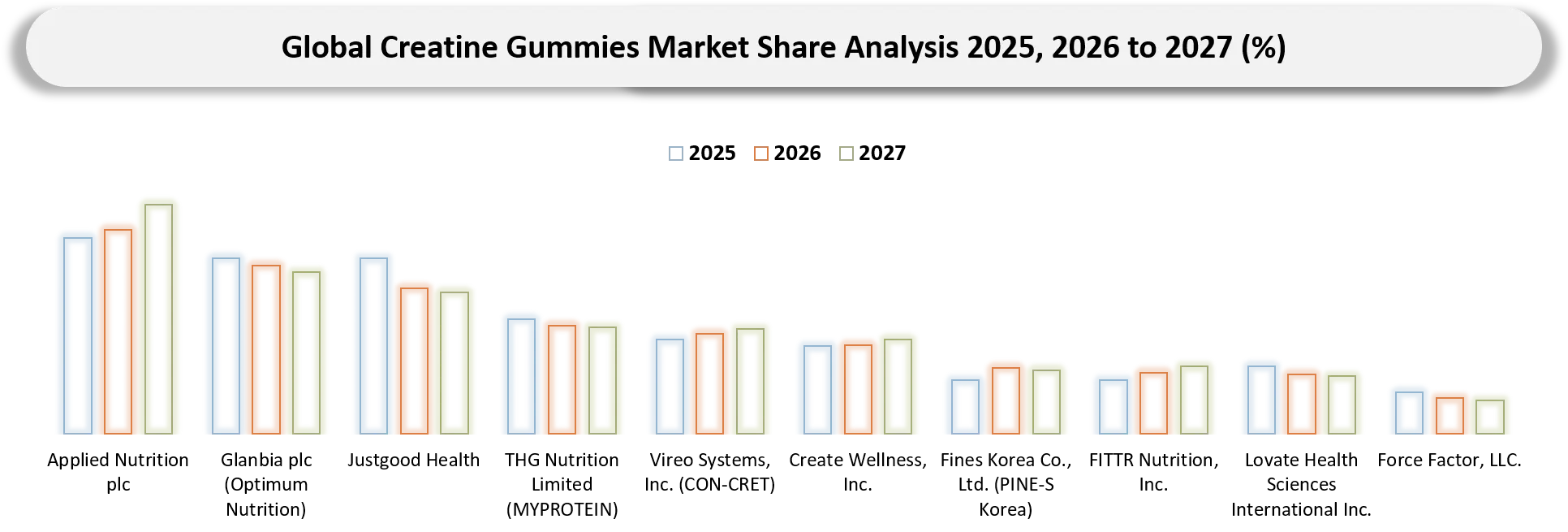
Applied Nutrition plc, Glanbia plc (Optimum Nutrition), and THG Nutrition Limited are positioned as Stars, supported by broad sports-nutrition portfolios, established global distribution networks, strong consumer brands, and growing presence in convenient creatine formats. Force Factor, LLC. and Fines Korea Co., Ltd. are positioned as Potential Stars, supported by creatine-focused product offerings, gummy formulation capabilities, and expansion across sports-nutrition and functional-supplement channels.
Justgood Health, Vireo Systems, Inc. (CON-CRET), and Create Wellness, Inc. are positioned as Question Marks, reflecting participation in creatine and gummy supplementation with comparatively narrower brand scale or market reach. FITTR Nutrition, Inc., and Lovate Health Sciences International Inc. are positioned as Tailenders, reflecting more focused market positions and comparatively limited presence in the global creatine gummies segment.
Creatine Gummies Market Dynamics
Driver Impact Analysis
| Driver | Market Growth Impact (%) | Demand Concentration | Impacted Areas | Strategic Impact |
Growing Consumer Preference for Convenient Creatine Supplementation | 30% | Strong demand across the U.S., Canada, U.K., Germany, Australia, Japan, and other developed sports-nutrition markets, supported by increasing preference for portable and ready-to-consume supplement formats. | Daily creatine supplementation, fitness nutrition, sports performance, travel and on-the-go consumption | Encourages manufacturers to develop convenient gummy formats that eliminate preparation and improve ease of daily consumption, supporting wider adoption among consumers who prefer alternatives to powders and capsules. |
Increasing Demand for High-Dose Creatine Gummies | 25% | Concentrated across North America and Europe, where consumers are increasingly familiar with creatine supplementation and manufacturers are introducing products capable of delivering higher doses per serving. | High-dose creatine delivery, strength and performance nutrition, daily supplementation | Drives investment in formulation technologies that increase creatine concentration per gummy while maintaining acceptable taste, texture, stability, and manageable serving sizes. |
Expansion of Creatine Beyond Traditional Sports Nutrition | 18% | Stronger demand in developed supplement markets, particularly the U.S., U.K., Germany, Australia, and other markets with established wellness and active-aging categories. | Healthy aging, cognitive wellness, women's wellness, menopause nutrition, general wellness | Encourages brands to reposition creatine gummies for broader consumer groups and develop application-specific products rather than relying solely on bodybuilding and athletic-performance positioning. |
Rising Demand for Sugar-Free, Vegan, and Clean-Label Gummies | 15% | Strong demand across North America and Europe, with growing interest in plant-based, reduced-sugar, and clean-label supplements. | Pectin-based gummies, vegan formulations, sugar-free products, natural flavors and colors, clean-label supplementation | Pushes manufacturers toward pectin-based, sugar-free, vegan, and simplified formulations while maintaining the sensory characteristics required for high-dose creatine gummies. |
Growing Adoption of Multifunctional Creatine Gummy Formulations | 12% | Concentrated in developed sports nutrition and dietary supplement markets where consumers increasingly prefer products combining multiple nutritional benefits. | Creatine + magnesium, creatine + zinc, creatine + vitamin D, electrolytes, amino acids, recovery and wellness formulations | Supports premium product development and enables manufacturers to differentiate gummies through multiple functional benefits, targeted consumer positioning, and higher-value formulations. |
Growing Adoption of Gummy-Based Creatine Supplementation
The growing availability of creatine gummy products and increasing participation of brands are expanding consumer access to gummy-based creatine supplementation. The number of creatine gummy products in Europe increased by 50% over the preceding 12 months, while the number of brands offering creatine gummies increased by 48%. The simultaneous increase in product availability and brand participation indicates stronger market adoption of the gummy format, supporting continued product launches and formulation innovation.
Ready-to-consume formats eliminate the need for scooping, mixing, or carrying powder, while flavored and chewable formats can make daily supplementation easier to incorporate into routine use. This is broadening the appeal of creatine gummies beyond traditional sports supplement users to consumers who prioritize convenience and ease of use.
Restraint Impact Analysis
| Restraint | Drag on Market Growth (%) | Primary Impact Area | Impacted Use Case | Strategic Impact |
High Creatine Loading Constraints in Gummy Formulations | 25% | Creatine concentration, gummy size, serving count and formulation stability | High-dose creatine gummies and products targeting 3–5 g or more per serving | Higher creatine loading can increase gummy size, serving count and formulation complexity, limiting manufacturers’ ability to deliver high doses while maintaining acceptable taste, texture and consumer convenience. |
Taste and Texture Challenges at Higher Creatine Concentrations | 20% | Flavor profile, chewability, mouthfeel and sensory stability | High-dose and daily-use creatine gummies | Increasing active concentration can create challenges in masking undesirable taste and maintaining a pleasant texture, potentially affecting repeat consumption and product acceptance. |
Higher Manufacturing Costs Compared with Conventional Creatine Formats | 20% | Gelling agents, flavoring, sweeteners, active loading, molding and packaging costs | Premium creatine gummies and high-dose formulations | Multiple formulation and processing requirements can increase production costs, resulting in higher retail prices and limiting adoption among price-sensitive consumers. |
Stability and Uniform-Dosing Requirements for Creatine Gummies | 15% | Creatine stability, moisture control, active distribution and shelf life | Long-shelf-life products and high-dose formulations | Maintaining consistent creatine content throughout shelf life requires controlled formulation and manufacturing conditions, increasing quality-control requirements and formulation complexity. |
High Sugar and Sweetener Formulation Trade-Offs | 10% | Sugar content, sweetener selection, calorie profile and taste | Conventional, low-sugar and sugar-free creatine gummies | Reducing sugar while maintaining taste and texture can require alternative sweeteners and formulation adjustments, while excessive sweetener use can affect sensory acceptance and consumer positioning. |
Creatine Stability and Gummy-Specific Testing Challenges
Creatine stability in gummy matrices remains a formulation constraint because moisture, heat, and pH conditions during processing can accelerate creatine degradation into creatinine. Manufacturers must therefore control water activity, processing temperature, pH, and curing conditions to maintain label potency through the stated shelf life, increasing formulation and quality-control requirements.
Analytical testing of creatine gummies also presents technical challenges because pectin, gelatin, agar, and other gummy matrices can affect sample extraction and measurement. Gummy-specific analytical methods are still being adopted across testing laboratories, while differences in extraction procedures and laboratory capabilities can create variability in potency assessment and increase testing requirements for manufacturers.
Creatine Gummies Market Segment Analysis
The global creatine gummies market is segmented based on creatine type, gelling agent, creatine content per serving, sugar content, flavor, consumer group, distribution channel, and region.
Dominance of Above 3 g to 5 g Creatine Content per Serving in Creatine Gummies
Above 3 g to 5 g is expected to be the dominant segment in the creatine gummies market, supported by the growing availability of products delivering around 5 g of creatine per serving. This range provides a substantial daily dose while maintaining a manageable gummy count, making it suitable for regular sports, fitness, and wellness supplementation. It also provides manufacturers with a commercially viable dose without the higher formulation burden associated with very high creatine loading.
The segment also offers a practical balance between creatine loading and formulation requirements. For instance, SIXSTAR offers 5 g of creatine monohydrate per three-gummy serving, while Gold’s Gym provides 5 g per serving. Doses above 5 g can require higher active loading or additional gummies, increasing challenges related to taste, texture, stability, and manufacturing cost. These constraints support the 3–5 g range as a more scalable format for mass-market products.
Creatine Gummies Market Geographical Penetration
North America Laser Cutting Market Supported by Automotive Production, Aerospace Manufacturing, and High-Power Laser Adoption
North America's creatine gummies market is supported by a strong fitness and sports-nutrition ecosystem, established daily creatine supplementation habits, and increasing availability of convenient, high-dose gummy formats. In Canada, fitness and recreational sports centres generated approximately USD 4.24 billion in operating revenue in 2024, up 14.9% from 2023, indicating stronger participation and spending across organized fitness facilities.
Canada is witnessing broader retail penetration of creatine gummies across gyms, nutrition stores, and pharmacies, with Limitless Pharma reporting distribution through 310 stores across nine provinces. This expanding physical retail presence increases product accessibility and supports adoption beyond direct-to-consumer online channels.
U.S. Creatine Gummies Market Trends
The U.S. creatine gummies market is supported by a large and highly engaged fitness consumer base, established creatine supplementation routines, and increasing availability of high-dose gummy formats. The U.S. had a record 81 million fitness-facility members in 2025, representing 26.1% of the population aged six and older. Fitness facilities also recorded nearly 7 billion visits during the year, providing a large base of consumers engaged in regular exercise and performance-oriented nutrition.
Creatine gummies are expanding into targeted wellness formulations that combine creatine with complementary functional ingredients. For instance, in January 2026, Lemme launched its Creatine Body Toning Gummies in the U.S., delivering 5 g of micronized creatine monohydrate per serving along with AstraGin. The product was positioned around strength, recovery, lean muscle tone, and cognitive health, expanding creatine gummies into women-focused wellness.
Asia Pacific Creatine Gummies Market Development and Product Innovation
Asia Pacific's creatine gummies market is supported by rising fitness and sports participation, growing demand for sports-nutrition products, and increasing consumer interest in convenient supplementation formats. The region is also witnessing product development across low-sugar, high-dose, and ready-to-consume creatine gummy formulations. For instance, in June 2026, PINE-S Korea introduced its PINE-S BODY POWER Creatine Gummy, positioning the product as a convenient, low-sugar alternative to powdered creatine for daily sports-nutrition routines.
China Creatine Gummies Market Trends
China's creatine gummies market is supported by a rapidly expanding fitness and sports-consumption base, increasing interest in sports nutrition, and the development of convenient functional-food formats. Product development is also extending creatine gummies across sports-nutrition, fitness, and broader wellness applications. For instance, in August 2025, China-based Justgood Health launched its Creatine Gummies, delivering 3–5 g of micronized creatine monohydrate per serving and targeting sports-nutrition and wellness applications through its B2B and private-label channels.
Furthermore, manufacturers are also introducing new gummy formulations through trade exhibitions and commercial product development, expanding the range of creatine delivery formats. For instance, in June 2025, China-based Foodmate publicly debuted its high-content Creatine Gummies at the Hi&Fi Asia-China 2025 exhibition in Shanghai, showcasing a gummy format designed to address the solubility and flavor challenges associated with creatine supplementation.
Japan Creatine Gummies Market Trends
Japan's creatine gummies market is supported by a growing fitness industry, increasing consumer participation in exercise, and the availability of creatine across convenient supplement formats. Japan's commercial fitness sector reached approximately 31,500 facilities and 11.83 million members in 2025, with industry revenue of around US$9.5 billion.
Creatine is already commercially established in Japan through powders, tablets, HCl, and gummies. Myprotein Japan currently lists 8 creatine products, including creatine monohydrate powder, tablets, HCl, and a dedicated Creatine Gummies product, indicating that gummies are being incorporated into an existing creatine-supplementation category rather than creating a new usage pattern.
Japan's functional-food market provides an established environment for supplements and food-based products with specific health positioning. The Consumer Affairs Agency received 1,176 new Foods with Function Claims notifications in FY2025, covering formats ranging from conventional supplements to beverages and snacks. This supports a broader consumer environment for functional, convenient nutrition formats.
Creatine Gummies Market Competitive Landscape
- The global Creatine Gummies market comprises manufacturers specializing in flatbed, tube and pipe, 3D, combination, robotic, and automated laser cutting systems, along with high-power fiber laser cutting technologies and integrated production solutions. Key participants include TRUMPF, AMADA CO., LTD., Bystronic AG, Yamazaki Mazak Corporation, Han’s Laser Technology Industry Group Co., Ltd., PRIMA INDUSTRIE S.p.A., Mitsubishi Electric Corporation, LVD Group NV, HSG Laser Co., Ltd., Salvagnini Italia S.p.A., HGTECH Co., Ltd., and IPG Photonics Corporation.
- TRUMPF (Germany), AMADA CO., LTD. (Japan), Bystronic AG (Switzerland), Yamazaki Mazak Corporation (Japan), Han’s Laser Technology Industry Group Co., Ltd. (China), PRIMA INDUSTRIE S.p.A. (Italy), Mitsubishi Electric Corporation (Japan), LVD Group NV (Belgium), HSG Laser Co., Ltd. (China), Salvagnini Italia S.p.A. (Italy), HGTECH Co., Ltd. (China), and IPG Photonics Corporation (United States) represent key participants across the global Creatine Gummies market.
Key Developments
- April 2026: SteviS launched a customized creatine gummies for complex metal bent pipes. The machine uses swing cutting technology to improve curved-tube precision and delivers 3× faster cutting efficiency than laser cutting robots. It targets automotive components, metal furniture, and bent pipe fittings.
- May 2025: AMADA unveiled the REGIUS-3015AJe 26 kW fiber creatine gummies and introduced the VENTIS-3015AJe 9 kW for the first time in Japan. The systems combine high-power laser technology with beam control and automation to improve cutting speed, precision and productivity.
- April 2025: TRUMPF introduced its AI-powered Cutting Assistant for TruLaser machines with 6 kW or higher power. The system evaluates cut-edge quality and recommends optimized cutting parameters, with its algorithm trained on more than 100,000 images.
- May 2025: HSG Laser showcased its G3015H high-power fiber creatine gummies at FABTECH Mexico. The system offers 3 kW to 30 kW laser power and uses high-speed piercing technology, with HSG reporting approximately 30% lower processing time compared with its predecessor.
Key Procurement Priorities and Buyer Evaluation Criteria
- Creatine gummy buyers prioritize creatine content per serving, creatine form, dosage consistency, taste, texture, ingredient quality, sugar content, dietary suitability, serving size, and product convenience.
- Evaluation is based on criteria such as creatine dosage, creatine monohydrate or other creatine forms, ingredient purity, active-ingredient stability, gummy size, chewability, flavor profile, sweetener system, gelling system, sugar content, calorie content, and consistency of creatine distribution across gummies.
- Sports nutrition brands, supplement companies, contract manufacturers, retailers, e-commerce platforms, and private-label companies consider formulation cost, minimum order quantities, manufacturing capabilities, production capacity, shelf life, packaging requirements, regulatory compliance, testing requirements, lead times, and total product cost.
- Preference is given to creatine gummy manufacturers with validated formulation capabilities, consistent active-ingredient dosing, stable gummy matrices, multiple gelling systems, sugar-free and vegan formulation options, flavor-development capabilities, quality-control systems, third-party testing, and scalable production capacity.
- Buyers particularly prioritize creatine gummy solutions that deliver an effective creatine dose in a convenient serving format, maintain potency throughout shelf life, provide acceptable taste and texture, accommodate dietary preferences, and support consistent large-scale production.
Why Choose DataM?
- Examines Creatine Gummy Technology & Formulation Analysis: Examines developments across creatine monohydrate, creatine HCl, micronized creatine, and blended formulations, along with pectin, gelatin, agar, carrageenan, and multi-hydrocolloid gummy systems. The analysis evaluates how formulation technologies affect dosage, stability, taste, texture, dietary positioning, and product scalability.
- Application & Consumer Analysis: Evaluates creatine gummy demand across sports performance, muscle growth and body composition, exercise recovery, daily wellness, healthy aging, and cognitive and mental performance. The analysis identifies requirements according to consumer group, dosage preference, dietary requirements, usage frequency, and functional benefits.
- Real-World Industry Evidence: Tracks creatine gummy launches, formulation developments, high-dose gummy introductions, sugar-free and vegan products, multifunctional formulations, contract manufacturing developments, ingredient innovations, clinical or scientific evidence, testing initiatives, and distribution expansion across major markets. The analysis incorporates developments from supplement brands, ingredient suppliers, gummy manufacturers, and sports nutrition companies.
- Competitive Landscape & Manufacturer Strategies: Analyzes how leading creatine gummy companies strengthen their positions through higher-dose formulations, alternative creatine forms, sugar-free and vegan products, multifunctional ingredient combinations, proprietary formulation technologies, improved stability, flavor development, third-party testing, and expanded distribution networks.
- Pricing & Procurement Analysis: Evaluates creatine gummy pricing based on creatine dosage, creatine form, number of gummies per serving, formulation complexity, gelling system, sweetener system, additional functional ingredients, packaging format, manufacturing scale, testing requirements, and distribution channel. The analysis also considers ingredient costs, formulation costs, packaging, quality testing, and total cost per effective creatine dose.
- Market Entry & Growth Opportunities: Identifies opportunities arising from the shift toward convenient supplementation, increasing demand for high-dose gummies, expansion of creatine into wellness and healthy aging, sugar-free and vegan product development, multifunctional formulations, e-commerce distribution, women's wellness, and broader consumer adoption beyond traditional sports nutrition.
Target Audience 2026
- Sports Nutrition and Dietary Supplement Manufacturers
- Creatine and Sports Supplement Brands
- Gummy and Nutraceutical Contract Manufacturers
- Ingredient Suppliers and Creatine Manufacturers
- Private-Label Supplement Companies
- Sports Nutrition Retailers and Specialty Supplement Stores
- E-Commerce and Online Health & Wellness Platforms
- Pharmacies and Health & Wellness Retailers
- Fitness Centers, Gyms and Sports Performance Facilities
- Functional Food and Nutraceutical Companies
- Food and Supplement Formulation and Product Development Companies
- Packaging and Supplement Manufacturing Service Providers


























































