


Corrugated Boxes Market Size and Overview
The global corrugated boxes market is estimated at US$ 182.40 billion in 2025 and is expected to reach US$ 297.09 billion by 2035, expanding at a CAGR of 5.0% during 2026-2035. The market is supported by essential packaging demand across food, beverages, e-commerce, industrial goods, personal care, household products, pharmaceuticals and agricultural produce. Growth is uneven because mature regions are balancing sluggish box demand and excess capacity while Asia-Pacific continues to add manufacturing, retail and parcel volumes. The opportunity is concentrated in value-added formats that reduce damage, improve pallet utilization, support automated packing and meet recycled-content or recyclability requirements.
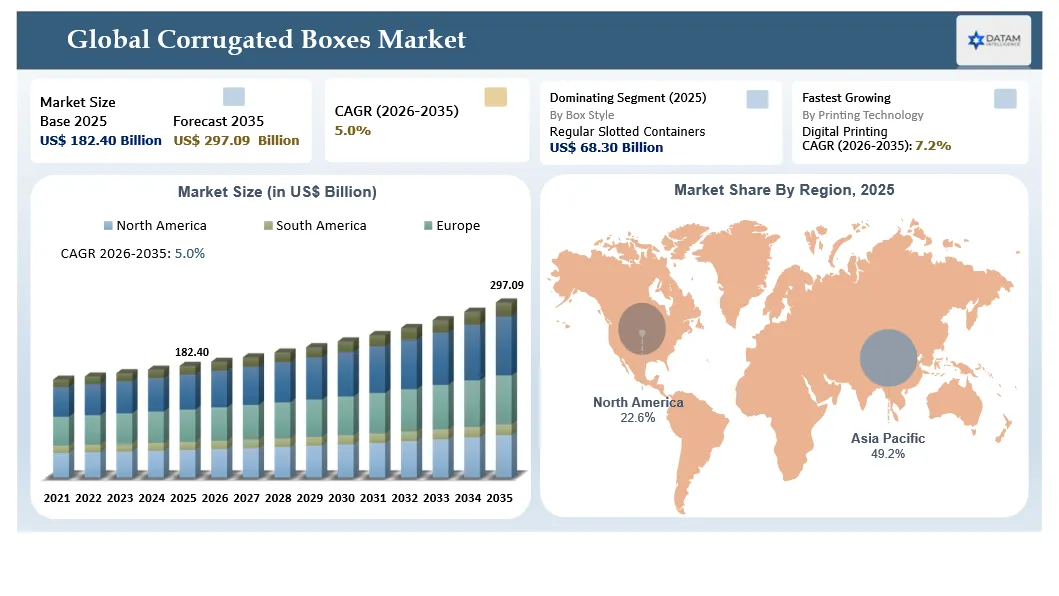
Industry scale remains substantial. The Fibre Box Association describes U.S. corrugated packaging and displays as a US$35.5 billion industry with approximately 1,145 manufacturing facilities and about 100,000 employees. In 2022, the U.S. industry produced about 401 billion square feet of corrugated material, equal to roughly 40 billion packages. In Europe, FEFCO reports about 49 billion square meters of corrugated board production, approximately 570 plants and around 100,000 employees. More than 40% of European corrugated packaging is used for food, and corrugated protects more than 75% of goods in the region. These figures show that corrugated boxes are embedded in physical distribution rather than dependent on one consumer trend.
The industry is also undergoing capacity rationalization. AF&PA reported that U.S. containerboard production declined 4.4% to 36.1 million tons in 2025 while capacity fell 5.1%. Operating rates remained firm at 91.9%, indicating that producers were removing less competitive assets to improve utilization. Smurfit Westrock announced more than 500,000 tons of capacity reductions in 2025 through closures in Minnesota and Texas. At the same time, producers continue investing in efficient machines, digital printing, renewable energy and high-performance recycled grades. The result is a market where total demand grows gradually while the value per box can increase through design, automation and sustainability services.
| Metric | Details |
|---|---|
| 2025 Market Size | US$ 182.40 Billion |
| 2035 Projected Market Size | US$ 297.09 Billion |
| CAGR, 2026-2035 | 5.0% |
| Largest Region | Asia-Pacific |
| Fastest Growing Region | Asia-Pacific |
| Largest Box Style | Regular Slotted Containers |
| Fastest Growing Technology | Digital Printing |
Corrugated Boxes Market Key Takeaways
Asia-Pacific is the largest regional market with an estimated 49.2% share in 2025. China provides the largest production and consumption base, while India, Vietnam, Indonesia and other Southeast Asian countries add demand through manufacturing relocation, food processing and e-commerce. North America remains a high-value market with strong integrated producers, large parcel networks and advanced automation. Europe is the leading regulatory market because the Packaging and Packaging Waste Regulation entered into force in February 2025 and generally applies from August 2026.
Slotted boxes remain the largest box-style segment because they are efficient to produce, ship flat and run on automated case-erecting and sealing equipment. Die-cut and folder formats are expected to grow faster because e-commerce, subscription products and shelf-ready retail require better opening, presentation and fit. Single-wall board leads volume, while double-wall and triple-wall formats remain important for appliances, automotive components, chemicals and export packaging. Recycled liner and medium dominate many mature markets, while virgin kraft liner remains critical where moisture resistance, stacking strength or long-distance transport require higher performance.
The commercial center of gravity is moving from board supply toward packaging performance. Buyers compare box cost against product damage, warehouse labor, trailer fill, pallet pattern, packing speed and returns. Digital printing supports shorter runs and faster artwork changes. Computer-aided structural design enables right-sized packs with lower board use. Automated box-on-demand systems reduce inventory and void fill. These capabilities create growth even when square-meter demand is stable.
| Scope Item | Coverage |
|---|---|
| Board Grade | Kraft liner, test liner, recycled liner, semi-chemical medium, recycled medium, white-top liner |
| Wall Construction | Single-wall, double-wall, triple-wall, microflute and specialty structures |
| Box Style | Slotted, overlap, die-cut, folder, mailer, telescope, trays, bulk bins |
| Printing | Flexographic, digital, lithographic lamination and specialty printing |
| End Use | Food, beverage, e-commerce, industrial, personal care, pharma, electronics, produce and textiles |
| Region | North America, Europe, Asia-Pacific, South America, Middle East and Africa |
Corrugated Boxes Market: Why This Report Matters
Corrugated procurement is becoming more strategic because packaging influences product protection, logistics cost, customer experience and environmental reporting. A lower priced box can create higher total cost when it fails under humidity, causes product damage or reduces pallet density. A heavier box can protect the product but increase paper use and producer responsibility fees. The report helps buyers compare these trade-offs through board-grade, wall-construction and application analysis.
The regulatory environment is changing quickly. The EU Packaging and Packaging Waste Regulation requires all packaging to become recyclable by 2030 and sets waste-prevention goals of at least 5% by 2030, 10% by 2035 and 15% by 2040 compared with 2018. It introduces recyclability performance grades and broader obligations on packaging minimization, labelling and producer responsibility. Corrugated packaging benefits from established recycling systems, but converters must still control coatings, laminates, inks, adhesives and unnecessary volume. Suppliers that help customers document recyclability and reduce material intensity can capture specification-led demand.
The report also matters for investors because corrugated is a local, capital-intensive industry with different economics by region. Transporting empty boxes over long distances is inefficient, so converting capacity must be close to customers. Integrated producers gain fiber security, while independent plants can compete through responsiveness and customization. Capacity closures in the U.S. and overcapacity in parts of Europe show why asset quality, customer mix, energy efficiency and mill integration are more important than nominal capacity alone.
Corrugated Boxes Market White Space and Investment Opportunities
The strongest white-space opportunity is right-sized e-commerce packaging. Parcel networks and online retailers need boxes that minimize void fill, reduce dimensional weight and protect products through multiple handling points. Automated box-on-demand systems, fanfold corrugated and algorithm-driven package selection can reduce inventory and shipping cost. Suppliers can monetize equipment, consumables, software and service contracts rather than selling only finished boxes.
High-graphics corrugated is another growth area. Digital and advanced flexographic printing allow brands to use corrugated for product education, personalization, regional promotions and retail presentation. Short-run digital printing reduces plates and setup time, making it viable for seasonal campaigns and smaller brands. Growth opportunities extend to water-based inks, inline quality inspection, color management and digital finishing.
Moisture-resistant and recyclable barrier solutions are needed for seafood, fresh produce, frozen food, cold chain and horticulture. Traditional waxed corrugated creates recycling challenges. New coatings must maintain board strength under humidity while remaining repulpable. This creates opportunities for bio-based coatings, dispersion barriers, functional papers, testing services and certified recycling claims.
Industrial and heavy-duty corrugated offers higher value than standard shipping cases. Triple-wall board, reinforced bulk bins, pallet boxes and corrugated replacements for wood can serve automotive parts, batteries, machinery and export shipments. The value proposition includes lower tare weight, easier disposal, flat shipment and reduced injury risk. Suppliers need engineering capability, testing and close coordination with logistics teams.
Regional consolidation and modernization are investable themes. Many converting markets remain fragmented, with family-owned sheet plants serving local customers. Acquirers can create value by centralizing procurement, adding digital print, installing automated converting lines and cross-selling design services. Attractive targets have durable food or industrial customers, good plant utilization and strong local service rather than exposure to commodity spot demand.
Corrugated Boxes Future Market Transformation
The market will transform through lighter board structures, higher recycled content, digital production and automated fulfilment. Box optimization will increasingly start with product and distribution data. Structural design software can simulate compression, vibration and stacking performance before physical trials. Digital twins and finite-element models can shorten development cycles for complex packaging. A 2025 corrugated-board research study demonstrated computationally efficient modelling approaches for large structures, reinforcing the shift toward simulation-led design.
Production will become more automated. Modern corrugators use closed-loop control for moisture, temperature, tension, warp and glue application. Converting lines integrate printing, die cutting, folding, gluing, inspection and robotic palletizing. AI can predict quality deviations from machine data and camera images. This reduces waste, downtime and customer complaints. The investment case is strongest where automation addresses labor scarcity and supports shorter production runs.
Circularity will remain central. FEFCO states that 88% of European corrugated packaging is derived from recycled content. The U.S. industry reports an average box recycled content of about 52% and an old corrugated container recovery rate near 90% over the last decade. Future performance depends on maintaining fiber quality through better collection and sorting while using virgin fiber where strength is required. Suppliers will need to communicate fiber loops, chain-of-custody certification and product-specific recyclability more clearly.
Corrugated Boxes Market Buyer Decision-Making Criteria
Buyers begin with product protection. They assess edge crush, burst strength, box compression, puncture resistance, Cobb value, humidity performance and stacking duration. Food and produce buyers add ventilation, food-contact compliance and cold-chain conditions. Industrial buyers focus on load stability, export handling and resistance to vibration. E-commerce buyers assess drop performance, opening experience and return use.
Operations teams prioritize fit with packing equipment. Box dimensions, score accuracy, slot depth, glue joint quality and board warp affect case-erector jams and line speed. A supplier that delivers consistent boxes can reduce downtime even when its unit price is higher. Buyers also review pallet patterns, warehouse cube and trailer utilization because packaging dimensions influence freight cost.
Procurement teams compare price, indexation, lead time, minimum runs, local capacity and business continuity. Large customers increasingly use dual sourcing for critical formats. Sustainability teams ask for recycled content, forest certification, carbon data, inks and coatings declarations, recyclability testing and EPR support. Winning suppliers coordinate technical, procurement and sustainability requirements in one data package.
Corrugated Boxes Market Economic and Investment Analysis
Corrugated economics are shaped by containerboard, recovered fiber, energy, starch, inks, labor and freight. Containerboard is the largest input, so integrated producers can capture mill and converting margins while independents remain more exposed to price changes. In 2025, U.S. paper and paperboard production declined 3.7% to 66.3 million tons. Containerboard accounted for more than half of U.S. paper capacity and maintained a 91.9% operating rate after capacity reductions. This illustrates how supply discipline can support pricing during weak demand.
Capital allocation is shifting toward efficient assets. Modern corrugators improve speed, board quality and basis-weight control. Digital printers and high-graphics flexo lines support premium products. Automated material handling and robotic palletizing reduce labor. Energy projects such as biomass, heat recovery, electrification and renewable power reduce cost and emissions. Smurfit Westrock announced approximately EUR600 million of investment across France in 2026 for modernization, decarbonization and sustainable packaging capability.
Investment risk is highest in commodity capacity without secure customers. Boxes are expensive to transport relative to value, so plants need dense local demand. Food, beverage and household essentials provide more stable volumes than discretionary durable goods. E-commerce can grow quickly but large platforms exert purchasing power and pursue packaging reduction. Investors should therefore evaluate customer concentration, contract structure, plant radius, product mix, board sourcing and machine age.
Corrugated Boxes Market AI Impact Analysis
AI is entering corrugated packaging through demand forecasting, structural design, quality inspection and maintenance. Demand models can combine customer orders, seasonality, promotional calendars and end-market indicators to improve paper purchasing and production planning. Better forecasts reduce finished-box inventory, emergency freight and machine changeovers.
Computer vision can detect print defects, registration errors, crushed flutes, glue skips and dimensional deviations at line speed. Predictive maintenance models use vibration, temperature and motor-current data to identify failure risk before breakdowns. AI-based scheduling can sequence jobs by board grade, ink color and tooling to reduce setup time and waste.
Generative and optimization tools can propose box dimensions, flute combinations and pallet patterns based on product size, fragility and distribution route. The strongest opportunity is human-guided design where engineers validate simulations and compliance. Suppliers with connected design, machine and quality data will learn faster than plants operating isolated systems.
Corrugated Boxes Market Disruption Analysis
Packaging minimization is the largest structural disruption. Brands and retailers are eliminating unnecessary secondary packaging, shipping products in their own containers and replacing boxes with paper mailers for suitable items. This can reduce unit demand for standard e-commerce cases. Corrugated suppliers must respond by designing lighter, right-sized formats and capturing categories where protection or returnability remains important.
Regulation creates both substitution and compliance opportunities. Paper-based packaging can replace some plastic formats, but corrugated cannot assume automatic preference. Reuse targets, packaging reduction rules and lifecycle comparisons may favor reusable crates in certain closed loops. Corrugated suppliers need application-specific evidence on damage, transport efficiency, recycling and water use.
Consolidation is also disruptive. Large integrated groups are rationalizing mills and converting assets while building global customer capabilities. Independent plants remain relevant through speed and customization. The winning model is likely to combine scale in board procurement and technology with local commercial service.
Corrugated Boxes Market BCG Matrix: Company Evaluation
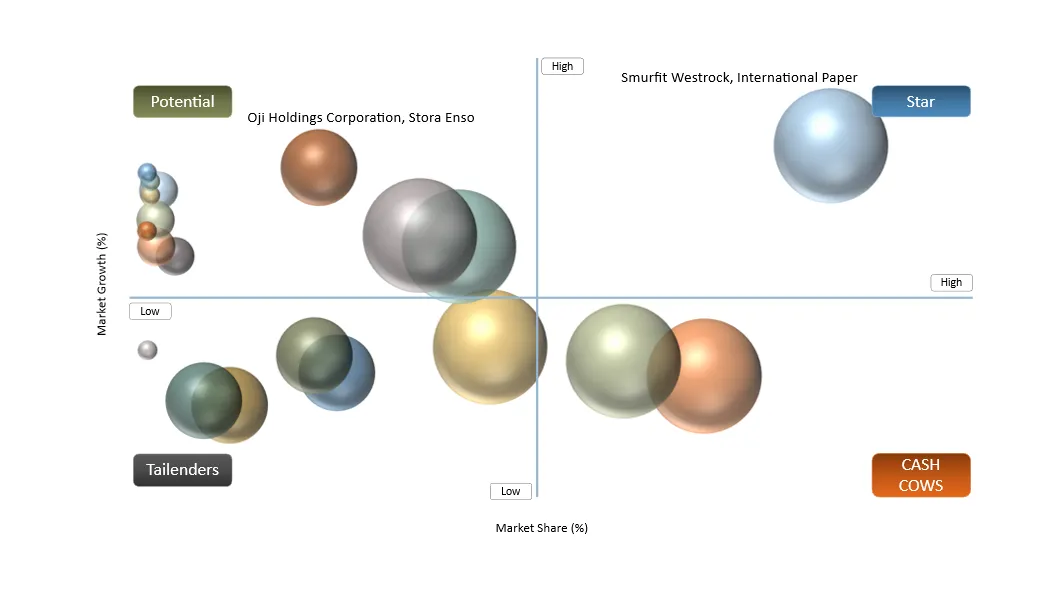
STAR
Key players that dominate the Corrugated Boxes Market are Smurfit Westrock, International Paper, Mondi plc, DS Smith, and Packaging Corporation of America owing to their robust production facilities, vertical integration within containerboard manufacturing, and a presence in the sectors of e-commerce, food & beverages, and industrial packaging. They have benefited from high manufacturing capacity, sustainable packaging, lightweight, and recyclable corrugated boxes. The capability to cater to multinationals via customized and digital packaging products has helped them establish themselves as key players in developed and developing markets.
POTENTIAL
The Corrugated Boxes Market offers immense opportunities for Oji Holdings Corporation, Stora Enso, Rengo Co., Ltd., Pratt Industries, and Georgia-Pacific, among others. These firms have been investing in the area of sustainable packaging, increased use of recycled fiber and developing manufacturing facilities across different regions. High demand for packaging that can be used in the e-commerce environment, shelf-ready solutions, and sustainable materials are some of the factors that will create immense growth prospects for these firms.
Corrugated Boxes Market Dynamics
| Driver | Growth Impact | Demand Concentration | Impacted Use Case | Strategic Impact |
|---|---|---|---|---|
E-commerce and parcel fulfilment | 24% | North America, Europe, Asia-Pacific | Mailers, right-sized cases, returns | Creates demand for automation, digital print and lower dimensional weight |
Food and beverage distribution | 23% | Global | Produce, beverages, processed food | Provides stable recurring demand and moisture-performance requirements |
Plastic substitution and circularity | 18% | Europe, North America | Retail trays, consumer packaging | Supports paper-based formats and recyclable coatings |
Manufacturing and export growth | 17% | Asia-Pacific, Mexico | Industrial and appliance boxes | Expands heavy-duty and export packaging |
Automation and digital printing | 13% | Mature markets | Short runs, high graphics, box-on-demand | Raises value per box and supports customer retention |
Driver: E-Commerce, Food Distribution and Manufacturing Activity
E-commerce remains a visible demand driver, but the opportunity is more specific than simple parcel growth. Retailers are reducing empty space, shifting suitable products to paper mailers and shipping some items in their original packaging. Corrugated suppliers therefore gain where boxes reduce damage, enable returns or run through automated right-sizing systems. Food and beverage provide a more stable base. More than 40% of European corrugated packaging is used for food, according to FEFCO. Boxes support processed food, fresh produce, beverages and cold-chain distribution. Manufacturing growth in Asia-Pacific and Mexico adds industrial demand for appliances, automotive parts and electronics. The combined driver is the movement of physical goods through increasingly automated networks. Suppliers that link box design to packing speed, product protection and freight cube will capture more value than suppliers relying on shipment growth alone.
Driver: Packaging Circularity and Plastic Substitution
Corrugated benefits from established recycling infrastructure and renewable fiber positioning. The U.S. old corrugated container recovery rate has remained around 90% for much of the past decade, while FEFCO reports 88% recycled content in European corrugated packaging. The EU PPWR requires all packaging to be recyclable by 2030 and introduces packaging waste reduction targets. This supports corrugated replacement of some plastic trays, wraps and protective formats. However, growth depends on design quality. Heavy boxes or complex coatings may undermine the environmental case. The investable trend is recyclable functional packaging, including water-resistant coatings, fiber-based inserts, paper tapes and lightweight structures. Suppliers need testing and documentation to prove performance and repulpability.
| Restraint | Drag on Growth | Primary Impact | Impacted Use Case | Strategic Impact |
|---|---|---|---|---|
Containerboard and fiber volatility | 20% | Converter margins | All box categories | Creates price adjustment and working-capital pressure |
| Packaging minimization | 18% | E-commerce and retail | Standard secondary boxes | Reduces units where mailers or ship-in-own-container models work |
| Mature-market overcapacity | 15% | Europe, North America | Commodity RSC boxes | Intensifies pricing and drives closures |
Moisture and performance limitations | 12% | Food, produce, cold chain | Recycled and lightweight boxes | Requires coatings, stronger liners and testing |
| Customer concentration | 10% | Large accounts | E-commerce, beverage, FMCG | Increases negotiating power and service requirements |
Restraint: Containerboard and Recovered Fiber Volatility
Containerboard and recovered paper prices can move faster than finished-box contracts. Independent converters are particularly exposed because they buy sheets or paper without mill integration. Energy, freight, starch, inks and labor add further volatility. India experienced kraft paper and duplex board price increases of INR3 to INR4 per kilogram during 2026 supply disruptions, with corrugated box prices reported about 10% higher in affected markets. Mature producers use index-linked contracts, board surcharges and shorter quotation validity. The restraint can reduce demand when customers delay redesigns or switch to lower specifications. It also encourages lightweighting, which lowers material use but requires stronger process control.
Restraint: Packaging Reduction and Mature-Market Overcapacity
Brands and e-commerce platforms are actively removing packaging where protection is not required. Mailers, reusable totes and ship-in-own-container programs reduce demand for standard boxes. Mature corrugated markets also face excess capacity after pandemic-era investment. In 2025, U.S. containerboard capacity declined 5.1% and production fell 4.4%, while Smurfit Westrock announced reductions exceeding 500,000 tons. Europe remains fragmented, with strong local competition. These conditions limit pricing power for commodity boxes. Producers must close inefficient assets, improve utilization and shift toward specification-led products. The restraint therefore accelerates consolidation and technology investment rather than eliminating the market.
Corrugated Boxes Market Segmentation Analysis
The market is segmented by board grade, wall construction, box style, printing technology, end-use industry, sales channel, sustainability position and buyer model. Each lens reflects a different purchasing decision and value pool.
By Board Grade
Recycled linerboard and recycled medium account for the largest volume because established collection systems supply old corrugated containers back into mills. FEFCO reports that 88% of European corrugated packaging is derived from recycled content, while the U.S. industry reports an average box recycled content of about 52%. Recycled grades offer cost and circularity advantages for domestic food, consumer goods and e-commerce applications. Performance depends on fiber quality, basis weight, moisture and mill technology. Virgin kraft liner remains important for export, fresh produce, refrigerated goods and heavy loads because long fibers provide higher tear and compression strength. Semi-chemical medium is used where flute stiffness is critical. The fastest growth is expected in optimized hybrid structures that combine high-performance virgin outer liners with recycled inner layers. Buyers will increasingly specify performance targets instead of fixed basis weights, allowing converters to lightweight boxes while preserving compression. Board suppliers that provide certified fiber sourcing, recycled-content evidence and consistent strength will gain preference.
By Wall Construction
Single-wall corrugated leads the market because it is suitable for most food, beverage, household and parcel applications. It balances material use, print quality, converting speed and compression. Double-wall formats serve heavier products, longer supply chains and higher stacking loads. Triple-wall board functions as a paper-based alternative to wood for machinery, automotive components, chemicals and bulk export packaging. Microflute structures such as E and F flute support retail-ready packs, electronics and high-quality graphics, while larger flutes provide cushioning and stacking strength. Growth will come from engineered flute combinations rather than simply adding material. Designers use edge-crush data, pallet patterns and humidity assumptions to choose the minimum structure that meets distribution requirements. This supports lightweighting and lower EPR exposure. Heavy-duty formats remain attractive because they provide higher revenue per box, but require specialized corrugators, die cutters, stitching, gluing and testing capability.
By Box Style
Regular slotted containers remain the largest format because they use board efficiently, ship flat and run on standard case-forming equipment. Full-overlap and half-slotted cases serve heavier or open-top applications. Die-cut boxes are growing faster as brands seek product-specific fit, easy opening, handles, locking tabs and retail presentation. Folder boxes and mailers are central to e-commerce because they can reduce tape and create a better unboxing experience. Telescope boxes support apparel, electronics and fragile products, while trays and shelf-ready cases reduce retail labor. Bulk bins and octabins serve agricultural produce, resins, powders and industrial components. Box style is increasingly selected through automated packing and logistics simulation. Buyers compare assembly time, closure method, pallet utilization and return usability. Suppliers with CAD design, sample tables and rapid prototyping can convert customer problems into higher-margin custom formats.
By Printing Technology
Flexographic printing remains the dominant technology because it is efficient for large runs and can be integrated inline with corrugating or converting. Improvements in plates, anilox rolls, inks and registration support higher graphics quality. Litho-laminated corrugated is used for premium consumer, beverage and electronics packaging where photographic imagery is important. Digital printing is the fastest-growing segment because it eliminates plates, enables variable data and supports shorter runs. It is attractive for e-commerce brands, regional promotions, personalization and frequent artwork changes. Adoption depends on ink cost, machine productivity, color consistency and compatibility with coated or uncoated liners. Digital technology also reduces obsolete printed inventory. Future competition will involve hybrid workflows where digital handles short runs and versioning while flexo manages stable high-volume products. Water-based inks, inline inspection and recyclable coatings will become stronger purchasing criteria.
By End-Use Industry
Food and beverage is the largest end-use segment because corrugated boxes are used for processed food, beverages, dairy, meat, bakery, frozen products and fresh produce. FEFCO reports that more than 40% of European corrugated packaging serves food products. Food demand is relatively stable, but specifications are demanding because boxes face moisture, cold storage, grease and direct or indirect food-contact requirements. E-commerce is the fastest-changing application. It drives mailers, return-ready boxes and automated right-sizing, while also encouraging packaging reduction. Industrial goods require heavy-duty board, export protection and custom inserts. Home and personal care, pharmaceuticals and electronics prioritize print quality, tamper evidence and product protection. Agricultural produce needs ventilation, wet strength and rapid seasonal supply. Suppliers should segment sales by operational need because the same box volume can have very different margin and service intensity.
By Sales Channel
Direct contracts with large brand owners, food processors and e-commerce platforms account for the largest revenue because these customers require dedicated design, service and capacity. Integrated producers can combine containerboard supply with converting networks and national account management. Independent sheet plants buy corrugated sheets and serve regional customers with shorter lead times and lower minimum orders. Distributors and packaging merchants aggregate demand from smaller buyers and provide inventory management. Online ordering is growing for standard boxes, samples and small runs, although custom high-volume packaging still requires technical selling. Contract packaging companies influence specifications when they manage packing operations for brands. The channel is moving toward service bundles that include design, inventory, packaging-line support, equipment and performance reporting. Digital customer portals for ordering, artwork approval and inventory visibility can improve retention.
By Sustainability Position
Standard recyclable corrugated remains the largest category because uncoated fiber-based boxes already fit established collection systems. Premium sustainability positions include high-recycled-content boxes, lightweight structures, certified virgin fiber, water-based inks, repulpable barriers and designs that replace plastic components. Buyers increasingly require product-level evidence. The EU PPWR requires all packaging to be recyclable by 2030 and introduces packaging-waste reduction goals. This will push converters to document material composition and eliminate difficult-to-recycle coatings or laminates. Reusable corrugated systems can serve closed-loop industrial and e-commerce applications, but performance declines with handling and moisture. Sustainability leadership will depend on total system outcomes, including damage, transport fill, fiber use and recovery. Suppliers that can quantify these variables will avoid competing only on recycled-content percentages.
By Buyer Model
Commodity buyers purchase standard slotted cases through tenders focused on price, lead time and service. Specification-led buyers require testing, design support and controlled materials. Strategic partnership buyers integrate packaging suppliers into product development, automation and sustainability programs. The last model creates the strongest retention because box changes affect packing lines, logistics and product damage. Multi-site customers prefer suppliers that can harmonize specifications across regions while providing local production. Smaller buyers value flexible runs and quick response. Supplier strategy should match service cost to buyer value. Design centers, labs and on-site packaging engineers are justified for complex accounts, while digital ordering and standardized products can serve smaller demand efficiently.
Kraft Linerboard
Kraft linerboard is selected where strength, moisture resistance and surface integrity are more important than maximum recycled content. It is common in fresh produce, refrigerated food, export cartons and heavy industrial boxes. Long virgin fibers deliver tear resistance and ring-crush performance. Buyers increasingly use kraft only on outer liners and combine it with recycled inner layers to reduce cost and fiber intensity. Demand is tied to forestry certification, pulp economics and regional kraft-liner capacity.
Recycled Liner and Medium
Recycled grades dominate domestic distribution in Europe and many urban markets because recovered corrugated containers provide a large fiber stream. Mills use screening, cleaning, dispersion and strength additives to improve recycled furnish. Quality can vary with collection contamination and repeated fiber cycles. High-performance recycled grades are an important investment area because they enable lighter boxes and higher recycled claims without sacrificing compression.
Single-Wall Boxes
Single-wall boxes lead volume and serve most consumer goods. The key innovation is basis-weight optimization. Better paper strength, flute formation and moisture control allow producers to lower grams per square meter. Customers gain lower material and freight weight, while converters gain cost efficiency. The risk is insufficient safety margin under humidity or long stacking. Testing must reflect the actual distribution route.
Double and Triple Wall
Double-wall and triple-wall structures provide stronger compression and puncture resistance. They are used for appliances, automotive parts, machinery, batteries, chemicals and export loads. Heavy-duty corrugated can replace wood crates in selected cases, reducing tare weight and disposal work. The segment requires specialized converting, large-format printing, stitching or heavy gluing and engineering support.
Digital Printed Corrugated
Digital print enables versioning, personalization and rapid launch. It is particularly valuable when customers need many SKUs or regional artwork but cannot justify plates. The technology can support direct-to-board and preprint models. Economics improve as machine speed rises and ink cost falls. Buyers still require color control, rub resistance and food-safe ink declarations.
Food and Produce Boxes
Food and produce boxes must survive moisture, refrigeration, stacking and rapid seasonal peaks. Ventilation design affects cooling and product life. Wax replacement remains a priority because waxed boxes are difficult to recycle. Repulpable barriers, treated liners and structural reinforcement create premium opportunities. Suppliers need local plants because produce demand can shift quickly with harvest timing.
E-Commerce Mailers
E-commerce mailers are designed around easy assembly, tamper evidence, opening and returns. They can reduce tape and void fill. The segment favors die cutting, digital print and box-on-demand. Large platforms use data to remove unnecessary packaging, so suppliers must demonstrate why a box is needed and how it minimizes dimensional weight.
Shelf-Ready Packaging
Shelf-ready packaging reduces retail labor by converting the transport case into a display tray. Perforation quality, print and structural integrity are critical. Discount retailers and high-throughput supermarkets are important buyers. The value proposition is faster shelf replenishment and better brand visibility.
Industrial Bulk Packaging
Octabins, bulk bins and pallet boxes serve resins, food ingredients, produce and industrial components. They reduce handling units and may replace rigid containers. Compression, liner bags, pallet integration and discharge design determine performance. These are engineering-led products with stronger margins than regular cases.
Online and Small-Run Sales
Online channels serve small businesses that need standard cartons or low-volume custom print. Digital quoting and automated artwork approval reduce selling cost. The challenge is balancing customization with production efficiency. Standard size libraries, digital print and scheduled production windows can create profitable small-run models.
Corrugated Boxes Market Geographical Penetration
Asia-Pacific Market Outlook
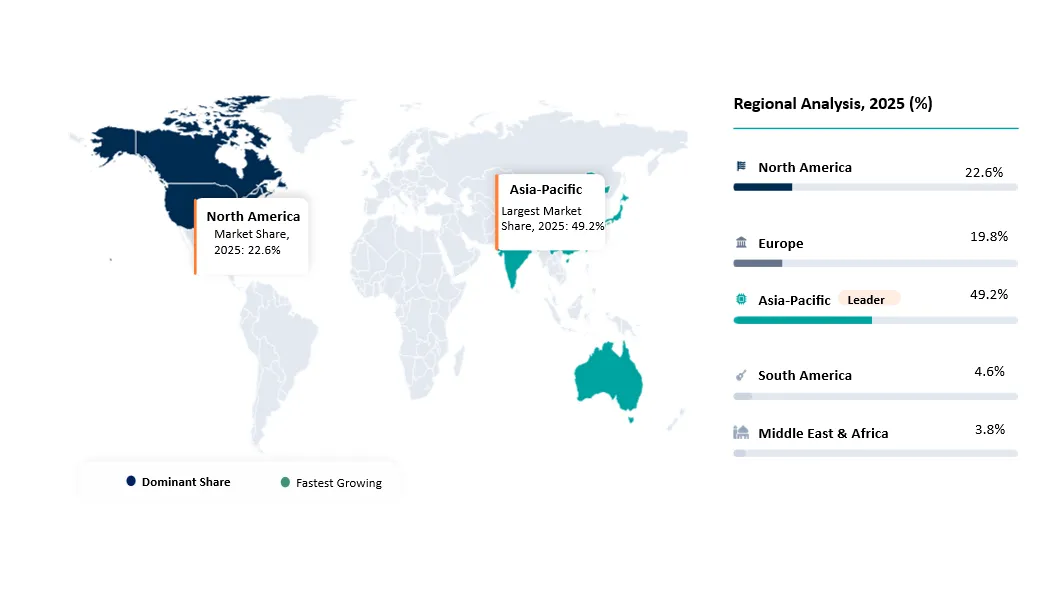
Asia-Pacific holds the largest market share because it combines global manufacturing, food processing, e-commerce growth and large paper industries. China is the largest national market, supported by electronics, appliances, consumer goods and export packaging. India is gaining through FMCG, pharmaceuticals, food processing and online retail, although the converter base remains fragmented and exposed to kraft-paper volatility. Japan and South Korea demand high-quality printing, precise dimensions and advanced retail packaging. Vietnam, Indonesia, Malaysia and Thailand benefit from manufacturing diversification and agricultural exports. Regional opportunity is strongest in modern corrugators, automated converting, high-strength recycled grades and local design support. Buyers increasingly require multinational quality standards while maintaining competitive local pricing.
North America Market Outlook
North America is a mature, high-value corrugated market with dense production networks and large integrated companies. The U.S. industry includes about 1,145 facilities and around 100,000 employees. Food, beverages, e-commerce and industrial goods provide the main demand base. U.S. containerboard production fell 4.4% to 36.1 million tons in 2025, while capacity declined 5.1% and operating rates held at 91.9%. This demonstrates active supply rationalization. Canada supports food, agriculture and industrial packaging. Mexico benefits from automotive, appliances and nearshoring. Growth opportunities include digital print, automated right-sizing, heavy-duty export boxes and recyclable moisture barriers. Customers value local supply, consistent quality and business continuity.
Europe Market Outlook
Europe is a large and innovation-led market with about 49 billion square meters of annual corrugated board production, around 570 plants and approximately 100,000 workers. Recycled fiber is central, with 88% of corrugated packaging derived from recycled content according to FEFCO. Germany, Italy, France, Spain, Poland and the UK are major markets. The PPWR creates a new compliance cycle from 2026, with recyclable packaging requirements, minimization and waste-prevention targets. Producers face mature demand and fragmented capacity, so consolidation and mill integration remain important. Opportunities lie in food packaging, shelf-ready formats, high-quality print, lightweighting and compliance services.
South America Market Outlook
South America is led by Brazil, with demand from food, beverages, meat, fresh produce, household goods and industrial exports. Brazil has an integrated pulp and paper base that supports virgin kraft liner and export packaging. Argentina contributes food, wine and agricultural demand but faces currency and import volatility. Regional buyers need moisture-resistant produce boxes, meat and beverage cases, and cost-efficient recycled formats. Local partnerships and reliable board supply are more important than broad geographic coverage. Investment opportunities include corrugator modernization, agricultural packaging and high-graphics consumer boxes.
Middle East and Africa Market Outlook
Middle East and Africa is a smaller but developing market. GCC demand comes from food imports, beverages, consumer goods, pharmaceuticals and industrial projects. Saudi Arabia and the UAE are expanding local manufacturing and logistics, creating demand for standardized transport packaging. Turkiye is a significant regional manufacturing and export base. South Africa supports food, agriculture, retail and industrial packaging, while Nigeria presents long-term demand linked to population and consumer goods. Challenges include imported paper dependence, energy cost, collection quality and fragmented converting. Attractive opportunities include food-safe boxes, produce packaging, local recycled-fiber systems and efficient small-to-mid-sized converting plants.
| Region | 2025 Share | Core Opportunity | Buyer Intent |
|---|---|---|---|
| Asia-Pacific | 49.2% | Manufacturing, e-commerce, food and export packaging | Scale, price, strength and local responsiveness |
| North America | 22.6% | Automation, food, e-commerce and heavy-duty packaging | Consistency, business continuity and logistics savings |
| Europe | 19.8% | PPWR compliance, lightweighting and shelf-ready packaging | Recyclability evidence, recycled content and efficiency |
| South America | 4.6% | Agriculture, food, beverage and exports | Moisture performance and local supply |
| Middle East & Africa | 3.8% | Food imports, industrialization and retail | Durability, cost and converter availability |
Corrugated Boxes Market Competitive Landscape
Competition includes integrated paper and packaging groups, regional corrugated producers, independent sheet plants, specialty heavy-duty suppliers and digital packaging companies. Smurfit Westrock, International Paper, DS Smith, Mondi, Packaging Corporation of America, Oji Holdings, Rengo, Nine Dragons Paper, Lee & Man Paper, Georgia-Pacific, Pratt Industries and Klabin are prominent participants. Integrated companies compete through fiber supply, mill networks, customer scale and sustainability platforms.
The market is consolidating while still remaining fragmented in many countries. The Smurfit Kappa and WestRock combination created a group with roughly US$34 billion of adjusted annual revenue at announcement. International Paper completed its acquisition of DS Smith, although subsequent strategic restructuring discussions have highlighted the complexity of balancing U.S. and European returns. Regional converters remain acquisition targets because local customer access is difficult to replicate.
Competitive differentiation is moving toward packaging design, automation support, digital printing, testing, recycled-content verification and supply-chain continuity. Commodity price competition remains intense for regular slotted boxes. Premium margins are more defensible in food-ready trays, high-graphics shelf-ready packs, heavy-duty industrial solutions and automated packaging systems.
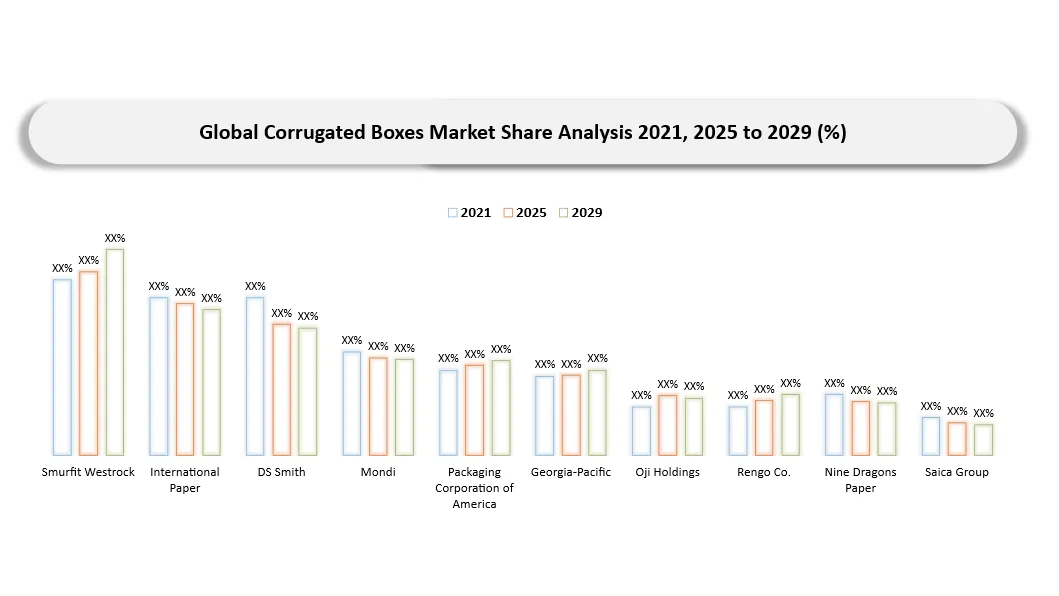
Key Companies of Corrugated Boxes Market
- Smurfit Westrock
- International Paper
- DS Smith
- Mondi
- Packaging Corporation of America
- Georgia-Pacific
- Pratt Industries
- Oji Holdings
- Rengo Co.
- Nine Dragons Paper
- Lee & Man Paper
- Klabin
- BW Packaging
- Saica Group
- VPK Group
Corrugated Boxes Market Major Pain Points
Raw material volatility can compress converter margins when box contracts do not adjust quickly. Recovered paper quality varies by collection system and export flows. Virgin kraft liner is exposed to pulp, wood and energy costs. Starch, inks and coatings add further variability.
Demand is cyclical in durable goods and industrial sectors. Box shipments can weaken before broader economic data, leaving plants with underutilized capacity. The 2025 U.S. market experienced lower containerboard output and significant mill closures, showing how quickly producers may need to adjust assets.
Performance failures create disproportionate costs. Moisture, incorrect flute selection, poor scoring or excessive warehouse stacking can cause collapse. Printing and die-cutting errors can halt customer packing lines. Suppliers need strong quality systems and application testing.
Sustainability claims are becoming harder to manage. High recycled content can reduce strength unless board design improves. Coatings can compromise repulpability. Customers may demand lower basis weight while maintaining compression. Converters need evidence rather than generic environmental messaging.
Corrugated Boxes Market Recent Developments
- June 2026: Smurfit Westrock announced plans to invest approximately EUR600 million in France over three to five years to modernize operations, improve efficiency, support innovation and decarbonize manufacturing.
- May 2026: AF&PA reported that U.S. paper and paperboard production declined 3.7% in 2025 to 66.3 million tons. Containerboard operating rates remained at 91.9% after a 5.1% capacity reduction.
- April 2026: AF&PA reported that Q1 2026 containerboard production declined 8% year on year, broadly matching capacity reductions, while recycled linerboard reached a record monthly high in March.
- April 2025: Smurfit Westrock announced closure-related actions expected to reduce containerboard and coated recycled board capacity by more than 500,000 tons and affect approximately 650 employees in the U.S. and Germany.
- February 2025: The EU Packaging and Packaging Waste Regulation entered into force. It generally applies from August 2026 and requires all packaging to be recyclable by 2030.
- 2025: Corrugated-board research advanced computational modelling for packaging structures, supporting faster design optimization and material reduction.
Expanded Supply and Value Chain Analysis
The corrugated value chain begins with forestry, recovered paper collection and pulp production. Containerboard mills produce kraft liner, recycled liner, semi-chemical medium and recycled medium. Corrugators combine liners and fluting through heat, steam, starch adhesive and pressure. Converting plants print, slot, die cut, fold, glue or stitch the board into boxes. Integrated companies control mills and box plants, while independent converters buy sheets or containerboard. Downstream customers include brand owners, contract packers, fulfilment centers, food processors and industrial manufacturers. Value is lost when poor forecasting causes excess reel inventory, short production runs or emergency freight. A published integrated-paper-company case study found that improved reel-stock policies could reduce total waste by 9% while lowering logistics cost. The strategic opportunity is connecting customer demand, paper planning and machine schedules through shared data.
Expanded Pricing Analysis
Corrugated pricing is usually based on board area, board grade, basis weight, converting complexity, print colors, die tooling, order quantity, freight and service. Commodity regular slotted boxes are closely linked to containerboard indexes. Custom die-cut boxes carry design and tooling charges. Digital print avoids plates but has ink and throughput economics that vary by run length. Heavy-duty boxes command premiums for engineering and testing. Buyers increasingly compare total packaging cost, including line downtime, warehouse space, void fill and damage. Contracts may include paper-index adjustments, energy surcharges or quarterly reviews. Suppliers with efficient machines and dense delivery routes can compete aggressively while protecting margin.
Expanded Regulatory Analysis
Regulation is becoming a commercial design input. The EU PPWR applies across materials and establishes requirements for minimization, recyclability, labelling and producer responsibility. All packaging must be recyclable by 2030, and packaging waste per capita must fall by at least 5% by 2030, 10% by 2035 and 15% by 2040 compared with 2018. Corrugated packaging is well positioned because collection and recycling systems are established. Compliance still depends on coatings, labels, inks, adhesives and composite components. Food-contact boxes must also meet migration and hygiene requirements. Forest certification supports responsible fiber claims. Producers selling across countries need product data systems that track composition and evidence.
Expanded Sustainability and ESG Analysis
Corrugated packaging is renewable, recyclable and often high in recycled content, but environmental performance varies. Recycled fiber reduces virgin resource use, while virgin fiber maintains strength and replenishes the fiber loop. Lightweighting lowers material and transport emissions, but under-designed boxes can increase product damage, which often has a larger footprint than the package. Mills are investing in biomass energy, heat recovery, water reuse and lower-carbon power. Converters are shifting toward water-based inks and repulpable barriers. ESG reporting will increasingly include product carbon data, certified fiber, recycled content, waste and recovery rates. Credible suppliers explain trade-offs rather than presenting every paper box as automatically sustainable.
Expanded Go-To-Market Strategy
A successful go-to-market strategy begins with end-use specialization. Food customers need moisture and food-contact knowledge. E-commerce customers need automation and dimensional-weight analysis. Industrial buyers need testing and heavy-duty engineering. Suppliers should build sector-specific design libraries, case studies and performance data. Local production is essential because box freight is expensive, so regional plants and distributor partnerships matter. Digital customer portals improve quotation, artwork approval and inventory visibility. Larger accounts benefit from on-site packaging engineers and vendor-managed inventory. The sales message should quantify damage reduction, packing labor, trailer fill and compliance rather than focusing only on board specification.
Expanded Risk Mitigation Framework
Producers can reduce risk through diversified fiber sourcing, index-linked contracts, backup mills and dual corrugator capability. Business continuity plans should map customer-critical SKUs and alternative plants. Quality risk requires incoming paper testing, moisture control, edge-crush testing, compression testing and traceable production records. Customer concentration should be monitored by plant because local dependence can be higher than group-wide figures. Regulatory risk is reduced through material declarations and recyclability testing. Cybersecurity is increasingly relevant as plants connect production systems and customer portals. Investment decisions should use demand scenarios that include packaging reduction and economic downturns.
Expanded Trade and Tariff Analysis
Corrugated boxes are mainly produced near customers, but containerboard and recovered paper trade affect regional economics. Virgin kraft liner moves from forest-rich regions to markets with limited fiber. Recovered paper exports influence domestic prices and mill furnish. Tariffs on paper, machinery, inks or chemicals can change converter cost. Trade disruption can also affect food and industrial shipments, which reduces box demand. Export packaging must meet destination requirements and withstand longer logistics routes. Companies entering a country should distinguish between paper import dependence and local converting availability.
Expanded Business Models Analysis
Integrated producers earn from containerboard and converting, giving them fiber security and the ability to optimize grade mix. Independent sheet plants buy sheets and compete through service, customization and local relationships. Sheet feeders provide board to smaller converters. Packaging-as-a-service models combine boxes, equipment, inventory and engineering. Box-on-demand models place equipment at fulfilment centers and generate recurring fanfold demand. Digital print specialists focus on short runs and high graphics. Contract packaging companies bundle packing labor and materials. Each model has different capital intensity and customer stickiness. The most resilient businesses solve operational problems and have recurring customer integration.
Expanded Demand-Supply Gap
Demand-supply conditions vary by region and grade. Mature U.S. and European markets have rationalized capacity after weak demand, while some Asian markets continue adding capacity. Local shortages can still occur for high-strength kraft liner, white-top liner or specific flute combinations. Corrugator capacity is constrained by machine width, grade changes and converting bottlenecks, not only annual tonnage. Seasonal food and produce demand can create short-term tightness. Suppliers with flexible schedules and multiple plants can charge for reliability. Investors should examine local shipment radius and customer density rather than global headline capacity.
Expanded Adoption Trends
Adoption is moving toward lower basis weight, higher performance recycled board, digital print, automated case forming and data-driven packaging selection. Brands are reducing void fill and eliminating boxes where suitable. Retailers are expanding shelf-ready formats. Industrial buyers are testing corrugated replacements for wood and plastic. Food exporters are adopting recyclable moisture barriers. Small brands are using online design and short-run digital print. These trends favor converters with flexible machines, design capability and testing. Plants focused only on long runs of standard boxes will face stronger pricing pressure.
Country-Level Corrugated Boxes Executive Implications
Executives should treat corrugated as a logistics and product-protection system. Packaging decisions affect customer satisfaction, freight, warehousing, labor and EPR obligations. Producers should prioritize plant efficiency, high-value end uses and customer integration. Buyers should measure total cost and avoid over-standardizing boxes across products with different risks. Investors should favor assets with strong local density, efficient machinery and defensible customer relationships. Technology suppliers should target digital print, inspection, automation, moisture control and design software. The market will reward companies that prove measurable outcomes.
United States Corrugated Boxes Opportunity
The U.S. combines large national accounts with thousands of local box users. Food, beverages, e-commerce and durable goods dominate. Capacity rationalization is improving operating rates, while new investments focus on efficient recycled mills and modern converting. Procurement emphasizes business continuity, automation compatibility and cost per shipped product.
China Corrugated Boxes Opportunity
China is the largest production base and serves domestic consumption plus export manufacturing. Demand spans electronics, appliances, food, express delivery and industrial goods. Competition is intense, and large paper groups have significant scale. Higher-quality recycled board, digital printing and export-strength boxes are attractive niches.
India Corrugated Boxes Opportunity
India has strong growth from FMCG, pharmaceuticals, processed food, appliances and e-commerce. The industry includes many small converters that face kraft-paper and energy volatility. Modern corrugators, automated printing and quality systems can improve consistency. Buyers increasingly seek multi-location suppliers and stronger sustainability documentation.
Germany Corrugated Boxes Opportunity
Germany is a major European corrugated market with automotive, machinery, food and retail demand. Customers expect high quality and technical service. PPWR compliance, lightweighting and shelf-ready formats are key opportunities. Energy efficiency and recycled-fiber quality are important investment considerations.
Mexico Corrugated Boxes Opportunity
Mexico benefits from nearshoring in automotive, appliances, electronics and consumer goods. Cross-border supply chains require export-strength packaging and reliable specifications. Corrugated plants located near industrial clusters can build sticky customer relationships. Fiber sourcing and power reliability remain important.
Brazil Corrugated Boxes Opportunity
Brazil combines food, beverage, meat, produce and industrial demand with a strong pulp and paper base. Virgin kraft liner supports export packaging. The market offers opportunities in produce boxes, beverages and high-graphics consumer goods. Regional logistics require local converting networks.
Saudi Arabia Corrugated Boxes Opportunity
Saudi demand is supported by food, beverages, pharmaceuticals, consumer goods and manufacturing localization. Imported goods still generate secondary packaging demand, while local production increases the need for consistent corrugated supply. Efficient plants, food-safe boxes and recycled-fiber collection are investment areas.
Vietnam Corrugated Boxes Opportunity
Vietnam is gaining manufacturing in electronics, furniture, apparel and consumer products. Export packaging and e-commerce are growing. Corrugated suppliers need to meet multinational customer specifications while maintaining cost competitiveness. New capacity should be located near industrial and port clusters.
Japan Corrugated Boxes Opportunity
Japan values precision, print quality, compact design and retail presentation. Smaller household sizes and sophisticated distribution create demand for right-sized boxes. Automation and high-quality recycled board are important. Suppliers compete through reliability and design rather than low price alone.
Turkiye Corrugated Boxes Opportunity
Turkiye serves domestic demand and exports to Europe, the Middle East and Central Asia. Food, appliances, textiles and industrial products support corrugated consumption. Currency and energy volatility can affect pricing. Export customers require strength, print and compliance with European rules.
Packaging Automation Opportunity
Packaging automation is becoming a major source of value for corrugated suppliers because labor availability, throughput and consistency are strategic concerns for fulfilment centers and factories. Automated case erectors, pack-size selection software, box-on-demand machines, robotic loading and automated sealing depend on accurate dimensions and predictable board properties. A box that varies in score depth, warp or glue-joint quality can create repeated machine stoppages. This shifts procurement toward suppliers that can validate boxes on customer equipment and maintain tighter tolerances. Equipment vendors and converters can build joint offerings that include machinery, fanfold material, preventive maintenance and data dashboards. The recurring-revenue opportunity is stronger than one-time box sales because the customer becomes integrated with the material and service platform. Large users may also connect order data to box production so sizes are generated according to the daily product mix. This reduces finished-box inventories and warehouse space. The investment case is strongest in high-SKU operations such as e-commerce, spare parts, electronics and contract logistics.
Recyclable Barrier Technology Opportunity
Barrier technology determines whether corrugated can expand into wet, greasy, refrigerated and frozen applications without creating recycling problems. Wax coatings historically provided water resistance, but they can interfere with fiber recovery. New dispersion coatings, bio-based treatments and functional papers aim to preserve strength while remaining repulpable. The technical challenge is balancing Cobb resistance, grease resistance, scuff performance, printability and glueability. Food customers also need migration and food-contact documentation. Fresh produce exporters need boxes that retain compression under high humidity and forced-air cooling. Seafood and frozen-food users require longer exposure resistance. Suppliers that develop verified barrier systems can win applications currently served by plastic crates, waxed boxes or composite packs. The business opportunity includes coating chemistry, application equipment, coated linerboard, testing and licensing. Recyclability claims should be validated under realistic mill conditions because small differences in coating weight or formulation can affect repulping. Buyers will increasingly require evidence that barrier performance and recovery work together.
Workforce and Skills Analysis
The corrugated industry employs large workforces across mills, corrugators, sheet plants, design centers and logistics. FEFCO reports around 100,000 employees in Europe, while the Fibre Box Association describes a similar employment base in the U.S. Skills are changing as plants add automation, digital printing, machine vision and connected maintenance. Operators need to understand moisture, paper behavior, print quality and equipment data. Designers need structural software, material knowledge and logistics awareness. Maintenance teams increasingly work with sensors, controls and robotics. Labor scarcity supports automation, but poorly implemented automation can increase downtime. Companies should combine equipment investment with training, standardized work and technical career pathways. The 2025 U.S. safety program covered more than 170 million hours worked across 715 participating plants and recognized 426 facilities for safety achievements. This indicates the scale of operational management required. Strong safety and skills programs can improve retention, quality and asset utilization, making workforce capability a competitive factor rather than only a cost.
Customer Switching and Qualification Analysis
Switching corrugated suppliers appears simple for standard boxes, but qualification can be complex for automated or high-risk applications. Customers may need line trials, compression testing, pallet tests, artwork approvals and logistics validation. Food and pharmaceutical buyers add hygiene and traceability checks. Large retailers may require packaging scorecards and sustainability data. These steps create switching costs for qualified suppliers, especially when they support many SKUs or multiple customer plants. New entrants can overcome barriers through rapid sampling, digital design and local service. They can also target customers with poor incumbent service or frequent shortages. Incumbents protect accounts through vendor-managed inventory, packaging audits, continuous lightweighting and on-site technical support. Investors should distinguish between contractual retention and operational retention. A customer without a long contract may still be difficult to move because packaging is integrated into equipment, artwork, specifications and distribution tests.
2035 Strategic Outlook
By 2035, corrugated boxes will remain a core part of global goods distribution, but market value will be less dependent on simple board consumption. Lightweighting and packaging reduction will limit area growth in mature markets. Value will expand through digital print, automated customization, barrier functionality, heavy-duty engineering and compliance support. Asia-Pacific will contribute the largest incremental volume as manufacturing, food processing and parcel networks expand. North America will continue capacity discipline and automation. Europe will shape regulatory and circularity practices. Producers will need flexible assets that can handle shorter runs and changing board structures. Integrated groups will use fiber security and network scale, while independent plants will succeed through local responsiveness and specialization. The strongest companies will connect design, manufacturing and customer operations with data. They will sell lower damage, faster packing, improved freight cube and verified recyclability. Commodity boxes will remain necessary, but returns will depend on utilization and cost control. Strategic growth will come from solving problems that customers can measure.
Corrugated Boxes Market Analyst View
Corrugated boxes will remain one of the most important transport packaging formats through 2035 because they combine protection, printability, low weight, flat shipment and established recycling. Growth will be strongest where suppliers sell measurable logistics and sustainability outcomes.
Asia-Pacific will lead volume growth, but North America and Europe will remain important for technology, premium formats and regulatory innovation. Capacity rationalization will continue in mature markets. Efficient mills and converters with strong food, beverage and e-commerce customers will gain share.
Digital print, box-on-demand, recyclable barriers and simulation-led design are the most attractive technology opportunities. Long-term leadership will depend on fiber security, local converting density, customer integration and verified performance.
Corrugated Boxes Market Target Audience
| Industry | Who Should Buy This Report? | Reason to Buy |
|---|---|---|
| Corrugated Producers | CEOs, strategy heads, sales leaders, plant managers | Assess segments, capacity, customer needs and regional expansion |
| Containerboard Mills | Commercial teams, planners, investment teams | Understand grade demand, recycled fiber and converter requirements |
| Brand Owners | Packaging, procurement, logistics and sustainability teams | Benchmark box performance, suppliers and redesign opportunities |
| E-Commerce and Retail | Fulfilment, operations and packaging teams | Evaluate right-sizing, returns, automation and customer experience |
| Food and Agriculture | Processors, exporters and packaging buyers | Identify moisture-resistant, food-safe and produce solutions |
| Machinery Suppliers | Corrugator, print, die-cut and automation vendors | Screen equipment demand and investment priorities |
| Investors and Consultants | Private equity, corporate development and advisors | Identify targets, white spaces, consolidation and technology opportunities |
Why Choose DATAM?
- Data-driven analysis covering market size, segment demand, board grades, box styles, pricing, regulations, capacity and buyer criteria.
- Post-purchase analyst support for supplier evaluation, market entry, investment screening and packaging strategy.
- White papers and case studies covering e-commerce right-sizing, recyclable barriers, digital printing and heavy-duty corrugated.
- Annual report updates reflecting containerboard capacity, regulations, company actions and end-market demand.
- Specialized emerging-market coverage across Asia-Pacific, Latin America, Middle East and Africa.
- Customized analysis that connects packaging data to the client’s products, facilities, customers and investment questions.
What DATAM Uniquely Provides
- Detailed 2025 to 2035 forecasts by board grade, wall construction, box style, printing technology, end use, channel and region.
- Buyer decision intelligence covering compression, moisture, automation, logistics, print, recycled content and supply continuity.
- Regulatory analysis covering PPWR, EPR, recycling labels, food contact and forest certification.
- Competitive analysis of integrated producers, independent plants, sheet feeders, digital packaging firms and equipment suppliers.
- White-space analysis for right-sized e-commerce boxes, digital print, recyclable barriers, heavy-duty packaging and automation.
- Country-level recommendations for producers, buyers, investors and machinery suppliers.



























































