


Global Converter Transformer Market Overview
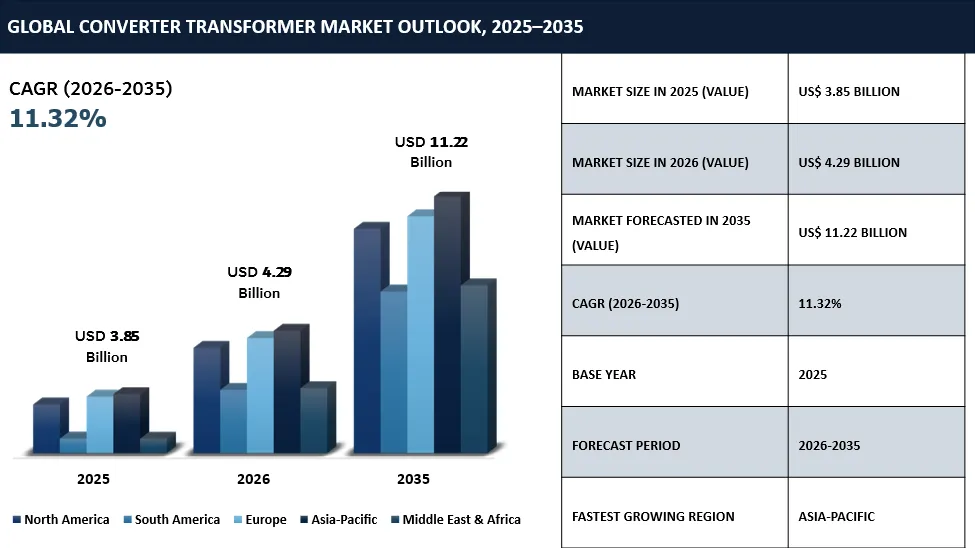
Converter transformers are becoming increasingly popular globally, owing to the increasing requirement for reliable, efficient and high-capacity electricity transmission. The growth in the development of high voltage direct current (HVDC) grids is contributing to the rising demand for converter transformers that are used in the transmission of large quantities of electricity over long distances, offshore wind farms, hydro power transmission, asynchronous connection of grids and international power systems. Converter transformers are essential components of the HVDC system since they facilitate voltage conversion between the AC grids and the converter valves, as well as ensuring electrical isolation. In addition, the construction of ultra-high voltage direct current (UHVDC) grids, renewable power transmission facilities and offshore wind farms is enhancing the demand for advanced converter transformers. The government policies, grid expansion and investment by utility and transmission system operator are providing additional impetus to market growth. As per International Energy Agency (IEA), the global electricity demand is expected to grow at a CAGR of 3.6% during the period of 2026-2030. The IEA report states that the annual investment in grid infrastructure, which is currently estimated at USD 400 billion, would have to be increased by about 50% by 2030 to accommodate increased electricity demand and new power generation.
Global Converter Transformer Market: Strategic Insights
- HVDC Infrastructure Expansion: The development of transmission lines in Europe is generating great opportunities for the manufacturer of the converter transformers. The report from European Network of Transmission System Operators for Electricity (ENTSO-E) in 2026 states that Europe had 52 converter stations in its 2025 baseline, 67 converter stations to be installed in 2030 and 138 converter stations in 2035. Among these, 119 bipolar converter stations are expected to be installed in 2035 in comparison with the 38 converter stations in its 2025 baseline. This growth signifies the growing need for transformer converters, technical expertise and production facilities within European transmission systems.
- Grid Investment and Manufacturing Bottlenecks: The growing demand for electricity and the modernization of the power grids are making greater demands for the purchase of specialized power transformers and HVDC equipment. The IEA World Energy Investment 2026 report states that the global investments in the power grid rose by $45 billion in 2025 to reach $450 billion, with an expected increase of 17% in 2026. Nonetheless, the lack of specialized manufacturing capacity, skilled labor force, grain oriented electrical steel and copper is creating supply chain problems. These factors show the need for increased production capacity, long-term sourcing arrangements and the timely supply of converter transformers.
- UHVDC Deployment and Transformer Technology Advancement: The growth of China’s ultra-high-voltage direct current (UHVDC) network is leading to an increased need for large capacity converter transformers. In May 2026, Hitachi Energy confirmed the delivery of a 750 MVA ±800 kV voltage source converter (VSC) transformer for China’s Gansu-Zhejiang UHVDC power transmission system. This transformer is believed to be the largest HVDC VSC transformer produced at that time. It demonstrates an evolving need for sophisticated technological needs for capacity of transformers, high voltage insulation, performance and special production facilities, thus creating avenues for firms with advanced HVDC transformer engineering expertise.
- Renewable Energy Integration and Transmission Demand: The increase in renewable electricity generation is driving the requirement for the development of transmission systems that can connect the remote generating stations with high consumption areas. According to the IEA Global Energy Review 2026, there was an unprecedented addition of 800 GW in global renewable energy capacity in 2025, a growth rate of 16% year-over-year. This capacity was made up of more than 3/4 in solar PV and around 20% from wind generation. Renewable energy generation and electricity consumption being geographically apart from each other are leading to developments in long distance HVDC transmission systems that provide business potential for renewable energy evacuation, offshore wind connections and interregional power networks.
Why Choose Datam?
- Accelerated Customer Identification – Target 2.0× Qualified Sales Leads: Help converter transformer manufacturers double their qualified customer pipeline through utility identification, transmission system operator (TSO) profiling and HVDC project stakeholder mapping. DataM enables businesses to identify high-value prospects, prioritize upcoming transmission projects and accelerate customer acquisition.
- Faster Market Entry & Business Expansion – Target 25% Reduction in Market Entry Time: Help converter transformer companies reduce market-entry timelines through regional HVDC opportunity assessments, regulatory intelligence and project pipeline analysis. DataM supports faster market penetration, strategic partnerships and expansion into emerging transmission infrastructure markets.
- Stronger Competitive Positioning – Target 25% Improvement in Sales Win Rate: Enable converter transformer manufacturers to improve sales win rates through competitor benchmarking, technical capability assessments, project reference analysis and product portfolio evaluation. DataM helps identify competitive gaps, strengthen differentiation and secure additional HVDC project contracts.
- Higher Customer Revenue & Account Expansion – Target 1.25× Revenue per Key Account: Support revenue growth from strategic utility and transmission operator accounts through project pipeline monitoring, customer requirement analysis and cross-selling opportunities. DataM helps manufacturers identify additional converter station requirements and strengthen long-term commercial relationships.
- Improved Pricing & Profitability – Target 2 Percentage-Point Gross Margin Improvement: Help converter transformer manufacturers improve gross margins through manufacturing cost intelligence, raw material price analysis, competitive benchmarking and project-specific pricing assessments. DataM supports better bidding decisions, stronger contract negotiations and improved profitability.
- Strategic Partnerships & Channel Expansion – Target 1.5× Qualified Project Opportunities: Help converter transformer companies increase qualified project opportunities through HVDC system integrator mapping, EPC contractor identification, utility partnerships and component supplier analysis. DataM supports stronger industry relationships and wider commercial reach across HVDC project ecosystems.
- Improved Demand Forecasting & Revenue Protection – Target 25% Reduction in Forecast Errors: Help converter transformer manufacturers reduce demand forecasting errors through HVDC project pipeline analysis, converter station installation tracking, procurement intelligence and scenario planning. DataM supports optimized manufacturing schedules, improved capacity utilization and better order fulfillment.
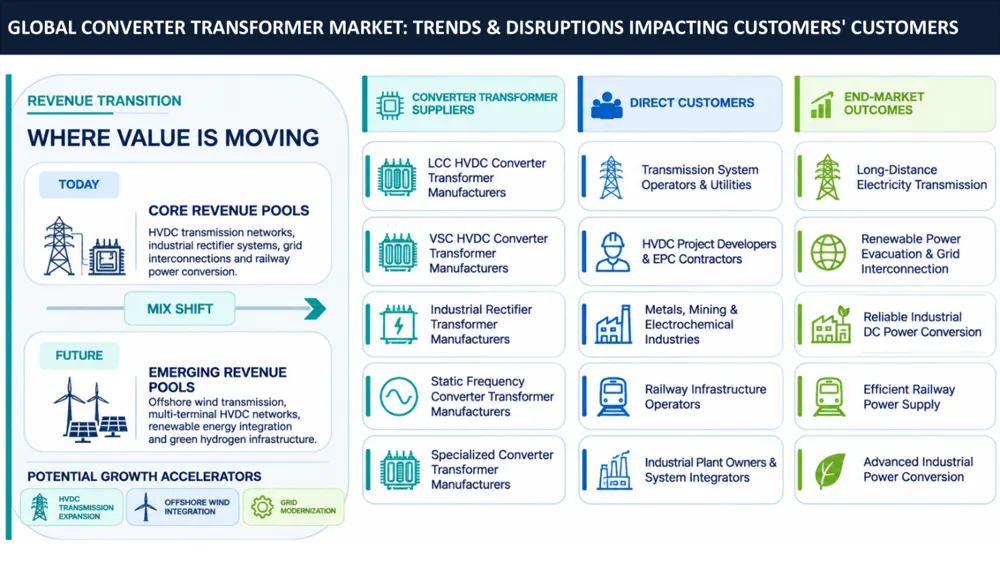
Global Converter Transformer Market: Trends & Disruption Impacting Client Customers
Global Converter Transformer Market: Commercial Use Cases Across Industries
| COMPANY | USE CASE DESCRIPTION | BENEFITS |
 | Converter transformers supplied for the 6,000 MW, ±800 kV Bhadla–Fatehpur HVDC transmission project in India, supporting renewable energy evacuation and long-distance electricity transmission. | Enables large-scale renewable power evacuation, controlled electricity transfer and stronger interregional grid connectivity. |
 | HVDC converter transformers for LCC and VSC transmission systems, including UHVDC bulk power transmission and offshore wind integration applications. | Supports voltage adaptation, electrical isolation, reliable converter operation and efficient long-distance power transmission. |
 | 607.5 MVA, ±1,100 kV converter transformers supplied for the sending end of the world's first ±1,100 kV UHVDC transmission project, supporting ultra-long-distance bulk electricity transfer. | Enables ultra-high-capacity power transmission, supports remote energy resource integration and strengthens interregional electricity connectivity. |
 | Converter transformers supplied for the ±800 kV, 6,000 MW Raigarh–Pugalur UHVDC transmission project, connecting India's western and southern regional electricity grids. | Supports bulk power transfer, improves regional grid connectivity and strengthens transmission reliability. |
 | HVDC converter transformer portfolio for LCC and VSC transmission applications, supporting long-distance power transmission, grid interconnections and renewable energy integration. | Provides specialized transformer solutions for high-voltage converter stations, supporting reliable power transfer and grid modernization. |
Global Converter Transformer Market Ecosystem
The global converter transformer market ecosystem comprises converter transformer manufacturers, HVDC system integrators, component manufacturers, raw material suppliers, engineering, procurement and construction (EPC) contractors, transmission system operators (TSOs), electricity utilities and renewable energy developers. Together, these stakeholders support converter transformer design, manufacturing, testing, procurement, installation and operation across HVDC transmission networks.
| CONVERTER TRANSFORMER MANUFACTURERS | HVDC SYSTEM INTEGRATORS | TRANSMISSION SYSTEM OPERATORS AND ELECTRICITY UTILITIES |
Hitachi Energy (Switzerland) | Siemens Energy (Germany) | State Grid Corporation of China (China) |
| Bharat Heavy Electricals Limited (India) | GE Vernova (United States) | Power Grid Corporation of India (India) |
TBEA Co., Ltd. (China) | Mitsubishi Electric Corporation (Japan) | National Grid (United Kingdom) |
Hyosung Heavy Industries (South Korea) | Toshiba Energy Systems & Solutions (Japan) | Terna (Italy) |
HD Hyundai Electric (South Korea) | Hitachi Energy (Switzerland) | TenneT (Netherlands/Germany) |
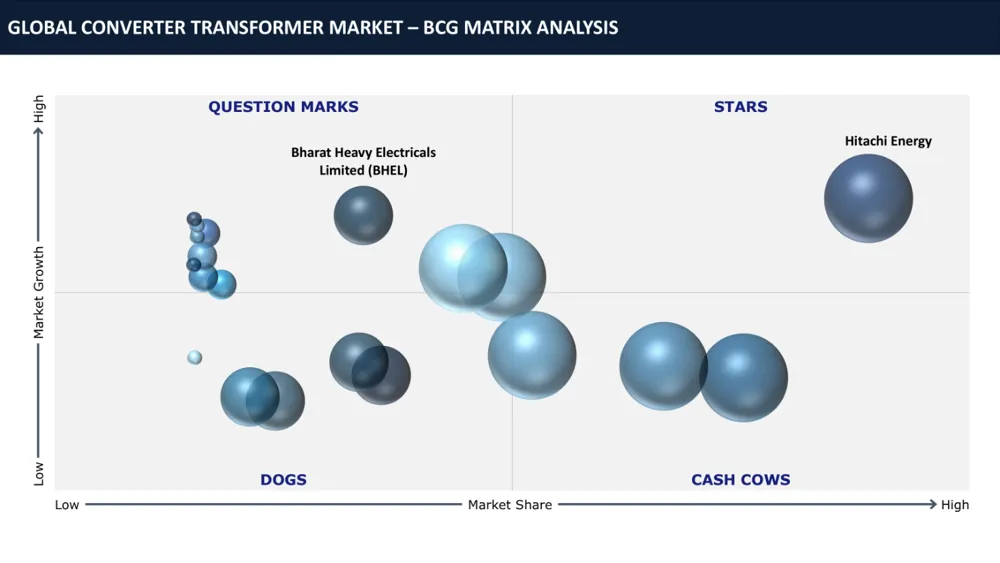
Converter Transformer Market: BCG Matrix Analysis
- Stars: Established HVDC converter transformer suppliers with strong project pipelines, advanced manufacturing capabilities and growing demand from UHVDC and offshore wind projects.
- Cash Cows: Established converter transformer product lines serving existing LCC-HVDC infrastructure and conventional transmission applications provide relatively stable revenue opportunities.
- Question Marks: Emerging VSC-HVDC applications, offshore wind connections and multi-terminal HVDC projects represent growth opportunities for manufacturers expanding their technological capabilities.
- Dogs: Manufacturers with limited HVDC expertise, outdated technical capabilities and weak project execution records face challenges in securing large-scale converter transformer contracts.
Global Converter Transformer Market: Key Market Players
- Hitachi Energy Ltd. (Switzerland)
- Siemens Energy AG (Germany)
- TBEA Co., Ltd. (China)
- China XD Electric Co., Ltd. (China)
- GE Vernova Inc. (United States)
- Bharat Heavy Electricals Limited (India)
- HYOSUNG HEAVY INDUSTRIES CORPORATION (South Korea)
- HD Hyundai Electric Co., Ltd. (South Korea)
- Mitsubishi Electric Corporation (Japan)
- Toshiba Energy Systems & Solutions Corporation (Japan)
- Changzhou XD Transformer Co., Ltd. (China)
- Baoding Tianwei Baobian Electric Co., Ltd. (China)
Global Converter Transformer Market: Recent Developments
- October 2026: Hitachi Energy announced a CAD 479 million investment in a new transformer insulation manufacturing facility in London, Ontario, Canada. This factory will produce electrical insulation pressboard and laminates, which are required in the production of transformers. It is estimated that the factory will be ready in 2028. This investment is aimed at improving the supply chain for transformer components within North America and aid in the growth of transformers production facilities.
- October 2026: Hitachi Energy showcased its 750 MVA/800 kV converter transformer for Voltage Source Converter (VSC)-based HVDC transmission at the 9th China International Import Expo. The firm stated that the device was the largest single-unit capacity that had been recorded for the VSC-HVDC transmission technology at the time and the transformer was to be used in the Chinese ultra-high voltage VSC-HVDC transmission projects. The innovation is indicative of advancements made in the technology of converter transformers for long-distance power transmission.
- September 2026: With the construction process almost 70% done, the new facility will be operational by July 2027. The expansion will enable Hyosung to boost its HVDC transformer manufacturing capacity up to 1.5 times that of 2024, a significant part of the scheduled production is contracted through agreements with suppliers for the manufacture of 500 kV HVDC transformers for major grid projects.
- August 2026: Hitachi Energy announced a USD 300 million investment in China to expand power transformer and component manufacturing capacity at its Hefei facility. The investment includes a new power transformer factory and expanded production of transformer components and bushings, strengthening the broader transformer supply chain and addressing manufacturing constraints affecting critical grid equipment.
Global Converter Transformer Market: Delivered Customization
| CLIENT REQUEST | CUSTOMIZATION DELIVERED | VALUE ADDS |
| HVDC Converter Transformer Manufacturer |
|
|
| HVDC System Integrator |
|
|
| Transmission System Operator / Electricity Utility |
|
|
| Renewable Energy Developer |
|
|
| EPC Contractor / Infrastructure Developer |
|
|
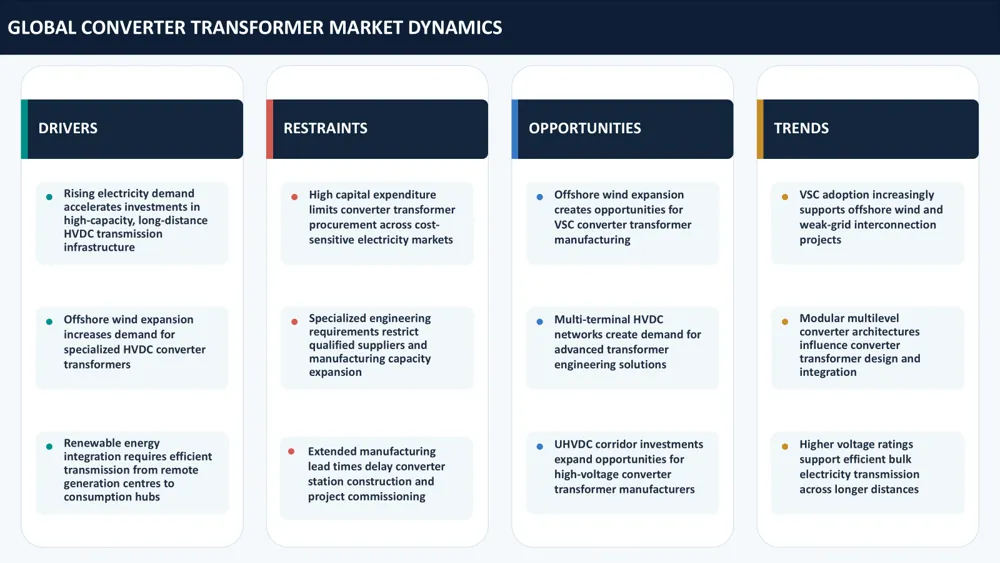
Global Converter Transformer Market: Market Dynamics
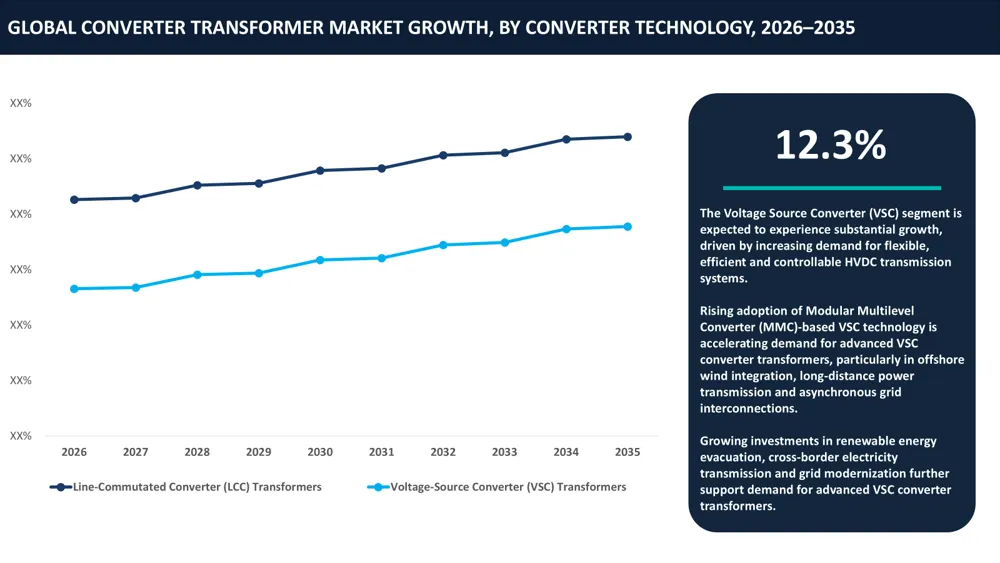
Global Converter Transformer Market: Market Segment Analysis
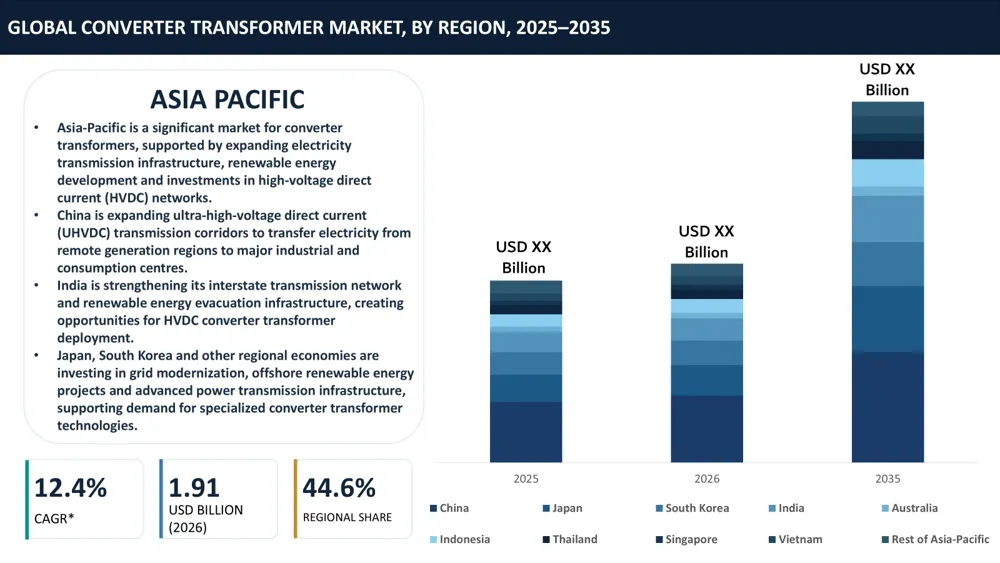
Global Converter Transformer Market: Region Wise Analysis
Global Converter Transformer Market: Market Scope
| Metrics | Details | |
| Market Size in 2025 (Value) | USD 3.85 Billion | |
| Market Size in 2026 (Value) | USD 4.29 Billion | |
| Market Forecasted in 2035 (Value) | USD 11.22 Billion | |
| CAGR (2026-2035) | 11.32% | |
| Years Considered | 2024-2035 | |
| Base Year | 2025 | |
| Forecast Period | 2026-2035 | |
| By Converter Technology | Line-Commutated Converter (LCC) Transformers Voltage-Source Converter (VSC) Transformers | |
| By Converter Station Function | Rectifier Transformers Inverter Transformers | |
| By Phase Construction | Single-Phase Converter Transformers Three-Phase Converter Transformers | |
| By Number of Windings | Two-Winding Converter Transformers Three-Winding Converter Transformers Multiple-Winding Converter Transformers | |
| By Voltage Rating | Below 200 kV 200–400 kV 401–600 kV 601–800 kV 801–1,000 kV Above 1,000 kV | |
| By Power Rating | Below 500 MVA 500–1,000 MVA 1,001–1,500 MVA 1,501–2,000 MVA 2,001–2,500 MVA 2,501–3,000 MVA Above 3,000 MVA | |
| By Cooling Type | Oil Natural Air Natural (ONAN) Oil Natural Air Forced (ONAF) Oil Forced Air Forced (OFAF) Oil Forced Water Forced (OFWF) Other Cooling Arrangements | |
| By Insulation Type | Mineral Oil-Based Insulation Natural Ester-Based Insulation Synthetic Ester-Based Insulation Other Insulation Systems | |
| By Installation Type | Indoor Installation Outdoor Installation Offshore Installation | |
| By Project Type | New Installation Retrofit & Replacement | |
| By Application | Long-Distance Bulk Power Transmission Renewable Energy Integration Asynchronous Power Grid Interconnection Offshore Transmission Grid Development Remote and Isolated Grid Interconnection Other Applications | |
| By End-User | Transmission System Operators (TSOs) Government-Owned Electricity Utilities Private Electricity Utilities Renewable Energy Developers and Operators Independent Power Transmission Developers Other End-Users | |
| By Region | North America | U.S., Canada, Mexico |
| Europe | Germany, UK, France, Spain, Italy, Poland | |
| Asia-Pacific | China, India, Japan, Australia, South Korea, Indonesia, Malaysia, Singapore, Vietnam, Thailand, Philippines, Taiwan | |
| South America | Brazil, Argentina | |
| Middle East and Africa | UAE, Saudi Arabia, South Africa, Israel, Turkiye | |
| Report Insights Covered | Competitive Landscape Analysis, Company Profile Analysis, Market Size, Market Share, Market Growth | |
Global Converter Transformer Market: Target Audience
| INDUSTRY | WHO SHOULD BUY THIS REPORT? | REASON TO BUY THIS REPORT |
| CONVERTER TRANSFORMER MANUFACTURERS | HVDC converter transformer manufacturers and power equipment producers | Assess market demand, product specifications, manufacturing capacity, competitor positioning and project procurement opportunities. |
| HVDC SYSTEM INTEGRATORS | LCC and VSC technology providers and HVDC system developers | Evaluate converter transformer requirements, project pipelines, technology developments and supplier capabilities. |
| TRANSMISSION SYSTEM OPERATORS | National and regional transmission network operators | Identify HVDC investment opportunities, converter station requirements, procurement strategies and grid expansion priorities. |
| ELECTRICITY UTILITIES | Public and private electricity utilities and power transmission companies | Assess converter transformer demand, equipment specifications, replacement requirements and long-term procurement needs. |
| RENEWABLE ENERGY DEVELOPERS | Offshore wind, solar, hydropower and large-scale renewable energy project developers | Evaluate HVDC transmission requirements, renewable energy evacuation opportunities and converter station infrastructure needs. |
| EPC CONTRACTORS | HVDC infrastructure, converter station and power transmission contractors | Understand equipment specifications, project opportunities, supplier availability and project execution requirements. |
| COMPONENT AND RAW MATERIAL SUPPLIERS | Electrical steel, copper, insulation, bushings and cooling-system suppliers | Evaluate converter transformer manufacturing demand, material requirements and supply-chain opportunities. |
| INDUSTRIAL AND ENERGY INFRASTRUCTURE INVESTORS | Infrastructure funds, private equity firms and strategic investors | Assess market growth opportunities, manufacturing investments, project pipelines and competitive positioning. |
| GOVERNMENT AND REGULATORY AUTHORITIES | Energy ministries, electricity regulators and infrastructure planning agencies | Evaluate HVDC deployment, domestic manufacturing capabilities, transmission investment priorities and supply-chain resilience. |
| CONSULTING AND ENGINEERING FIRMS | Power system consultants, engineering advisors and technical service providers | Analyze technology trends, project feasibility, transformer specifications and regional market opportunities. |
Why Does This Report Matter In 2026?
The global converter transformers market will be going through an extremely important period in 2026 owing to the increased spending on high-voltage direct current (HVDC) transmission systems by governments, transmission system operators, electricity utilities, renewable energy projects and power equipment manufacturing companies. With the growing demand for power, renewable energy integration, offshore wind farms and modern grids, countries such as China, India, the United States, Japan and Europe are making increased investments. This transition is changing converter transformers from mere transmission equipment to become strategically vital equipment for long-distance bulk power transmission, border electricity connectivity, evacuation of renewable energy, hydropower integration and regional grid development.
At the same time, converter transformer makers are facing pressure to increase manufacturing capacity, optimize production efficiency and cater to higher technical complexities in light of high capital cost, manufacturing cycle time and rigorous testing requirements. Developments in UHVDC transmission technology, voltage source converters (VSCs), modular multi-level converters (MMCs), insulation technology and transformer cooling systems are affecting the design, performance requirements and competitive positioning of converter transformers. While MMCs are converters and not transformers, their electrical properties affect transformer specifications. Buyers, investors and infrastructure developers demand greater transparency into manufacturing capacity, individual transformer power capacity, voltage specifications, backlog of orders, future projects, supplier qualifications, availability of materials, technology capabilities and government-funded HVDC transmission projects for evaluating the long-term competitive edge of suppliers, minimizing procurement risks and identifying business opportunities in the global converter transformer industry.
GLOBAL CONVERTER TRANSFORMER MARKET: ANALYST VIEW / OPINION
The global converter transformer market is progressively marked by two primary technology and application segments, namely traditional line commutated converters (LCC) used for bulk power transmission and voltage source converters (VSC) used for integrating offshore wind farms and asynchronous grids to renewable energies. These segments should not be forecast using a single demand or pricing assumption. LCC-based systems depend on the insulation capacity, transformer robustness, thermal behavior and scalability of equipment to be competitive. On the other hand, customization of electrical characteristics, voltage conversion capability, insulation coordination and interaction with converter stations are becoming vital for VSC systems.
Three competitive challenges require attention. First specialized converter transformers have a technically sophisticated nature, rigorous insulation standards, factory testing and limited production capacity. Long delivery periods may affect the project implementation of HVDC projects even if other equipment is readily available. The solution is in capacity planning, supplier selection and coordination with HVDC system integrators and utility companies. Second, huge capital investments and a prolonged project development process mean that there are considerable risks regarding purchasing of materials. Phase commitments in manufacturing, project pipeline evaluation and proper handling of the order backlog are critical here. Third, the emergence of new voltage requirements, new designs of VSC converters and offshore transmission pose increased technical difficulty and risk of having to make costly changes to design. Further investment in engineering expertise, insulating technology, cooling and manufacturing process standardization will help to improve competitiveness of suppliers and minimize implementation risks.