


Compostable Packaging Market Overview
The global Compostable Packaging market Size reached an estimated US$ 92.30 billion in 2025 and is expected to reach approximately US$ 202.80 billion by 2035, growing at a CAGR of 8.2% during the forecast period 2026-2035. Growth is supported by restrictions on problematic single-use plastics, brand commitments, foodservice conversion, organics-collection programs and innovation in barrier coatings and flexible films.
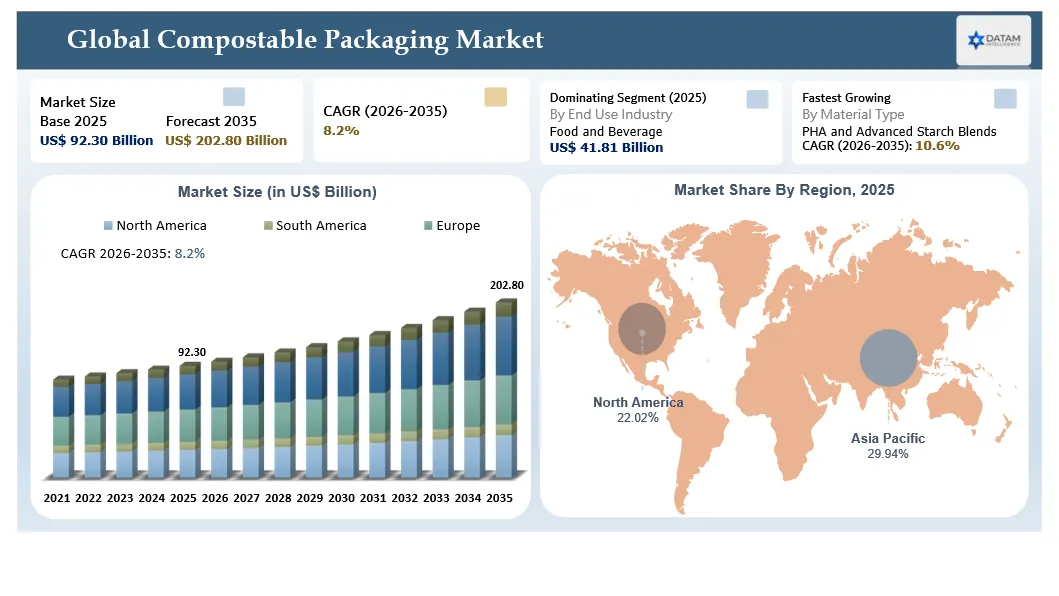
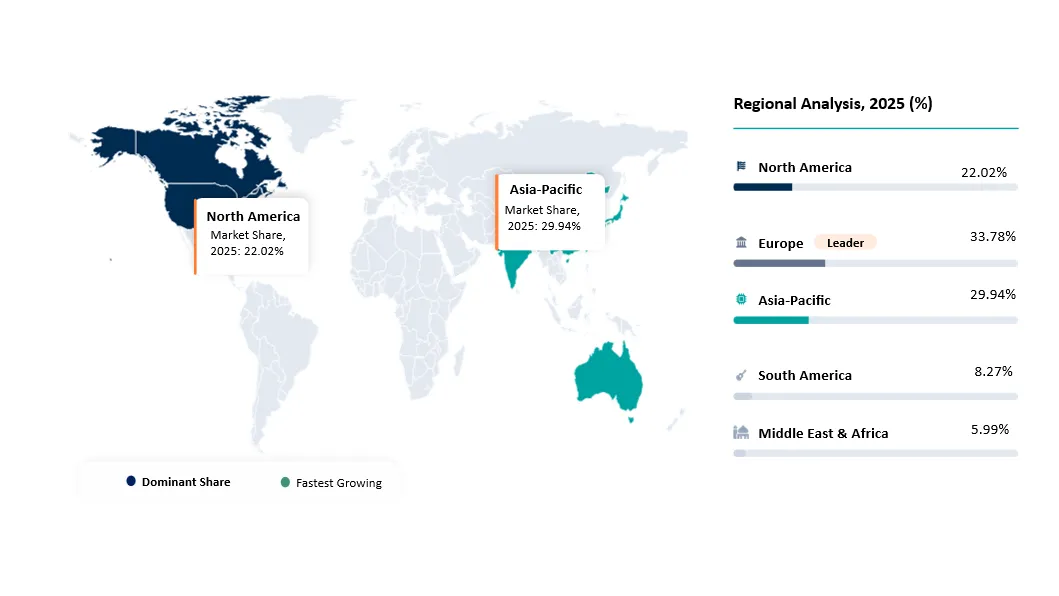
Food and beverage applications represent the largest demand pool because compostable formats can simplify disposal when packaging is contaminated with food. Flexible packaging is expanding through certified films, pouches and produce bags, while molded fiber and coated paper formats are gaining share in takeaway and quick-service applications. Europe is the leading regulatory market, while Asia-Pacific is expected to record the fastest volume growth through packaging expansion and biopolymer manufacturing.
| Metric | Details |
| 2025 Market Size | US$ 92.30 Billion |
| 2035 Projected Market Size | US$ 202.80 Billion |
| CAGR (2026-2035) | 8.2% |
| Largest Market | Europe |
| Fastest Growing Market | Asia-Pacific |
| Dominating Segment | Food and Beverage |
| Fastest Growing Material | PHA and advanced starch blends |
Compostable Packaging Market Key Takeaways
- Food and beverage applications lead because food contamination often limits mechanical recycling and supports organics diversion.
- Europe remains the strongest policy-led market as the Packaging and Packaging Waste Regulation generally applies from August 2026 and introduces harmonized packaging requirements.
- Industrial compostability dominates current certified volume, while home-compostable formats are growing from a smaller base.
- PLA remains a major biopolymer, while PHA, cellulose films and compostable coated fiber are gaining investment for performance and end-of-life differentiation.
- Limited composting access, inconsistent facility acceptance and consumer confusion remain the largest structural constraints.
- Long-term winners will combine barrier performance, machinability, certification, transparent labeling and end-market partnerships.
Compostable Packaging Industry Trends and Strategic Insights
- Packaging strategies are becoming application-specific, with compostability prioritized for food-soiled, small-format and organics-associated packaging rather than as a universal replacement for recycling.
- Converters are investing in water-based, dispersion and bio-based barrier coatings to improve grease, moisture and oxygen protection on fiber substrates.
- Brand owners increasingly require proof of industrial or home compostability, PFAS restrictions, food-contact compliance and chain-of-custody information before qualification.
- Digital printing and shorter production runs are helping emerging brands test compostable formats without committing to very large minimum orders.
- Composters and municipalities are becoming critical commercial stakeholders because facility acceptance determines whether certified packaging delivers its intended end-of-life value.
Compostable Packaging Market Scope
| Metrics | Details |
| 2025 Market Size | US$ 92.30 Billion |
| 2035 Projected Market Size | US$ 202.80 Billion |
| CAGR (2026-2035) | 8.2% |
| Largest Market | Europe |
| Fastest Growing Market | Asia-Pacific |
| By Material Type | Polylactic Acid (PLA), Polyhydroxyalkanoates (PHA), Starch Blends, Cellulose and Regenerated Cellulose, Paper and Paperboard, Molded Fiber and Bagasse, Other Compostable Materials |
| By Packaging Type | Flexible Packaging, Rigid Packaging, Paper-Based Packaging, Molded Fiber Packaging, Compostable Serviceware |
| By Product Type | Bags and Sacks, Pouches and Sachets, Films and Wraps, Trays and Clamshells, Cups and Bowls, Plates and Cutlery, Labels and Tapes, Other Products |
| By Compostability | Industrial Compostable, Home Compostable |
| By Application | Fresh Produce, Ready Meals and Takeaway, Beverages, Bakery and Confectionery, Dry Foods and Snacks, Personal and Home Care, Healthcare and Pharmaceuticals, E-commerce and Retail |
| By End Use Industry | Food and Beverage, Foodservice and Hospitality, Retail and E-commerce, Personal Care and Cosmetics, Healthcare, Agriculture, Industrial and Institutional |
| By Distribution Channel | Direct Sales, Packaging Distributors, Online B2B Platforms, Retail and Foodservice Supply |
| By Region | North America, Europe, Asia-Pacific, South America, Middle East and Africa |
| Report Insights Covered | Market Size, Share, Growth, Regulation, Certification, Competitive Landscape and Country-Level Opportunity |
Why does this report matter in 2026?
The year 2026 is an inflection point because Europe’s Packaging and Packaging Waste Regulation generally begins applying in August, while brands and converters face tighter scrutiny of recyclability, compostability claims and packaging reduction. Commercial decisions made in 2026 will influence resin sourcing, certification, labeling, equipment investment and market access through the remainder of the decade.
The report matters because growth depends on more than material substitution. A compostable pack must protect the product, run on converting and filling equipment, meet food-contact and compostability requirements, communicate disposal instructions and enter a collection system that accepts it. The study therefore links material and format forecasts with infrastructure, certification, regulation and buyer economics.
Compostable Packaging Market White Space & Investment Opportunities
- High-barrier flexible packaging for coffee, snacks, frozen food and personal care remains a large white space because oxygen and moisture protection are difficult to combine with certified compostability.
- Home-compostable films and coated fiber formats can expand where industrial composting access is limited, provided certification and real-world performance are credible.
- Food-waste caddy liners, produce labels, tea and coffee formats and takeaway packaging offer strong system value because they can travel with organic waste.
- Regional resin and film capacity in India, Southeast Asia, Latin America and the Middle East can reduce import dependence and improve lead times.
- Collection, sorting and facility-identification solutions can create value by reducing contamination and improving composter confidence.
Compostable Packaging Future Market Transformation
The market will shift from generic green claims toward verified application performance and controlled end-of-life pathways. Certified products will increasingly use harmonized labeling, digital product information and clear distinctions between industrial and home compostability. Brand owners will prioritize formats that solve a specific waste problem rather than replacing conventional plastic without infrastructure alignment.
Material innovation will improve heat resistance, sealability, transparency, puncture performance and barrier properties. Hybrid fiber-biopolymer structures will expand in foodservice and retail, while flexible films will gain share as coating and multilayer design improves. Commercial leadership will depend on lifecycle data, traceable feedstocks, converting support and partnerships with waste-management systems.
Compostable Packaging Market Buyer Decision-Making Criteria
Buyers evaluate shelf life, seal integrity, grease and moisture resistance, heat tolerance, printability, stiffness, clarity, drop performance and compatibility with existing filling equipment. They also assess certification standard, food-contact compliance, PFAS status, labeling, minimum order quantity, supply reliability and price premium.
Procurement decisions increasingly include end-of-life evidence. Buyers ask whether the packaging is accepted by target composting facilities, whether consumers can distinguish it from conventional plastic and whether claims comply with regional rules. Suppliers that provide application trials, certification support, artwork guidance and collection partnerships have a stronger route to adoption.
Compostable Packaging Market Economic & Investment Analysis
Economics are driven by resin cost, conversion yield, coating complexity, certification expense, machinery modification and scale. Compostable packaging often carries a premium over conventional plastic, but the gap can narrow through larger volumes, downgauging, regional production and avoided compliance or waste-management costs. The strongest investment cases are in categories where recycling is ineffective and organics collection creates measurable system value.
Investment is moving toward resin capacity, high-barrier films, molded fiber, compostable coatings and regional converting. Investors should distinguish between material platforms, converters and branded-product companies because margin structure, capital intensity and customer qualification differ. Partnerships with anchor customers and waste-system operators reduce commercialization risk.
Compostable Packaging Investment Trends in the Market
- Capacity investment is increasing in PLA, PHA, starch compounds and specialty cellulose films.
- Converters are upgrading extrusion, coating, thermoforming and printing lines to handle temperature-sensitive biopolymers.
- Molded fiber investment is expanding for trays, clamshells and foodservice formats.
- Certification, lifecycle assessment and digital traceability are becoming standard commercialization costs.
- Strategic partnerships increasingly connect resin suppliers, converters, brands, composters and municipalities.
Strategic Indicators For Compostable Packaging Market
High Regulation Impact
Packaging waste rules, single-use restrictions, food-contact requirements and environmental-claim laws directly shape product design and labeling. Regulation can accelerate demand but may also restrict compostable formats to applications with a credible collection pathway.
High Investment Activity
Investment is concentrated in resin capacity, barrier coatings, fiber conversion, home-compostable materials and regional manufacturing. Capital remains selective because qualification cycles and price premiums can delay utilization.
Supply Chain Disruption
The market depends on agricultural feedstocks, fermentation capacity, specialty additives, certified inks and coatings. Crop variability, energy costs, transport disruption and limited resin suppliers can affect availability and pricing.
Pricing Volatility
Resin prices fluctuate with feedstock, energy, scale and capacity utilization. Specialty certified films and laminates command higher premiums than simple serviceware or molded fiber products.
Procurement Pressure
Brand owners demand lower premiums, consistent quality, third-party certification and reliable delivery. Large accounts increasingly require supplier sustainability data and multi-region support.
New Technology Adoption
Advanced coatings, nanocellulose, PHA blends, reactive extrusion, water-based barriers and digital printing are improving performance and reducing minimum order barriers.
Regional Expansion Opportunity
Asia-Pacific, Latin America and the Middle East offer strong growth as modern retail, food delivery and packaging regulation expand. Local composting and certification ecosystems will determine conversion speed.
Government Policy Support
Organic-waste collection, composting grants, public procurement and restrictions on hard-to-recycle plastics can support demand when policy is coordinated with infrastructure.
Pricing Intelligence
Industrial compostable flexible packaging typically carries a higher premium than coated paper or molded fiber. Premiums fall with scale, downgauging and long-term contracts but remain sensitive to barrier requirements.
Disruption Analysis of Compostable Packaging Market
The market is being disrupted by a shift from material-centric claims to systems-based evaluation. Certification alone is no longer sufficient when composters do not accept the product or consumers cannot identify the correct bin. Brands are therefore integrating packaging design with collection, labeling and facility engagement.
Regulation is also changing competitive priorities. Reuse and recycling remain preferred pathways for many formats, which means compostable packaging must prove a distinct benefit in food-soiled or organics-linked applications. Companies that overextend compostability claims may face regulatory and reputational risk, while focused solutions can gain durable adoption.
Compostable Packaging Market BCG Matrix: Company Evaluation
STAR
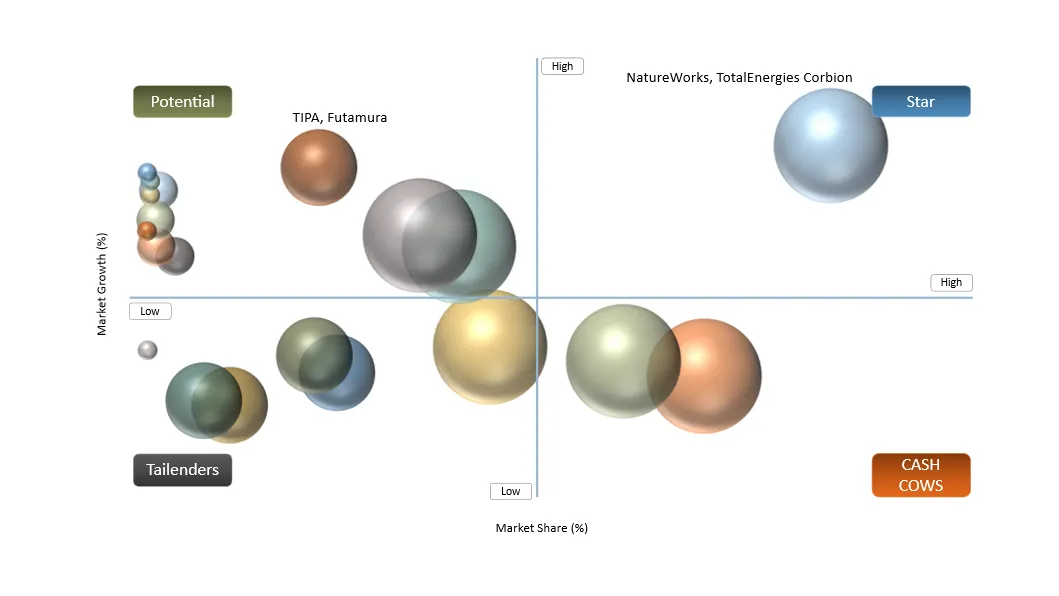
NatureWorks, TotalEnergies Corbion, Novamont and BASF are positioned as Stars because they combine material technology, production scale, application support and global customer relationships. Their influence extends across resin development, certification and converter ecosystems.
POTENTIAL
TIPA, Futamura, BioPak, Vegware and specialized molded-fiber or PHA companies represent Potential players. Their growth depends on differentiation in flexible packaging, home compostability, foodservice systems and customer education.
Compostable Packaging Market Dynamics
Driver Impact Analysis
| Driver | Market Growth Impact | Demand Concentration | Impacted Use Case | Strategic Impact |
| Single-use plastic regulation | High | Europe and selected U.S./Asia markets | Foodservice, bags and flexible formats | Accelerates qualification of certified alternatives. |
| Brand sustainability commitments | High | Food, beverage and retail | Consumer-facing packaging | Supports multi-year conversion programs. |
| Organics collection growth | Medium-High | Cities with food-waste systems | Liners, serviceware and food-soiled packaging | Improves end-of-life value and composter partnerships. |
| Material and coating innovation | Medium-High | Premium packaged goods | High-barrier and heat-resistant formats | Expands addressable applications. |
Driver: Rising Demand for Sustainable Foodservice and Food Packaging
Foodservice operators and packaged-food brands face pressure to reduce conventional single-use plastics while maintaining hygiene, shelf life and convenience. Compostable packaging can be attractive where products are contaminated with food and can be collected with organics. Growth is strongest when procurement commitments are aligned with certified products and local composting access.
Restraint Impact Analysis
| Restraint | Drag on Market Growth | Primary Impact Area | Impacted Use Case | Strategic Impact |
| Higher material cost | High | Procurement and margins | Flexible packaging and serviceware | Encourages downgauging, scale contracts and value engineering. |
| Limited composting infrastructure | High | End-of-life performance | All compostable formats | Requires facility engagement and regional targeting. |
| Consumer confusion and contamination | Medium-High | Collection quality | Look-alike plastic formats | Increases need for clear labeling and education. |
| Performance limitations | Medium | Shelf life and processing | High-barrier and hot-fill applications | Drives coating and polymer innovation. |
Restraint: Limited Infrastructure and Inconsistent Acceptance
Many communities lack separate food-waste collection, and some industrial composters do not accept compostable packaging because of contamination, identification or processing-time concerns. Packaging can therefore enter landfill or recycling streams, reducing environmental value and creating operational problems. Market expansion requires coordinated labeling, facility acceptance and collection investment.
Compostable Packaging Market Segment Analysis
The global Compostable Packaging market is segmented based on Material Type, Packaging Type, Product Type, Compostability, Application, End Use Industry, Distribution Channel and region.
By Material Type
PLA and Fiber-Based Materials Retain Scale While PHA Gains Momentum
PLA has an established conversion ecosystem and is widely used in cups, films and rigid formats. Paper, paperboard and molded fiber hold strong positions in foodservice, while PHA and advanced starch blends are expected to grow faster as performance improves and customers seek broader end-of-life options.
By Packaging Type
Flexible Packaging Expands Through Films and Pouches
Flexible packaging is gaining through produce bags, pouches, wraps and flow packs, but barrier and seal performance remain critical. Rigid and molded-fiber packaging retain strong demand in takeaway, fresh food and institutional catering because they are easier for consumers and composters to identify.
By Product Type
Bags, Films and Foodservice Containers Lead Adoption
Bags and films benefit from organics collection, produce and retail applications. Cups, bowls, trays and cutlery remain important in foodservice, while compostable labels and tapes are emerging because small conventional components can contaminate otherwise compostable packs.
By Compostability
Industrial Compostable Formats Dominate Current Volume
Industrial compostable products lead because standards, certification systems and material performance are more mature. Home-compostable products are growing, particularly for thin films and paper-based formats, but require stricter validation under lower-temperature and less-controlled conditions.
By Application
Ready Meals and Takeaway Create Strong System Value
Takeaway and ready-meal packaging is well suited to compostability because it is frequently food-soiled. Fresh produce, coffee, tea, bakery and dry-food applications also provide growth, while healthcare and personal care require additional barrier, hygiene and regulatory validation.
By End Use Industry
Food and Beverage Remains the Largest End-Use Industry
Food and beverage leads through packaged food and fresh produce, while foodservice and hospitality provide high visibility through cups, bowls, trays and cutlery. Retail and e-commerce are expanding in mailers, labels and protective formats where clear disposal guidance is available.
By Distribution Channel
Direct Sales Lead Large Brand and Converter Programs
Direct sales dominate large brand, retailer and foodservice accounts because qualification requires technical trials, certification and custom printing. Distributors remain important for small foodservice operators, institutions and regional customers.
Compostable Packaging Market Geographical Penetration
U.S. Compostable Packaging Market Landscape
The U.S. market is supported by state and municipal organics programs, foodservice conversion and BPI certification. Growth is uneven because access to food-waste composting and facility acceptance varies widely. California and other policy-active states create early demand, while national brands require multi-region disposal guidance.
Germany Compostable Packaging Market Outlook
Germany has strong waste-management infrastructure and strict packaging policy, but compostable plastics face careful scrutiny regarding collection and treatment. Opportunity is strongest in certified food-waste applications, coated fiber and targeted flexible formats rather than broad substitution.
China Compostable Packaging Market Trends
China combines large packaging consumption with expanding biopolymer and converting capacity. Local restrictions on selected single-use plastics support demand, while export-oriented manufacturers serve Europe and North America. Standards alignment and end-of-life infrastructure remain important.
India Compostable Packaging Market Outlook
India offers strong growth through food delivery, retail, packaging investment and restrictions on selected single-use plastics. Domestic production of starch blends, PLA conversion and bagasse-based serviceware is expanding, although certification enforcement and collection infrastructure vary.
Japan Compostable Packaging Market Outlook
Japan emphasizes high-quality, lightweight and carefully designed packaging. Compostable materials are gaining in selected food, agricultural and retail applications, supported by major chemical and packaging companies. Commercial adoption depends on performance, labeling and fit with local waste systems.
Brazil Compostable Packaging Market Outlook
Brazil has renewable feedstock advantages, a large food industry and growing demand for sustainable serviceware and flexible packaging. Market expansion is supported by bagasse, starch and biopolymer opportunities, but price sensitivity and uneven composting access constrain adoption.
Middle East and Africa Compostable Packaging Outlook
Growth is led by hospitality, aviation, foodservice and sustainability initiatives in Gulf markets, while South Africa offers an established packaging base. Regional opportunity depends on import economics, local fiber resources, certification and development of organics-processing infrastructure.
Compostable Packaging Market Competitive Landscape
- Competition spans upstream resin suppliers, film and coating specialists, integrated converters, molded-fiber manufacturers and branded foodservice packaging companies.
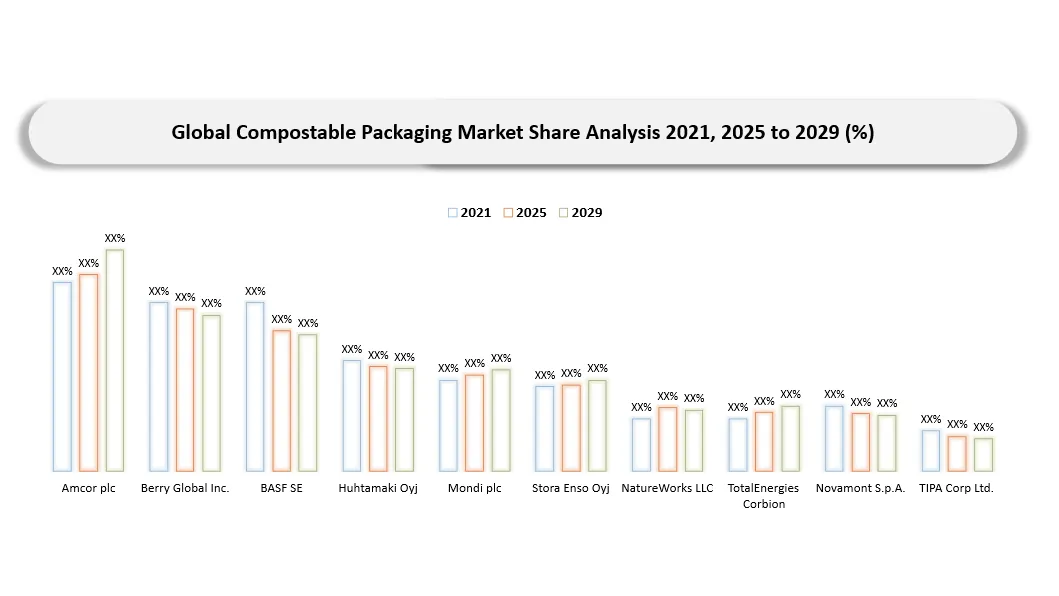
- NatureWorks, TotalEnergies Corbion, Novamont and BASF influence material availability and application development, while TIPA and Futamura are differentiated in flexible and cellulose-based films.
- Large packaging groups are expanding compostable options selectively where customer demand, regulation and end-of-life pathways justify investment.
- Differentiation depends on certification, barrier performance, machinability, print quality, technical support, regional supply and credible lifecycle evidence.
- Partnerships across resin, converting, brands and composting systems are increasingly important because no single participant controls the full value chain.
Key Companies
- NatureWorks LLC
- TotalEnergies Corbion
- Novamont S.p.A.
- BASF SE
- TIPA Corp Ltd.
- Futamura Chemical Co., Ltd.
- BioPak Pty Ltd.
- Vegware Ltd.
- Huhtamaki Oyj
- Mondi plc
- Amcor plc
- Berry Global Inc.
- Stora Enso Oyj
- Eco-Products, PBC
- Genpak, LLC
Company Profiles
NatureWorks LLC
NatureWorks is a leading producer of Ingeo PLA biopolymers used in rigid packaging, films, coatings and foodservice products. Its competitive position is based on resin scale, technical application support and a broad converter network. Strategic priorities include capacity expansion, lower-carbon feedstocks and improved heat and barrier performance.
TotalEnergies Corbion
TotalEnergies Corbion supplies Luminy PLA grades for packaging and other applications. The company combines polymer expertise with global market access and focuses on high-heat, durable and compostable solutions supported by lifecycle and certification data.
Novamont S.p.A.
Novamont is a pioneer in biodegradable and compostable materials, including Mater-Bi compounds used in bags, films and food-waste applications. Its model links materials with organic-waste systems and agricultural feedstocks, providing strong credibility in Europe.
BASF SE
BASF participates through certified compostable polymers and compounds such as ecovio, supported by global polymer, additive and application capabilities. Its portfolio serves bags, films, coatings and foodservice products.
TIPA Corp Ltd.
TIPA focuses on compostable flexible packaging designed to provide conventional-plastic-like functionality. Its opportunity lies in pouches, flow packs and films for food and consumer products where flexible packaging is difficult to recycle.
Futamura Chemical Co., Ltd.
Futamura is known for NatureFlex regenerated cellulose films used in transparent, printable and compostable flexible packaging. The company is differentiated by renewable cellulose feedstock and specialty barrier film expertise.
BioPak Pty Ltd.
BioPak Pty Ltd. is profiled for its role in compostable materials, packaging conversion, foodservice products or sustainable packaging systems. Its competitive position depends on certified product breadth, manufacturing scale, customer relationships, technical support and the ability to align packaging performance with regional end-of-life infrastructure.
Vegware Ltd.
Vegware Ltd. is profiled for its role in compostable materials, packaging conversion, foodservice products or sustainable packaging systems. Its competitive position depends on certified product breadth, manufacturing scale, customer relationships, technical support and the ability to align packaging performance with regional end-of-life infrastructure.
Huhtamaki Oyj
Huhtamaki Oyj is profiled for its role in compostable materials, packaging conversion, foodservice products or sustainable packaging systems. Its competitive position depends on certified product breadth, manufacturing scale, customer relationships, technical support and the ability to align packaging performance with regional end-of-life infrastructure.
Mondi plc
Mondi plc is profiled for its role in compostable materials, packaging conversion, foodservice products or sustainable packaging systems. Its competitive position depends on certified product breadth, manufacturing scale, customer relationships, technical support and the ability to align packaging performance with regional end-of-life infrastructure.
Amcor plc
Amcor plc is profiled for its role in compostable materials, packaging conversion, foodservice products or sustainable packaging systems. Its competitive position depends on certified product breadth, manufacturing scale, customer relationships, technical support and the ability to align packaging performance with regional end-of-life infrastructure.
Berry Global Inc.
Berry Global Inc. is profiled for its role in compostable materials, packaging conversion, foodservice products or sustainable packaging systems. Its competitive position depends on certified product breadth, manufacturing scale, customer relationships, technical support and the ability to align packaging performance with regional end-of-life infrastructure.
Stora Enso Oyj
Stora Enso Oyj is profiled for its role in compostable materials, packaging conversion, foodservice products or sustainable packaging systems. Its competitive position depends on certified product breadth, manufacturing scale, customer relationships, technical support and the ability to align packaging performance with regional end-of-life infrastructure.
Eco-Products, PBC
Eco-Products, PBC is profiled for its role in compostable materials, packaging conversion, foodservice products or sustainable packaging systems. Its competitive position depends on certified product breadth, manufacturing scale, customer relationships, technical support and the ability to align packaging performance with regional end-of-life infrastructure.
Genpak, LLC
Genpak, LLC is profiled for its role in compostable materials, packaging conversion, foodservice products or sustainable packaging systems. Its competitive position depends on certified product breadth, manufacturing scale, customer relationships, technical support and the ability to align packaging performance with regional end-of-life infrastructure.
Compostable Packaging Market Major Pain Points
- Higher material and conversion cost compared with conventional plastics.
- Limited access to industrial composting and inconsistent facility acceptance.
- Consumer confusion between compostable, biodegradable and recyclable packaging.
- Contamination of compost and recycling streams by look-alike materials.
- Barrier, heat resistance and shelf-life limitations in demanding applications.
- Complex regional certification, labeling and food-contact requirements.
- Feedstock and resin capacity constraints for some advanced biopolymers.
- Risk of unsupported environmental claims and greenwashing scrutiny.
Compostable Packaging Market Recent Developments
- August 2026: The EU Packaging and Packaging Waste Regulation began its general application, increasing the importance of compliant design, labeling and end-of-life claims across packaging placed on the EU market.
- June 2026: ASTM published the active D6400-26 specification for labeling plastics designed for aerobic composting in municipal or industrial facilities.
- 2025: BPI launched a Home Compostability Certification Program based on NF T 51-800, with commercial compostability certification as a prerequisite.
- 2025-2026: Material suppliers and converters continued expanding high-barrier compostable films, coated fiber and molded-fiber products for foodservice and packaged-food applications.
- 2025-2026: Brand sustainability programs increasingly combined packaging trials with lifecycle assessment, organics collection and composter engagement.
Analyst View / Opinion on Compostable Packaging Market
- The market will maintain strong growth, but adoption will become more selective as regulators and buyers demand proof that compostability solves a specific waste-management problem.
- Food-soiled packaging, organics liners, produce labels, tea and coffee formats and takeaway serviceware offer the clearest near-term value proposition.
- High-barrier flexible packaging remains the largest technical opportunity because conventional multilayer structures are difficult to recycle.
- Infrastructure and facility acceptance are as important as material performance, making partnerships with composters and municipalities a commercial capability.
- Europe will remain the regulatory reference market, while Asia-Pacific will lead incremental volume through packaging growth and material manufacturing.
- Long-term leaders will combine certified performance, reliable supply, transparent claims, competitive economics and end-of-life system integration.
Compostable Packaging Market Target Audience
| Industry | Who Should Buy This Report? | Reason to Buy This Report |
| Packaging Materials | Biopolymer producers, coating suppliers and compounders | Assess material demand, capacity, certification and application white spaces. |
| Packaging Converters | Film, rigid, fiber and label converters | Evaluate format growth, customer requirements and equipment investment. |
| Food and Beverage | Brand owners, processors and packaging teams | Identify suitable applications, supplier options and end-of-life risks. |
| Foodservice and Hospitality | Restaurant groups, caterers and distributors | Plan serviceware conversion and organics-diversion programs. |
| Retail and E-commerce | Retailers, marketplaces and fulfillment operators | Assess bags, mailers, labels and customer disposal communication. |
| Waste Management | Composters, municipalities and organics programs | Understand certified-product flows, contamination and acceptance issues. |
| Investors and Consulting | Private equity, venture capital and strategy teams | Evaluate market size, company positioning and investment opportunities. |
Why Choose DATAM?
- Data-driven analysis connecting packaging demand, material capacity, certification and end-of-life infrastructure.
- Post-purchase analyst consultations for material selection, market entry and partnership strategy.
- Annual updates covering regulation, standards, capacity, product launches and competitive developments.
- Specialized focus on emerging markets and country-level packaging systems.
- Actionable analysis that distinguishes appropriate compostable applications from formats better served by reuse or recycling.
What DATAM Uniquely Provides
- Ten-year forecasts across material, packaging type, product, compostability, application, end use, channel and region.
- Competitive benchmarking of resin suppliers, converters and branded packaging companies.
- Assessment of ASTM, EN and certification pathways and their commercial impact.
- Buyer-focused analysis of barrier performance, machinery compatibility, price premiums and disposal claims.
- Country-level views linking regulation, foodservice demand and composting infrastructure.



























































