


Commercial Elevator Market Overview
The global commercial elevator market reached US$ 65.16 billion in 2025 and is expected to reach US$ 143.30 billion by 2035, growing with a CAGR of 8.2% during the forecast period 2026-2035. As population increases within the urban centers, there will be more vertical construction, especially within countries such as India and China, where the government-sponsored smart city projects are changing the dynamics of the real estate market. In addition, infrastructural investment is increasing as the World Bank highlights that developing countries need billions of dollars yearly for infrastructural investments, most of which are channeled toward the construction of commercial buildings, metro systems, airports and mixed-use projects that involve a lot of elevators.
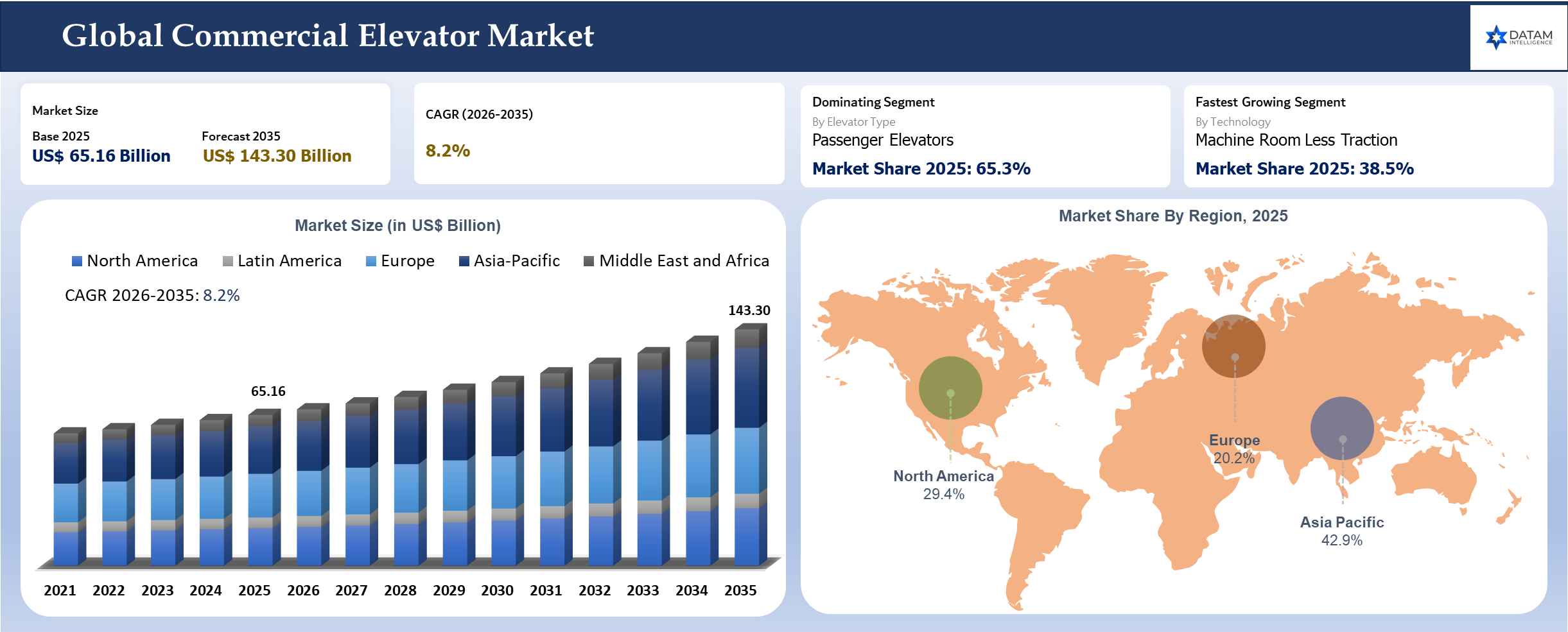
Development of new technology is yet another factor impacting the elevator market. Connected and smart elevators that can operate effectively with less consumption of electricity have started attracting customers. Some of the major manufacturers in this field, including Otis Worldwide Corporation, KONE Corporation and Schindler Holding Ltd., are focusing on introducing IoT-driven predictive maintenance, traffic management through AI and touchless controls in their products. For example, connected elevator solutions have already made way into the elevator industry, where customers can monitor the performance of their elevators and plan their maintenance requirements ahead of time. Moreover, the concept of sustainable development is driving product development since 37% of greenhouse gas emissions come from buildings, as reported by the International Energy Agency, which has led to the use of regenerative drives.
Commercial Elevator Industry Trends and Strategic Insights
- Advanced and networked elevator systems are emerging as key players in the market, with predictive maintenance cutting down downtime by as much as 50%, based on statistics from the digital services platform offered by top-tier OEMs; remote monitoring systems using the cloud are becoming commonplace among high-end commercial buildings.
- Energy-saving machine-room-less (MRL) elevators are becoming popular due to their potential to cut electricity use by 25%-40% relative to traditional traction-based systems.
Market Scope
| Metrics | Details | |
| 2025 Market Size | US$ 65.16 Billion | |
| 2035 Projected Market Size | US$ 143.30 Billion | |
| CAGR (2026-2035) | 8.2% | |
| Largest Market | Asia-Pacific | |
| Fastest Growing Market | North America | |
| By Elevator Type | Passenger Elevators, Service Elevators, Freight Elevators, Observation Elevators, Firefighter Elevators, Hospital Bed Elevators | |
| By Technology | Machine Room Less Traction, Geared Traction, Gearless Traction, Hydraulic | |
| By Rise | Low Rise, Mid Rise, High Rise, Super High Rise | |
| By Building Type | Office Buildings, Hotels, Hospitals, Retail and Mixed Use, Airports and Transit Hubs, Education Buildings, Warehousing and Commercial Logistics | |
| By Service Type | New Installation, Modernization, Maintenance and Repair, Digital Monitoring and Remote Service | |
| By Control Layer | Conventional Control, Destination Control, Touchless and Access Integrated, Predictive Connected Service | |
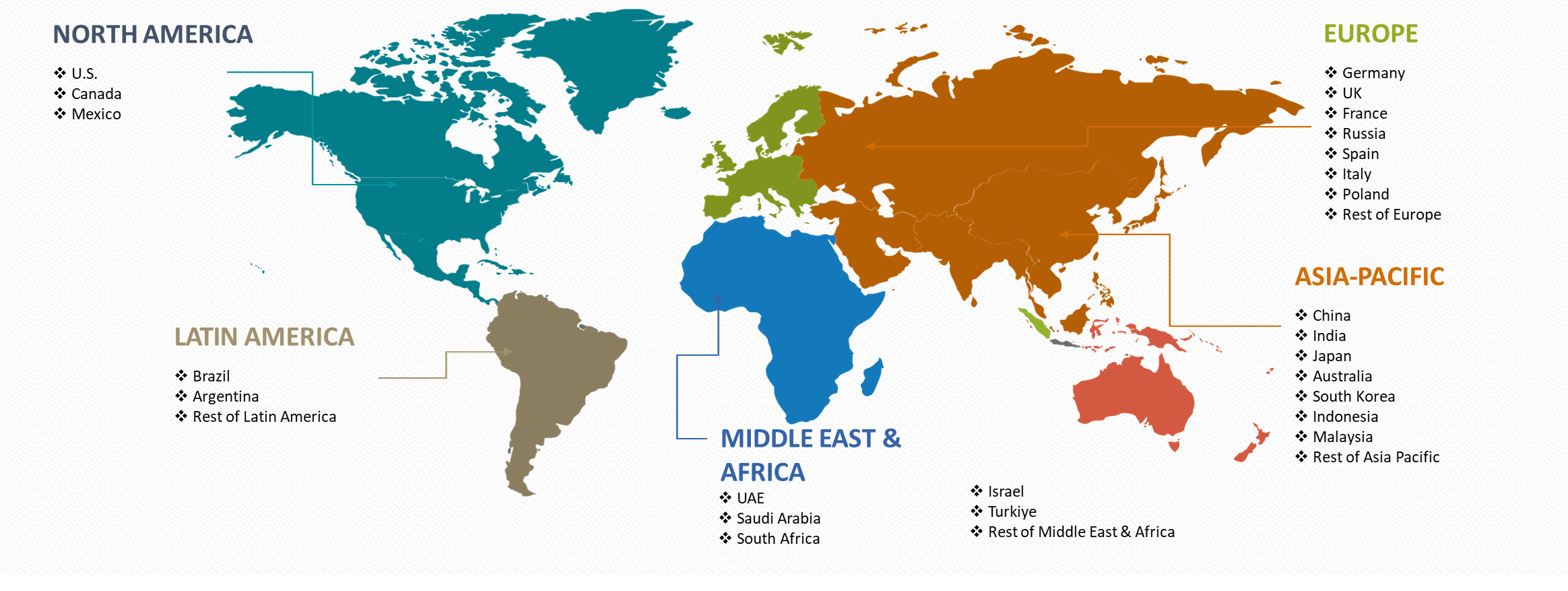
| By Region | North America | USA, Canada, Mexico |
| Europe | Germany, UK, France, Spain, Italy, Poland | |
| Asia-Pacific | China, India, Japan, Australia, South Korea, Indonesia, Malaysia | |
| Latin America | Brazil, Argentina | |
| Middle East and Africa | UAE, Saudi Arabia, South Africa, Israel, Turkiye | |
| Report Insights Covered | Competitive Landscape Analysis, Company Profile Analysis, Market Size, Share, Growth | |
Disruption Analysis
IoT, along with other technologies such as AI, apart from cloud computing technologies, has been used to transform lifts into intelligent means of transportation. Some examples include Mitsubishi Electric Corporation and Hitachi, Ltd., companies that have started using intelligent surveillance technology in their lifts to improve uptime and enhance customer satisfaction. Moreover, energy-saving elevators that are designed based on the criteria of green building certifications like the Leadership in Energy and Environmental Design rating system and other similar programs have accelerated modernization. Additionally, the increased demand for elevators with faster and destination control systems due to the construction of smart cities and skyscrapers with mixed-use property is another factor driving this trend. On the other hand, disruption will come from new players implementing modular manufacturing technologies, especially in Asia.
BCG Matrix: Company Evaluation
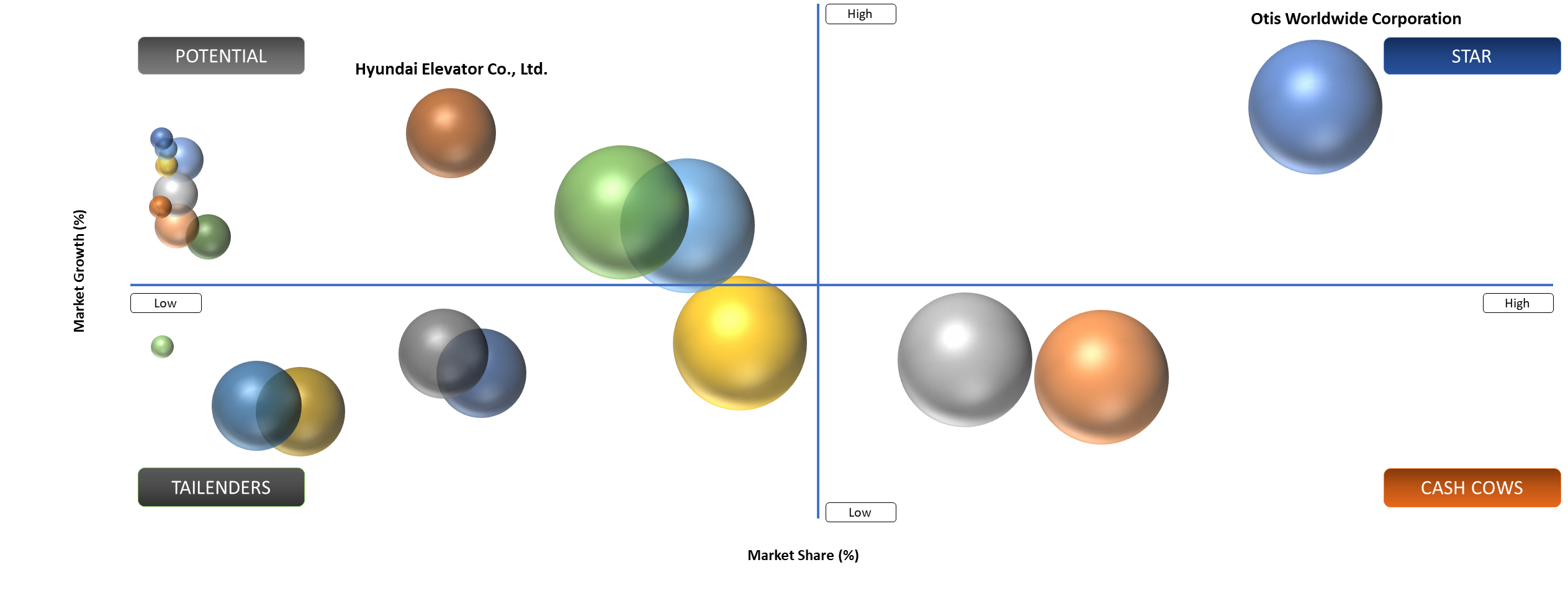
Leading market players like Otis Worldwide Corporation and KONE Corporation belong to the Stars category due to their robust order backlog, effective elevator placements and high presence in rapidly growing urban economies. Companies in the Potential category are capitalizing on their steady revenue from maintenance services, which constitute a large portion of their life cycle earnings. Question Marks involve new entrants and regional firms that are investing in AI-based vertical transport systems and IoT connectivity, but lack global scale. The industry trend is moving towards a service-centric model.
Market Dynamics
Rising High-Rise Commercial Construction and Urban Redevelopment
With limited options for horizontal growth of infrastructure due to reduced availability of land, the best option left is the growth in vertical terms. According to the figures provided by the Council on Tall Buildings and Urban Habitat (CTBUH), there are more than 1,900 tall buildings with heights higher than 200 meters and many others are under construction. The vertical growth phenomenon can be observed mostly in the Asia Pacific region and Middle East region. China is the leading country as far as commercial construction is concerned in the whole world. As per the last report issued by the National Bureau of Statistics of China, there is more than 4.2 billion square meters of managed commercial floor space by 2025. Likewise, even in India, there is good performance, as there is around 18% increase in commercial projects registered under RERA by 2025.
Modernization Challenges Across Aging Elevator Infrastructure
Commercial buildings from countries such as those in North America, Europe and Japan are still employing elevator systems installed more than 20 to 30 years ago. According to the European Lift Association, it is estimated that around 6 million elevators within Europe need modernization in order to conform to contemporary standards of energy efficiency and accessibility. On the other hand, according to the Bureau of Labor Statistics from the United States, an increase in expenses has been observed in elevator maintenance since it is getting harder and more costly to repair old mechanical systems amid labor shortages. In connection with modernization, building owners would need to undergo structural modifications and temporary disruptions as well as adhere to new standards related to fire safety and accessibility. Another constraint would involve the need for digital security for elevator operations once it becomes interconnected within a building's IoT network.
Segmentation Analysis
The global commercial elevator market is segmented based on the elevator type, technology, rise, building type, service type, control layer and region.
Office and Commercial Complex Segment Leads Market Deployment
Elevators used for commercial applications in office buildings and commercial buildings will continue to be one of the dominant market segments in the industry due to an increasing need for superior workspace and dense occupancy. As highlighted by the Global Commercial Real Estate Outlook 2025, total investment for premium office redevelopment worldwide reached more than US$ 600 billion, with much of that investment made on sustainability upgrades. Increasingly, advanced office skyscrapers will require advanced systems where elevators have the capability of performing destination-based dispatching to ensure faster passenger transportation. In 2025, various commercial buildings were planned in important urban business districts, which required advanced vertical transportation solutions. For instance, projects such as Canary Wharf in London, Hudson Yards in New York and GIFT City in India all incorporated advanced elevator ecosystems.
Geographical Penetration
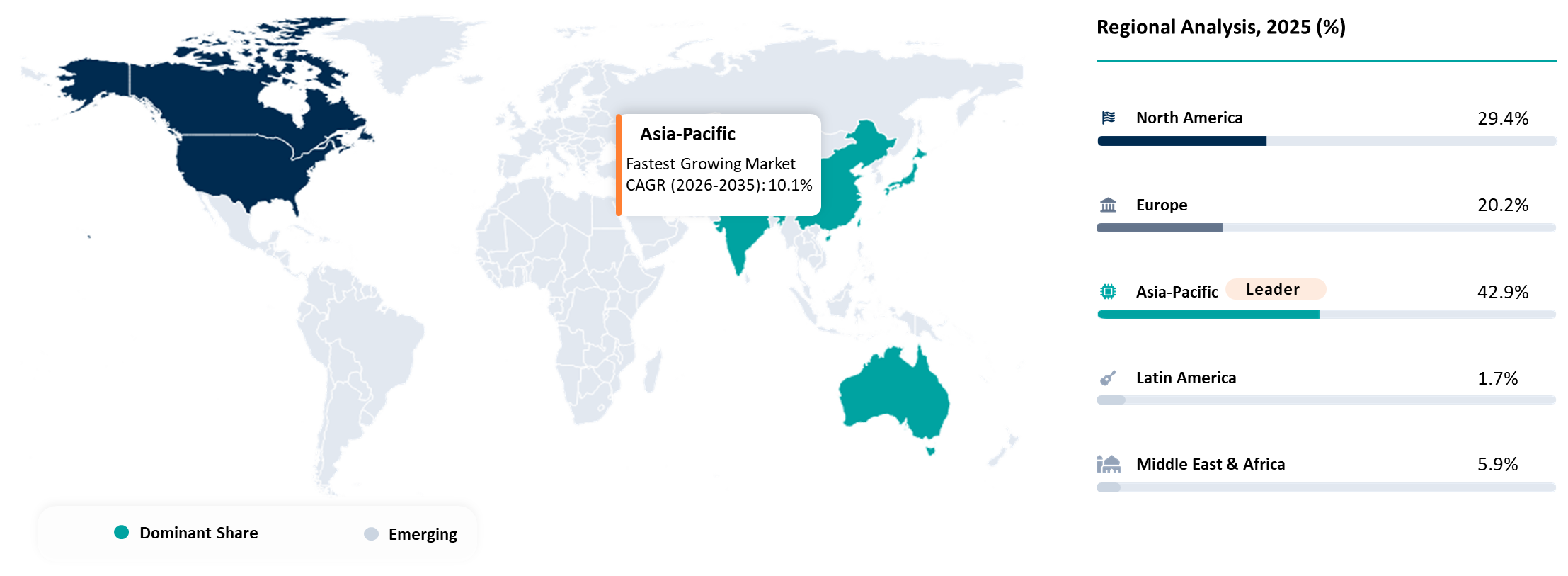
Asia-Pacific Dominates Commercial Elevator Deployment
The Asia-Pacific region holds the largest market share due to its high rate of urbanization, infrastructural development and construction activities within the commercial buildings sector. Most of the elevator installations take place in China. As per China Elevator Association, China has an annual installation of millions of elevators due to city remodeling and smart city development. Another market that is growing rapidly is India. India's Ministry of Housing and Urban Affairs stated that around 8,000 smart city projects are being developed, which include commercial buildings, metro stations and airports. They require high-end elevators. Southeast Asia is one of the emerging regions in the market. Many countries, such as Indonesia, Vietnam, Thailand and Philippines, have been receiving substantial investment from abroad for the development of their commercial buildings and urban infrastructure projects.
India Commercial Elevator Market Trends
The growth of the elevator market for commercial purposes in India is mainly attributed to the urbanization process, infrastructural development and smart cities initiative supported by the government. For instance, more than 100 smart cities are being built by the government and thus, there is an increase in demand for elevators for commercial complexes, metros, airports and office spaces. The urban population of India is expected to rise to 600 million by the year 2030, as indicated by the UN Department of Economic and Social Affairs, leading to an increase in tall buildings.
In addition, due to the establishment of the metro railway network stretching 900 kilometers, modern lifts and escalators have been installed in these transit systems. Many large organizations, such as Otis Worldwide Corporation and KONE Corporation, are investing heavily in India, setting up factories and research and development units for developing energy-efficient lifts in India. Furthermore, since India promotes green building construction through Indian Green Building Council, with over 10 billion sq. ft. of green buildings having been registered in India, Internet of Things and regenerative drives elevators for commercial buildings are adopted.
China Commercial Elevator Market Trends
Millions of elevators are being used in China owing to construction activities taking place and renovation projects carried out in the country every year. Urban redevelopment initiatives and transit-oriented developments have been contributing to a rise in the number of elevator installation projects within subway transportation systems and multi-use complexes. The robust domestic production capacity that has been driving growth within the elevator market in China, along with the participation of major foreign companies in the production of smart elevators, AI-powered elevator maintenance technologies and high-speed elevator systems. In addition, China will adopt stringent energy efficiency standards in buildings in the years ahead as part of its objective of carbon neutrality by 2050.
Competitive Landscape
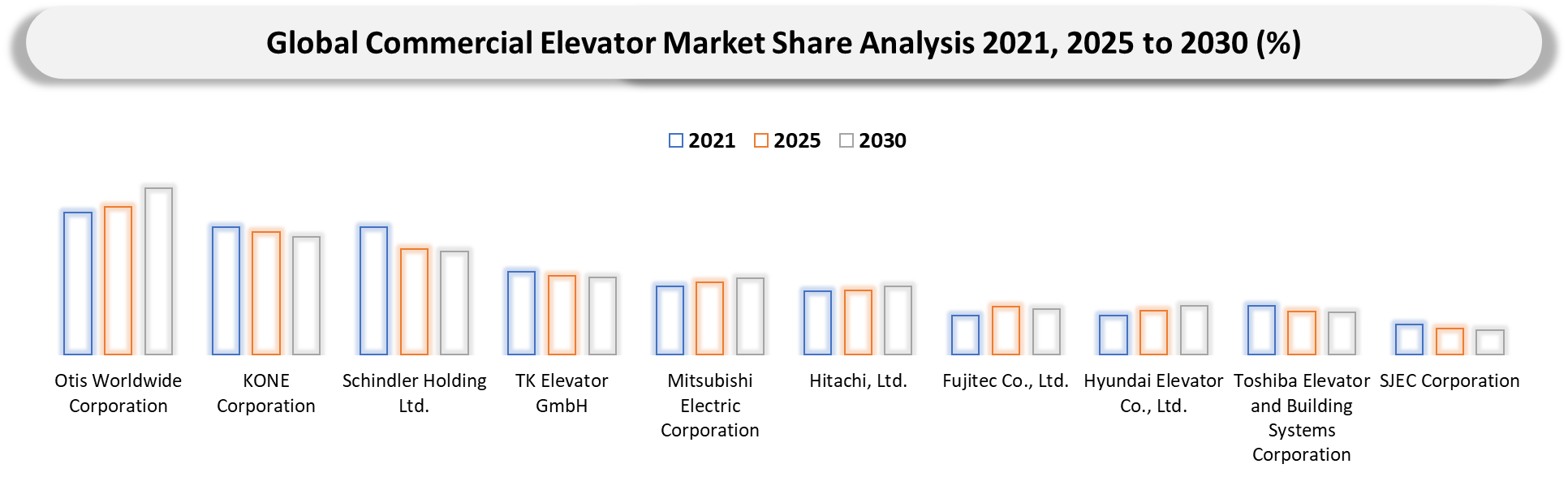
- The global commercial elevator market is highly consolidated, dominated by multinational OEMs with strong service networks, digital maintenance capabilities and modernization expertise.
- Key players include Otis Worldwide Corporation, KONE Corporation, Schindler Holding Ltd., TK Elevator GmbH, Mitsubishi Electric Corporation, Hitachi Ltd., Fujitec Co. Ltd., Hyundai Elevator Co. Ltd., Toshiba Elevator and Building Systems Corporation and Johnson Lifts Private Limited.
- Competition centers around smart connectivity platforms, energy-efficient traction systems, predictive maintenance software and lifecycle service offerings.
- Strategic investments are increasingly focused on AI-enabled traffic management, regenerative drive systems, destination dispatch innovation, cybersecurity for connected elevators and sustainability-driven modernization solutions.
- Partnerships with smart building platform providers and integration with broader building management systems are becoming critical differentiators as commercial buildings evolve into digitally connected ecosystems.
Key Developments
- April 2026: KONE Corporation announced a € 29.4 billion acquisition of TK Elevator, forming world’s largest elevator company, expanding Americas presence and generating €700 million in synergies.
- March 2026: Schindler Holding Ltd. publicly opposed KONE-TK Elevator merger, planning antitrust challenges, highlighting competitive concerns and potential industry consolidation impacts across global elevator markets.
- February 2026: Hitachi, Ltd. highlighted as a key player advancing smart elevator systems, integrating IoT, predictive analytics and energy-efficient technologies for high-rise commercial infrastructure projects.
- February 2026: Mitsubishi Electric Corporation was recognized among leading smart elevator innovators focusing on AI-enabled predictive maintenance, energy efficiency and advanced urban mobility infrastructure solutions globally.
- February 2026: Otis Worldwide Corporation launched flexible modernization packages and integrated transport robots with elevators, enhancing automation, efficiency and material flow in commercial buildings.
- January 2026: Otis Worldwide Corporation secured major infrastructure contracts, including London Underground modernization and Shanghai Metro escalator installations, strengthening its global urban mobility solutions portfolio.
Why Choose DataM?
- Data-Driven insights: Dive into detailed analyses with granular insights such as pricing, market shares and value chain evaluations, enriched by interviews with industry leaders and disruptors.
- Post-Purchase Support and Expert Analyst Consultations: As a valued client, gain direct access to our expert analysts for personalized advice and strategic guidance, tailored to your specific needs and challenges.
- White Papers and Case Studies: Benefit quarterly from our in-depth studies related to your purchased titles, tailored to refine your operational and marketing strategies for maximum impact.
- Annual Updates on Purchased Reports: As an existing customer, you enjoy the privilege of annual updates to your reports, ensuring you stay abreast of the latest market insights and technological advancements. Terms and conditions apply.
- Specialized Focus on Emerging Markets: DataM differentiates itself by delivering in-depth, specialized insights specifically for emerging markets, rather than offering generalized geographic overviews. The approach equips our clients with a nuanced understanding and actionable intelligence that are essential for navigating and succeeding in high-growth regions.
Value of DataM Reports: Our reports offer specialized insights tailored to the latest trends and specific business inquiries. The personalized approach provides a deeper, strategic perspective, ensuring you receive the precise information necessary to make informed decisions. The insights complement and go beyond what is typically available in generic databases.
Target Audience 2026
- Commercial Building Owners and Asset Managers: Operators of offices, hotels, hospitals, retail complexes and mixed-use developments evaluating elevator investments for traffic performance, uptime, tenant experience and lifecycle cost.
- Facility Management and Service Procurement Teams: Organizations responsible for maintenance contracts, service response, modernization timing and portfolio-wide reliability across commercial building estates.
- Developers and Project Consultants: Real-estate developers, architects and vertical-transport consultants selecting technologies such as MRL traction, gearless systems and destination control for new commercial builds and repositioning projects.
- Healthcare and Institutional Operators: Hospital groups, universities and public-building managers prioritizing dependable mobility, phased modernization and code-compliant evacuation planning.
- Airport and Transit Infrastructure Authorities: Mobility planners and project owners integrating commercial elevator systems into terminals, interchanges and high-footfall public environments.
- Technology and Access-Control Providers: Companies delivering building management software, touchless entry, robotics and security systems that need elevator integration.
- Private Equity and Real Estate Investors: Investors reviewing modernization backlogs, service-margin potential and building repositioning opportunities tied to vertical transport upgrades.
- Building Sustainability and Compliance Leaders: Teams responsible for embodied carbon, energy performance, accessibility and safety upgrades within commercial building portfolios.


























































