


Collagen Peptides Market Size and overview
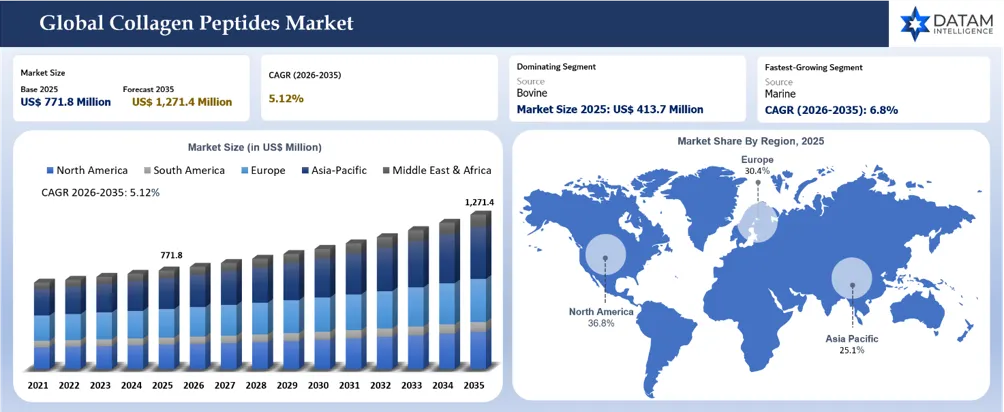
The global collagen peptides market reached US$771.8 million in 2025 and is expected to reach US$1,271.4 million by 2035, growing with a CAGR of 5.12% during the forecast period 2026-2035.
Growth is being shaped by increasing consumer expenditure on healthy ageing, beauty-from-within, sports recovery and preventive nutrition. Collagen peptides are moving beyond conventional powders into gummies, capsules, ready-to-drink beverages, nutrition bars, coffee mixes and functional foods. Bovine collagen remains the market’s revenue foundation because of its broad availability, scalable processing economics and established use across nutraceutical applications. However, commodity pricing, limited clinical differentiation and variability in taste, odor and dissolution restrict value capture among undifferentiated suppliers.
Marine collagen represents the market’s principal growth vector. Demand is supported by premium beauty positioning, pescatarian compatibility and the commercial utilization of fish skin and scales from seafood-processing side streams. Competitive advantage increasingly depends on molecular-weight consistency, bioactive peptide concentration, species traceability, clinical substantiation, sustainability certification and performance within complex formulations.
The next value-creation cycle will centre on application-specific peptides targeting skin elasticity, joint mobility, bone strength, tendon recovery and muscle performance. Sustainable leadership will require proprietary hydrolysis capabilities, ingredient-specific human studies, lower effective dosages and dependable raw-material sourcing. Companies combining clinical evidence with technical formulation support, regulatory-compliant claims and scalable international supply will be best positioned to capture premium value.
Collagen Peptides Market Key Takeaways
- Sustained Market Expansion Through 2035: The global collagen peptides market was valued at USD 771.8 million in 2025 and is projected to reach approximately USD 1,270.3 million by 2035, registering a CAGR of 5.12% during 2026-2035.
- Bovine Collagen Peptides Maintain Market Leadership: Bovine collagen peptides accounted for an estimated 53.6% share in 2025, equivalent to approximately USD 413.7 million, supported by broad raw-material availability, scalable production and extensive use across nutritional supplements and functional foods.
- Marine Collagen Peptides Become the Primary Growth Engine: Marine collagen peptides are expected to register the fastest CAGR of approximately 6.8% through 2035, driven by beauty-from-within demand, premium positioning, pescatarian compatibility and greater utilization of fish-processing side streams.
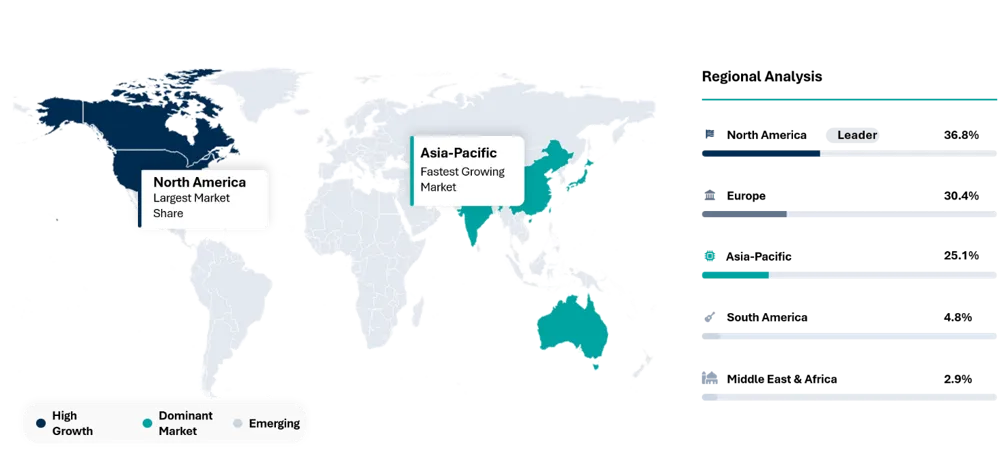
- North America Maintains Regional Dominance: North America accounted for an estimated 36.8% of the market in 2025, equivalent to approximately USD 284 million, supported by mature supplement consumption, strong retail and e-commerce penetration, and demand for sports nutrition and healthy-ageing products.
- Clinical Differentiation Reshapes Competitive Strategy: Future leadership will depend on proprietary peptide profiles, ingredient-specific human studies, traceable sourcing and formulation performance. Suppliers delivering clinically supported benefits, lower effective dosages, neutral sensory properties and reliable supply will be best positioned to secure premium customers.
Collagen Peptides Market Scope
| Metrics | Details | |
| 2025 Market Size | US$771.8 Million | |
| 2035 Projected Market Size | US$1,271.4 Million | |
| CAGR (2026-2035) | 5.12% | |
| Largest Market | North America | |
| Fastest Growing Market | Asia-Pacific | |
| By Source | Marine, Bovine, Porcine | |
| By Form | Dry, Liquid | |
| By Application | Pharmaceuticals, Nutritional Products, Food and Beverages | |
| By Region | North America | U.S., Canada, Mexico |
| Europe | Germany, UK, France, Spain, Italy, Poland | |
| Asia-Pacific | China, India, Japan, Australia, South Korea, Indonesia, Malaysia, Singapore, Vietnam, Thailand, Philippines, Taiwan | |
| South America | Brazil, Argentina | |
| Middle East and Africa | Israel, Saudi Arabia, UAE, Turkiye, South Africa, Nigeria | |
| Report Insights Covered | Competitive Landscape Analysis, Company Profile Analysis, Market Size, Share, Growth | |
Collagen Peptides Market White Space & Investment Opportunities
- Clinically Validated Application-Specific Peptides: Invest in proprietary collagen peptide profiles supported by ingredient-specific human clinical evidence for skin elasticity, joint mobility, bone density, tendon recovery, muscle performance and healthy ageing. Clearly defined dosages and measurable outcomes can support premium positioning and defensible health claims.
- Low-Dose Bioactive Collagen Formulations: Develop peptides that deliver clinically meaningful benefits at lower daily dosages. Reduced serving requirements can improve formulation flexibility, consumer adherence and economics across gummies, capsules, shots, nutrition bars and ready-to-drink beverages.
- Traceable and Sustainable Marine Collagen: Establish vertically integrated supply chains utilizing fish skin and scales from seafood-processing side streams. Species verification, allergen controls and sustainability certification can differentiate marine collagen in premium beauty-from-within and pescatarian wellness applications.
- Sensory-Optimized Functional Food and Beverage Ingredients: Invest in neutral-tasting, odor-controlled, rapidly soluble and heat-stable collagen peptides suitable for coffee, dairy products, sports drinks, clear beverages and functional foods. Improving sensory performance can accelerate adoption beyond conventional supplement powders.
- Personalized Collagen Nutrition Platforms: Develop formulations tailored by age, gender, activity level and desired health outcome. Combining collagen peptides with vitamin C, hyaluronic acid, minerals, creatine or complementary proteins can create differentiated solutions for women’s health, sports recovery and senior nutrition.
- Emerging-Market Localization and Certified Production: Expand affordable collagen products across China, India, Southeast Asia, the Middle East and Latin America through local manufacturing, smaller pack sizes and regional distribution partnerships. Halal, Kosher, non-GMO and source-specific certification will be critical for addressing fragmented dietary and cultural requirements.
Collagen Peptides Market Buyer Decision-Making Criteria
Major Buyer Decision-Making Criteria:
- Collagen Source, Including Bovine, Porcine, Marine and Ovine
- Collagen Type and Peptide Molecular-Weight Profile
- Protein Content, Purity and Amino-Acid Composition
- Clinical Evidence for Skin, Joint, Bone, Muscle and Tendon Benefits
- Effective Daily Dosage and Bioactive Peptide Concentration
- Solubility, Dispersibility and Dissolution Speed
- Taste Neutrality, Odor Control and Mouthfeel
- Stability Under Heat, pH and Processing Conditions
- Suitability for Powders, Beverages, Gummies, Capsules and Functional Foods
- Raw-Material Origin, Traceability and Supply-Chain Transparency
- Halal, Kosher, Non-GMO and Sustainability Certifications
- Allergen Status and Dietary Compatibility
- FSSC 22000, ISO, GMP and Relevant Food-Safety Compliance
- Batch-to-Batch Consistency and Certificate-of-Analysis Reliability
- Regulatory Status and Permitted Health-Claim Support
- Minimum Order Quantity, Lead Time and Supply Flexibility
- Pricing, Formulation Cost and Cost per Effective Daily Dose
- Manufacturing Capacity and Geographic Supply Availability
- Technical Support, Application Development and Customization Capabilities
- Intellectual Property, Branded-Ingredient Recognition and Marketing Support
Collagen Peptides Market BCG Matrix: Company Evaluation
STAR
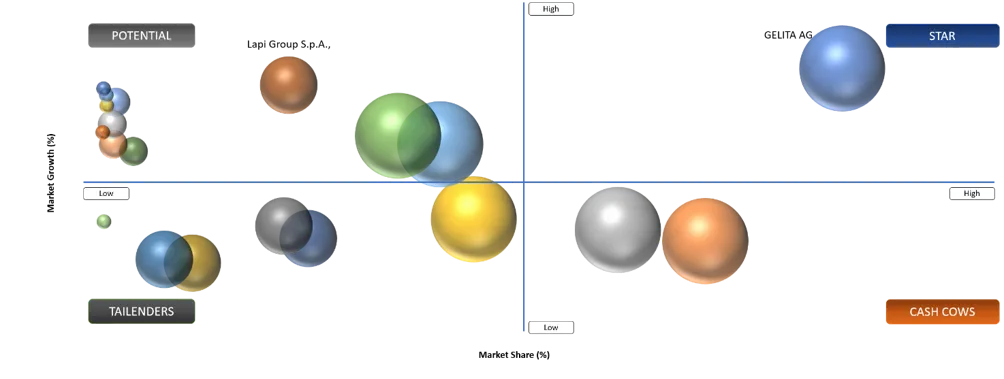
GELITA AG, Darling Ingredients Inc., Tessenderlo Group NV, Nitta Gelatin Inc. and Weishardt Holding SA are positioned in the Star category based on their large-scale production capabilities, international distribution networks, diversified collagen sources and clinically substantiated peptide portfolios. GELITA maintains a strong position through VERISOL, BODYBALANCE, FORTIGEL, FORTIBONE, TENDOFORTE and PEPTENDURE. Darling Ingredients competes through Rousselot’s Peptan and Nextida portfolios, while Tessenderlo Group addresses food, beverage, nutraceutical and active-lifestyle applications through PB Leiner’s SOLUGEL range.
Nitta Gelatin strengthens its position through Wellnex Replenwell collagen peptides targeting beauty, joint health, sports nutrition and healthy ageing. Weishardt differentiates through Naticol marine and bovine collagen peptides. Future leadership will depend on clinical substantiation, application-specific peptide development, raw-material traceability, sustainable sourcing and formulation capabilities across powders, beverages, gummies and functional foods. Companies combining proprietary hydrolysis technologies with global technical support and dependable supply chains are expected to retain stronger competitive positioning.
POTENTIAL
Lapi Group S.p.A., Italgel S.p.A., Nippi, Incorporated, Amicogen, Inc., Hainan Huayan Collagen Technology Co., Ltd., Titan Biotech Limited and Thai Union Group PCL are positioned in the Potential category due to their expanding production capabilities, specialized sourcing strategies and growing participation in premium nutraceutical, beauty-from-within and sports-nutrition applications.
Lapi Group is expanding bovine, fish and porcine collagen capabilities through Lapi Gelatine and Juncà Gelatines, while Italgel is strengthening its value proposition through hydrolyzed collagen and the Avvera beauty portfolio. Nippi brings established collagen expertise, whereas Amicogen differentiates through enzyme-processed fish peptides. Hainan Huayan and Titan Biotech are expanding cost-competitive collagen peptide supply, while Thai Union is commercializing tuna-derived ThalaCol marine collagen peptides. Progression toward the Star category will depend on international certifications, branded-ingredient development, human clinical evidence, export-market penetration, capacity expansion, customer formulation support and long-term raw-material security.
Collagen Peptides Market Dynamics
Driver Impact Analysis
| Driver | Market Growth Impact (%) | Demand Concentration | Impacted Use Case | Strategic Impact |
Shift from Commodity Hydrolyzed Collagen Toward Clinically Substantiated, Application-Specific Peptides | 16.8% | High across North America, Europe and Japan; expanding across South Korea and China | Skin elasticity, wrinkle reduction, joint mobility, bone health and muscle recovery | Supports premium pricing and strengthens the competitive advantage of suppliers with proprietary peptide profiles, human clinical studies and defensible branded ingredients. |
Expansion of Collagen Peptides into Ready-to-Drink Beverages, Gummies and Everyday Functional Foods | 14.9% | High among nutraceutical, sports-nutrition and functional-beverage manufacturers | Collagen drinks, gummies, nutrition bars, dairy products, coffee mixes and single-serve sachets | Expands consumption beyond traditional powder supplements and increases demand for highly soluble, neutral-tasting and heat-stable peptide formulations. |
Accelerating Commercialization of Marine Collagen Through Traceable Fish-Processing Side Streams | 13.6% | Strong across Asia Pacific and Europe; growing in premium North American beauty supplements | Beauty-from-within, healthy ageing, premium wellness and pescatarian-positioned supplements | Creates higher-value opportunities for seafood processors and marine-ingredient companies while reducing dependence on bovine and porcine raw-material streams. |
Rising Formulation Demand for Low-Dose Bioactive Peptides with Targeted Health Claims | 12.4% | Concentrated among premium supplement brands, clinical-nutrition companies and science-led ingredient formulators | Mobility support, tendon recovery, bone-density maintenance, skin health and active ageing | Encourages investment in enzymatic hydrolysis, molecular-weight control and clinical validation, shifting competition from volume-based supply toward evidence-backed performance. |
Driver: Shift from Commodity Hydrolyzed Collagen Toward Clinically Substantiated, Application-Specific Peptides
Collagen peptide demand is shifting from general protein supplementation toward scientifically differentiated ingredients designed for specific outcomes, including skin elasticity, joint mobility, bone strength, tendon recovery and muscle performance. Brand owners increasingly require human clinical evidence, characterized peptide profiles and recommended daily dosages before incorporating collagen into premium formulations. This transition benefits suppliers such as GELITA, Darling Ingredients, Nitta Gelatin and Weishardt, which compete through proprietary hydrolysis processes and branded ingredients supported by application-focused research. Clinical substantiation enables clearer product positioning while reducing direct price comparison with undifferentiated collagen powders.
Commercially, application-specific peptides improve supplier pricing power, customer retention and entry into higher-margin nutraceutical, functional food and clinical nutrition channels. They also enable manufacturers to formulate lower-dose products, gummies, beverages and single-serve formats without compromising the intended benefit. However, leadership requires sustained investment in randomized clinical studies, regulatory-compliant claims, peptide characterization and customer formulation support. Suppliers lacking evidence-backed differentiation risk remaining exposed to raw-material price volatility and competition from lower-cost regional producers. Consequently, intellectual property, clinical credibility and reproducible bioactivity are becoming central competitive barriers.
Restraint Impact Analysis
| Restraint | Drag on Market Growth (%) | Primary Impact Area | Impacted Use Case | Strategic Impact |
Limited Clinical Differentiation Across Commodity Collagen Peptide Products | 15.7% | Product credibility, premium positioning and customer conversion | Skin health, joint support, bone health and sports recovery supplements | Weak clinical substantiation increases product commoditization, intensifies price competition and restricts suppliers’ ability to secure premium formulations and long-term contracts. |
Raw-Material Traceability and Disease-Control Risks Across Bovine, Porcine and Marine Supply Chains | 14.3% | Supply continuity, regulatory compliance and quality assurance | Nutraceuticals, functional foods, beverages and clinical nutrition | Inconsistent origin documentation, contamination concerns and processing variability increase qualification costs, prolong customer approval cycles and encourage dual-sourcing strategies. |
Religious, Dietary and Allergen-Related Restrictions Limiting Cross-Market Product Acceptance | 12.8% | Consumer eligibility, geographic commercialization and formulation selection | Bovine, porcine, fish and shellfish-derived collagen supplements | Halal, Kosher, pescatarian and allergen considerations fragment demand by source, requiring separate certifications, production controls and market-specific portfolio strategies. |
Sensory and Processing Limitations in High-Dose Functional Food and Beverage Formulations | 11.6% | Product formulation, consumer adherence and manufacturing scalability | Ready-to-drink beverages, gummies, nutrition bars, dairy products and powdered mixes | Off-notes, odor, foaming, viscosity and stability issues can restrict effective dosage levels, raise masking costs and delay commercialization of convenient consumer formats. |
Restraint: Limited Clinical Differentiation Across Commodity Collagen Peptide Products
A substantial portion of the collagen peptides market remains characterized by standardized hydrolyzed powders with similar protein content, amino-acid profiles and functional claims. Many products lack ingredient-specific human clinical evidence demonstrating measurable benefits for skin, joints, bones or muscle recovery. This weakens differentiation at the formulation stage and makes purchasing decisions increasingly dependent on price, minimum order quantities and supply availability. Brand owners also face difficulty translating generalized collagen research into compliant product claims, particularly when evidence cannot be directly linked to the specific ingredient, dosage or molecular-weight profile used in the finished product.
For suppliers, limited substantiation compresses margins and increases exposure to lower-cost producers offering technically comparable materials. It also restricts access to premium nutraceutical, clinical-nutrition and practitioner-led channels where scientific credibility influences product selection. Manufacturers must therefore invest in randomized human studies, standardized peptide characterization and application-specific efficacy packages. Without these capabilities, suppliers risk remaining confined to commodity contracts, experiencing weaker customer retention and losing opportunities to clinically validated branded ingredients that support premium pricing and long-term formulation partnerships.
Collagen Peptides Market Geographical Penetration
U.S. Collagen Peptides Market Landscape
The U.S. collagen peptides market is transitioning from undifferentiated protein powders toward clinically substantiated ingredients positioned for skin health, joint mobility, healthy ageing and sports recovery. Demand is concentrated across dietary supplements but is expanding into gummies, functional beverages, nutrition bars and convenient single-serve formats. Ingredient leaders such as GELITA, Darling Ingredients and Nitta Gelatin compete through proprietary peptide profiles, application support and domestic customer relationships, while consumer brands use dosage transparency and recognizable sourcing to support premium positioning. In 2026, Vital Proteins continued to offer 20 grams of collagen peptides per serving in its flagship format, illustrating the high-dose positioning established in U.S. retail.
Supply-chain control is becoming a decisive competitive factor as manufacturers seek traceable bovine and marine inputs, consistent sensory performance and regulatory-compliant claims. Darling Ingredients reported that its network transformed approximately 15% of worldwide animal by-products across more than 260 facilities, based on 2025 data, demonstrating the scale supporting collagen availability. Future growth will favour clinically validated branded peptides, low-dose bioactive ingredients and formats offering rapid dissolution and neutral taste. However, commodity pricing pressure, variable substantiation and source-related dietary restrictions will continue separating premium suppliers from volume-oriented competitors.
Japan Collagen Peptides Market Outlook
Japan’s collagen peptides market is highly developed, supported by long-standing consumer familiarity with beauty drinks, functional foods and daily health supplements. Demand is shifting toward peptides positioned for skin hydration, joint mobility, bone maintenance, muscle function and healthy ageing. Domestic manufacturers benefit from established hydrolysis expertise, stringent quality controls and strong relationships with beverage, cosmetics and nutraceutical companies. Nippi reported in its 2026 corporate information that it holds over 54% of Japan’s collagen market, including 8% attributed to contract manufacturing, highlighting significant domestic supplier concentration.
Competitive differentiation increasingly centres on molecular-weight consistency, bioactive peptide content, solubility, taste neutrality and source traceability. Nippi’s premium offering reports at least 92% collagen peptide purity and an average molecular weight of approximately 5,000 Da, illustrating the market’s focus on characterized formulations. Nitta Gelatin also strengthens the domestic ecosystem through Wellnex functional peptides targeting beauty, mobility and healthy ageing. Future growth will be driven by low-dose clinically substantiated ingredients, convenient beverages, gummies and senior-nutrition products. However, Japan’s mature supplement penetration means suppliers must generate growth through differentiated claims, formulation innovation, export expansion and stronger evidence rather than relying solely on volume growth.
Collagen Peptides Market Competitive Landscape
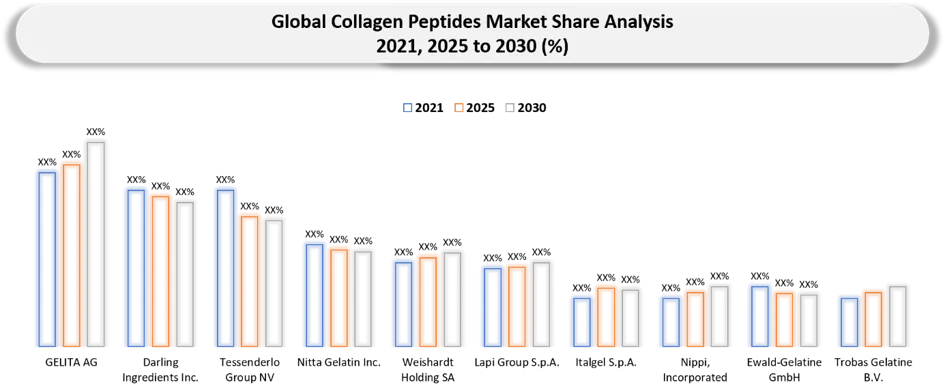
- The collagen peptides market is moderately consolidated at the upstream ingredient level, with GELITA, Darling Ingredients, Tessenderlo Group, Nitta Gelatin and Weishardt commanding strong positions through vertically integrated sourcing, large-scale hydrolysis capabilities, broad geographic distribution and clinically substantiated branded ingredients. Competitive differentiation is shifting beyond commodity collagen protein toward application-specific peptides targeting skin elasticity, joint mobility, bone strength, muscle recovery, healthy ageing and sports performance. Leading suppliers are strengthening defensibility through proprietary enzymatic hydrolysis, controlled molecular-weight profiles, clinical evidence, formulation support and certifications covering traceability, food safety, Halal, Kosher and sustainable sourcing.
- Competition is intensifying as European specialists, Asian marine-collagen producers and Indian manufacturers expand capacity and pursue export markets. Lapi Group, Italgel, Nippi, Amicogen, Thai Union Group, Titan Biotech and Hainan Huayan are widening the supplier base across bovine, porcine, fish and ovine sources. Marine collagen is creating a differentiated growth platform, particularly in beauty-from-within and premium nutraceutical applications. Strategic priorities include securing reliable raw materials, improving taste and solubility, developing low-dose bioactive formulations and supporting customers across powders, beverages, gummies and functional foods. Future leadership will depend on clinical substantiation, supply-chain transparency, scalable production and the ability to convert collagen peptides from a general protein ingredient into targeted health solutions.
Key Companies of Collagen Peptides Market
- GELITA AG (Germany)
- Darling Ingredients Inc. (United States)
- Tessenderlo Group NV (Belgium)
- Nitta Gelatin Inc. (Japan)
- Weishardt Holding SA (France)
- Lapi Group S.p.A. (Italy)
- Italgel S.p.A. (Italy)
- Nippi, Incorporated (Japan)
- Ewald-Gelatine GmbH (Germany)
- Trobas Gelatine B.V. (Netherlands)
- SARIA SE & Co. KG (Germany)
- Amicogen, Inc. (South Korea)
- Hainan Huayan Collagen Technology Co., Ltd. (China)
- Baotou Dongbao Bio-Tech Co., Ltd. (China)
- Titan Biotech Limited (India)
- India Gelatine & Chemicals Limited (India)
- Narmada Gelatines Limited (India)
- Holista Colltech Limited (Australia)
- Thai Union Group PCL (Thailand)
- Nestlé S.A. (Switzerland)
Collagen Peptides Market Recent Developments
- September 2026: Thai Union Group showcased its vertically integrated marine-longevity portfolio at Vitafoods Asia 2026. The portfolio included ThalaCol tuna collagen peptides, manufactured from upcycled tuna skin. The company emphasized end-to-end traceability across tuna sourcing, processing and finished-ingredient production. A cited clinical study found that 5 grams daily improved skin hydration by 68%, density by 26% and elasticity by 16%.
- September 2026: The Collagen Stewardship Alliance highlighted a 24-week randomized trial involving 80 adults with knee osteoarthritis. Participants receiving 10 grams of collagen peptides daily recorded a reduction in the CTX-II cartilage-degradation biomarker that was more than four times greater than placebo, strengthening evidence for joint-health positioning.
- September 2026: A systematic review covering 25 randomized controlled trials reported improvements in skin hydration in 10 of 15 trials, elasticity in 10 of 13 trials and wrinkle outcomes in 9 of 10 trials. However, the authors identified a need for larger and more standardized studies.
- August 2026: A randomized controlled trial reported that 15 grams of specific collagen peptides daily, combined with 12 weeks of high-load resistance training, increased intramuscular collagen type I by 29.8%, compared with 9.9% for placebo. The findings expand collagen’s positioning beyond skin and joints into muscle-connective-tissue remodeling.
- July 2026: The Collagen Stewardship Alliance highlighted collagen’s transition from a supplement-focused ingredient into functional foods and beverages, emphasizing opportunities across bars, coffee, gummies, dairy products and ready-to-drink formats.
What DATAM Uniquely Provides
- In-depth segmentation of the collagen peptides market by source, collagen type, molecular weight, form, functionality, application, end-use industry, distribution channel and region.
- Competitive analysis of leading collagen peptide companies covering production capacity, raw-material integration, source diversification, branded peptide portfolios, clinical substantiation, product purity, molecular-weight profile, certifications, geographic reach and commercialization strategy.
- Comprehensive assessment of demand across dietary supplements, functional foods, beverages, sports nutrition, beauty-from-within, clinical nutrition, pharmaceuticals, cosmetics and pet-nutrition applications, including dosage requirements, formulation challenges and buyer preferences.
- Actionable intelligence on collagen peptide pricing, cost per effective daily dose, raw-material sourcing, supply-chain traceability, contract manufacturing, regulatory requirements, health-claim support, Halal and Kosher certifications, distribution partnerships, licensing activity and investment opportunities.
- Analyst forecasts highlighting high-growth collagen sources, commercially attractive applications, regional expansion opportunities and emerging competitive threats across bovine, marine, porcine and ovine peptides, including low-dose bioactive formulations, beauty peptides, joint-health ingredients, sports-recovery products and functional beverage solutions.





























































