


Cognitive Nootropics Market Size and Overview
The global cognitive nootropics market reached US$4.72 billion in 2025 and is expected to reach US$12.87 billion by 2035, growing with a CAGR of 10.6% during the forecast period 2026-2035.
The global cognitive nootropics market is expanding as consumers increasingly seek products that support memory, focus, mental clarity, alertness, learning capacity and long-term brain health. Demand is being driven by rising academic and workplace pressure, digital multitasking, preventive wellness trends and growing concern over age-related cognitive decline. The market includes nootropic dietary supplements, functional beverages, functional foods and other ingestible cognitive-enhancement products across natural, synthetic and hybrid formulations.
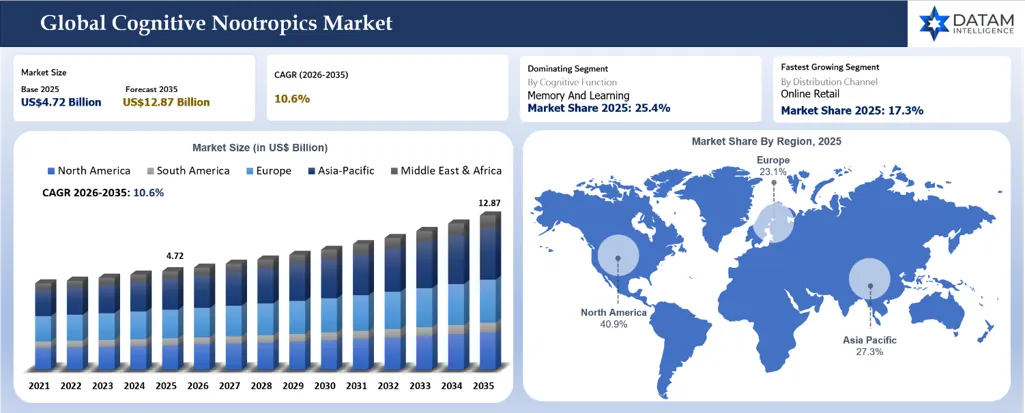
Capsules and tablets remain widely used, while gummies, powders, shots and ready-to-drink formats are gaining traction due to convenience and younger consumer adoption. Online retail is becoming increasingly important as consumers compare formulations, ingredients, reviews and scientific claims before purchase. Competitive differentiation is shifting toward clinically supported ingredients, transparent labeling, personalized formulations and premium positioning. However, limited clinical validation, regulatory restrictions and inconsistent product quality remain key challenges influencing consumer trust and long-term category development.
Cognitive Nootropics Market Key Takeaways
- Memory and learning remain the leading cognitive-function demand areas, supported by students, professionals and aging consumers seeking stronger recall, focus and long-term brain health.
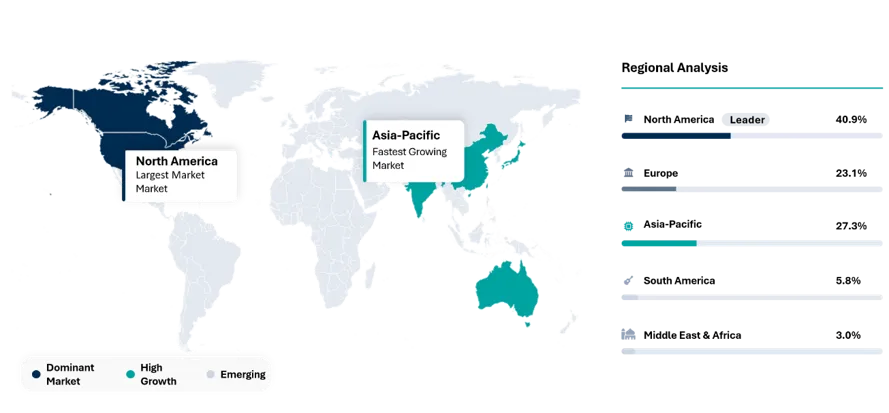
- North America remains the largest regional market, supported by high supplement usage, premium cognitive-wellness spending, strong direct-to-consumer brands and mature e-commerce channels.
- Asia-Pacific represents the fastest-growing region, driven by rising disposable incomes, preventive-health awareness, aging populations and expanding digital retail across China, Japan, India and South Korea.
- Online retail is becoming the most dynamic distribution channel, supported by subscription models, digital product discovery, personalized recommendations and growing adoption of direct-to-consumer nootropic brands.
- Clinically supported formulations, functional beverages and personalized nootropics are emerging as major growth opportunities, as consumers increasingly prioritize efficacy, convenience, transparency and targeted cognitive benefits.
Cognitive Nootropics Industry Trends and Strategic Insights
- Shift Toward Evidence-Backed Formulations: Brands are increasingly prioritizing clinically studied ingredients, transparent dosages and stronger scientific substantiation to build consumer trust.
- Rapid Growth Of Convenient Delivery Formats: Gummies, shots, powders and ready-to-drink nootropics are expanding adoption beyond traditional capsules and tablets.
- Rising Demand For Personalized Cognitive Wellness: Companies are developing targeted formulations for memory, focus, stress, productivity and healthy aging based on specific consumer needs.
- Expansion Of Digital-First Business Models: Direct-to-consumer platforms, subscriptions, online assessments and personalized recommendations are strengthening customer engagement and repeat purchases.
- Premiumization And Clean-Label Positioning: Consumers are increasingly favoring stimulant-free, botanical, functional mushroom and premium multi-ingredient formulations with clear sourcing and safety positioning.
Cognitive Nootropics Market Scope
| Metrics | Details | |
| 2025 Market Size | US$4.72 Billion | |
| 2035 Projected Market Size | US$12.87 Billion | |
| CAGR (2026-2035) | 10.6% | |
| Largest Market | North America | |
| Fastest Growing Market | Asia-Pacific | |
| By Source | Natural Nootropics, Synthetic Nootropics, Hybrid Nootropics, Others | |
| By Formulation Type | Single-Ingredient Formulations, Multi-Ingredient Formulations, Others | |
| By Form | Capsules and Tablets, Powders, Gummies and Chewables, Drops and Tinctures, Shots, Ready-to-Drink Beverages, Others | |
| By Cognitive Function | Memory and Learning, Attention and Focus, Mental Energy and Alertness, Mood and Stress Support, Healthy Cognitive Aging, Others | |
| By Consumer Age Group | Below 18 Years, 18-24 Years, 25-44 Years, 45-64 Years, 65 Years and Above | |
| By Price Positioning | Mass Market, Premium, Super-Premium, Others | |
| By Distribution Channel | Online Retail, Pharmacies and Drugstores, Health and Nutrition Specialty Stores, Supermarkets and Hypermarkets, Convenience Stores, Others | |
| By Region | North America | U.S., Canada, Mexico |
| Europe | Germany, UK, France, Spain, Italy, Poland | |
| Asia-Pacific | China, India, Japan, Australia, South Korea, Indonesia, Malaysia, Singapore, Vietnam, Thailand, Philippines, Taiwan | |
| South America | Brazil, Argentina | |
| Middle East and Africa | Israel, Saudi Arabia, UAE, Turkiye, South Africa, Nigeria | |
| Report Insights Covered | Competitive Landscape Analysis, Company Profile Analysis, Market Size, Share, Growth | |
Why does this report matter in 2026?
The cognitive nootropics market is entering a more mature and competitive phase in 2026, as demand moves beyond niche biohacking toward mainstream cognitive wellness, preventive brain health and performance-focused nutrition. Consumers are increasingly seeking products for memory, focus, mental energy, stress support and healthy cognitive aging, creating opportunities across supplements, gummies, powders, functional beverages and ready-to-drink formats. At the same time, competition is intensifying around clinically supported ingredients, formulation transparency, safety, convenience and premium positioning. Digital-first brands, personalized nootropic solutions and subscription models are also reshaping customer acquisition and retention strategies. Significant white-space opportunities remain in healthy aging, personalized cognitive support, stimulant-free formulations and functional beverages. In 2026, understanding consumer demand shifts, ingredient innovation, channel expansion, pricing, regulatory constraints and competitive positioning is essential for identifying high-growth segments, emerging brands and future market leaders. This report provides a structured view to support strategic planning and investment decisions.
Cognitive Nootropics Market White Space & Investment Opportunities
- Personalized cognitive formulations represent a major white-space opportunity as consumers increasingly seek targeted solutions for memory, focus, productivity, stress resilience and healthy cognitive aging. Personalized bundles, digital assessments and subscription-based models can improve differentiation and recurring revenue.
- Clinically validated nootropic ingredients offer strong investment potential as the market shifts toward evidence-backed products. Companies using standardized, branded and scientifically supported ingredients can strengthen consumer trust, justify premium pricing and differentiate from generic formulations.
- Functional beverages and ready-to-drink nootropics present significant growth opportunities by combining cognitive benefits with convenience. These formats are particularly attractive to younger consumers, professionals and fitness-oriented users seeking alternatives to conventional energy drinks.
- Healthy cognitive aging solutions remain underpenetrated despite growing demand from aging populations. Products focused on memory maintenance, mental clarity and long-term brain health can capture premium demand across developed and rapidly aging markets.
- Stimulant-free and clean-label formulations provide attractive white-space potential as consumers increasingly seek sustained cognitive support without high caffeine dependence. Botanical ingredients, adaptogens and functional mushrooms can support differentiated positioning.
- Asia-Pacific market expansion offers substantial investment potential through rising disposable incomes, digital commerce, preventive wellness awareness and growing demand for premium cognitive-health products.
Cognitive Nootropics Market Future Market Transformation
The cognitive nootropics market is expected to undergo significant transformation as consumer demand expands beyond traditional memory and focus supplements toward broader cognitive wellness, healthy aging, stress resilience, mental energy and personalized brain-health solutions. Future competition will increasingly focus on clinical substantiation, ingredient efficacy, formulation transparency, safety, bioavailability and convenience while strengthening brand credibility and consumer trust. Product development is expected to move beyond conventional capsules and tablets toward gummies, powders, shots, functional beverages and personalized multi-ingredient formulations.
Greater emphasis on stimulant-free products, branded ingredients, functional mushrooms, adaptogens and evidence-backed botanical compounds will further reshape innovation strategies. Digital assessments, subscription models and direct-to-consumer platforms are also likely to support more personalized product recommendations and recurring purchases. As the market matures, products offering measurable cognitive benefits, convenient delivery, cleaner formulations and stronger scientific validation are likely to gain competitive advantage and expand nootropics from a niche performance category into a broader cognitive wellness ecosystem.
Cognitive Nootropics Market Buyer Decision-Making Criteria
- Clinical Evidence and Demonstrated Cognitive Benefits
- Effectiveness for Memory, Focus and Mental Performance
- Ingredient Quality, Purity and Standardization
- Safety, Tolerability and Long-Term Usage Profile
- Transparent Dosage and Labeling
- Bioavailability and Formulation Quality
- Natural, Synthetic or Hybrid Ingredient Preference
- Delivery Format and Consumption Convenience
- Taste, Texture and Overall Consumer Experience
- Brand Reputation and Product Credibility
- Price, Value for Money and Subscription Economics
- Availability Across Online and Offline Channels
- Personalization and Targeted Cognitive Benefits
- Clean-Label, Stimulant-Free and Allergen-Free Positioning
Cognitive Nootropics Market Economic & Investment Analysis
The cognitive nootropics market offers attractive investment potential as demand expands beyond traditional memory supplements toward broader cognitive wellness, mental performance, stress support and healthy aging. Established brands benefit from growing consumer awareness, strong direct-to-consumer channels and increasing acceptance of premium cognitive-health products, while the market is gradually shifting toward more differentiated and evidence-backed formulations. Investment attractiveness is increasingly linked to clinical substantiation, ingredient quality, brand credibility, pricing power, repeat-purchase behavior and the ability to scale across multiple product formats.
From an investment perspective, opportunities are expanding across personalized nootropics, functional beverages, gummies, stimulant-free formulations, branded cognitive ingredients and healthy-aging solutions. Digital-first brands with subscription models can offer attractive recurring-revenue characteristics, while ingredient suppliers with clinically supported compounds may benefit from broader adoption across multiple finished-product companies. Future investment decisions will increasingly depend on regulatory compliance, customer-acquisition economics, retention rates, gross margins, distribution scalability, geographic expansion and product pipeline depth. Companies capable of combining scientific credibility, premium positioning and efficient digital distribution are likely to command stronger long-term strategic valuations.
Cognitive Nootropics Market Trends
- Growing shift toward evidence-based nootropic formulations as companies increasingly prioritize clinically studied ingredients, transparent dosages, standardized extracts and stronger scientific substantiation to improve product credibility.
- Rising adoption of personalized cognitive wellness Solutions as brands develop targeted formulations for memory, focus, mental energy, stress resilience and healthy cognitive aging based on specific consumer needs.
- Increasing focus on convenient delivery formats including gummies, shots, powders and ready-to-drink cognitive beverages designed to expand adoption beyond conventional capsules and tablets.
- Greater emphasis on stimulant-free and clean-label products as consumers increasingly seek botanical ingredients, functional mushrooms, adaptogens and sustained cognitive support without high caffeine dependence.
- Expansion of digital-first and subscription business models as nootropic brands leverage direct-to-consumer platforms, recurring purchases, personalized recommendations and online education to strengthen consumer engagement and retention.
Strategic Indicators for the Cognitive Nootropics Market
High Regulation Impact
The cognitive nootropics market is significantly influenced by regulatory requirements governing dietary supplements, functional foods, functional beverages, ingredient safety and cognitive-performance claims. Companies must ensure that product labeling, ingredient composition, dosage levels and marketing claims comply with country-specific regulations. Authorities increasingly scrutinize claims related to memory, focus, mental performance, stress support and healthy cognitive aging to ensure they are adequately substantiated and do not imply unauthorized disease treatment or prevention.
Regulatory complexity is particularly important for botanical extracts, novel ingredients, stimulant-containing formulations and products marketed across multiple jurisdictions. Differences in permitted ingredients, health claims, maximum dosage levels and labeling standards can increase compliance costs and delay geographic expansion. As the market moves toward clinically supported and premium formulations, stronger evidence requirements are likely to become an important competitive factor. Companies with transparent labeling, standardized ingredients, robust safety documentation and credible scientific substantiation will be better positioned to manage regulatory risk and strengthen consumer trust.
High Investment Activity
Investment activity in the cognitive nootropics market is increasing as nutraceutical companies, functional beverage manufacturers, digital wellness brands and ingredient developers expand into brain health, mental performance and healthy aging. Capital is increasingly directed toward clinically validated ingredients, personalized nootropic formulations, functional beverages, gummies, stimulant-free products, botanical extracts and functional mushroom-based solutions.
Strategic partnerships, ingredient licensing, formulation collaborations and brand acquisitions are becoming more important as companies seek differentiated intellectual property, scientific validation and stronger distribution capabilities. Investment priorities are shifting toward businesses with high repeat-purchase rates, direct-to-consumer models, subscription revenues, premium pricing and scalable digital customer acquisition. Companies combining evidence-backed formulations with strong branding, transparent ingredient positioning and omnichannel distribution are likely to attract greater strategic and financial interest. Healthy cognitive aging, personalized wellness, convenient delivery formats and clinically supported cognitive ingredients represent particularly attractive long-term investment opportunities.
Supply Chain Disruption
The cognitive nootropics market faces moderate supply chain vulnerability because manufacturers depend on a wide range of botanical extracts, amino acids, vitamins, minerals, functional mushrooms, specialty cognitive ingredients and contract manufacturing capabilities. Key dependencies include standardized herbal raw materials, branded nootropic compounds, encapsulation and tableting capacity, flavor systems, packaging materials and certified ingredient suppliers. Disruptions in agricultural output, extraction capacity, import availability, logistics or quality testing can affect formulation consistency, production lead times and product availability. Supply risk is particularly relevant for premium botanical ingredients and specialized compounds with limited qualified suppliers or geographically concentrated sourcing. Rapid demand growth for functional beverages, gummies and multi-ingredient formulations can further increase procurement complexity. Companies with diversified sourcing, long-term supplier relationships, strong quality-control systems, regional manufacturing partnerships and sufficient inventory buffers will be better positioned to manage shortages, maintain product consistency and protect margins.
Pricing Volatility
The cognitive nootropics market is characterized by moderate pricing volatility due to differences in ingredient quality, formulation complexity, clinical substantiation, brand positioning and distribution strategy. Pricing varies significantly between mass-market supplements and premium nootropic products containing branded ingredients, standardized botanical extracts, functional mushrooms or specialized cognitive compounds. Input-cost fluctuations for botanical raw materials, imported ingredients, flavor systems, packaging and contract manufacturing can affect retail pricing and gross margins. Premium pricing is increasingly dependent on transparent dosages, scientific evidence, clean-label positioning, convenience and perceived cognitive benefits. Direct-to-consumer brands may maintain higher price points through subscriptions, personalized bundles and strong digital positioning, while retail competition can increase discounting pressure. As the category becomes more crowded, companies will need to balance affordability with formulation quality and differentiation. Competitive advantage will increasingly depend on sustaining strong perceived value, controlling ingredient costs and protecting margins without weakening product credibility or consumer trust.
Procurement Pressure
The cognitive nootropics market faces moderate procurement pressure because manufacturers depend on reliable access to standardized botanical extracts, specialty cognitive ingredients, amino acids, vitamins, functional mushrooms and contract manufacturing capacity. Procurement decisions are increasingly influenced by ingredient purity, clinical evidence, supplier certifications, dosage consistency, lead times, minimum-order requirements and cost stability. Companies using branded or patented ingredients may face higher procurement costs but can benefit from stronger differentiation and scientific positioning. Limited supplier availability for certain premium extracts or specialized compounds can increase dependence on a small number of qualified vendors and reduce negotiating flexibility. Rapid growth in gummies, functional beverages and multi-ingredient formulations can also increase pressure on flavor systems, packaging and manufacturing capacity. Companies with diversified supplier networks, long-term sourcing agreements, dual-sourcing strategies and strong quality assurance systems will be better positioned to manage procurement risk, maintain consistent product quality and protect margins.
Regional Expansion Opportunity
The cognitive nootropics market offers meaningful regional expansion opportunities as consumer awareness of brain health rises, digital retail penetration increases and demand expands beyond traditional supplements into functional beverages, gummies, powders and personalized formulations. North America remains the most commercially mature region, supported by high supplement consumption, strong direct-to-consumer brands, premium pricing and established e-commerce channels. Europe offers additional growth potential through demand for evidence-backed, clean-label and botanical cognitive products, although regulatory claim requirements remain relatively strict. Asia-Pacific, particularly China, Japan, India and South Korea, represents a strong long-term expansion opportunity driven by rising disposable incomes, aging populations, preventive wellness trends and rapid digital commerce adoption. Future regional growth will depend on regulatory compliance, ingredient acceptance, pricing, local consumer preferences, distribution partnerships and brand localization. Companies offering clinically supported, convenient and culturally relevant cognitive wellness products are likely to gain stronger positions across emerging and developed markets.
Government Policy Support
The cognitive nootropics market receives moderate policy support through broader government initiatives related to preventive healthcare, healthy aging, nutrition, mental wellness and consumer access to dietary supplements and functional foods. Public-health programs promoting healthy lifestyles and active aging indirectly support demand for products positioned around memory, focus and long-term cognitive health. At the same time, regulatory authorities are strengthening oversight of ingredient safety, labeling, health claims and product quality to protect consumers and improve market credibility.
Government frameworks supporting nutraceutical innovation, food-safety modernization and domestic supplement manufacturing can improve product development and supply-chain resilience. However, policy support remains balanced by restrictions on unsubstantiated cognitive or disease-related claims, particularly where products risk being positioned as therapeutic alternatives. Future market development will therefore depend on clearer regulatory pathways, ingredient approvals, evidence-based claims, manufacturing standards and stronger consumer-protection frameworks. Companies that align product innovation with scientifically substantiated.
AI Impact Analysis of Cognitive Nootropics Market
Artificial intelligence is expected to increasingly influence the cognitive nootropics market across ingredient discovery, formulation development, personalization, consumer targeting and demand forecasting. AI-enabled platforms can analyze scientific literature, ingredient interactions, bioavailability data and consumer-response patterns to identify promising cognitive compounds and optimize combinations targeting memory, focus, mental energy, stress support and healthy aging. These capabilities can shorten formulation-development timelines and help brands differentiate products through more targeted and evidence-driven positioning.
AI is also becoming increasingly relevant in personalized cognitive wellness, where digital assessments, behavioral data and consumer preferences can be used to recommend individualized nootropic formulations or product bundles. Within commercial operations, AI-driven analytics can improve customer segmentation, subscription retention, pricing optimization, inventory planning and digital marketing efficiency. Over time, deeper AI integration could support faster innovation, more precise product positioning, improved consumer engagement and stronger recurring-revenue models, particularly for digital-first and personalized nootropic brands.
Disruption Analysis of Cognitive Nootropics Market
The cognitive nootropics market is undergoing significant disruption as competition shifts from generic memory and focus supplements toward personalized cognitive wellness, clinically validated formulations and convenient functional formats. Competitive differentiation is increasingly centered on scientific substantiation, ingredient transparency, bioavailability, safety, targeted cognitive benefits and consumer experience rather than formulation novelty alone.
The product landscape is also being reshaped by functional beverages, gummies, shots, stimulant-free formulations, functional mushrooms, adaptogens and personalized multi-ingredient blends. Digital-first brands are disrupting traditional supplement distribution through direct-to-consumer models, subscriptions, online assessments and data-driven recommendations. At the same time, branded ingredients and evidence-backed compounds are raising expectations for product credibility and measurable outcomes.
AI-enabled personalization, precision nutrition and digital cognitive assessments may further transform the market by linking consumer needs with tailored formulations. Competitive advantage will increasingly favor companies capable of combining strong clinical positioning, differentiated delivery formats, scalable digital distribution and recurring-revenue business models across memory, focus, mental energy, stress support and healthy cognitive aging.
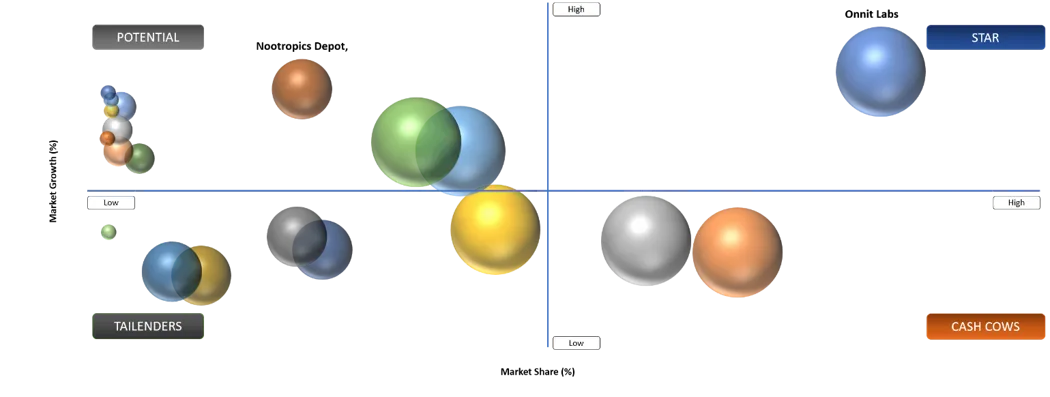
Cognitive Nootropics Market BCG Matrix: Company Evaluation
STAR
Onnit Labs, Neurohacker Collective, Thesis and Performance Lab Group are positioned as Star companies in the cognitive nootropics market due to their strong brand recognition, specialized cognitive-performance portfolios and established direct-to-consumer presence. Onnit maintains a prominent position through Alpha BRAIN, while Neurohacker Collective has developed a premium portfolio centered on Qualia Mind. Thesis differentiates through personalized nootropic formulations, whereas Performance Lab Group has strengthened its position through Mind Lab Pro and related cognitive wellness products. Their leadership is supported by premium positioning, multi-ingredient formulations, digital-first distribution, subscription models and continued product innovation across focus, memory, mental energy and long-term cognitive health.
POTENTIAL
Nootropics Depot, BrainMD Health, NOW Health Group, Jarrow Formulas, Life Extension and Gaia Herbs are positioned as Potential companies due to their expanding cognitive-health portfolios, established supplement distribution networks and opportunities to capture growing demand for evidence-backed brain-health products. Nootropics Depot is differentiated by its broad range of specialized nootropic ingredients and formulations, while BrainMD Health focuses strongly on brain-health positioning. NOW Health Group, Jarrow Formulas and Life Extension benefit from extensive nutritional supplement portfolios and wide retail reach, whereas Gaia Herbs offers opportunities through botanical and plant-based cognitive formulations. Their future positioning will depend on product differentiation, clinical substantiation, premiumization, digital-channel expansion and successful development of targeted cognitive-performance formulations.
Cognitive Nootropics Market Dynamics
Driver Impact Analysis
| Driver | Market Growth Impact (%) | Demand Concentration | Impacted Use Case | Strategic Impact |
Rising Demand For Memory, Focus And Mental Performance | 8.6% | High in North America, Europe and urban Asia-Pacific | Memory, learning, attention and productivity | Expands the core consumer base across professionals, students and knowledge workers |
Growing Preventive Brain Health And Healthy Aging Awareness | 7.9% | Strong across U.S., Germany, Japan and developed Asian markets | Memory maintenance and healthy cognitive aging | Supports recurring consumption and premium long-term brain-health formulations |
Expansion Of Functional Beverages And Convenient Nootropic Formats | 7.2% | Concentrated among younger consumers and metropolitan markets | Mental energy, alertness and on-the-go focus | Broadens adoption beyond conventional capsules into beverages, shots and gummies |
Driver: Rising Demand For Memory, Focus And Mental Performance
Rising Demand For Memory, Focus And Mental Performance: Growing academic pressure, demanding work environments, digital multitasking and longer screen exposure are increasing consumer interest in products that support memory, concentration, alertness and sustained mental performance. Students, professionals, gamers and knowledge-intensive workers are increasingly adopting cognitive nootropics to improve productivity and maintain mental endurance during prolonged tasks. Demand is also supported by greater awareness of cognitive wellness and preventive brain health. As a result, manufacturers are developing targeted formulations using ingredients associated with memory, attention and mental energy, while expanding into convenient formats such as capsules, powders, gummies and functional beverages to address diverse consumer preferences.
Restraint Impact Analysis
| Restraint | Drag on Market Growth (%) | Primary Impact Area | Impacted Use Case | Strategic Impact |
Limited Clinical Validation And Inconsistent Product Efficacy | 5.6% | Consumer Trust And Product Adoption | Memory, focus, mental clarity and long-term cognitive support | Can reduce repeat purchases, increase skepticism and favor brands with stronger clinical substantiation |
Regulatory Restrictions On Cognitive And Health Claims | 4.9% | Product Marketing And Market Access | Cognitive enhancement, healthy aging and stress-support formulations | Limits promotional flexibility, increases compliance costs and encourages more conservative product positioning |
Ingredient Quality, Purity And Dosage Variability | 4.5% | Product Quality And Brand Credibility | Multi-ingredient supplements, botanical nootropics and functional beverages | Can create inconsistent consumer outcomes and strengthen demand for standardized, traceable ingredients |
Restraint: Limited Clinical Validation And Inconsistent Product Efficacy
Limited Clinical Validation And Inconsistent Product Efficacy: Many cognitive nootropic products are marketed with claims related to memory, focus, mental clarity and brain performance, but the level of clinical evidence varies significantly across formulations and ingredients. Some products rely on small studies, ingredient-level research or consumer perception rather than robust product-specific trials. This creates uncertainty around effectiveness, particularly when formulations differ in dosage, ingredient quality and bioavailability. Inconsistent consumer outcomes can reduce trust, weaken repeat purchases and increase skepticism toward the broader category. As competition intensifies, companies with clinically supported formulations, transparent ingredient dosages and stronger scientific substantiation are likely to gain greater credibility and long-term market advantage.
Cognitive Nootropics Market Segment Analysis
The global cognitive nootropics market is segmented based on the product type, source , formulation type, form, cognitive function, consumer age group, distribution channel and region.
By Cognitive Function
Memory And Learning Remains The Leading Cognitive Function
Memory and learning represent a major cognitive function within the global cognitive nootropics market, driven by demand from students, working professionals, older adults and consumers seeking long-term brain health support. Products in this category are commonly positioned to improve memory retention, recall, learning efficiency, concentration and overall cognitive performance. Demand is being supported by rising academic and workplace pressure, increasing awareness of preventive cognitive wellness and growing concern around age-related memory decline. Multi-ingredient formulations containing citicoline, phosphatidylserine, Bacopa monnieri, lion’s mane, choline compounds and other cognitive-support ingredients are increasingly used in memory-focused products. Premium brands are also strengthening differentiation through clinically supported formulations, transparent labeling and targeted cognitive claims. Growth is expected to remain steady as consumers increasingly adopt nootropics for both short-term mental performance and sustained cognitive maintenance, creating opportunities for specialized formulations across supplements, gummies, powders and functional beverages.
By Distribution Channel
Online Retail Is Reshaping Nootropics Distribution
Online retail is becoming a highly important distribution channel in the global cognitive nootropics market due to strong direct-to-consumer adoption, subscription models, broad product availability and growing digital product discovery. Nootropic consumers frequently research ingredients, compare formulations, review clinical evidence and evaluate user feedback before purchasing, making e-commerce particularly well suited to the category. Brand-owned websites, specialist supplement platforms and major online marketplaces allow companies to introduce premium formulations, bundles and personalized recommendations while maintaining direct relationships with consumers. Online channels also support faster product launches, recurring-order programs, targeted digital marketing and access to niche formulations that may receive limited shelf space in traditional pharmacies or supermarkets. Younger consumers, professionals and biohacking communities are particularly active online, supporting demand for capsules, powders, gummies and functional beverages. Continued growth in digital commerce, cross-border purchasing and convenience-driven shopping is expected to strengthen the role of online retail through the forecast period.
Cognitive Nootropics Market Geographical Penetration
U.S. Cognitive Nootropics Market Landscape
The United States represents one of the most commercially developed markets for cognitive nootropics, supported by high supplement awareness, strong direct-to-consumer brands, widespread e-commerce adoption and growing demand for focus, memory, mental energy and healthy aging products. Demand spans working professionals, students, gamers, fitness consumers and older adults, with premium multi-ingredient formulations, gummies, powders and functional beverages gaining visibility alongside traditional capsules and tablets. The aging population provides an important structural demand base: the U.S. Census Bureau reported 61.2 Billion people aged 65 and above in 2024, representing 18.0% of the population. Product differentiation is increasingly centered on clinically studied ingredients, transparent labeling, stimulant-free formulations and personalized cognitive support. Regulatory compliance remains critical because FDA distinguishes structure/function claims from disease-treatment claims and requires substantiation and appropriate disclaimers for qualifying supplement claims.
Germany Cognitive Nootropics Market Outlook
Germany represents an important European market for cognitive nootropics, supported by a mature dietary supplement sector, strong consumer interest in preventive health and a sizable aging population. Demand is concentrated around memory, concentration, mental performance, stress support and healthy cognitive aging, with consumers placing significant emphasis on ingredient quality, scientific credibility, safety and transparent labeling. Germany’s demographic profile reinforces long-term brain-health demand: Destatis reported that people aged 60 and above accounted for 31% of the population in 2025, while people aged 65 and above represented 23.2% in 2024. Pharmacies, drugstores, specialist health retailers and online platforms remain important channels, while premium botanical, vitamin-based and multi-ingredient formulations offer differentiation opportunities. Regulatory positioning is relatively strict: Germany’s Federal Office of Consumer Protection and Food Safety states that food supplements cannot be marketed as medicines or promoted using disease prevention, treatment or cure claims.
China Cognitive Nootropics Market Outlook
China is an increasingly attractive cognitive nootropics market, supported by a large consumer base, rapid urbanization, rising health awareness and growing interest in preventive nutrition and healthy aging. Demand is developing across younger consumers seeking concentration, mental energy and productivity support, as well as older consumers purchasing memory and brain-health products. Demographics create a substantial long-term opportunity: China’s National Bureau of Statistics reported 323.38 Billion people aged 60 and above in 2025, equal to 23.0% of the population, while 223.65 Billion were aged 65 and above. E-commerce and social-commerce channels are important for product discovery, particularly for functional beverages, gummies, botanical formulations and premium supplements. The regulatory environment also favors stronger evidence and disciplined claims. In 2025, Chinese authorities emphasized scientific evaluation of health-food ingredient claims and reinforced that ordinary foods cannot claim disease prevention or treatment benefits.
Cognitive Nootropics Market Competitive Landscape
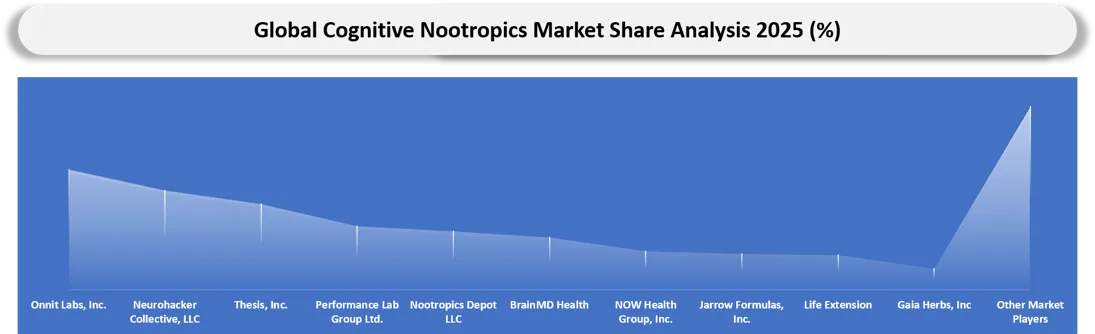
- Competition is led by Onnit Labs, Neurohacker Collective, Thesis and Performance Lab Group, supported by strong cognitive-performance brands, specialized product portfolios and established direct-to-consumer distribution.
- Competitive differentiation is increasingly driven by ingredient efficacy, clinical substantiation, formulation quality, bioavailability, safety, clean-label positioning, convenience and consumer trust rather than product novelty alone.
- Product competition is expanding across capsules, powders, gummies, functional beverages and ready-to-drink formats, with companies increasingly developing multi-ingredient formulations targeting specific cognitive outcomes.
- Memory, attention, focus, mental energy, stress resilience and healthy cognitive aging are becoming major competitive areas as brands target students, professionals, gamers and aging consumers.
- Innovation is increasingly focused on personalized nootropic formulations, botanical ingredients, functional mushrooms, adaptogens, clinically studied compounds and synergistic ingredient combinations for differentiated cognitive benefits.
- Future market leadership will depend on delivering clinically credible, differentiated and convenient cognitive nootropics while expanding digital distribution, subscription models, premium positioning and consumer education.
Key Companies of Cognitive Nootropics Market
- Onnit Labs, Inc. (United States)
- Thesis (United States)
- Neurohacker Collective (United States)
- Performance Lab Group Ltd. (United Kingdom)
- truBrain, Inc. (United States)
- NS 360 Inc. - Natural Stacks (United States)
- Nootropics Depot (United States)
- BrainMD Health (United States)
- 10000 Inc. - Magic Mind (United States)
- Roar Ambition Ltd. (United Kingdom)
- Neuro Gum, LLC (United States)
- Double Wood LLC (United States)
- Live Wellness Limited - NooCube (United Kingdom)
- Avantera Health, LLC (United States)
- Gorilla Mind LLC (United States)
- Jarrow Formulas, Inc. (United States)
- NOW Health Group, Inc. (United States)
- Life Extension (United States)
- Gaia Herbs, Inc. (United States)
- Elysium Health, Inc. (United States)
Cognitive Nootropics Market Major Pain Points
- Limited Clinical Validation and Inconsistent Efficacy: Many nootropic products lack robust, large-scale clinical evidence, creating uncertainty around cognitive benefits and weakening consumer and healthcare professional confidence.
- Regulatory and Claims Compliance Challenges: Varying regulations for dietary supplements, functional foods and beverages restrict cognitive-performance claims and increase compliance complexity across international markets.
- Ingredient Quality and Safety Concerns: Variability in ingredient purity, dosage, sourcing and formulation quality can affect product consistency, while stimulant-related side effects and potential ingredient interactions may limit adoption.
Cognitive Nootropics Market Recent Developments
- July 2026: Kirin Holdings and Blackmores launched Blackmores Cognition Ultra in Australia and Ultra Brain Care in New Zealand, featuring Cognizin® Citicoline for memory, attention, focus and cognitive performance.
- January 2026: Cognitive Brands reformulated its Fuel & Elevate functional beverage portfolio around nootropics, adaptogens and energy-support ingredients and signed a distribution agreement with Luminary Beverages to expand market reach.
- September 2025: Reckitt launched Neuriva Memory 3D, formulated with Cognicell and Neurofactor to support short-term, long-term and working memory, expanding its brain-health supplement portfolio.
- April 2025: Nootropics Depot launched Ecklonia cava, a marine-derived supplement developed over six years to support brain health, stress management, sleep and broader cognitive wellness.
- October 2024: Doctor’s Best launched Citicoline CDP-Choline with Cognizin®, a nootropic supplement positioned to support focus, attention, memory and overall cognitive health.
Analyst View / Opinion on Cognitive Nootropics Market
- The cognitive nootropics market is shifting from niche biohacking products toward mainstream cognitive wellness, driven by rising demand for focus, memory, mental energy, stress support and healthy brain aging.
- Significant opportunities remain across personalized nootropic formulations, functional beverages, gummies, mushroom-based products, adaptogenic blends and clinically validated cognitive ingredients targeting professionals, students and aging consumers.
- Future competition is likely to center on clinical substantiation, ingredient efficacy, safety, transparency, bioavailability, convenience and brand credibility rather than formulation novelty alone.
- Companies capable of combining evidence-backed ingredients, differentiated delivery formats, personalized recommendations, premium positioning and strong digital distribution are likely to strengthen long-term market share and consumer loyalty.
Cognitive Nootropics Market Target Audience
| INDUSTRY | WHO SHOULD BUY THIS REPORT? | REASON TO BUY THIS REPORT |
| Nutraceutical And Dietary Supplement Companies | Nootropic Supplement Manufacturers And Brain Health Brands | To benchmark product portfolios, cognitive claims, pricing, market positioning and expansion opportunities across memory, focus and brain health. |
| Functional Food And Beverage Companies | Functional Beverage, Energy Drink And Cognitive Nutrition Manufacturers | To identify opportunities in nootropic beverages, functional foods, emerging formats, consumer preferences and premium cognitive-wellness products. |
| Ingredient And Formulation Companies | Nootropic Ingredient Suppliers, Botanical Extract Companies And Formulation Developers | To evaluate high-growth ingredients, formulation trends, competitive differentiation, demand patterns and partnership opportunities with finished-product manufacturers. |
| Retail And E-Commerce Companies | Pharmacies, Health Stores, Online Retailers And Specialty Nutrition Platforms | To assess category growth, consumer demand, product assortment, pricing trends, channel performance and fast-growing nootropic brands. |
| Investment And Private Equity Firms | Investors, Venture Capital Firms And Strategic Acquirers | To identify high-growth companies, emerging brands, investment opportunities, market consolidation potential and attractive cognitive-health segments. |
Why Choose DATAM?
- Product-Level Competitive Intelligence: Gain detailed intelligence on leading cognitive nootropics, formulations, ingredients, product positioning, pricing, claims, delivery formats and competitive differentiation.
- Consumer Need and Opportunity Analysis: Assess opportunities across memory, focus, attention, mental energy, stress support, cognitive performance and healthy brain aging.
- Innovation and Market Tracking: Monitor new product launches, emerging ingredients, formulation trends, functional beverages, gummies, personalized nootropics, clinical evidence and evolving consumer preferences.
What DATAM Uniquely Provides
- Deep Cognitive Nootropics Market Segmentation: Detailed analysis across product type, source, formulation type, form, cognitive function, consumer age group, price positioning, distribution channel and geography.
- Product and Competitive Benchmarking: Comparative assessment of leading cognitive nootropic products based on formulation, ingredient profile, cognitive claims, delivery format, pricing, brand positioning and commercial presence.
- Cognitive Need and White-Space Mapping: Identification of high-value opportunities across memory, attention, focus, mental energy, stress support, healthy cognitive aging and emerging personalized cognitive-wellness solutions.
- Pricing, Consumer and Channel Intelligence: Assessment of pricing tiers, consumer preferences, e-commerce penetration, pharmacy and specialty retail performance, premiumization and evolving purchase behavior.


























































