China PFAS CRM Market Size and Overview
The China Per- and Polyfluoroalkyl Substances Certified Reference Materials (PFAS CRM) market is estimated at USD 14.2 million in 2025 and is projected to reach USD 34.9 million by 2035, growing at an assumed CAGR of 9.1% during 2026-2035. The growth of the China PFAS certified reference materials market is attributed to stringent discharge regulations of PFAS in chemical industrial parks, increased testing for PFAS in drinking water and industrial wastewater, higher identification of novel PFAS compounds, and the rising demand for compound-specific reference materials that can be tracked.
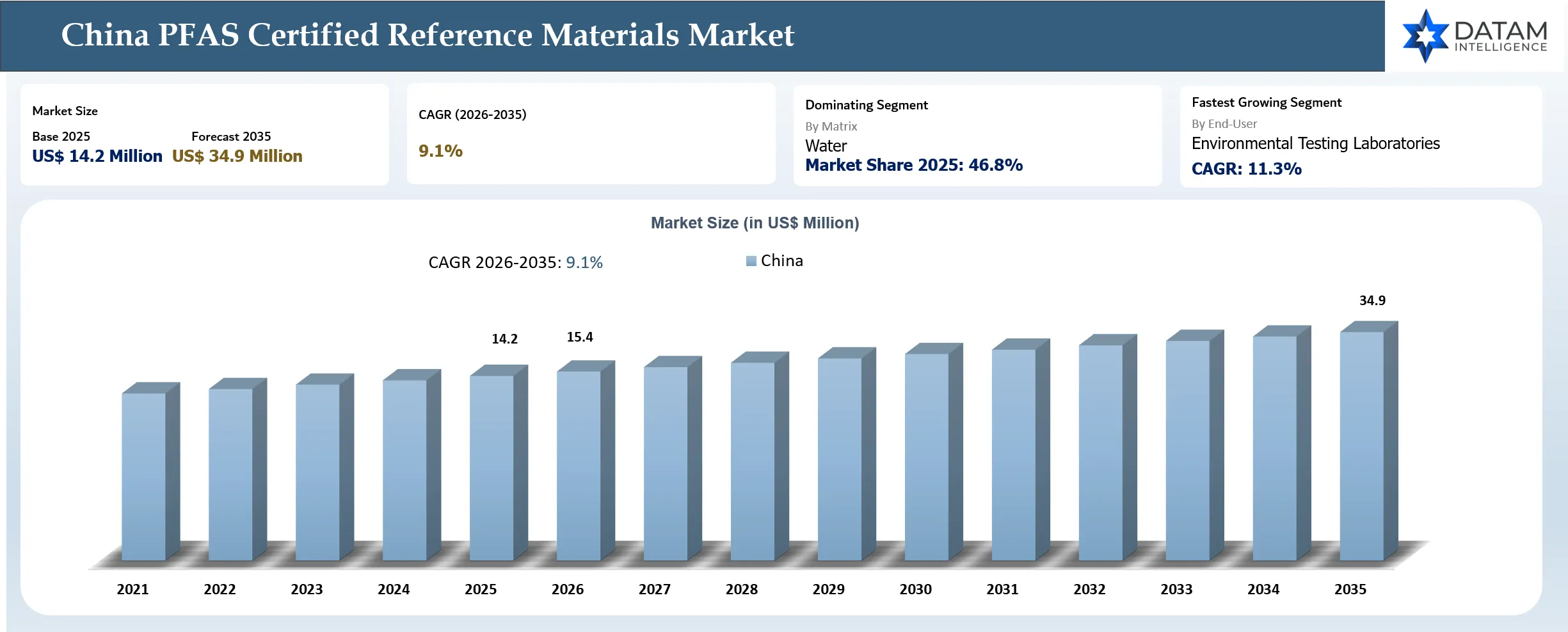
The adoption of more stringent PFAS discharge regulations in China has increased the demand for reliable analytical testing of industrial wastewater. In July 2025, Sichuan Province enacted DB51/3202-2024 standards, setting the PFOS and PFOA discharge limits in chemical industrial parks, and requiring that PFOS cannot be detected. Such standards create the need for PFAS certified reference material (CRMs) for analytical calibration, validation of methods, and wastewater testing, especially when it comes to proving non-detectability of PFOS and quantification of PFOA in designated amounts.
China PFAS CRM Market Key Takeaways
- Water testing dominated the China PFAS Certified Reference Materials (CRM) market in 2025, accounting for 46.8% market share. Demand is supported by PFAS surveillance in drinking water, surface water, and groundwater, where laboratories require certified standards for calibration, method validation, and analytical quality control. The focus on water testing is reinforced by China’s expanding research into PFAS contamination and its potential health risks.
- Environmental Testing Laboratories are projected to be the fastest-growing end-user segment in China’s PFAS CRM market, with a CAGR of 11.3%. Growth is supported by increased investigation of PFAS in water, soil, sediment, and other environmental matrices, alongside the need for reliable analytical results for contamination assessment and environmental risk management.
- Growing environmental monitoring activities and analysis of research data in China increase the need for PFAS testing capabilities. For instatance, in May 2026, Shimadzu China collaborated with the State Key Laboratory of Environmental Criteria and Risk Assessment from the Chinese Research Academy of Environmental Sciences to develop PFAS analysis techniques for water, soil, and other samples. This is an attempt to meet the need for proper reference materials for testing purposes.
China PFAS CRM Market Scope
| Metrics | Details |
| 2025 Market Size | USD 14.2 Million |
| 2035 Projected Market Size | USD 34.9 Million |
| CAGR (2026-2035) | 9.1% |
| By Product Type | Native PFAS CRMs, Stable Isotope-Labeled (SIL) PFAS CRMs, Others |
| By PFAS Chemical Class | Perfluoroalkyl Carboxylic Acids (PFCAs), Perfluoroalkane Sulfonic Acids (PFSAs), Fluorotelomer Compounds (FTs), FOSAs & FOSEs, Others |
| By Matrix | Water, Soil & Sediment, Biological Samples, Food & Feed, Consumer Products & Packaging, Aqueous Film-Forming Foam (AFFF), Others |
| By Regulatory Method | EPA Methods, ASTM Methods, ISO Methods, DIN Methods, AOAC Methods, Others |
| By Analytical Technique | LC-MS/MS, LC-HRMS, GC-MS, Other Analytical Techniques |
| By End User | Environmental Testing Laboratories, Government & Regulatory Laboratories, Food & Consumer Product Testing Laboratories, Pharmaceutical & Biotechnology Laboratories, Industrial Manufacturing Laboratories, Academic & Research Institutes, Contract Research Organizations (CROs) |
| Report Insights Covered | Competitive Landscape Analysis, Company Profile Analysis, Market Size, Share, Growth |
China PFAS CRM Market Disruption Analysis
Shift Toward PFAS-Free Materials and Verification Testing Reshaping CRM Requirements
The China PFAS market faces an ongoing transition towards PFAS-free material formulations, which requires changes in testing laboratory needs for validation of absence of targeted PFAS, method verification, and confirmation of the true PFAS-free status of tested formulations. The latter is often difficult to establish since the formulation can contain traces of PFAS or other fluorinated compounds. The transition adds relevance to low-level calibration standards, multi-analyte reference mixtures, and reference materials allowing to reliably confirm limits of detection and performance of analytical methods used by PFAS certified reference material (CRM) suppliers.
In April 2026, Clariant showcased PFAS-free AddWorks PPA 101 FG and PPA 122 G polymer processing aids at Chinaplas 2026 in Shanghai and while SGS awarded Transfar Functional Chemicals the first “No PFAS Detected” Green Mark certificate for its TRANSWR TF-501M water-repellent agent. The two events prove the rising role of verification of analytical results in the transition towards PFAS-free formulations. Testing laboratories need suitable PFAS reference materials to confirm the validity of the analytical results at low concentration levels.
China PFAS CRM Market BCG Matrix: Company Evaluation
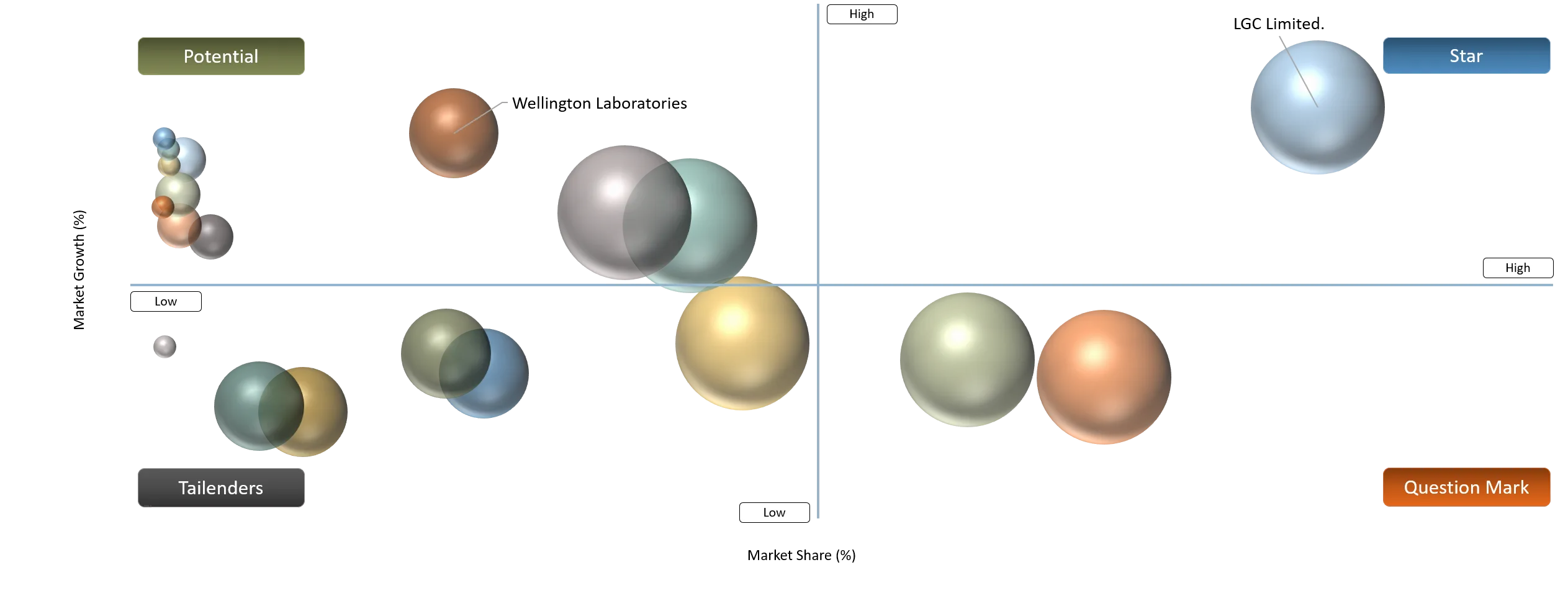
In the China PFAS CRM market, LGC Standards and AccuStandard are suitable candidates for the Stars category, supported by their broad PFAS analytical reference-standard portfolios and international distribution networks serving Chinese laboratories. Wellington Laboratories and Cambridge Isotope Laboratories can be classified as Potential Stars, owing to their specialised PFAS reference materials, certified mixtures, and isotope-labelled standards for environmental analysis.
CATO Research Chemicals Inc. and Beijing MANHAGE Bio-Tech Co., Ltd. (BePure) is positioned in the Question Marks category, reflecting their relevant reference-material portfolios and potential to serve China's PFAS testing requirements. Restek Corporation can be placed among the Tailenders for this qualitative assessment, given its broader focus on chromatography products, analytical consumables, and reference standards. These classifications are indicative, as verified China-specific market shares and growth rates are unavailable.
China PFAS CRM Market Segment Analysis
The China PFAS CRM market is segmented based on product type, PFAS chemical class, matrix, regulatory method, analytical technique, end-user industry, and region.
Expansion of PFAS Testing Across Drinking Water and Wastewater Systems
Water testing contributes to a significant portion of the China PFAS market owing to growing needs to test drinking water quality and detect PFAS contamination. Growing activities of water testing drive demand for certified reference materials for PFAS used for analytical calibration, method validation, and drinking water quality assurance. For instance, in September 2025, SGS China carried out PFAS testing for a water supply company catering to almost 10 million inhabitants in east China. The tests involved raw and treated drinking water samples, involving over 20 PFAS indicators, all well within the EU standards.
The growing scrutiny of chemical pollutants highlights the demand for PFAS analysis in industrial and municipal sewage water in China. In May 2025, Nankai University researchers published their study on municipal sewage water from nine Chinese cities and semiconductor wastewater from three semiconductor factories in Environmental Science & Technology. The study found 82 PFAS in 25 classes of chemicals at up to 12 μg/L in semiconductor wastewater indicating the need for CRMs for PFAS to validate the testing results and measure more PFAS substances.
China PFAS CRM Market Competitive Landscape
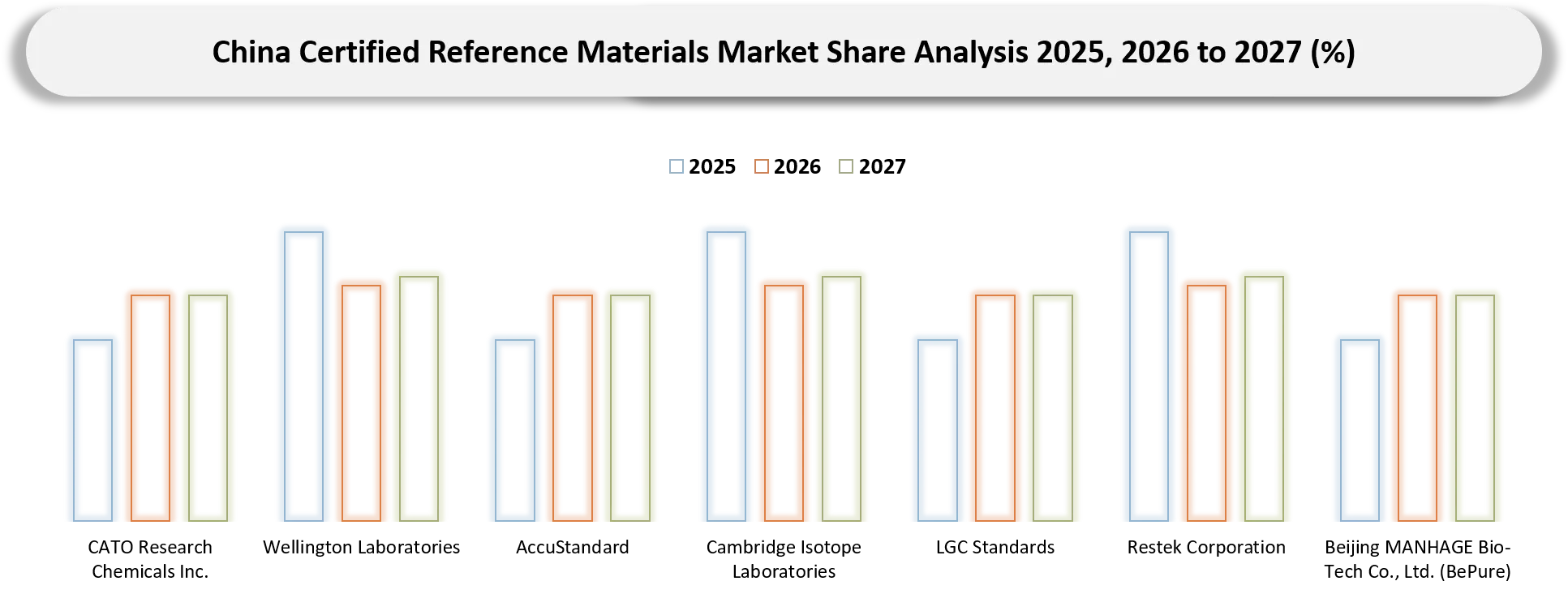
- PFAS CRM suppliers serving the China market include CATO Research Chemicals Inc., Wellington Laboratories, AccuStandard, Cambridge Isotope Laboratories, LGC Standards, Restek Corporation, and Chiron AS. Their portfolios cover PFAS reference standards, certified multi-component mixtures, isotope-labelled compounds, and analytical standards used in environmental monitoring, drinking-water analysis, and laboratory quality control.
- Key players in the China PFAS CRM market include these seven companies, which serve laboratories through specialised PFAS reference-material portfolios and international supply and distribution networks. CATO Research Chemicals lists PFAS-related standards for environmental and consumer-product testing, while the other suppliers offer specialised PFAS analytical materials for laboratory applications. Their inclusion reflects market availability and supply presence, not confirmed PFAS CRM manufacturing within China.
Key Developments
- April 2026: Americhem announced its clean compounding facility in Suzhou, China, which is set to open by the second half of 2026. This facility, designed in accordance with ISO 13485 and cGMP regulations, is expected to augment the company’s healthcare production capability in Asia. During the Chinaplas 2026 event, Americhem introduced two PFAS-free material solutions, including EcoLube MD and nDryve.
- April 2026: Clariant showcased its AddWorks PPA 101 FG and PPA 122 G PFAS-free polymer processing aids at Chinaplas 2026 in Shanghai, China. The products are designed to improve film extrusion efficiency, reduce surface defects and die buildup, and support food-contact compliance as manufacturers respond to tightening PFAS regulations.
- April 2026: SGS awarded the Transfar Functional Chemicals with the first "No PFAS Detected" Green Mark certificate. The test confirmed that the TRANSWR TF-501M water repellent agent meets the certification criteria and ensures the fluorine-free performance of water repelling for clothing, outdoor fabrics, home fabrics, and bags.
Why Choose DataM?
- Technological Innovations: Examines advancements in PFAS certified reference materials, including stable isotope-labeled standards, multi-component PFAS mixtures, matrix-specific reference materials, and standards for emerging PFAS compounds, supporting accurate quantification and reliable laboratory testing.
- Product Performance & Market Positioning: Evaluates how PFAS CRM manufacturers differentiate their products through certified concentrations, measurement uncertainty, traceability, purity, stability, and compatibility with EPA analytical methods, particularly Methods 533, 537.1, and 1633A.
- Real-World Applications: Highlights the use of PFAS CRMs by China laboratories in drinking-water compliance testing, contaminated-site investigations, groundwater monitoring, wastewater analysis, firefighting-foam contamination assessment, and food and biological sample testing.
- Market Updates & Industry Changes: Tracks developments during 2025-2026, including PFAS reference-standard launches, expanded compound coverage, new matrix-specific materials, supplier portfolio expansions, and changes in China PFAS monitoring and analytical requirements.
- Pricing & Market Access: Assesses PFAS CRM pricing based on compound composition, isotope labeling, concentration, certification level, mixture size, and packaging. It also examines supplier availability, distribution channels, procurement requirements, and access to specialized standards for China environmental, industrial, government, and research laboratories.
- Market Entry & Expansion: Identifies opportunities arising from drinking-water testing, environmental remediation, industrial contamination monitoring, and emerging PFAS analysis requirements. It evaluates strategies such as expanding isotope-labeled standard portfolios, developing matrix-specific CRMs, strengthening laboratory partnerships, and improving access to specialized reference materials across the United States.
Target Audience 2026
- PFAS Certified Reference Material Manufacturers and Producers
- Analytical and Environmental Testing Laboratories
- Government and Regulatory Agencies
- Pharmaceutical and Biotechnology Companies
- Food and Beverage Testing Organizations
- Environmental Monitoring and Water Quality Organizations
- Industrial Chemical and Manufacturing Companies
- Semiconductor and Electronics Manufacturers
- Wastewater Treatment and Remediation Companies
- Contract Research Organizations and Academic Research Institutes
- Reference Material Distributors and Laboratory Suppliers
- Mining, Metals and Critical Minerals Companies