


China Certified Reference Materials (CRM) Market Size and Overview
The China Certified Reference Materials (CRM) market reached USD 229.7 million in 2025 and is expected to reach USD 575.3 million by 2035, growing with a CAGR of 9.9% during the forecast period 2026-2035. China’s certified reference materials (CRM) market is supported by the expansion of industrial quality control, pharmaceutical and food testing, environmental monitoring, and analytical instrument use. Demand also benefits from national measurement-standardisation programmes and the need for traceable calibration materials that help laboratories verify measurement accuracy and demonstrate compliance with testing requirements.
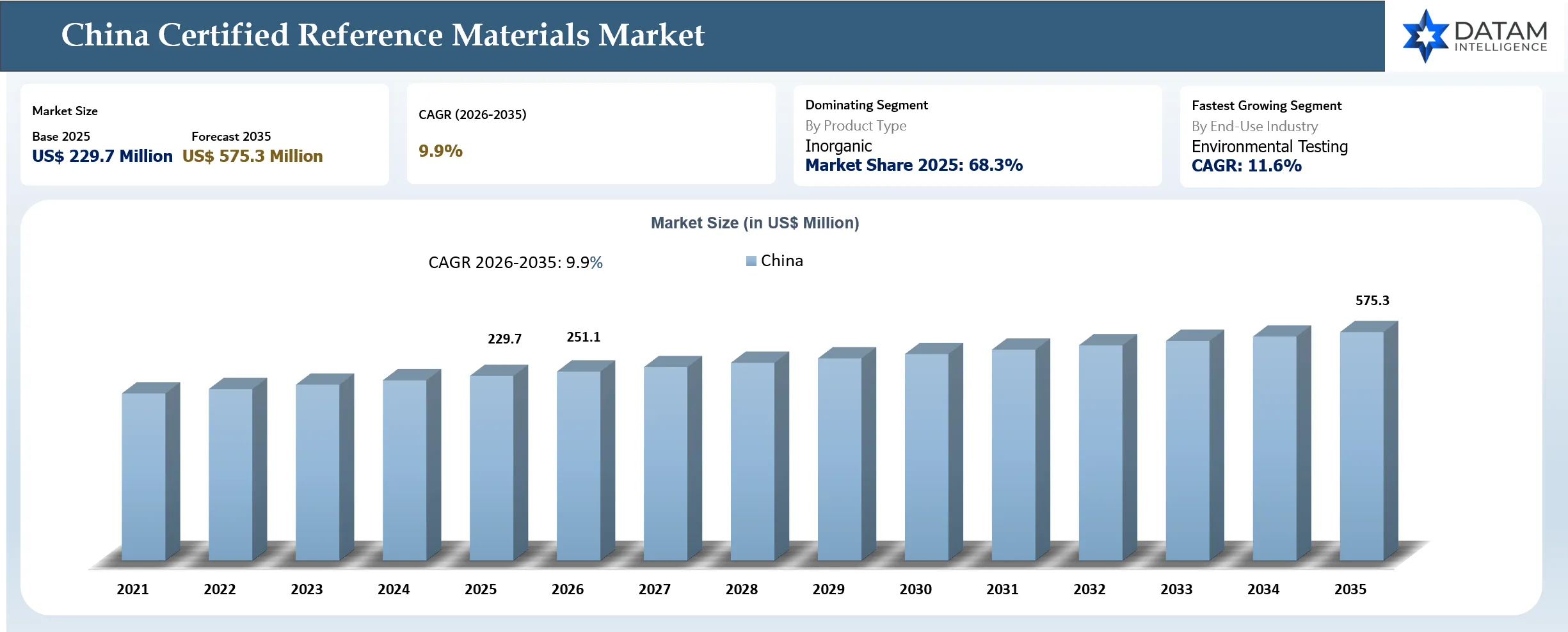
China’s large and expanding testing industry creates a substantial user base for certified reference materials used in analytical calibration, method validation, and quality assurance. According to China’s State Administration for Market Regulation (SAMR), the country had 54,340 accredited qualification-recognised testing and inspection institutions at the end of 2025, which issued 571 million testing reports during the year. The volume of testing across industrial, consumer, environmental, and scientific applications supports recurring requirements for traceable reference materials.
China Certified Reference Materials (CRM) Market Key Takeaways
- Inorganic dominated the China Certified Reference Materials (CRM) Market by product type in 2025, accounting for 68.3% market share. Demand is supported by the need for accurate elemental analysis, instrument calibration, and measurement verification across metallurgy, mining, chemicals, electronics, and industrial manufacturing. Inorganic reference materials, including certified metal solutions, high-purity substances, and geological reference materials, help laboratories verify analytical methods and maintain reliable measurements of elemental composition.
- Environmental testing is the fastest-growing end-use industry segment, with a projected CAGR of 11.6%. Growth is driven by China’s environmental monitoring requirements for water, soil, air, and industrial emissions, alongside the need to measure heavy metals, organic pollutants, and emerging contaminants. Environmental laboratories use certified reference materials to calibrate analytical instruments, validate testing methods, and maintain the accuracy and traceability of pollution-monitoring results.
- China’s development of specialised environmental reference materials is expanding the range of certified standards available for pollution analysis. For instance, in July 2026, the National Geological Experiment and Testing Center received approval for seven reference materials for organic pollutants in soil, including three for petroleum hydrocarbons and four for hexabromocyclododecane (HBCD). The HBCD materials addressed a domestic gap in reference materials for this pollutant, while the full set supports analytical calibration, measurement traceability, and quality control in soil-pollution monitoring.
China Certified Reference Materials (CRM) Market Scope
| Metrics | Details |
| 2025 Market Size | USD 229.7 Million |
| 2035 Projected Market Size | USD 575.3 Million |
| CAGR (2026-2035) | 9.9% |
| By Product Type | Organic, Inorganic |
| By Application | Quality Control & Assurance, Method Validation, Regulatory Compliance Testing, R&D & Analytical Development, Calibration & Instrument Validation |
| By End-User Industry | Consumer Industry, Contract Testing, University / Non-Profit, Energy Industry, Environmental Testing, Health Care, Industrial / Manufacturing, Materials / Mining |
| Report Insights Covered | Competitive Landscape Analysis, Company Profile Analysis, Market Size, Share, Growth |
China Certified Reference Materials (CRM) Market Disruption Analysis
Regulatory Standardisation Reshaping CRM Development and Supplier Compliance
China’s certified reference materials market is entering a period of regulatory change, as authorities strengthen the framework governing reference material classification, certification, production, and distribution. The updated requirements are expected to influence how CRM producers develop products, maintain certification, and demonstrate metrological traceability. This shift may increase the value of technically qualified suppliers while creating additional compliance requirements for manufacturers and distributors.
In January 2026, China’s State Administration for Market Regulation (SAMR) announced a revised Measures for the Administration of Reference Materials, scheduled to take effect on December 1, 2026. The revised framework introduces a three-level classification system comprising national primary reference materials, first-level reference materials, and second-level reference materials, replacing the previous two-level management structure. It also updates certification and production-management requirements. The market disruption lies in the transition toward a more structured regulatory system, which may affect product certification processes, supplier qualification, and competitive positioning among domestic and international CRM providers.
China Certified Reference Materials (CRM) Market BCG Matrix: Company Evaluation
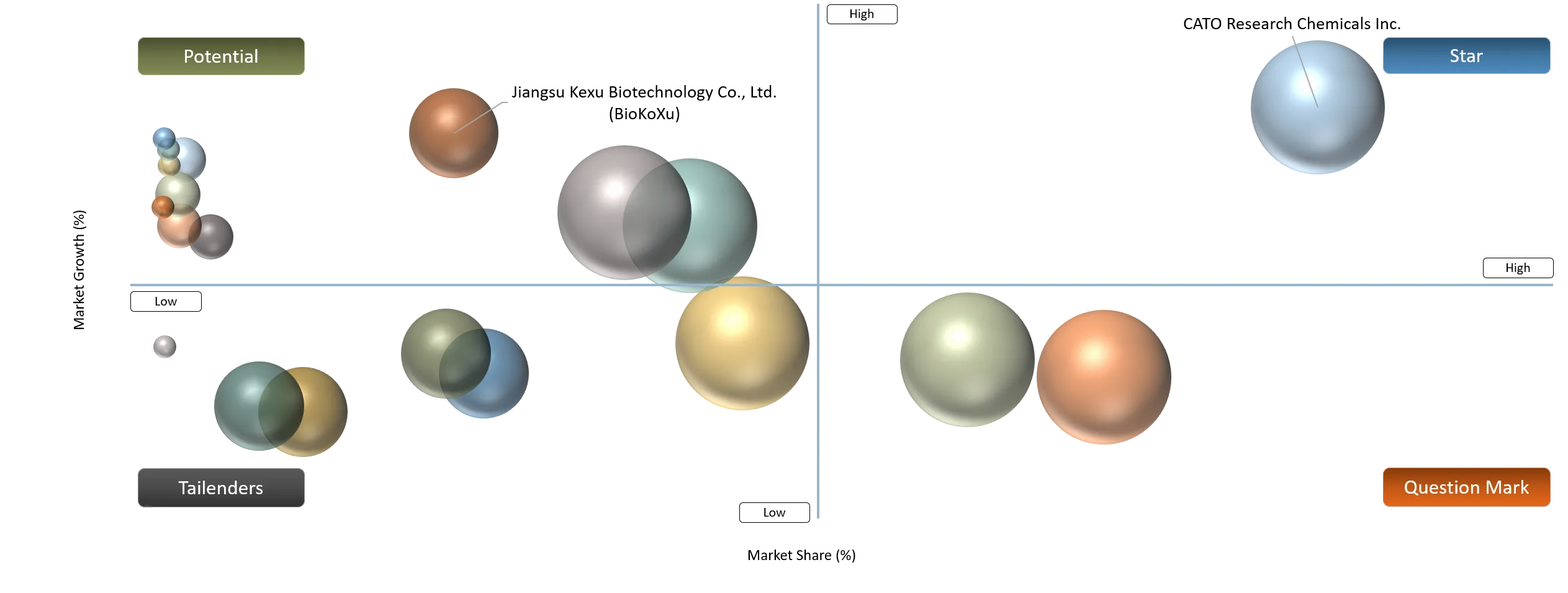
CATO Research Chemicals Inc. is positioned as a Star in the China Certified Reference Materials Market due to its reference-material production capabilities and broad analytical standards portfolio. Jiangsu Kexu Biotechnology Co., Ltd. (BioKoXu), Shenzhen ChemStrong Scientific Co., Ltd., Merck KGaA, and LGC Limited are classified as Potential Stars, supported by their specialised or diversified reference-material portfolios and applications across pharmaceutical, chemical, environmental, and analytical testing.
AccuStandard and Antylia Scientific are classified as Question Marks because of their specialised reference-material offerings and potential to serve China’s analytical testing market. Tailenders may include Starna Scientific Limited and Quality Control Solutions Ltd. if their portfolios or market presence are narrower than those of the larger suppliers. These classifications are qualitative assessments based on portfolio breadth, accreditation, and market presence.
China Certified Reference Materials (CRM) Market Segment Analysis
The China certified reference materials (CRM) market is segmented based on product type, application, end-user industry, and region.
Stringent Chemical Safety Regulations Driving Demand for Certified Reference Materials
Environmental monitoring remains a major application area for reference materials used to measure contaminants in water, soil, air, and industrial emissions. SAMR reported that 205 environmental reference materials were approved during January–July 2025, representing 37.3% of all newly approved national reference materials in that period. Approvals in this category increased 64% year on year, indicating a strong emphasis on environmental measurement capability. These materials support calibration, analytical verification, and quality control in environmental testing laboratories.
Furthermore, in August 2026, China’s National Geological Experiment and Testing Center announced that it had obtained approval for seven reference materials for analysing organic pollutants in soil. The portfolio included three first-grade national reference materials for petroleum hydrocarbons in soil and four second-grade materials for hexabromocyclododecane (HBCD). The HBCD materials filled a domestic gap in reference materials for this contaminant. The development supports more accurate soil-pollution analysis, measurement traceability, and quality control in environmental monitoring laboratories.
China Certified Reference Materials (CRM) Market Competitive Landscape
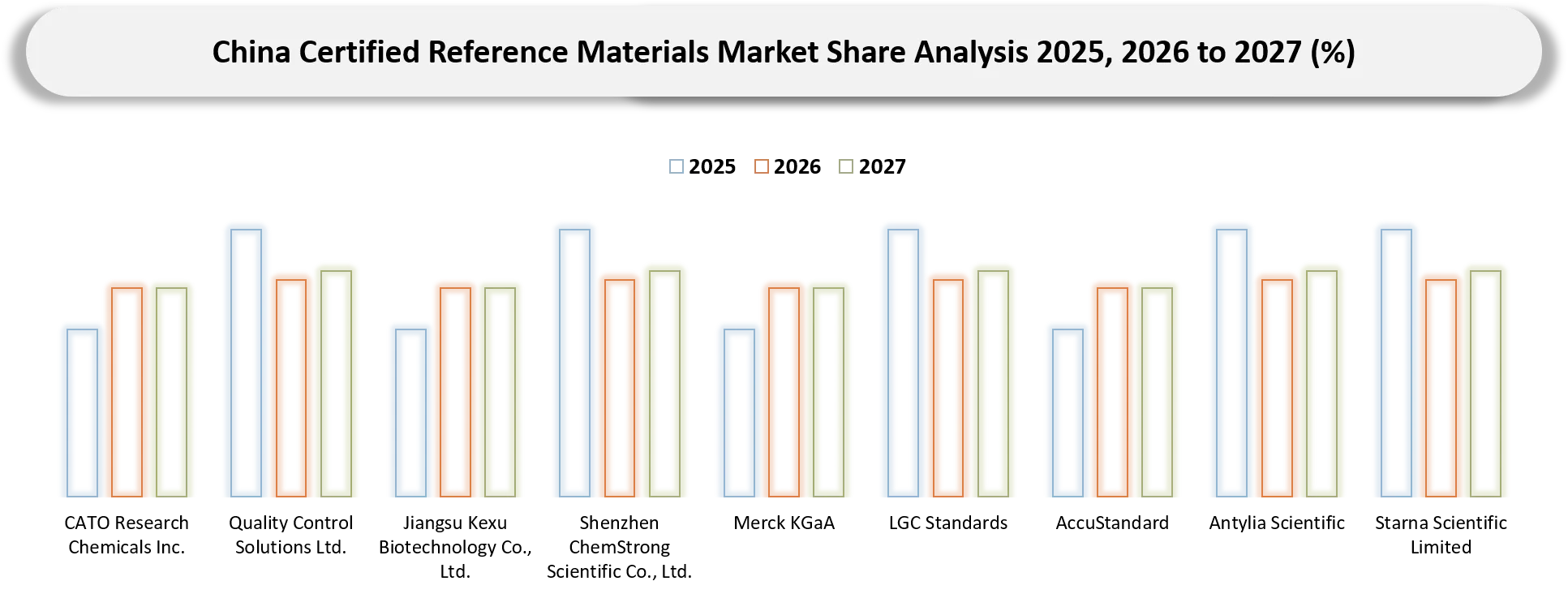
- Chinese companies such as CATO Research Chemicals Inc., Quality Control Solutions Ltd., Jiangsu Kexu Biotechnology Co., Ltd., and Shenzhen ChemStrong Scientific Co., Ltd. supply certified reference materials and analytical reference standards for pharmaceutical, food safety, pesticide residue, veterinary drug, and environmental testing applications. International suppliers, including Merck KGaA, LGC Limited / LGC Standards, AccuStandard, Antylia Scientific, and Starna Scientific Limited, extend the market offering through pharmaceutical and environmental reference standards, analytical calibration materials, and spectroscopy reference materials.
- Key players in the China certified reference materials (CRM) market include CATO Research Chemicals Inc. (China), Quality Control Solutions Ltd. (China), Jiangsu Kexu Biotechnology Co., Ltd. (China), Shenzhen ChemStrong Scientific Co., Ltd. (China), Merck KGaA (Germany, with China operations), LGC Limited / LGC Standards (United Kingdom, with China operations), AccuStandard (United States), Antylia Scientific (United States, with China presence), and Starna Scientific Limited (United Kingdom, with China presence).
Key Developments
- August 2026: China’s National Geological Experiment and Testing Center announced that it had obtained approval for seven reference materials for analysing organic pollutants in soil. The portfolio included three first-grade national reference materials for petroleum hydrocarbons in soil and four second-grade materials for hexabromocyclododecane (HBCD).
- March 2026: BioKoXu participated in the China International Agrochemical & Crop Protection Exhibition (CAC 2026) in Shanghai, showcasing agrochemical reference materials and customized traceability solutions. The company highlighted its ISO 17034:2016 accreditation and portfolio of pesticide reference materials used in analytical testing and quality control.
- December 2025: Jiangsu Kexu Biotechnology Co., Ltd., operating under the BioKoXu brand, announced its CNAS ISO 17034 accreditation for reference material production, following national reference-material grading certification earlier in 2025. Its portfolio includes pesticide and pharmaceutical impurity reference materials, custom-synthesized standards, and mixed standard solutions.
Why Choose DataM?
- Technological Innovations: Examines advancements in Certified Reference Materials (CRMs), including matrix-matched standards, high-purity elemental reference materials, quantitative nuclear magnetic resonance (qNMR) standards, and specialized materials for emerging analytical techniques, supporting improved measurement accuracy and laboratory reliability.
- Product Performance & Market Positioning: Evaluates how CRM manufacturers and suppliers differentiate their offerings through certified values, measurement uncertainty, metrological traceability, material homogeneity, certification quality, and suitability for environmental, pharmaceutical, food safety, mining, and industrial testing applications.
- Real-World Evidence: Highlights CRM applications in Canadian laboratories, including contaminant detection, elemental impurity analysis, water-quality monitoring, shellfish toxin testing, pharmaceutical quality control, and critical-mineral characterization, demonstrating their role in analytical validation and reliable measurement outcomes.
- Market Updates & Industry Changes: Tracks developments during 2025–2026, including new CRM introductions, specialized reference-material launches, product portfolio expansions, and changes in analytical testing requirements, helping identify evolving demand across China's environmental, food, healthcare, and industrial sectors.
- Pricing & Market Access: Assesses differences in CRM pricing based on material composition, certification complexity, concentration, packaging size, intended application, and production requirements. It also examines supplier availability, distribution channels, delivery lead times, and access to specialized reference materials for Canadian research institutions, industrial laboratories, and regulated testing facilities.
- Market Entry & Expansion: Identifies opportunities arising from environmental contaminant monitoring, food safety testing, pharmaceutical quality assurance, critical-mineral analysis, and emerging nanomaterial measurement requirements. It also evaluates strategies such as developing application-specific CRMs, strengthening laboratory partnerships, expanding distribution networks, and improving access to traceable reference materials across China.
Target Audience 2026
- CRM Manufacturers and Producers
- Analytical Testing Laboratories
- Government and Regulatory Agencies
- Pharmaceutical and Biotechnology Companies
- Food and Beverage Companies
- Environmental Monitoring and Water Testing Organizations
- Mining, Metals, and Critical Minerals Companies


























































