


China Cables & Wires Market Size and Overview
The China cables and wires market reached US$ 35.63 billion in 2025 and is projected to reach US$ 47.17 billion by 2031, representing 4.79% annualized growth over 2025–2031. The market encompasses building and industrial wiring, medium- and high-voltage transmission cables, optical fiber and data cables plus specialty cables for renewable energy, ports, vessels and extraction industries. Low-voltage cables account for 48.95% of 2025 demand, followed by medium- and high-voltage cables at 32.18%.
Demand reflects distribution-grid investment, transmission infrastructure, construction and industrial automation, renewable generation interconnections, export-oriented manufacturing plus broadband and enterprise connectivity. China has an extensive domestic cable manufacturing base and a broad supplier spectrum, from volume-oriented building wire to qualified high-voltage, submarine, fire-resistant and industrial cable products. Competitive outcomes depend on project qualification, copper and aluminum input costs, price discipline and reliable delivery.
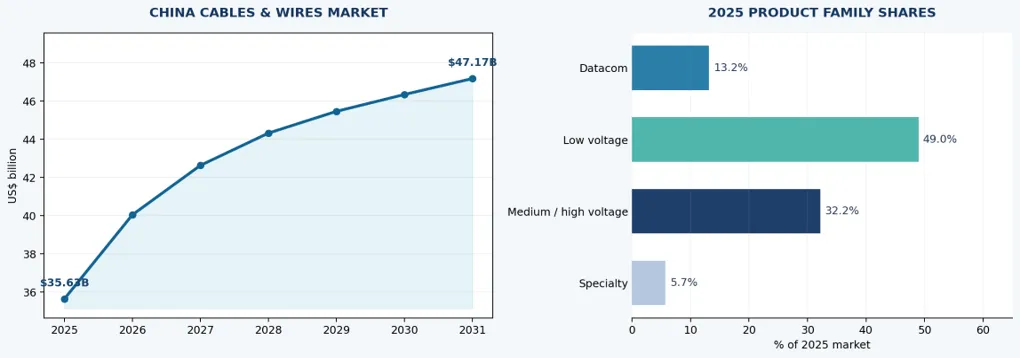
China cable and wire market value grows from US$ 35.63 billion in 2025 to US$ 47.17 billion in 2031, increasing by US$ 11.54 billion.
The market records a 4.79% annualized expansion across the 2025–2031 period, supported by power-network and industrial requirements.
Low-voltage cables represent 48.95% of 2025 market value, primarily associated with building wiring, distribution installations and industrial facilities.
Medium- and high-voltage cables contribute 32.18% of 2025 market value, linked to grid expansion and renewable-energy transmission.
Datacom cables represent 13.16% of 2025 value, supported by optical-fiber networks, enterprise IT and communications investments.
Cable purchasing decisions increasingly consider qualification, metal-index price mechanisms, fire performance, lead time and lifecycle reliability.
China Cables & Wires Industry Trends and Strategic Insights
Transmission upgrades, interprovincial interconnection and utility investments create procurement opportunities for medium- and high-voltage cables as well as associated cable accessories.
Wind, photovoltaic and grid-storage deployments influence demand for purpose-engineered renewable cables, including thermal-resistant and outdoor installation designs.
Fiber networking, industrial digitization and data-center connectivity sustain demand for high-performance optical and copper datacom cables, especially where bandwidth needs increase.
A competitive domestic manufacturing base intensifies price competition for standardized products while engineering certifications and project execution experience protect premium cable opportunities.
China Cables & Wires Market Scope
| METRICS | DETAILS |
| 2025 Market Size | US$ 35.63 Billion |
| 2031 Projected Market Size | US$ 47.17 Billion |
| CAGR (2026–2031) | 4.79% |
| Geographic Coverage | China (national market; provincial and end-use demand context) |
| By Cable Type | Datacom Cables (Communication & Data Cables, Fiber Optic Cables); Low-Voltage Cables (Fire Resistant Cables, Low Smoke & Halogen Free Cables, Low Voltage Cables & Wires); Medium- and High-Voltage Cables (Medium Voltage Cables, High Voltage Cables); Special Cables (Mining Oil & Gas Cables, Photovoltaic Cables, Ship & Harbour Cables, Windmill Cables) |
| By Industry | Industrial — Discrete (Aerospace & Defense, Automotive, Batteries, Electrical & Electronics, Machine Building, Semiconductor); Process (Chemicals, Energy/Oil & Gas, Metal Processing); Hybrid (Food & Beverage, Lifesciences, Mining & Quarrying, Other Manufacturing). Non Industrial — Transportation (Air, Land, Rail, Marine Services); Infrastructure & Services (Commercial Real Estate, Data Centers, Healthcare, Hospitality & Entertainment, Public Sector/Research/Education, Residentials, Water & Waste, Others). Power Utilities — Power Generation (Coal, Conventional Excl. Coal, Renewables); Power Distribution & Transmission. |
| By Conductor / Transmission Medium | Copper; Aluminum; Optical Fiber; Composite / Hybrid Construction |
| By Voltage Rating (Power Cables) | Low Voltage (up to 1 kV); Medium Voltage (above 1 to 35 kV); High Voltage (above 35 to 230 kV); Extra-High Voltage (above 230 kV) |
| By Insulation and Sheathing Material | Cross-Linked Polyethylene (XLPE); Polyvinyl Chloride (PVC); Ethylene Propylene Rubber (EPR/EPDM); Polyethylene (PE); Low Smoke Zero Halogen (LSZH); Other Materials |
| By Installation Method | Overhead; Underground / Buried; Submarine / Underwater; Indoor / Building; Outdoor / Industrial |
| Competitive Landscape | Competitive positioning, 10 company profiles, recent developments and partnerships |
| Market Data Coverage | Cable-type and cable-subtype market values, 2025–2031 (US$ million); industry, material, voltage and installation breakdowns within the defined report scope |
China Cables & Wires Market White Space & Investment Opportunities
Grid modernization: Advanced medium- and high-voltage cables, accessories and low-loss solutions address network reinforcement, transmission expansion and renewable-grid integration.
Industrial modernization: Automation, robotics, electronics manufacturing and heavy industries support demand for specialty, control, flexible and low-smoke cables.
Communications and renewables: Fiber deployment, photovoltaic parks and wind generation require application-specific designs and suppliers with strong technical qualification capabilities.
Eastern and coastal manufacturing hubs support broad industrial, commercial and communications cable demand. Central provinces offer opportunities related to urban infrastructure and factories, while western and northern regions feature major renewable-energy and long-distance power-transmission projects. Supplier competitiveness varies with provincial utility prequalification, project delivery distance, local distributor relationships and installation environment.
Driver Impact Analysis
China’s cable demand benefits from continued upgrades to utility networks, grid integration of renewable power and electrification of industrial activity. Medium- and high-voltage cable requirements follow power-grid reinforcement and interregional transmission construction. Low-voltage cables support electrical installations in factories, transport infrastructure and the built environment. Datacom networks and industrial connectivity generate requirements for optical fiber and structured copper cable, especially as digital infrastructure intensifies.
| DRIVER | AFFECTED PRODUCT / SIGNAL | 2026–2031 CAGR | STRATEGIC IMPACT |
| Grid investment and transmission expansion | High- and medium-voltage power cables | High | Advance utility prequalification and project partnerships. |
| Renewables and grid interconnection | PV, wind, HV and outdoor cable | Moderate–High | Align capacity with grid and renewable developers. |
| Industrial and infrastructure upgrades | LV, fire-resistant and control cables | Moderate–High | Support engineering consultants and contractor channels. |
| Fiber and digital infrastructure | Optical fiber and data cabling | Moderate | Target telecom operators and enterprise infrastructure. |
Procurement conversion depends on approvals, tender schedules, network investment cycles and the ability of cable suppliers to meet voltage, fire-safety and installation standards. Higher-specification cable families require extensive testing, reference projects and engineering support. Suppliers that coordinate with utility designers, EPCs, system integrators and contractors early in project planning can improve tender positioning and forecast manufacturing capacity more accurately.
Restraint Impact Analysis
Copper and aluminum price volatility affect manufacturing cost, selling prices and working-capital commitments. Strong domestic competition places margin pressure on conventional low-voltage and commodity cable categories. Specialty polymer availability, qualification requirements and product-testing capacity influence more complex projects. Export-oriented suppliers may also face trade restrictions, foreign technical certifications and currency exposure, while local demand depends on investment timing in property and industrial construction.
| RESTRAINT | PRIMARY EXPOSURE | RISK LEVEL | STRATEGIC IMPACT |
| Copper and aluminum price volatility | Cable margins and tender quotations | High | Use indexed contracts and materials procurement controls. |
| Commoditization and intense competition | Standard low-voltage cable pricing | High | Differentiate through qualification and specialty products. |
| Project approvals and tender delays | Utility and infrastructure delivery timing | Moderate–High | Diversify backlog and stage manufacturing. |
| Certification and export requirements | Complex power and specialty projects | Moderate | Invest in product testing and engineering capabilities. |
Order timing for grid and infrastructure programs can change with approvals, engineering revisions and contractor schedules. Excess capacity in standardized cable categories can weaken price realization, particularly when metal prices move sharply. Advanced high-voltage or application-specific products require longer qualification cycles and production planning. Suppliers can mitigate these risks through indexed pricing, portfolio specialization, diversified distribution, improved yield and early engagement with infrastructure project owners.
China Cables & Wires Market Competitive Landscape
China’s competitive landscape includes large integrated cable manufacturers, specialist power-cable suppliers and optical-fiber companies. Firms compete across low-voltage building wire, distribution and transmission cables, fiber-optic connectivity plus specialty products for energy, industrial automation and marine applications. Scale, manufacturing efficiency, testing capability and utility project references strongly influence market positioning.
| COMPANY | CHINA CABLES & WIRES POSITIONING |
| Hengtong Group | Power cable, optical fiber and integrated cable solutions for utility and telecom procurement. |
| ZTT (Jiangsu Zhongtian Technology) | Power transmission, submarine cable and optical communication products. |
| Far East Cable | Building wire, industrial cable and power transmission cable portfolio. |
| Baosheng Science & Technology Innovation | Energy, industrial and aerospace-related power and specialty cables. |
| Jiangnan Group | Low-, medium- and high-voltage cable products for industrial and infrastructure customers. |
| Orient Cable (Ningbo Orient Wires & Cables) | Submarine power cables, offshore wind links and land-based power transmission. |
| FiberHome Telecommunication Technologies | Optical fiber, optical cable and communications network infrastructure. |
| YOFC (Yangtze Optical Fibre and Cable) | Optical fiber and cable manufacturing for communication networks. |
| Tongding Interconnection Information | Optical communications cable and supporting network products. |
| TBEA | Transmission and distribution cable products within broader power-equipment operations. |
Strategic differentiation centers on certifications, technical design support, product reliability and high-voltage manufacturing competence. Price and distribution coverage remain influential in standard cables, while major infrastructure awards emphasize qualification, quality control and delivery planning. Selected companies are extending offshore wind, high-voltage transmission and advanced fiber capabilities to serve higher-value demand.
China Cables & Wires Market Recent Developments
2026: Grid-modernization and transmission programs continue to influence tender pipelines for high-voltage power cables and associated accessories.
2026: Onshore and offshore renewable-energy development sustains demand for photovoltaic, wind and grid-connection cable specifications.
2026: Optical-fiber network expansion and industrial connectivity support product development in communications cable families.
2026: Industrial automation and factory modernization promote requirements for control, fire-resistant and flexible cable designs.
2026: Domestic manufacturers continue to prioritize product qualification, high-voltage cable performance and factory automation.
2026: Copper-price movements and infrastructure project schedules remain important influences on cable quotations and supplier capacity allocation.


























































