


Central Nervous System (CNS) Biomarkers Market Size and Trends
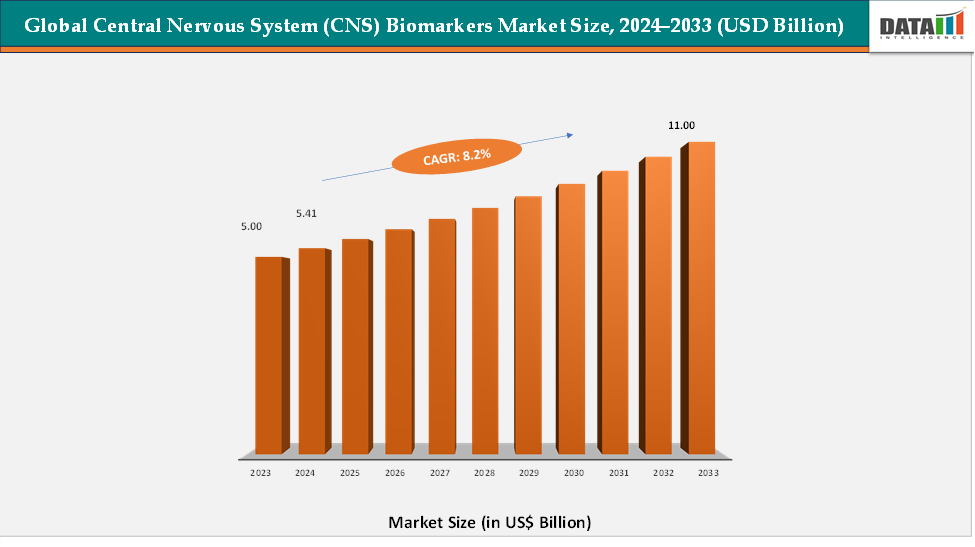
The global central nervous system (CNS) biomarkers market reached US$ 5.00 billion in 2023, with a rise to US$ 5.41 billion in 2024, and is expected to reach US$ 11.00 billion by 2033, growing at a CAGR of 8.2% during the forecast period 2025–2033. The global central nervous system (CNS) biomarkers market is experiencing robust growth, driven by the increasing prevalence of neurological disorders, rising demand for early and accurate diagnosis, and rapid advancements in biomarker discovery and validation technologies. Growing awareness of conditions such as Alzheimer’s disease, Parkinson’s disease, multiple sclerosis, and other neurodegenerative disorders is fueling the adoption of CNS biomarkers in clinical and research settings. These biomarkers play a crucial role in disease detection, monitoring progression, and evaluating therapeutic efficacy, enabling personalized treatment strategies and improving patient outcomes.
Key Market highlights
- North America leads the central nervous system (CNS) biomarkers market, accounting for approximately 43.1% of global revenue. The region’s dominance is supported by its advanced healthcare infrastructure, high diagnostic capabilities, and strong presence of leading pharmaceutical and biotechnology companies focused on neurodegenerative disease research..
- Asia–Pacific represents the fastest-growing market for CNS biomarkers, holding around 17.6% of the global share. The region’s rapid growth is attributed to the increasing incidence of neurological disorders among the aging population, expanding access to advanced diagnostic technologies, and growing government investments in neuroscience research.
- Kits dominate the CNS Biomarkers market, contributing approximately 44.8% of total revenue. Their leading position is driven by the increasing demand for standardized, ready-to-use solutions that simplify biomarker testing and ensure reliable, reproducible results.
Market Size & Forecast
- 2024 Market Size: US$ 5.00 billion
- 2033 Projected Market Size: US$ 11.00 billion
- CAGR (2025–2033): 8.2%
- North America: Largest market in 2024
- Asia Pacific: Fastest-growing market
Market Dynamics
Driver: Rising Prevalence of Neurological Disorders
The rising prevalence of neurological disorders is a major driver of the CNS biomarkers market, as early and accurate diagnosis becomes increasingly critical for effective disease management. Conditions such as Alzheimer’s disease, Parkinson’s disease, multiple sclerosis, and epilepsy are affecting millions globally, creating a growing demand for reliable diagnostic tools. CNS biomarkers enable clinicians to detect these disorders at earlier stages, monitor disease progression, and evaluate treatment efficacy, which is particularly important given the complex and often progressive nature of neurological conditions.
With the global population aging and lifestyle-related risk factors contributing to higher rates of neurodegenerative and chronic neurological diseases, healthcare providers and researchers are increasingly adopting CNS biomarkers to facilitate timely interventions, improve patient outcomes, and support the development of targeted therapies.
Restraint: High Cost of Biomarker Development
The high cost of biomarker development is a key factor that could restrain the growth of the CNS biomarkers market. Developing and validating CNS biomarkers involves complex, time-consuming, and resource-intensive processes, including extensive laboratory research, clinical trials, and regulatory approvals. These activities require advanced technologies, skilled personnel, and substantial financial investment, which can limit accessibility, particularly in emerging markets with constrained healthcare budgets.
For more details on this report, Request for Sample
Segmentation Analysis
The global central nervous system (CNS) biomarkers market is segmented by type, application, disease, end-user and region.
Type: The assays segment is estimated to have 44.8% of the central nervous system (CNS) biomarkers market share.
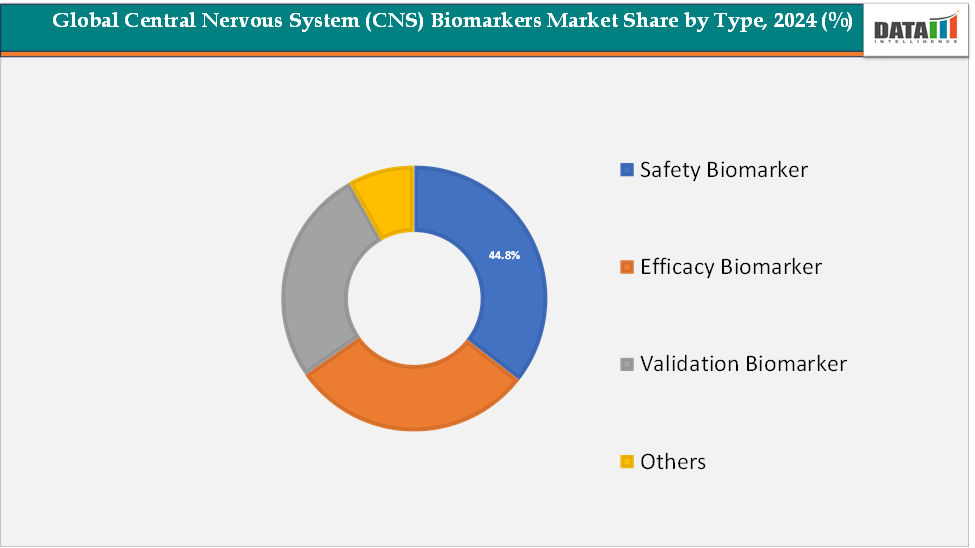
The assays segment is expected to dominate the CNS biomarkers market. Assays are essential for the precise detection, quantification, and monitoring of biomarkers such as neurofilament light chain (NfL), GFAP, Tau proteins, and amyloid-beta, which are critical for diagnosing and managing neurological disorders like Alzheimer’s, Parkinson’s, and multiple sclerosis. Their widespread adoption in hospitals, diagnostic laboratories, and clinical research is driven by their high sensitivity, reproducibility, and ability to provide accurate results for disease progression and therapeutic monitoring.
Technological advancements, including immunoassays, ELISA, and high-sensitivity digital detection platforms, further enhance their utility, making assays the largest and most relied-upon segment in the CNS biomarkers market.
The kits segment is estimated to have 21.4% of the central nervous system (CNS) biomarkers market share.
The Kits segment is the fastest-growing in the CNS biomarkers market. Kits simplify the testing process by providing pre-prepared reagents, standardized protocols, and ready-to-use components, enabling rapid and convenient biomarker analysis even in decentralized or smaller laboratory settings. The rising demand for point-of-care testing, ease of use, and increasing adoption in clinical research and hospitals are driving the rapid growth of the kits segment. Additionally, manufacturers are developing highly specialized CNS biomarker kits that cater to specific neurodegenerative diseases, further accelerating adoption and market expansion.
Global Central Nervous System (CNS) Biomarkers Market - Geographical Analysis
The North America central nervous system (CNS) biomarkers market was valued at 43.1% market share in 2024
North America remains the dominant region in the CNS biomarkers market, driven by a combination of advanced healthcare infrastructure, robust research and development capabilities, and high healthcare expenditure. The region is characterized by a high prevalence of neurological disorders, including Alzheimer’s disease, Parkinson’s disease, multiple sclerosis, and epilepsy, which significantly increases the demand for accurate and early diagnostic tools. CNS biomarkers are increasingly adopted in hospitals, research institutions, and pharmaceutical companies across the U.S. and Canada to facilitate early disease detection, monitor therapeutic responses, and support personalized treatment strategies.
Additionally, the strong presence of leading biotechnology and pharmaceutical companies, coupled with favorable regulatory frameworks and substantial investment in precision medicine and clinical research, has reinforced North America’s dominant position. The region also benefits from widespread awareness among healthcare providers and patients regarding the importance of biomarker-based diagnostics, further fueling the adoption of CNS biomarkers across both clinical and research settings.
The Europe central nervous system (CNS) biomarkers market was valued at 22.8% market share in 2024
Europe holds a significant position in the CNS biomarkers market, underpinned by well-established healthcare systems, high prevalence of neurological disorders, and extensive clinical research activities. The region benefits from strong regulatory support for biomarker validation, ongoing government and private sector initiatives in neurotherapeutics, and a focus on precision medicine and innovative diagnostic technologies. Countries such as Germany, the UK, and France are leading in clinical trials, research collaborations, and the adoption of advanced CNS biomarkers, which enable more accurate disease detection and monitoring of therapeutic efficacy. Moreover, the European market is characterized by high awareness among healthcare professionals and patients about the benefits of CNS biomarkers, supported by comprehensive healthcare policies and reimbursement frameworks, allowing the region to maintain a key and stable presence in the global CNS biomarkers market.
The Asia-Pacific central nervous system (CNS) biomarkers market was valued at 17.6% market share in 2024
The Asia–Pacific region is emerging as the fastest-growing market for CNS biomarkers, driven by rapid urbanization, an aging population, and the rising incidence of neurodegenerative and chronic neurological disorders. Growing awareness of neurological health, coupled with expanding healthcare infrastructure and increasing investment in diagnostics and research, has created significant demand for biomarker-based solutions in countries such as China, India, Japan, and South Korea.
The region is witnessing a surge in clinical research initiatives, government-backed healthcare programs, and the adoption of advanced diagnostic technologies, all of which are contributing to the rapid market growth. Additionally, rising disposable incomes and increasing access to healthcare services are enabling a larger patient population to benefit from early detection and personalized treatment strategies, positioning the Asia–Pacific as a highly lucrative and fast-expanding segment of the global CNS biomarkers market.
Competitive Landscape
The major players in the central nervous system (CNS) biomarkers market include Quanterix, Alamar Biosciences, Inc., Thermo Fisher Scientific Inc., F. Hoffmann-La Roche Ltd, Siemens Healthineers AG and Sysmex Corporation, among others.
Market Scope
| Metrics | Details | |
| CAGR | 8.2% | |
| Market Size Available for Years | 2022-2033 | |
| Estimation Forecast Period | 2025-2033 | |
| Revenue Units | Value (US$ Bn) | |
| Segments Covered | Type | Kits, Assays, Reagents, Others |
| Application | Drug Discovery & Development, Disease Risk Assessment, Diagnostics Others | |
| Disease | Multiple Sclerosis, Alzheimer's Disease, Parkinson's Disease, Traumatic Brain Injury, Others | |
| End-User | Diagnostic Labs, Clinics, Hospitals, Research Centers, Others | |
| Regions Covered | North America, Europe, Asia-Pacific, South America, and the Middle East & Africa | |
The global central nervous system (CNS) biomarkers market report delivers a detailed analysis with 70 key tables, more than 66 visually impactful figures, and 195 pages of expert insights, providing a complete view of the market landscape


























































