

Capacitor Bank Market Size Overview
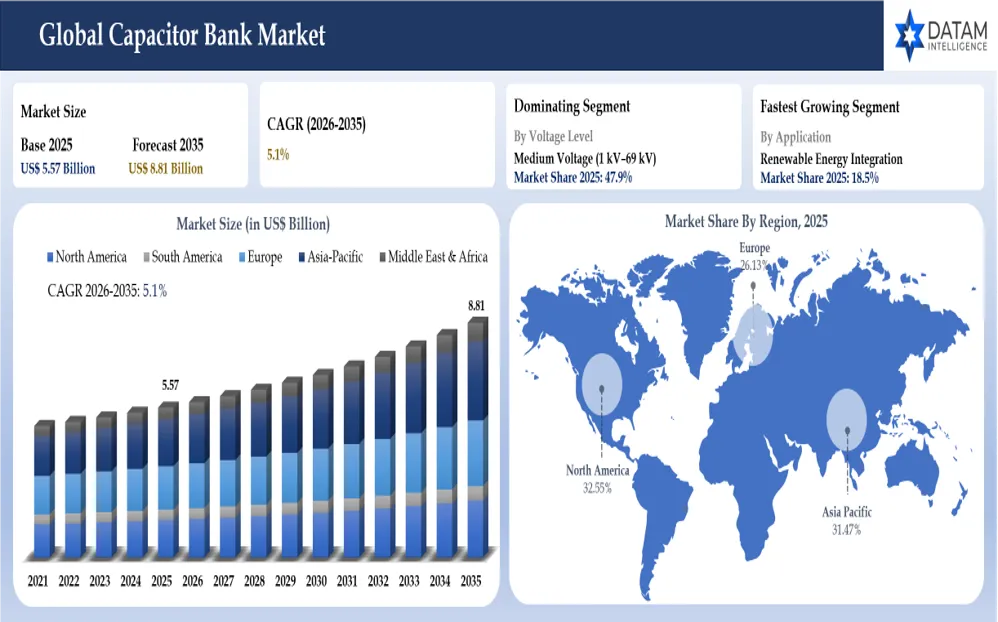
The global capacitor bank market reached US$ 5.57 billion in 2025 and is expected to reach US$ 8.81 billion by 2035, growing with a CAGR of 5.1% during the forecast period 2026-2035.
The growing installations of renewable energy facilities will drive the market for reactive power compensation and voltage regulation, thus boosting the demand for capacitor banks. The International Renewable Energy Agency (IRENA) reported that 2025 saw the installation of 692 GW worldwide, or, over the year, renewable power capacity increased by 15.5%. The solar sector provided approximately 511 GW of new capacity while wind energy amounted to 159 GW. As these unstable renewable energy resources are increasingly connected to transmission and distribution systems, there arises demand for medium- and high-voltage capacitor banks needed for reactive power compensation and voltage stability. It is creating new possibilities for installing capacitor banks in substations and interconnections of renewable energy facilities.
More electricity usage from the data centers is also creating an opportunity for the use of capacitor banks in power-intensive installations. International Energy Agency (IEA) forecasts that the amount of power consumed by the global data centers would increase from 485 TWh in 2025 to 950 TWh in 2030. This growth is making the need for power factor correction, reactive power management and electrical power distribution very important in data centers. Additionally, the increasing installation of uninterruptible power supplies, variable frequency drives and other types of power electronics can contribute to the creation of harmonics, thus making it necessary to have automatic and detuned capacitor banks. Such requirements will increase the use of capacitor banks in achieving good power quality, minimizing electrical losses and providing reliable operation in data centers and industries.
Capacitor Bank Market Key Takeaways
- The medium-voltage capacitor bank (1 kV-69 kV) held a dominant share of 47.9% in the global capacitor bank market in 2025, as they are commonly installed in distribution substations, industry facilities and renewable energy collection systems.
- The integration of renewable energy is expected to emerge as the most rapidly growing application segment with a 6.6% CAGR over the forecast period, attributed to the growth of solar and wind capacity additions and the requirement for compensation of reactive power and voltage regulation.
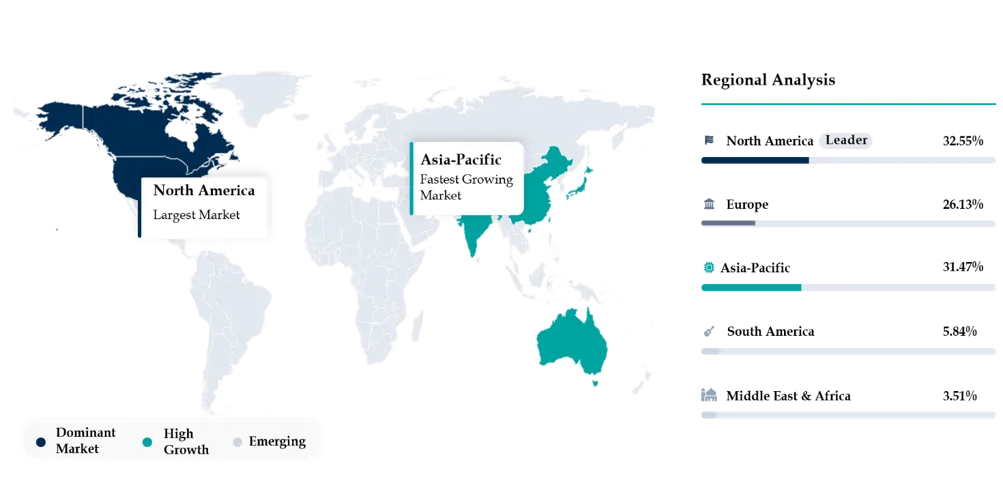
- North America emerged as the dominating region in the global capacitor bank market with a market share of 32.55% in 2025, owing to infrastructure development for transmission and distribution, modernization of grids, integration of renewables and growing demand for electricity in data centers and industries.
- The increasing use of automatic capacitor banks and digitally controlled switchgear systems has become a major motivation for companies to develop smart power factor controllers and remote monitoring solutions.
- The rising demand from utility companies, industries, renewable energy projects and data centers provides an increased number of applications for various types of capacitor bank systems, such as shunt capacitor banks, detuned capacitor banks, harmonic filters and medium and high voltage reactive power compensation systems.
Capacitor Bank Industry Trends and Strategic Insights
- Automatic capacitor banks fitted with intelligent controllers are being adopted in industrial plants due to the requirement for handling variable loads, ensuring required power factors and minimizing the reactive power charge.
- The increased application of variable frequency drives, UPS and other power electronics devices has raised the requirement for capacitor banks which are detuned using series reactors to prevent any harmonic resonance in order to ensure better power quality.
- The rise in applications for solar and wind power generation has resulted in more installations of medium and high-voltage capacitor banks used for the purpose of reactive power compensation and voltage regulation.
- Capital investments in transmission and distribution systems have facilitated the use of shunt and series capacitor banks at substations, thereby enhancing the voltage profile, increasing power transmission capability and minimizing the reactive power transmitted through the network.
- Manufacturers have been concentrating on the design of modular capacitor banks, efficient switching systems and computerized control in order to simplify their installation, maintain them through predictive maintenance and ensure their reliability.
Capacitor Bank Market Scope
| Metrics | Details | |
| 2025 Market Size | US$ 5.57 Billion | |
| 2035 Projected Market Size | US$ 8.81 Billion | |
| CAGR (2026-2035) | 5.1% | |
| Largest Market | North America | |
| Fastest Growing Market | Asia-Pacific | |
| By Voltage Level | Low Voltage (Below 1 kV), Medium Voltage (1 kV–69 kV) and High Voltage (Above 69 kV) | |
| By Type | Internally Fused Capacitor Banks, Externally Fused Capacitor Banks, and Fuseless Capacitor Banks | |
| By Function | Shunt Capacitor Banks and Series Capacitor Banks | |
| By Installation Type | Pole-Mounted, Open-Air Substation, Metal-Enclosed Substation, Indoor Panel-Mounted and Other Installations | |
| By Switching Mechanism | Fixed Capacitor Banks, Mechanically Switched Capacitor Banks and Thyristor-Switched Capacitor Banks | |
| By Connection Type | Star (Wye) Connection, Delta Connection and Double-Star Connection | |
| By Application | Power Factor Correction, Harmonic Filtering, Voltage Regulation and Stabilization, Renewable Energy Integration, Transmission and Distribution Network Compensation, Data Center Power Management, Electric Vehicle Charging Infrastructure, Railway Electrification and Other Applications | |
| By End-User | Utilities, Industrial, Commercial, Renewable Energy Operators, Transportation and Data Center Operators | |
| By Region | North America | U.S., Canada, Mexico |
| Europe | Germany, UK, Russia, France, Spain, Italy, Poland | |
| Asia-Pacific | China, India, Japan, Australia, South Korea, Indonesia, Malaysia, Singapore, Vietnam, Thailand, Philippines, Taiwan | |
| South America | Brazil, Argentina | |
| Middle East and Africa | UAE, Saudi Arabia, South Africa, Israel, Turkiye, Nigeria | |
| Report Insights Covered | Competitive Landscape Analysis, Company Profile Analysis, Market Size, Share, Growth | |
Delivered Customizations
| CLIENT REQUEST | CUSTOMIZATION DELIVERED | VALUE ADDED |
Industrial Power Factor Correction Demand and Specification Analysis | Assessment of capacitor bank requirements across manufacturing, oil & gas, cement, mining and chemical industries, covering voltage ratings, kvar capacity, switching mechanisms, harmonic filtering and power factor correction requirements. | Identify high-demand industrial applications, align product specifications with customer requirements and support targeted sales strategies. |
Competitor Product and Technology Benchmarking | Comparative analysis of leading capacitor bank manufacturers, covering fixed and automatic capacitor banks, internally fused and fuseless designs, thyristor-switched and detuned capacitor banks, voltage ratings, technical specifications and reactive power compensation solutions. | Identify product portfolio gaps, evaluate competitive positioning, benchmark technological capabilities and support product development and pricing decisions. |
Utility Grid Modernization and Renewable Energy Integration Analysis | Assessment of capacitor bank deployment opportunities across transmission and distribution networks, solar and wind power plants, covering medium- and high-voltage installations, reactive power compensation, voltage regulation and grid stability requirements. | Identify utility-scale investment opportunities, prioritize high-growth applications and develop strategies to target grid modernization and renewable energy projects. |
Why does this report matter in 2026?
The year 2026 will witness the growing significance of reactive power compensation due to the increase in electrical demands, integration of renewables and development of the T&D network infrastructure. Utilities are working on the modernization of substations in order to stabilize voltage levels, enhance the transfer capabilities and ensure the proper functioning of the power system. Meanwhile, industries and data centers have their needs in stable power quality and better power factor control. This report will be useful to the stakeholders in understanding the requirements for fixed, automatic, detuned and high voltage capacitors.
The report analyzes the emerging competitive landscape, with increasing use of intelligent switching devices, digital control, harmonic filters and hybrid reactive power compensators. The emerging opportunities arising from the increasing use of renewable energy sources, industrial electric drives and upgrading of power grids in key markets like China, USA, India and Japan are also analyzed. The analysis will assist companies to determine new market segments to target and technological developments in the industry and their position among competitors for strategic investment decisions in 2026.
Capacitor Bank Market White Space & Investment Opportunities
- The increasing demand for capacitor banks that come with features such as real time power factor monitoring and automatic stage switching can provide good scope for innovation.
- Rising demand for power electronics provides an opportunity for investments in capacitor banks that have been detuned and work together with reactors and harmonic filters.
- Growing solar and wind power generation systems provide opportunities for medium and high voltage capacitor banks manufacturers for reactive power control and voltage regulation purposes.
- Increasing demand for energy-efficient infrastructure presents a business opportunity for modular and pre-assembled capacitor banks to be installed in urban substations, commercial buildings and data centers.
- Increased use of digital technologies presents a business opportunity for solutions to monitor the degradation, temperature, switch performance and health of the capacitors.
Capacitor Bank Future Market Transformation
The capacitor bank market is expected to shift towards intelligent, modular and digitally monitored reactive power compensation systems. In future, solutions will be more likely to incorporate automatic switching, detuned reactors, harmonic filters and condition monitoring. Higher penetration of renewable energy, infrastructure for charging of electric vehicles and data centers will lead to the requirement for flexible capacitor bank arrangements in utilities and industry grids. The manufacturing companies can expect to put emphasis on the development of compact designs, protection systems, predictive maintenance and hybrid compensation methods. Such trends will help reinforce the importance of capacitor banks within modern and increasingly automated electric power systems.
Capacitor Bank Market Buyer Decision-Making Criteria
The buyers of capacitor bank equipment consider the ability of the equipment to satisfy the need of reactive power compensation, maintain the desired levels of power factors and ensure the safe operation of the electrical network. The utility sector is more interested in voltage rating, capacity for reactive power, switching performance and compatibility with existing infrastructure in the grid system. However, the commercial and industrial sector gives more weight to harmonic control, costs of operation and maintenance and flexibility in operation. Other factors that have to be considered in purchasing decisions are durability of the product, standardization in electrical engineering, reliability of the supplier, technical support and after-sales services.
Major Buyer Decision-Making Criteria
- Reactive Power Capacity (kvar/Mvar)
- Voltage Rating
- Harmonic Mitigation
- Switching Technology
- System Reliability
- Installation and Space Requirements
- Total Cost of Ownership
- Standards and Grid Compliance
- Monitoring and Automation
- Manufacturer Support
Capacitor Bank Market Economic & Investment Analysis
Capacitor bank’s market economic future depends on the amount of money put into power transmission and distribution systems, industrialization and the introduction of renewables. Electric companies invest in improving substations and setting up reactive power compensation systems in order to increase the efficiency of the network and improve voltage stability. Sectors like steel industry, cement industry, chemical industry, mining industry and manufacturing sector are putting their investments in power factor correction systems that will help to cut down the cost of energy and penalties of reactive power. Furthermore, increasing energy usage by data centers and major commercial buildings is leading to the requirement for power quality equipment, contributing towards investments in fixed, automatic and detuned capacitors.
There exist opportunities for investment in the production of medium and high voltage capacitor banks, intelligent switchgears, harmonic filters and digitally controlled power compensation devices. The expansion of solar and wind power capacity is generating investment opportunities for providers of large scale shunt capacitor banks, while industrial upgrading is creating demands for small and automated systems. The participants in the market are analyzing the growth potential in China, the USA, India and Japan, where development of power networks and the modernization of the electrical grid infrastructure is fostering favorable market conditions for growth. Investment in regional manufacturing, technology, partnering with utility companies and cooperation with EPC firms can provide a company with enhanced market presence.
Capacitor Bank Investment Trends in the Market
- Investment in allocating capital for installation of auto power factor correction equipment in order to cater for efficient reactive power handling and minimize electricity bills in industries.
- Increasing investments in the production of medium- and high-voltage capacitor banks to facilitate the growth of transmission and distribution networks.
- Increasing investments in detuned capacitor banks and harmonic filters due to issues in power quality in places where variable frequency drives and UPS systems are employed.
- Increasing funds allocated to the installation of capacitor banks that are required to manage the reactive power and regulate voltages in solar and wind energy projects.
- Increased investments in digital instrumentation, advanced switching devices and predictive maintenance to improve the operational life and efficiency of the capacitor banks.
Strategic Indicators for Capacitor Bank Market
High Regulation Impact
The market for the capacitor bank is affected by the electrical safety standards, grid interconnection rules and power quality standards relating to reactive power compensation and voltage performance. Utilities and industrial organizations need to make sure that capacitor banks are installed according to all the appropriate standards concerning insulation coordination, short circuit resistance, harmonics, switch performance and equipment protection. Requirements such as the IEC 60871 standard dealing with high-voltage shunt capacitors and the IEC 61921 standard dealing with low-voltage power factor correction capacitors affect the design, testing and certification of products. Such conditions impose additional compliance responsibilities while promoting the design of better and more reliable capacitor bank designs for use in the power grid.
High Investment Activity
There has been an upsurge in investment activities in the capacitor bank market due to the expansion of transmission substations, renewable energy initiatives and power infrastructures in industries. The utilities sector is focusing its investment on medium and high voltage shunt capacitor banks that help in improving reactive power compensation and voltage stability within the growing grid networks. At the same time, the industrial sector has increased its investments in the development of automatic power factor correction systems and detuned capacitor banks to manage varying loads and harmonic distortions. Moreover, there is an increasing investment in modular design for capacitor banks, better switchgear systems and digital monitoring by the manufacturers to meet the changing demands of the grid industry and improve their presence in the utility sector.
Supply Chain Disruption
The capacitor bank market faces the threat of supply chain disruption due to the changes in the availability and cost of critical raw materials like aluminium foil, polypropylene film, copper, steel and insulation materials. The raw materials play a critical role in the production of components such as capacitor components, busbars, enclosures, among others. Limitations in the supply of the raw materials, an increase in the cost of raw materials and long delivery times of the raw materials make the production process costly and time-consuming. These issues have been tackled by manufacturers through diversification of their supplier base, building stronger regional supply chains, maintaining inventories of key components and increasing local production capacity.
Pricing Volatility
Factors affecting the price in the capacitor bank industry include the variations in costs associated with aluminum, copper, polypropylene films and other electrical materials. Sensitivity analysis can be performed with an illustrative 5–10% fluctuation on the cost of critical raw materials, but the impact of the cost is dependent on the material makeup, supplier contract and procurement process. A 10% rise in the cost of inputs will lead to higher costs of production and will affect the price of the equipment and its profit margins. Price variations are also dependent on factors like voltages, kvar/Mvar capacity, switching arrangements, harmonic filtering needs and enclosures used, which will affect quotation prices and budgets.
Procurement Pressure
Procurement pressure in the capacitor bank market is on the rise due to the need for reliable equipment that is cost-effective, can be supplied within the desired time frame and meets technical specifications. In large-scale substation projects, there is a need to procure capacitors, switching units, reactors, protection relays and control panels, meaning availability of components and reliability of suppliers is very important. Additionally, there are difficulties in acquiring unique medium voltage and high voltage equipment with varying kvar ratings and harmonic filtering capabilities. Increasing prices of raw materials, manufacturing lead times and dependency on experienced suppliers is driving companies to adopt different strategies for procurement.
New Technology Adoption
There is a steady trend towards the adoption of more sophisticated technology in the capacitor bank market, such as thyristor switch capacitor banks, intelligent power factor controllers and digital compensation system. The application of thyristors allows fast switching operations in capacitors, which is appropriate for industrial plants that face varying load conditions. Moreover, the manufacturers are using tuned reactors and filters for better performance on networks having nonlinear loads. In addition to that, the real-time monitoring of capacitance, temperature, voltage and switching are enabling the system to detect and predict any faults or failures. With these advances in technology, there has been an improvement in operational flexibility, a reduction in downtime and increased reliability in the installation of capacitor banks across utility and industrial applications.
Regional Expansion Opportunity
Capacitor bank market regional growth prospects are being seen in various regions of Asia-Pacific, Middle East and Latin America due to investments made in the transmission system, renewable energy installations and electrification of industries. The opportunities in China and India are coming from substation upgradation, incorporation of solar and wind energy and increasing demand for power factor correction equipment in industries. For the Middle Eastern region, renewable energy installations and grid expansions are driving the demand for medium voltage and high voltage capacitor banks. On the other hand, South American countries have been upgrading their transmission network infrastructure, presenting chances for equipment makers to grow by forming alliances, developing regional distribution networks and participating in EPC projects.
Government Policy Support
Government policies that are favorable to grid modernization, renewables integration and industrial energy efficiency will foster a conducive environment for the capacitor bank market. Investments into transmission systems, smart grid systems and renewable evacuation systems will create a higher need for equipment used in reactive power compensation and voltage regulation. Policies aimed at fostering better power factor performance, energy efficiency and reduction of electrical losses will be an incentive for adopting capacitor bank systems by utility companies and industrial plants. Government initiatives and programs for infrastructure development and renewable energy in markets like India, China and the United States have created indirect drivers for the demand of medium voltage and high voltage capacitor banks.
Pricing Intelligence
The pricing of capacitor bank is determined by several factors such as the type of equipment configuration and technical specifications, among others. The low-voltage automatic power factor correction panels are normally priced depending on their Kvar rating, capacitor steps, controller features and enclosure type, but the medium and high voltage capacitor banks have other factors such as switching systems, protection system, reactors and substation installations. Harmonic and detuned arrangements generally need higher engineering standards as well as better component specifications than the usual capacitor bank systems. In addition to that, suppliers differentiate their products according to costs related to customization, installation, warranty and maintenance services. Therefore, buyer analyzes the quotation based on total installed costs, technical performance and life-cycle values rather than just the equipment costs.
| HS Code | Reporter | Trade Flow | 2025 Trade Value | Interpretation |
| 853210 | China | Export | US$188 million | Leading exporter, reflecting its strong power capacitor manufacturing and global supply capabilities. |
| 853210 | United States | Export | US$77 million | Significant exporter supported by established electrical component manufacturing capabilities. |
| 853210 | Sweden | Import | US$130 million | Leading importer, indicating substantial demand for fixed power capacitors in its electrical infrastructure and industrial applications. |
| 853210 | United Kingdom | Import | US$122 million | High import demand reflects requirements across industrial facilities, power distribution networks and electrical infrastructure. |
Note: HS Code 853210 - Fixed capacitors designed for use in 50/60 Hz circuits with a reactive power-handling capacity of at least 0.5 kvar. Trade data indicates global supply and demand for power capacitors used in capacitor bank systems.
AI Impact Analysis of Capacitor Bank Market
The use of artificial intelligence technology can help to improve the performance of capacitor banks through intelligent monitoring, prediction and automation of reactive power management. The controllers that have been made intelligent through AI technology can process the electrical parameters like voltage, current, power factor and harmonic distortion for optimization of switching of capacitor stages in response to varying loads. Machine learning algorithms can also be used to recognize abnormal operating behavior, degradation of capacitors and possible machine failure to decrease downtime and increase system reliability.
The use of AI technology is leading to the emergence of better management of the capacitors banks in renewable energy systems, industries and advanced substations. The usage of predictive analytics would allow for prediction of reactive power demand in case of variable loads and renewable energy production. Manufacturers have been looking into using artificial intelligence-based digital monitoring and control systems to boost their performance and maintenance as well as manage the power quality better.
Disruption Analysis of Capacitor Bank Market
Disruption of the capacitor bank market is seen in terms of technology through the use of dynamic reactive power compensation techniques such as Static Var Compensators (SVCs) and Static Synchronous Compensators (STATCOMs). These systems provide a quicker response and more flexible control of voltages than conventional capacitor banks especially for applications where there is an unsteady load condition and renewable energy sources are used. They do not completely replace the capacitor bank but rather complement the conventional approaches in hybrid reactive power compensators thus putting pressure on competitors who need quick voltage control.
Aother major disruption is the transition from traditional systems of power quality to digitally controlled power quality systems. The introduction of intelligent control systems, monitoring, thyristor-controlled capacitor banks and harmonic filter systems is revolutionizing the design of traditional capacitor banks. Companies are now concentrating on modular system design, switching systems and condition monitoring. These advancements have motivated traditional manufacturers to improve their product range and create advanced capacitor bank systems.
Capacitor Bank Market BCG Matrix: Company Evaluation
STAR
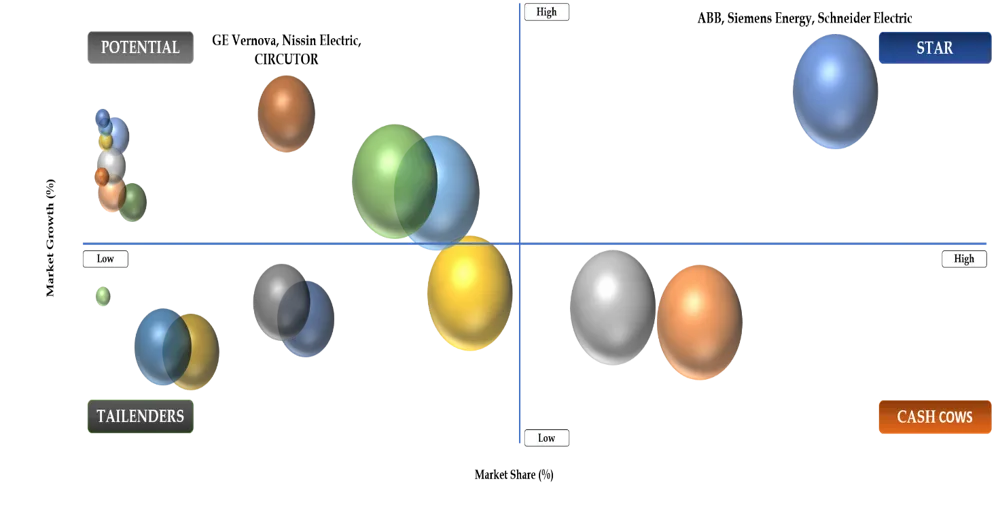
ABB, Siemens Energy, Schneider Electric, Eaton and Hitachi Energy are regarded as the leaders that have prominent competitive position in the capacitor bank industry. These companies electrical equipment range, their relationships with utility companies, as well as their ability to compensate reactive power enable them to enjoy the above-mentioned status. The rising need for automatic power factor correction, medium voltage and high voltage capacitor banks, as well as harmonic filters will allow them to improve their market positions. Futuristic investments in grid modernization, renewable energy sources, digitized monitoring and high-end switching technology will aid in sustaining their competitive success.
POTENTIAL
Some of the companies that have a good chance of enhancing their market share in the capacitor bank industry include GE Vernova, Nissin Electric, CIRCUTOR, Comar Condensatori and Enerlux Power. With their specific expertise in shunt capacitor banks, power factor correction, harmonic filters and reactive power compensation, there is an opportunity in the utility and industrial segments. Growing demands from renewable energy projects, industries and transmission lines provide an opportunity to expand the portfolio and penetrate the regional market. Investment in automatic switching systems, modular design systems and power quality management systems would enhance their competitive position further.
Capacitor Bank Market Dynamics
Driver Impact Analysis
| Driver | Market Growth Impact (%) | Demand Concentration | Impacted Use Case | Strategic Impact |
Increasing investments in power transmission and distribution infrastructure | 30% | Utilities, substations and power grids | Reactive power compensation and voltage stabilization | Drives large-scale deployment of medium- and high-voltage capacitor banks. |
Rising demand for industrial power factor correction | 28% | Manufacturing, oil & gas, chemicals, cement and mining | Power factor improvement and reduction of reactive power penalties | Accelerates adoption of automatic capacitor banks and industrial power compensation systems. |
Growing integration of renewable energy sources | 24% | Solar farms, wind power plants and renewable energy developers | Voltage regulation and reactive power compensation | Creates demand for advanced capacitor banks to support grid stability and renewable energy integration. |
Expansion of data centers and commercial infrastructure | 18% | Data centers, commercial buildings and hospitals | Power factor correction and electrical power quality management | Supports demand for compact, automatically controlled capacitor banks and advanced power distribution solutions. |
Driver: Increasing Investments in Power Transmission and Distribution Infrastructure
The increasing capital expenditure on transmission substation, distribution grids and grid upgrading are contributing to the increased demand for capacitor banks. There is an increased installation of medium voltage and high voltage shunt capacitor banks that provide reactive power compensation, voltage stabilization and reduced reactive power transmission within electric grids. The increased installation of renewable energy and increased demand for electricity are creating additional needs for grid voltage control. Capacitor banks offer an efficient solution for power factor correction and capacity augmentation within existing grids without infrastructure replacement.
Restraint Impact Analysis
| Restraint | Drag on Market Growth (%) | Primary Impact Area | Impacted Use Case | Strategic Impact |
High initial installation and equipment costs | 30% | Small and medium-sized industrial facilities, commercial establishments | Power factor correction and reactive power compensation | Limits adoption among cost-sensitive customers and extends investment payback periods. |
Risk of harmonic resonance and power quality disturbances | 25% | Industrial facilities and electrical distribution networks | Harmonic filtering and power quality management | Increases system design complexity and creates additional requirements for detuned reactors and harmonic mitigation solutions. |
Maintenance requirements and capacitor degradation | 23% | Utilities, industrial plants and substations | Voltage regulation and reactive power compensation | Raises lifecycle costs and creates challenges in maintaining long-term system reliability. |
Availability of alternative reactive power compensation technologies | 22% | Utilities, renewable energy installations and large industrial facilities | Voltage regulation and dynamic reactive power compensation | Creates competitive pressure from STATCOM, SVC and other advanced power compensation technologies, particularly in applications requiring rapid dynamic response. |
Restraint: Harmonic Resonance and Power Quality Challenges
The increased use of variable frequency drives, UPS systems, rectifiers and other non-linear loads causes distortion and can negatively impact the functioning of capacitor banks. At times, under some conditions, capacitor banks tend to resonate with the system inductance to cause heavy currents, overheating, dielectric stresses and failure of the system components. Dealing with such problems usually demands more financial resources to be spent on installing detuned reactors and harmonic filters. Such technical specifications can deter industrial consumers who are cost-conscious from using capacitor banks where there is distortion in electrical load.
Capacitor Bank Market Segmenta Analysis
The global capacitor bank market is segmented based on the voltage level, type, function, installation type, switching mechanism, connection type, application, end-user and region .
By Voltage Level
Strong Utility and Industrial Demand Positions Medium-Voltage Banks at the Forefront
The medium-voltage category (1 kV to 69 kV) was a major segment in the worldwide capacitor bank market in 2025 and held a market share of 47.9%. This market dominance can be attributed to wide application in distribution substations, industrial power grid applications and renewable energy collection systems where power factor correction plays a vital role in controlling voltage levels and minimizing distribution losses. The benefit of using medium voltage capacitor banks is that they permit power corporations and industry to enhance the power factor at the feeder level cost-effectively and provide voltage support. The demand for this voltage category will still be bolstered by higher investment in grid modernization, renewable energy connection and industrial electrification.
By Application
Renewable Energy Integration Emerges as the Fastest-Growing Application
Renewable energy integration would witness the highest rate of growth during the forecast period at a CAGR of 6.6%. The growing installation of solar and wind power systems has resulted in the increasing demand for voltage control and reactive power compensation solutions. Unlike other power generation systems, renewable power sources, which use inverters for conversion, can create unstable voltage and reactive power levels, necessitating the use of reactive power compensation equipment to ensure compliance with grid codes. A capacitor bank, specifically a switched medium voltage/high voltage shunt system, is an effective way to support voltage stabilization and manage reactive power in renewable energy power plants and substations.
Capacitor Bank Market Geographical Penetration
China Capacitor Bank Market Trends
Market for capacitor bank in China is influenced by the huge spending on ultra high voltage transmission grids, renewable energy systems and industrial power supply system. The growing installation of solar farms and wind farms has led to the growing need for medium and high-voltage shunt capacitors in order to improve reactive power compensation and voltage regulation. Moreover, the use of variable frequency drives and automation in industries is contributing to the rising demand for automatic and detuned capacitors to regulate power factor and harmonic distortion. Domestic manufacturers of electrical equipment are also stepping up production capacities to facilitate modernization of the grid and electrification of industries.
U.S. Capacitor Bank Market Landscape
Capacitor bank market in the United States is driven by developments related to the modernization of the power grid, replacing old power transmission networks and increasing electricity demand from data centers and industries. Utilities are utilizing medium voltage and high voltage shunt capacitor banks to regulate voltage levels and to manage reactive power on the grid. Increased usage of renewable energy sources, especially solar and wind energy, is also leading to the need for reactive power compensation systems on the grid side. Furthermore, industries are installing automatic and detuned capacitor banks in order to boost the power factor and resolve the problem of harmonic distortion due to variable frequency drives.
India Capacitor Bank Market Analysis
The Indian market for capacitor banks is receiving a boost from investments in transmission lines, renewable energy capacity and industrial electrification. With the increased investments in interstate transmission lines and renewable energy capacity such as solar and wind power projects, there is a higher need for medium and high voltage capacitor banks for use in reactive power compensation and voltage regulation purposes. Another key area driving the uptake of automatic power factor correction devices in India is the development within industries such as manufacturing, steel, cement, chemicals and others which are energy-intensive. Investments in smart grid infrastructure and substation automation projects is also generating new opportunities for Indian players involved in capacitor bank manufacture and technology.
Japan Capacitor Bank Market Outlook
Market drivers for Japan’s capacitor bank market include investment into grid stability, industrial automation and renewable energy deployment. Growing use of solar energy and offshore wind farms in the country has created the requirement for equipment related to power factor correction and voltage regulation in substations and grid interfaces. Upgradation of outdated electrical equipment and reliable electricity generation is creating opportunities for medium and high-voltage shunt capacitor banks. In addition, the highly developed industries of Japan including its manufacturing, semiconductor, automotive and electronics sector require automatic and detuned capacitor banks due to power factor improvement and harmonic distortion issues.
Capacitor Bank Market Competitive Landscape
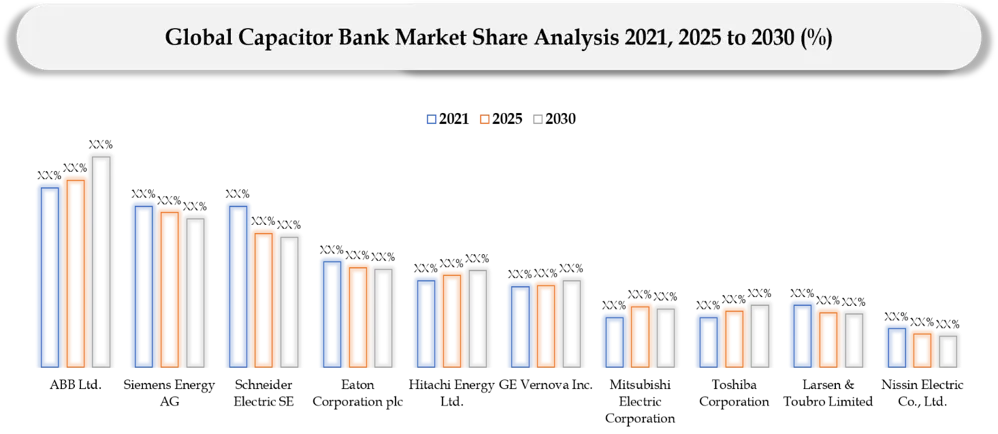
- This market environment has characteristics that include the presence of existing suppliers of electrical equipment manufacturers providing low voltage, medium voltage and high voltage capacitor banks.
- Main competitors in this market engage in expansion of their product range through the introduction of fixed capacitors, automatic capacitors, shunt capacitors, series capacitors and detuned capacitors.
- Key technological innovations in this industry include intelligent switches, harmonics management technology, digitization and capacitor protection technologies.
- Businesses are reinforcing their market presence by forming strategic alliances with utility companies, renewable energy developers and EPC contractors in order to secure substantial substation and industrial projects.
- The regional manufacturing growth, custom-designed engineering solutions and after-sales services become critical competitive elements to be awarded utility and industrial projects.
Public Company Q1-Q2 2026 Performance Comparison
The table below compares five publicly listed companies with direct exposure to the capacitor bank market. Financial metrics are company-wide or relevant business-segment figures because standalone capacitor bank revenue is generally not separately disclosed. Performance drivers therefore distinguish overall corporate growth from direct capacitor bank market exposure.
| Company | Q1–Q2 2026 Performance | Capacitor Bank Exposure | Key Performance Driver |
| GE Vernova Inc. | US$11.10 billion Q2 2026 revenue | High- and low-voltage capacitor banks, shunt capacitor banks, detuned filters and harmonic filtering solutions. | Strong electrification orders, transmission infrastructure expansion and renewable energy integration. |
| ABB Ltd. | US$18.21 billion H1 2026 revenue (Q1: US$8.73 billion; Q2: US$9.48 billion) | Power capacitors, reactive power compensation and capacitor and filter solutions. | Grid modernization investments, electrification demand and strong order growth. |
| Schneider Electric SE | US$23.35 billion H1 2026 revenue (Q1: US$11.00 billion; Q2: US$12.35 billion) | VarSet low-voltage automatic and detuned capacitor banks for power factor correction. | Data center expansion, industrial electrification and increasing demand for energy management solutions. |
| Siemens Energy AG | US$22.00 billion H1 2026 revenue (Q1: US$10.67 billion; Q2: US$11.33 billion) | Mechanically switched capacitors, shunt capacitor banks and series compensation solutions. | Transmission network expansion, grid modernization and increasing demand for grid stability solutions. |
| Eaton Corporation plc | US$15.98 billion H1 2026 revenue (Q1: US$7.45 billion; Q2: US$8.53 billion) | AutoVAR automatic capacitor banks, fixed capacitor banks and medium-voltage power capacitors. | Data center investments, electrical infrastructure expansion and increasing demand for power management solutions. |
Note: Company-level revenue should not be interpreted as capacitor bank revenue unless separately disclosed. Financial reporting periods differ across companies because of different fiscal calendars.
Key Companies of Capacitor Bank Market
- ABB Ltd. (Switzerland)
- Siemens Energy AG (Germany)
- Schneider Electric SE (France)
- Eaton Corporation plc (Ireland)
- GE Vernova Inc. (United States)
- Hitachi Energy Ltd. (Switzerland)
- Toshiba Corporation (Japan)
- Mitsubishi Electric Corporation (Japan)
- Larsen & Toubro Limited (India)
- CG Power and Industrial Solutions Limited (India)
- Nissin Electric Co., Ltd. (Japan)
- Arteche Group (Spain)
- CIRCUTOR, S.A. (Spain)
- Comar Condensatori S.p.A. (Italy)
- Enerlux Power S.r.l. (Italy)
- ZEZ SILKO s.r.o. (Czech Republic)
- Lifasa S.A. (Spain)
- Crompton Greaves (India)
- Shreem Electric Limited (India)
- American Superconductor Corporation (United States)
Company Profiles of Capacitor Bank Market
ABB Ltd.
ABB is an international company specializing in electrification and automation technology solutions, including power distribution, grid protection and power quality products. Among its product offerings are capacitor bank protection and control solutions, harmonic filter protection relays and high voltage capacitor switches that can be applied in reactive power compensation applications. Such solutions ensure safe and efficient operation of capacitor banks in both utility and industrial networks.
Competitive priorities involve enhanced protection and control of grids, expansion of digital power management services, reliable operation of capacitor bank switches and utility modernization programs.
Siemens Energy AG
Siemens Energy offers grid technology solutions for reactive power compensation, voltage regulation and transmission network stability. Siemens Energy’s product range includes mechanical switched capacitors (MSC) and mechanical switched capacitors with damping networks (MSCDN). These technologies enable better control of reactive power and management of harmonic amplification in the electrical grid.
Competitive priorities are increasing grid stability solutions, enhancing transmission grid capabilities, improving damping solutions for harmonics and integrating renewable energy sources through advanced reactive power compensation systems.
Schneider Electric SE
Schneider Electric specializes in energy management and electrical distribution systems, supplying capacitor banks to correct power factor and reactive power. The company’s products portfolio includes VarSet, VarSet Fast, VarSet Hybrid and PowerLogic PFC capacitor banks that cater to the needs of installations that have to deal with varying loads, harmonics filters and intelligent power management.
The competitive priorities of Schneider Electric include increasing the number of automatic power factor correction devices, incorporation of digital monitoring tools, developing transient free switch technology and handling power quality requirements.
Eaton Corporation
Eaton is a manufacturer of power management products that provides low- and medium-capacitor banks for industrial and commercial settings. It produces auto-switched capacitor banks called AutoVAR and MV-AutoVAR that automatically adjust capacitor stages based on load requirements to ensure the targeted power factor is maintained.
Competitive priorities involve growing the range of automatic reactive power compensators, building modular and scalable capacitor bank systems, improving industrial power quality solutions and responding to customer needs related to variable electrical loads.
Hitachi Energy Ltd.
Hitachi Energy is one of the largest vendors of grid technology and power quality equipment. It has a wide range of capacitor and filters products covering low-, medium- and high-voltage segments. Its products comprise QBank open rack shunt capacitor banks, ABBACUS metal-enclosed capacitor banks, EMPAC systems, pole mounted capacitor banks, harmonic filters and capacitor bank controllers.
Competitive priorities include the expansion of high-voltage reactive power compensation techniques, the development of smaller and more modular capacitor bank designs, enhancing the harmonic filtering abilities and grid modernization.
GE Vernova Inc.
The GE Vernova firm participates in the capacitor banks industry by having Electrification and Grid Solutions products that are low-, medium- and high-voltage capacitor banks. The company's product line consists of automatic and fixed power factor correction devices, shunt capacitor banks, pole-mounted capacitor banks, metal-enclosed capacitor banks and harmonic filters.
The competitive priorities of the firm are to enhance its grid modernization products, develop reactive power compensation solutions, design modular capacitor banks and help the utilities and industries increase their network efficiency and voltage control.
Capacitor Bank Market Major Pain Points
- High initial investment costs and installation expenses especially for large capacitor bank systems that operate at medium and high voltage could deter several cost-sensitive industrial and commercial users from adapting the technology.
- Due to harmonic resonance caused by loads that are nonlinear, overheating of the capacitors may occur leading to premature veiling and the need for new equipment such as harmonic filters and detuned reactors.
- Degradation of capacitors, breakdown of dielectrics and repeated switching contribute to increased maintenance needs and difficulties with reliable equipment operation.
- Variable load on the electricity supply system causes continuous switching of capacitor banks and consequently switching transients and increased component wear, hence reduced lifetime of components.
- The existence of competing methods of reactive power compensation, for example Static Var Compensator (SVCs) and STATCOMs, may hinder the use of capacitor banks in some applications.
Capacitor Bank Market Recent Developments
- Schneider Electric - October 2026: On October 5, 2026, Schneider Electric launched an energy storage system in India. The battery energy storage system incorporates power conversion systems, electrical infrastructure and digital energy management.
- Eaton Corporation - September 2026: Eaton signed an agreement on September 25, 2026, to acquire COL Group. This increased its manufacturing capacity and enabled expansion into the European, Middle Eastern and African data center and utility infrastructure markets.
- Hitachi Energy - September 2026: Hitachi Energy released the revised version of the product brochures for medium-voltage wet AC/DC capacitors and open rack capacitor banks and harmonic filter banks on September 24, 2026.
- Hitachi Energy - September 2026: On September 24, 2026, Hitachi Energy concluded two significant contracts with French electricity distributor Enedis worth €350 million, contributing to France's energy infrastructure upgrading. The contracts contribute to increased demand for grid products and power quality.
- ABB Ltd. - September 2026: ABB has launched the Infinitus direct current portfolio on September 21, 2026, which was designed to serve AI data center infrastructure through medium voltage power systems and DC power distribution.
Analyst View / Opinion on Capacitor Bank Market
- The market is set to benefit from further investment in transmission and distribution infrastructure as utilities will require capacitor banks to help them optimize voltage performance and control reactive power in expanding electrical grids.
- Intelligent and automatic capacitor banks are poised for acceptance among industry and commercial consumers owing to the ability to adjust to varying loads and ensure power factor consistency.
- Detuned capacitor banks have the potential for rapid growth owing to increased adoption of power electronics such as Variable Frequency Drives (VFDs), UPS and other equipment which create the need for harmonic control.
- It is anticipated that the installation of renewable energy will favor the demand for medium and high-voltage capacitor banks, especially where there are solar and wind generation systems that require reactive power control from the grid side and voltage control.
- Differentiation will shift towards areas such as digital monitoring, modularity and high-tech switching systems, which will encourage manufacturers to engage in innovation and customization of power quality solutions.
Target Audience of Capacitor Bank Market
| INDUSTRY | WHO SHOULD BUY THIS REPORT? | REASON TO BUY THIS REPORT |
| Electrical Equipment Manufacturing | Capacitor Bank Manufacturers, Power Capacitor Manufacturers and Electrical Equipment Suppliers | Assess product demand, identify technology trends and evaluate opportunities in fixed, automatic and switched capacitor banks. |
| Power Utilities | Electricity Generation Companies, Transmission System Operators and Distribution Utilities | Evaluate demand for reactive power compensation, voltage regulation and grid modernization solutions. |
| Industrial Manufacturing | Manufacturing Plant Operators, Industrial Equipment Manufacturers and Factory Energy Managers | Identify opportunities to improve power factor, reduce electricity costs and optimize industrial power consumption. |
| Renewable Energy | Solar Power Developers, Wind Energy Operators and Renewable Energy EPC Companies | Assess capacitor bank requirements for renewable energy integration, voltage stabilization and grid connectivity. |
| Oil & Gas and Petrochemicals | Oil Refiners, Pipeline Operators, Petrochemical Companies and Oilfield Service Providers | Understand demand for power factor correction and reliable electrical infrastructure across energy-intensive operations. |
| Mining & Metals | Mining Companies, Steel Manufacturers, Aluminium Producers and Mineral Processing Operators | Evaluate capacitor bank applications in heavy machinery, electric furnaces, motors and high-power industrial systems. |
| Data Centers & IT Infrastructure | Hyperscale Data Center Operators, Colocation Providers and Data Center Infrastructure Companies | Identify opportunities arising from increasing electricity demand, power quality requirements and electrical infrastructure expansion. |
| Engineering, Procurement & Construction (EPC) | Electrical EPC Contractors, Substation Contractors and Power Infrastructure Developers | Understand project specifications, procurement trends and opportunities in capacitor bank installations across utility and industrial projects. |
| Commercial Infrastructure | Commercial Building Developers, Facility Management Companies, Hospitals, Hotels and Shopping Mall Operators | Evaluate power factor correction requirements and energy efficiency opportunities in large commercial facilities. |
| Investment & Financial Services | Private Equity Firms, Venture Capital Investors, Investment Banks and Market Research Firms | Assess market growth opportunities, competitive positioning, investment potential and emerging technology developments in the capacitor bank industry. |
Why Choose DATAM?
- Data-Driven insights: Dive into detailed analyses with granular insights such as pricing, market shares and value chain evaluations, enriched by interviews with industry leaders and disruptors.
- Post-Purchase Support and Expert Analyst Consultations: As a valued client, gain direct access to our expert analysts for personalized advice and strategic guidance, tailored to your specific needs and challenges.
- White Papers and Case Studies: Benefit quarterly from our in-depth studies related to your purchased titles, tailored to refine your operational and marketing strategies for maximum impact.
- Annual Updates on Purchased Reports: As an existing customer, enjoy the privilege of annual updates to your reports, ensuring you stay abreast of the latest market insights and technological advancements. Terms and conditions apply.
- Specialized Focus on Emerging Markets: DataM differentiates itself by delivering in-depth, specialized insights specifically for emerging markets, rather than offering generalized geographic overviews. The approach equips our clients with a nuanced understanding and actionable intelligence that are essential for navigating and succeeding in high-growth regions.
- Value of DataM Reports: Our reports offer specialized insights tailored to the latest trends and specific business inquiries. The personalized approach provides a deeper, strategic perspective, ensuring you receive the precise information necessary to make informed decisions. The insights complement and go beyond what is typically available in generic databases.
What DATAM Uniquely Provides
- Detailed market segmentation of capacitor bank market on the basis of voltage, types, applications, functions, switching, connection types, applications and end users.
- Comparative analysis of fixed, automatic, detuned, shunt, series and intelligent switched capacitor banks along with technical parameters and product differentiation.
- Application-wise requirement study for various sectors like utilities, industrial applications, renewable energy projects, data centers, commercial applications and transportation applications.
- Detailed competitive study of main players in terms of product offerings, technological advancement, joint ventures, geographical distribution and competitive stance.
- Recognition of potential investment opportunities in smart power factor correction, harmonic elimination, renewable energy integration, modular capacitor banks and solutions monitored by digital solutions systems.
Questions This Report Answers
- What are the current and projected market size, growth rate and regional outlook of the global capacitor bank market?
- Which voltage levels, capacitor bank types, functions and applications account for the largest market shares and fastest growth?
- What are the key factors driving the adoption of capacitor banks across utilities, industrial facilities, renewable energy projects and data centers?
- Who are the major manufacturers in the capacitor bank market and how do their product portfolios, technologies and competitive strategies differ?
- What emerging technologies, investment opportunities and regional developments are expected to shape the future growth of the capacitor bank market?