


Canned Alcoholic Beverages Market Size and Overview
The global canned alcoholic beverages market was valued at US $39.8 billion in 2025 and is projected to reach US $115.0 billion by 2035, growing at a CAGR of 11.2% during 2026–2035. The global canned alcoholic beverages market is driven by the rising demand for ready-to-drink (RTD) alcoholic beverages, increasing consumer preference for convenient and portable beverage formats, growing adoption of low-alcohol and flavored alcoholic drinks, expansion of premium and craft beverage offerings, increasing availability through retail and online distribution channels, and the growing use of aluminum cans due to their lightweight, recyclable, and sustainable packaging advantages.
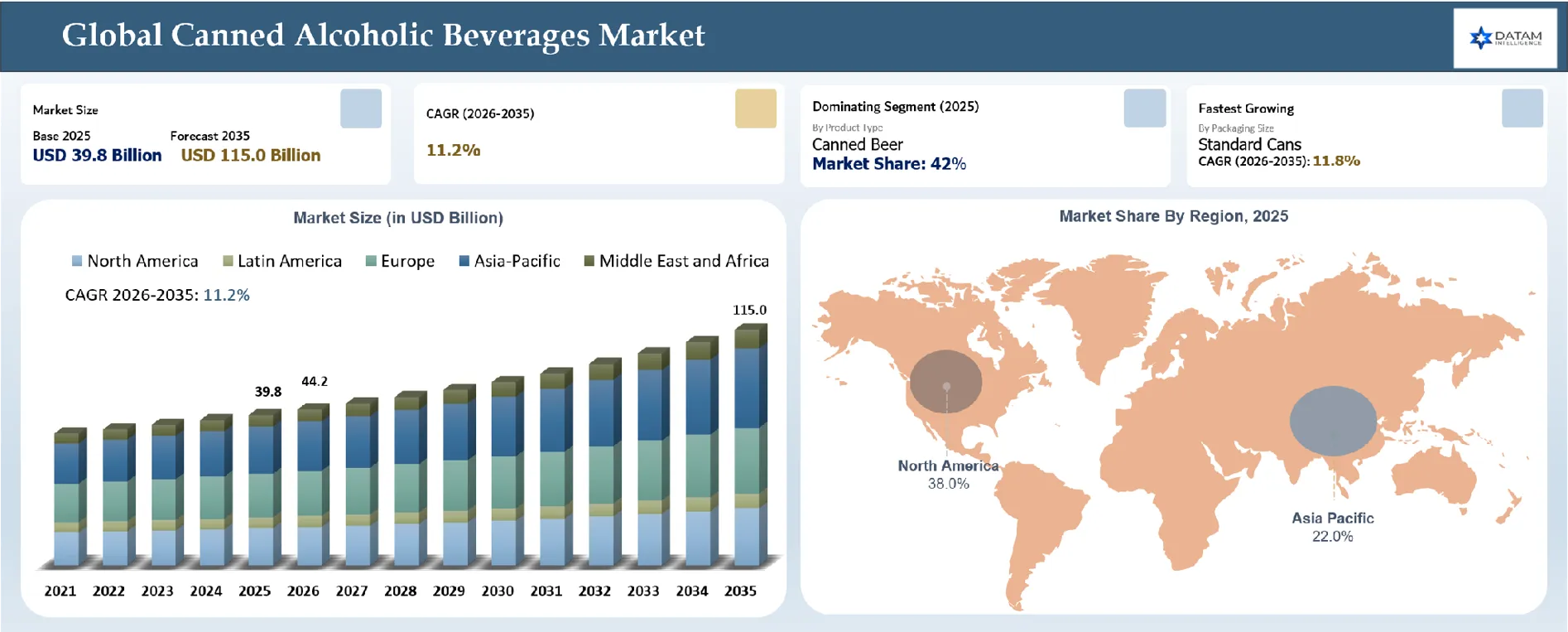
Beverage companies are expanding canned offerings through flavored RTDs, cocktail-inspired beverages, and spirit-based products. While consumer and manufacturer preference for lightweight, portable, and recyclable packaging is accelerating the adoption of cans in alcoholic beverages. According to the Brewers Association, aluminum cans accounted for 78% of craft beer packaged volume in 2025, increasing from 76% in 2024, while glass bottles represented 22% of packaged craft beer volume.
Canned Alcoholic Beverages Market Key Takeaways
- North America held the largest regional market share, accounting for approximately 38% of the global canned alcoholic beverages market in 2025, supported by strong demand for canned beer, hard seltzers, RTD cocktails, and other convenient alcoholic beverage formats. The United States and Canada remain major contributors, with established beverage industries, broad retail distribution networks, and increasing consumer acceptance of ready-to-drink alcoholic beverages.
- Canned Beer dominated the global canned alcoholic beverages market in 2025, accounting for approximately 42% of the market, supported by its established consumption base, extensive retail availability, and widespread adoption of canned packaging. Leading beer brands offer canned products across mainstream, premium, craft, and specialty categories, sustaining demand across supermarkets, convenience stores, liquor retailers, and other distribution channels.
- Standard Cans are expected to be the fastest-growing packaging size segment, with an estimated CAGR of 11.8% during 2026–2035, driven by the widespread use of 250–500 ml formats across canned beer, RTD cocktails, hard seltzers, cider, and other alcoholic beverages. The format is gaining traction across both single-serve and multipack products, supporting its adoption across diverse consumption occasions and retail channels.
Canned Alcoholic Beverages Market Industry Trends and Strategic Insight
- Premiumization and product diversification are becoming key areas of development in the canned alcoholic beverages industry as consumers increasingly seek differentiated drinking experiences. Beverage companies are introducing premium beers, craft beverages, spirit-based RTDs, fruit-flavored drinks, and specialty cocktails in cans to address demand across different consumption occasions and price points.
- Flavor innovation and reduced-sugar product development are gaining importance as manufacturers respond to changing consumer preferences for lighter and more varied alcoholic beverages. Companies are introducing fruit-forward flavors, sugar-free formulations, and lower-calorie options across hard seltzers, canned cocktails, and other RTD categories, while seasonal and limited-edition variants are being used to generate consumer interest.
- Canned alcoholic beverages are gaining wider retail penetration as beverage companies strengthen their presence across supermarkets, convenience stores, liquor retailers, and other off-premise channels. The broader availability of canned beer, RTD cocktails, hard seltzers, cider, and wine is helping brands reach consumers across casual, social, outdoor, and at-home drinking occasions.
Canned Alcoholic Beverages Market Scope
| Metrics | Details | |
| 2025 Market Size | USD 39.8 Billion | |
| 2035 Projected Market Size | USD 115.0 Billion | |
| CAGR (2026-2035) | 11.2% | |
| Largest Market | North America | |
| Fastest Growing Market | Asia-Pacific | |
| By Product Type | Ready-to-Drink (RTD) Cocktails, Hard Seltzers, Canned Beer, Canned Wine, Canned Cider, Other Canned Alcoholic Beverages | |
| By Packaging Size | Small Cans (<250 ml), Standard Cans (250–500 ml), Large Cans (>500 ml) | |
| By Alcohol Content | Low Alcohol (≤5% ABV), Medium Alcohol (5–10% ABV), High Alcohol (>10% ABV) | |
| By Distribution Channel | Supermarkets & Hypermarkets, Convenience Stores, Liquor Stores & Specialty Retailers, Online Retail, Bars & Restaurants, Others | |
| By Region | North America | U.S., Canada, Mexico |
| Europe | Germany, United Kingdom, France, Italy, Spain, Netherlands, Switzerland, Sweden, Norway, Denmark, Belgium, Poland, Austria, Ireland, Portugal, Greece, Finland, and Rest of Europe. | |
| Asia-Pacific | China, Japan, India, South Korea, Australia, New Zealand, Singapore, Malaysia, Thailand, Indonesia, Vietnam, Philippines, Taiwan, and Rest of Asia Pacific. | |
| Latin America | Brazil, Argentina, Rest of Latin America | |
| Middle East and Africa | UAE, Saudi Arabia, South Africa, Israel, Türkiye, Rest of Middle East and Africa | |
| Report Insights Covered | Competitive Landscape Analysis, Company Profile Analysis, Market Size, Share, Growth | |
Canned Alcoholic Beverages Market Disruption Analysis
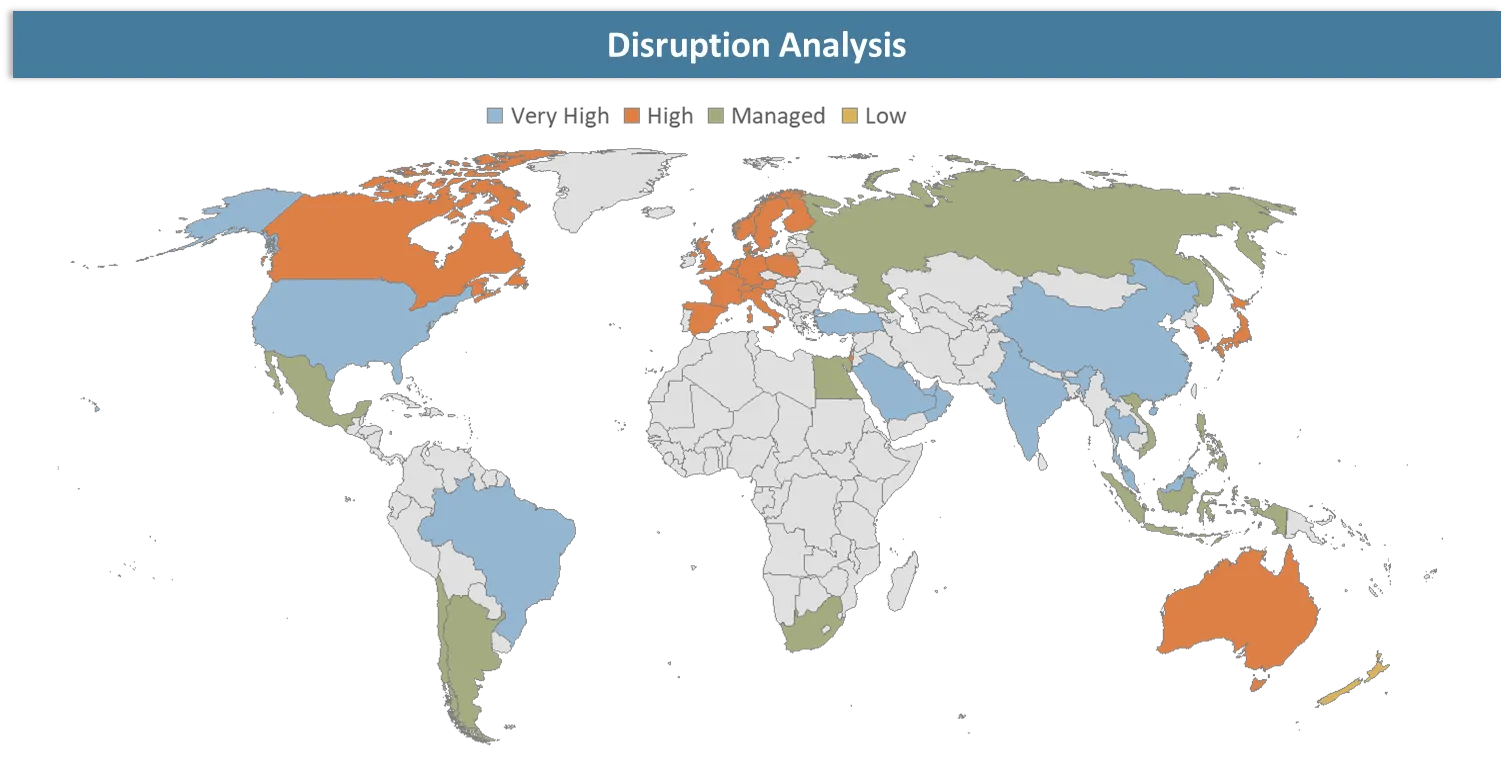
Premiumization, Moderation Trends, and Evolving Consumption Patterns Transforming the Canned Alcoholic Beverages Market
The global canned alcoholic beverages market is being reshaped by a major shift in consumer drinking habits, with increasing preference for convenient, personalized, and experience-driven alcoholic beverages. Traditional categories such as beer and wine are facing disruption from the rapid emergence of ready-to-drink (RTD) cocktails, spirit-based canned beverages, hard seltzers, and flavored alcoholic drinks. Consumers are increasingly seeking products that offer unique flavors, lower alcohol content, portion control, and ease of consumption, encouraging manufacturers to diversify their product portfolios.
The market is also experiencing disruption from the rise of premium and craft beverage offerings, as companies introduce bar-inspired canned cocktails, specialty brews, and limited-edition products to differentiate themselves in a competitive environment. Changing social consumption patterns, including outdoor events, casual gatherings, and at-home consumption, are further accelerating demand for portable canned formats. Additionally, younger consumers are influencing product development through preferences for experimentation, authenticity, and innovative beverage experiences.
Canned Alcoholic Beverages Market BCG Matrix: Company Evaluation

Anheuser-Busch InBev, Heineken, Asahi Group Holdings, Diageo, and Molson Coors are positioned as Stars, supported by strong global beverage portfolios, extensive distribution networks, and broad exposure to canned beer and RTD products. Constellation Brands, Suntory, Kirin, and Carlsberg are positioned as Potential-to-Star companies, reflecting established brands and growth opportunities in canned and RTD alcoholic beverages.
Pernod Ricard, Bacardi, Campari, Brown-Forman, Boston Beer, Mark Anthony Brands, Tsingtao Brewery, and United Breweries are positioned as Question Marks, with established beverage businesses but comparatively narrower positioning in canned alcoholic beverages. No company from the selected list is classified as a Tailender, as all maintain established participation in the alcoholic beverage industry.
Canned Alcoholic Beverages Market Dynamics
Driver Impact Analysis
| Driver | Market Growth Impact (%) | Demand Concentration | Impacted Product Areas | Strategic Impact |
Rising Adoption of Ready-to-Drink (RTD) Alcoholic Beverages | 30% | Strong demand across North America, Europe, and Asia-Pacific, particularly in the U.S., U.K., Japan, Australia, and South Korea, driven by convenience-focused consumption and preference for pre-mixed beverages. | RTD cocktails, spirit-based canned beverages, malt-based RTDs, flavored alcoholic drinks | Expands demand for convenient, ready-to-consume formats while encouraging beverage companies to develop new flavors, premium formulations, and cocktail-inspired products with consistent taste and quality. |
Growing Consumer Preference for Low-Alcohol and Moderation-Focused Beverages | 25% | High concentration across North America and Europe, with increasing adoption among younger consumers seeking lower-calorie, lower-sugar, and lighter alcoholic options. | Hard seltzers, low-ABV RTDs, light beers, flavored alcoholic beverages | Encourages manufacturers to introduce products with reduced alcohol content, healthier positioning, and transparent ingredient profiles while supporting innovation in formulation and packaging. |
Increasing Demand for Portable and Convenient Alcoholic Beverage Formats | 20% | Strong demand across urban markets, outdoor recreation markets, festivals, sporting events, and travel-related consumption channels globally. | Aluminum canned beer, canned cocktails, canned wine, cider, single-serve alcoholic beverages | Supports the shift from traditional glass packaging toward cans due to lightweight handling, durability, portability, and suitability for on-the-go consumption occasions. |
Premiumization and Product Innovation in Alcoholic Beverages | 15% | Concentrated in developed markets such as the U.S., Canada, Western Europe, Japan, and Australia, where consumers look for premium experiences and differentiated products. | Premium RTD cocktails, craft canned beer, specialty wines, botanical and flavored alcoholic beverages | Drives manufacturers to invest in unique flavors, premium ingredients, innovative formulations, and attractive packaging designs to differentiate products in a competitive market. |
Expansion of Retail and Digital Alcohol Distribution Channels | 10% | Broad demand across developed and emerging markets, supported by supermarkets, convenience stores, specialty alcohol retailers, and online alcohol delivery platforms. | Packaged canned alcoholic beverages across retail channels | Improves product accessibility, enables wider brand reach, and supports smaller beverage companies in reaching consumers through e-commerce and direct-to-consumer platforms. |
Growing Consumer Preference for Convenient Ready-to-Drink (RTD) Alcoholic Beverages
The increasing preference for convenient, pre-mixed alcoholic beverages is accelerating demand for canned alcoholic products. RTD beverages eliminate preparation requirements, provide consistent taste, and appeal to consumers seeking portable options for social occasions, outdoor activities, and at-home consumption. According to the Distilled Spirits Council of the United States (DISCUS), U.S. premixed cocktails, including spirits-based RTDs, increased 16.5% in sales during 2024, adding approximately US$468 million in revenue compared with the previous year. The category reached US$3.3 billion in sales in 2024.
Restraint Impact Analysis
| Restraint | Market Growth Impact (%) | Demand Concentration | Impacted Use Case | Strategic Impact |
Stringent Alcohol Regulations and Taxation | 30% | Strong impact across North America, Europe, Asia-Pacific, and other markets with strict alcohol licensing, taxation, advertising, and distribution regulations. | Canned beer, hard seltzers, RTD cocktails, canned wine, spirit-based RTDs | High excise duties, alcohol-specific taxes, age restrictions, licensing requirements, and advertising regulations can increase retail prices and restrict market access, particularly for premium and higher-ABV canned beverages. |
Fluctuations in Aluminum Can and Packaging Costs | 25% | Significant impact across North America, Europe, and Asia-Pacific, particularly in regions dependent on aluminum and packaging-material supply chains. | Aluminum cans, slim cans, specialty cans, printed cans, secondary packaging | Volatility in aluminum, energy, printing, and transportation costs can increase production expenses and pressure margins. Beverage companies may optimize can sizes, packaging designs, sourcing strategies, and recycled aluminum usage. |
Health Concerns Associated with Alcohol Consumption | 20% | Strong impact in developed markets and increasingly relevant across urban markets in Asia-Pacific and other emerging economies. | Beer, hard seltzers, canned cocktails, wine-based RTDs, high-ABV products | Growing awareness of alcohol-related health risks can discourage frequent consumption and encourage consumers toward moderation, alcohol-free alternatives, low-ABV beverages, and functional or better-for-you formulations. |
Competition from Alcohol-Free and Alternative Beverages | 15% | Broad impact across Europe, North America, and increasingly Asia-Pacific, where consumers have greater access to non-alcoholic beer, mocktails, functional beverages, and soft drinks. | Low-ABV RTDs, hard seltzers, canned cocktails, beer, social drinking occasions | Expansion of alcohol-free beer, mocktails, functional beverages, energy drinks, and premium soft drinks can capture occasions traditionally served by alcoholic beverages, particularly among younger and moderation-focused consumers. |
Perishability and Quality Challenges in Canned Wine and RTD Products | 10% | Higher impact in markets with long distribution chains, temperature fluctuations, and limited cold-chain infrastructure. | Canned wine, cocktails, beer-based RTDs, fruit-flavored alcoholic beverages | Flavor degradation, oxidation, carbonation loss, leakage, and stability issues can affect product quality and consumer acceptance. Manufacturers must invest in appropriate formulations, can coatings, processing technologies, and storage conditions. |
Stringent Alcohol Regulations and Taxation Restrict Market Expansion
Stringent alcohol regulations and taxation can restrain the growth of the canned alcoholic beverages market by increasing product prices, limiting distribution, and restricting marketing activities. Canned beer, hard seltzers, RTD cocktails, and canned wine are subject to excise duties, licensing requirements, minimum-age restrictions, labeling standards, and advertising regulations, which vary across countries and regions. For instance, in the U.S., federal and state-level alcohol taxes and regulations can create different pricing and market-access conditions across states, while in India, alcohol is primarily regulated at the state level, with individual states imposing different excise duties, licensing requirements, and retail restrictions. In the U.K., alcohol duty rates are linked to alcohol strength, potentially increasing the tax burden on higher-ABV canned beverages.
Canned Alcoholic Beverages Market Segment Analysis
The global canned alcoholic beverages market is segmented based on product type, packaging size, alcohol content, distribution channel and region.
Canned Beer Dominant Share Supported by Strong Consumer Base and Premiumization
Canned beer holds a significant share due to its established consumer base, broad product availability, and strong presence across retail channels. Major brands such as Heineken, Corona, Kingfisher, and Budweiser offer canned variants across lager, and premium beer categories, supporting the segment’s widespread adoption across supermarkets, convenience stores, and liquor retailers.
Premiumization is becoming increasingly visible in the canned beer segment, with breweries introducing craft and specialty beers in packaged formats. The trend is bringing more differentiated beer styles, including pilsners, wheat beers, and specialty lagers, into organized retail channels. For instance, in April 2026, Independence Brewing Company launched its first super-premium beers in cans, introducing ENZO and WIT UNO across eight cities in India. The products were made available through approximately 2,000 retail outlets, expanding the brewery’s craft beer portfolio into the packaged and on-the-go segment.
Canned Alcoholic Beverages Market Geographical Penetration
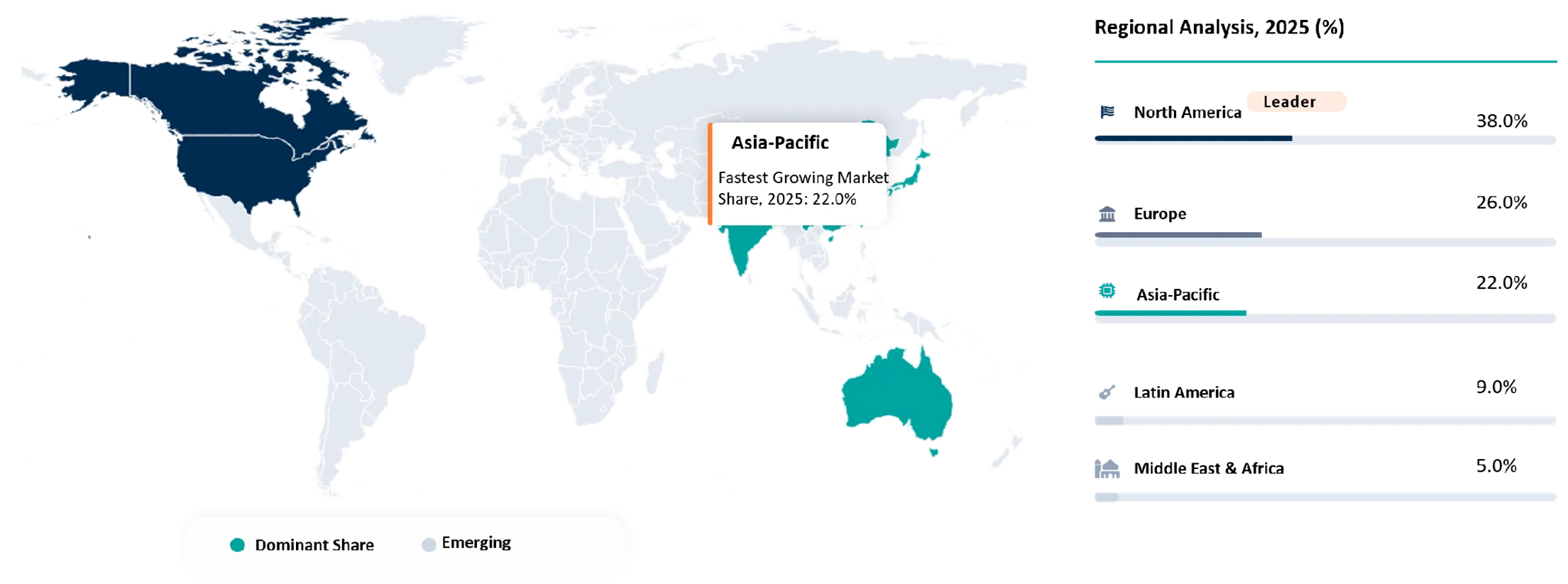
Established Alcoholic Beverage Market Supporting Canned Beverage Growth
North America is a strong market for canned alcoholic beverages, supported by the established beer industry in the U.S. and Canada and the growing availability of hard seltzers, coolers, canned cocktails, and other RTD alcoholic beverages. In Canada ciders and coolers category increased its share of alcoholic-beverage sales from 8.7% in 2023/24 to 9.3% in FY 2024/25, making it the only category to gain share during the period. Furthermore, nation such as Canada has a well-established retail and production ecosystem for packaged alcoholic beverages. In 2024/25, beer remained Canada's largest alcoholic-beverage category, generating approximately US$6.54 billion in sales, while ciders and coolers generated approximately US$1.72 billion.
U.S. Brands Expand Premium Canned Formats Through Product Innovation
The U.S. is a key market for canned alcoholic beverages, supported by the rapid adoption of ready-to-drink (RTD) cocktails, hard seltzers, and other convenient packaged alcoholic drinks. The country also has a large and established spirits industry, with more than 2,200 distilleries operating across the country, according to the Distilled Spirits Council of the United States (DISCUS).
U.S. beverage companies are increasingly expanding their canned alcoholic beverage portfolios with premium products, innovative packaging formats, and diverse flavor profiles. For instance, in September 2025, Sierra Nevada Brewing Co. launched PILS in a new 8.4-ounce can format, introducing an 8-pack designed to deliver a premium pilsner drinking experience. The European-inspired pilsner features a 4.7% ABV profile with citrus, floral, and malt flavors and was expanded to nationwide draft availability. The launch reflects Sierra Nevada’s focus on premium canned beer formats and enhanced consumer drinking experiences
Asia Pacific Rising Adoption of Convenient and Premium Alcoholic Beverages
The Asia Pacific alcoholic beverage market is supported by large beer-consuming countries such as China, Japan, India, and Thailand, alongside strong demand for convenient and packaged alcoholic beverages. In 2024, global beer consumption reached approximately 194.12 million kiloliters, with China remaining the largest beer-consuming country, while India recorded 14.6% growth in beer consumption.
Asia Pacific’s alcoholic beverage market is witnessing growing demand for convenient, premium, and ready-to-drink alcoholic beverages. Manufacturers are expanding their canned product portfolios through new flavors, formats, and RTD offerings to meet changing consumer preferences. For instance, in March 2026, Asahi Group announced the launch of Asahi CLEAR HIGHBALL in South Korea, marking the company’s first Asahi-branded canned RTD in the market. The 350ml, 5% ABV whisky-based drink is available in Original and Lemon variants, supporting Asahi’s strategy to expand its RTD portfolio in South Korea’s rapidly growing RTD market.
China’s Beer Industry Creates Opportunities for Canned Alcoholic Beverages
China is a large and established alcoholic beverage market, with beer, baijiu, and other alcoholic drinks forming the core of consumption. China produced approximately 35.21 billion liters of beer in 2024, maintaining its position as the world's largest beer-producing market. Meanwhile, Tsingtao Beer recorded product sales of 3.99 million kiloliters in the first three quarters of 2025, representing 4.1% year-on-year growth. The large scale of beer consumption provides a strong foundation for packaged formats, including canned beer and other ready-to-drink alcoholic beverages.
The market is increasingly supported by changing consumer preferences, convenient packaged formats, and growing interest in newer alcoholic beverages such as RTD cocktails and flavored drinks. In 2025, China's retail sales of tobacco and liquor increased 2.7%, while beverage retail sales increased 1.0%, indicating continued consumer spending across packaged beverage categories.
Japan’s Growing Demand for Low-Sugar and Meal-Friendly RTD Beverages
Japan is a well-established market for canned alcoholic beverages, particularly RTD drinks such as chūhai, canned cocktails, and fruit-based alcoholic beverages. The market is supported by strong consumer acceptance of convenient, ready-to-drink formats and continued demand for refreshing, fruit-forward and low-sugar options. Japanese consumers are increasingly preferring beverages with less sweetness that can be consumed with meals. Kirin reported that RTDs carrying a "sugar-free" designation increased their share from 4% in 2020 to 24% in 2024. Its Hyoketsu Muto series also surpassed 1.3 billion cans cumulatively by the end of 2024.
Product innovation is helping brands attract new consumers while strengthening the appeal of convenient, flavor-led alcoholic beverages. For instance,, in December 2025, Suntory announced the limited-time launch of -196 Ruby Grapefruit, a 350ml, 5% ABV fruit-flavored chu-hi, across Japan. The launch followed strong performance of the -196 series, which exceeded its annual sales target and reached 60 million bottles by October 2025, as Suntory sought to expand its consumer base and stimulate the RTD market.
Canned Alcoholic Beverages Market Competitive Landscape
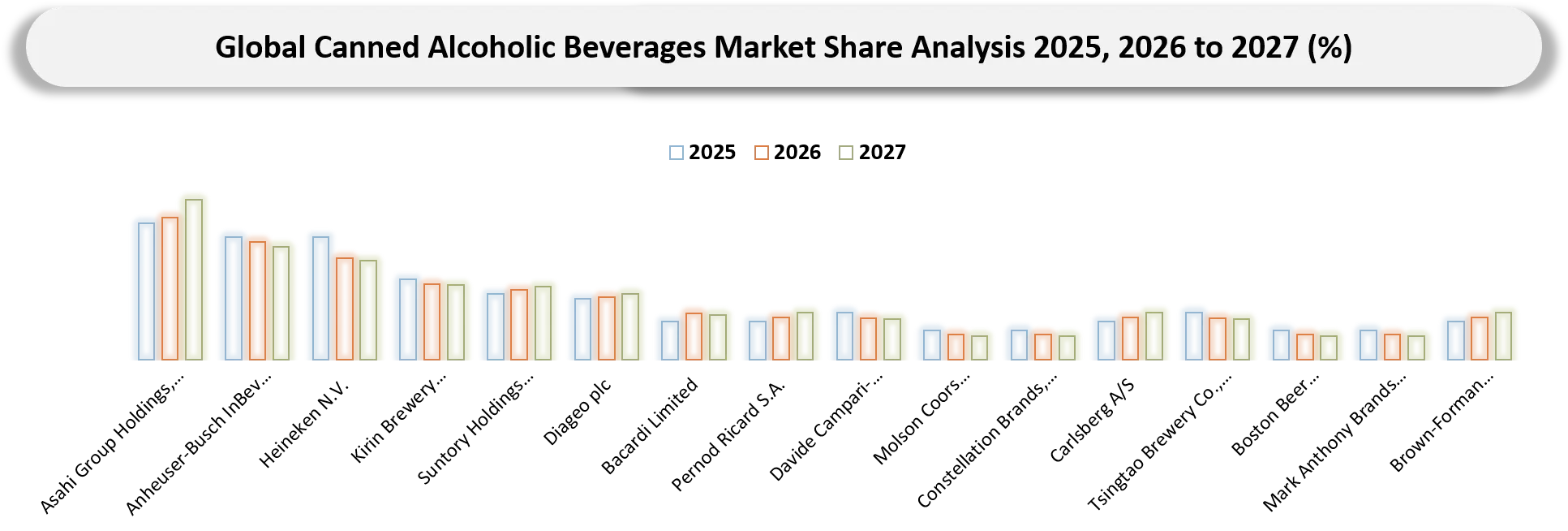
- Group Holdings, Ltd., Anheuser-Busch InBev SA/NV, Heineken N.V., Kirin Brewery Company, Limited, Suntory Holdings Limited, Diageo plc, Bacardi Limited, Pernod Ricard S.A., Davide Campari-Milano N.V., and Molson Coors Beverage Company are among the notable players. Competition is primarily focused on product innovation, flavor variety, brand strength, premiumization, packaging formats, distribution networks, production capacity, and the development of convenient alcoholic beverages to address changing consumer preferences.
- Asahi Group Holdings, Ltd. (Japan), Anheuser-Busch InBev SA/NV (Belgium), Heineken N.V. (Netherlands), Kirin Brewery Company, Limited (Japan), Suntory Holdings Limited (Japan), Diageo plc (United Kingdom), Bacardi Limited (Bermuda), Pernod Ricard S.A. (France), Davide Campari-Milano N.V. (Italy), Molson Coors Beverage Company (United States), Constellation Brands, Inc. (United States), Carlsberg A/S (Denmark), Tsingtao Brewery Co., Ltd. (China), The Boston Beer Company, Inc. (United States), Mark Anthony Brands International ULC (Canada), and Brown-Forman Corporation (United States) are among the key companies operating in the global canned alcoholic beverages market.
Recent Developments
- September 2026: Rupee Beer expanded its U.S. distribution into Nevada through a partnership with Southern Glazer’s Wine & Spirits. The launch introduces the Indian-inspired beer brand’s portfolio, including Basmati Rice Lager, IPA, Mango Wheat Ale, and non-alcoholic beer, to Las Vegas and surrounding markets. The expansion strengthens Rupee Beer’s presence across the U.S., where it is distributed in 24 states. The company aims to capitalize on growing consumer interest in global cuisines and food-pairing beverages.
- August 2026: Great Lakes Brewing Company launched aSPLASH, its first ready-to-drink (RTD) canned cocktail, developed with Watershed Distillery using Four Peel Gin. The gin-based long drink combines grapefruit and orange flavors and is available in 6% ABV and 4% ABV variants. The product expands Great Lakes Brewing Company’s portfolio beyond beer into the growing canned cocktail segment. It will be distributed through retail stores in Ohio and the company’s Ohio City brewpub.
- December 2025: Suntory announced the limited-time launch of -196 Ruby Grapefruit, a 350ml, 5% ABV fruit-flavored chu-hi, across Japan. The launch followed strong performance of the -196 series, which exceeded its annual sales target and reached 60 million bottles by October 2025, as Suntory sought to expand its consumer base and stimulate the RTD market.
- September 2025: Sierra Nevada Brewing Co. launched PILS in a new 8.4-ounce can format, introducing an 8-pack designed to deliver a premium pilsner drinking experience. The European-inspired pilsner features a 4.7% ABV profile with citrus, floral, and malt flavors and was expanded to nationwide draft availability. The launch reflects Sierra Nevada’s focus on premium canned beer formats and enhanced consumer drinking experiences.
Key Procurement Priorities and Buyer Evaluation Criteria
- Buyers prioritize products that provide consistent taste, alcohol content, product quality, shelf stability, packaging integrity, and convenience while meeting applicable food, beverage, and alcohol regulations across target markets.
- Evaluation is based on criteria such as product taste and quality, alcohol-by-volume (ABV), flavor profile, ingredient quality, shelf life, carbonation stability, can size and format, packaging durability, labeling compliance, portability, brand recognition, and compatibility with consumer preferences and retail requirements.
- Producers, distributors, retailers, and other buyers consider factors including product cost, production and packaging expenses, transportation and storage costs, minimum order quantities, delivery timelines, shelf life, inventory requirements, expected sales performance, and total procurement cost. Consistent product availability and reliable supply are also important when selecting alcoholic beverage manufacturers for continuous retail and distribution operations.
- Preference is given to manufacturers with proven beverage quality, strong brand portfolios, reliable ingredient and raw-material sourcing, efficient production capabilities, robust quality-control systems, regulatory expertise, and the ability to offer different canned formats, flavors, alcohol strengths, and product categories to address diverse market requirements.
- Alcoholic beverage distributors, supermarkets, convenience stores, liquor retailers, restaurants, bars, hospitality companies, event operators, and other commercial buyers particularly prioritize suppliers that can provide consistent product quality, attractive packaging, reliable replenishment, diverse flavor and product options, regulatory compliance, and scalable supply capabilities across different markets.
Why Choose DataM?
- Product & Packaging Innovations: Examines developments in canned alcoholic beverages, including new RTD cocktails, hard seltzers, canned beer, cider, canned wine, premixed spirits, low- and no-sugar formulations, and innovative can formats. The analysis evaluates how manufacturers use flavor innovation, alcohol-strength variations, serving sizes, packaging formats, and product formulations to address changing consumer preferences and differentiate their offerings.
- Product Performance & Market Positioning: Evaluates canned alcoholic beverages based on taste, flavor profile, alcohol-by-volume (ABV), ingredient quality, shelf life, carbonation stability, packaging integrity, convenience, portability, and product positioning. The analysis also assesses how manufacturers position premium, mainstream, low-calorie, low-sugar, flavored, and convenience-oriented products across different alcoholic beverage categories.
- Real-World Evidence: Examines actual product launches, manufacturing facilities, canning operations, retail availability, distribution agreements, and market introductions across beer, hard seltzer, RTD cocktails, cider, wine, and premixed alcoholic beverages. The analysis provides evidence of how manufacturers and brands are responding to consumer demand across supermarkets, convenience stores, liquor retailers, restaurants, bars, hospitality venues, and e-commerce channels.
- Market Updates & Industry Changes: Tracks key developments such as new product launches, production and canning capacity additions, manufacturing facility investments, flavor innovations, brand extensions, acquisitions, strategic partnerships, distribution agreements, and investments in RTD and hard seltzer production across North America, Europe, Asia Pacific, Latin America, and the Middle East & Africa.
- Competitive Strategies: Analyzes how leading alcoholic beverage manufacturers strengthen their positions through new product development, expansion of RTD and hard seltzer portfolios, flavor diversification, premiumization, geographic expansion, acquisitions, strategic partnerships, distribution network development, and investments in manufacturing and canning capacity.
- Pricing & Market Access: Explains variations in canned alcoholic beverage pricing based on product category, alcohol content, ingredients, flavor formulation, can size, packaging format, brand positioning, production costs, distribution expenses, taxation, and market-specific regulations. The analysis also evaluates market access through supermarkets, convenience stores, liquor retailers, restaurants, bars, hospitality operators, distributors, and e-commerce channels.
- Market Entry & Expansion: Identifies growth opportunities driven by rising demand for convenient alcoholic beverages, RTD cocktails, hard seltzers, premium canned products, flavor innovation, lower-sugar formulations, and single-serve formats. The analysis also outlines strategies such as establishing local production capabilities, forming distribution partnerships, launching region-specific flavors, expanding retail networks, developing localized product portfolios, and strengthening brand presence across emerging and established markets.
Target Audience
- Alcoholic Beverage Manufacturers, Canned Beverage Producers, and RTD Beverage Companies
- Breweries, Craft Beer Producers, and Canned Beer Manufacturers
- Alcoholic Beverage Packaging Companies and Aluminum Can Manufacturers
- Ingredient Suppliers, Flavor Manufacturers, and Beverage Formulation Companies
- Contract Beverage Manufacturers and Co-Packing Companies
- Alcohol Distribution Companies, Wholesalers, and Beverage Importers
- Supermarkets, Hypermarkets, Convenience Stores, and Specialty Retailers
- Online Alcohol Retail Platforms and E-Commerce Beverage Distributors
Bars, Restaurants, Hospitality Companies, and Entertainment Venues



























































