


Canada Smart Hospitals Market Overview
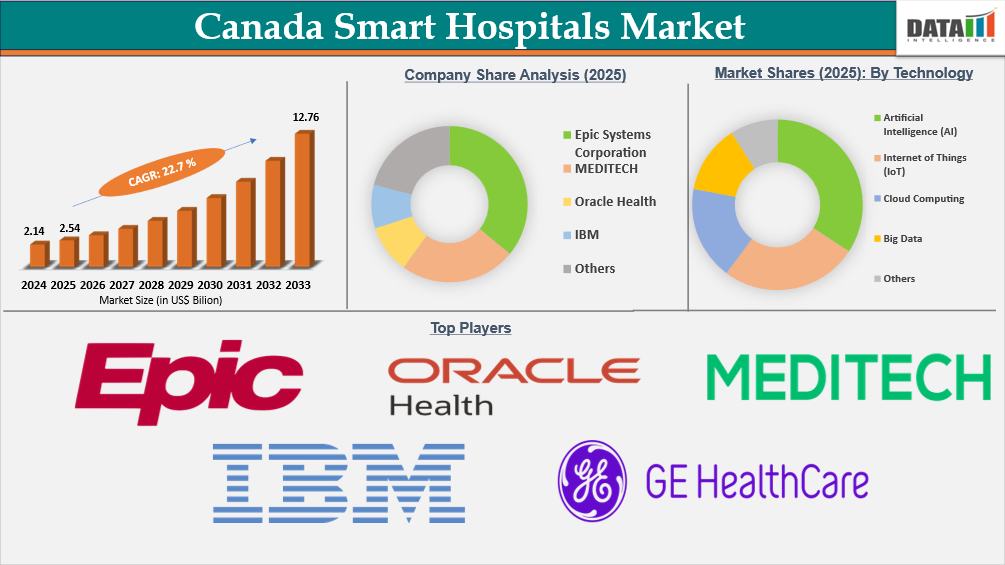
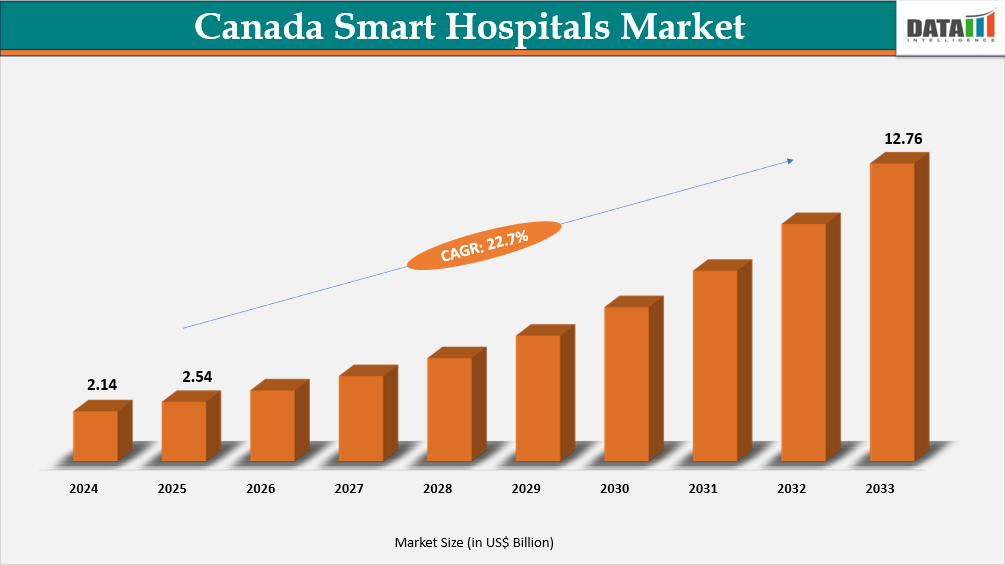
The Canada Smart Hospitals Market reached US$ 2.14 Billion in 2024, rising to US$ 2.54 Billion in 2025 and is expected to reach US$ 12.76 Billion by 2033, growing at a CAGR of 22.7% from 2026 to 2033.
The market for smart hospitals in Canada is growing as medical facilities speed up digital transformation to improve care coordination, patient safety, and operational efficiency. As of 2023, 7.4 million individuals, or 18.9% of Canada's population, are 65 years of age or older. This percentage is predicted to increase gradually over the following ten years, which would increase demand for inpatient and outpatient treatments and further strain hospital resources. As a result, hospitals are progressively implementing telehealth platforms, automated dispensing technologies, IoT-enabled monitoring devices, AI-assisted clinical decision systems, and integrated electronic health records (EHRs) to optimize workflows, enhance resource efficiency, and lower medical errors.
As automation and digital prescription reduce adverse drug events and increase compliance, medication safety and operational efficiency continue to be important factors. Smarter, safer, and more effective care delivery is made possible by federal and provincial digital health efforts that support cybersecurity, interoperability, and hospital IT infrastructure upgrading. The confluence of demographic pressures, growing service demand, and government-backed digital health plans is preparing Canada's smart hospital industry for sustainable long-term development, despite ongoing hurdles including system integration, cybersecurity threats, and worker training.
Smart Hospitals Industry Trends and Strategic Insights
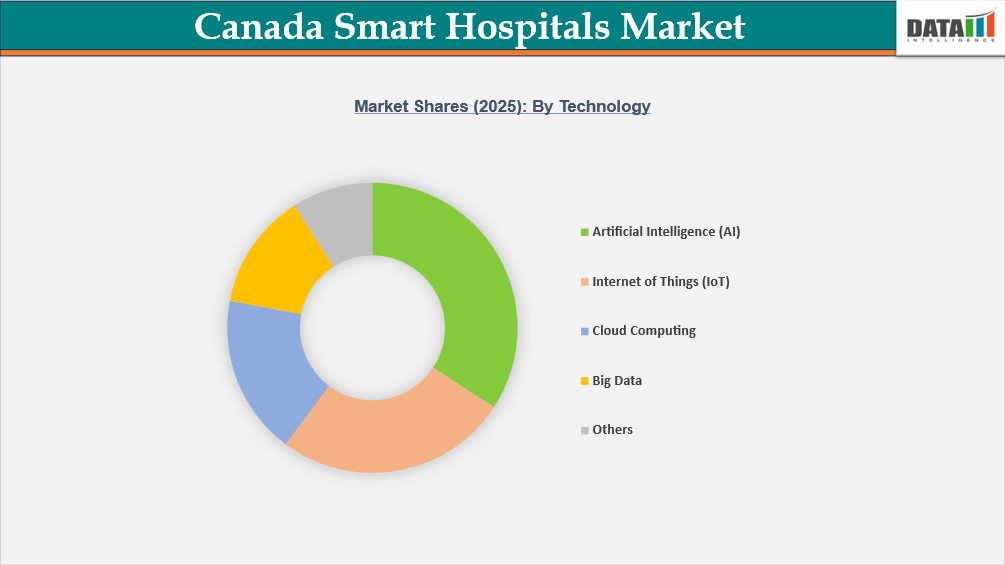
- By Technology, Artificial Intelligence (AI) led the Canada Smart Hospitals Market, capturing the largest revenue share of 34.21% in 2025.
Canada Smart Hospitals Market Size and Future Outlook
- 2025 Market Size: US$ 2.54 Billion
- 2033 Projected Market Size: US$ 12.76 Billion
- CAGR (2026–2033): 22.7%
Market Dynamics
Rising Adoption of AI, IoT, and Advanced Digital Health Technologies
Canada's smart hospital industry is driven largely by the increased use of artificial intelligence (AI), the Internet of Things (IoT), and other advanced digital health technologies to improve the clinical outcomes, operational efficiency, and patient safety of hospitals. Clinical decision support software powered by AI helps physicians make more timely and more accurate diagnoses, while also improving their ability to develop optimal treatment plans for their patients. Hospitals are also using predictive analytics to manage their resources proactively by monitoring patients throughout their hospital stay. Medical devices connected by IoT allow healthcare professionals to monitor their patients' vital signs in real-time, thereby allowing them to detect any potential complications early. Furthermore, digital health platforms provide hospitals with electronic health records (EHRs), automated workflows, and other integrated digital technologies to streamline administrative functions and reduce the frequency of human error, while at the same time facilitating care coordination. Together, these tools allow hospitals to cope with growing patient loads, limited staffing, and an increasingly complex delivery of healthcare and position the healthcare systems in Canada to provide more efficient, safer and patient-centered care than previously possible.
Segmentation Analysis
The Canada Smart Hospitals Market is segmented based on component, technology, molecule type, application, connectivity and end-user.
Artificial Intelligence (AI) in Canada Smart Hospitals
Artificial intelligence (AI) is accelerating the growth of smart hospitals in Canada by improving clinical treatment, operational efficiency, and decision-making across health systems. A rising number of Canadian healthcare institutions are using AI tools to assist clinical processes, with over 150 clinical AI projects reported throughout the country, many of which are now being deployed in hospital settings for diagnostic support, risk prediction, and workflow automation. According to recent industry statistics, AI usage in Canadian healthcare is rapidly increasing, with 87% of businesses reporting the use of AI in patient care, including medical record management, clinical data analysis, and treatment personalization—far above global standards. Ongoing government and private sector investments in AI solutions aimed at improving access and care quality promote the use of these technologies to improve care delivery, such as machine learning algorithms in diagnostic imaging and predictive monitoring.
Competitive Landscape
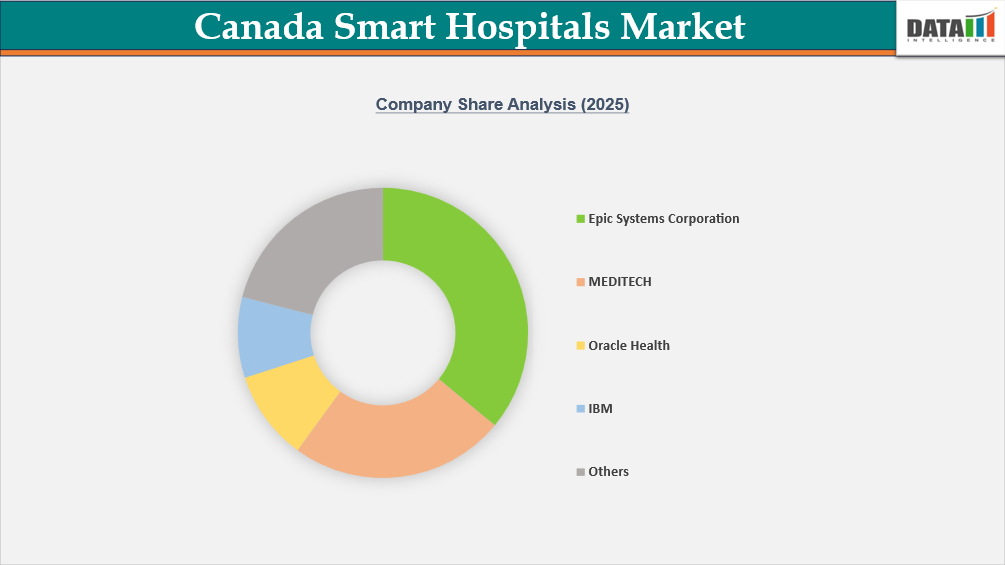
The Canada Smart Hospitals Market's competitive environment is relatively consolidated, with global technology giants and Canadian digital health providers dominating. Epic Systems Corporation, MEDITECH, IBM, and Oracle Health are among the leading providers of EHR platforms, cloud infrastructure, AI analytics, and interoperability solutions that serve as the foundation for smart hospital operations. Multinational medical technology companies such as GE Healthcare, Siemens Healthineers, and Koninklijke Philips N.V. maintain a strong presence in hospitals by offering diagnostic imaging, patient monitoring, IoT-enabled devices, and workflow automation solutions that address operational efficiency, patient safety, and real-time clinical insights.
Particularly at community and specialty hospitals, smaller Canadian firms like Altera Digital Health and LGI Healthcare promote regional EMR adoption, telehealth integration, and virtual care platforms. As hospitals place more emphasis on enhancing care quality, data-driven decision-making, and cost-effective digital transformation, the main competitive strategies influencing market positioning are strategic alliances, AI-driven clinical decision support, connected device integration, and automated workflow solutions.
Key Developments
- In January 2026, Fraser Health Authority installed an AI-powered discharge summary tool within its MEDITECH Expanse EHR system, resulting in significant gains in discharge efficiency. Using this generative AI solution, clinicians reduced average discharge documentation time from 12.5 to 5.5 minutes per patient, freeing up staff time and facilitating care transitions.
What Sets This Canada Smart Hospitals Market Intelligence Report Apart
- Latest Data & Forecasts – Comprehensive and up-to-date market intelligence with forecasts through 2033, covering Canada demand across key segments including component, technology, application, connectivity, and end-user, with detailed value-based analysis and growth projections.
- Regulatory Intelligence – In-depth assessment of Canadian healthcare regulatory frameworks impacting smart hospital adoption and commercialization, including provincial health data privacy laws, Health Canada oversight for AI-enabled medical technologies and connected devices, Canada Health Infoway interoperability initiatives, cybersecurity regulations, and federal and provincial digital health transformation programs.
- Competitive Benchmarking – Structured benchmarking of leading technology providers, healthcare IT vendors, medical device manufacturers, cloud service providers, and system integrators based on solution portfolios, innovation capabilities, deployment models, pricing structures, strategic partnerships, and geographic presence across Canada.
- Actionable Strategies & Cost Dynamics – Strategic insights into digital transformation roadmaps, ROI optimization models, pricing structures, interoperability challenges, cybersecurity investments, infrastructure modernization costs, and partnership strategies supported by expert perspectives from healthcare executives, digital health specialists, regulatory advisors, and technology providers operating within the Canadian healthcare ecosystem.


























































