


Canada PFAS CRM Market Size and Overview
The Canadian Per- and Polyfluoroalkyl Substances Certified Reference Materials (PFAS CRM) market is estimated at USD 1.60 million in 2025 and is projected to reach approximately USD 5.15 million by 2035, growing at an assumed CAGR of 12.4% during 2026–2035. These figures are model-based estimates for this analysis, as a verified public estimate for Canada's standalone PFAS CRM market was not identified.
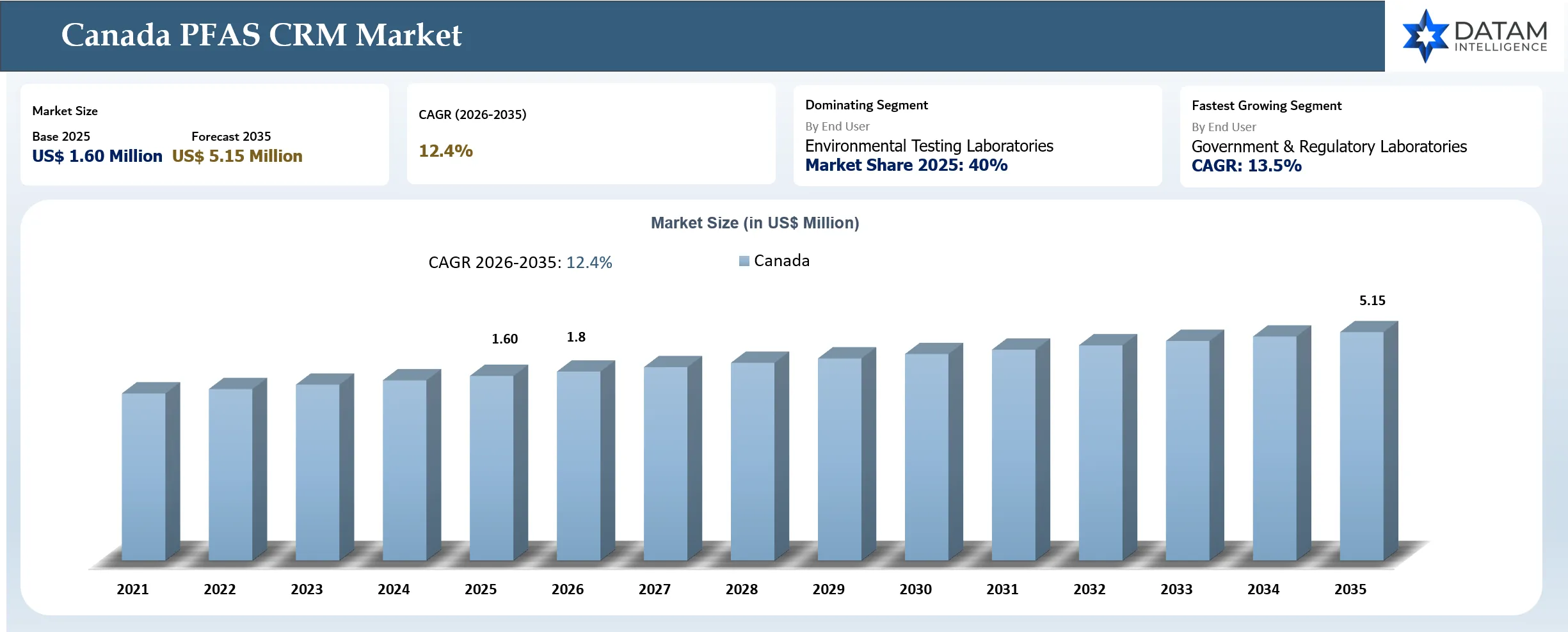
The market is associated with environmental monitoring, drinking-water analysis, contaminated-site assessment and laboratory quality assurance. Health Canada's drinking-water objective sets a limit of 30 ng/L for the combined concentration of 25 specified PFAS, while Canada's Prohibition of Certain Toxic Substances Regulations, 2025 came into force on June 30, 2026, further restricting PFOS, PFOA and long-chain PFCA-related substances. These requirements create a need for accurate analytical standards and reliable laboratory measurement.
Canada PFAS CRM Market Key Takeaways
- Native PFAS CRMs are modelled as the leading product segment in 2025, with an assumed 55% share. Demand is associated with quantitative analysis of established compounds such as PFOA, PFOS and PFHxS, with Wellington Laboratories and Restek offering native and multi-component reference standards.
- Stable Isotope-Labeled PFAS CRMs are modelled as the fastest-growing product segment, with an assumed CAGR of 14.5% during 2026–2035. Wellington Laboratories' May 2026 introduction of a mass-labelled long-chain PFAS standard illustrates product development in this category.
- Canada's PFAS regulatory changes are expanding the importance of traceable analytical measurement. The June 2026 implementation of the Prohibition of Certain Toxic Substances Regulations, 2025 and Health Canada's 30 ng/L drinking-water objective for 25 specified PFAS provide relevant regulatory context for environmental laboratories and CRM suppliers.Canada PFAS CRM Market Scope
| Metrics | Details |
| 2025 Market Size | USD 1.60 Million |
| 2035 Projected Market Size | USD 5.15 Million |
| CAGR (2026-2035) | 12.4% |
| By Product Type | Native PFAS CRMs, Stable Isotope-Labeled (SIL) PFAS CRMs, Others |
| By PFAS Chemical Class | Perfluoroalkyl Carboxylic Acids (PFCAs), Perfluoroalkane Sulfonic Acids (PFSAs), Fluorotelomer Compounds (FTs), FOSAs & FOSEs, Others |
| By Matrix | Water, Soil & Sediment, Biological Samples, Food & Feed, Consumer Products & Packaging, Aqueous Film-Forming Foam (AFFF), Others |
| By Regulatory Method | EPA Methods, ASTM Methods, ISO Methods, DIN Methods, AOAC Methods, Others |
| By Analytical Technique | LC-MS/MS, LC-HRMS, GC-MS, Other Analytical Techniques |
| By End User | Environmental Testing Laboratories, Government & Regulatory Laboratories, Food & Consumer Product Testing Laboratories, Pharmaceutical & Biotechnology Laboratories, Industrial Manufacturing Laboratories, Academic & Research Institutes, Contract Research Organizations (CROs) |
| Report Insights Covered | Competitive Landscape Analysis, Company Profile Analysis, Market Size, Share, Growth |
Canada PFAS CRM Market Disruption Analysis
Tighter Restrictions on Legacy PFAS Reshape Analytical Reference-Standard Requirements
Canada's PFAS CRM market faces changes as restrictions on legacy PFAS expand and laboratories require standards that reflect updated compliance needs. The Prohibition of Certain Toxic Substances Regulations, 2025 took effect on June 30, 2026, further restricting the manufacture, use, sale and import of PFOS, PFOA and long-chain PFCAs, subject to specified exemptions. The regulatory change increases the relevance of accurate analytical measurement for compliance testing and the assessment of residual contamination.
The disruption extends to CRM portfolio development as laboratories assess more compounds and sample types. In May 2026, Canadian manufacturer Wellington Laboratories announced four new PFAS reference standards, including a mixture containing all 40 analytes in U.S. EPA Method 1633 and a mass-labelled standard for long-chain PFAS quantification. This development illustrates how suppliers are expanding beyond individual legacy compounds to serve broader analytical panels.
Canada PFAS CRM Market BCG Matrix: Company Evaluation
Wellington Laboratories Inc. and LGC Group are positioned as Stars in the Canada PFAS Certified Reference Materials (CRM) Market due to their established reference-standard portfolios and product development aligned with environmental and regulatory testing. Wellington Laboratories specializes in analytical reference standards, including PFAS compounds, while LGC Standards expanded its manufacturing capabilities through the opening of its 203,000 sq. ft. Organic Chemistry Centre of Excellence in Vaughan, Ontario, in September 2025. LGC also launched more than 130 PFAS standards as part of a broader release of over 2,000 products, strengthening its ability to serve laboratories requiring reliable reference materials for PFAS analysis.
Canada PFAS CRM Market Segment Analysis
The Canada PFAS CRM market is segmented based on product type, PFAS chemical class, matrix, regulatory method, analytical technique, end-user industry, and region.
Expansion of PFAS Reference Standards and Environmental Testing Applications
Canada’s PFAS CRM market is driven by the need for reliable reference standards for environmental testing, regulatory monitoring and laboratory quality control. In September 2025, LGC Standards strengthened its reference-material manufacturing capabilities through the opening of its 203,000 sq. ft. Organic Chemistry Centre of Excellence in Vaughan, Ontario. The company also expanded its product portfolio by launching more than 2,000 products, including over 130 PFAS standards. This expansion increases the availability of reference materials for laboratories analysing PFAS in drinking water, soil and other environmental samples.
Demand is also linked to Canada’s drinking-water monitoring requirements and PFAS restrictions. Health Canada established a drinking-water objective of 30 ng/L for the combined concentration of 25 specified PFAS, increasing the importance of accurate measurement and laboratory quality control. Suppliers such as Wellington Laboratories provide PFAS reference standards used in analytical testing, while international suppliers such as Restek offer PFAS CRM mixtures. These products help laboratories calibrate instruments and verify test results across different sample types.
Canada PFAS CRM Market Competitive Landscape
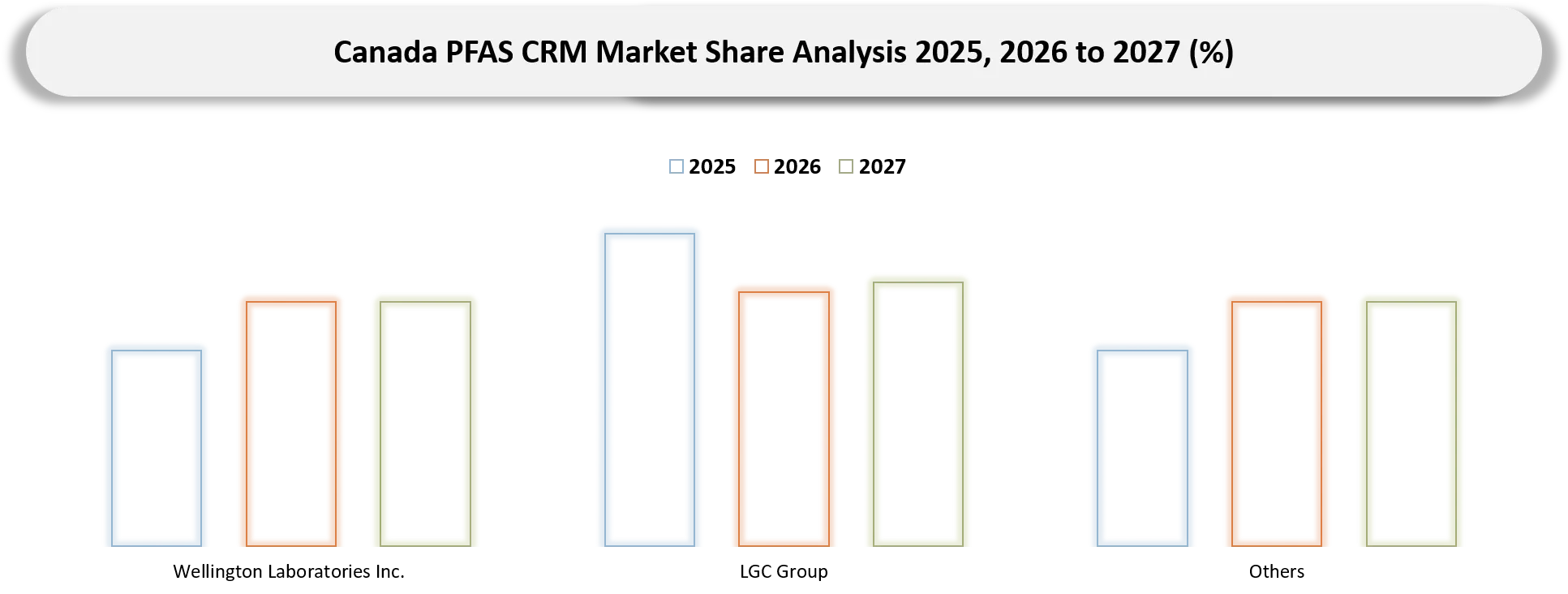
- Key players in the Canada PFAS CRM market include Wellington Laboratories Inc., LGC Group
Key Developments
- May 2026: Wellington Laboratories introduced four new PFAS reference standards. The additions included an EPA Method 1633 mixture containing all 40 target analytes, a mass-labelled long-chain PFAS standard, 7H-PFHpA and FNSA-I. The expanded portfolio addresses multi-analyte testing and additional PFAS compounds.
- June 30, 2026: Canada's Prohibition of Certain Toxic Substances Regulations, 2025 came into force. The regulations further restricted PFOS, PFOA and long-chain PFCA-related substances, including certain products containing them, with limited exemptions for specified uses. Laboratories performing relevant compliance analyses must meet applicable accreditation requirements, including ISO/IEC 17025.
Why Choose DataM?
- Technological Innovations: Examines developments in PFAS certified reference materials, including stable isotope-labelled standards, multi-compound PFAS mixtures, standards for different sample types, and reference materials covering emerging PFAS compounds to support accurate laboratory testing.
- Product Performance & Market Positioning: Evaluates how PFAS CRM suppliers differentiate their products through certified concentrations, measurement uncertainty, traceability, purity, stability, and compatibility with analytical methods used by Canadian environmental and water-testing laboratories.
- Real-World Applications: Highlights the use of PFAS CRMs in drinking-water testing, contaminated-site investigations, groundwater monitoring, wastewater analysis, firefighting-foam contamination assessment, and food and biological sample testing across Canada.
- Market Updates & Industry Changes: Tracks developments during 2025–2026, including new PFAS reference-standard launches, expanded compound coverage, manufacturing investments, supplier portfolio expansions, and changes in Canadian PFAS restrictions and water-quality monitoring requirements.
- Pricing & Market Access: Assesses PFAS CRM pricing based on compound composition, isotope labelling, concentration, certification level, mixture size, and packaging. It also examines supplier availability, distribution channels, procurement requirements, and access to specialized reference standards for Canadian laboratories.
- Market Entry & Expansion: Identifies opportunities arising from drinking-water monitoring, environmental remediation, industrial contamination testing, and evolving PFAS regulations. It evaluates strategies such as expanding isotope-labelled standards, developing reference materials for different sample types, strengthening laboratory partnerships, and improving access to specialized PFAS CRMs across Canada.
Target Audience 2026
- PFAS Certified Reference Material Manufacturers and Producers
- Analytical and Environmental Testing Laboratories
- Government and Regulatory Agencies
- Pharmaceutical and Biotechnology Companies
- Food and Beverage Testing Organizations
- Environmental Monitoring and Water Quality Organizations
- Industrial Chemical and Manufacturing Companies
- Semiconductor and Electronics Manufacturers
- Wastewater Treatment and Remediation Companies
- Contract Research Organizations and Academic Research Institutes
- Reference Material Distributors and Laboratory Suppliers
- Mining, Metals and Critical Minerals Companies


























































