


Canada Data Center Cables & Wires Market Size and Overview
The Canada data center cables and wires market encompasses power feeders, low-voltage distribution conductors, UPS and generator connections, structured copper data cabling, optical fiber, high-speed electrical cable assemblies and specialty control cables installed in Canadian hyperscale, colocation, enterprise and AI data centers. The market measures cable and wire product sales for data-center facilities and network upgrades, excluding transformers, switchgear, UPS units, servers and other non-cable electrical equipment.
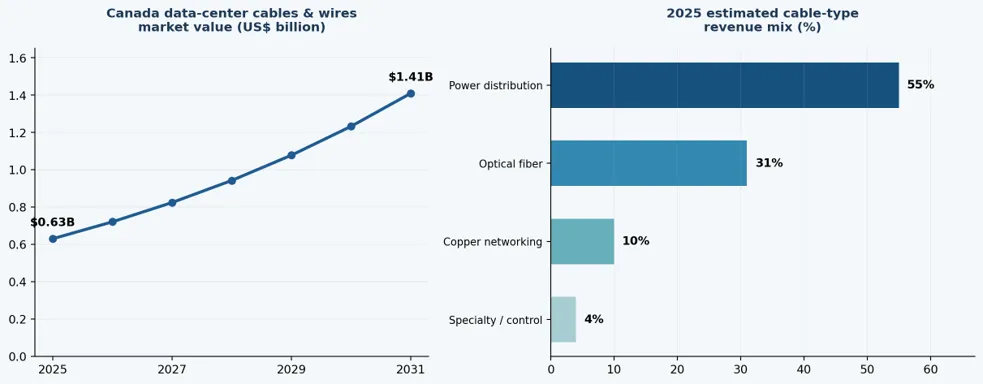
DataM estimates the Canada data center cables and wires market at US$ 0.63 billion in 2025, rising to US$ 1.41 billion by 2031 at a 14.37% CAGR during 2026–2031. The cable-only model applies a 12% cabling allocation to Canada data-center electrical-components expenditure in 2025, increasing to 14% by 2031, reflecting higher network fiber density, greater power delivery per rack and new campus fit-outs. The estimated market covers only in-scope power, optical, copper networking and specialty cabling products.
Canada Data Center Cables & Wires Market Key Takeaways
- DataM estimates Canadian data-center cable and wire revenue at US$ 0.63 billion in 2025 and US$ 1.41 billion by 2031, reflecting a 14.37% forecast CAGR during 2026–2031.
- Power-distribution cables account for an estimated 55% of 2025 cable sales, reflecting site feeders, low-voltage distribution, standby-power links and rack-level power delivery.
- Optical fiber cables represent an estimated 31% of 2025 market value, supported by data-hall connectivity, high-count trunks, cloud interconnection and AI-oriented network expansion.
- Copper networking cables and high-speed electrical interconnects account for an estimated 10% of 2025 sales as structured networks and short-reach rack connections remain essential.
- Specialty, control and fire-performance cables represent an estimated 4% of 2025 demand, with opportunities in modular campuses, resilient power installations and certified indoor pathways.
Canada Data Center Cables & Wires Industry Trends and Strategic Insights
- AI-ready Canadian data centers are raising requirements for preterminated optical fiber, high-density cable management and fast-deployment interconnect assemblies. Optical cable qualification increasingly addresses insertion loss, rack density and compatibility with evolving networking architecture.
- Large data-center developments require coordinated utility connections, electrical contractor scheduling and equipment-room installation. Medium-voltage feeders and low-voltage conductors are critical to power-system milestones before data-hall commissioning.
- Modular data halls and prefabricated power packages are shifting procurement toward labeled and tested cable assemblies. Standardized specifications help buyers duplicate cable packages across expansion phases.
- Higher rack densities increase cable-tray occupancy and thermal-management complexity. Fire-performance approvals, bend-radius control and predictable installed cost therefore influence Canadian project awards.
Canada Data Center Cables & Wires Market Scope
| METRICS | DETAILS |
| Base Year / Forecast | 2025 / 2026–2031 |
| Geographic Coverage | Canada |
| Market Size and Growth | US$ 0.63 billion (2025); US$ 1.41 billion (2031); 14.37% CAGR (2026–2031). Canada data-center cable and wire products only. |
| By Cable Type | Power Cables & Wires (MV feeders, LV distribution, UPS / battery / generator cables, rack power whips); Datacom & Network Cables (SMF, MMF, copper Ethernet, DAC / AEC); Specialty (fire-rated / LSZH, control, grounding). |
| By Data Center Type | Hyperscale; Colocation; Enterprise / Private; Edge / Modular; AI / High-Density Compute. |
| By Cable Application | Site Power / Utility Interconnection; Electrical Distribution; UPS & Backup; Rack-Level Power; Structured Cabling; Campus Fiber; Controls / Fire Safety / BMS. |
| By Network / Transmission Medium | Copper Power Conductors; Copper Data Interconnects; Single-Mode Fiber; Multimode Fiber; Hybrid Copper-Fiber. |
| By Power Cable Voltage Rating | Low Voltage (up to 1 kV); Medium Voltage (above 1 kV to 35 kV); High Voltage (above 35 kV, utility / campus application). |
| By Cable Jacket / Fire Performance | Plenum / Riser; LSZH; Fire-Resistant / Circuit Integrity; XLPE / PVC / EPR and other materials. |
| By Deployment Location | Outside Plant / Campus; Electrical Rooms; Overhead Cable Tray; Underfloor / Conduit; Rack / Row Interconnect. |
| Competitive Landscape | 10 company profiles; product positioning; channel coverage; data-center partnerships and recent developments. |
| Market Insights | Cable-only market sizing, power and optical product mix, project installation demand, segment opportunities, demand drivers, restraints and competitor positioning. |
Canada Data Center Cables & Wires Market White Space & Investment Opportunities
- High-density optical infrastructure: Design-in opportunities for preterminated fiber trunks, low-loss connections, structured fiber pathways and modular expansion programs at hyperscale and AI facilities.
- Critical-power cables: Suppliers can target factory-tested low-voltage distribution assemblies, medium-voltage feeders, resilient grounding and flexible rack-level power interconnects.
- Prefabricated and modular delivery: Cable harnesses and labeled assemblies can reduce on-site labor intensity and accelerate phased hall commissioning.
- Service-led differentiation: Documentation, onsite logistics, testing support, rapid replenishment and compatibility with preferred installer standards create recurring account value.
- Brownfield upgrades: Refreshes of enterprise sites and leased colocation halls create demand for power densification, fiber reconfiguration and fire-code-compliant replacements.
Canada Data Center Cables & Wires Market Dynamics
Canadian data-center cable demand is primarily driven by energized construction phases, AI and cloud facility expansions, upgrades in critical electrical distribution and more fiber-intensive networking architectures. Cable volumes are ordered in phases: major power feeders during base-build electrical works, low-voltage circuits and critical-power wiring during hall fit-out, then optical fiber and high-speed connections as computing equipment is deployed. Suppliers able to track actual energized capacity and contractor procurement schedules are better positioned than those relying only on public announcements.
Driver Impact Analysis
| DRIVER | DEMAND EXPOSURE | IMPACTED CABLES | STRATEGIC IMPLICATION |
| Hyperscale / AI capacity additions | New campus builds and phased hall fit-out | MV / LV power; SMF; rack interconnects | Secure approved vendor status and project-based supply programs. |
| Higher power per rack | UPS / distribution expansion; greater electrical density | LV feeders; rack whips; grounding | Develop application-qualified assemblies and improve installation efficiency. |
| Network architecture upgrades | Migration to high-density links and fiber pathways | SMF; MMF; DAC / AEC | Expand optical portfolio and preterminated system capabilities. |
| Modular / prefabricated construction | Factory-built electrical blocks and repeatable designs | Preassembled power / control / fiber | Partner with OEMs, EPCs and modular integrators. |
Growing hyperscale and colocation capacity drives orders for medium-voltage campus cables, low-voltage conductors, generator and UPS wiring, optical fiber trunks and rack-level interconnects. AI workloads often require greater network connectivity between computing halls and additional power delivery capacity per rack. Ontario and Quebec remain important demand centers, while new capacity across western Canadian markets adds opportunities tied to utility availability, energy procurement and reliable long-haul connectivity.
From a procurement perspective, cable suppliers can win early specifications with electrical EPC contractors, owners, engineering consultants and network integrators. Repeatable campus designs benefit preterminated fiber systems, prefabricated electrical wiring and tested assemblies. Existing sites also create aftermarket opportunities through power-density increases, optical network refreshes and replacement of fire-rated cabling along congested routes.
Restraint Impact Analysis
| RESTRAINT | EXPOSURE AREA | IMPACTED USE CASE | STRATEGIC RESPONSE |
| Power connection / permitting delays | Utility interconnection and campus energization | MV feeders and facility electrical distribution | Align manufacturing slots to verified utility and EPC milestones. |
| Conductor and polymer cost volatility | Long-duration contracts and fixed-price bids | Copper / aluminum power cables; specialty jackets | Price-index mechanisms, procurement planning and disciplined contract terms. |
| Installation labor and pathway constraints | High-density retrofits and accelerated fit-out | Fiber trunks; structured cabling; power whips | Use preterminated designs, documentation and installer training. |
| Rapid network-standard evolution | High-speed AI and cloud interconnect upgrades | Optical / copper data cables | Maintain flexible architecture and interoperability testing. |
Utility interconnection availability is a leading constraint because cable procurement may be delayed until grid upgrades, transformer lead times and facility permitting are sufficiently advanced. Canadian winters, remote-site logistics and short construction windows can increase installation risk, particularly for outside-plant power and fiber networks. The delay between announced capacity and equipment-ready buildings makes the project-conversion pipeline a key commercial variable.
Copper and aluminum prices, polymer costs, exchange rates and long-distance freight can materially influence cable quotations. Installation labor shortages, high-density cable trays, optical loss requirements and fire-safety compliance can also raise total installed cost. Vendors can mitigate these barriers through transparent price-adjustment clauses, standardized cable packages, pretermination and contractor-oriented documentation. Lead-time certainty and verified installation performance are decisive during phased commissioning.
Canada Data Center Cables & Wires Market Competitive Landscape
Canada data-center cable competition includes power-cable manufacturers, fiber-optic suppliers, structured cabling specialists and high-speed interconnect providers. The competitive assessment covers only products and associated cable systems sold into Canadian data centers. Strategic differentiation depends on technical approvals, available capacity, distribution footprint, repeatable project delivery and relationships with electrical EPCs and IT infrastructure contractors.
| COMPANY | Canada DATA-CENTER POSITIONING |
| Prysmian | Power cables and optical-fiber cabling supporting Canadian campus and data-center infrastructure. |
| Nexans | Power cables and electrical infrastructure systems serving Canadian utility and project specifications. |
| Corning | Optical fiber, preterminated connectivity and high-density data-center cabling. |
| CommScope | Structured copper and fiber connectivity systems for colocation and enterprise data-center networks. |
| Belden | Data and control cables, network connectivity and industrial-grade communications. |
| AFL | Fiber-optic cable, accessories, assemblies and installation solutions. |
| Amphenol | High-speed copper / optical interconnects and cable assemblies. |
| Leviton | Copper and fiber structured cabling, patching and facility network infrastructure. |
| Panduit | Structured cabling, pathways, cable management and data-center connectivity. |
| Marmon Electrical | Power and specialty cables for mission-critical industrial and electrical infrastructure. |
Suppliers compete on electrical rating and fire performance, optical loss and density specifications, connector interoperability, price protection and availability during critical installation windows. Large multi-category vendors can service both electrical and network work packages. Specialist vendors can win by providing high-count fiber trunks, fast-install cable harnesses, short-reach interconnect technology and responsive contractor support.
Canada Data Center Cables & Wires Market Recent Developments
- Corning — 2026: Continued expanding its optical-connectivity focus for AI data-center deployments and dense fiber architectures.
- Prysmian — 2026: North American fiber-optic and power-cable capacity and procurement initiatives remain important to data-center supply chains.
- Belden — 2026: Advanced high-density fiber and connectivity product offerings relevant to mission-critical infrastructure.
- Amphenol — 2026: Expanded high-speed interconnect capabilities through its optical and datacom portfolio.
- Nexans — 2026: Canadian electrical infrastructure and cable-system supply remains relevant to large-load grid interconnection planning.


























































