


Canada Certified Reference Materials (CRM) Market Size and Overview
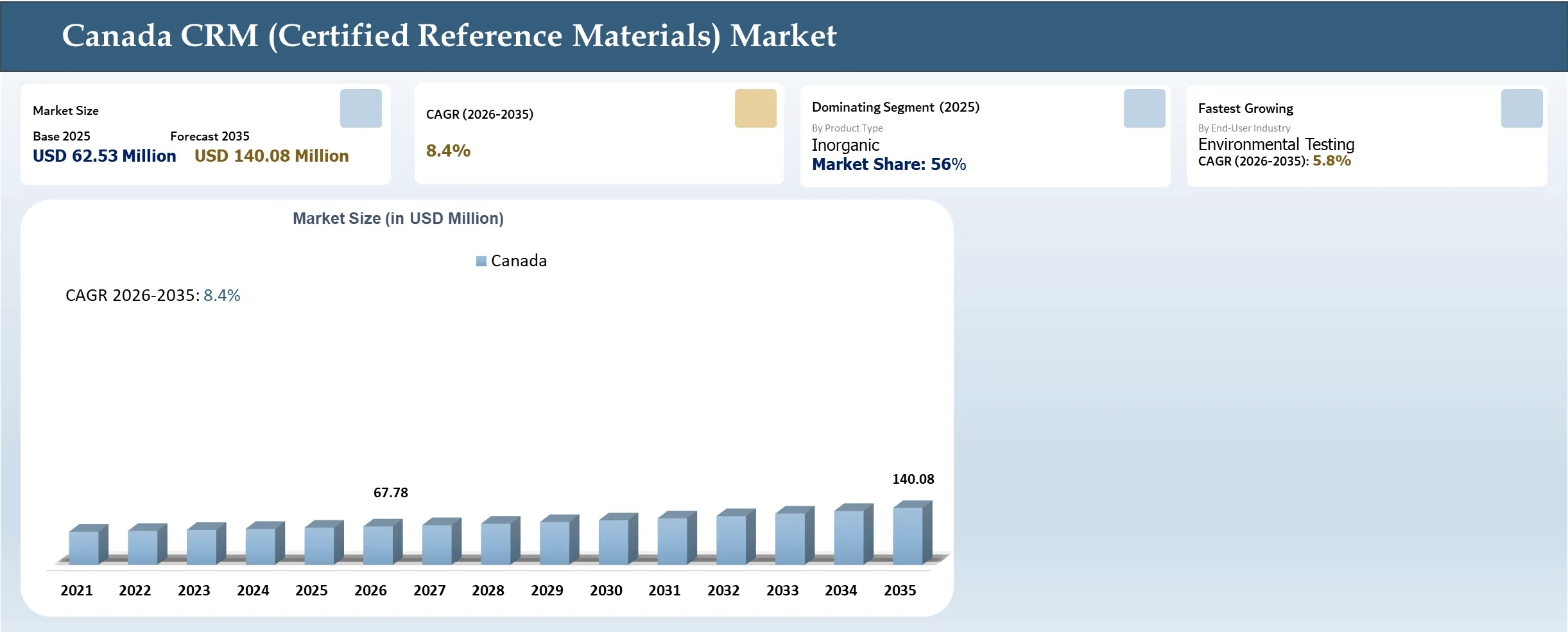
The Canada Certified Reference Materials (CRM) market reached USD 62.53 million in 2025 and is expected to reach USD 140.08 million by 2035, growing with a CAGR of 8.4% during the forecast period 2026-2035. The market growth is supported by increasing requirements for traceable analytical measurements across environmental testing, food safety, pharmaceuticals, and mineral analysis. In May 2026, the development is the launch of qNMR-CD, a caffeine calibration solution certified reference material by the National Research Council Canada (NRC). It is issued in a closed 5 mm NMR tube.
The material is meant to be used directly as an external calibration standard for qNMR studies. The certified values of caffeine in the material include the following: a mass fraction of 1.766 mg/g with an expanded uncertainty of 0.008 mg/g, a mass concentration of 1.951 mg/mL with an expanded uncertainty of 0.010 mg/mL, and a concentration of 10.05 mmol/L with an expanded uncertainty of 0.05 mmol/L. The material is valid for five years from the date of sale and must be stored at +4°C. This example clearly illustrates increasing specialisation of Canada's portfolio of CRMs for accurate chemical quantification and measurement traceability.
Canada Certified Reference Materials (CRM) Market Key Takeaways
- The inorganic CRM segment dominated the Canadian market in 2025 with a commanding 56% market share. This share is driven by extensive elemental and metal testing in pharmaceutical quality control, environmental, and mining sectors.
- The increasing demand for accurate analytical testing serves as the top market driver, contributing a 30% market growth impact. It targets pharmaceutical, chemical, and mining laboratories performing instrument calibration and method validation.
- Growing focus on food safety and contaminant detection accounts for a 25% market growth impact. This demand focuses on detecting shellfish toxins, heavy metals, and pesticide residues in food and agricultural labs.
- In May 2026, the NRC launched qNMR-CD, a caffeine CRM with a certified mass fraction of 1.766 mg/g (expanded uncertainty 0.008 mg/g). It features a mass concentration of 1.951 mg/mL and has a 5-year validity period when stored at +4°C.
Canada Certified Reference Materials (CRM) Market Scope
| Metrics | Details |
| 2025 Market Size | USD 62.53 Million |
| 2035 Projected Market Size | USD 140.08 Million |
| CAGR (2026-2035) | 8.4% |
| By Product Type | Organic, Inorganic |
| By Application | Quality Control & Assurance, Method Validation, Regulatory Compliance Testing, R&D & Analytical Development, Calibration & Instrument Validation |
| By End-User Industry | Consumer Industry, Contract Testing, University / Non-Profit, Energy Industry, Environmental Testing, Health Care, Industrial / Manufacturing, Materials / Mining |
| Report Insights Covered | Competitive Landscape Analysis, Company Profile Analysis, Market Size, Share, Growth |
Canada Certified Reference Materials (CRM) Market Disruption Analysis
Shift Toward Specialized and Direct-Use Certified Reference Materials Reshaping Canada's Analytical Testing Landscape
The disruption in the Canada certified reference materials (CRM) market is increasingly being related to the change from traditional calibration standards to more specific reference materials that are geared towards advanced analytical techniques and difficult sample matrices. CRMs are increasingly required to assist in quantitative measurements, method validation, and measurement traceability rather than merely having standards.
Recent developments from 2025 to 2026 illustrate this disruption through the National Research Council Canada’s (NRC) expansion of specialised reference materials. In November 2025, the NRC introduced NPPP-1, a 5 mL nanoscale polypropylene reference material priced at CAD 695, intended to support nanomaterial characterization and measurement-method development.
Canada Certified Reference Materials (CRM) Market BCG Matrix: Company Evaluation
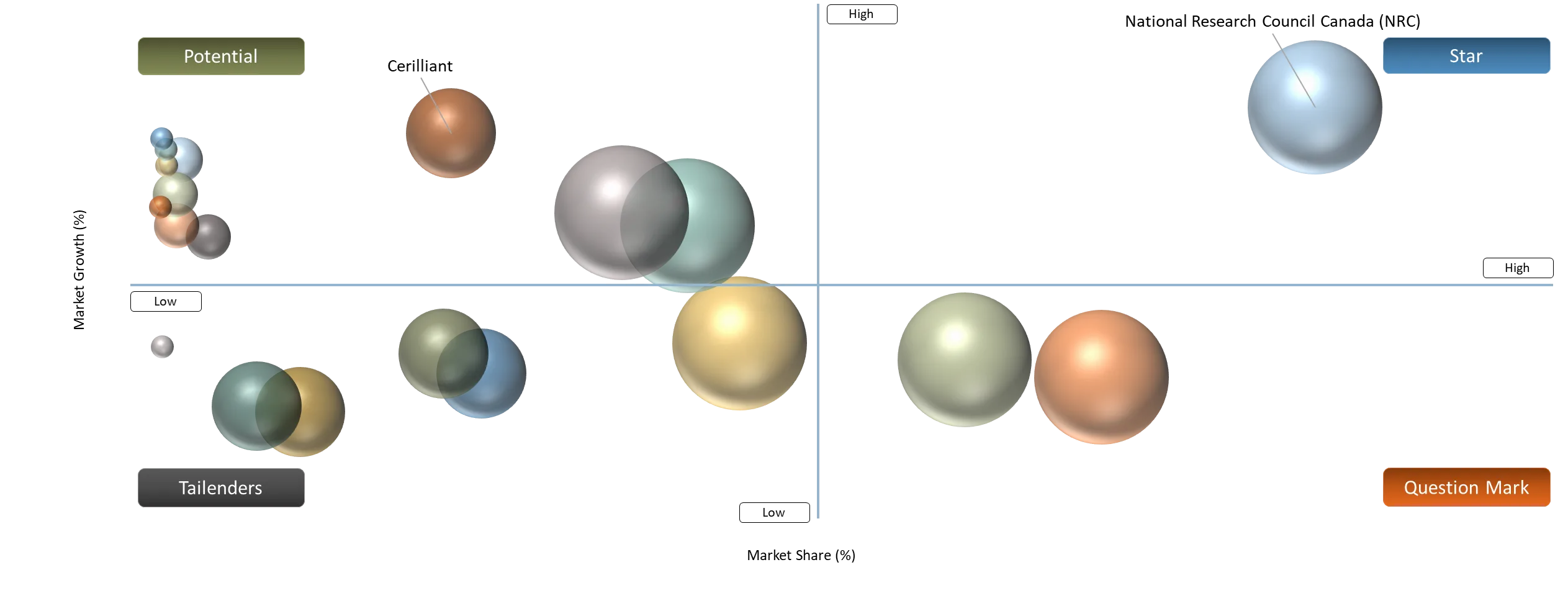
Stars include the National Research Council Canada (NRC) and Wellington Laboratories Inc. NRC holds a strong strategic position in Canada's CRM market through its government-backed metrology capabilities and specialized reference materials for environmental testing, food safety, health, and advanced analytical applications. Question Marks include LGC Standards, AccuStandard, and Inorganic Ventures.
Potential includes Cerilliant and Restek Corporation. Cerilliant focuses on pharmaceutical, clinical, forensic toxicology, and other specialised analytical standards, while Restek serves environmental, food, cannabis, petroleum, and chromatography-related testing applications. Tailenders include CPAchem, which supplies organic and inorganic reference materials and calibration solutions to international laboratories.
Canada Certified Reference Materials (CRM) Market Dynamics
Driver Impact Analysis
| Driver | Market Growth Impact (%) | Demand Concentration | Impacted Use Case | Strategic Impact |
Increasing Demand for Accurate Analytical Testing | 30% | Pharmaceutical laboratories, chemical testing laboratories, mining and industrial laboratories | Instrument calibration, analytical method validation, measurement traceability, and laboratory quality control | Supports demand for high-accuracy, application-specific CRMs and strengthens laboratory compliance and testing reliability. |
Stricter Environmental Monitoring Requirements | 25% | Environmental testing laboratories, water utilities, government monitoring agencies, and industrial compliance laboratories | Water and soil analysis, trace-metal detection, and measurement of environmental contaminants | Encourages adoption of certified standards for regulatory monitoring, environmental assessments, and reliable contaminant quantification. |
Growing Focus on Food Safety and Contaminant Detection | 25% | Food testing laboratories, seafood processors, agricultural laboratories, and food regulatory agencies | Detection of shellfish toxins, pesticide residues, heavy metals, and other food contaminants | Increases demand for matrix-matched CRMs that improve testing accuracy, support food-safety compliance, and reduce the risk of unreliable results. |
Growing Need for Nanomaterial and Nanoplastics Measurement | 15% | Advanced analytical laboratories, environmental research institutions, polymer laboratories, and academic research centres | Nanoplastic identification, particle characterization, polymer analysis, and environmental sample testing | Creates opportunities for specialized CRMs that support emerging analytical methods and improve the comparability and reproducibility of nanomaterial measurements. |
Increasing Demand for Accurate Analytical Testing
The increasing importance of accurate, reliable, and traceable measurement results in laboratories has been one of the major factors spurring the demand for certified reference materials (CRMs) in Canada. CRMs have been used by various laboratories engaged in environmental analysis, food safety testing, pharmaceutical testing, and mineral testing to ensure calibration of analytical equipment, test method validation, and measurement accuracy.
The demand is reflected in the National Research Council Canada (NRC)'s expanding portfolio of specialised reference materials for food safety, environmental monitoring, and critical-mineral analysis. In September 2025, the NRC issued HIMO-1, a high-purity molybdenum Certified Reference Material, supplied in approximately 1 g units and priced at CAD 445. The products support laboratories in verifying measurement accuracy, assessing analytical methods, and generating reliable results for elemental analysis and food-safety testing.
Canada Certified Reference Materials (CRM) Market Segment Analysis
The Canada certified reference materials (CRM) market is segmented based on product type, application, end-user industry, and region.
Inorganic CRMs Dominate the Market Due to Extensive Use in Elemental Analysis and Pharmaceutical Quality Control
The inorganic segment holds a dominant position in the certified reference materials (CRMs) market, with a market share of 56% in 2025. Inorganic certified reference materials (CRMs) constitute the analytical foundation for elemental and metal analysis across environmental monitoring, pharmaceutical quality control, food safety, geological surveys, industrial metals testing, and clinical chemistry.
The scale of inorganic elemental impurity testing in pharmaceuticals is substantial. USP maintains more than 4,000 drug monograph standards in USP-NF, with over 200 FDA staff embedded in USP expert committees helping to develop and update those standards, including elemental impurity limits. Each new pharmaceutical NDA or ANDA submission must include certified elemental impurity characterisation, ensuring that inorganic CRM usage is hardwired into every drug approval pipeline.
Canada Certified Reference Materials (CRM) Market Competitive Landscape
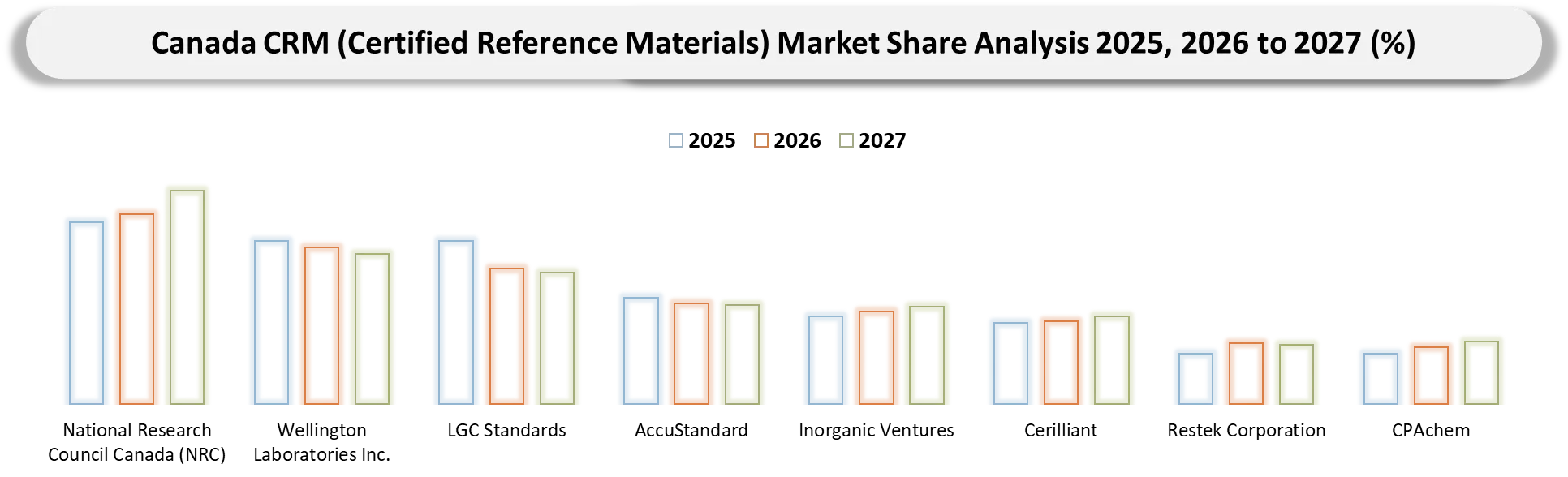
- The Canada certified reference materials (CRM) market is characterised by national metrology organisations, specialised Canadian reference-material producers, and international suppliers serving analytical laboratories. National Research Council Canada (NRC) plays a central role through its nationally traceable CRMs for environmental testing, food and water safety, health, and critical-mineral analysis. Wellington Laboratories Inc. specialises in organic reference standards for environmental contaminants, including PFAS, PCBs, dioxins, and related compounds; its quality credentials include ISO/IEC 17025 and ISO 17034 accreditation. International suppliers such as LGC Standards, AccuStandard, Inorganic Ventures, Cerilliant, Restek Corporation, and CPAchem broaden the competitive offering through analytical standards, calibration solutions, and application-specific reference materials.
- Key players in the Canada certified reference materials (CRM) market include National Research Council Canada (NRC) (Canada), Wellington Laboratories Inc. (Canada), LGC Standards (United Kingdom), AccuStandard (United States), Inorganic Ventures (United States), Cerilliant (United States), Restek Corporation (United States), and CPAchem (Bulgaria).
Key Developments
- July 2025: Microbix Biosystems Inc., a Canadian life sciences company, launched QUANTDx, a new product line of characterised reference materials for diagnostic assay development and validation.
- February 2026: Natural Resources Canada (NRCan), a Canadian federal government department, released STSD-5, a Certified Reference Material (CRM) for stream sediment, through its Canadian Certified Reference Materials Project (CCRMP), operated by CanmetMINING.
- April 2026: AnalytiChem Group, a global laboratory solutions company, announced the release of new OREAS Certified Reference Materials (CRMs) through its Australian-based brand, OREAS, headquartered in Melbourne, Australia.
- May 2026: TLC Pharmaceutical Standards Ltd. (TLC), a Canada-based pharmaceutical reference standards supplier, developed Tacrolimus-¹³C-d₄, a stable isotope-labelled reference standard designed to improve the accuracy of highly sensitive liquid chromatography–tandem mass spectrometry (LC-MS/MS) analysis.
Key Procurement Priorities and Buyer Evaluation Criteria
- Organizations procuring certified reference materials (CRMs) in Canada prioritize suppliers that provide certified measurement values, documented uncertainty, metrological traceability, and reliable batch-to-batch consistency to support accurate analytical testing across environmental, pharmaceutical, food safety, mining, and industrial applications.
- The procurement decision-making process is increasingly influenced by laboratory accreditation requirements, regulatory compliance, advanced analytical techniques, and the need to detect contaminants at low concentrations. Buyers assess whether CRMs are suitable for instrument calibration, analytical method validation, quality control, proficiency testing, and verification of laboratory measurement performance.
- Buyers consider factors such as CRM purity and homogeneity, certified property values, measurement uncertainty, matrix compatibility, certificate documentation, shelf life, storage conditions, and availability of supporting analytical data when evaluating suppliers. Accreditation to ISO 17034 for reference-material producers and ISO/IEC 17025 for testing and calibration laboratories can also influence supplier qualification, depending on the application and procurement requirements.
Why Choose DataM?
- Technological Innovations: Examines advancements in Certified Reference Materials (CRMs), including matrix-matched standards, high-purity elemental reference materials, quantitative nuclear magnetic resonance (qNMR) standards, and specialized materials for emerging analytical techniques, supporting improved measurement accuracy and laboratory reliability.
- Product Performance & Market Positioning: Evaluates how CRM manufacturers and suppliers differentiate their offerings through certified values, measurement uncertainty, metrological traceability, material homogeneity, certification quality, and suitability for environmental, pharmaceutical, food safety, mining, and industrial testing applications.
- Real-World Evidence: Highlights CRM applications in Canadian laboratories, including contaminant detection, elemental impurity analysis, water-quality monitoring, shellfish toxin testing, pharmaceutical quality control, and critical-mineral characterization, demonstrating their role in analytical validation and reliable measurement outcomes.
- Market Updates & Industry Changes: Tracks developments during 2025–2026, including new CRM introductions, specialized reference-material launches, product portfolio expansions, and changes in analytical testing requirements, helping identify evolving demand across Canada's environmental, food, healthcare, and industrial sectors.
- Competitive Strategies: Analyzes the competitive positioning of National Research Council Canada (NRC), Wellington Laboratories Inc., LGC Standards, AccuStandard, Inorganic Ventures, Cerilliant, Restek Corporation, and CPAchem, assessing their product specialization, certification capabilities, distribution networks, technical expertise, and strategies for serving Canadian laboratories.
- Pricing & Market Access: Assesses differences in CRM pricing based on material composition, certification complexity, concentration, packaging size, intended application, and production requirements. It also examines supplier availability, distribution channels, delivery lead times, and access to specialized reference materials for Canadian research institutions, industrial laboratories, and regulated testing facilities.
- Market Entry & Expansion: Identifies opportunities arising from environmental contaminant monitoring, food safety testing, pharmaceutical quality assurance, critical-mineral analysis, and emerging nanomaterial measurement requirements. It also evaluates strategies such as developing application-specific CRMs, strengthening laboratory partnerships, expanding distribution networks, and improving access to traceable reference materials across Canada.
Target Audience 2026
- CRM Manufacturers and Producers
- Analytical Testing Laboratories
- Government and Regulatory Agencies
- Pharmaceutical and Biotechnology Companies
- Food and Beverage Companies
- Environmental Monitoring and Water Testing Organizations
- Mining, Metals, and Critical Minerals Companies


























































