


Canada Cables & Wires Market Size and Overview
The Canada cables and wires market was valued at US$ 9.25 billion in 2025 and is projected to reach US$ 11.07 billion by 2031, growing at a 2.78% CAGR during 2026–2031. The market includes electrical power cables, communication and fiber-optic cables, building wires plus specialized cables used by utilities, industrial operators, infrastructure projects and digital networks.
Canadian cable demand is supported by investments in grid reliability, electricity generation, industrial electrification, residential and commercial construction plus broadband infrastructure. Power delivery across long distances and challenging operating environments increases demand for application-specific conductor, insulation and installation designs. Provincial utility programs and major-project procurement shape order timing.
| 2025 MARKET SIZE | 2031 FORECAST | CAGR (2026–2031) |
| US$ 9.25 Billion | US$ 11.07 Billion | 2.78% |
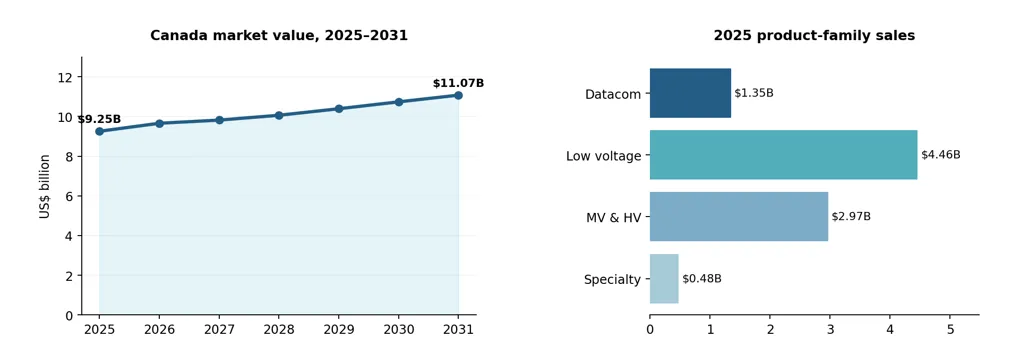
Canada’s cables and wires market reaches US$ 9.25 billion in 2025 and US$ 11.07 billion in 2031, adding approximately US$ 1.82 billion in market value.
The 2.78% forecast CAGR reflects continuing investment in electrical distribution infrastructure, building upgrades and industrial systems across provinces.
Low-voltage cable demand is anchored by construction wiring and commercial electrical installations, while medium- and high-voltage products benefit from utility network renewal.
Optical-fiber and communication cables support broadband deployment, telecom network upgrades and rising connectivity requirements in Canadian data centers.
Remote mining operations, renewable projects and marine infrastructure create opportunities for armored, weather-resistant, specialty and high-performance cable constructions.
Supplier competitiveness increasingly depends on specification approval, copper and aluminum procurement, project logistics and regional distribution reach.
Canada Cables & Wires Industry Trends and Strategic Insights
Grid expansion and refurbishment support demand for medium- and high-voltage cables. Utilities face aging assets, reliability requirements and the need to connect new generation and power loads.
Broadband extension, data-center investment and enterprise network upgrades expand opportunities for optical-fiber and datacom cables, with particular attention to installation efficiency and performance verification.
Industrial electrification and renewable energy projects support specialty products including mining cable, wind-energy cable and solar PV cable, where environmental durability and safety ratings are critical.
Canadian suppliers and international participants compete on product approvals, regional inventory, long-term supply agreements and their ability to serve dispersed sites with reliable schedules.
Canada Cables & Wires Market Scope
| METRICS | DETAILS |
| 2025 Market Size | US$ 9.25 Billion |
| 2031 Projected Market Size | US$ 11.07 Billion |
| CAGR (2026–2031) | 2.78% |
| Geographic Coverage | Canada (national market; provincial demand context) |
| By Cable Type | Datacom Cables (Communication & Data Cables, Fiber Optic Cables); Low-Voltage Cables (Fire Resistant Cables, Low Smoke & Halogen Free Cables, Low Voltage Cables & Wires); Medium- and High-Voltage Cables (Medium Voltage Cables, High Voltage Cables); Special Cables (Mining Oil & Gas Cables, Photovoltaic Cables, Ship & Harbour Cables, Windmill Cables) |
| By Industry | Industrial — Discrete (Aerospace & Defense, Automotive, Batteries, Electrical & Electronics, Machine Building, Semiconductor); Process (Chemicals, Energy/Oil & Gas, Metal Processing); Hybrid (Food & Beverage, Lifesciences, Mining & Quarrying, Other Manufacturing). Non Industrial — Transportation (Air, Land, Rail, Marine Services); Infrastructure & Services (Commercial Real Estate, Data Centers, Healthcare, Hospitality & Entertainment, Public Sector/Research/Education, Residentials, Water & Waste, Others). Power Utilities — Power Generation (Coal, Conventional Excl. Coal, Renewables); Power Distribution & Transmission. |
| By Conductor / Transmission Medium | Copper; Aluminum; Optical Fiber; Composite / Hybrid Construction |
| By Voltage Rating (Power Cables) | Low Voltage (up to 1 kV); Medium Voltage (above 1 to 35 kV); High Voltage (above 35 to 230 kV); Extra-High Voltage (above 230 kV) |
| By Insulation and Sheathing Material | Cross-Linked Polyethylene (XLPE); Polyvinyl Chloride (PVC); Ethylene Propylene Rubber (EPR/EPDM); Polyethylene (PE); Low Smoke Zero Halogen (LSZH); Other Materials |
| By Installation Method | Overhead; Underground / Buried; Submarine / Underwater; Indoor / Building; Outdoor / Industrial |
| Competitive Landscape | Competitive positioning, 10 company profiles, recent developments and partnerships |
| Market Data Coverage | Cable-type and cable-subtype market values, 2025–2031 (US$ million); industry, material, voltage and installation breakdowns within the defined report scope |
Market coverage includes cable-type values from the Canada worksheet and industry end markets from the workbook classification. The additional conductor, voltage, insulation and installation dimensions structure analysis of Canadian cable applications.
Canada Cables & Wires Market White Space & Investment Opportunities
Grid renewal and utility demand: Investments in distribution and transmission provide opportunities for qualified power-cable suppliers, specialty accessories and long-term supply programs with provincial utilities.
Remote industrial operations: Mining, energy and heavy-industry sites require durable, armored and temperature-resistant cable designs that can support demanding maintenance and installation conditions.
Digital connectivity: Broadband extension and data-center deployments create opportunities in optical-fiber cable, higher-density distribution and installer-ready cable solutions.
Canada offers differentiated opportunities across provinces. Ontario and Quebec feature large industrial and electrical networks, Alberta has significant energy and resource-sector requirements while British Columbia and Atlantic Canada host major utility, infrastructure and renewable-energy projects. Demand timing differs with permitting, grid access and capital budgets.
Driver Impact Analysis
Canada’s cables and wires market is supported by grid reinforcement, clean power integration, electrification and recurring replacement of installed electrical assets. Utility projects create demand for medium- and high-voltage cables, insulation systems and accessories. Building renovation and commercial developments also sustain low-voltage requirements, while optical networks and data-center buildouts encourage the adoption of fiber-based products.
| DRIVER | AFFECTED PRODUCT / SIGNAL | 2026–2031 CAGR | STRATEGIC IMPACT |
| Grid renewal and power-system reliability | Distribution and transmission power cables | High | Support long-term utility qualifications and supplier agreements. |
| Broadband, network and data-center upgrades | Fiber-optic and communication cables | High | Expand network-cable portfolio and qualified installation partnerships. |
| Renewable project interconnection | Medium-voltage and PV / wind cable products | Moderate–High | Align inventory and certification with renewable construction cycles. |
| Industrial and resource-sector electrification | Armored and specialty power cables | Moderate–High | Target remote-site durability, technical support and regional logistics. |
The impact of these drivers depends on specification readiness and delivery execution. Utility procurement normally requires lengthy product qualification, engineering review and installation coordination. Manufacturers with approved cable designs, stable production scheduling and distributor or contractor partnerships are better positioned to convert planned capital expenditure into shipments. Exposure to remote and severe-weather operating conditions can also favor higher-performance cable constructions.
Restraint Impact Analysis
Copper and aluminum price volatility remains a major commercial constraint for Canadian cable manufacturers and distributors. Exchange-rate movements can increase the landed cost of imported conductor material, compounds and finished products. Large utility and infrastructure orders may also be delayed by permitting, environmental reviews, tender schedules and the availability of qualified installation contractors.
| RESTRAINT | PRIMARY EXPOSURE | RISK LEVEL | STRATEGIC IMPACT |
| Copper and aluminum price volatility | Low- and medium-voltage product pricing and contractor budgets | High | Index-based quotations, hedging and pass-through clauses protect project margins. |
| Permitting and infrastructure delays | Utility transmission and specialized power-cable orders | High | Diversify project backlog and stage production around realistic commissioning dates. |
| Manufacturing and skilled-labor constraints | Canadian extrusion capacity, testing and specialized cable production | Moderate–High | Invest in process capability, workforce development and delivery reliability. |
| Competitive price pressure and imports | Standardized low-voltage and commodity datacom cables | Moderate | Compete through product certification, channel service and customer-specific designs. |
Canada’s geographically dispersed project base creates additional supply-chain pressure. Transportation to remote mines, northern communities, hydroelectric sites and coastal infrastructure can extend delivery lead times. Cable specifications differ across utility and industrial buyers, limiting substitution when a preferred product is unavailable. Suppliers can reduce these risks through indexed pricing, flexible stocking, early qualification and coordinated project logistics.
Canada Cables & Wires Market Competitive Landscape
Canada’s competitive landscape includes established domestic manufacturing and distribution operations alongside multinational power-cable, fiber-optic and specialty-cable suppliers. Competition centers on power utility approvals, compliance with Canadian standards, regional availability, contractor service and the ability to deliver specialized configurations.
| COMPANY | CANADIAN CABLES & WIRES POSITIONING |
| Nexans | Building wire, power cables and utility-linked electrical infrastructure. |
| Prysmian | Power, industrial, construction and optical-cable systems. |
| Southwire | Electrification and low-voltage wire, including expanded Canadian manufacturing presence. |
| Corning | Optical fiber, cable and advanced connectivity for data centers and broadband. |
| Belden | Industrial communication, specialty cables and network connectivity. |
| Amphenol | Fiber and copper connectivity systems across datacom and infrastructure. |
| AFL | Optical fiber cable systems, accessories and network services. |
| Marmon Electrical | Diversified electrical wire and cable solutions for industrial and utility uses. |
| General Cable | Power and submarine cable systems with Canadian investment activity. |
| Sumitomo Electric Industries | Optical fiber, energy cable and industrial wiring systems. |
Leading suppliers can differentiate through long-term relationships with utility engineering teams, bundled accessories and cable systems, quality assurance, reliable conductor sourcing and project-specific technical support. Service to remote industrial locations and high-voltage infrastructure is a particularly important capability.
Canada Cables & Wires Market Recent Developments
2026: Canadian power transmission and distribution investment plans continue to shape orders for qualified medium- and high-voltage cable systems and related accessories.
2026: Broadband network upgrades and data-center capacity additions support continued procurement of optical fiber, structured cabling and high-performance connectivity products.
2026: Renewable-power and utility-interconnection activity raises demand for weather-resistant cable products and project-specific installation systems.
2026: Mining and industrial electrification programs increase the need for armored power cable, specialty insulation and dependable regional delivery capabilities.
2026: Cable suppliers continue prioritizing product qualification, distributor partnerships and metal-price management for infrastructure procurement.
2026: Grid resiliency and network-hardening priorities sustain cable replacement opportunities in aging and weather-exposed electrical infrastructure.


























































