


Brewing Ingredients Market Size and Overview
The global brewing Ingredients market reached USD 120.1 billion in 2025 and is expected to reach USD 215.05 billion by 2035, growing with a CAGR of 6% during the forecast period 2026-2035. The market is being shaped by investments in brewery capacity, expanding non-alcoholic beer portfolios, and demand for consistent flavour and fermentation performance. In May 2026, Anheuser-Busch announced a US$5 million investment in its Columbus, Ohio, brewery to expand production of Michelob ULTRA, Michelob ULTRA Zero, and Michelob ULTRA Zero Lime. The investment highlights continued brewery spending on conventional and non-alcoholic beer production, creating opportunities for suppliers of malt, yeast, enzymes, and other brewing ingredients.
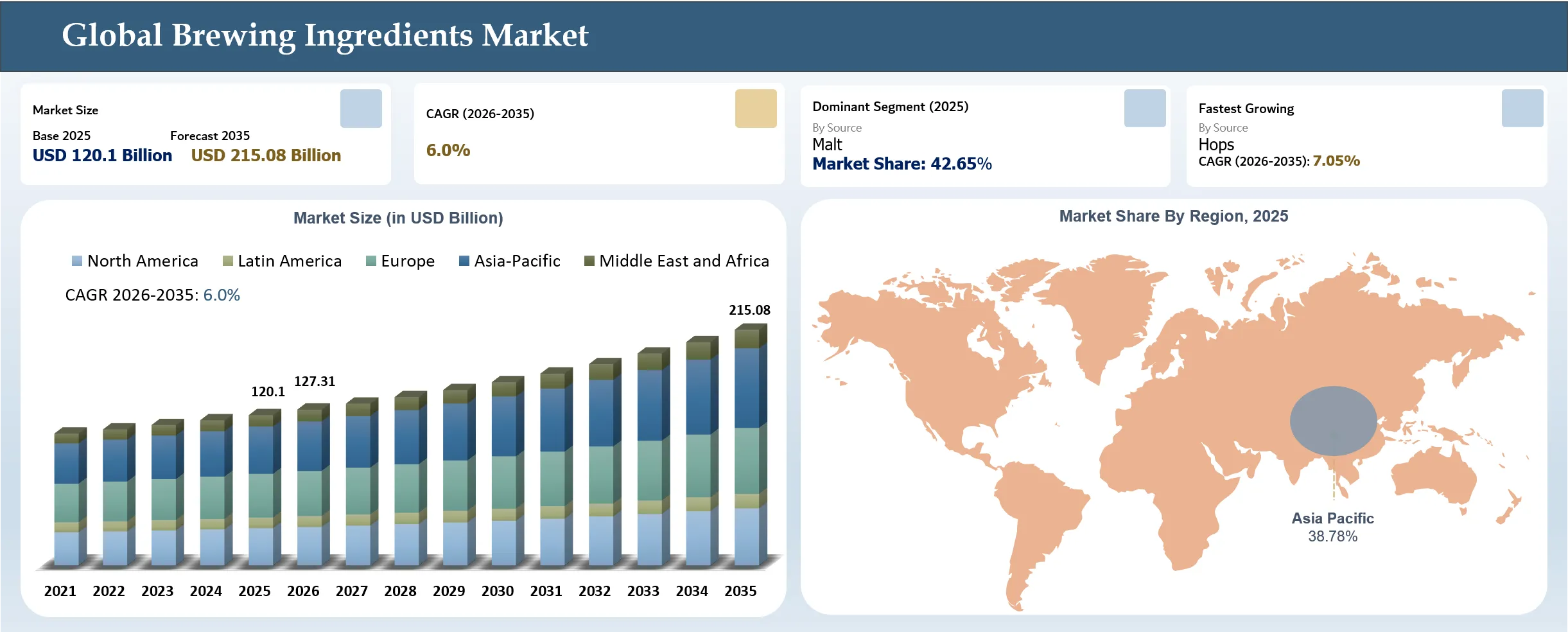
Ingredient requirements are also evolving as breweries expand their non-alcoholic offerings alongside established beer brands. Production of alcohol-free beer places particular emphasis on alcohol reduction, flavour retention, and fermentation control, increasing the relevance of specialised yeast strains and enzyme solutions. These developments are strengthening demand for application-specific brewing ingredients that support consistent product quality and efficient production across different beer formulations.
White-Space Opportunities in Alcohol-Free Brewing Ingredient Solutions
Diageo’s expansion of brewing capacity creates an opportunity for ingredient suppliers to target the growing production requirements of conventional and alcohol-free beer. In May 2026, Diageo opened its nearly €300 million Littleconnell Brewery in Ireland and announced a further estimated €400 million investment in a second brewery dedicated to Guinness and Guinness 0.0 production. The second facility is planned to more than double the site’s total capacity, creating a potential supply opportunity for specialised malt, yeast, enzymes, and other brewing ingredients used in alcohol-free formulations.
The clearest white space lies in ingredients that preserve flavour and improve process efficiency in alcohol-free brewing. Suppliers can target Diageo and comparable large-scale brewers with specialised yeast strains, enzyme systems, and formulation solutions designed for alcohol reduction, flavour retention, and consistent batch quality. The investment also creates an opportunity to qualify ingredients for high-volume production rather than relying solely on smaller craft-brewing customers.
Brewing Ingredients Market Key Takeaways
- Asia-Pacific accounted for an estimated 38.78% of the Brewing Ingredients Market in 2025, making it the largest regional market based on the regional allocation used here. Brewery expansion, rising beer consumption, and increasing demand for specialty brewing ingredients across China, India, and other Asian markets are key factors supporting regional demand.
- Malt and grains represent a core ingredient category in brewing, as they provide fermentable sugars, colour, flavour, and body. Demand is supported by their essential role in beer production across large breweries, craft breweries, and other brewing producers. The 2025 segment share and fastest-growing segment CAGR require a consistent segment-level dataset.
- Hops play a key role in beer bitterness, aroma, and flavour, with demand influenced by premium beer launches, craft brewing, and experimentation with distinctive hop profiles. Specialty hop varieties and concentrated hop products are creating opportunities for suppliers serving breweries seeking differentiated flavour characteristics. A verified 2025 share and comparable CAGR are needed to rank hops against other ingredient segments.
- Specialty yeast and fermentation solutions are gaining importance as breweries expand low- and no-alcohol beer portfolios. Investments in non-alcoholic beer production, including Anheuser-Busch’s US$5 million investment in its Columbus brewery announced in May 2026, highlight opportunities for ingredients that support alcohol reduction, flavour retention, and consistent fermentation performance.
Brewing Ingredients Market Industry Trends and Strategic Insight
- The shift toward differentiated beer styles and premium brewing is increasing demand for specialty malt, aroma hops, and tailored yeast strains that deliver distinct flavour, aroma, colour, and fermentation characteristics.
- The growing adoption of low- and no-alcohol brewing is expanding demand for specialised yeast strains, fermentation-control solutions, and enzymes that help breweries reduce alcohol content while preserving beer flavour and mouthfeel.
- Increasing focus on brewing efficiency is raising demand for high-performance enzymes and yeast cultures that improve extract yield, fermentation consistency, processing time, and raw-material utilisation.
- Climate variability and pressure on agricultural supply are increasing the importance of resilient barley and hop varieties, encouraging ingredient suppliers and growers to invest in crop development, sourcing diversification, and more reliable raw-material supply.
- The expansion of craft breweries and specialised beer portfolios is increasing demand for small-batch, application-specific ingredients, including distinctive hop varieties, specialty malts, and yeast strains tailored to individual brewing recipes.
- Advances in liquid hop products, concentrated hop extracts, and specialty ingredient formats are creating opportunities for suppliers to offer more consistent dosing, simplified handling, and greater control over flavour and aroma.
- Growing demand for alcohol-free and alternative fermented beverages is encouraging brewing ingredient suppliers to extend their portfolios beyond conventional beer production, particularly through specialised cultures and fermentation technologies.
- Brewery investment in automated production and process control is increasing the value of ingredients that deliver predictable performance across mashing, fermentation, conditioning, and filtration, making consistency a key factor in supplier selection.
Brewing Ingredients Market Scope
| Metrics | Details | |
| 2025 Market Size | USD 120.1 Billion | |
| 2035 Projected Market Size | USD 215.08 Billion | |
| CAGR (2026-2035) | 6% | |
| Largest Market | Asia-Pacific | |
| Fastest Growing Market | Asia-Pacific | |
| By Source | Malt & Grains, Hops, Yeast, Adjuncts, Enzymes, Other Ingredients | |
| By Form | Dry, Liquid | |
| By Function Type | Fragrance, Preservatives, Flavors, Proteins, Others | |
| By Process | Mashing, Boiling & Hopping, Fermentation, Conditioning & Maturation, Clarification & Filtration, Others | |
| By Application | Beer, Cider, Ale, Others | |
| By End User | Large Breweries, Craft Breweries, Microbreweries, Brewpubs, Contract Breweries, Home Brewers, Other Brewing Producers | |
| By Region | North America | U.S., Canada, Mexico |
| Europe | Germany, United Kingdom, France, Italy, Spain, Netherlands, Switzerland, Sweden, Norway, Denmark, Belgium, Poland, Austria, Ireland, Portugal, Greece, Finland, Rest of Europe | |
| Asia-Pacific | China, Japan, India, South Korea, Australia, New Zealand, Singapore, Malaysia, Thailand, Indonesia, Vietnam, Philippines, Taiwan, Rest of Asia Pacific | |
| Latin America | Brazil, Argentina, Chile, Colombia, Peru, Rest of Latin America | |
| Middle East and Africa | Saudi Arabia, United Arab Emirates, Qatar, Kuwait, Oman, Bahrain, South Africa, Egypt, Nigeria, Morocco, Rest of Middle East & Africa | |
| Report Insights Covered | Competitive Landscape Analysis, Company Profile Analysis, Market Size, Share, Growth | |
Brewing Ingredients Market Disruption Analysis
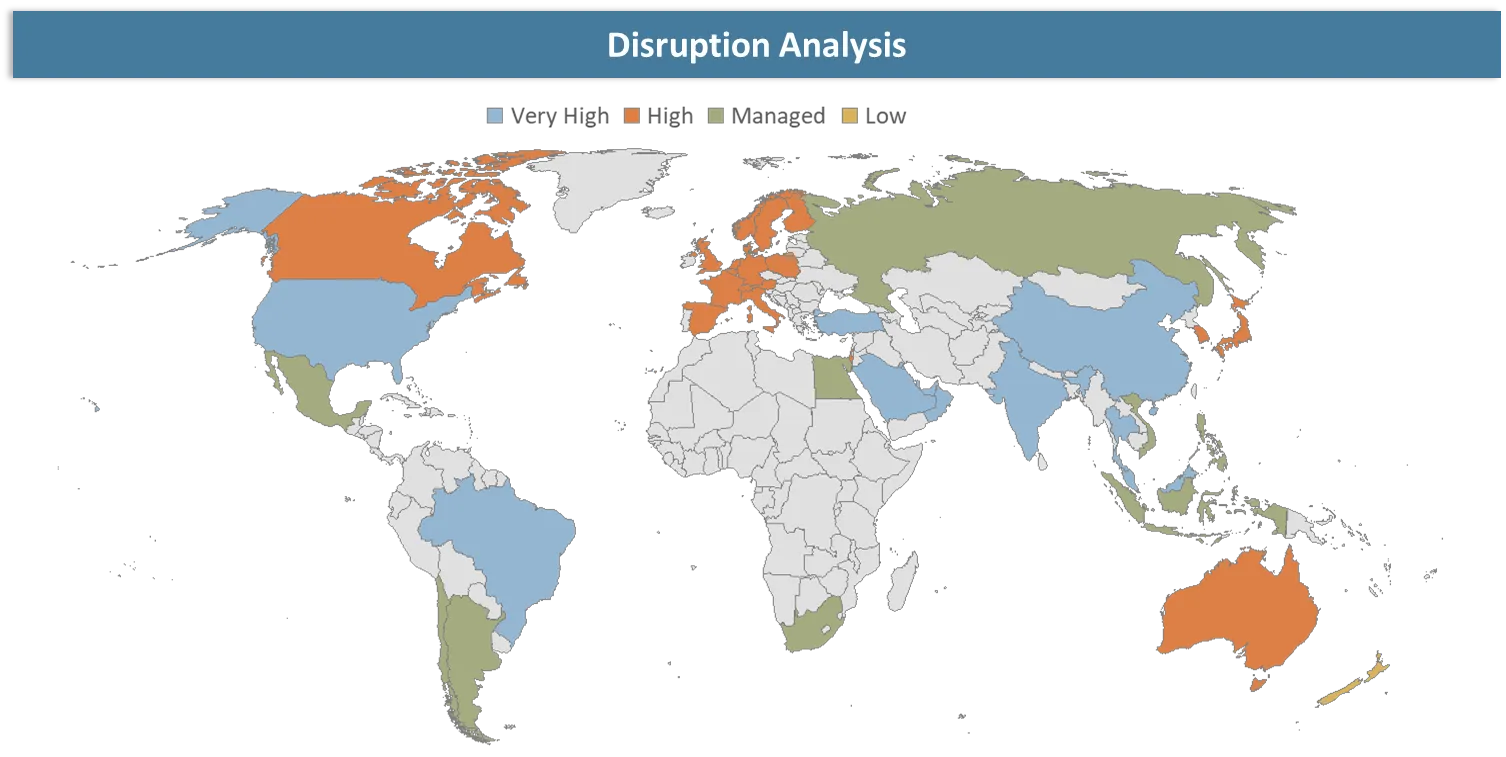
Shift Toward Performance-Engineered Brewing Yeast
The Brewing Ingredients market is being disrupted by specialised yeast strains designed to improve fermentation speed, maturation time, and production consistency. In September 2025, Lallemand Brewing introduced LalBrew House Ale, a yeast strain developed by Escarpment Labs with a focus on fermentation performance, stress tolerance, and consistent reuse across brewing batches. This shifts yeast requirements beyond basic fermentation toward strains selected for specific production outcomes.
The development is shifting competition toward fermentation efficiency and repeatable performance, rather than yeast supply alone. Breweries adopting specialised strains can target shorter production cycles and more consistent batches, while yeast suppliers can differentiate through measurable process benefits. This increases the importance of strain-specific performance in ingredient selection and creates opportunities for suppliers whose yeast products address brewery throughput and operational consistency.
Brewing Ingredients Market BCG Matrix: Company Evaluation
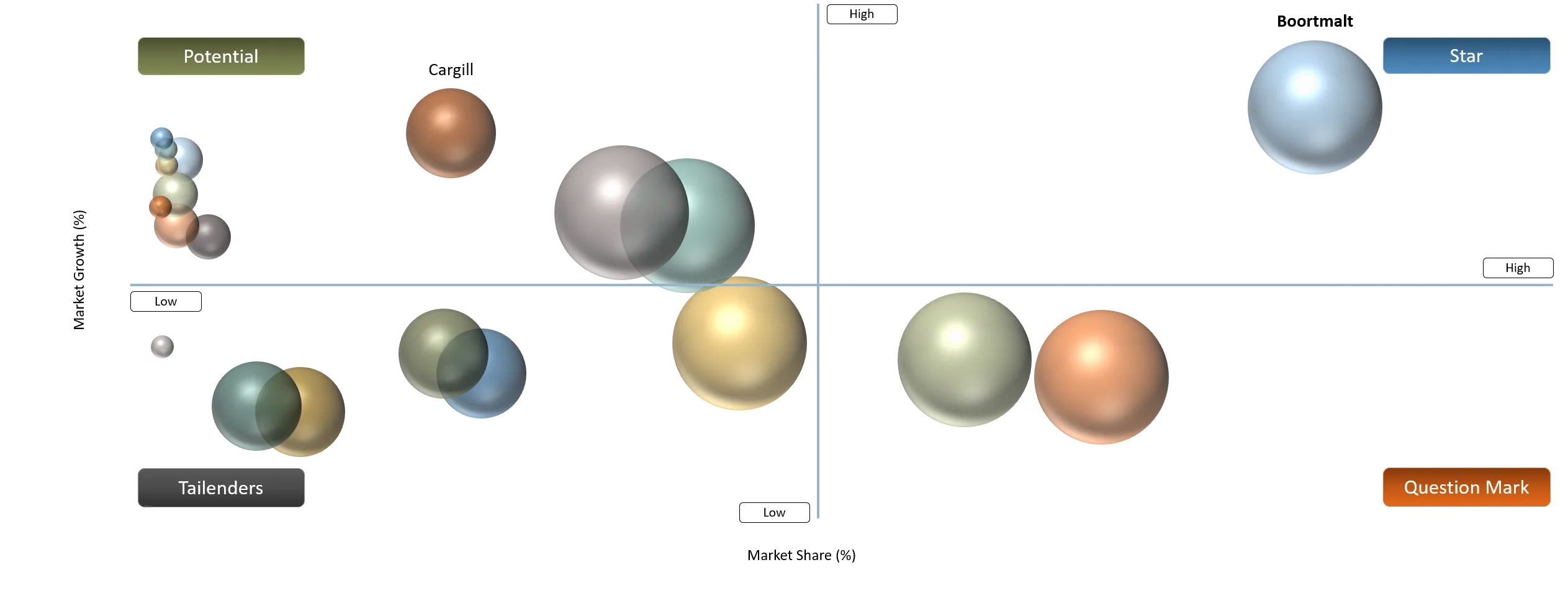
The Stars category comprises Boortmalt, MALTEUROP, Rahr Corporation, and BarthHaas GmbH, supported by established malt and hop ingredient portfolios, international supply networks, and exposure to industrial brewing and specialty beer production. The Potential Companies category includes Cargill, Incorporated, Muntons Plc, Simpsons Malt, and Briess Malt & Ingredients, with established malt and grain capabilities and opportunities to expand through specialty ingredients, regional sourcing, and differentiated brewing applications.
The Question Marks category comprises AngelYeast Co., Ltd., Lallemand Inc., Lesaffre International, and Hopsteiner, where yeast, fermentation technology and hop expertise offer opportunities in specialty brewing and emerging formulations, although their relative positions depend on the specific ingredient category and geographic market. The Tailenders category includes Malzfabrik Weyermann, reflecting its more focused specialty-malt positioning relative to diversified ingredient suppliers.
Brewing Ingredients Market Dynamics
Driver Impact Analysis
| Driver | Market Growth Impact (%) | Demand Concentration | Impacted Use Case | Strategic Impact |
Premium and specialty beer launches require higher-value malt, hops and yeast | 22% | Premium beer producers, craft breweries and brands developing differentiated beer styles | Specialty malt selection, aroma hops, flavour yeast and premium beer formulation | Increases demand for differentiated brewing ingredients with specific flavour, aroma, colour and fermentation characteristics. |
Asian brewery expansion broadens demand for locally adapted ingredient portfolios | 21% | Breweries and ingredient suppliers across China, India, Japan and other Asia-Pacific markets | Local malt sourcing, regional hop varieties, brewing yeast and ingredient distribution | Creates opportunities for regional ingredient production, local sourcing partnerships and portfolios adapted to brewing conditions and consumer preferences. |
Non-alcoholic brewing requires specialized yeast, enzymes and flavour-system solutions | 20% | Non-alcoholic beer manufacturers, industrial breweries and specialist fermentation ingredient suppliers | Low-alcohol fermentation, residual-sugar management, flavour restoration and alcohol reduction | Strengthens demand for specialised yeast strains, enzyme systems and flavour ingredients that maintain beer characteristics at lower alcohol levels. |
Craft portfolio diversification increases consumption of specialty hops and yeasts | 19% | Craft breweries, specialty beer producers and breweries expanding their product ranges | IPA production, seasonal beers, experimental fermentation and distinctive aroma profiles | Expands opportunities for new hop varieties, specialty yeast strains and small-batch ingredient solutions tailored to differentiated beer styles. |
Low-ABV formulations create incremental demand for flavour-preserving brewing ingredients globally | 18% | Low-alcohol beer producers, mainstream breweries and beverage manufacturers diversifying their portfolios | Reduced-alcohol beer, low-ABV lager, flavour retention and fermentation optimisation | Encourages development of ingredients that preserve aroma, mouthfeel and flavour while reducing alcohol formation or supporting controlled fermentation. |
Premium Beer Innovation Is Increasing Demand for Advanced Brewing Yeast and Hop Formats
Brewers developing premium and specialty beers are adopting ingredients that deliver stronger aroma, distinctive flavour and greater formulation flexibility. In January 2026, Yakima Chief Hops and Indie Hops introduced Strata® Cryo Hops, a concentrated form of the Strata hop variety produced through cryogenic separation of lupulin and plant material. The product intensifies passion fruit, grapefruit and strawberry notes while reducing vegetal matter, giving brewers a concentrated hop option for flavour-focused beer formulations.
Yeast innovation is also enabling brewers to extract more flavour from existing ingredients. Fermentis introduced SafLager SH-45 for hop-forward lagers, with biotransformation capabilities that release aromatic compounds from hop precursors, enhancing tropical fruit and citrus notes. The yeast can help brewers achieve stronger hop expression with less hops or intensify flavour using the same quantity, creating opportunities for specialised yeast products alongside premium hop ingredients.
Restraint Impact Analysis
| Restraint | Drag on Market Growth (%) | Primary Impact Area | Impacted Use Case | Strategic Impact |
Climate volatility disrupts barley and hop yields, quality, and availability | 24% | Agricultural supply, ingredient pricing and raw-material quality | Malt production, hop cultivation, seasonal ingredient sourcing | Increases supply uncertainty and procurement costs, encouraging diversified sourcing, climate-resilient crop varieties and longer-term supplier agreements. |
Softening beer volumes in mature markets limits ingredient consumption growth | 22% | Brewery production volumes and ingredient demand | Malt, hops, yeast and brewing additives for established beer markets | Limits incremental ingredient purchases and increases pressure on suppliers to secure demand through specialty products and alternative beverage applications. |
Ingredient contamination risks raise quality-control requirements across barley-to-beer supply chains | 20% | Food safety, ingredient traceability and quality assurance | Barley storage, malt processing, hop handling, yeast production and brewing | Raises testing, monitoring and traceability costs while increasing the importance of supplier audits and consistent ingredient-quality standards. |
Small breweries face ingredient price volatility and constrained procurement leverage | 18% | Purchasing costs, working capital and supply access | Specialty hops, small-batch malt, brewing yeast and limited-volume ingredient orders | Restricts access to premium ingredients and bulk-purchase discounts, encouraging supplier partnerships, coordinated purchasing and flexible order quantities. |
Climate-Related Supply Risks Are Increasing the Need for Scalable Brewing Ingredient Production
Brewing ingredient suppliers face the challenge of maintaining consistent quality and reliable supply as demand for specialized fermentation products grows. In December 2025, Angel Yeast reported trial production at its new specialty yeast facility in Yichang, China, with planned annual capacity of 8,500 tonnes at full ramp-up. The facility expands its specialty yeast manufacturing capabilities for craft brewing, wine and other applications, combining automated production processes with stricter contamination controls to maintain product consistency.
For the brewing ingredients industry, the development highlights the importance of scalable production, quality assurance and reliable ingredient availability. Specialty yeast requires controlled manufacturing and storage conditions, while breweries depend on consistent fermentation performance between batches. Angel Yeast’s expansion addresses these production requirements, although the announcement does not establish that climate volatility caused the investment. Climate-related risks to barley and hop crops remain a separate supply constraint requiring agricultural resilience and diversified sourcing.
Brewing Ingredients Market Segment Analysis
The global brewing Ingredients market is segmented by source, form, function type, process, application, end-user and region.
Hop Innovation and Climate-Resilient Cultivation Are Expanding Brewing Ingredient Opportunities
Hops are an important brewing ingredient because they provide bitterness, aroma and flavour, while developments in new varieties and concentrated hop products are expanding brewers’ formulation options. In February 2026, Hop Products Australia introduced Luna®, a new hop variety with mango, dark berry and spicy citrus notes and high polyphenol content. Following strong demand in its first commercial crop in 2026, the company announced plans to increase Luna production from the 2027 crop onward.
The introduction creates opportunities for specialty hop suppliers to serve brewers seeking distinctive flavour profiles and differentiated beer formulations. In September 2025, BarthHaas also introduced PRYSMA®, a liquid hop-flavour platform using a fully hop-derived emulsification system. It disperses hop oils in hot and cold beverages and enables post-filtration dosing, giving brewers greater flexibility to adjust flavour profiles without changing the base beer stream.
Brewing Ingredients Market Geographical Penetration
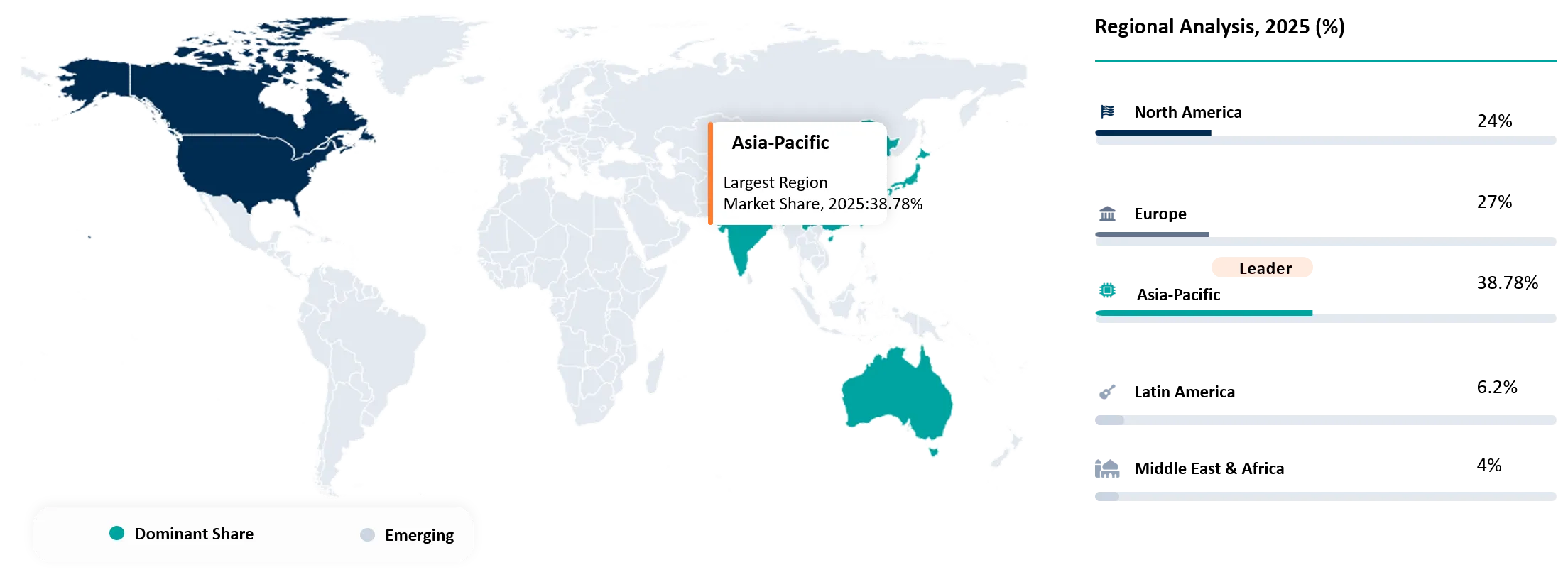
Expansion of Malt Production Is Strengthening Asia-Pacific Brewing Ingredient Supply
Asia-Pacific’s brewing ingredients market is benefiting from investments in local malt production and technology development for key brewing inputs. In February 2026, Soufflet Malt announced a €100 million investment in a new AI-enabled malthouse in Rajasthan, India, with an initial annual capacity of 110,000 tonnes and completion targeted for early 2028. The project is designed to strengthen local malt supply for beer, distilling and other food and beverage manufacturers.
The investment is also linked to domestic barley sourcing, with Soufflet Malt planning to work with more than 50,000 Indian farmers and source up to 250,000 tonnes of barley annually when the facility reaches full capacity following its second expansion phase. This development directly addresses the malt segment by increasing planned processing capacity, strengthening the agricultural supply chain and expanding access to locally produced brewing ingredients.
China Brewing Ingredients Market Trends
China’s brewing ingredients industry is advancing through investment in fermentation research and the industrial application of brewing microorganisms. In November 2025, Angel Yeast commissioned its Brewing Functional Microorganism Pilot Test Platform to evaluate microbial strains under conditions simulating commercial brewing operations. The facility uses real-time monitoring to assess microbial activity and flavour-compound development, accelerating the transition from laboratory research to practical brewing applications.
The platform is directly relevant to brewing yeast and fermentation solutions because it enables more controlled evaluation of microbial performance, flavour development and production consistency. By shortening the development cycle for brewing applications, Angel Yeast aims to help beverage manufacturers validate fermentation solutions before industrial use. This strengthens China’s brewing ingredient development capabilities, particularly in specialised yeast and microbial technologies.
Japan Brewing Ingredients Market Trends
Japan’s brewing ingredients sector is addressing climate-related risks to hop production through agricultural technology development. In September 2025, Kirin Holdings announced a seedling cultivation technology designed to improve heat and drought tolerance in hops without compromising their original aroma and flavour characteristics. Tested using Saaz and Hersbrucker varieties, the approach applies a six-week heat treatment during seedling propagation to improve resilience under stressful growing conditions.
The development is directly relevant to hops, a key brewing ingredient responsible for beer bitterness, aroma and flavour. Field evaluations in Iwate Prefecture found improved plant growth in heat-treated seedlings, with a tendency towards higher hop-cone yields in one test location. Kirin plans further validation across growing locations and hop varieties, targeting more stable ingredient production as climate conditions become less predictable.
Brewing Ingredients Market Competitive Landscape
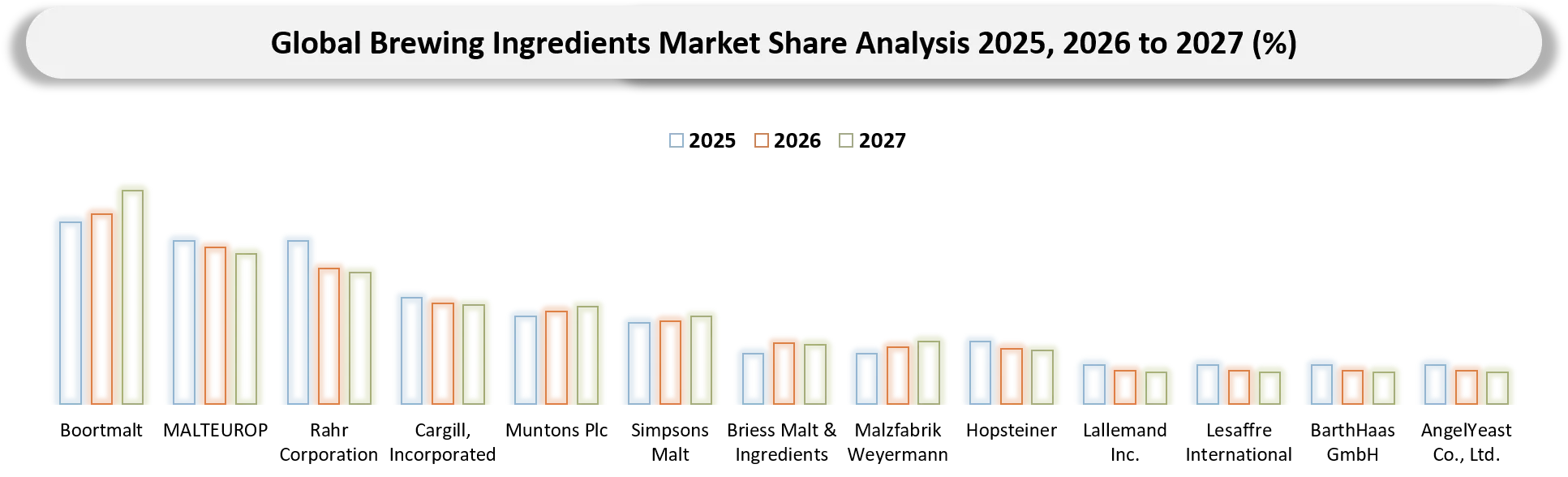
- Key players in the brewing ingredients market include Boortmalt, MALTEUROP, Rahr Corporation, Cargill, Incorporated, Muntons Plc, Simpsons Malt, Briess Malt & Ingredients, Malzfabrik Weyermann, Hopsteiner, Lallemand Inc., Lesaffre International, BarthHaas GmbH, and AngelYeast Co., Ltd.
Key Developments
February 2026: Hop Products Australia introduced Luna, a new flavour hop variety featuring mango, dark berry and spicy citrus notes alongside high polyphenol content, giving brewers an additional ingredient option for developing distinctive flavour and mouthfeel profiles across beer styles.
February 2026: Soufflet Malt announced a €100 million investment in a new AI-enabled malthouse in southern Rajasthan, India, with an initial annual capacity of 110,000 tonnes and first-phase completion expected in early 2028, expanding domestic malt production for beer, distilling and other food and beverage applications.
March 2026: RahrBSG partnered with Yakima Chief Hops to expand North American brewers’ access to a wider selection of hop varieties and enhanced hop products through RahrBSG’s distribution network, improving the availability of specialised brewing ingredients while both companies remain independently operated.
April 2026: Fermentis launched SafBrew LA-02, an active dry Torulaspora delbrueckii yeast that ferments simple sugars while leaving maltose largely unfermented, enabling craft and industrial brewers to produce very-low-alcohol and non-alcoholic beers without specialised dealcoholisation equipment.
August 2026: Muntons partnered with HEINEKEN UK, barley merchant Cefetra, Soil Capital and maltster Boortmalt in a regenerative malting-barley programme that pays farmers premiums for qualifying yields and provides agronomic guidance, strengthening the sustainable sourcing of barley for beer production.
September 2025: BarthHaas introduced PRYSMA, a liquid hop-flavour platform using a fully hop-derived emulsification system to disperse hop oils and natural flavour compounds in hot and cold beverages, enabling consistent flavour delivery and post-filtration dosing without synthetic solvents or non-hop-based additives.
July 2025: Kalsec relaunched its hops division as KalHops, strengthening its portfolio of hop-derived ingredients and application expertise for alcoholic and non-alcoholic beverages, with solutions designed to improve flavour and aroma development, brewhouse yields and production efficiency.
Key Procurement Priorities and Buyer Evaluation Criteria
- Breweries increasingly prioritize ingredients delivering consistent fermentation performance, flavor profile, extract yield, aroma intensity, and batch-to-batch quality across production volumes.
- Procurement decisions are influenced by beer style, recipe formulation, brewing process, brewery scale, alcohol target, ingredient availability, regional sourcing, and production consistency, particularly for specialty and low/no-alcohol beers.
- Buyers evaluate manufacturers based on ingredient quality, technical specifications, brewing performance, consistency, purity, shelf life, customization, certifications, supply reliability, lead times, technical support, sustainability credentials, and total ingredient cost.
Why Choose DataM?
- Technological Innovations: Explores advances in brewing ingredient technologies, including specialty malts, hop extracts, aroma systems, brewing yeast strains, fermentation enzymes, adjuncts, yeast nutrients, clarification aids, and ingredient solutions for low/no-alcohol and specialty beer production.
- Product Performance & Market Positioning: Evaluates brewing ingredients based on extract yield, enzymatic activity, fermentation performance, attenuation, aroma intensity, flavor contribution, foam stability, clarification efficiency, shelf stability, process consistency, and compatibility with specific beer styles.
- Real-World Evidence: Highlights commercial applications of specialty malt, differentiated hop products, brewing yeast, enzymes, adjuncts, and processing aids across lager, ale, IPA, stout, sour, craft, low-alcohol, and non-alcoholic beer production.
- Market Updates & Industry Changes: Tracks ingredient launches, brewery collaborations, strain development, specialty malt expansions, hop-processing investments, enzyme innovations, sustainability initiatives, acquisitions, manufacturing expansions, and formulation developments shaping brewing ingredient demand across major brewing regions.
- Competitive Strategies: Analyzes how leading brewing ingredient manufacturers strengthen positions through proprietary yeast strains, specialty malt portfolios, hop breeding, extraction technologies, enzyme formulations, customized brewing solutions, technical support, brewery partnerships, application development, and regional manufacturing expansion.
- Pricing & Market Access: Explains pricing variations according to ingredient type, grade, variety, processing method, concentration, performance characteristics, customization, supply availability, production scale, and sourcing region, alongside procurement through breweries, ingredient distributors, brewing-equipment partners, and specialized ingredient suppliers.
- Market Entry & Expansion: Identifies opportunities arising from craft beer diversification, low/no-alcohol brewing, specialty beer formulations, climate-resilient barley and hops, alternative grains, enzyme-assisted processing, regional ingredient production, and customized solutions for emerging brewery markets.
Target Audience 2026
- Brewing Ingredient Manufacturers
- Malt Producers and Malting Companies
- Hop Growers and Hop Processing Companies
- Brewing Yeast and Fermentation Ingredient Manufacturers
- Brewing Enzyme and Processing-Aid Manufacturers
- Commercial Breweries and Beer Producers
- Craft Breweries and Microbreweries
- Non-Alcoholic and Low-Alcohol Beer Producers
- Brewing Equipment and Process Technology Companies
- Brewing Ingredient Distributors and Specialty Suppliers
- Beverage Ingredient Companies Expanding into Brewing
- Brewing Industry Associations and Research Organizations



























































