


Brazil Certified Reference Materials (CRM) Market Size and Overview
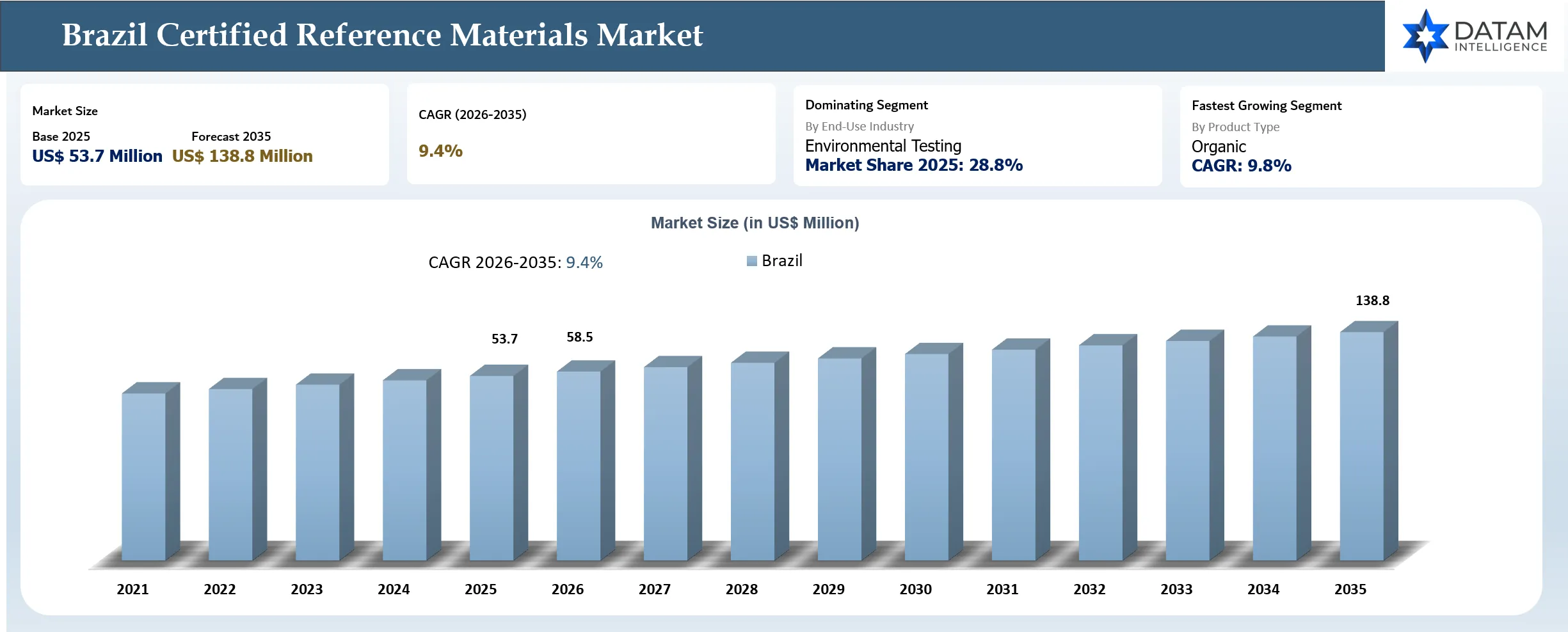
The Brazil Certified Reference Materials (CRM) market reached USD 53.7 million in 2025 and is expected to reach USD 138.8 million by 2035, growing with a CAGR of 9.4% during the forecast period 2026-2035. The Brazil certified reference materials market is driven by the expansion of accredited laboratory testing and quality assurance, stringent food safety and pesticide residue monitoring requirements, extensive mining and mineral processing activities, increasing pharmaceutical and industrial analytical testing, and growing demand for environmental contaminant detection.
Brazil’s certified reference materials market benefits from stringent food safety requirements and pesticide residue monitoring, which increase demand for reliable analytical standards for residue detection and regulatory compliance. In December 2025, Brazil’s National Health Surveillance Agency (Anvisa) reported that its 2024 monitoring programme analysed 3,084 samples across 14 food types, with 20.6% classified as non-compliant and 12 samples (0.39%) indicating potential acute health risks. These findings reinforce the need for pesticide reference standards and certified materials to support accurate residue quantification, method validation, and food safety testing.
Brazil Certified Reference Materials (CRM) Market Key Takeaways
- Environmental Testing dominated the Brazil Certified Reference Materials (CRM) market by end-use industry in 2025, accounting for 28.8% market share. Demand is supported by the monitoring of soil, surface water, groundwater, wastewater and industrial contamination. Testing for pesticides, heavy metals and emerging contaminants requires reference materials for instrument calibration, analytical method validation and quality control, helping laboratories produce reliable and traceable results.
- Organic CRMs represent the fastest-growing product type, with a projected CAGR of 9.8%. Growth is supported by the need to measure organic contaminants, including pesticide residues, hydrocarbons and emerging pollutants, in environmental, food and industrial samples. Organic reference standards help laboratories establish calibration curves, verify analytical recovery and validate methods used in techniques such as gas chromatography–mass spectrometry (GC-MS) and liquid chromatography–mass spectrometry (LC-MS).
- Brazil’s expanding PFAS monitoring and research activities are increasing the need for specialised environmental testing and analytical quality control. In March 2026, researchers at the University of Campinas (Unicamp) and Embrapa Meio Ambiente identified 85 PFAS compounds in contaminated groundwater using advanced mass spectrometry, supporting demand for reference materials in contaminant detection and method validation.
Brazil Certified Reference Materials (CRM) Market Scope
| Metrics | Details |
| 2025 Market Size | USD 53.7 Million |
| 2035 Projected Market Size | USD 138.8 Million |
| CAGR (2026-2035) | 9.4% |
| By Product Type | Organic, Inorganic |
| By Application | Quality Control & Assurance, Method Validation, Regulatory Compliance Testing, R&D & Analytical Development, Calibration & Instrument Validation |
| By End-User Industry | Consumer Industry, Contract Testing, University / Non-Profit, Energy Industry, Environmental Testing, Health Care, Industrial / Manufacturing, Materials / Mining |
| Report Insights Covered | Competitive Landscape Analysis, Company Profile Analysis, Market Size, Share, Growth |
Brazil Certified Reference Materials (CRM) Market Disruption Analysis
Specialised Domestic CRM Production Challenging Reliance on Standard Imported Material
Brazil’s CRM market could experience a shift in supplier competition as domestic institutions develop certified reference materials for specialised applications that are not adequately served by general-purpose standards. This changes the competitive basis from simply supplying established reference materials to developing matrix-specific products with validated homogeneity, stability, and certified property values. For laboratories, the availability of domestically developed materials may broaden sourcing options for niche analytical requirements, while international suppliers may face greater competition in applications served by Brazilian producers.
In its research on CRM 8969.0001, Brazil’s National Institute of Metrology, Quality and Technology (Inmetro) documented the certification of selenium-enriched yeast, with certified values of 2,637 ± 139 mg/kg for total selenium and 3,248 ± 325 mg/kg for selenomethionine. Separately, the Mineral Technology Center (CETEM) maintains ISO 17034 accreditation for producing CRMs covering bauxite, copper sulphide ore and concentrate, and mining waste. These show Brazilian institutions building specialised production capabilities across nutraceutical and mineral-testing applications. The potential disruption is a gradual change in the range of locally available materials and the competitive position of suppliers.
Brazil Certified Reference Materials (CRM) Market BCG Matrix: Company Evaluation
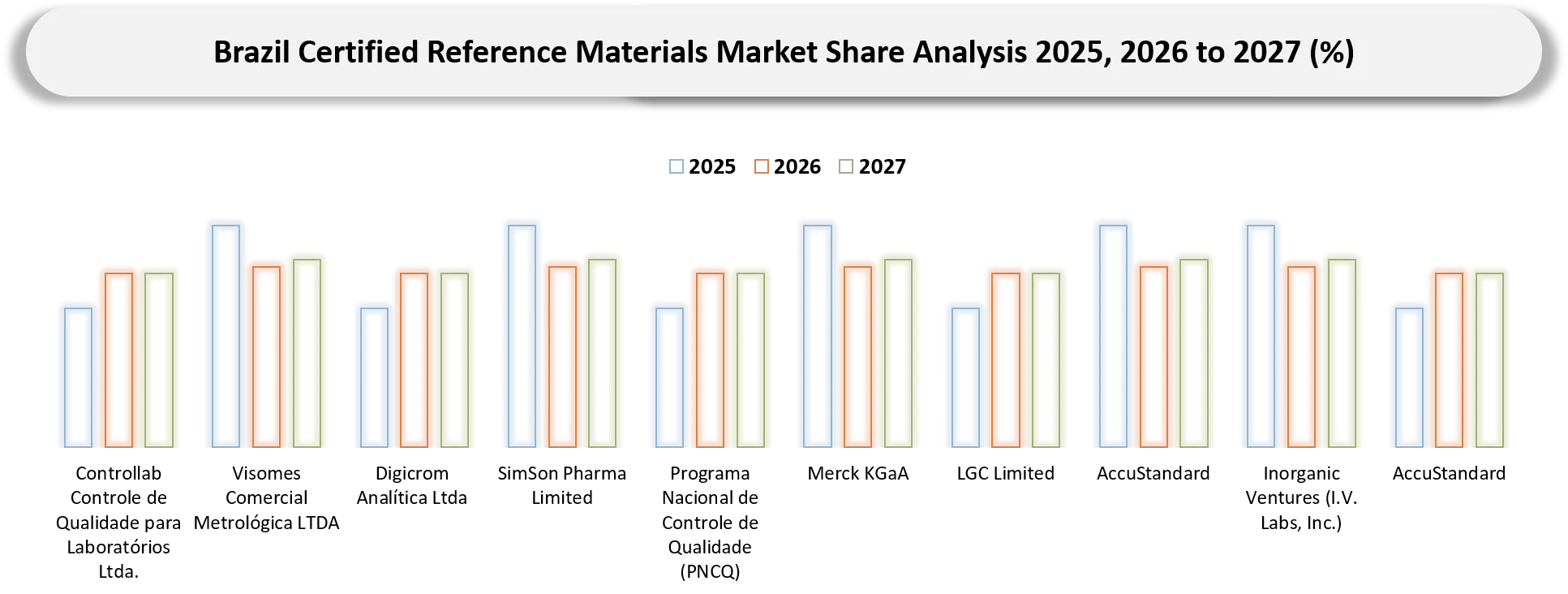
Controllab Controle de Qualidade para Laboratórios Ltda., Merck KGaA, and LGC Limited are positioned as Stars in the Brazil Certified Reference Materials (CRM) market, supported by their broad reference-material portfolios, established laboratory customer bases, and applications across chemical, environmental, pharmaceutical, and analytical testing. Visomes Comercial Metrológica Ltda. and Digicrom Analítica Ltda. are classified as Potential Stars, reflecting their specialised metrology and analytical reference-material offerings serving Brazilian laboratories.
AccuStandard and Inorganic Ventures (I.V. Labs, Inc.) are positioned as Question Marks, given their specialised portfolios of organic, inorganic, and environmental analytical standards and their reliance on Brazilian distribution channels to reach customers. Programa Nacional de Controle de Qualidade (PNCQ) is classified as a Tailender within the broader CRM market because of its focus on clinical laboratory quality control and proficiency-testing applications. SimSon Pharma Limited is also positioned as a Tailender, reflecting its specialised pharmaceutical reference-standard portfolio relative to suppliers serving multiple analytical testing industries.
Brazil Certified Reference Materials (CRM) Market Segment Analysis
The Brazil certified reference materials (CRM) market is segmented based on product type, application, end-user industry, and region.
Environmental Contaminant Monitoring Driving CRM Demand in Brazil
Environmental testing holds a major share of Brazil’s certified reference materials market due to the need to monitor contamination from mining and other industrial activities. In September 2026, Brazil’s Federal Public Prosecutor’s Office (MPF) pursued legal action demanding a permanent monitoring system for mercury contamination in Amazonian rivers, sediments, and fish across Amazonas, Rondônia, and Roraima. The proposed monitoring programme supports the relevance of mercury reference standards and matrix-matched CRMs for accurate contaminant measurement, analytical validation, and environmental laboratory quality control.
Brazil’s need to assess persistent chemical contamination in drinking-water sources supports the use of certified reference materials in environmental testing. In February 2026, a study published in Toxics investigated per- and polyfluoroalkyl substances (PFAS) and polybrominated diphenyl ethers (PBDEs) in Brazilian surface waters used for urban water supply. The research underscores the need for reliable contaminant measurement, with appropriate analytical standards and quality-control materials supporting method validation and accurate quantification in water samples.
Brazil Certified Reference Materials (CRM) Market Competitive Landscape
- Brazilian companies such as Controllab Controle de Qualidade para Laboratórios Ltda., Visomes Comercial Metrológica Ltda., Digicrom Analítica Ltda., and Programa Nacional de Controle de Qualidade (PNCQ) supply certified reference materials and related laboratory standards for chemical analysis, water-quality testing, clinical diagnostics, and laboratory quality control. SimSon Pharma Limited also offers pharmaceutical reference standards, including drug working standards, impurity standards, and metabolites.
- Brazil-based companies include Controllab Controle de Qualidade para Laboratórios Ltda. (Brazil), Visomes Comercial Metrológica Ltda. (Brazil), Digicrom Analítica Ltda. (Brazil), and Programa Nacional de Controle de Qualidade (PNCQ) (Brazil). International suppliers serving the market include SimSon Pharma Limited (India), Merck KGaA (Germany), LGC Limited (United Kingdom), AccuStandard (United States), and Inorganic Ventures (I.V. Labs, Inc.) (United States).
Key Developments
- March 2026: Researchers at the University of Campinas (Unicamp), in collaboration with Embrapa Meio Ambiente, developed an analytical workflow for detecting emerging contaminants in water. The study identified 85 different PFAS compounds in known-contaminated groundwater samples using liquid chromatography–mass spectrometry, solid-phase extraction, and data-processing software, improving the identification of complex PFAS mixtures in environmental monitoring.
- October 2025: Controllab, highlighted its reference strains recognized as Certified Reference Materials (CRMs), sourced from internationally recognized culture collections, including NCTC® and NCPF®. These materials support microbiological quality control, method validation, and metrological traceability in clinical, veterinary, food, water, pharmaceutical, and environmental testing laboratories.
- July 2023: Controllab expanded its ISO 17034-accredited Certified Reference Material (CRM) portfolio in Brazil after receiving recognition from INMETRO for additional categories, including thermodynamic properties and environmental chemical composition, bringing its accredited portfolio to nearly 150 materials. The expansion covered environmental and chemical parameters, physical properties, and approximately 80 reference strains for clinical, veterinary, food, water, pharmaceutical, and environmental microbiology testing, strengthening laboratory quality control and method validation capabilities.
Why Choose DataM?
- Technological Innovations: Examines advancements in Certified Reference Materials (CRMs), including matrix-matched standards, high-purity elemental reference materials, quantitative nuclear magnetic resonance standards, and specialized materials for emerging analytical techniques, supporting improved measurement accuracy and laboratory reliability.
- Product Performance & Market Positioning: Evaluates how CRM manufacturers and suppliers differentiate their offerings through certified values, measurement uncertainty, metrological traceability, material homogeneity, certification quality, and suitability for environmental, pharmaceutical, food safety, mining, and industrial testing applications.
- Real-World Evidence: Highlights CRM applications in Canadian laboratories, including contaminant detection, elemental impurity analysis, water-quality monitoring, shellfish toxin testing, pharmaceutical quality control, and critical-mineral characterization, demonstrating their role in analytical validation and reliable measurement outcomes.
- Market Updates & Industry Changes: Tracks developments during 2025–2026, including new CRM introductions, specialized reference-material launches, product portfolio expansions, and changes in analytical testing requirements, helping identify evolving demand across Brazil's environmental, food, healthcare, and industrial sectors.
- Pricing & Market Access: Assesses differences in CRM pricing based on material composition, certification complexity, concentration, packaging size, intended application, and production requirements. It also examines supplier availability, distribution channels, delivery lead times, and access to specialized reference materials for Canadian research institutions, industrial laboratories, and regulated testing facilities.
- Market Entry & Expansion: Identifies opportunities arising from environmental contaminant monitoring, food safety testing, pharmaceutical quality assurance, critical-mineral analysis, and emerging nanomaterial measurement requirements. It also evaluates strategies such as developing application-specific CRMs, strengthening laboratory partnerships, expanding distribution networks, and improving access to traceable reference materials across Brazil.
Target Audience 2026
- CRM Manufacturers and Producers
- Analytical Testing Laboratories
- Government and Regulatory Agencies
- Pharmaceutical and Biotechnology Companies
- Food and Beverage Companies
- Environmental Monitoring and Water Testing Organizations
- Mining, Metals, and Critical Minerals Companies


























































