


Brazil Cables & Wires Market Size and Overview
The Brazil cables and wires market was valued at US$ 5.85 billion in 2025 and is projected to reach US$ 6.11 billion by 2031, representing 0.73% annualized growth between these endpoints. The market includes low-voltage building wires, medium- and high-voltage power cables, datacom and fiber-optic cables plus specialty products used across utilities, commercial construction, industrial production, renewable energy and telecommunications. Low-voltage cables represent 47.68% of 2025 value, followed by medium- and high-voltage cables at 32.32%.
Demand in Brazil reflects electric utility grid reinforcement, distribution maintenance, solar and wind connections, industrial electrical installations and fiber-network investment. Cable orders depend on transmission and distribution tender execution, private-sector capital expenditure, construction conditions and commodity costs. Geographic market access varies between the Southeast industrial belt, the South, renewable-energy corridors in the Northeast and remote power and communications installations.
| 2025 MARKET SIZE | 2031 FORECAST | CAGR (2026–2031) |
|---|---|---|
| US$ 5.85 Billion | US$ 6.11 Billion | 0.73% |
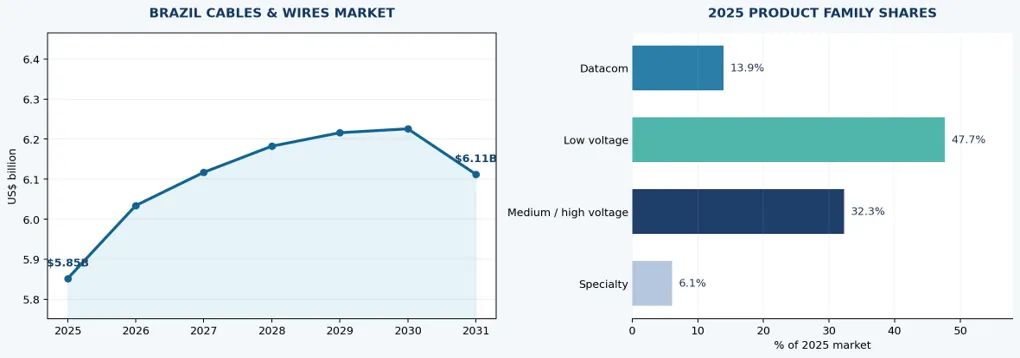
Brazil’s cable and wire market increases from US$ 5.85 billion in 2025 to US$ 6.11 billion in 2031, a net gain of US$ 0.26 billion.
The 0.73% endpoint-based annualized growth reflects a relatively mature cable market with fluctuating demand by project type and product family.
Low-voltage cables account for 47.68% of 2025 revenue, supported by building wiring, industrial plants and distribution installations.
Medium- and high-voltage cables represent 32.32% in 2025, linked to transmission projects, utility reinforcement and renewable connections.
Datacom cables hold 13.94% in 2025, reflecting enterprise networks, fiber deployment and telecommunications infrastructure.
Supplier differentiation depends on technical qualification, inventory depth, local production, logistics performance and copper/aluminum price discipline.
Brazil Cables & Wires Industry Trends and Strategic Insights
Power-sector investment supports medium- and high-voltage cable demand as utilities improve network capacity, resilience and reliability through reinforcements and expansions.
Solar and wind interconnection requirements encourage procurement of PV, medium-voltage and weather-resistant cable designs, particularly where generation sites are distant from substations.
Telecommunications modernization and enterprise connectivity sustain demand for optical fiber and structured cabling, although installation schedules remain dependent on operator budgets.
Domestic manufacturing, product certification, metal-index contracts and regional distribution are central to competing across Brazil’s large and geographically dispersed market.
Brazil Cables & Wires Market Scope
| METRICS | DETAILS |
| 2025 Market Size | US$ 5.85 Billion |
| 2031 Projected Market Size | US$ 6.11 Billion |
| CAGR (2026–2031) | 0.73% |
| Geographic Coverage | Brazil (national market; state and subnational demand context) |
| By Cable Type | Datacom Cables (Communication & Data Cables, Fiber Optic Cables); Low-Voltage Cables (Fire Resistant Cables, Low Smoke & Halogen Free Cables, Low Voltage Cables & Wires); Medium- and High-Voltage Cables (Medium Voltage Cables, High Voltage Cables); Special Cables (Mining Oil & Gas Cables, Photovoltaic Cables, Ship & Harbour Cables, Windmill Cables) |
| By Industry | Industrial — Discrete (Aerospace & Defense, Automotive, Batteries, Electrical & Electronics, Machine Building, Semiconductor); Process (Chemicals, Energy/Oil & Gas, Metal Processing); Hybrid (Food & Beverage, Lifesciences, Mining & Quarrying, Other Manufacturing). Non Industrial — Transportation (Air, Land, Rail, Marine Services); Infrastructure & Services (Commercial Real Estate, Data Centers, Healthcare, Hospitality & Entertainment, Public Sector/Research/Education, Residentials, Water & Waste, Others). Power Utilities — Power Generation (Coal, Conventional Excl. Coal, Renewables); Power Distribution & Transmission. |
| By Conductor / Transmission Medium | Copper; Aluminum; Optical Fiber; Composite / Hybrid Construction |
| By Voltage Rating (Power Cables) | Low Voltage (up to 1 kV); Medium Voltage (above 1 to 35 kV); High Voltage (above 35 to 230 kV); Extra-High Voltage (above 230 kV) |
| By Insulation and Sheathing Material | Cross-Linked Polyethylene (XLPE); Polyvinyl Chloride (PVC); Ethylene Propylene Rubber (EPR/EPDM); Polyethylene (PE); Low Smoke Zero Halogen (LSZH); Other Materials |
| By Installation Method | Overhead; Underground / Buried; Submarine / Underwater; Indoor / Building; Outdoor / Industrial |
| Competitive Landscape | Competitive positioning, 10 company profiles, recent developments and partnerships |
| Market Data Coverage | Cable-type and cable-subtype market values, 2025–2031 (US$ million); industry, material, voltage and installation breakdowns within the defined report scope |
The report measures Brazil cable-market value by product family, supported by a multilevel industry end-market segmentation. Conductor, voltage, insulation and installation categories provide additional perspectives on product mix, procurement and application requirements.
Brazil Cables & Wires Market White Space & Investment Opportunities
Grid and distribution renewal: Supply opportunities include technically qualified medium-voltage feeders, higher-capacity power cables and accessories for utility projects.
Industrial and commercial electrification: Factory upgrades, process automation and commercial construction require durable low-voltage and specialty cable systems.
Renewable energy and connectivity: Wind and solar projects create application-specific power-cable needs, while fiber expansion offers opportunities to telecommunications and structured-cabling suppliers.
Southeast Brazil concentrates industrial and commercial demand, while the South offers manufacturing and infrastructure opportunities. The Northeast remains important for renewable generation connections. Projects in the North and Center-West require additional logistics planning for utility, mining, agriculture and telecommunications applications. Regional lead times, regulatory approvals and contractor capacity influence when installed cable demand converts into supplier revenue.
Driver Impact Analysis
Brazil’s cable demand is shaped by grid maintenance and expansion, distributed generation and industrial electrical upgrades. Transmission and distribution projects require medium- and high-voltage cables that meet utility qualification standards, while factory modernization supports flexible, fire-resistant and control-cable products. Commercial buildings and residential installations add a recurring base of low-voltage wiring demand. Renewable connections and telecommunications investment provide additional pockets of growth across distinct product types.
| DRIVER | AFFECTED PRODUCT / SIGNAL | 2026–2031 CAGR | STRATEGIC IMPACT |
| Grid reinforcement and utility upgrades | MV/HV and distribution cable procurement | Moderate–High | Build utility qualification and project-tender partnerships. |
| Solar and wind interconnections | PV, MV and weather-resistant cables | Moderate–High | Align technical specifications with EPC and concession programs. |
| Industrial and building investment | Low-voltage, fire-resistant and control wiring | Moderate | Maintain contractor channels and industrial stock availability. |
| Fiber and network expansion | Optical fiber and structured copper datacom | Moderate | Target operator build-outs and enterprise connectivity projects. |
Demand conversion is affected by the timing of concession investment plans, public and private tenders, grid-connection approvals and construction milestones. Suppliers capable of bidding early with compliant specifications, documented testing and contractor support can secure preferred positions. Investment in local cable inventory, technical services and reliable regional transport enables faster execution when projects move from engineering to purchase orders.
Restraint Impact Analysis
Copper and aluminum volatility can alter selling prices, project economics and working-capital requirements. Foreign-exchange movements affect imported equipment, polymers and specialty components, while price competition is intense in standard building wire. Technical qualification and testing requirements can delay access to higher-value utility and industrial opportunities. Tax and logistics complexity across states also raises the cost of moving bulky cable products to dispersed job sites.
| RESTRAINT | PRIMARY EXPOSURE | RISK LEVEL | STRATEGIC IMPACT |
| Copper and aluminum price variation | Commodity and project pricing | High | Use indexed quotations, hedging and procurement controls. |
| Utility approvals and tender slippage | MV/HV order timing and capacity planning | High | Diversify customer backlog and stage production. |
| Interstate logistics and import exposure | Long-distance distribution and specialty inputs | Moderate–High | Develop regional inventory and local sourcing options. |
| Standard-cable price competition | Low-voltage wiring and commodity datacom | Moderate | Differentiate on standards compliance and service. |
Utility tender delays, environmental licensing and construction bottlenecks can shift expected cable deliveries between years. Cable producers must balance manufacturing utilization against unpredictable infrastructure order timing, while fiber deployments may face operator investment resets. Contractors may defer installation during periods of financing pressure. Effective mitigation includes indexed metal pricing, flexible production scheduling, diversified industrial and utility sales, regional stocks plus collaboration with EPCs and channel partners.
Brazil Cables & Wires Market Competitive Landscape
Brazil’s competitive landscape includes domestic power-cable producers, global manufacturers and specialized fiber and connectivity suppliers. Competition spans commodity low-voltage wiring, utility-grade medium- and high-voltage cables, telecom fiber and industrial specialty designs. Producers with local capacity, certified cable families and broad electrical distributor coverage are positioned to address project demand throughout the country.
| COMPANY | BRAZILIAN CABLES & WIRES POSITIONING |
| Nexans | Building wire, power cables and utility-linked electrical infrastructure. |
| Prysmian | Power, industrial, construction and optical-cable systems. |
| Southwire | Electrification and low-voltage wire, including expanded Brazilian manufacturing presence. |
| Corning | Optical fiber, cable and advanced connectivity for data centers and broadband. |
| Belden | Industrial communication, specialty cables and network connectivity. |
| Amphenol | Fiber and copper connectivity systems across datacom and infrastructure. |
| AFL | Optical fiber cable systems, accessories and network services. |
| Marmon Electrical | Diversified electrical wire and cable solutions for industrial and utility uses. |
| General Cable | Power and submarine cable systems with Brazilian investment activity. |
| Sumitomo Electric Industries | Optical fiber, energy cable and industrial wiring systems. |
Differentiation increasingly rests on utility prequalification, quality assurance, delivery certainty and responsiveness to copper-price movements. For long-cycle infrastructure projects, bidders are evaluated on lifecycle performance as well as upfront pricing. Relationships with distributors, electrical contractors, transmission developers, renewable EPCs and telecom operators can strengthen project access and aftermarket demand.
Brazil Cables & Wires Market Recent Developments
2026: Utility network reinforcement and transmission investment remain key procurement themes for medium- and high-voltage cable suppliers in Brazil.
2026: Renewable-energy developments sustain requirements for solar, wind and interconnection cable specifications where projects advance to construction.
2026: Telecommunications and enterprise network upgrades maintain opportunities for optical fiber and data cables.
2026: Industrial electrical modernization supports demand for low-voltage, automation and specialty cable applications.
2026: Domestic suppliers continue to prioritize delivery reliability, certification and indexed metal-price arrangements in project bidding.
2026: Regional infrastructure logistics and utility tender schedules continue to influence the timing of cable procurement.


























































