


Blast Furnace Market Size and Overview
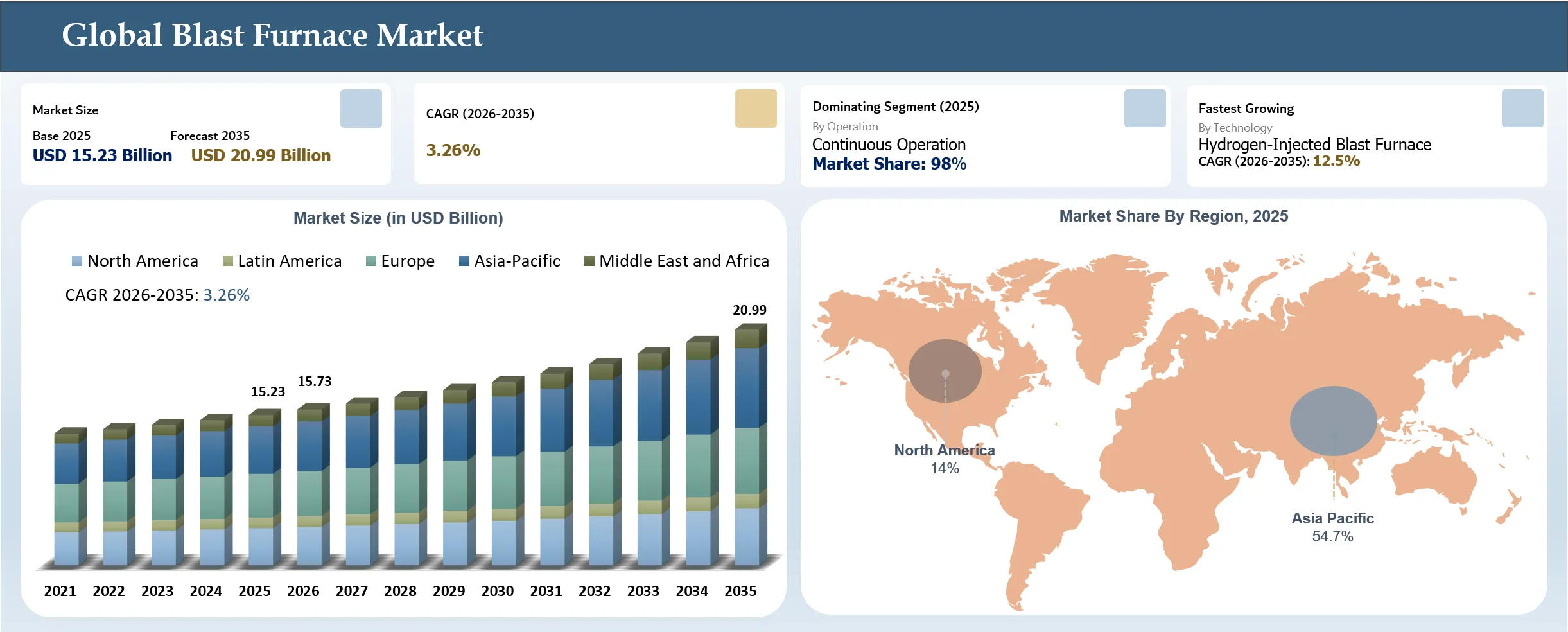
The global blast furnace market reached USD 15.23 billion in 2025 and is expected to reach USD 20.99 billion by 2035, growing with a CAGR of 3.26% during the forecast period 2026-2035. The market demand remains closely linked to continued investments in the primary steel production capacity since, according to the OECD Steel Outlook 2026, the world's steelmaking capacity grew to a record of 2,445.1 million tonnes in 2025; whereas the share in Asia was 1,658.6 million tonnes, which corresponds to about 67.8% of the world's capacity. Additionally, the OECD estimates 24.3 million tonnes of additional capacity in the process and 59.7 million tonnes of planned additional capacity in Asia for 2026–2028, totaling 84.0 million tonnes; 31.8 million tonnes may potentially come from India. In May 2026, according to the Financial Times, India's contribution to the global growth of coal-based steel production capacity. The report by the OECD also notes that blast furnaces of large capacity are still being installed, especially in emerging Asian countries.
The use of AI and digital technology has increased the speed of modernization in blast furnaces, allowing manufacturers to enhance their process efficiencies and reduce costs in operations. In June 2026, according to China Daily, the Chinese steelmaker Baosteel is digitizing the process at its No. 1 Blast Furnace through the use of AI technology. Commissioned in 1985, the furnace has an output capacity in excess of 4,000 m³ and can operate at temperatures of about 1,510°C. After completion of the process, all four blast furnaces at the Baoshan base of Baosteel are set to be AI-enabled. It is estimated that AI technology will result in cost savings of more than RMB 10 million (USD 1.48 million) per year per furnace while reducing carbon dioxide emissions by 5 kg per metric ton of hot metal, highlighting the growing adoption of smart technologies in blast furnace ironmaking.
White-Space Opportunities for Blast Furnace Modernization and AI-Enabled Ironmaking
In August 2026, the U.S. Department of Energy (DOE) announced a USD 500 million award to support a USD 1 billion modernization investment at Cleveland-Cliffs’ Middletown Works in Ohio, creating a major opportunity for the U.S. blast furnace modernization and ironmaking ecosystem. The highest investment is directed toward rebuilding and upgrading the plant’s main coal-fired ironmaking furnace, with the overall project also deploying AI for blast furnace optimization and energy-efficiency improvements. Additional investment areas include an on-site facility to convert steel mill process gases into electricity and follow-on projects to convert industrial byproducts into concrete materials for regional infrastructure. The investment is expected to protect 2,300 jobs and strengthen domestic steel production, while benefiting downstream sectors including automotive, HVAC, appliances, and steel distribution through continued access to domestically produced steel.
The investment creates opportunities primarily for Cleveland-Cliffs, the direct beneficiary and operator of Middletown Works, particularly through the blast furnace rebuild, furnace efficiency upgrades, AI-based process optimization, blast furnace gas utilization, and steelmaking modernization. The USD 500 million DOE award represents the government-supported portion of the USD 1 billion total investment. In contrast, the remaining investment supports the broader modernization scope and is not separately allocated by DOE to disclosed dollar amounts. Companies and industrial suppliers involved in AI and process optimization, such as Honeywell, Siemens, ABB, and Emerson, could benefit from automation and furnace-control requirements; furnace and refractory suppliers such as RHI Magnesita, Vesuvius, and Calderys could gain opportunities from furnace rebuilding and refractory upgrades; industrial-gas and energy-equipment companies such as Air Liquide, Linde, GE Vernova, and Siemens Energy could benefit from process-gas utilization and power-generation infrastructure; while engineering and construction firms such as Bechtel, Fluor, Jacobs, and Burns & McDonnell could gain opportunities in project engineering, construction, and plant modernization. The project also indirectly benefits steel-consuming companies in the automotive, HVAC, appliance, and steel-distribution sectors, which rely on Middletown Works for domestic steel supply.
Blast Furnace Market Key Takeaways
- Asia-Pacific dominated the market with a 54.7% share in 2025, followed by Europe at 19% and North America at 14.0%.
- Hydrogen-injected blast furnaces represent the fastest-growing technology segment, expanding at a 12.5% CAGR from 2026 to 2035. The continuous operation segment held 98% of the market share in 2025.
- Nippon Steel committed USD 350 million to modernize Blast Furnace No. 14 at U.S. Steel’s Gary Works site. The investment is part of a broader USD 11 billion plant commitment following its USD 14.1 billion acquisition.
- A USD 500 million federal award supports a USD 1 billion total modernization project at Cleveland-Cliffs’ Middletown Works. The project safeguards 2,300 existing positions and will generate 1,500 peak construction jobs.
Blast Furnace Market Industry Trends and Strategic Insight
- Blast furnace investment is increasingly shifting toward emerging Asian economies, particularly India and Southeast Asia, where integrated steelmaking capacity is being expanded to serve domestic industrial demand.
- Steel producers in mature markets are prioritizing furnace relining, equipment replacement, process optimization, and productivity upgrades to extend the operating life of existing blast furnaces rather than investing exclusively in new capacity.
- Operators are increasingly evaluating hydrogen injection, alternative reductants, energy-efficiency improvements, and carbon-management technologies to reduce the emissions intensity of established BF-BOF assets.
- In mature steel markets, suppliers are increasingly targeting brownfield modernization, efficiency enhancement, emissions-control upgrades, and furnace-life extension rather than relying on new blast furnace construction.
- Blast furnace suppliers are increasingly differentiating their offerings through systems capable of accommodating hydrogen, alternative reductants, carbon capture, improved gas recovery, and advanced process control.
Blast Furnace Market Scope
| Metrics | Details | |
| 2025 Market Size | USD 15.23 Billion | |
| 2035 Projected Market Size | USD 20.99 Billion | |
| CAGR (2026-2035) | 3.26% | |
| Largest Market | Asia-Pacific | |
| Fastest Growing Market | Middle East & Africa | |
| By Furnace Type | Hot Blast Ovens, Cold Blast Blowers | |
| By Technology | Coke-Based Blast Furnace, Pulverized Coal Injection (PCI) Blast Furnace, Natural Gas Injection Blast Furnace, Hydrogen-Injected Blast Furnace, Oxygen-Enriched Blast Furnace, Others | |
| By Furnace Capacity | Small - Less than 1,000 tons/day, Medium - 1,000-5,000 tons/day, Large - More than 5,000 tons/day | |
| By Component | Furnace Body, Hot-Blast Stoves, Cold-Blast Blowers, Charging System, Tuyere System, Cooling System, Gas Cleaning System, Top-Gas Recovery System, Others | |
| By Operation | Continuous Operation, Batch / Intermittent Operation | |
| By Application | Iron Production / Pig Iron Production, Steel Production, Foundry Iron Production, Cast Iron Production, Hot Metal Production for BOF Steelmaking, Hot Metal Production for EAF/EOF Steelmaking, Ferroalloy Production, Metal Smelting,Others | |
| By Region | North America | U.S., Canada, Mexico |
| Europe | Germany, UK, France, Spain, Italy, Poland | |
| Asia-Pacific | China, India, Japan, Australia, South Korea, Indonesia, Malaysia | |
| Latin America | Brazil, Argentina | |
| Middle East and Africa | UAE, Saudi Arabia, South Africa, Israel, Türkiye | |
| Report Insights Covered | Competitive Landscape Analysis, Company Profile Analysis, Market Size, Share, Growth | |
Blast Furnace Market Disruption Analysis
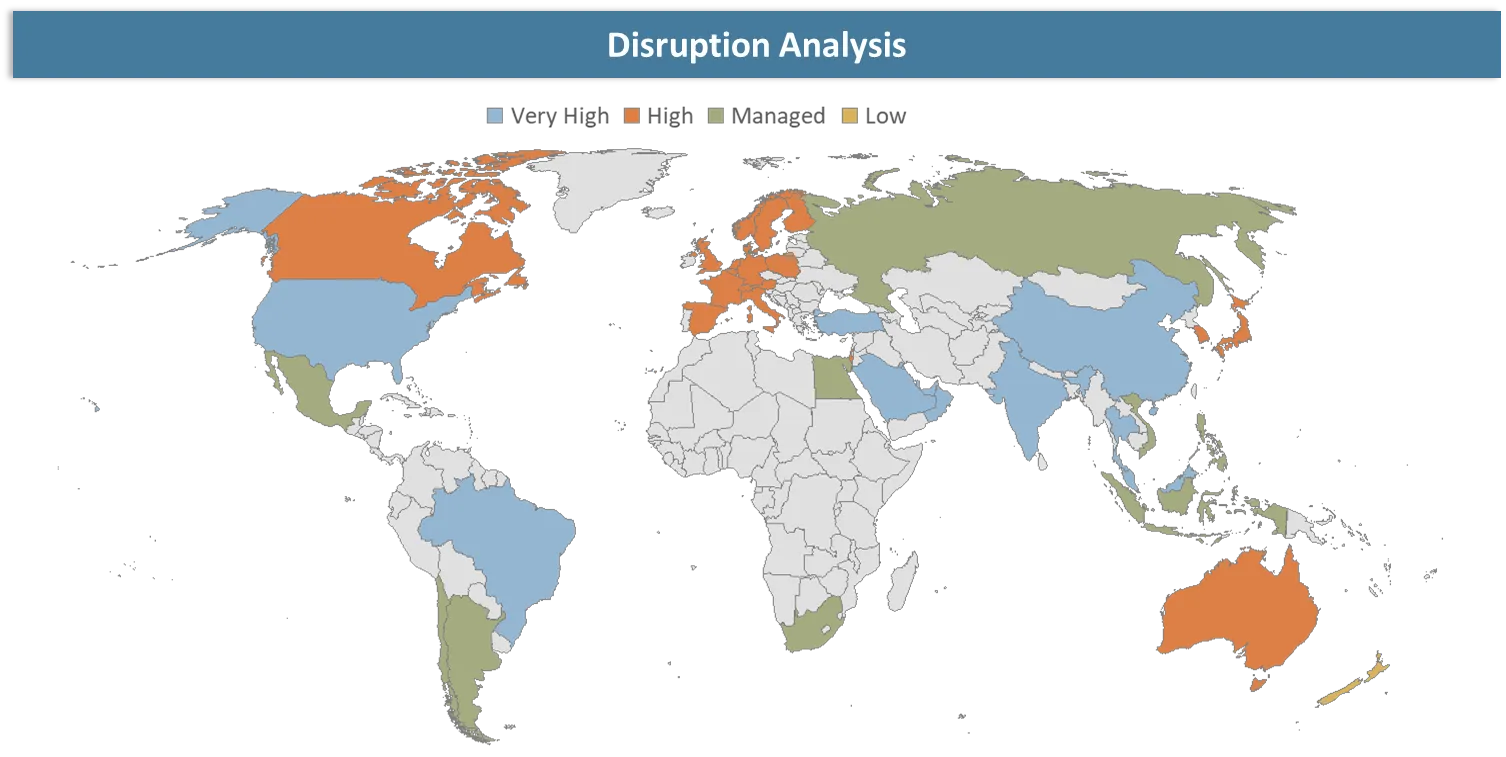
Shift Toward DRI-EAF Technology Substitution Reshaping the Blast Furnace Market
The disruption in the blast furnace market is increasingly attributed to the adoption of direct reduced iron (DRI) and electric arc furnace (EAF), which is developing a new route to the traditional blast furnace-basic oxygen furnace (BF-BOF) route of steel making. In June 2026, according to OECD, during the first six months of 2025, projects that constitute 19% of the entire low-emission steel pipeline up until 2027 were delayed, and the BF-BOF to EAF conversion projects constituted 27% of the delayed projects, while the hydrogen-based DRI projects constituted 18%. This means that the DRI-EAF approach has interfered with traditional methods of making investments in iron production, despite high energy prices, surplus capacity, and uncertainty about regulations.
The disruption is also becoming evident as more capital investments flow towards EAF-based steelmaking processes. In April 2025, according to Reuters, JFE Steel announced a ¥329.4 billion (USD 2.26 billion) capital investment in a new EAF at the company's Kurashiki plant with an annual production capacity of 2 million tonnes of steel and backed by up to USD 657.36 million (¥104.5 billion) in Japanese government funds as part of the company's efforts to reduce emissions. According to Reuters news in June 2026, roughly half of green steel projects were delayed, highlighting how the substitution of DRI-EAF is taking place, but also faces economic and infrastructural challenges. As a result, blast furnace producers are becoming more focused on modernizing and improving efficiency, injecting different reducing agents into the process, as well as developing emission reduction solutions, while EAF and DRI technology providers are increasingly securing investments in future-oriented steel production.
Blast Furnace Market BCG Matrix: Company Evaluation

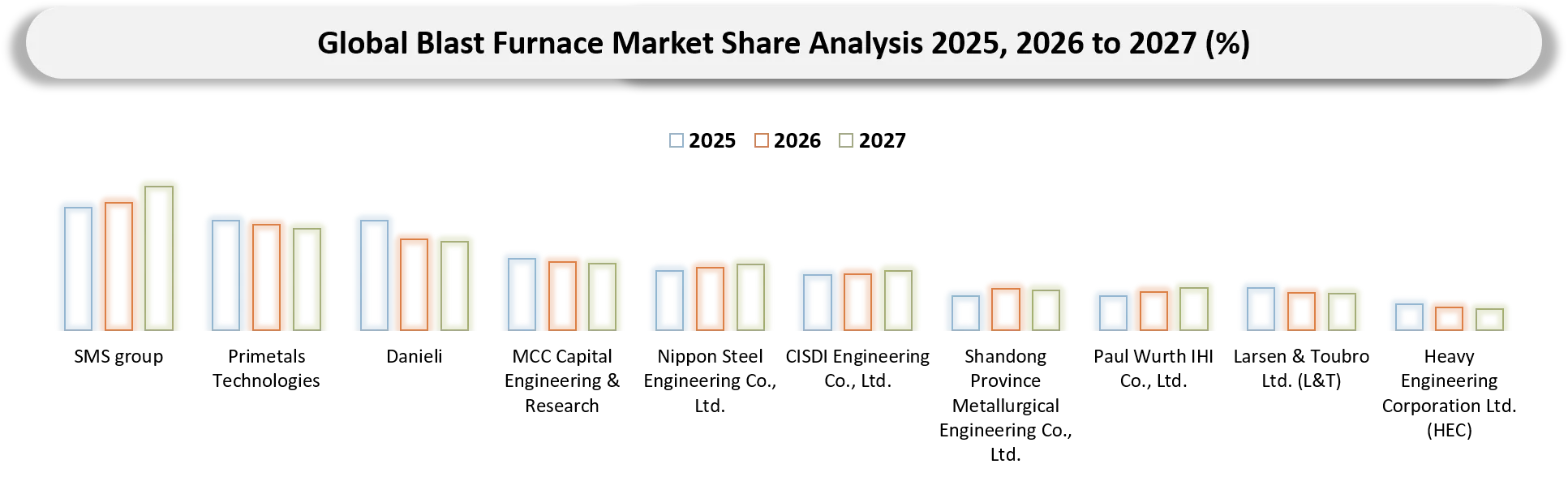
Stars include SMS group, Primetals Technologies, and Danieli because they have strong positions in blast furnace engineering, modernization, and integrated ironmaking technologies, supported by extensive project experience and broad technology portfolios. Question Marks include MCC Capital Engineering & Research, CISDI Engineering Co., Ltd., and Nippon Steel Engineering Co., Ltd., which have substantial metallurgical engineering capabilities and access to expanding Asian steelmaking projects but face intense competition from established European and Japanese technology suppliers.
The Potential category includes Shandong Province Metallurgical Engineering Co., Ltd., Paul Wurth IHI Co., Ltd., and Larsen & Toubro Ltd. (L&T). These companies benefit from regional steel-industry expansion, engineering capabilities, and demand for blast furnace construction and modernization, but their blast furnace market presence is more geographically concentrated or specialized compared with the leading global technology providers. Tailenders include Heavy Engineering Corporation Ltd. (HEC), whose blast furnace-related capabilities are supported by its heavy-engineering and metallurgical equipment heritage but whose competitive position is comparatively constrained by financial, technological, and global-market limitations.
Blast Furnace Market Dynamics
Driver Impact Analysis
| Driver | Market Growth Impact (%) | Demand Concentration | Impacted Use Case | Strategic Impact |
High Productivity of Blast Furnace–BOF Technology | 27% | Large integrated steel plants, particularly Asia-Pacific | High-volume pig iron and hot-metal production for BOF steelmaking | Strengthens demand for high-capacity furnaces, productivity optimization, automation, and furnace-life extension |
Advancements in Blast Furnace Efficiency | 22% | Existing blast furnace fleets and mature integrated steel plants | Fuel optimization, heat recovery, process stabilization, and productivity enhancement | Shifts supplier opportunity toward modernization, digital controls, refractory upgrades, cooling systems, and energy-recovery solutions |
Technological Upgrades for Lower Emissions | 20% | Existing BF-BOF facilities facing decarbonization requirements | Hydrogen/alternative reductant injection, gas recycling, carbon management, and emissions control | Creates demand for retrofit technologies that reduce emissions while preserving existing blast furnace assets |
Expansion of Integrated Steel Plants | 19% | Emerging Asian steelmaking markets, especially India and Southeast Asia | New integrated ironmaking and steelmaking capacity | Supports greenfield blast furnace projects, complete ironmaking systems, raw-material handling, and auxiliary equipment |
Growing Infrastructure Development | 12% | Construction, transportation, energy, urban infrastructure, and industrial projects | Production of structural steel, plate, rebar, and other high-volume steel products | Sustains underlying steel demand and encourages producers to expand or upgrade primary ironmaking capacity |
High Productivity of Blast Furnace–BOF Technology
The high productivity and established operating economics of the blast furnace-basic oxygen furnace (BF-BOF) route continue to support demand for blast furnace systems, particularly in large integrated steel plants. In June 2026, as per the OECD, pig iron production in the world through blast furnaces was around 1.3 billion tonnes compared to direct reduced iron (DRI), which was 145.6 million tonnes, thus indicating the significantly higher volume of production that blast furnace-based iron-making serves. It should be noted that large blast furnaces continue to be commissioned and upgraded even in developing countries in Asia, where integrated steel mills are more concerned about high volume production and asset utilization.
The productivity advantage is further strengthened by the relevance of the BF-BOF path for world steel production. According to the World Steel Association, of the total volume of crude steel produced globally in 2025, 69.4% was manufactured using the oxygen route, whereas 30.3% was manufactured using the electrical route, indicating the large capacity that exists because of the integrated steelmaking process. On the other hand, modern blast furnaces are getting improved in terms of digitization, top-gas recycling, low-carbon reducing agents, hydrogen injection, oxyfuel systems, and process improvements. This allows the producer to increase the productivity of the furnace in spite of the restrictions on emissions. This combination of volume capacity and technological enhancements still supports investments in blast furnaces despite the increasing popularity of DRI-EAF options.
Restraint Impact Analysis
| Restraint | Drag on Market Growth (%) | Primary Impact Area | Impacted Use Case | Strategic Impact |
Growing Shift Toward Low-Emission Ironmaking | 30% | Technology investment & capacity expansion | New steelmaking capacity; greenfield ironmaking projects | Shifts investment toward H₂-DRI-EAF, scrap-EAF and other low-emission routes, reducing long-term demand for conventional blast furnaces |
Dependence on Metallurgical Coal and Coke | 25% | Raw-material cost & operational economics | Integrated BF-BOF steel production | Exposure to coke and metallurgical coal prices increases operating costs and encourages producers to evaluate coal-reduced or coal-free ironmaking technologies |
Stringent Environmental Regulations | 20% | Compliance costs & carbon emissions | Existing blast furnace operations and new furnace installations | Increases spending on emission-control, carbon-reduction and retrofit technologies while raising the risk of stranded carbon-intensive assets |
Competition from Electric Arc Furnaces | 25% |
Technology adoption & production capacity
| Scrap-based steelmaking and flexible mini-mill production | EAFs gain attractiveness because of their substantially lower emissions intensity |
Growing Shift Toward Low-Emission Ironmaking
One of the major constraints preventing the development of conventional blast furnace technology is the rapid trend towards ironmaking processes that have low emissions, such as H₂-based direct reduced iron-electric arc furnace (H₂-DRI-EAF) and scrap-based EAF steelmaking processes. According to the International Energy Agency (IEA), the BF-BOF process contributes to about 70% of the total world’s steelmaking capacity; hence, the trend away from conventional blast furnace-based steel production becomes more important. At the same time, according to the worldsteel Sustainability Indicators Report 2025, CO₂ emissions intensity in the BF-BOF route was 2.34 t CO₂ per tonne of crude steel, whereas in scrap-EAF and DRI-EAF were 0.69 t and 1.47 t, respectively.
In addition, the rising commercial development of alternative iron-making processes could undermine the financial case for conventional blast furnaces due to the rising need to comply with stringent decarbonization requirements. As per the International Energy Agency (IEA), H₂-DRI-EAF routes are gaining prominence in some regions as a preferred process with low emissions, but the initial costs of commercial operations involving full 100% hydrogen blends would be 50% – 140% higher than that of BF-BOF operations, depending on the region. Moreover, the Worldsteel Sustainability Indicators Report 2025 reveals that while the total GHG emissions intensity for BF-BOF is 2.66 tonnes CO₂e per tonne of crude steel, for scrap-EAF and DRI-EAF, it is 0.71 tonnes and 1.66 tonnes, respectively. The combination of higher emissions from blast furnace operations and rising developments of alternative options with lower emissions can limit further investment in blast furnaces, thereby affecting the growth prospects of the blast furnace market.
Blast Furnace Market Segmentation Analysis
The global blast furnace market is segmented based on furnace type, technology, furnace capacity, component, operation, application, and region.
Continuous Operation Dominance Supported by High Furnace Utilization and Capacity Expansion
The continuous operation segment dominates the blast furnace market, capturing nearly 98% of the market share in 2025, owing to the necessity for blast furnaces to have a constant high temperature and an uninterrupted iron production process. Continuous operation enables consistency in hot metal production, effective fuel utilization, and increased productivity of the furnaces without losses resulting from frequent start-stop operations. The continued expansion of the blast furnaces further strengthens this need. In May 2026, as per the Global Energy Monitor, 319 million tonnes per annum (mtpa) of coal-based blast furnace capacity had been either announced or under construction worldwide, which marks a 5% increase compared to the previous year, along with 80 mtpa of blast furnace capacity that has been planned for relinings. This is more than 141 mtpa of active blast furnace capacity with planned retirements.
Leading companies in the steel industry are also continuing and reactivating blast furnace capacities in order to cater to steel demands, ensuring the supremacy of the continuous operation method. In March 2026, U. S. Steel stated that it had managed to restart Blast Furnace B of Granite City Works, which it began to reactivate in December 2025 due to customers’ demands, using approximately 400 employees to ensure blast furnace functioning. In addition, Reuters reported that according to the Centre for Research on Energy and Clean Air, China’s blast furnace capacity utilization increased from 85.6% in 2021 to 88.6% in the first half of 2025. This situation proves the continuing utilization, growth, and upgrading of blast furnace capacities, ensuring the leadership of continuous operation as the primary and profitable operation segment of the blast furnace market.
Blast Furnace Market Geographical Penetration
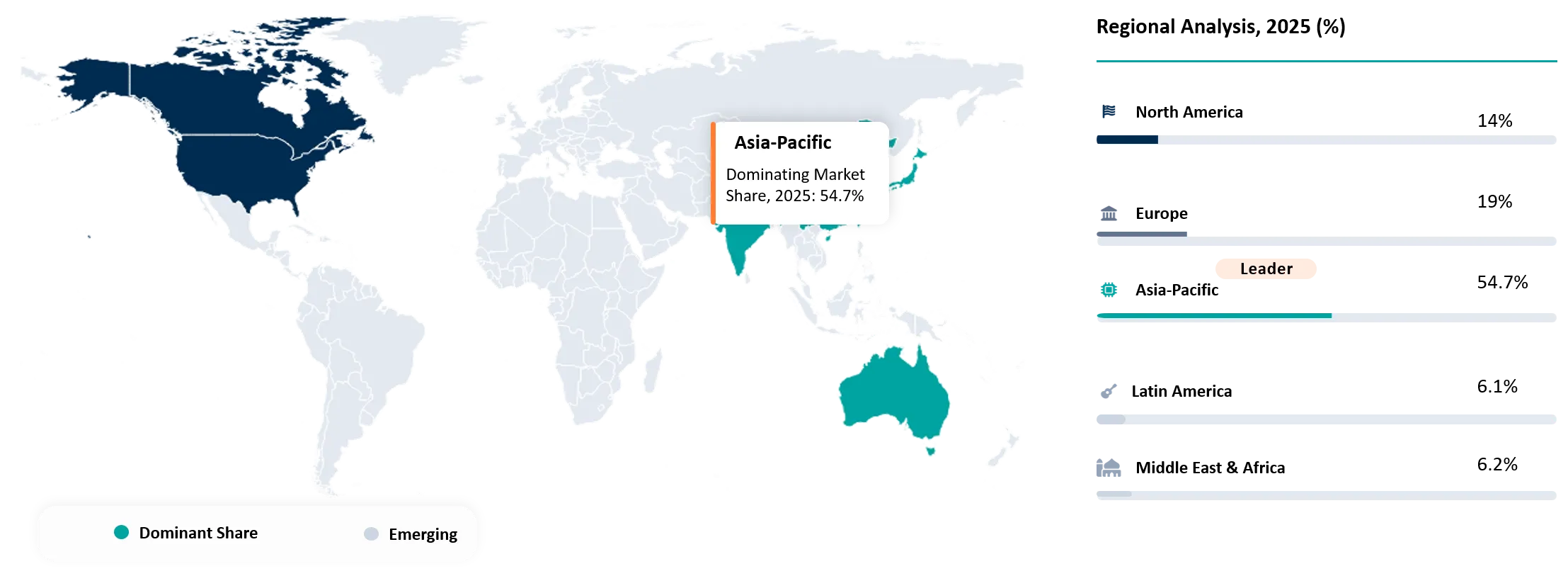
Large-Scale Steelmaking Capacity and Continued Blast Furnace Investments Driving Asia-Pacific Dominance
The Asia-Pacific region dominates the blast furnace market, accounting for approximately 54.7% of the market share in 2025, primarily due to its large-scale steel production base, strong dependence on integrated blast furnace–basic oxygen furnace (BF-BOF) steelmaking, and the presence of major steel manufacturers across China, India, Japan, South Korea, and other emerging Asian economies. The concentration of established ironmaking infrastructure, abundant raw-material supply chains, and large domestic steel consumption creates sustained demand for blast furnace installations, modernization, relining, and operational upgrades. In addition, the region's growing emphasis on expanding domestic steel production and improving the efficiency of existing ironmaking assets continues to strengthen the adoption of blast furnace technologies.
The growing focus on decarbonizing existing blast furnace assets is creating opportunities for advanced low-carbon ironmaking technologies across the steel industry. In April 2026, Tata Steel Limited, an India-based integrated steel producer, partnered with SMS group GmbH, a Germany-based metallurgical plant and technology engineering company, and its Luxembourg-based subsidiary Paul Wurth S.A. to implement the world’s first industrial demonstration of EASyMelt (Electrically-Assisted Syngas Smelter) technology at Tata Steel’s 649 m³ E Blast Furnace at Jamshedpur Works, India. The project will be implemented in phases and aims to reduce CO₂ emissions by more than 50% compared with the blast furnace’s baseline operation. EASyMelt uses resource-flexible syngas-based technology to decarbonize existing blast furnace ironmaking, supporting Tata Steel’s target of achieving net-zero emissions by 2045.
China Blast Furnace Market Trends
China holds a dominant position in the Asia-Pacific blast furnace market due to its extensive integrated steelmaking infrastructure, large domestic steel consumption base, established iron ore and metallurgical supply chains, and the significant presence of blast furnace-based production facilities. The country's steel industry has developed a highly integrated ecosystem covering ironmaking, steelmaking, raw-material processing, equipment manufacturing, and downstream steel production, enabling steel producers to operate blast furnaces at large scale and optimize production efficiency. The concentration of major steel producers and established industrial infrastructure also supports continuous investment in blast furnace maintenance, relining, modernization, and productivity improvements.
The decarbonization of conventional blast furnace ironmaking is driving steelmakers and raw-material suppliers to pursue advanced process optimization and low-carbon technologies. In March 2025, HBIS Group, a China-based integrated steel producer, signed a memorandum of understanding with Rio Tinto, an Australia-based global mining and metals company, to jointly develop technologies aimed at reducing carbon emissions from steelmaking. The companies will focus on optimizing blast furnace feed mixtures and improving energy efficiency, while also collaborating on hydrogen-based metallurgy to support the steel industry’s low-carbon transition. The initiative directly supports blast furnace decarbonization by targeting improvements in raw-material utilization and furnace energy performance, although the source does not disclose a specific investment amount or capacity associated with the collaboration.
Japan Blast Furnace Market Outlook
Japan remains a major country in the Asia-Pacific blast furnace market, supported by its established integrated steelmaking infrastructure, presence of leading steel producers such as Nippon Steel and JFE Steel, and a technologically advanced ironmaking ecosystem. The country’s blast furnace industry benefits from decades of expertise in large-scale iron production, sophisticated furnace operation, process optimization, and energy-efficiency technologies. Although Japanese steelmakers are progressively shifting toward electric arc furnaces and lower-carbon production routes, blast furnaces continue to form an important part of the country’s steelmaking infrastructure.
The shift toward alternative fuels is creating new opportunities to decarbonize conventional blast furnace operations while reducing dependence on fossil-based inputs. In June 2025, Kobe Steel, Ltd., a Japan-based steelmaker, partnered with Mitsubishi UBE Cement Corporation (MUCC), a Japan-based cement and materials company, to advance the use of torrefied wood pellets, or black pellets, in steelmaking. The companies agreed in May 2025 to conduct a feasibility study and are targeting the establishment of a joint venture in 2026. MUCC currently produces approximately 60,000 tonnes of black pellets annually at its Ube factory, where the pellets have been co-fired with coal in a thermal power plant since 2019. Kobe Steel plans to use the torrefied wood pellets primarily for heat generation in the blast furnace at its Kakogawa Works, creating an opportunity to reduce the steelmaking sector’s carbon footprint through alternative biomass-based fuels.
Established Integrated Steelmaking Infrastructure and Blast Furnace Modernization Supporting North America’s Market Leadership
The North America one of the key region in the blast furnace market, accounting for approximately 14.0% of the market share in 2025, supported by its established integrated steelmaking infrastructure, presence of major steel producers, mature iron ore and metallurgical coal supply chains, and continued focus on maintaining high-efficiency blast furnace assets. The region, particularly the U.S., has a well-developed base of integrated steel mills serving automotive, construction, infrastructure, manufacturing, and other steel-intensive industries. Although electric arc furnaces are gaining importance across North America, blast furnaces remain strategically important for producing high-quality steel grades and supporting large-scale integrated production.
The modernization of aging blast furnace assets is creating significant investment opportunities in the North American steel industry, particularly through furnace rebuilding, automation, and energy-efficiency upgrades. In August 2026, Cleveland-Cliffs Inc., a U.S.-based integrated steel producer, announced a USD 1 billion modernization project at its Middletown Works steel mill in Ohio, supported equally by USD 500 million from Cleveland-Cliffs and a USD 500 million federal award from the U.S. Department of Energy, a U.S.-based federal government agency. The project includes a major blast furnace rebuild and upgrade, AI-enabled process automation, modernized material-handling systems, and an on-site cogeneration facility that will convert blast furnace off-gases into electricity and steam. The investment is expected to protect 2,300 jobs and create more than 1,500 construction jobs at peak activity, with completion of the blast furnace modernization targeted for early 2030.
U.S. Blast Furnace Market Trends
The U.S. is dominating the North American blast furnace market, supported by its established integrated steelmaking infrastructure, large installed base of ironmaking facilities, and presence of major steel producers with extensive blast furnace operations. The country’s automotive, construction, infrastructure, machinery, and manufacturing industries continue to generate demand for high-volume and high-quality steel, supporting the utilization of integrated blast furnace–basic oxygen furnace production. In addition, U.S. steelmakers are increasingly focusing on modernizing, relining, and restarting existing blast furnaces rather than relying solely on new capacity additions.
The modernization of existing blast furnace infrastructure is becoming a key investment strategy for steelmakers seeking to preserve high-volume ironmaking capacity and strengthen domestic steel supply. In December 2025, Nippon Steel Corporation, a Japan-based integrated steel producer, announced plans to invest USD 350 million to modernize and reline Blast Furnace No. 14 at U.S. Steel’s Gary Works in Indiana, U.S. The furnace is the largest blast furnace at the Gary Works facility and supplies iron for high-strength steel used in applications including automobiles and buildings. The investment forms part of Nippon Steel’s broader commitment to invest approximately USD 11 billion in U.S. Steel by 2028 following its USD 14.1 billion acquisition, completed in June 2025.
Blast Furnace Market Competitive Landscape
- The Blast Furnace Market is characterized by three key participant groups: integrated blast furnace technology and plant engineering providers, specialized ironmaking and process-technology companies, and diversified heavy engineering and steel-technology companies. SMS group, Primetals Technologies, Paul Wurth IHI, and CISDI Engineering lead in blast furnace design, modernization, hot-blast systems, automation, and process optimization; Danieli, MCC Capital Engineering & Research, and Shandong Province Metallurgical Engineering focus on large-scale metallurgical plant engineering, furnace construction, and integrated steelmaking projects; while Nippon Steel Engineering, Larsen & Toubro, and Heavy Engineering Corporation provide engineering, project execution, equipment manufacturing, and plant infrastructure capabilities. The competitive landscape is shaped by furnace productivity, campaign life extension, energy efficiency, automation, modernization, environmental performance, and the ability to deliver integrated engineering solutions, making technological expertise, project execution capabilities, and long-term customer relationships important factors in determining competitiveness.
- Key players include SMS group (Germany), Primetals Technologies (UK), Danieli (Italy), MCC Capital Engineering & Research (China), Nippon Steel Engineering Co., Ltd. (Japan), CISDI Engineering Co., Ltd. (China), Shandong Province Metallurgical Engineering Co., Ltd. (China), Paul Wurth IHI Co., Ltd. (Japan), Larsen & Toubro Ltd. (India), and Heavy Engineering Corporation Ltd. (India).
Key Developments
- April 2026: POSCO Holdings Inc., a South Korea-based steel and industrial group, and JSW Steel Ltd., an India-based integrated steel producer, established a 50:50 joint venture to develop an integrated steel plant in Odisha, India, with an estimated investment of USD 7.289 billion.
- June 2025: Marubeni Corporation, a Japan-based diversified trading and investment company, acquired an additional 6.7% stake in Jellinbah Group Pty Ltd, an Australia-based steelmaking coal mining company, increasing its ownership from 33.3% to 40.0%.
- August 2025: Nippon Steel Corporation, a Japan-based integrated steel producer, announced a tender offer of approximately USD 476.14 million (¥75.8 billion) to acquire the remaining shares of Krosaki Harima Corporation, a Japan-based refractory-materials manufacturer, and make it a wholly owned subsidiary.
- February 2026: Blastr Green Steel, a Norway-based privately owned green-steel developer, was among the bidders seeking to acquire Speciality Steels UK (SSUK), a UK-based specialty steel producer, which operates sites in Rotherham and Sheffield.
- April 2026: Salzgitter AG, a Germany-based integrated steel and technology group, received clearance to acquire Hüttenwerke Krupp Mannesmann (HKM), a Germany-based integrated steel producer, a Duisburg-based steelworks operating two blast furnaces with combined production capacity of up to 5 million tonnes of crude steel per year.
Key Procurement Priorities and Buyer Evaluation Criteria
- Organizations procuring blast furnace systems and associated equipment prioritize suppliers based on their ability to deliver high-productivity, energy-efficient, reliable, and scalable ironmaking solutions that can support continuous operation under demanding production conditions.
- The procurement decision is increasingly influenced by requirements for higher furnace productivity, reduced coke and fuel consumption, longer campaign life, lower emissions, advanced process automation, and integration of digital monitoring and control systems, particularly as steel producers seek to modernize existing furnaces while improving environmental performance.
- Buyers evaluate factors such as furnace volume and production capacity, hot-metal productivity, fuel and coke-rate performance, refractory durability, furnace availability, campaign life, equipment reliability, maintenance requirements, automation capabilities, and compliance with environmental and safety standards when selecting blast furnace technology and engineering suppliers.
Why Choose DataM?
- Technological Innovations: Explores advancements in blast furnace technologies, including high-efficiency furnace designs, advanced hot-blast systems, top-pressure recovery turbines, waste-heat recovery, intelligent process control, and automation, enabling improved productivity, reduced fuel consumption, longer campaign life, and enhanced environmental performance.
- Product Performance & Market Positioning: Evaluates how different players deliver blast furnace solutions based on furnace productivity, hot-metal production capacity, coke and fuel efficiency, furnace availability, refractory performance, campaign life, automation capabilities, and maintenance requirements, highlighting how leading companies differentiate through technological expertise, operational reliability, and integrated engineering capabilities.
- Real-World Evidence: Highlights the deployment, modernization, relining, and restart of blast furnaces across major steel-producing regions, demonstrating benefits such as higher production efficiency, improved furnace stability, reduced operating costs, extended asset life, and optimized ironmaking performance.
- Market Updates & Industry Changes: Tracks key developments such as new blast furnace construction, furnace relining and modernization projects, capacity expansions, furnace restarts, automation upgrades, decarbonization initiatives, and investments in low-emission ironmaking technologies across Asia-Pacific, Europe, North America, and other major steel-producing regions.
- Competitive Strategies: Analyzes how leading companies expand their market presence through advanced furnace technologies, large-scale EPC projects, modernization and relining contracts, strategic partnerships, digital process-control solutions, and integrated engineering capabilities to address steel producers' requirements for productivity, efficiency, reliability, and emissions reduction.
- Pricing & Market Access: Explains variations in blast furnace project costs based on furnace size, production capacity, technology configuration, level of automation, refractory requirements, environmental-control systems, and project complexity, along with market access through EPC contractors, metallurgical engineering companies, technology licensors, equipment manufacturers, and integrated steelmaking suppliers.
- Market Entry & Expansion: Identifies growth opportunities driven by expansion of steel production, replacement and modernization of aging blast furnace assets, demand for higher furnace productivity, capacity additions in emerging economies, and the transition toward energy-efficient and lower-emission ironmaking, while outlining strategies such as localized engineering, technology partnerships, capacity expansion, aftermarket services, and advanced process optimization.
Target Audience
- Integrated Steel Producers and Ironmaking Companies
- Blast Furnace Technology and Engineering Companies
- Steel Plant Procurement and Sourcing Teams
- Blast Furnace Operations and Maintenance Managers
- Equipment and Component Manufacturers
- Metallurgical Engineering and Consultancy Firms
- Raw Material and Fuel Suppliers


























































