


Bio-Waste-Derived Hard Carbon Anode Market Size and Overview
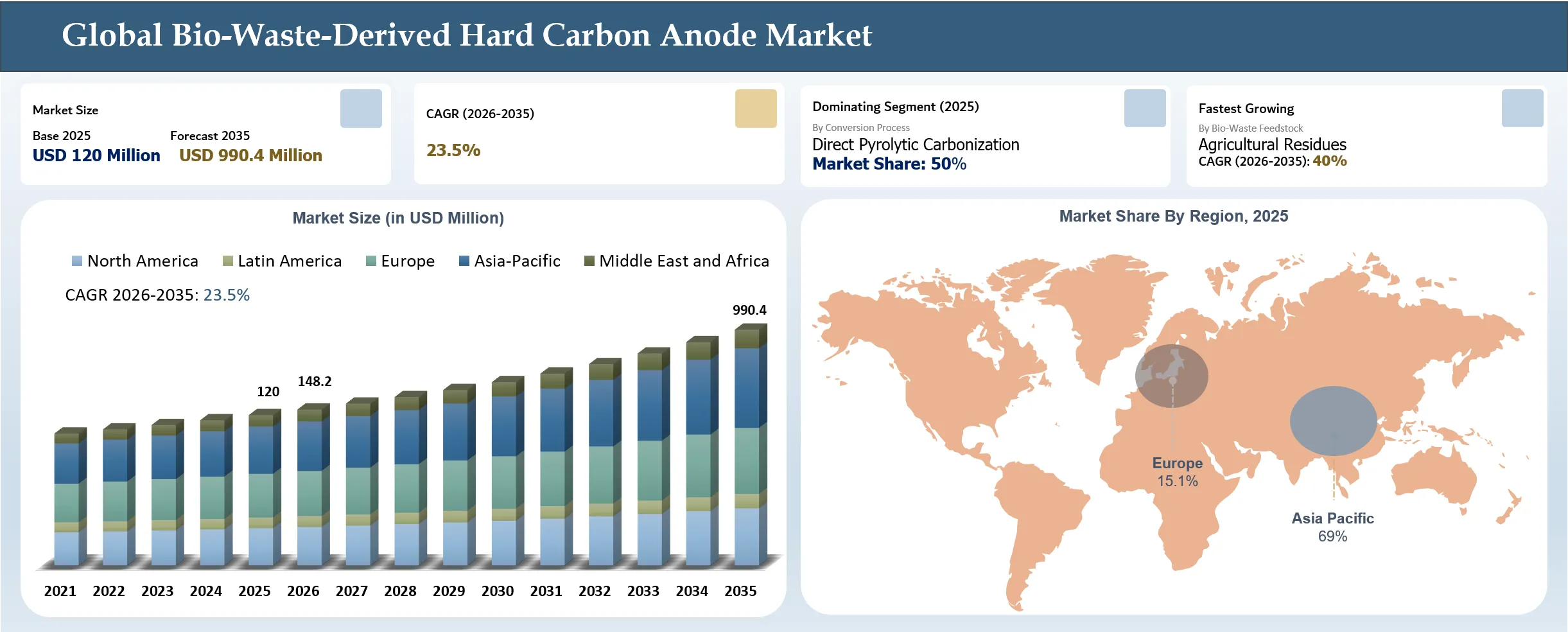
The global bio-waste-derived hard carbon anode market reached USD 120 million in 2025 and is expected to reach USD 990.4 million by 2035, growing with a CAGR of 23.5% during the forecast period 2026-2035. The market is witnessing increasing demand as battery manufacturers seek renewable carbon sources and high-performance anode materials for Li-ion and Na-ion batteries, with bio-waste-based hard carbons as the solution to turn abundant biomass into useful electrode materials. In March 2026, as per Nature Communications, the intelligent carbonization process was able to make hard carbon out of biochar with reversible capacity of 369 mAh/g in comparison to untreated biochar whose capacity was 150 mAh/g while undergoing more than 5,000 cycles at 3 A/g; the process needed 0.1 kWh/g of energy and brought down carbonization time to under one minute which is almost 500 times faster than any other process. In addition, they were able to estimate that the cost of production would be approximately USD 6,000 per tonne, giving support to the potential of energy-efficient and scalable production of hard carbon from biomass. Kuraray has also developed hard carbon derived from plants for Li-ion batteries using its KURANODE Bio Hard Carbon technology, which has an interlayer spacing of 0.38 nm, specific surface area of 4–6 m²/g and particle size ranging from 5-9 μm.
Increased use of biomass materials in the manufacture of next-generation batteries has contributed to sustainable hard carbon anodes. In March 2025, according to Stora Enso, the company joined the ATENA+ project, which was funded by the EU and initiated in January 2025 as a four-year program with 12 consortium members for the development of sustainable and cost-effective sodium-ion batteries in Europe. In this regard, Stora Enso is contributing to the development of the project through Lignode, which is a bio-based anode material made from lignin of European wood, supporting the development of bio-based anode materials while reducing dependence on critical materials.
White-Space Opportunities for Bio-Waste-Derived Hard Carbon Anode Production and European Sodium-Ion Battery Supply Chains
In May 2025, the European Economic and Social Committee (EESC) identified a significant opportunity for developing a European bio-based hard-carbon supply chain for sodium-ion batteries, particularly through the use of wood waste, food waste, and agricultural waste as feedstocks for hard-carbon anodes. The EESC noted that sodium-ion battery anodes are mainly hard carbon derived from wood or food waste and recommended investment subsidies, targeted project calls, investment vouchers, production tax credits, and public–private R&D support to strengthen European sodium-battery manufacturing. The highest investment opportunity is therefore concentrated in hard-carbon anode production and sodium-ion cell manufacturing, while other areas include biomass collection and preprocessing, carbonization and purification, battery-component manufacturing, recycling, and stationary energy-storage deployment. Altris received USD 2.92 million (EUR 2.5 million) in non-dilutive EIC Accelerator funding and was eligible for up to USD 11.67 million (EUR 10 million) in equity investment through the EIC Fund in 2026, supporting its sodium-ion battery technology development.
The policy direction is expected to create opportunities for companies across the European bio-based hard-carbon and sodium-ion battery value chain. Stora Enso can benefit from demand for lignin-based anode materials through its Lignode technology, while companies developing hard carbon from forestry, wood-processing, food, and agricultural residues can capture opportunities in feedstock conversion and anode-material production. Altris can benefit from expansion of sodium-ion cell manufacturing through its cathode technology, while battery manufacturers and energy-storage companies can benefit from the broader European push toward localized sodium-ion production. The main opportunity areas therefore include bio-waste-to-hard-carbon conversion, commercial-scale hard-carbon production, sodium-ion cell manufacturing, and stationary energy-storage applications, with companies such as Stora Enso and Altris positioned to benefit from the emerging European supply chain.
Bio-Waste-Derived Hard Carbon Anode Market Key Takeaways
- Asia-Pacific accounted for 69.0% of the global market in 2025, making it the largest regional market due to its battery-manufacturing ecosystem and biomass availability.
- Direct pyrolytic carbonization held a 50% market share in 2025, supported by its ability to convert bio-waste directly into hard carbon through thermal processing.
- The 24% market-growth impact from rapid sodium-ion battery commercialization makes it the strongest identified growth driver, followed by low-cost energy storage at 22% and abundant agricultural/biological waste at 19%.
- Intelligent carbonization achieved 369 mAh/g reversible capacity versus 150 mAh/g for untreated biochar, while maintaining performance for more than 5,000 cycles at 3 A/g.
Bio-Waste-Derived Hard Carbon Anode Market Industry Trends and Strategic Insight
- Biomass feedstock diversification is becoming a core manufacturing strategy, with producers and researchers moving beyond conventional wood-derived carbon toward agricultural residues, fruit shells, forestry waste, food-processing residues, and other locally available biomass streams.
- Feedstock-to-performance consistency is emerging as a critical technology differentiator. The heterogeneous chemical composition of biomass can produce substantial variations in pore structure, interlayer spacing, defects, ash content, and electrochemical behavior.
- Intelligent carbonization is moving hard-carbon production toward process-controlled manufacturing. Recent research combines programmable heating with machine-learning models to correlate carbonization conditions with hard-carbon structure and electrochemical performance, indicating a transition from empirical trial-and-error processing toward data-guided process optimization.
- The strongest commercial proposition will combine low-cost feedstock with predictable electrochemical performance. Merely sourcing inexpensive bio-waste is insufficient; the strategic objective is to convert heterogeneous waste into hard carbon with repeatable structural and electrochemical characteristics.
- Technology providers should prioritize closed-pore and interface control rather than pursuing capacity gains through uncontrolled porosity. Future product differentiation is likely to depend on balancing reversible sodium storage, initial efficiency, rate capability, density, and cycling stability.
Bio-Waste-Derived Hard Carbon Anode Market Scope
| Metrics | Details | |
| 2025 Market Size | USD 120 Million | |
| 2035 Projected Market Size | USD 990.4 Million | |
| CAGR (2026-2035) | 23.5% | |
| Largest Market | Asia-Pacific | |
| Fastest Growing Market | Asia-Pacific | |
| By Bio-Waste Feedstock | Agricultural Residues, Forestry & Wood Waste, Food-Processing Waste, Fruit & Nut Shell Waste, Non-Wood Plant Waste, Other Bio-Waste | |
| By Conversion Process | Direct Pyrolytic Carbonization, Hydrothermal-Assisted Carbonization, Chemical Pretreatment-Assisted Carbonization, Activation-Assisted Carbonization, Template-Assisted Carbonization, Other Integrated Processes | |
| By Hard Carbon Structure | Low-Porosity Hard Carbon, High-Porosity Hard Carbon, Hierarchical-Porous Hard Carbon, Heteroatom-Doped Hard Carbon, Others | |
| By Technology | Surface Modification, Heteroatom Doping, Pore-Structure Engineering, Composite Formation, Activation, Others | |
| By Application | Stationary Energy Storage, Electric Mobility, Consumer Electronics, Industrial & Backup Power, Other Applications | |
| By Region | North America | U.S., Canada, Mexico |
| Europe | Germany, UK, France, Spain, Italy, Poland | |
| Asia-Pacific | China, India, Japan, Australia, South Korea, Indonesia, Malaysia | |
| Latin America | Brazil, Argentina | |
| Middle East and Africa | UAE, Saudi Arabia, South Africa, Israel, Türkiye | |
| Report Insights Covered | Competitive Landscape Analysis, Company Profile Analysis, Market Size, Share, Growth | |
Bio-Waste-Derived Hard Carbon Anode Market Disruption Analysis
Data-Driven Intelligent Carbonization Disrupting Conventional Biomass-to-Hard-Carbon Manufacturing
The disruption in the bio-waste-derived hard carbon anode market is primarily associated with the emergence of AI-driven and data-based carbonization that presents a challenge to the conventional approach of trial-and-error in obtaining performance-consistent hard carbon from heterogeneous bio-waste. In June 2025, according to RSC Sustainability, seven machine learning models were developed on 170 samples, where 141 samples were employed for the training process, and 29 samples were used for validation purposes. In this study, it was predicted that the maximum reversible capacity of biomass-derived hard carbon will be 341.1 mAh/g for activated orange-peel-derived hard carbon with the initial Coulombic efficiency of 48% and 100 mA/g current density, while the minimum reversible capacity will be 170.3 mAh/g with 43% initial Coulombic efficiency and the same current density.
The optimization of precursors and processes via machine learning has disrupted traditional biomass selection through the identification of quantitative relationships between the composition of the bio-waste material, the carbonization process, hard carbon structure, and electrochemical performance. In the 2025 Journal of Power Sources study, researchers gathered information from 149 peer-reviewed articles, providing them with 839 data points, which were filtered to 442 data points based on their quality. The optimized machine learning model provided a training and testing R² of up to 0.99 and 0.60, respectively, and also revealed that the content and structure of lignin are very important parameters affecting hard carbon capacity and that correct pyrolysis temperature and time are necessary for its performance. These results disrupt the traditional process of biomass-specific production since they allow for computational screening of biomass and process parameters before actual synthesis.
Bio-Waste-Derived Hard Carbon Anode Market BCG Matrix: Company Evaluation
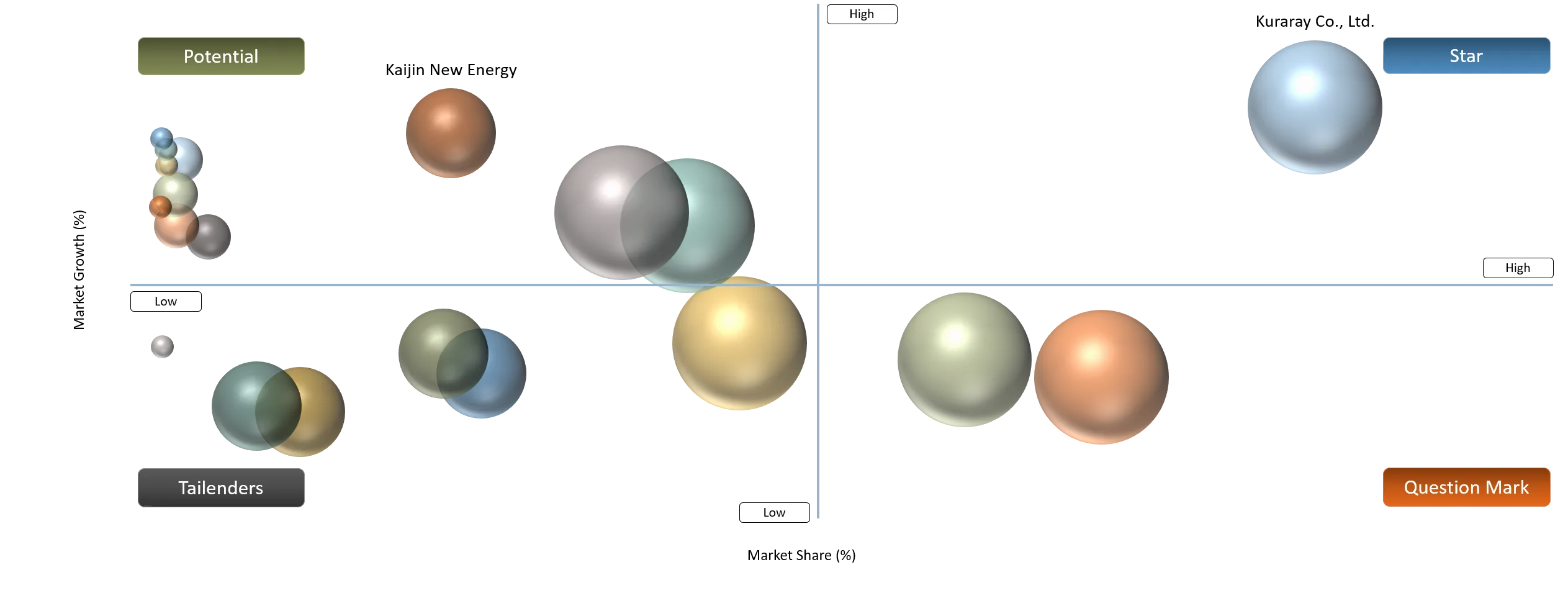
Stars include Kuraray Co., Ltd. and Shengquan Group because they have established hard-carbon material capabilities and are actively positioning their carbon-material portfolios toward sodium-ion battery applications. These companies combine established material-processing capabilities with growing sodium-ion battery demand, placing them in the high-growth, high-position Stars category. Question Marks include Stora Enso, BTR New Material Group Co., Ltd., and Putailai, as these companies possess significant carbon-material, battery-material, or biomass-processing capabilities but face increasing competition as dedicated hard-carbon producers expand. However, their relative positioning in bio-waste-derived hard carbon remains less established than their broader battery-material businesses, making continued investment and technology development important for strengthening their market position.
The Potential category includes Kaijin New Energy, Sparc Technologies, and Altris AB, which benefit from the emerging sodium-ion battery ecosystem but have comparatively narrower positions in bio-waste-derived hard-carbon anode commercialization. These companies therefore have growth potential but require greater commercialization scale and integration to move toward the Stars category. Tailenders include Aekyung Chemical Co., Ltd., primarily because its participation in the hard-carbon anode market is comparatively limited and its core business remains more diversified across chemical materials. As sodium-ion batteries develop, further investment in biomass-derived carbon materials, production capacity, and direct partnerships with battery-cell manufacturers would be required for Aekyung Chemical to strengthen its position in this market.
Bio-Waste-Derived Hard Carbon Anode Market Dynamics
Driver Impact Analysis
| Driver | Market Growth Impact (%) | Demand Concentration | Impacted Use Case | Strategic Impact |
Rapid commercialization of sodium-ion batteries is driving demand for hard carbon anodes. | 24% | High — Asia Pacific, particularly China; expanding into Europe and North America | Grid-scale energy storage, stationary storage, commercial & industrial storage, electric mobility | Accelerates qualification of hard-carbon suppliers and encourages manufacturers to establish dedicated sodium-ion anode production capabilities, creating opportunities for bio-waste-derived materials to enter commercial battery supply chains. |
Growing demand for low-cost energy-storage systems is increasing the adoption of bio-waste-derived hard carbon for sodium-ion battery applications. | 22% | High — Grid-scale and stationary storage markets; strongest in Asia Pacific and emerging North American projects | Grid-scale energy storage, stationary energy storage, commercial & industrial energy storage | Strengthens the business case for converting low-cost agricultural, forestry, and food-processing waste into anode materials. The strategic advantage is shifting toward suppliers capable of combining low-cost feedstock with consistent electrochemical performance. |
Abundant availability of agricultural and biological waste is supporting the use of renewable biomass as a low-cost feedstock for hard carbon production. | 19% | High — Agricultural and forestry regions across Asia Pacific, Europe, and North America
| Agricultural-residue valorization, sodium-ion batteries, stationary storage | Encourages localized biomass-to-anode supply chains and reduces dependence on a narrow group of conventional carbon precursors. |
Increasing pressure to develop sustainable battery materials is driving the conversion of agricultural and organic waste into value-added anode materials. | 18% | High — Europe and Asia Pacific; increasing relevance in North America | Sustainable sodium-ion batteries, stationary storage, grid-scale storage, circular battery-material supply chains | Creates a differentiation opportunity for producers that can demonstrate waste valorization, renewable feedstock sourcing, lower-impact processing, and consistent material performance. |
Growing requirements for high-capacity sodium-ion battery anodes are supporting demand for biomass-derived hard carbon. | 17% | High — Battery-material development centers in Asia Pacific, with expanding European and North American activity | Passenger EVs, commercial EVs, grid storage, high-cycle stationary storage, consumer electronics | Pushes producers toward pore-structure engineering, heteroatom doping, activation, and surface modification to improve reversible capacity, initial Coulombic efficiency, rate capability, and cycle life. |
Growing demand for low-cost energy-storage systems is increasing the adoption of bio-waste-derived hard carbon for sodium-ion battery applications
The increasing requirement for low-cost energy-storage systems is strengthening the adoption of bio-waste-based hard carbon anodes in sodium-ion batteries. Sodium-ion battery technology has become popular among energy storage solutions due to the abundant presence of sodium and possibilities to reduce the dependence on limited battery material resources. Simultaneously, bio-waste is an easily accessible and renewable source of carbon, which makes it possible to convert different types of agricultural, forestry, food-processing, and other wastes into economically beneficial anode materials. In June 2025, according to RSC, biomass-based hard carbon has several advantages including cheapness, abundance, renewability, and suitable sodium storage features, strengthening its potential as a commercially viable anode platform.
Availability of inexpensive agricultural waste biomass is providing scope for converting such biomass into sustainable hard-carbon anode material for sodium-ion battery use. In December 2025, according to Royal Society of Chemistry (RSC), hard carbon was produced from cottonseed cake, which is the agricultural biomass waste product. The optimized hard carbon resulted in an initial reversible capacity of 302.1 mAh/g, an initial Coulombic efficiency of 92.3%, and 95.8% capacity retention in 200 cycles. For the full cell device, the material attained a performance of 136.1 mAh/g and showed 72.2% capacity retention in 200 cycles, proving the possibility of producing hard carbon from agricultural biomass waste materials for energy storage in sodium ion batteries.
Restraint Impact Analysis
| Restraint | Drag on Market Growth (%) | Primary Impact Area | Impacted Use Case | Strategic Impact |
High variability in bio-waste composition makes it difficult to achieve consistent hard-carbon quality and batch-to-batch electrochemical performance. | 15% | Feedstock standardization & manufacturing consistency | Commercial sodium-ion battery anodes, particularly automotive and stationary storage cells | Increases quality-control requirements and process optimization costs, slowing qualification of bio-waste-derived hard carbon for large-scale battery production. |
Low initial Coulombic efficiency of bio-waste-derived hard carbon limits its practical energy density and full-cell performance in sodium-ion batteries. | 18% | Electrochemical performance & full-cell efficiency | EV batteries, stationary energy storage and high-energy-density sodium-ion cells | Creates a major commercialization barrier because irreversible sodium loss during the first cycle can reduce full-cell capacity and require compensating cathode capacity or presodiation. |
High energy and chemical consumption during carbonization, activation, and purification can increase the overall production cost of bio-waste-derived hard carbon. | 12% | Production economics & process efficiency | Battery-grade hard-carbon production at industrial scale | Raises the capital and operating-cost burden and can weaken the cost advantage of biomass feedstocks. Process integration, wastewater recycling, lower-energy carbonization, and reduced chemical treatment will become important for achieving competitive production economics. |
Low carbon yield from certain bio-waste feedstocks reduces material output and weakens the cost advantage of biomass-derived hard carbon production. | 11% | Material yield & feedstock economics | Large-scale sodium-ion battery anode manufacturing | Low-yield feedstocks increase the quantity of biomass required per tonne of battery-grade hard carbon, raising logistics, preprocessing and conversion costs. |
High variability in bio-waste composition makes it difficult to achieve consistent hard-carbon quality and batch-to-batch electrochemical performance
One of the main restrictions that preventing the large-scale adoption of bio-waste-derived hard carbon anodes is the substantial variability in the chemical composition and structural characteristics of biomass feedstocks. Cellulose, hemicellulose, lignin, minerals, and ash contents vary in agricultural waste, forest residues, fruit shells, etc., and even within one kind of feedstock there may be some deviations that affect the process of carbonization and the structure of the resulting hard carbon. It was pointed out in the 2026 Nature Communications article that diversity of the biomass feedstock and the difficulty in controlling the process of carbonization and its microstructure are the main obstacles preventing the creation of a hard carbon of predictable characteristics. The performance of hard-carbon materials obtained from biomass usually changes in the range of about 150-300 mAh/g.
The variability in terms of the raw materials used in biomass results in problems in the consistency of the hard carbon properties and its performance in sodium-ion batteries. In June 2026, as per Wiley's cMat, there are several obstacles faced by biomass-based hard carbons due to variability of feedstocks and batch-to-batch variation. It is mentioned in the review that the differences in chemical nature and processing of biomass could alter the pores’ structure, defects, and chemistry of the surface, hence influence the electrochemical activity and make industrial quality control impossible. It is also mentioned that an initial Coulombic efficiency greater than 90% is required for practical applications of full-cell sodium-ion batteries, while low tap density of porous biomass-based hard carbons restricts their volumetric energy density.
Bio-Waste-Derived Hard Carbon Anode Market Segment Analysis
The global bio-waste-derived hard carbon anode market is segmented based on bio-waste feedstock, conversion process, hard carbon structure, technology, application, and region.
Direct Pyrolytic Carbonization Driving High-Volume Demand
The direct pyrolytic carbonization segment dominated the conversion process in the bio-waste-derived hard carbon anode market, with a 50% market share in 2025 due to its capability to convert bio-waste directly into hard carbon by means of thermal processing. The process is now favored as the route to manufacture anode materials for sodium-ion batteries because of its simplicity, in addition to the possibility to control parameters such as pores, defects, interlayer spacing, and surface chemistry. The increasing availability of agricultural residue, forest waste, nut shells, and other bio resources made it possible to favor the use of direct pyrolytic carbonization.
The recent developments in 2025 and 2026 have added strength to the position of direct pyrolytic carbonization through the identification of the role of precursor chemistry and carbonization-induced structure on the electrochemical performance. In March 2026, according to ACS journal featured a study, which showed that hard carbon obtained from cellulose had specific capacities of 312.84 mAh/g at 30 mA/g and 188.00 mAh/g at 3,000 mA/g. The study also noted that the bamboo flesh consisted of 37.5% cellulose, and that this resulted in the formation of hard carbon with a low degree of disorder and the best sodium storage performance of all tested biomass precursors. Such results show the potential of choosing cellulose-abundant bio-waste feedstocks and tuning the conditions of pyrolytic conversion to increase the performance of hard carbon. The presence of abundant bio-waste feedstocks, simplicity of the process, tunability of the properties of the material, and increasing applications of sodium-ion batteries have made direct pyrolytic carbonization the most promising conversion process.
Bio-Waste-Derived Hard Carbon Anode Market Geographical Penetration
Rapid Commercialization and Bio-Waste-Based Anode Capacity Expansion in Asia-Pacific
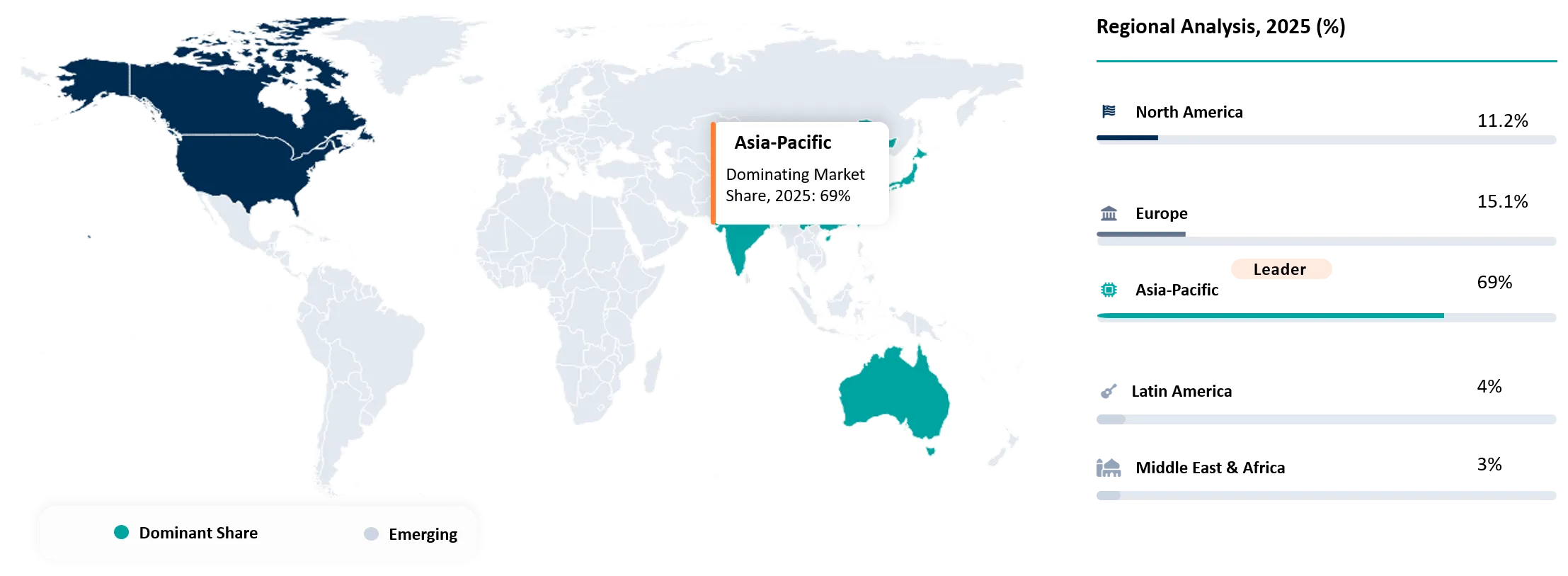
The Asia-Pacific region is dominating the bio-waste-derived hard carbon anodes market, accounting for a 69.0% market share in 2025, supported by the region's strong battery manufacturing ecosystem, rapid commercialization of sodium-ion batteries, and availability of diverse biomass feedstocks. China, Japan, South Korea, and other Asian economies are increasingly investing in sodium-ion battery technologies as manufacturers seek alternatives to lithium-based chemistries and cost-effective anode materials. The region's established battery-material supply chains, large-scale cell manufacturing capabilities, and significant agricultural and forestry waste generation provide favorable conditions for producing biomass-derived hard carbon at commercial scale. The growing deployment of sodium-ion batteries for energy storage and mobility applications is further increasing demand for locally sourced, sustainable anode materials.
The Asia-Pacific region is strengthening its position in sustainable battery-material development by converting waste biomass into advanced hard-carbon anode materials. In August 2025, H2G Green Limited, a Singapore-based sustainable energy solutions company, and its subsidiary Green Energy Investment Holding Pte. Ltd. (GEIH) entered into a licensing agreement with Singapore’s Agency for Science, Technology and Research (A*STAR), a government research agency, to commercialize A*STAR IMRE’s technology for converting waste-biomass-derived biochar into high-value hard carbon anode material for sodium-ion batteries. The process is being scaled toward commercialization, with the resulting hard carbon targeted for grid-scale energy storage, electric vehicles, and consumer electronics; earlier testing indicated that GEIH’s hard carbon had a high graphite content favorable for sodium-ion anodes.
China Bio-Waste-Derived Hard Carbon Anode Market Trends
China is in a dominant position in the Asia-Pacific bio-waste-derived hard carbon anode market owing to its established battery manufacturing ecosystem, rapid commercialization of sodium-ion batteries, extensive biomass resources, and increasing domestic development of hard-carbon anode technologies. The country's large-scale battery and materials supply chain enables close integration between sodium-ion battery manufacturers, anode-material producers, and research institutions, accelerating the development and commercialization of biomass-derived hard carbon for energy-storage and electric-mobility applications. Recent 2025–2026 research from Chinese institutions has also demonstrated continued advances in biomass-derived hard carbon performance, strengthening China's position in the emerging supply chain.
The shift toward localized and sustainable battery-material supply chains is creating new opportunities to convert forestry residues into renewable anode materials in China. In July 2026, Contemporary Amperex Technology Co., Limited (CATL), a China-based lithium-ion battery manufacturer, entered into a strategic investment partnership with CarbonScape Ltd., a New Zealand-based battery-materials technology company, to develop a new supply chain that converts forestry waste into battery-grade graphite for lithium-ion battery anodes. CATL and Lochpine Capital, a Hong Kong-based investment firm, will jointly acquire a 20% stake in CarbonScape, while CarbonScape’s technology will undergo demonstration-scale testing at CATL facilities in China, followed by process optimization and potential commercialization. CarbonScape is targeting commercial biographite production by the end of the decade, creating an opportunity to use forestry residues as a renewable feedstock for battery anode materials.
Japan Bio-Waste-Derived Hard Carbon Anode Market Outlook
Japan is one of the key players in the Asia-Pacific bio-waste-derived hard carbon anode market owing to its established battery-materials industry, strong research capabilities in advanced battery technologies, and government support for strengthening domestic battery manufacturing. The country is increasingly focusing on next-generation battery chemistries, including sodium-ion batteries, where hard carbon is considered a key anode material because of its low cost, resource availability, and suitable sodium-storage characteristics. Japan's Battery and Power Industry Strategy, revised by METI in June 2026, targets the establishment of a 150 GWh-per-year domestic battery manufacturing base by 2030–mid-2030s and aims to triple the global battery-related sales of Japanese companies between 2025 and 2035, creating a stronger foundation for advanced anode-material development.
According to Kuraray Co., Ltd., a Japan-based publicly listed chemical manufacturing company headquartered in Chiyoda-ku, Tokyo, its KURANODE is a plant-based hard-carbon anode material produced from eco-friendly natural plant raw materials for lithium-ion batteries, with advantages including cost competitiveness, low moisture absorption, cycle performance, and low-temperature performance. The technology is supported by Kuraray’s Japanese Bio Hard Carbon Co., Ltd. joint venture with Kureha Battery Materials Japan Co., Ltd., which established a plant-based hard-carbon manufacturing facility in Bizen, Okayama, Japan, with an initial production capacity of 1,000 tons per year and approximately USD 18.95 million (¥3 billion) in capital investment. Bio Hard Carbon was established with USD 0.63 million (¥100 million) capital, equally owned by Kuraray Chemical and Kureha Battery Materials Japan, demonstrating an early commercial-scale development of plant-derived hard-carbon anode materials in Japan.
Rapid Commercialization and Sustainable Anode Development in North America
The North America market is an important regional market for bio-waste-derived hard carbon anodes, accounting for a 11.2% market share in 2025, supported by growing investment in sodium-ion battery technologies, domestic battery-material development, and the availability of agricultural and lignocellulosic biomass resources. The combination of battery technology developers, universities, government research programs, and established energy-storage manufacturers is creating an ecosystem for the development of sustainable hard-carbon anodes for sodium-ion batteries. Increasing interest in sodium-ion technology for stationary energy storage is further encouraging the development of domestically sourced anode materials, particularly as North American manufacturers seek to reduce dependence on conventional lithium-ion battery supply chains.
The North American battery-materials industry is increasingly exploring waste-derived carbon resources to develop lower-cost and lower-emission anode materials. In November 2025, 8 Clockwise, a U.S.-based venture studio focused on industrial decarbonization and clean technology, announced a strategic partnership with CarboMat Inc., a Canadian cleantech and advanced-materials company, to commercialize sustainable carbon fibers and battery-grade anode materials. CarboMat’s technology converts asphaltenes and other carbon-rich industrial by-products into advanced carbon materials, including hard carbon for sodium-ion batteries and synthetic graphite for lithium-ion batteries. Its carbon-fiber products can provide up to 60% lower cost and 50% lower greenhouse-gas emissions compared with conventional PAN-based fibers.
U.S. Bio-Waste-Derived Hard Carbon Anode Market Trends
The U.S. is a leading country in the North American bio-waste-derived hard carbon anode market owing to its growing focus on domestic battery-material supply chains, increasing development of sodium-ion energy-storage technologies, and strong research capabilities in biomass-derived carbon materials. The combination of national laboratories, universities, battery developers, and energy-storage companies is supporting the development of sustainable anode materials that can reduce dependence on conventional graphite-based supply chains. The growing emphasis on grid-scale energy storage is also creating opportunities for sodium-ion batteries, where biomass-derived hard carbon is regarded as a promising anode because of its low cost, abundant feedstock availability, and tunable microstructure.
U.S. government funding is accelerating the development of biomass-derived carbon materials to strengthen domestic battery-anode supply chains and reduce reliance on imported graphite. In November 2025, Solidion Technology Inc., a U.S.-based advanced battery technology company, was awarded a U.S. Department of Energy (DOE) ARPA-E OPEN program grant to advance the electrochemical manufacturing of high-performance graphite from biomass-derived carbon precursors. The project is being conducted in partnership with Oak Ridge National Laboratory (ORNL), a U.S. Department of Energy national laboratory headquartered in Oak Ridge, Tennessee, and has a total DOE project value of USD 2.999 million, with a project period from November 13, 2025, to November 12, 2028. The technology uses molten salts and operates at approximately 850°C for 3–6 hours to produce high-purity synthetic graphite, to reduce production energy, cost, and emissions for electric-vehicle and broader energy-storage applications.
Bio-Waste-Derived Hard Carbon Anode Market Competitive Landscape
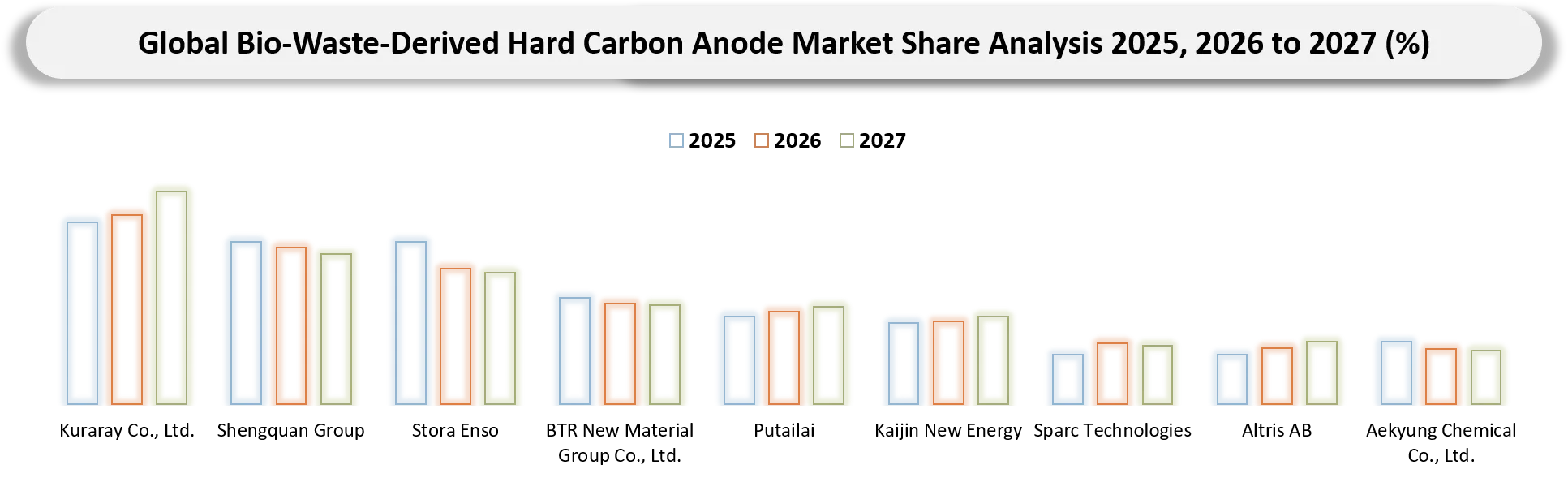
- The market is characterized by a mix of established bio-based hard-carbon producers, battery-material manufacturers, and emerging sodium-ion technology companies. Kuraray Co., Ltd. offers KURANODE™, a plant-based hard-carbon anode material suitable for lithium-ion, lithium-ion capacitor, and sodium-ion batteries, while Stora Enso has developed Lignode®, a hard carbon produced from wood-based lignin and positioned for both lithium-ion and sodium-ion applications. BTR New Material Group has commercial hard-carbon products for sodium-ion batteries and states that its new-anode portfolio includes hard carbon produced for lithium/sodium-ion batteries and energy-storage applications. Altris AB combines a bio-based hard-carbon anode with its sodium-ion cell platform, while Putailai is expanding its sodium-ion battery ecosystem through equipment and manufacturing collaborations. This creates an increasingly integrated competitive landscape in which feedstock availability, hard-carbon performance, scalable production, battery integration, and commercialization capability define competitiveness.
- Key players include Kuraray Co., Ltd., Shengquan Group, Stora Enso, BTR New Material Group Co., Ltd., Putailai, Kaijin New Energy, Sparc Technologies, Altris AB, and Aekyung Chemical Co., Ltd.
Key Developments
- May 2026: Epsilon Advanced Materials Pvt. Ltd. (EAMPL), an India-based advanced battery-materials company, developed a hard-carbon anode material for sodium-ion batteries, using coconut-shell waste and other biomass residues as feedstocks.
- April 2026: the Technology Development Board (TDB) under India’s Department of Science & Technology (DST), a government technology-development and funding agency, extended financial assistance to Indigenous Energy Storage Technologies Pvt. Ltd. (IEST), an India-based energy-storage technology company, for the commercialization of bio-waste/agricultural-waste-derived hard carbon for sodium-ion batteries.
- August 2026: Indi Energy (Indigenous Energy Storage Technologies Pvt. Ltd.), an India-based energy-storage technology startup, developed sodium-ion batteries using BioBlack hard carbon derived from agricultural and bio-waste as the anode material.
Key Procurement Priorities and Buyer Evaluation Criteria
- Organizations procuring Bio-Waste-Derived Hard Carbon Anodes are increasingly selecting suppliers based on their ability to provide consistent, high-performance hard carbon from scalable bio-waste feedstocks, with emphasis on sodium-ion battery compatibility, electrochemical performance, production consistency, and long-term supply availability.
- The procurement decision-making process is increasingly influenced by the commercialization of sodium-ion batteries, demand for sustainable battery materials, diversification away from graphite-based anodes, and the growing deployment of cost-effective energy-storage systems. Buyers are therefore prioritizing suppliers capable of converting agricultural, forestry, and other biomass waste into anode materials at commercial scale while maintaining consistent material quality.
- Buyers consider factors such as specific capacity, initial Coulombic efficiency, cycle life, rate capability, tap density, pore-size distribution, interlayer spacing, and surface chemistry when evaluating hard-carbon suppliers. In addition, feedstock consistency, carbonization yield, purity, moisture content, particle-size distribution, and batch-to-batch uniformity are important procurement criteria because variations in biomass composition and processing conditions can directly affect battery performance.
Why Choose DataM?
- Technological Innovations: Explores advancements in bio-waste-derived hard carbon production, including pyrolytic carbonization, biomass pretreatment, pore-structure engineering, and surface modification, enabling improved sodium-ion storage performance, higher initial Coulombic efficiency, longer cycle life, and more sustainable anode production.
- Product Performance & Market Positioning: Evaluates how different players differentiate hard-carbon products based on specific capacity, initial Coulombic efficiency, cycle stability, rate capability, tap density, interlayer spacing, pore structure, and carbon yield, highlighting supplier capabilities across sodium-ion batteries, stationary energy storage, electric mobility, and other emerging applications.
- Real-World Evidence: Highlights commercial and pilot-scale adoption of biomass-derived hard carbon using agricultural residues, forestry waste, lignin, nutshells, and other bio-waste feedstocks, demonstrating benefits such as reduced dependence on conventional graphite, utilization of renewable resources, lower-cost feedstock potential, and suitability for next-generation sodium-ion battery systems.
- Market Updates & Industry Changes: Tracks key developments such as new hard-carbon product launches, pilot and commercial production facilities, sodium-ion battery commercialization, biomass-to-carbon technology advancements, strategic investments, and partnerships across Asia-Pacific, Europe, and North America, supporting the transition toward sustainable battery-material supply chains.
- Competitive Strategies: Analyzes how leading companies expand through production-capacity scaling, feedstock diversification, process optimization, technology development, strategic partnerships, and vertical integration with battery manufacturers to address increasing demand for sustainable hard-carbon anodes.
- Pricing & Market Access: Explains pricing variations based on bio-waste feedstock type, preprocessing requirements, carbonization temperature, production yield, purity, electrochemical performance, processing scale, and quality specifications, while assessing access through specialized anode-material suppliers, battery-material manufacturers, and integrated sodium-ion battery producers.
- Market Entry & Expansion: Identifies growth opportunities driven by sodium-ion battery commercialization, grid-scale energy storage, electric mobility, renewable-energy integration, and demand for sustainable alternatives to graphite, while outlining strategies such as regional production expansion, low-cost biomass sourcing, technology differentiation, and partnerships with battery-cell manufacturers to achieve commercial scale.
Target Audience 2026
- Sodium-Ion Battery Manufacturers
- Battery Anode Material Manufacturers
- Energy Storage System (ESS) Manufacturers
- Battery Raw Material & Feedstock Suppliers
- Automotive & Electric Mobility Companies
- Battery Technology Developers & R&D Organizations
- Chemical & Advanced Materials Companies


























































