


Bifacial Solar Market Size
Global Bifacial Solar Market Size reached US$ 9.65 billion in 2025 and is expected to reach US$ 22.16 billion by 2033, growing with a CAGR of 11.85 % during the forecast period 2026-2033.
The global bifacial solar market is experiencing rapid expansion, driven by increasing demand for high-efficiency solar energy solutions. Bifacial solar panels generate electricity from both sides, capturing reflected sunlight, leading to enhanced energy output compared to traditional monofacial modules. The market growth is fueled by rising investments in renewable energy, favorable government policies, and advancements in photovoltaic (PV) technologies. According to the International Energy Agency (IEA), global solar capacity is projected to reach between 5,457 and 7,203 GW by 2030, with bifacial technology playing a crucial role in this growth. Key market players are focused on innovation to improve panel efficiency and reduce costs.
Bifacial Solar Market Segment Outlook (Application)
The utility-scale segment dominates the bifacial solar market, accounting for the largest share due to its widespread adoption in large solar farms and power plants. Utility companies prefer bifacial modules because they offer higher energy yield and lower Levelized Cost of Electricity (LCOE) compared to conventional panels. The ability to capture sunlight from both sides increases energy generation by up to 20%, making it an attractive solution for large-scale projects. Several major bifacial solar projects have been commissioned globally. In February 2024, Vikram Solar announced the development of new 725 W bifacial heterojunction PV modules with efficiency levels ranging from 22.53% to 23.34%. Similarly, in January 2024, Tata Power Renewable Energy initiated a 1,000kW bifacial solar project in West Bengal, expected to generate 1.5 million units of energy annually, reducing the carbon footprint by 29,420 lakh tons.
Bifacial Solar Market Regional Overview
Asia-Pacific leads the global bifacial solar market, driven by the rapid expansion of solar infrastructure, supportive government policies, and growing energy demand. China, India, and Japan are the primary contributors to this growth, with significant investments in renewable energy projects. China remains the dominant player in the bifacial solar sector, supported by its robust manufacturing capabilities and ambitious solar energy targets. The country installed over 100 GW of solar capacity in 2023, with bifacial modules comprising a significant share. The Chinese government’s 14th Five-Year Plan prioritizes renewable energy expansion, with bifacial technology playing a crucial role in achieving its carbon neutrality goals by 2060. India is another major market for bifacial solar panels, with the government aiming to achieve 280 GW of solar capacity by 2030. In December 2023, the Indian government introduced new incentives for bifacial solar projects under its Production-Linked Incentive (PLI) scheme, encouraging domestic manufacturing and reducing dependency on imports.
Fastest Growing Market
Asia-Pacific is growing at the fastest CAGR of 17.5% during the forecast period (2026-2033)
Bifacial Solar Market Competitive Landscape in Bifacial Solar Market
The competitive landscape of the Bifacial Solar market is highly competitive, with key players such as LONGI, LG Electronics, and Adani Group dominating the market. Factors influencing competition include technological innovation, strategic partnerships, and regional presence. Companies are focusing on R&D investments to develop next-generation platforms while navigating challenges like high lifecycle maintenance costs and export regulations.
- LONGI
- Trina Solar
- LG Electronics
- Waaree
- Neo Solar Power
- Panasonic
- Prism Solar
- Nexus Solar Energy
- Adani Group
- Lumos Solar
Procurement Analysis for Bifacial Solar
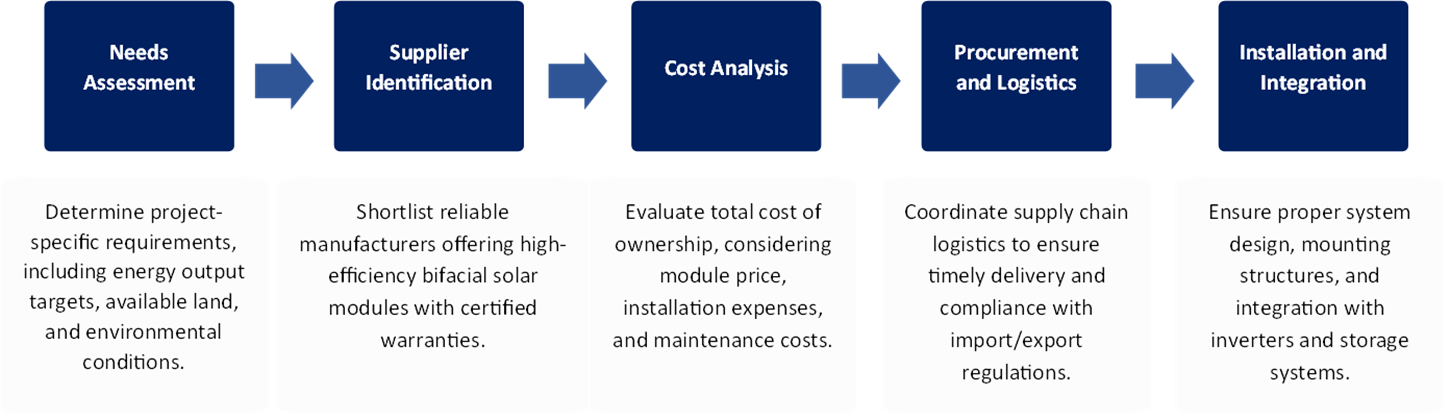
This report provides a comprehensive analysis of the procurement process, covering key phases such as requirement assessment, supplier selection, bid evaluation, contract finalization, and implementation. It includes insights into supplier landscapes, cost-benefit considerations, regulatory compliance, and quality assurance measures. Additionally, the report examines procurement challenges, risk mitigation strategies, and best practices for optimizing supply chain efficiency.
Technological Road Map for Bifacial Solar Market (2025, 2028, 2032)
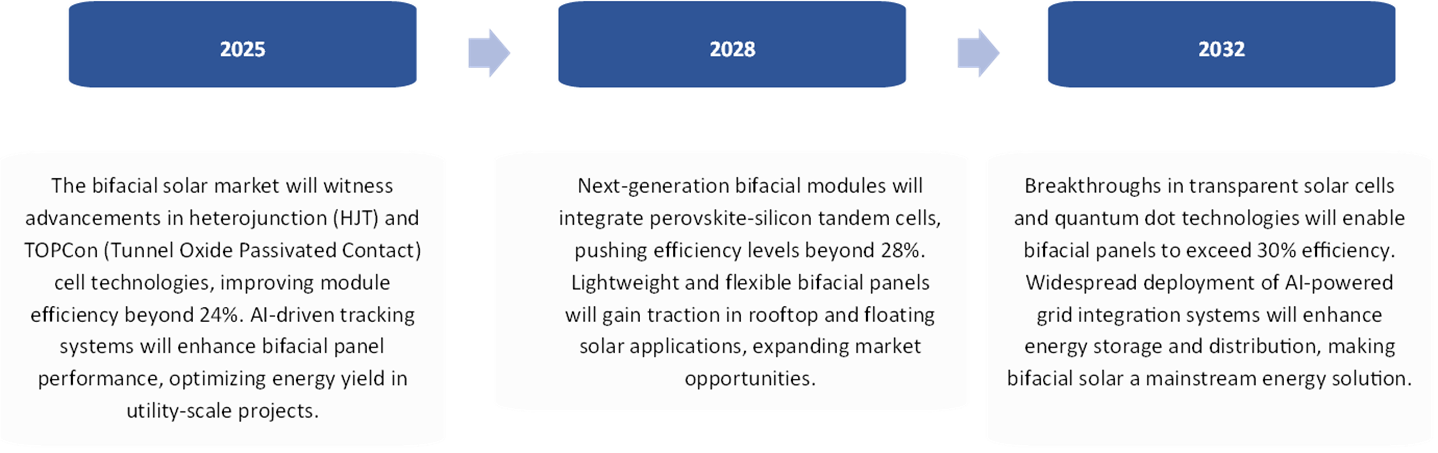
The technological roadmap outlines the phased development and adoption of emerging technologies within a specific market, covering milestones for innovation, commercialization, and large-scale deployment. It typically includes key targets for production capacity, infrastructure expansion, cost reduction, policy support, and sustainability goals over current, mid-term (4 years), and long-term (8 years) horizons.
Life Cycle Analysis (LCA) for Bifacial Solar
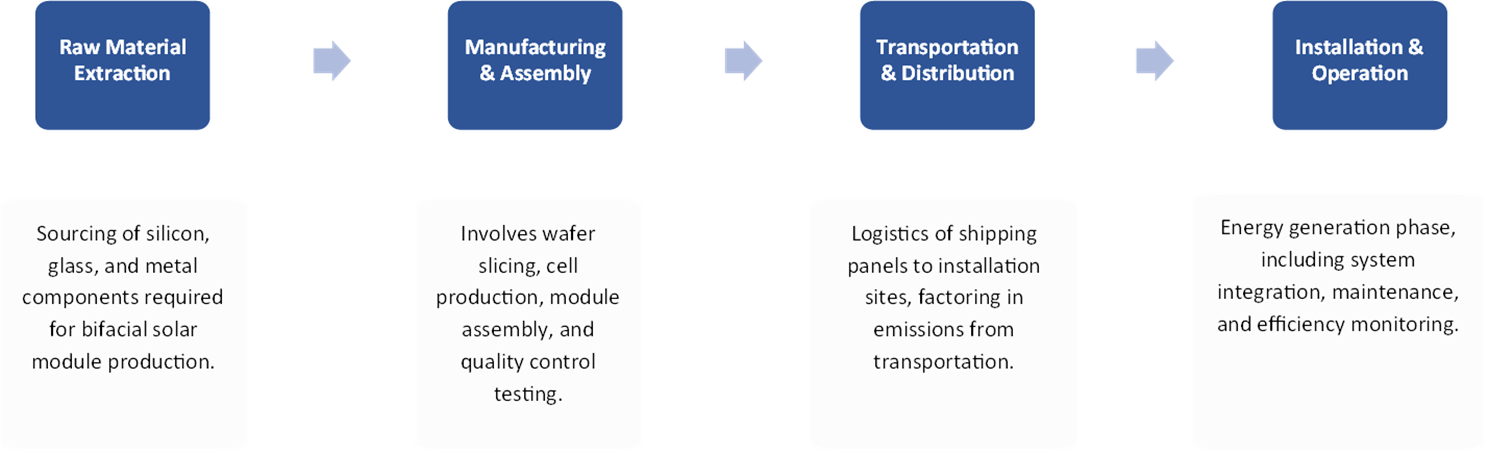
This report will provide a comprehensive analysis of the hydrogen economy life cycle, covering key aspects such as technical expertise, regulatory compliance, financial stability, product reliability, scalability, and after-sales support. It will include meticulous examination of each phase, considering the specific production methods, storage solutions, distribution logistics, and end-use applications to comprehensively assess environmental and economic impacts.
Bifacial Solar Market Recent Developments
- July 2026 – Tongwei achieves record bifaciality for 770 W solar module
Tongwei announced a 93.08% bifaciality factor for its 770 W TOPCon solar module, a result verified by TÜV Rheinland. The module reportedly reaches 24.8% conversion efficiency, highlighting continued industry focus on higher rear-side power generation and improved energy yield. - July 2026 – TNO demonstrates industrial-scale bifacial tandem solar technology
TNO demonstrated bifacial tandem solar technology designed to generate significantly more electricity from the same surface area. The development combines bifacial operation with tandem-cell architecture, supporting higher power density and next-generation PV applications. - June 2026 – Trinasolar advances TOPCon 3.0 for bifacial utility-scale PV
Trinasolar highlighted TOPCon 3.0 as a key technology for bifacial utility-scale solar, where bifacial systems account for a substantial share of global installations. The company reported that TOPCon 3.0 can improve overall energy yield by 2%–3% over conventional technologies in challenging environments such as deserts, snowy regions and tidal flats. - June 2026 – Bluebird Solar launches 630 Wp n-type TOPCon bifacial modules
Bluebird Solar introduced its G12R n-type TOPCon bifacial module series with power output of up to 630 Wp and module efficiency of up to 23.32%. The glass-to-glass modules target utility-scale, commercial and industrial, and rooftop applications, reflecting growing adoption of high-power bifacial modules. - June 2026 – Oxford PV and Fraunhofer ISE develop high-efficiency bifacial tandem module
Oxford PV and Fraunhofer ISE combined perovskite-silicon tandem cells with Matrix Shingle interconnection technology to develop a 546 W bifacial module for large-scale ground-mounted installations. The module achieved 25.6% efficiency across its entire module area, demonstrating the potential of tandem technology for next-generation bifacial PV. - May 2026 – Saatvik Green Energy secures ₹171.45 crore TOPCon bifacial module order
Saatvik Green Energy received a ₹171.45 crore order to supply TOPCon bifacial glass-glass solar PV modules for a utility-scale project in India. The order highlights increasing demand for durable, high-efficiency bifacial modules in large ground-mounted solar farms. - April 2026 – Research advances bifacial perovskite solar cell commercialization
Research published in Advanced Functional Materials highlighted advances in bifacial perovskite solar cells, focusing on dual-sided device architectures, transparency-efficiency optimization, stability and scalable manufacturing. These developments could support future tandem, building-integrated and flexible bifacial PV applications. - June 2026 – Reflective surfaces emerge as a pathway to improve bifacial PV yield
Research published in Applied Energy found that highly reflective building skins could increase power generation from tested bifacial PV prototypes by 26%–36%, while modeling showed potential bifacial gains of 6.6%–21.4% depending on array configuration. The findings reinforce the importance of albedo and surrounding-surface design in maximizing bifacial solar performance. - August 2026 – CNR develops spectral-splitting bifacial PV tile
Italy's National Research Council (CNR) developed a four-terminal photovoltaic tile that directs visible light to a GaAs cell and infrared radiation to a bifacial silicon cell. The design aims to improve albedo collection while reducing self-shading, opening potential applications in space-constrained and building-integrated solar installations.
Insights Covered in This Report:
- Comprehensive market size analysis and year-over-year growth projections.
- Breakdown of market segmentation by panel type, power capacity, frame type, cell technology, application, and region.
- Regional analysis covering North America, Europe, Asia-Pacific, South America, and the Middle East & Africa.
- Industry dynamics, including key drivers, restraints, opportunities, and impact assessments.
- Covers supplier landscape, procurement strategies, and cost optimization for industry players.
- Highlights potential international markets, trade policies, and key exporting nations.
- Mergers, acquisitions, and key strategic developments shaping the competitive landscape.
- Future outlook and investment opportunities for new and existing market participants.
- Regulatory framework analysis to help businesses navigate compliance challenges.
Why Choose DataM?
- Data-Driven Insights: Dive into detailed analyses with granular insights such as pricing, market shares, and value chain evaluations, enriched by interviews with industry leaders and disruptors.
- Post-Purchase Support and Expert Analyst Consultations: As a valued client, gain direct access to our expert analysts for personalized advice and strategic guidance, tailored to your specific needs and challenges.
- White Papers and Case Studies: Benefit quarterly from our in-depth studies related to your purchased titles, tailored to refine your operational and marketing strategies for maximum impact.
- Annual Report Updates: As an existing customer, enjoy the privilege of annual updates to your reports, ensuring you stay abreast of the latest market insights and technological advancements. Terms and conditions apply.
- Specialized Focus on Emerging Markets: DataM differentiates itself by delivering in-depth, specialized insights specifically for emerging markets, rather than offering generalized geographic overviews. This approach equips our clients with a nuanced understanding and actionable intelligence that are essential for navigating and succeeding in high-growth regions.
- Value of DataM Reports: Our reports offer specialized insights tailored to the latest trends and specific business inquiries. This personalized approach provides a deeper, strategic perspective, ensuring you receive the precise information necessary to make informed decisions. These insights complement and go beyond what is typically available in generic databases.


























































